Distance-Based security data transmission in Biometric-Based
Encryption
Mounika Malaga 1, Ravuri Venkata Kiran Kumar 2
1 PG Scholar, Dept of ECE, Rise Krishna Sai Gandhi Group of Institutions, Ongole, AP, India.
2Associate Professor, Dept of ECE, Rise Krishna Sai Gandhi Group of Institutions, Ongole, AP, India.
Abstract:
Crypto-biometric system model
introduces a new encryption notion called
distance-based encryption (DBE) Biometrics in
identity-based encryption. In this notion, a
cipher text encrypted with a vector and a
threshold value can be decrypted with a private
key of another vector, if and only if the distance
between these two vectors is less than or equal
to the threshold value. The adopted distance
measurement is called Mahalanob is distance,
which is a generalization of Euclidean
distance. The most important of this new
encryption notion is to incorporate biometric
identities, such as iris, finger and face. this
method, usually the input biometric identity
associated with a private key will not be
exactly the same as the input biometric identity
in the encryption phase, even though they are
from the same user. And it shows how to
construct generically and efficiently using DBE
with reasonable size of private keys and cipher
texts. Also proposed a new DBE scheme with
the shortest private keys are build. In this
encryption efficiently using RSA algorithm
1 Introduction
There has been recent interest about the
challenge of generating cryptographic keys
from biometric inputs. The primary difficulty
in generating a strong key from a biometric
input is that the measured value of the a
biometric can change slightly upon each
sampling. This effect can be explained by
differences in sampling devices, environmental
noise, or small changes in the human trait
itself. This inherent non-determinism makes it
difficult to extract a cryptographic key from a
biometric input. Recent work has produced
techniques to derive cryptographic keys from
biometric inputs for symmetric key
applications. For example, Monrose et al. [12,
11, 10] develop techniques to extract secrets
from keyboard typing dynamics and later voice
prints by using a form of error-tolerant secret
sharing. Other work by Davida et al. [4] and
Juels and Wattenberg [7] use error-correcting
codes to compensate for the noise in the
biometric input. These techniques are useful
for symmetric key cryptography applications
key encryption. However, there does not seem
to be a clear way to move these techniques into
the realm of public key cryptography. In
particular the work above seems does not fit
into the paradigm of Identity Based
Encryption. We propose a new type of Identity
Based Encryption that we call Fuzzy Identity
Based Encryption. In a Fuzzy Identity Based
encryption scheme a user with secret key for
the identity id is able to decrypt a ciphertext
encrypted with the public key id0 if and only if
id and id0 are within a certain distance of each
other as judged by some metric. For the
remainder of this paper we view identities as n
bit vectors and use the Hamming distance
between them as the metric of distance.
However, a Fuzzy Identity Based Encryption
scheme could be built using some other metric.
1.1Our Contributions
We introduce Euclidean
Distance based Encryption (EDE). In this
encryption notion, a private key of vector
~y can decrypt a ciphertext encrypted with
another vector ~x and a threshold value t, if
and only if the Euclidean distance between
~x and ~y is less than or equal to t. The
primary motivation of this work is to bride
the gap between biometric based
encryption and pattern recognition. In this
poster, we propose this encryption notion
Euclidean distance measurement is called
weighted squared Euclidean distance,
which is a generalization of (squared)
Euclidean distance. We show how to
generically and efficiently construct an
EDE from an inner-product encryption
(IPE) with reasonable size of private keys
and ciphertexts. Given any integer k0
defined by the system generator, each EDE
key has k0 + 1 numbers of IPE keys and
each EDE ciphertext has d t k0 e numbers
of IPE ciphertexts. A proper k0 can be
selected to balance the size between private
keys and ciphertexts. We also propose a
new IPE scheme equipped with a specific
characteristic to build EDE, namely the
need for a short private key. The private
key of our IPE scheme comprises of two
group elements only, compared to the best
efficient IPE scheme in the literature with
nine group elements [3]. The EDE
instantiation from our IPE will therefore
save more than 75% secure memory for
private key storage. We prove the security
of our IPE scheme with payload security in
the selective security model under the
Decision Bilinear Diffie-Hellman
Watermark Scheme
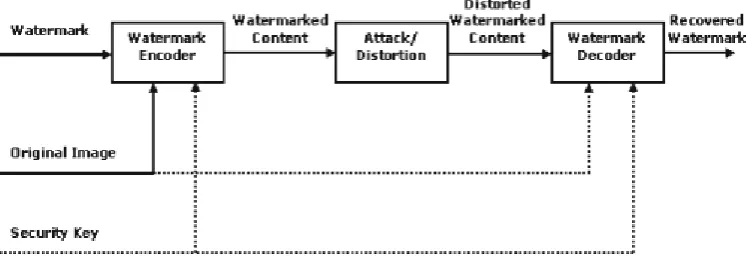
A watermark should be embedded in
such a way that it remains detectable as long as
the perceptual quality of the digital content
stays at an acceptable level .In general, any
watermarking system consists of following
parts:Watermark, Carrier,
Encoder,Decoder.The conceptual model of the
watermarking system is explained in figure 1 .
Original image depicts the carrier which needs
protection. The watermark encoder embeds the
watermark in to the cover image. The
watermark can be a pseudo-random number or
binary sequence. The optional key is used to
enhance the security of the system. Decoder
estimates the watermark from the received
image with the help of key and original image
if required. Watermarked image is subjected to
various forms of manipulations on
communication channel.
Watermarking schemes can be classified based
on the presence or absence of original contentat
the time of watermark detection.
(i) Non-blind scheme: It requires presence of
original content during watermark detection.
(ii) Blind scheme: It does not require the
presence of original content while decoding
thewatermark.
In the early days non-blind watermarking
schemes were popular as they were more
robust thanblind schemes. It is due to the fact
that in watermarking model, original content is
treated as anoise source to watermark, which is
the signal of interest. Presence of original
content at thereceiver nullifies the effect of this
noise. However, non-blind schemes suffer from
two distinctdisadvantages.
(i) Security compromise: Non-blind detection
does not guarantee unequivocal claims of
ownership by the content creator. Attacker can
easily fool the system and even worst, may
claimthe ownership by inserting another
watermark in the content.
(ii) Practical application constraints: It is not
possible to ensure presence of original
contentduring detection for every
watermarking application. For e.g., copy
protection in DVD. With the development in
watermarking research, blind schemes are
matching the performance criteria of non-blind
schemes. Hence state-of-art watermarking
system offers blind detection, which is the case
Figure 1.A typical watermarking system.
Watermarking Systems
In this scheme, an entropy masking model has
been applied on the host image for the texture
segmentation. Moreover, the local luminance
and textures of the host image are considered
for watermark embedding procedure to
increase the robustness of the watermarking
scheme. In contrast to all existing SVD-based
watermarking systems that have been designed
to embed visual watermarks, our system uses a
pseudo-random sequence as a watermark. We
have tested the performance of our method
using a wide variety of image processing
attacks on different test images. A comparison
is made between the results of our proposed
algorithm with those of a wavelet-based
method to demonstrate the superior
performance of our algorithm.
An Effective Wavelet-Based Watermarking
On behalf of the content owners and
distributors, copyright protection and content
authentication of digital content has developed
into a grave problem. This issue can be
resolved by the solution offered by the Digital
watermarking. In recent times, Digital
watermarking has seen rapid escalation.
Ownership protection, authentication, and
content integrity verification of intellectual
property in digital form have comprehensively
utilized watermarking, of late. The process of
embedding data into multimedia elements such
as images, audios and videos is defined as
watermarking. The detection or extraction of
this embedded data from the multimedia offers
the proof of ownership or other purposes.
Diverse ways can be employed to find the
different classifications of watermarking and
digital watermarks namely the visible and
invisible watermarks. In visible watermarks,
the ownership of the image is illustrated by the
distinctive unique visible message or a
company logo and in the invisible watermarks,
the invisibly watermarked digital content and
the original image are extremely alike when
envisaged. The intent of the design of the
major accessible invisible watermarking
schemes is to offer either the copyright
protection or content authentication. Robust
and fragile watermarks are the two extensive
categories of the invisible watermarks, the
former principally intends at copyright
protection where the need for high resistance
against numerous signal processing operations
is signified by the term robust. In contrast,
content authentication is the primary objective
of the latter. In addition, non-blind, semi-blind
and blind methods are the divisions of
watermarking. In non-blind methods, the
original image itself are employed for the
extraction of watermark, while the certain
characteristics of the original image are
engaged by the semi-blind methods, whereas
the detection process in the blind methods do
not necessitate the original image.
A good watermarking scheme should be robust
enough to defend against attacks while being
invisible such that the dissimilarity between the
watermarked image and the host image should
not be distinguishable by the human eyes.
A Novel Synchronization Invariant Audio
Watermarking Scheme Based on DWT and
DCT
The watermark is a signal embedded into the
host media to be protected, such as an image or
audio or video.It contains useful certifiable
information for the owner of the host media,
such as producer's name, company logo, etc;
the watermark can be detected or extracted
later to make an assertion about the host media
. For this aim, digital watermarking techniques
are developing and their number is growing,
searching all for the equilibrium between three
criteria: data hiding capacity, imperceptibility,
and robustness, depending on the image
domain representation.
The choice of a domain lies mainly on
robustness criteria required relating to specific
data manipulations or malicious attacks.
Between these domains the spatial presentation
is robust against geometrical attacks. In the
other, hand its restrictions dissuades its use
because of the poor capacity of data embedding
with respect to the imperceptibility condition.
In order to further performance improvements
algorithms could be obtained by jointing DWT
with DCT.
Spatial Domain Digital Watermarking of
Multimedia Objects for Buyer
Authentication
The proposed algorithm embeds a perceptually
recognizable binary pattern, such as owner's
logotype. Firstly the video sequences are
segmented by each scene, and then the binary
watermark pattern is embedded into Discrete
Wavelet Transform (DWT) domain of the
randomly selected scene blocks. To increase
the security of the proposed scheme, the biary
watermark pattern is mapped to a noise like
binary pattern using a chaotic mixing method,
before its embedding. Simulation results show
the watermark imperceptibility and robustness
against several attacks, such as noise
contamination, frame dropping, frame
averaging and frame swapping; the evaluation
results also show that the extracted watermark
pattern is sufficiently clear, although the
watermarked video sequence may suffered
several attacks.
Digital Video Watermarking in DWT
Domain Using Chaotic Mixtures
Various comprehensive investigations on the
existing watermarking technologies have been
accomplished. And it has been discerned that
resist all sorts of attacks. With this outcome,
this paper proposes a robust scheme for digital
video watermarking based on scrambling &
then embedding the watermark into different
parts of the source video according to its scene
change. Certain watermarking schemes of each
class have been preferred for enactment and
various tests are accomplished to relate their
robustness. Literature review reveals that
watermarking schemes can be crudely divided
into two classes: spatial domain, and
transformed domain. Some of the spatial
domain techniques discussed are: Least
significant bit (LSB) based watermarking
scheme: The most straightforward method of
watermark embedding would be to embed the
watermark into the least significant bits of the
cover object. LSB substitution, however,
despite its simplicity brings a host of
drawbacks. Although, it may survive
transformations such as cropping, any addition
of noise or lossy compression is likely to defeat
the watermark. An even better attack would be
to simply set the LSB bits of each pixel to 1,
fully defeating the watermark with negligible
impact on the cover object. Threshold based
correlation watermarking scheme: G.
Langelaar,has discussed the threshold and non
threshold based watermarking scheme. Direct
spread spectrum model to the watermarking of
digital video. The watermarked video is robust
to video editing attempts such as sub-sampling,
frame reordering.
3. RESULTS
The experimental results of the
proposed digital video watermarking scheme
using discrete wavelet transform are presented.
The watermarked video sequences possess
superior Peak Signal to Noise Ratio (PSNR)
and visual quality for grayscale watermark
images.
The output acquired from the proposed video
watermarking scheme has been evaluated by
Fig.1.Watermarked Image
Fig.2.watermarked Video
Fig.3.Watermarked Frame
3.Concusion
the distance based encryption and identity based encryption schemes. This schemes aims to transfer the message in secured communication systems.
References
[1] F. Guo, W. Susilo, and Y. Mu, “POSTER: Euclidean distance based encryption: How to embed fuzziness in biometric based encryption,” in Proc. ACM Conf. Comput. Commun.Secur., 2014, pp. 1430–1432.
[2] T. Kanade, “Picture processing system by computer complex and recog-nition of human faces,” Ph.D. dissertation, Dept. Inf. Sci., Kyoto Univ., Kyoto, Japan, 1973.
[3] R. Brunelli and T. Poggio, “Face recognition: Features versus templates,” IEEE Trans. Pattern Anal. Mach. Intell., vol. 15, no. 10, pp. 1042–1052, Oct. 1993.
[4] A. K. Jain, S. Prabhakar, L. Hong, and S. Pankanti, “Filterbank-based fingerprint matching,”IEEE Trans. Image Process., vol. 9, no. 5, pp. 846–859, May 2000. [5] H. Moon and P. J. Phillips, “Computational and performance aspects of PCA-based face-recognition lgorithms,”Perception, vol. 30, no. 3, pp. 303–322, 2001
Author’s Profile:
MOUNIKA MALAGA has
received her B.Tech Degree in
Electronic Communication
Engineering from Pace Institute of
Technology and Sciences affiliated to JNTU
Kakinada in 2015 and pursuing M.Tech degree in
DECS in Rise Krishna Sai Gandhi Group of
Institutions, Ongole affiliated to JNTU Kakinada in
RAVURI VENKATA KIRAN KUMAR has received his B.Tech in Electronics & Communications
Engineering from Malineni
Lakshmaiah College of
Engineering & Technology, affiliated to JNTU
Hyderabad in 2006 and M.Tech degree in DECS
from Samuel George college of Engineering
affiliated to JNTU Kakinada in 2012.He is
dedicated to teaching field from last 12 Years. He
has guided 12 P.G students.His research areas
included Signal Processing. At present he is
working as Associate professor in Rise Krishna Sai
Gandhi Group of Institutions, Ongole, affiliated to