Efficient Methods for Exploiting Faults
Induced at AES Middle Rounds
Chong Hee Kim
Abstract
Faults occurred during the operations in a hardware device cause many problems such as performance deteri-oration, unreliable output, etc. If a fault occurs in a cryptographic hardware device, the effect can be even serious because an adversary may exploit it to find the secret information stored in the device. More precisely, the adversary can find the key of a block cipher using differential information between correct and faulty ciphertexts obtained by inducing faults during the computation of ciphertexts. This kind of attack is calledDifferential Fault Analysis(DFA). Among many ciphersAdvanced Encryption Standard (AES) has been the main target of DFA due to its popularity. AES is widely used in different platforms and systems including Intel and AMD microprocessors.
Normally DFA on AES exploits faults induced at the last few rounds. Hence, a general countermeasure is to recompute the last few rounds of AES and compare it with the original output. As redundancy is a costly countermeasure, one should ascertain exactly which rounds need to be protected. In 2006, Phan and Yen introduced a new type of DFA, so called Square-DFA, that works even when faults are induced into some middle rounds. However, it is impractical as it requires several hundreds of faulty ciphertexts as well as a bit fault model. In this article, we propose new attacks that need only dozens of faulty ciphertexts in a byte fault model. Normally it is believed that randomly corrupting a byte is easier than corrupting a specific bit. In addition, we extend the attacks to the AES-192 and AES-256, which is the first result in the literature.
Index Terms
Fault Analysis, Security, Differential Fault Analysis, AES.
I. INTRODUCTION
Reliable computation is one of the main concerns in many hardware devices. Especially faults occurred during
the operations cause many problems such as performance deterioration, unreliable output, etc. and hence a lot of
works to minimize, detect, or prevent faults have been researched. Nowadays we can easily find cryptographic
hardware devices such as smart cards everywhere in our daily lives from banking cards to SIM cards for GSM.
C. H. Kim is with Information Security Group, ICTEAM institute, Universit´ecatholique de Louvain, Place Sainte Barbe, 2, 1348
Louvain-la-Neuve, Belgium. E-mail: [email protected].
These devices are believed to be tamper-resistant. However, if a fault is occurred, an adversary can find the secret
information stored in the device. Therefore, we are challenging a new type of fault problem.
More precisely, an adversary can find the key of a block cipher using differential information between correct
and faulty ciphertexts obtained by inducing faults during the computation of ciphertexts. This kind of attack is
calledDifferential Fault Analysis (DFA). The block cipher is widely used in many cryptographic applications and
has been studied extensively in the literature. Traditionally cryptanalysis of block cipher targets the cipher’s design
and architecture based on an abstract mathematical approach. However, in practice a cipher has to be implemented
on a real device that is exposed to physical cryptanalysis such as side-channel attacks [10], [18], [24] and fault
attacks [3], [16].
An adversary gets faulty ciphertexts by giving external impact on a device with voltage variation, glitch, laser,
etc. [3]. The first DFA presented by Biham and Shamir in 1997 [5] targeted DES [1]. Afterward many people tried
to break several cryptosystems such as Triple-DES [14], CLEFIA [8], [26], AES [4], [6], [7], [11], [13], [15], [17],
[20], [21], [23], [25], [27], [28], SMS4 and MacGuffin [19]. Among them, Advanced Encryption Standard (AES)
[2] has been the main target due to its popularity. AES has three variants according to the key size: 128, 192, and
256-bit keys (they are called AES-128, AES-192, and AES-256 respectively).
DFA on AES exploits faults induced at the last few rounds of AES. The best result of DFA on AES-128 exploits
faults induced at roundr−3 [12], [23], [29] and DFA on AES-192 and AES-256 exploit faults at roundsr−4and
r−3 [15], whereris the number of rounds. Hence, a general countermeasure is to recompute the last few rounds
of AES and compare it with the original output. As redundancy is a costly countermeasure, one should ascertain
exactly which rounds need to be protected.
In 2006, Phan and Yen introduced a new type of DFA, so called Square-DFA, that integrated the technique of
DFA and conventional cryptanalysis of block ciphers [22]. Square-DFA can be mounted with a more flexible attack
model, where faults can be induced even in rounds where previous DFAs are inapplicable. However, Square-DFA
has two weaknesses that hinder the use of it in practice. First, it requires several hundreds of faulty ciphertexts.
Secondly it works in a bit-level fault model.
In this article, we introduce new Square-DFAs that solve the weaknesses that Phan and Yen’s Square-DFA have.
Specifically, the contributions of this article are as follows:
• We first point out several flaws in Phan and Yen’s Square-DFA in [22]. LetSDFA-RxPhan and Yen’s
Square-DFA that exploits faults induced between roundsr−xandr−x+ 1.
– We show thatSDFA-R2andSDFA-R3 cannot be applied to recover the secret key.
– We show thatSDFA-R4needs more faults than that Phan and Yen claimed. They claimed that only 255
faults are necessary. However, SDFA-R4cannot identify the secret key with 255 faults, but actually216
candidates remain. Therefore, another 255 faults or an exhaustive search using a pair of plaintext and
ciphertext is necessary.
– We show thatSDFA-R5 also needs more faults. Phan and Yen claimed that 255 faults are necessary. In
• We introduce new Square-DFAs,NSDFA-R4 andNSDFA-R5, in the same fault model (i.e., a bit-level fault
model) that Phan and Yen used.
– NSDFA-R4 shows that 255 faults are enough to identify the key. In other words, an adversary is not
required to know the plaintext anymore as no exhaustive search is required.
– NSDFA-R5 shows that the time complexity can be reduced from266 to242.
• In Phan and Yen’s Square-DFAs, an adversary needs to obtain 255 faulty ciphertexts from the faults induced into
the same byte such that it would have all 256 (one correct and 255 faulty) values. Therefore, it is assumed that
the adversary could induce a bit of fault in a byte. This is very strong assumption as the bit-level modification
by faults is very difficult to achieve in practice. Hence, we relax this and introduce new attacks,NSDFA2-R4,
in a byte fault modelwhere a byte is assumed to be randomly modified by faults.
– NSDFA2-R4finds the secret key with only 46 faults in a byte fault model.
• We extend Square-DFAs to AES-192 and AES-256, which is the first result in the literature. This extension
is important because AES-192 and AES-256 have been deployed more and more.
The remainder of this article is organized as follows: we briefly describe AES in the next section. The
Square-DFA is presented in Section III. The analysis of Phan and Yen’s Square-Square-DFA and our new attacks are given in
Section IV. After comparing our attacks with existing DFAs in Section V, we conclude in Section VI.
II. AES
AES [2] can encrypt and decrypt 128-bit blocks with 128, 192, or 256-bit keys. The intermediate computation
result of AES, calledstate, is usually represented by a4×4matrix, where each cell represents a byte. We denote
the output of round i by Si. For example,Si
j,k denotes the (j+ 1)
th row and the (k+ 1)th column byte of the
ith round output, where j, k∈ {0, . . .3}, and i ∈ {1, . . . r}. AES-128, AES-192, and AES-256 have 10, 12, and
14 rounds respectively. Each round function is composed of 4 transformations except the last round: SubBytes,
ShiftRows,MixColumns, andAddRoundKey. The last round is lackingMixColumns.
1) SubBytes: It is made up of the application of 16 identical8×8S-boxes. This is a non-linear byte substitution.
We denote the function ofSubBytesbySB. That is,SB(Si)= SubBytes(Si). We denoteInverse SubBytesbySB−1.
2) ShiftRows: Each row of the state is cyclically shifted over different offsets. Row 0 is not shifted, row 1
is shifted by 1 byte, row 2 is shifted by 2 bytes, and row 3 by 3 bytes. We denote ShiftRows and its inverse,
InverseShiftRows, bySR andSR−1 respectively.
3) MixColumns: This is a linear transformation to each column of the state. Each column is considered as
polynomial overF28 and multiplied modulox4+ 1with a fixed polynomiala(x) = 03∗x3+ 01∗x2+ 01∗x+ 02.
We denote the function ofMixColumns byMCand its inverse byMC−1 .
III. SQUARE-DFA
Phan and Yen proposed a new DFA, so called Square-DFA, on the AES at CARDIS 2006 [22] based on the
Square Distinguisher presented by Daemon et al. in [9]. We briefly describe them.
A. Square Distinguisher
Consider a set of 256 plaintexts that differ by one byte in which they take all the possible values (the plaintexts
are equal in the other bytes).SubBytesandAddRoundKeysare permutations so after them the data still have all the
possible values in that byte and equal in the others. Then the inputs of the thirdMixColumnshave all 256 possible
values in each byte. So the XOR of them in each byte is 0. The MixColumns is a linear transformation so this
property holds after the MixColumnstoo.
B. Square-DFA
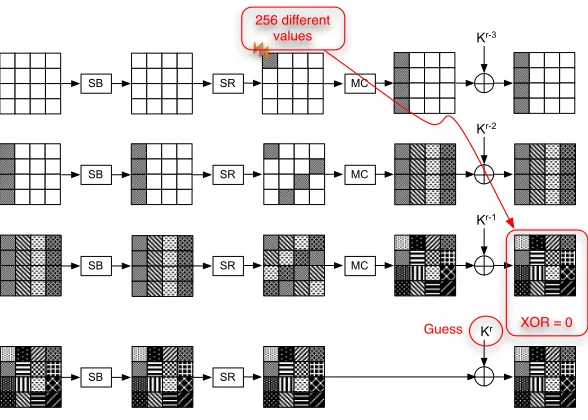
The principle of Square-DFA is as follows: the attacker encrypts the same plaintexts and induces a bit of fault
on the same byte of any state between the MixColumns of rounds r−4 and r−3, and repeats for 255 times,
each time inducing one or more bits of fault into that same byte such that it would have all 256 (one correct and
255 faulty) values. By the Square Distinguisher, the XOR of all these 256 ciphertexts (1 correct and 255 faulty
ciphertexts) would result in zero in all byte positions at the output of roundr−1as shown in Fig. 1.
The adversary now guesses all possible values of any byte ofKrand partially decrypts these 256 ciphertexts by one round up to the output of roundr−1, and checks if their XOR equals zero. A correct guess always satisfies
this property, while a wrong guess would only satisfy with a very low probability. In the same way, she can find
the remaining fifteen bytes ofKr using the same ciphertexts. The time complexity is28×16 = 212.
Phan and Yen noticed that it is possible to induce the faults a bit deeper into the middle of the AES, in particular
one round before, i.e., between the MixColumns of rounds r−5 and r−4. We call this attack SDFA-R5 to
distinguish it from the previous attack (we also call the previous attackSDFA-R4).
In SDFA-R5, the adversary needs to apply the Square Distinguisher from roundr−4to roundr−2. Now the
adversary should decrypt the ciphertexts by the last two rounds. To do so, she has to guess a column of Kr−1
and the corresponding four bytes of Kr. Then she partially decrypts the ciphertexts by the last two rounds up to
the output of round r−2 and checks if the XOR is zero in any byte of the column corresponding to that column
of guessed Kr−1. Repeating this for the other tree columns, she obtains both Kr−1 andKr. However the time
complexity is much higher than that ofSDFA-R4. She has to guess 8 bytes each time and repeat it four times. So
the time complexity is(28)8×4 = 266.
Phan and Yen also extended their attack to the cases that faults are induced between theMixColumns of rounds
r−3 andr−2and between the MixColumnsof rounds r−2andr−1. We call themSDFA-R3andSDFA-R2
respectively.
InSDFA-R3, we are guaranteed that after roundr−1 we always have all 256 unique values in each byte. This
MC SR
SB
Kr-3
MC SR
SB
Kr-2
MC SR
SB
Kr-1
SR SB
Kr XOR = 0
256 different values
Guess
Fig. 1. SDFA-R4: faults are injected between theMixColumnsof roundsr−4andr−3. The XOR of all values in each byte is 0 at the
output of theMixColumnsof roundr−1.
number of faulty ciphertexts, except that instead of computing the XOR value, one would further have to check if
all 256 unique values exist.
In SDFA-R2, after round r−1 we have all 256 unique values in the column in which the fault was induced.
We guess at a time each of the four bytes of Kr that corresponds to that column, each time reusing the same
faulty ciphertexts. We repeat this four times to obtain all 4 columns of the key, and hence requiring 4 times more
ciphertexts.
IV. IMPROVEDSQUARE-DFA
A. Analysis of Phan and Yen’s SDFAs
1) Probability that a wrong key passes the test:: In SDFA-R4, Phan and Yen said that they needed 255 faulty
ciphertexts to find the key because for a given byte the probability that the XOR of the 256 values of that byte at
the output of round r−1 equals zero is very low if a wrong value is guessed for the corresponding byte of Kr
[22].
However, we found that this probability is not negligible. The probability of this event (a wrong key satisfies
that the XOR equals zero) is 2561 . As there are 256 candidates for each byte of Kr, on average one wrong guess
is left after the test. Hence, for each byte ofKr, on average two candidates (one correct key and one wrong key)
remain1 and for sixteen bytes ofKr, on average216candidates remain. Therefore, we can find the correct key by
performing the test again with another set of 255 faulty ciphertexts (hence the total number of faulty ciphertexts
becomes 510) or by doing exhaustive search of 216.
2) SDFA-R3and SDFA-R2are impossible:: InSDFA-R3, we always have all 256 unique values in each byte
at the output of round r−1 regardless of keys. This property holds even at the output of round r (i.e., in the
ciphertexts) since there is no MixColumnsin the final round. Therefore every candidates forKr passes the test of
SDFA-R3. The same consideration applies toSDFA-R2. All candidates forKr pass the test. Therefore, we know
that the Square Distinguisher can be used only for three or more rounds to derive the key.
3) Required number of faulty ciphertexts forSDFA-R5:: Phan and Yen said that they could find the key with
255 faulty ciphertexts with SDFA-R5[22]. The adversary needs to guess eight bytes (a column forKr−1 and the corresponding four bytes forKr) each time and test if the XOR is equal to zero for each byte of the corresponding
column at the output of roundr−2. The probability that wrong candidates are sorted out by the test for a byte (i.e.,
the XOR is equal to zero) is 228 = 2
−7(one correct key and one wrong key survive). The probability for a column
is(2−7)4= 2−28. Therefore, among 264 candidates,264×2−28= 236 candidates remain. We have to perform the
same procedures for the other three columns. Finally(236)4= 2144 candidates remain. Therefore, with 255 faulty
ciphertexts we cannot find the key.
Then how many faulty ciphertexts are required to find the key? If we have two sets of 255 faulty ciphertexts,
the probability that wrong candidates are sorted out by the test for a column is ((2−7)2)4 = 2−56. Therefore
264×2−56 = 28 candidates remain for a column and hence 232 candidates remain forKr−1 andKr. With three sets, we have264×((2−7)3)4= 264×2−84= 2−20. Therefore we have one correct key with3∗255 = 765faulty
ciphertexts.
B. Improved SDFAs
We propose two new Square-DFAs, NSDFA-R4 and NSDFA-R5, that reduce the number of required faulty
ciphertexts.
1) NSDFA-R4:: The SDFA-R4requires two sets of faulty ciphertexts (therefore 510 faulty ciphertexts) to find
the key as shown in Section IV-A. We propose a new attack, NSDFA-R4, that can find the key with only one set
of faulty ciphertexts.
The SDFA-R4 partially decrypts 256 ciphertexts by one round up to the output of round r−1 and checks if
their XOR equals zero. The probability that a wrong guess passes this test is 2561 . We notice that the inputs of
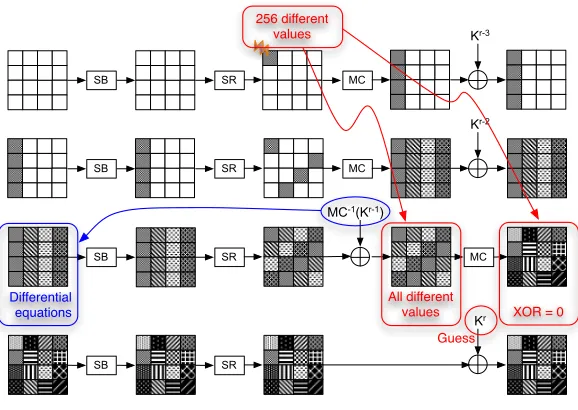
MixColumnsof roundr−1should have all 256 possible values in each byte. Furthermore, we can switch between
MixColumns andAddRoundKeys of roundr−1 by usingMC−1(Kr−1)as shown in Fig. 2.
The attack is composed of two steps. In the first step, the adversary uses the property that the XOR equals zero
at the output of roundr−1 and reduces the number of candidates. Then in the second step, she uses the property
that each byte has all 256 possible values at the input ofMixColumnsof roundr−1and find the correct key. More
precisely the adversary finds216candidates forKr bySDFA-R4in Step 1. Then for each candidate she computes
MC SR
SB
Kr-3
MC SR
SB
Kr-2
MC SR
SB
MC-1(Kr-1)
SR SB
Kr
All different values 256 different
values
XOR = 0
Guess
Fig. 2. NSDFA-R4: faults are injected between theMixColumnsof roundsr−4andr−3. Then each byte at the input ofMixColumnsof
roundr−1has all different values. The XOR of all values in each byte is 0 at the output ofMixColumnsof roundr−1.
Fig. 2. Finally she checks if each byte has all 256 different values. The probability that a wrong guess passes the
test is 256256!256 '0. Therefore, we have only one correct key at the end.
2) NSDFA-R5:: We propose a new attack, NSDFA-R5, that reduces the time complexity and required number
of faulty ciphertexts when the faults are induced between MixColumnsof rounds r−5 andr−4.
The adversary guesses one byte ofKbr−1=MC−1(Kr−1)and the corresponding four bytes ofKr(for example, b
K0r,−01, Kr
0,0, K1r,3, K2r,2, and K3r,1) as shown in Fig. 3. Then she partially decrypts 256 ciphertexts by the last two
rounds to the output of roundr−2. We denote the output of roundr−2bySr−2. She checks if the XOR of the
values for the corresponding byte, for example,S0r,−02, atSr−2equals zero. We do the same test with another set of
faulty ciphertexts. Then the number of remaining candidates is(28)5×(2−7)2= 226 as we have(28)5 candidates
for Kb0r,−01, K0r,0, K1r,3, K2r,2, andK3r,1 and two sets of faulty ciphertexts eliminate(27)2 wrong candidates. She guesses another byte in the same column of Kbr−1, for example, Kb
r−1
1,0 . The number of candidates for b
K1r,−01 and the four corresponding bytes of Kr (K0r,0, K1r,3, K2r,2, and K3r,1) is 28×226 = 234. With two sets
of faulty ciphertexts she checks if the XOR of the values for the corresponding byte, S1r,−02, equals zero. The number of remaining candidates for (Kr
0,0, K1r,3, K2r,2, and K3r,1) is 234 ×2−14 = 220. She applies the same
procedure for Kb2r,−01 and Kb3r,−01. Finally the number of remaining candidates for (K0r,0, K1r,3, K2r,2, and K3r,1) is (220×28×28)×(2−14)2= 28.
MC SR
SB
Kr-4
MC SR
SB
Kr-3
MC SR
SB
MC-1(Kr-1)
SR SB
Kr 256 different
values
Guess MC SR
SB
Kr-2
XOR = 0
Fig. 3. NSDFA-R5: faults are injected betweenMixColumnsof roundsr−5andr−4. The XOR of all values in each byte is 0 at the output
ofMixColumnsof roundr−2.
C. SDFAs on the AES-192 and AES-256
We extend SDFAs and NSDFAs to the AES-192 and AES-256. In the cases of AES-192 and AES-256, we need
two round keys, Kr−1andKr, to compute the master secret key.
1) Application of Phan and Yen’s attack:: With two sets of 255 faulty ciphertexts obtained with the faults injected
between theMixColumnsof roundr−4andr−3, the adversary can findKr. Then she gets two new sets of 255
faulty ciphertexts with the faults induced between MixColumns of roundsr−5 and r−4. She partially decrypts
two rounds withKrand a guessed byte ofMC−1(Kr−1)and checks if the XOR of the corresponding byte equals zero. She repeats this search for the other fifteen bytes with the same ciphertexts. Therefore a total of 1020 faulty
ciphertexts are required.
2) Improved attack:: The adversary obtains 255 faulty ciphertexts with the faults induced betweenMixColumns
of roundsr−4andr−3and finds Kr withNSDFA-R4as explained in Section IV-B. She decrypts one round up
to the output of roundr−1 withKr. Then she can find MC−1(Kr−1)with a general DFA (for example, [23])
with any two of 255 faulty ciphertexts as shown in Fig. 4. Therefore total 255 faulty ciphertexts are required.
D. Square-DFA with a Byte Fault Model
In Square-DFA the adversary needs to obtain 255 faulty ciphertexts from the faults induced into the same byte
MC SR
SB
Kr-3
MC SR
SB
Kr-2
MC SR
SB
MC-1(Kr-1)
SR SB
Kr
All different values 256 different
values
XOR = 0
Guess Differential
equations
Fig. 4. Improved attacks on the AES-192 and the AES-256: faults are injected betweenMixColumnsof roundsr−4andr−3. TheKr
is derived by Square-DFA and theKr−1 is derived by DFA.
MC SR
SB
Kr-3
MC SR
SB
Kr-2
MC SR
SB
MC-1(Kr-1)
SR SB
Kr
All different values Random
byte faults
Guess
induce a bit of fault in a byte. This is very strong assumption as the bit-level modification by faults is very difficult
to achieve in practice.
What if the adversary can only induce byte-level faults instead of bit-level faults? Then how many faulty
ciphertexts do we need to have all 255 different values assuming that random byte faults are induced on a byte?
We simulated 100,000 times to figure out this and as a result, we found that on average 1560.77 faulty ciphertexts
were required. In other words, if we have about 1560 faulty ciphertexts obtained with random byte faults on the
same byte, each of 255 different values appears at least once. Therefore we can apply Square-DFA.
We introduce a new method, so calledNSDFA2-R4, in a byte fault model that requires less faulty ciphertexts by
carefully observing the Square-Distinguisher. In NSDFA-R4, we first reduce the candidates by checking if the XOR
equals zero at the output of round r−1 . Then for the remaining candidates we check if all values are different
at the input of MixColumns of round r−1 for 255 faulty ciphertexts (see Fig. 2). The probability that a wrong
candidate passes the test is 256256!256, which is almost equal to 0. If we haven, (n < 255), faulty ciphertexts, the
probability thatnvalues randomly chosen between 0 and 255 are different ispn=
255·(254)·(255−n+1)
255n . Whennis
large enough, this probability goes to 0. Therefore we can find the key with less than 255 faulty ciphertexts.
The new attack works as follows (see Fig. 5): the adversary encrypts the same plaintext and induces abyte fault
on the same byte of any state betweenMixColumns of rounds r−4 andr−3, and repeats it ntimes. She then
guesses four bytes ofKrcorresponding to the first column of the output of roundr−1(i.e.,Kr
0,0, K1r,3, K2r,2, and Kr
3,1) and partially decryptsnciphertexts by one round up to the input ofMixColumnsof roundr−1 (we switch
betweenMixColumnsandAddRoundKeysof roundr−1. So we do not need to consider the effect of the (r−1)th
round key). For each byte of the first column of the input of MixColumnsof round r−1, she checks ifnvalues
are different. If it is not, she removes that candidate. She repeats this for the three remaining columns and finally
findsKr.
The number of remaining candidates for a column of Kr is 232×(p
n)4. Therefore the number of remaining
candidates forKr is(232×(p
n)4)4. We provide the theoretical values in Table I.
Table II contains the results of our attack simulated on a PC with a 3.20 GHz Intel and 8GB memory using
Visual C++ 7.1 Compiler. From Tables I and II we can conclude that we can find the master key with 46 faulty
ciphertexts obtained withrandom byte faults enabling exhaustive key search of232.
1) NSDFA2-R5:: Let us consider the application of NSDFA2-R4 to one round earlier. In other words, faults are
assumed to be induced between MixColumns of roundsr−5 andr−4. Then, we have to check if each byte of
the input ofMixColumns of roundr−2 has different values withnfaulty ciphertexts. This makes us to guess all
sixteen bytes ofKr together and hence, it is impossible to realize.
2) Application to AES-192 and AES-256:: We assume that the faults are induced betweenMixColumnsof rounds
r−4 andr−3. The adversary first finds k candidates of Kr with NSDFA2-R4 and finds Kr−1 with DFA as
explained in Section IV-C. The time complexity for the first step is 234 and that of the second step is k×220.
TABLE I
NUMBER OF CIPHERTEXTS AND REMAINING WRONG CANDIDATES INNSDFA2-R4:THEORETICAL ANALYSIS
#of ciphertexts pn
#of remaining wrong
candidates forKr
1 1 2128
2 0.9961 2127.9
3 0.9883 2127.7
· · ·
45 0.0161 232.7
46 0.0132 228.2
47 0.0109 223.6
· · ·
49 0.0072 214.07
50 0.0058 29.14
51 0.0047 17.24
52 0.0037 0.49
53 0.0030 0.01
54 0.0024 0.0003
55 0.0019 0.000007
TABLE II
NUMBER OF CIPHERTEXTS AND REMAINING WRONG CANDIDATES INNSDFA2-R4:SIMULATION RESULTS
#of ciphertexts #of remaining wrong candidates forKr
44 237.46
45 232.92
46 228.61
47 224.04
48 219.49
49 214.98
50 210.24
51 33.18
52 27.98
53 2.86
54 2.86
55 1.45
56 2.07
57 1
58 1
TABLE III
COMPARISON OFDFAS ONAES-128
Attack Ref. Fault Fault location #of faulty Time Remaining
model (Between MCs of) ciphertexts complexity candidates
DFA
[23]
Byte r-3 and r-2
2 220 1
[12] 1 220 232
[29] 1 232 28
SDFA-R4 [22] Bit
r-4 and r-3
510 212 1
255 212 216
NSDFA-R4 This paper Bit 255 216 1
NSDFA2-R4 This paper Byte 57 2
34 1
Byte 46 234 232
SDFA-R5 [22] Bit
r-5 and r-4
765 266 1
510 266 232
NSDFA-R5 This paper Bit 510 242 232
V. COMPARISON
We summarize DFAs on AES-128 in Table III and DFAs on AES-192 and AES-256 in Table IV. Generally we
notice that Square-DFAs can exploit the faults induced one or two rounds earlier compared togeneralDFAs.
In the case of AES-128, our attack (NSDFA-R4) requires half of the faulty ciphertexts compared to Phan and
Yen’s (SDFA-R4) or does not require a plaintext for an exhaustive search in a bit fault model. We can further
reduce the required number of faulty ciphertexts down to 46 even in a byte fault model. If the faults are induced
betweenMixColumnsof roundsr−5andr−4, our attack (NSDFA-R5) can find the key with time complexity of
242 while Phan and Yen’s (SDFA-R5) requires time complexity of266.
In the case of AES-192 and AES-256, our attacks require less faulty ciphertexts compared to the extension of
Phan and Yen’s. Furthermore our attacks need only one attack point (between MixColumns of rounds r−5 and
r−4or betweenMixColumns of roundsr−4andr−3). However, the extension of Phan and Yen’s and general
DFAs require two attack points that can be cumbersome for the adversary.
VI. CONCLUSION ANDFUTUREWORK
Square-DFA has good advantage over general DFA in exploiting faults induced into some middle rounds. However,
the previous Square-DFA requires several hundreds of faulty ciphertexts and works in a bit-level fault model that
have hindered the use of it in practice for several years.
In this article, we introduced new Square-DFAs that solved these two problems. When faults are induced between
MixColumnsof roundsr−4andr−3, we can find AES-128 key with 46 faulty ciphertexts in a byte fault model.
We also extended Square-DFAs to AES-192 and AES-256 where our new attack could find the key with 50 faulty
TABLE IV
COMPARISON OFDFAS ONAES-192ANDAES-256
Attack Fault Fault location #of faulty Time Remaining
model (Between MCs of) ciphertexts complexity candidates
DFA on AES-192
Byte (r-3 and r-2)& 2 232 1
[15] (r-4 and r-3)
DFA on AES-256
Byte (r-3 and r-2)& 3 232 1
[15] (r-4 and r-3)
App. of Phan and
Bit (r-4 and r-3)& 1020 216 1
Yen’s to AES-192/256 (r-5 and r-4)
New Square-DFA
Bit r-4 and r-3 255 220 1
on AES-192/256 Byte r-4 and r-3 50 234 1
When faults are induced between MixColumns of rounds r−5 and r−4, our attack showed that the time
complexity could be reduced from266 to242in a bit model. Unfortunately, we could not find a practical attack in
a byte fault model.
Therefore, we can conclude that round r−4 should be protected against fault attacks but round r−5 has a
marginal security. Reducing time complexity in exploiting faults induced at roundr−5seems an interesting topic
for future research.
REFERENCES
[1] National Institute of Standard and Technology,Data Encryption Standard, NIST FIPS PUB 46-2, 1993.
[2] National Institute of Standard and Technology,Advanced Encryption Standard, NIST FIPS PUB 197, 2001.
[3] H. Bar-El, H. Choukri, D. Naccache, M. Tunstall, and C. Whelan. The sorcerer’s apprentice guide to fault attacks. InFault Diagnosis and
Tolerance in Cryptography in association with DSN 2004 – The International Conference on Dependable Systems and Networks, pages
330–342, 2004.
[4] A. Barenghi, G. Bertoni, L. Breveglieri, M. Pellicioli, and G. Pelosi. Low voltage fault attacks to AES and RSA on general purpose
processors. IACR eprint archive, 2010-130, 2010.
[5] E. Biham and A. Shamir. Differential fault analysis of secret key cryptosystems. InAdvances in Cryptology - CRYPTO ’97, 17th Annual
International Cryptology Conference, volume 1294 ofLecture Notes in Computer Science, pages 513–525. Springer, 1997.
[6] J. Bl¨omer and J.-P. Seifert. Fault based cryptanalysis of the advanced encryption standard (AES). In Financial Cryptography, 7th
International Conference, FC 2003, volume 2742 ofLecture Notes in Computer Science, pages 162–181. Springer, 2003.
[7] C.-N. Chen and S.-M. Yen. Differential fault analysis on AES key schedule and some countermeasures. InInformation Security and
Privacy, 8th Australasian Conference, ACISP 2003, volume 2727 ofLecture Notes in Computer Science, pages 118–129. Springer, 2003.
[8] H. Chen, W. Wu, and D. Feng. Differential fault analysis on CLEFIA. InInformation and Communications Security, 9th International
Conference, ICICS 2007, volume 4861 ofLecture Notes in Computer Science, pages 284–295. Springer, 2007.
[9] J. Daemen, L. R. Knudsen, and V. Rijmen. The Block Cipher Square. InFast Software Encryption, 4th International Workshop, FSE ’97,
volume 1267 ofLecture Notes in Computer Science, pages 149–165. Springer, 1997.
[10] J.-F. Dhem, F. Koeune, P.-A. Leroux, P. Mestr´e, J.-J. Quisquater, and J.-L. Willems. A practical implementation of the timing attack. In
[11] P. Dusart, G. Letourneux, and O. Vivolo. Differential fault analysis on AES. InApplied Cryptography and Network Security, First
International Conference, ACNS 2003, volume 2846 ofLecture Notes in Computer Science, pages 293–306. Springer, 2003.
[12] T. Fukunaga and J. Takahashi. Practical fault attack on a cryptographic LSI with ISO/IEC 18033-3 block ciphers. In6th International
Workshop on Fault Diagnosis and Tolerance in Cryptography, FDTC 2009, pages 84–92. IEEE Computer Society, 2009.
[13] C. Giraud. DFA on AES. InAdvanced Encryption Standard - AES, 4th International Conference, AES 2004, volume 3373 ofLecture
Notes in Computer Science, pages 27–41. Springer, 2005.
[14] L. Hemme. A differential fault attack against early rounds of (Triple-) DES. InCryptographic Hardware and Embedded Systems - CHES
2004: 6th International Workshop, volume 3156 ofLecture Notes in Computer Science, pages 254–267. Springer, 2004.
[15] C. H. Kim. Differential fault analysis against AES-192 and AES-256 with minimal faults. In Fault Diagnosis and Tolerance in
Cryptography, 7th International Workshop, FDTC 2010, pages 3–9. IEEE Computer Society, 2010.
[16] C. H. Kim and J.-J. Quisquater. Faults, injection methods, and fault attacks.IEEE Design and Test of Computers, 24(6):544–545, 2007.
[17] C. H. Kim and J.-J. Quisquater. New differential fault analysis on AES key schedule: Two faults are enough. InSmart Card Research
and Advanced Applications, 8th IFIP WG 8.8/11.2 International Conference, CARDIS 2008, volume 5189 ofLecture Notes in Computer
Science, pages 48–60. Springer, 2008.
[18] P. C. Kocher, J. Jaffe, and B. Jun. Differential power analysis. InAdvances in Cryptology - CRYPTO ’99, 19th Annual International
Cryptology Conference, volume 1666 ofLecture Notes in Computer Science, pages 388–397. Springer, 1999.
[19] W. Li, D. Gu, and Y. Wang. Differential fault analysis on the contracting UFN structure, with application to SMS4 and Macguffin.
Journal of Systems and Software, 82(2):346–354, 2009.
[20] A. Moradi, M. T. M. Shalmani, and M. Salmasizadeh. A generalized method of differential fault attack against AES cryptosystem. In
Cryptographic Hardware and Embedded Systems - CHES 2006, 8th International Workshop, volume 4249 ofLecture Notes in Computer
Science, pages 91–100. Springer, 2006.
[21] D. Mukhopadhyay. An improved fault based attack of the advanced encryption standard. InAFRICACRYPT 2009, volume 5580 ofLecture
Notes in Computer Science, pages 421–434. Springer-Verlag, 2009.
[22] R. C.-W. Phan and S.-M. Yen. Amplifying side-channel attacks with techniques from block cipher cryptanalysis. InSmart Card Research
and Advanced Applications, 7th IFIP WG 8.8/11.2 International Conference, CARDIS 2006, volume 3928 ofLecture Notes in Computer
Science, pages 135–150. Springer, 2006.
[23] G. Piret and J.-J. Quisquater. A differential fault attack technique against SPN structures, with application to the AES and KHAZAD. In
Cryptographic Hardware and Embedded Systems - CHES 2003, 5th International Workshop, volume 2779 ofLecture Notes in Computer
Science, pages 77–88. Springer, 2003.
[24] J.-J. Quisquater and D. Samyde. Electromagnetic analysis (EMA): Measures and counter-measures for smart cards. In Smart Card
Programming and Security, International Conference on Research in Smart Cards, E-smart 2001, volume 2140 of Lecture Notes in
Computer Science, pages 200–210. Springer, 2001.
[25] J. Takahashi and T. Fukunaga. Differential fault analysis on the AES key schedule. IACR eprint archive, 2007-480.
[26] J. Takahashi and T. Fukunaga. Improved differential fault analysis on CLEFIA. InFifth International Workshop on Fault Diagnosis and
Tolerance in Cryptography, 2008, FDTC 2008, pages 25–34. IEEE Computer Society, 2008.
[27] J. Takahashi and T. Fukunaga. Differential fault analysis on AES with 192 and 256-bit keys. IACR eprint archive, 2010-023, 2010.
[28] J. Takahashi, T. Fukunaga, and K. Yamakoshi. DFA mechanism on the AES key schedule. In4th International Workshop on Fault
Diagnosis and Tolerance in Cryptography, FDTC 2007, pages 62–74. IEEE Computer Society, 2007.
[29] M. Tunstall and D. Mukhopadhyay. Differential fault analysis of the advanced encryption standard using a single fault. IACR eprint