Fully Homomorphic Encryption with Polylog Overhead
C. Gentry1, S. Halevi1, and N.P. Smart2
1
IBM T.J. Watson Research Center, Yorktown Heights, New York, U.S.A.
2 Dept. Computer Science, University of Bristol,
Bristol, United Kingdom.
Abstract. We show that homomorphic evaluation of (wide enough) arithmetic circuits can be accomplished with only polylogarithmic overhead. Namely, we present a construction of fully homomorphic encryption (FHE) schemes that for security parameterλcan evaluate any width-Ω(λ)circuit withtgates in timet·polylog(λ).
To get low overhead, we use the recent batch homomorphic evaluation techniques of Smart-Vercauteren and Brakerski-Gentry-Vaikuntanathan, who showed that homomorphic operations can be applied to “packed” ciphertexts that encrypt vectors of plaintext elements. In this work, we introduce permuting/routing techniques to move plaintext elements across these vectors efficiently. Hence, we are able to implement general arithmetic circuit in a batched fashion without ever needing to “unpack” the plaintext vectors.
We also introduce some other optimizations that can speed up homomorphic evaluation in certain cases. For example, we show how to use the Frobenius map to raise plaintext elements to powers ofpat the “cost” of a linear operation.
Keywords. Homomorphic encryption, Bootstrapping, Batching, Automorphism, Galois group, Permutation net-work.
Acknowledgments. The first and second authors are sponsored by DARPA and ONR under agreement number N00014-11C-0390. The U.S. Government is authorized to reproduce and distribute reprints for Governmental purposes notwithstanding any copyright notation thereon. The views and conclusions contained herein are those of the authors and should not be interpreted as necessarily representing the official policies or endorsements, either expressed or implied, of DARPA, or the U.S. Government. Distribution Statement “A” (Approved for Public Release, Distribution Unlimited).
Table of Contents
Fully Homomorphic Encryption with Polylog Overhead. . . i
C. Gentry, S. Halevi, and N.P. Smart 1 Introduction . . . 1
1.1 Packing Plaintexts and Batched Homomorphic Computation . . . 1
1.2 Permuting Plaintexts Within the Plaintext Slots . . . 2
1.3 FHE with Polylog Overhead . . . 3
2 Computing on (Encrypted) Arrays . . . 3
2.1 Computing with`-Fold Gates . . . 4
2.2 Permutations over Hyper-Rectangles . . . 5
2.3 Batch Selections, Swaps, and Permutation Networks . . . 5
2.4 Cloning: Handling High Fan-out in the Circuit . . . 6
3 Permutation Networks from Abelian Group Actions . . . 7
3.1 Permutation Networks from Cyclic Rotations and Swaps . . . 8
3.2 Generalizing to Sharply-Transitive Abelian Groups . . . 8
4 FHE With Polylog Overhead . . . 10
4.1 The Basic Setting of FHE Schemes Based on Ideal Lattices and Ring LWE . . . 10
4.2 Implementing Group Actions on FHE Plaintext Slots . . . 10
4.3 Parameter Setting for Low-Overhead FHE . . . 12
Plaintext-Space Terminology and Notations . . . 12
Step 1. Lower-Bounding the Dimension . . . 13
Step 2. Choosing the parameterm . . . 14
4.4 Achieving Depth-Independent Overhead . . . 15
References . . . 15
A Additional Optimizations . . . 16
A.1 Faster Cloning . . . 16
A.2 Faster Routing . . . 17
A.3 Powering (Almost) for Free . . . 17
B Proofs . . . 18
C Basic Algebra . . . 21
C.1 Reductions of Cyclotomic Fields . . . 21
C.2 Underlying Plaintext Algebra . . . 21
C.3 Galois Theory of Cyclotomic Fields . . . 22
WhenHis cyclic . . . 23
D.1 Canonical Embeddings and Norms . . . 26
Modular Reduction in Canonical Embedding. . . 26
D.2 Our Cryptosystem . . . 27
Decryption. . . 27
Key Generation. . . 28
Encryption. . . 29
Addition. . . 29
“Raw Multiplication”. . . 29
Key Switching. . . 29
Galois Group Actions. . . 30
Modulus Switching. . . 31
Variants. . . 32
E A Delayed-Reduction Technique . . . 33
E.1 Key generation . . . 33
E.2 Encryption . . . 34
E.3 Addition . . . 34
E.4 “Raw multiplication” . . . 34
E.5 Key switching . . . 35
E.6 Modulus switching . . . 36
1 Introduction
Fully homomorphic encryption (FHE) [16, 9, 8] allows a worker to perform arbitrarily-complex dynamically-chosen computations on encrypted data, despite not having the secret decryption key. Processing encrypted data homomorphically requires more computation than processing the data unencrypted. But how much more? What is theoverhead, the ratio of encrypted computation complexity to unencrypted computation complexity (using a circuit model of computation)? Here, under the ring-LWE assumption, we show that the overhead can be made as low aspolylogarithmicin the security parameter.
We accomplish this bypackingmany plaintexts into each ciphertext; each ciphertext hasΩ˜(λ)“plaintext slots”. Then, we describe a complete set of operations – Add,MultandPermute – that allows us to evaluate arbitrary circuitswhile keeping the ciphertexts packed. BatchAddandMulthave been done before [18], and follow easily from the Chinese Remainder Theorem within our underlying polynomial ring. Here we introduce the operation
Permute, that allows us to homomorphically move data between the plaintext slots, show how to realize it from our underlying algebra, and how to use it to evaluate arbitrary circuits.
Our approach begins with the observation [3, 18] that we can use an automorphism groupHassociated to our underlying ring to “rotate” or “re-align” the contents of the plaintext slots. (These automorphisms were used in a somewhat similar manner by Lyubashevsky et al. [15] in their proof of the pseudorandomness of RLWE.) While
Halone enables only a few permutations (e.g., “rotations”), we show that any permutation can be constructed as a log-depth permutation network, where each level consists of a constant number of “rotations”, batch-additions and batch-multiplications. Our method works when the underlying ring has an associated automorphism groupH
which is abelian and sharply transitive, a condition that we prove always holds for our scheme’s parameters. Ultimately, theAdd,MultandPermuteoperations can all be accomplished withO˜(λ)computation by building on the recent Brakerski-Gentry-Vaikuntanathan (BGV) “FHE without bootstrapping” scheme [3], which builds on prior work by Brakerski and Vaikuntanathan and others [5, 4, 12]. Thus, we obtain an FHE scheme that can evaluate any circuit that hasΩ(λ)average width with only polylog(λ)overhead. For comparison, the smallest overhead for FHE wasO˜(λ3.5)[19] until BGV recently reduced it toO˜(λ)[3].3
In addition to their essential role in letting us move data across plaintext slots, ring automorphisms turn out to have interesting secondary consequences: they also enable more nimble manipulation of datawithinplaintext slots. Specifically, in some cases we can use them to raise the packed plaintext elements to a high power with hardly any increase in the noise magnitude of the ciphertext! In practice, this could permit evaluation of high-degree circuits without resorting to bootstrapping, in applications such as computing AES. See Appendix A.3.
1.1 Packing Plaintexts and Batched Homomorphic Computation
Smart and Vercauteren [17, 18] were the first to observe that, by an application the Chinese Remainder Theorem to number fields, the plaintext space of some previous FHE schemes can be partitioned into a vector of “plain-text slots”, and that a single homomorphic Add or Multof a pair of ciphertexts implicitly adds or multiplies (component-wise) the entire plaintext vectors. Each plaintext slot is defined to hold an element in some finite field Kn = Fpn, and, abstractly, if one has two ciphertexts that hold (encrypt) messages m0, . . . , m`−1 ∈ K`n andm00, . . . , m0`−1 ∈ K`nrespectively in plaintext slots0, . . . , `−1, applying`-Addto the two ciphertexts gives a new ciphertext that holds m0 +m00, . . . , m`−1+m0`−1 and applying`-Multgives a new ciphertext that holds
m0·m00, . . . , m`−1·m0`−1. Smart and Vercauteren used this observation forbatch(or SIMD [11]) homomorphic
3However, the polylog factors in our new scheme are rather large. It remains to be seen how much of an improvement this approach yields
in practice, as compared to theO˜(λ3.5)
operations. That is, they show how to evaluate a function f homomorphically `times in parallel on `different inputs, with approximately the same cost that it takes to evaluate the function once without batching.
Here is a taste of how these separate plaintext slots are constructed algebraically. As an example, for the ring-LWE-based scheme, suppose we use the polynomial ringA=Z[x]/(x`+ 1)where`is a power of 2. Ciphertexts
are elements ofA2q where (as in in [3])q has only polylog(λ) bits. The “aggregate” plaintext space isAp (that is, ring elements taken modulop) for some small primep = 1 mod 2`. Any primep= 1 mod 2`splitsover the field associated to this ring – that is, inA, the ideal generated byp is the product of`ideals{pi}each of norm
p– and thereforeAp ≡Ap0 × · · · ×Ap`−1. Consequently, using the Chinese remainder theorem, we can encode `independent mod-pplaintextsm0, . . . , m`−1 ∈ {0, . . . , p−1}as the unique element inAp that is in all of the cosetsmi+pi. Thus, in a single ciphertext, we may have`independent plaintext “slots”.
In this work, we often use`-Addand`-Multto efficiently implement aSelectoperation: Given an index setI
we can construct a vector vI of “select bits” (v0, . . . , v`−1), such that vi = 1 ifi ∈ I andvi = 0 otherwise. Then element-wise multiplication of a packed ciphertextcwith the select vectorvresults in a new ciphertext that contains only the plaintext element in the slots corresponding toI, and zero elsewhere. Moreover, by generating two complementing select vectorsvI andvI¯we can mix-and-match the slots from two packed ciphertextsc1 and c2: Settingc= (vI×c1) + (vI¯×c2), we pack intocthe slots fromc1 at indexes fromI and the slots fromc2 elsewhere.
While batching is useful in many setting, it does not, by itself, yield low-overhead homomorphic computation in general, as it does not help us to reduce the overhead of computing a complicated function just once. Just as in normal program execution of SIMD instructions (e.g., the SSE instructions on x86), one needs a method of moving data between slots in each SIMD word.
1.2 Permuting Plaintexts Within the Plaintext Slots
To reduce the overhead of homomorphic computationin general, we need acompleteset of operations overpacked vectors of plaintexts. The approach above allows us to add or multiply messages that are in the same plaintext slot, but what if we want to add the content of thei-th slot in one ciphertext to the content of thej-th slot of another ciphertext, fori6=j? We can “unpack” the slots into separate ciphertexts (say, using homomorphic decryption4[8, 9]), but there is little hope that this approach could yield very efficient FHE. Instead, we complement`-Addand
`-Multwith an operation`-Permuteto move data efficiently across slots within a a given ciphertext, and efficient procedures to clone slots from a packed ciphertext and move them around to other packed ciphertexts.
Brakerski, Gentry, and Vaikuntanathan [3] observed that for certain parameter settings, one can use automor-phismsassociated with the algebraic ringAto “rotate” all of plaintext spaces simultaneously, sort of like turning
a dial on a safe. That is, one can transform a ciphertext that holdsm0, m1, . . . , m`−1 in its`slots into another ciphertext that holds mi, mi+1, . . . , mi+`−1 (for an arbitrary giveni, index arithmetic mod`), and this rotation operation takes time quasi-linear in the ciphertext size, which is quasi-linear in the security parameter. They used this tool to constructPackandUnpackalgorithms whereby separate ciphertexts could be aggregated (packed) into a single ciphertext with packed plaintexts before applying bootstrapping (and then the refreshed ciphertext would be unpacked), thereby lowering the amortized cost of bootstrapping.
We exploit these automorphisms more fully, using the basic rotations that the automorphisms give us to con-structpermutation networksthat can permute data in the plaintext slots arbitrarily. We also extend the application of the automorphisms to more general underlying rings, beyond the specific parameter settings considered in prior work [5, 4, 3]. This lets us devise low-overhead homomorphic schemes for arithmetic circuits over essentially any small finite fieldFpn.
4
Our efficient implementation ofPermute, described in Section 3, uses the Beneˇs/Waksman permutation net-work [2, 20]. This netnet-work consists of two back-to-back butterfly netnet-work of width 2k, where each level in the network has2k−1 “switch gates” and each switch gate swaps (or not) its two inputs, depending on a control bit. It is possible to realize any permutation of`= 2kitems by appropriately setting the control bits of all the switch gates. Viewing this network as acting onk-bit addresses, thei-th level of the network partitions the2k addresses into2k−1pairs, where each pair of addresses differs only in the|i−k|-th bit, and then it swaps (or not) those pairs. The fact that the pairs in thei-th level always consist of addresses that differ by exactly2|i−k|, makes it easy to implement each level using rotations: All we need is one rotation by2|i−k| and another by−2|i−k|, followed by two batchedSelectoperations.
For general ringsA, the automorphisms do not always exactly “rotate” the plaintext slots. Instead, they act on
the slots in a way that depends on a quotient groupHof the appropriate Galois group. Nonetheless, we use basic theorems from Galois theory, in conjunction with appropriate generalizations of the Beneˇs/Waksman procedure, to construct a permutation network of depthO(log`)that can realize any permutation over the`plaintext slots, where each level of the network consists of a constant number of permutations fromHandSelectoperations. As with the rotations considered in [3], applying permutations fromHcan be done in time quasi-linear in ciphertext size, which is only quasi-linear in the security parameter. Overall, we find that permutation networks and Galois theory are a surprisingly fruitful combination.
We note that Damg˚ard, Ishai and Krøigaard [7] used permutation networks in a somewhat analogous fashion to perform secure multiparty computation withpacked secret shares. In their setting, which permits interaction between the parties, the permutations can be evaluated using much simpler mathematical machinery.
1.3 FHE with Polylog Overhead
In our discussion above, we glossed over the fact that ciphertext sizes in a BGV-like cryptosystem [3] depend polynomially on the depth of the circuit being evaluated, because the modulus size must grow with the depth of the circuit (unless bootstrapping [8, 9] is used). So, without bootstrapping, the “polylog overhead” result only applies to circuits of polylog depth. However, decryption itself can be accomplished in log-depth [3], and moreover the parameters can be set so that a ciphertext withΩ˜(λ)slots can be decrypted using a circuit of sizeO˜(λ). Therefore, “recryption” can be accomplished with polylog overhead, and we obtain FHE with polylog overhead for arbitrary (wide enough) circuits.
2 Computing on (Encrypted) Arrays
As we explained above, our main tool for low-overhead homomorphic computation is to compute on “packed ciphertexts”, namely make each ciphertext hold a vector of plaintext values rather than a single value. Throughout this section we let`be a parameter specifying the number of plaintext values that are packed inside each ciphertext, namely we always work with`-vectors of plaintext values. LetKn=Fpndenote the plaintext space (e.g.,Kn=F2 if we are dealing with binary circuits directly). It was shown in [3, 18] how to homomorphically evaluate batch addition and multiplication operations on`-vectors:
`-Add hu0, . . . , u`−1i,hv0, . . . , v`−1i def
= hu0+v0, . . . , u`−1+v`−1i
`-Mult hu0, . . . , u`−1i,hv0, . . . , v`−1i def
on packed ciphertexts in timeO˜((`+λ)(log|Kn|)whereλis the security parameter (with addition and multipli-cation inKn).5Specifically, if the size of our plaintext space is polynomially bounded and we set`=Θ(λ), then
we can evaluate the above operations homomorphically in timeO˜(λ).
Unfortunately, component-wise`-Addand`-Multare not sufficient to perform arbitrary computations on en-crypted arrays, since data at different indexes within the arrays can never interact. To get acomplete set of opera-tions for arrays, we introduce the`-Permuteoperation that can arbitrarily permute the data within the`-element arrays. Namely, for any permutation π over the indexesI` = {0,1, . . . , `−1}, we want to homomorphically evaluate the function
`-Permuteπ hu0, . . . , u`−1i
=uπ(0), . . . , uπ(`−1)
.
on a packed ciphertext, with complexity similar to the above. We will show how to implement`-Permute homo-morphically in Sections 3 and 4 below. For now, we just assume that such an implementation is available and show how to use it to obtain low-overhead implementation of general circuits.
2.1 Computing with`-Fold Gates
We are interested in computing arbitrary functions using “`-fold gates” that operate on`-element arrays as above. We assume that the functionf(·)to be computed is specified using a fan-in-2 arithmetic circuit witht“normal” arithmetic gates (that operate on singletons). Our goal is to implement f using as few `-fold gates as possible, hopefully not much more thant/`of them.
We assume that the input tof is presented in a packed form, namely when computing anr-variate function
f(x1, . . . , xr) we get as inputdr/`earrays (indexedA0, . . . , Adr/`e) with thej’th array containing the input
ele-mentsxj`throughxj`+`−1. The last array may contain less than`elements, and the unused entries contain “don’t care” elements. In fact, throughout the computation we allow all of the arrays to contain “don’t care” entries. We say that an array is sparseif it contains`/2or more “don’t care” entries. We maintain the invariant that our collection of arrays is always at least half full, i.e., we holdrvalues using at mostd2r/`e`-element arrays.
The gates that we use in the computation are the`-Add,`-Mult, and`-Permutegates from above. The rest of this section is devoted to establishing the following theorem:
Theorem 1. Let`, t, wandW be parameters. Then anyt-gate fan-in-2 arithmetic circuitCwith average widthw
and maximum widthW, can be evaluated using a network ofO dt/`e · d`/we ·logW ·polylog(`)
`-fold gates of types`-Add,`-Mult, and`-Permute. The depth of this network of`-fold gates is at mostO(logW)times that of the original circuitC, and the description of the network can be computed in timeO˜(t)given the description ofC.
Before turning to proving Theorem 1, we point out that Theorem 1 implies that if the original circuitC has sizet= poly(λ), depthL, and average widthw=Ω(λ), and if we set the packing parameter as`=Θ(λ), then we get anO(L·logλ)-depth implementation ofCusingO(t/λ·polylog(λ))`-fold gates. If implementing each
`-fold gate takesO˜(Lλ)time, then the total time to evaluateCis no more than
O t
λpolylog(λ)·L·λ·polylog(λ)
=O(t·L·polylog(λ)).
Therefore, with this choice of parameter (and for “wide enough” circuits of average widthΩ(λ)), our overhead for evaluating depth-L circuits is only O(L·polylog(λ)). And if L is also polylogarithmic, as in BGV with bootstrapping [3], then the total overhead is polylogarithmic in the security parameter.
5
The high-level idea of the proof of Theorem 1 is what one would expect. Consider an arbitrary fan-in two arithmetic circuitC. Suppose that we have≈woutput wire values of leveli−1packed into roughlyw/`arrays. We need to route these output values to their correct input positions at level i. It should be obvious that the
`-Permutegates facilitate this routing, except for two complications:
1. The mapping from outputs of leveli−1to inputs of leveliis not a permutation. Specifically, level-(i−1) gates may have high fan-out, and so some of the output values may need to becloned.
2. Once the output values are cloned sufficiently (for a total of, say,w0values), routing to leveliapparently calls for abig permutationoverw0elements, not just a small permutation within arrays of`elements.
Below we show that these complications can be handled efficiently.
2.2 Permutations over Hyper-Rectangles
First, consider the second complication from above – namely, that we need to perform a permutation over some
welements (possiblyw`) using`-Add,`-Mult, and`-Permuteoperations that only work on`-element arrays. We use the following basic fact (cf. [14]), for completeness we provide a proof in Appendix B.
Lemma 1. LetS ={0, . . . , a−1} × {0, . . . , b−1}be a set ofabpositions, arranged as a matrix ofarows and
bcolumns. For any permutationπoverS, there are permutationsπ1, π2, π3such thatπ=π3◦π2◦π1(that is,π is the composition of the three permutations) and such thatπ1andπ3only permute positions within each column (these permutations only change the row, not the column, of each element) andπ2only permutes positions within each row. Moreover, there is a polynomial-time algorithm that given π outputs the decomposition permutations
π1, π2, π3.
In our context, Lemma 1 says that if we havewelements packed intok=dw/`e`-element arrays, we can express any permutationπ of these elements asπ = π3 ◦π2 ◦π1 where π2 invokes`-Permute (k times in parallel) to permute data within the respective arrays, and π1, π3 only permute (` times in parallel) elements that share the same index within their respective arrays. In Section 2.3, we describe how to implement π1, π3using `-Addand
`-Mult, and analyze the overall efficiency of implementingπ. The following generalization of Lemma 1 to higher dimensions will be used later in this work. It is proved by invoking Lemma 1 recursively.
Lemma 2. LetS = In1 × · · · ×Ink where Ini = {0, . . . , ni−1}. (Each element in S haskcoordinates.) For any permutationπoverS, there are permutationsπ1, . . . , π2k−1 such thatπ=π2k−1◦ · · · ◦π1and such thatπi affects only thei-th coordinate fori≤kand only the(2k−i)-th coordinate fori≥k.
2.3 Batch Selections, Swaps, and Permutation Networks
We now describe how to use`-Addand`-Multto realize the outer permutationsπ1, π3, which permute (`times in parallel) elements that share the same index within their respective arrays. To perform these permutations, we can apply apermutation network `a la Beneˇs/Waksman [2, 20]. Recall that ar-dimensional Beneˇs network consists of two back-to-back butterfly networks. Namely it is a (2r−1)-level network with2rnodes in each level, where for
Lemma 3. [13, Thm 3.11]Given any one-to-one mappingπof2rinputs to2routputs in anr-dimensional Beneˇs network (one input per level-0 node and one output per level-(2r−1)node), there is a set of node-disjoint paths from the inputs to the outputs connecting inputito outputπ(i)for alli.
In our setting, to implement ourπ1andπ3from Lemma 1 we need to evaluate`of these permutation networks in parallel, one for each index in our`-fold arrays. Assume for simplicity that the number of `-fold arrays is a power of two, say2r, and denote these arrays byA0, . . . , A2r−1, we would have a (2r−1)-level network, where thei’th level in the network consists of operating on pairs of arrays(Aj, Aj0), such that the indexesj, j0differ only
in the|r−i|’th bit.
The operation applied to two such arraysAj, Aj0 works separately on the different indexes of these arrays. For
eachk= 0,1, . . . , `−1the operation will either swapAj[k]↔Aj0[k]or will leave these two entries unchanged,
depending on whether the paths in thek’th permutation network uses the cross edges or the straight edges between nodesjandj0in levelsi−1, iof the permutation network.
Thus, evaluating`such permutation networks in parallel reduces to the followingSelectfunction: Given two arrays A = [m0, . . . , m`−1]and A0 = [m00, . . . , m0`−1] and a string S = s0· · ·s`−1 ∈ {0,1}`, the operation
SelectS(A, A0) outputs an arrayA00 = [m000, . . . , m00`−1]where, for eachk, m
00
k = mk ifsk = 1andm00k = m
0
k otherwise. It is easy to implementSelectS(A, A0)using just the`-Addand`-Multoperations – in particular
SelectS(A, A0) =`-Add `-Mult(A, S), `-Mult(A0,S¯)
whereS¯is the bitwise complement ofS. Note thatSelectS¯(A, A0)outputs precisely the elements that are discarded bySelectS(A, A0). So,SelectS(A, A0)andSelectS¯(A, A0)are exactly like the arraysA0andA0, except that some pairs of elements with identical indexes have beenswapped– namely, those pairs at indexkwhereSk= 0. Hence we obtain the following, again the proof is deferred to Appendix B.
Lemma 4. Evaluating `permutation networks in parallel, each permutingk items, can be accomplished using
O(k·logk)gates of`-Addand`-Mult, and depthO(logk). Also, evaluating a permutationπoverk·`elements that are packed into k `-element arrays, can be accomplished usingk `-Permute gates andO(klogk) gates of
`-Addand`-Mult, in depthO(logk). Moreover, there is an efficient algorithm that givenπcomputes the circuit of
`-Permute,`-Add, and`-Multgates that evaluates it, specifically we can do it in timeO(k·`·log(k·`)).
2.4 Cloning: Handling High Fan-out in the Circuit
We have described how to efficiently realize a permutation overw > `items using`-Add,`-Multand`-Permute
gates that operate on`-element arrays. However, the wiring between adjacent levels of a fan-in-two circuit are typically not permutations, since we typically have gates with high fan-out. We therefore need to clone the output values of these high-fan-out gates before performing a permutation that maps them to their input positions at the next level. We describe an efficient procedure for this “cloning” step.
A cloning procedure. The input to the cloning procedure consists of a collection ofkarrays, each with`slots, where each slot is either “full” (i.e., contains a value that we want to use) or “empty” (i.e., contains a don’t-care value). We assume that initially more thank·`/2of the available slots are full, and will maintain a similar invariant throughout the procedure. Denote the number of full slots in the input arrays byw(withk·`/2< w≤k·`), and denote thei’th input value byvi. The ordering of input values is arbitrary – e.g., we concatenate all the arrays and order input values by their index in the concatenated multi-array.
in the output arrays will therefore bew0 def= m1+m2+· · ·+mw ≥w. In more detail, the output of the cloning procedure must consist of some numberk0 of`-slot arrays, wherek0`/2 < w0 ≤ k0`, such thatv1 appears in at leastm1of the output slots,v2appears in at leastm2of the output slots, etc.
Denote the largest intended multiplicity of any value byM = maxi{mi}. The cloning procedure works in
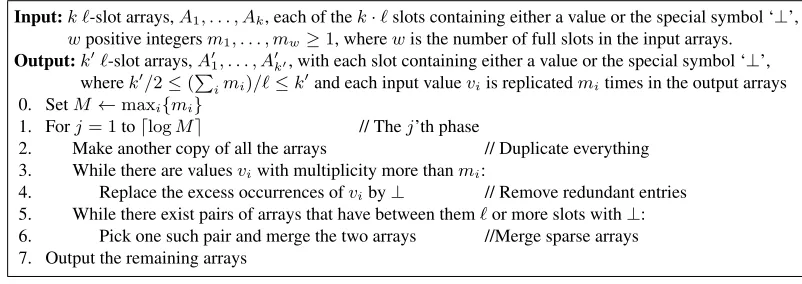
dlogMephases, such that after thej’th phase each valuevi is duplicated min(mi,2j)times. Each phase consists of making a copy of all the arrays, then for values that occur too many times marking the excess slots as empty (i.e., marking the extra occurrences as don’t-care values), and finally merging arrays that are “sparse” until the remaining arrays are at least half full. A simple way to merge two sparse arrays is to permute them so that the full slots appear in the left half in one array and the right half in the other, and then applySelectin the obvious way. A pseudo-code description of this procedure is given in Figure 1, whilst the proof of the following lemma is in Appendix B.
Input:k `-slot arrays,A1, . . . , Ak, each of thek·`slots containing either a value or the special symbol ‘⊥’, wpositive integersm1, . . . , mw≥1, wherewis the number of full slots in the input arrays. Output:k0`-slot arrays,A01, . . . , A0k0, with each slot containing either a value or the special symbol ‘⊥’,
wherek0/2≤(P
imi)/`≤k
0
and each input valueviis replicatedmitimes in the output arrays 0. SetM ←maxi{mi}
1. Forj= 1todlogMe // Thej’th phase
2. Make another copy of all the arrays // Duplicate everything 3. While there are valuesviwith multiplicity more thanmi:
4. Replace the excess occurrences ofviby⊥ // Remove redundant entries 5. While there exist pairs of arrays that have between them`or more slots with⊥: 6. Pick one such pair and merge the two arrays //Merge sparse arrays 7. Output the remaining arrays
Fig. 1.The cloning procedure
Lemma 5. (i)The cloning procedure from Figure 1 is correct.
(ii)Assuming that at least half the slots in the input arrays are full, this procedure can be implemented by a network ofO(w0/`·log(w0))`-fold gates of type`-Add, `-Multand`-Permute, wherew0is the total number of full slots in the output,w0 =P
mi. The depth of the network is bounded byO(logw0).
(iii)This network can be constructed in timeO˜(w0), given the input arrays and themi’s.
We also describe some more optimizations in Appendix A, including a different cloning procedure that im-proves on the complexity bound in Lemma 5. Putting all the above together we can efficiently evaluate a circuit using`-Permute,`-Addand`-Mult, yielding a proof of Theorem 1, see Appendix B.
3 Permutation Networks from Abelian Group Actions
Our goal in this section is therefore to efficiently implement an`-Permuteπoperation for an arbitrary permuta-tionπusing only the simple permutations that the algebra gives us (and also the`-Addand`-Multoperations that we have available). We begin in Section 3.1 by showing how to efficiently realize arbitrary permutations when the small set of “simple permutations” is the set of rotations. In Section 3.2 we generalize this construction to a more general set of simple permutations.
3.1 Permutation Networks from Cyclic Rotations and Swaps
Consider the Beneˇs permutation network discussed in Lemma 3. It has the interesting property that when the2r
items being permuted are labeled withr-bit strings, then thei-th level only swaps (or not) pairs whose index differs in the|r−i|-th bit. In other words, thei-th level swaps only disjoint pairs that have offset2|r−i|from each other. We call this operation an “offset-swap”, since all pairs of elements that might be swapped have the same mutual offset.
Definition 1 (Offset Swap). LetI` = {0, . . . , `−1}. We say that a permutationπ overI` is ani-offset swap if it consists only of 1-cycles and 2-cycles (i.e., π = π−1), and moreover all the 2-cycles inπ are of the form
(k, k+imod`)for different valuesk∈I`.
Offset swaps modulo`are easy to implement by combining two rotations with theSelectoperation defined in Section 2.3. Specifically, for ani-offset swap, we need rotations byiand−imod`and twoSelectoperations. By Lemma 3, a Beneˇs network can realize any permutation over2relements using2r−1levels where thei-th level is a2|k−i|-offset swap modulo2r. Ani-offset modulo2r,` < 2r <2`can be cobbled together using a constant number of offset swaps modulo`andSelectoperations, with offsetsiand2`−i. Therefore, given a cyclic group of “simple” permutationsHandSelectoperations, we can implement any permutation using a Beneˇs network with low overhead. Specifically, we prove the following lemma in Appendix B.
Lemma 6. Fix an integer`and letk=dlog`e. Any permutationπoverI`={0, . . . , `−1}can be implemented by a(2k−1)-level network, with each level consisting of a constant number of rotations andSelectoperations on
`-arrays.
Moreover, regardless of the permutationπ, the rotations that are used in leveli(i= 1, . . . ,2k−1)are always exactly 2|k−i| and`−2|k−i| positions, and the network depends onπ only via the bits that control the Select
operations. Finally, this network can be constructed in timeO˜(`)given the description ofπ.
3.2 Generalizing to Sharply-Transitive Abelian Groups
Below, we extend our techniques above to deal with a more general set of “simple permutations” that we get from our ring automorphisms. (See Sections 4 and C.3.)
Definition 2 (Sharply Transitive Permutation Groups).Denote the`-element symmetric group byS`(i.e., the group of all permutations overI` ={0, . . . , `−1}), and letHbe a subgroup ofS`. The subgroupHissharply transitiveif for every two indexesi, j∈I`there exists a unique permutationh∈ Hsuch thath(i) =j.
namely rotation byj−i. However, rotations are certainly not the only example. We now explain how to efficiently realize arbitrary permutations using as building blocks the permutations from any sharply-transitive abelian group. Recall that any abelian group is isomorphic to a direct product of cyclic groups, henceH ∼=C`1 × · · · ×C`k
(where C`i is a cyclic group with`i elements for some integers`i ≥ 2 where`i divides `i+1 for alli). As any cyclic group with`i elements is isomorphic toI`i ={0,1, . . . , `i−1}with the operation of addition mod`i, we will identify elements in Hwith vectors in the boxB = I`1 × · · · ×I`k, where composing two group elements
corresponds to adding their associated vectors (modulo the box). The groupHis generated by thekunit vectors
{er}k
r=1(whereer=h0, . . . ,0,1,0, . . . ,0iwith 1 in ther-th position). We stress that our groupHhas polynomial size, so we can efficiently compute the representation of elements inHas vectors inB.
SinceHis a sharply transitive group of permutations over the indexesI` ={0, . . . , `−1}, we can similarly label the indexes inI`by vectors inB: Pick an arbitrary indexi0 ∈I`, then for allh∈ Hlabel the indexh(i0)∈I` with the vector associated withh. This procedure labels every element inI`with exactly one vector fromB, since for every i ∈ I` there is a uniqueh ∈ Hsuch that h(i0) = i. Also, since H ∼= B, we use all the vectors inB for this labeling (|H| =|B|=`). Note that with this labeling, applying the generatorerto an index labeled with vectorv ∈ B, yields an index labeled withv0 =v+ermodB. Namely we increment by one ther’th entry inv
(mod`r), leaving the other entries unchanged.
In other words, rather than a one-dimensional array, we viewI` as ak-dimensional matrix (by identifying it withB). The action of the generatoreron this matrix is to rotate it by one along ther-th dimension, and similarly applying the permutationekr ∈ Hto this matrix rotates it bykpositions along ther-th dimension. For example, whenk = 2, we viewI` as an`1×`2 matrix, and the groupHincludes permutations of the formek1 that rotate all the columns of this matrix bykpositions and also permutations of the formek2 that rotate all the rows of this matrix bykpositions.
Using Lemma 6, we can now implement arbitrary permutations along ther’th dimension using a permutation network built from offset-swaps along ther’th dimension. Moreover, since the offset amounts used in the network do not depend on the specific permutation that we want to implement, we can use just one such network to im-plement in parallel different arbitrary permutations on differentr’th-dimension sub-matrices. For example, in the 2-dimensional case, we can effect a different permutation on every column, yet realize all these different permuta-tions using just one network of rotapermuta-tions andSelects, by using the same offset amounts but differentSelectbits for the different columns. More generally we can realize arbitrary (different)`/`rpermutations along all the different “generalized columns” in dimension-r, using a network of depthO(log`r)consisting of permutationsh∈ Hand
`-foldSelectoperations (and we can construct that network in time`/`r·O˜(`r) = ˜O(`)).
Once we are able to realize different arbitrary permutations along the different “generalized columns” in all the dimensions, we can apply Lemma 2. That lemma allows us to decompose any permutationπonI`into2k−1 permutationsπ =πi◦ · · · ◦π2k−1where eachπiconsists only of permuting the generalized columns in dimension
r = |k −i|. Hence we can realize an arbitrary permutation on I` as a network of permutations h ∈ H and
`-foldSelectoperations, of total depth bounded by 2Pk−1
i=0 O(log`i) = O(log`)(the last bound follows since
`=Qki=0−1`i). Also we can construct that network in time bounded by2Pki=0−1O˜(`i) = ˜O(`)(the bound follows sincek≤log`). Concluding this discussion, we have:
Lemma 7. Fix any integer`and any abelian sharply-transitive group of permutations overI`,H ⊂ S`. Then for every permutationπ ∈ S`, there is a permutation network of depthO(log`)that realizesπ, where each level of the network consists of a constant number of permutations fromHandSelectoperations on`-arrays.
Moreover, the permutations used in each level do not depend on the particular permutation π, the network depends onπonly via the bits that control theSelectoperations. Finally, this network can be constructed in time
˜
Lemma 7 tells us that we can implement an arbitrary`-Permute operation using a log-depth network of per-mutationsh∈ H(in conjunction with`-Addand`-Mult). Plugging this into Theorem 1 we therefore obtain:
Theorem 2. Let`, t, wandW be parameters, and letHbe an abelian, sharply-transitive group of permutations overI`.
Then anyt-gate fan-in-2 arithmetic circuitCwith average widthwand maximum widthW, can be evaluated using a network ofO dt/`e·d`/we·logW·polylog(`)`-fold gates of types`-Add,`-Mult, andh∈ H. The depth of this network of`-fold gates is at mostO(logW ·log`)times that of the original circuitC, and the description of the network can be computed in timeO˜(t·log`)given the description ofC. ut
4 FHE With Polylog Overhead
Theorem 2 implies that if we could efficiently realize`-Add,`-Mult, andH-actions on packed ciphertexts (where
H is a sharply transitive abelian group of permutations on`-slot arrays), then we can evaluate arbitrary (wide enough) circuits with low overhead. Specifically, if we could set` = Θ(λ) and realize`-Add,`-Mult, and H -actions in timeO˜(λ), then we can realize any circuit of average width Ω(λ) with just polylog(λ) overhead. It remains only to describe an FHE system that has the required complexity for these basic homomorphic operations.
4.1 The Basic Setting of FHE Schemes Based on Ideal Lattices and Ring LWE
Many of the known FHE schemes work over a polynomial ring A = Z[X]/F(X), whereF(X) is irreducible
monic polynomial, typically a cyclotomic polynomial. Ciphertexts are typically vectors (consisting of one or two elements) overAq =A/qAwhereq is an integer modulus, and the plaintext space of the scheme isAp =A/pA
for some integer modulusp q with gcd(p, q) = 1, for examplep = 2. (Namely, the plaintext is represented as an integer polynomial with coefficients modp.) Secret keys are also vectors overAq, and decryption works by taking the inner productb ← hc,si inAq (so bis an integer polynomial with coefficients in (−q/2, q/2]) then recovering the message asbmodp. Namely, the decryption formula is[[hc,simodF(X)]q]p where[·]qdenotes modular reduction into the range(−q/2, q/2]. Below we consider ciphertext vectors and secret-key vectors with two entries, since this is indeed the case for the variant of the BGV scheme [3] that we use.
Smart and Vercauteren [18] observed that the underlying ring structure of these schemes makes it possible to realize homomorphic (batch)AddandMultoperations, i.e. our`-Addand`-Mult. Specifically, thoughF(X)is typically irreducible overQ, it may nonetheless factor modulop;F(X) = Q`i=0−1Fi(X) modp. In this case, the plaintext space of the scheme also factors:Ap = ⊗`j=0−1Apj wherepiis the ideal inAgenerated bypandFi(X). In particular, the Chinese Remainder Theorem applies, and the plaintext space is partitioned into`independent non-interacting “plaintext slots”, which is precisely what we need for component-wise `-Add and`-Mult. The decryption formula recovers the “aggregate plaintext”a←[[hc,simodF(X)]q]p, and this aggregate plaintext is decoded to get the individual plaintext elements, roughly viazj ←amod (Fi(x), p)∈Apj.
4.2 Implementing Group Actions on FHE Plaintext Slots
While component-wise Add and Mult are straightforward, getting different plaintext slots to interact is more challenging. For ease of exposition, suppose at first that F(X) is the degree-(m −1) polynomial Φm(X) =
(Xm−1)/(X−1)formprime, and thatp≡1 (mod m). Thus our ringAabove is themth cyclotomic number
we obtain`=m−1plaintext slots, each slot holding an element of the finite fieldFp(i.e. in this caseApi above is equal toFp).
To get Φm to factor modulo p into linear terms we must have p ≡ 1 (mod m), sop > m. Also we need
m=Ω(λ)to get security (sincemis roughly the dimension of the underlying lattice). This means that to getΦm to factor into linear terms we must use plaintext spaces that are somewhat large (in particular we cannot directly useF2). Later in this section we sketch the more elaborate algebra needed to handle the general (and practical)
case of non-primem andp m, whereΦm may not factor into linear terms. This is covered in more detail in Appendix C. For now, however, we concentrate on the simple case whereΦmfactors into linear terms modulop.
Recall that ciphertexts are vectors overZq[X]/Φm(X), so each entry in these vectors corresponds to an integer polynomial. Consider now what happens if we simply replaceXwithXi inside all these polynomials, for some exponenti∈Zm∗, i >1. Namely, for each polynomialf(X), we considerf(i)(X) =f(Xi) modΦm(X). Notice that if we were using polynomial arithmetic moduloXm−1(rather then moduloΦ
m(X)) then this transformation would just permutes the coefficients of the polynomials. Namelyf(i)has the same coefficients asfbut in a different order, which means that if the coefficient vector off has small norm then the same holds for the coefficient vector off(i). In Appendix D we show that using a different notion of “size” of a polynomial (namely, the norm of the canonical embedding of a polynomial rather than the norm of its coefficient vector), we can conclude the same also for mod-Φmpolynomial arithmetic. Namely, the mappingf(X)7→f(Xi) modΦm(X)does not change the “size” of the polynomial. To simplify presentation, below we describe everything in terms of coefficient vectors and arithmetic moduloXm−1. The actual mod-Φmimplementation that we use is described in Appendix D (and a slightly different implementation is described in Appendix E).
Let us now consider the effect of the transformationX7→Xion decryption. Letc= (c0(X), c1(X))ands=
(s0(X), s1(X))be ciphertext and secret-key vectors, and letb=hc,simod (Xm−1, q)anda=bmodp. Denote c(i)= (c0(Xi), c1(Xi)) mod (Xm−1), and defines(i),b(i)anda(i)similarly. Sincehc,si=b (modXm−1, q), we have that
c0(X)s0(X) +c1(X)s1(X) = b(X) +q·r(X) + (Xm−1)s(X) (overZ[X])
for some integer polynomialsr(X), s(X), and therefore also
c0(Xi)s0(Xi) +c1(Xi)s1(Xi) = b(Xi) +q·r(Xi) + (Xmi−1)s(Xi) (overZ[X]).
SinceXm−1dividesXmi−1, then we also have D
c(i),s(i)E = b(i)+q·r(Xi) + (Xm−1)S(X) (overZ[X])
for somer(X), S(X). That is,b(i) = c(i),s(i)mod (Xm−1, q). Clearly, we also havea(i) = b(i) (mod p). This means that ifcdecrypts to the aggregate plaintextaunders, thenc(i)decrypts toa(i)unders(i)!
The cryptosystem from [3, 4] have a mechanism for “key switching” (which is also applicable to the scheme from [5]), transforming a ciphertextcthat decrypts toaundersto a new ciphertextc0that decrypts to the samea
under some other secret keys0. Using the same mechanism, we can translate the transformed ciphertextc(i) into one that decrypts toa(i)under anothers0 of our choice. We can even translate it back to a ciphertext decryptable under the original s is we are willing to assume circular security. Using the BGV cryptosystem [5, 4, 3] with appropriate parameters, key switching can be accomplished in timeO˜(λ). (See Appendices D and E for details on our variants of the BGV scheme [5].)
But how does this new aggregate plaintexta(i)relate to the originala? Here we apply to Galois theory, which tells us that decoding the aggregatea(i) (which we do roughly by settingz
that we get is exactly the same as when decoding the original aggregatea, albeit in different order. Roughly, this is because each of our plaintext slots corresponds to a root of the polynomialF(X), and the transformationsX 7→ Xi, which are precisely the elements of the Galois group, permute these roots. In other words by transforming c →c(i)(followed by key switching), we can permute the plaintext slots inside the packed ciphertext. Moreover, in our simplified case, the permutations have a single cycle – i.e., they are rotations of the slots. Arranging the slots appropriately we can get that the transformationc → c(i)rotates the slots by exactlyipositions, thus we get the group of rotations that we were using in Section 3.1. In general the situation is a little more complicated, but the above intuition still can be made to hold; for more details see Appendix C.
The general case.In the general case, whenmis not a prime, the polynomialΦm(X)has degreeφ(m)(whereφ(·) is Euler’s totient function), and it factors modpinto a number of same-degree irreducible factors. Specifically, the degree of the factors is the smallest integerdsuch thatpd= 1 (mod m), and the number of factors is`=φ(m)/d
(which is of course an integer), Φm(X) = Q`j=0−1Fj(X). For us, it means that we have ` plaintext slots, each isomorphic to the finite fieldFpd, and an aggregate plaintext is a degree-(φ(m)−1)polynomial overFp.
Suppose that we want to evaluate homomorphically a circuit over some underlying fieldKn = Fpn, then we need to find an integermsuch thatΦm(X)factors modpinto degree-dfactors, wheredis divisible byn. This way we could directly embed elements of the underlying plaintext spaceKninside our plaintext slots that hold elements ofFpd, and addition and multiplication of plaintext slots will directly correspond to additions and multiplications of elements inKn. (This follows sinceKn=Fpnis a subfield ofFpdwhenndividesd.)
Note that each plaintext slot will only havenlogpbits of relevant information, i.e., the underlying element of
Fpn, but it takesdlogpbits to specify. We thus get an “embedding overhead” factor ofd/neven before we encrypt anything. We therefore need to choose our parametermso as to keep this overhead to a minimum.
Even for a non-primem, the Galois groupGal(Q[X]/Φm(X))consists of all the transformationsX 7→ Xi for i ∈ Z∗m, hence there are exactly φ(m) of them. As in the simplified case above, if we have a ciphertext c that decrypts to an aggregate plaintextaunders, thenc(i)decrypts toa(i)unders(i). Differently from the simple case, however, not all members of the Galois group induce permutations on the plaintext slots, i.e., decoding the aggregate plaintexta(i) does not necessarily give us the same set of (permuted) plaintext elements as decoding the original a. Instead Gal(Q[X]/Φm(X)) contains a subgroup G = {(X 7→ Xp
j
) : j = 0,1, . . . , d−1}
corresponding to the Frobenius automorphisms6modulop. This subgroup does not permute the slots at all, but the quotient groupH =Gal/Gdoes. Clearly,G has orderdandHhas orderφ(m)/d =`. In Appendix C we show that the quotient groupHacts as a transitive permutation group on our`plaintext slots, and since it has order`
then it must be sharply transitive. In the general case we therefore use this groupHas our permutation group for the purpose of Lemma 7. Another complication is that the automorphism that we can compute are elements ofGal
and not elements in the quotient groupH. In Appendix C we also show how to emulate the permutations inH, via use of coset representatives inGal.
4.3 Parameter Setting for Low-Overhead FHE
Given the background from above (and the modification of the BGV cryptosystem [5] in Appendices D or E), we explain how to set the parameters for our variant of the BGV scheme so as to get low-overhead FHE scheme. Below we first show how to evaluate depth-Lcircuits with average-widthΩ(λ)with overhead of onlyO˜(L)·polylog(λ), and then use bootstrapping to get overhead of polylog(λ)regardless of depth.
Plaintext-Space Terminology and Notations The discussion below refers to three different “plaintext spaces”:
6
– The “underlying plaintext space”: The circuit that we want to evaluate homomorphically is an arithmetic circuit over some (finite) ring, and that finite ring is the “underlying plaintext space”. We typically think of the underlying plaintext space as being justF2, but it is sometimes convenient to use other spaces (e.g.,F28 when
computing AES, or perhapsFpfor some 32-bit primepin other applications).
In this work we always assume that the underlying plaintext space is small, either of constant size or at most of size polynomial inλ. Moreover, we assume that it is a field, namelyKn=Fpn for some primepand integer
n≥1.
– The“embedded plaintext space”. This is what is held in each of our plaintext slots. For example, we could have underlying spaceF2, but embed our bits in elements ofFpfor some larger integerp, or maybe in elements ofF2dfor somed >1. (In the former case we need to emulate binary XOR using a degree-2 polynomial modp, in the latter case multiplication and addition work as expected.)
– The“aggregate plaintext space”. This is the plaintext space that is natively encrypted in the cryptosystem: An element in the aggregate plaintext space is a polynomial in someFp[X], and as explained above it encodes (via CRT) an`-vector over the embedded plaintext space.
When choosing parameters for our FHE construction, we are given the depth and width of the circuits that we need to evaluate homomorphically, as well as the underlying plaintext space and the security parameter. We then want to choose the “embedded” and “aggregate” plaintext spaces and all the other parameters so as to minimize the overhead. Namely, minimize the ratio between the number of gates in the underlying circuits and the time that it takes to evaluate them homomorphically. We describe two methods for choosing the parameters: One is likely to be more efficient in practice, but we can only prove that it yields low overhead for either small underlying plaintext spaces (of size polylog(λ)) or very wide circuits (of widthΩ(λ·pn)). The other (simpler) method can be shown to work for any poly-size underlying plaintext space and circuits of widthΩ(λ), but is almost certain to yield worst performance in practice.
In either approach, we begin by lower-bounding the dimension of the lattice that we need (in order to get security), thus getting a lower-bound on our parameter m (recall that we will eventually get a dimension-φ(m)
lattice). Once we have this lower-boundM, we either pickm=pns−1≥M for some integers, or just choosem
asp0−1for some prime numberp0 sufficiently larger thanM. In the former case we have “embedded plaintext space”Fpns into which we can directly embed the underlying spaceFpn, and in the latter case we need to emulate
Fpnarithmetic using polynomials overFp0.
Once we set the parametermand get the corresponding “embedded plaintext space”, we can easily compute the packing parameter`and all the other parameters.
Step 1. Lower-Bounding the Dimension Suppose that we want to evaluate homomorphically circuits of depthL
over some small finite fieldFpn, with average depthwand maximum depthW =poly(λ), whereλis the security parameter. Clearly, for security parameter λ we need ciphertexts of size at least Ω(λ), so we cannot hope to evaluate any homomorphic operation faster than O˜(λ). To get low overhead, we therefore must be able to pack at least` = ˜Ω(λ)plaintext slots (from our “embedded” space) into one ciphertext. This means that we only get low-overhead implementation when the width of the underlying circuits is at leastΩ˜(λ).
From Theorem 2 we know that for any packing parameter`we can evaluate depth-Lcircuits using a network of `-fold gates of depth L0 = O(L ·logW ·log`). (If we use the second approach below for choosing the parameter mthen we need another additive term ofL·log(pn) = O(L·logλ)to emulate
Fpn arithmetic using mod-mpolynomials.) We will show below that it is sufficient to choose either`=Θ(λ)or`=Θ(pn·λ)≤poly(λ)
Recall that the BGV cryptosystem needsL0 different moduliqi when evaluating a depth-L0 network. When implementing arithmetic operations over a characteristic-pfield and working with dimension-Mlattices, the largest modulus needs to beq0 = (M·p)c
0·L0
(for some constantc0<2) to get the homomorphic evaluation functionality, andM ≥λ·logq0to get security. Plugging in all these constraints, we get a lower-bound on the dimension of the latticeM ≥ c00·L·λlogλ·logW ·logpfor some constantc00that we can compute from the given parameters (note thatM = ˜Θ(L·λ)).
Step 2. Choosing the parameterm Below we will choose our parametermso as to getφ(m)≥M. We use the following lemma, whose proof is in Appendix B.
Lemma 8. For all positive integersmwe havem/φ(m) =O(log logm).
We will then choose our parametermlarger thanc∗M for somec∗ =O(log logM), to ensure thatφ(m)≥M.
Approach 1: Using Extension Fields. Settings=dlogpn(c∗M+ 1)e, we see that the integerm=pns−1satisfies all our requirements. On one hand it is large enough,m ≥c∗M by construction. On the other hand ford=n·s
we clearly have thatpd= 1 (mod m), which is what we need in order to use the “embedded plaintext space”Fpd with the “aggregate plaintext space”Fp[X]/Φm(X).
Moreover, the “embedding overhead”d/n =sis small: sinceM = ˜O(L·λ)ands ≤log2(c∗M + 1)then clearlys=O(log(L·λ)). Thus the number of bits that it takes to specify an “aggregate plaintext” is only a factor ofO(log(L·λ))larger than what you need to specify all the elements of the “underlying plaintext space” that are embedded in this aggregate plaintext.
However, in some cases the parametermitself (and therefore the lattice dimension) could be large: Note that we haveM = ˜O(L·λ)and sinces=dlogpn(c∗M+ 1)ethenpns<(c∗M+ 1)·pn. If the size of the underlying plaintext space (i.e.,pn) is polylogarithmic, then we havem= ˜O(L·λ)which is what we need. However, if the underlying plaintext size is larger, saypn≈λ, then we could havem= ˜Θ(L·λ2). In this case we can no longer hope to evaluate homomorphic operations in timeO˜(L·λ)(since the ciphertext size is too large).
If the circuits that we want to evaluate are very wide (i.e., of widthΩ˜(λ·pn)) then we can just pack sufficiently many plaintext slots inside each ciphertext to get the overhead down. We can do this since the “embedding over-head” is logarithmic. But for narrower circuits, say of widthΘ(λ+pn), we just don’t have enough plaintext to put in all these slots, hence our overhead increases.
We point out that we may be able to do better thanm = pns−1, for example we can use anym0 such that
φ(m0) > M and m0 divides pns −1. But it is not clear that such m0 < mexists (for example when p = 2
then pns−1could be a prime number). It is also permissible to choose some s0 > sand then choose m0 that dividespns0−1withφ(m0)≥ M. As long ass0 ≤polylog(L·λ)then we still have only a polylog “embedding overhead”, and m0 may be much smaller thanm = pns−1. Unfortunately we were not able to prove that such
s0 ≤polylog(L·λ)andm0 ≤O˜(L·λ)always exist, we consider this an interesting open problem.
Approach 2: Using Prime Fields. An alternative, simpler, approach is to just pickm=p0−1for a prime number
p0sufficiently larger thanM, (so as to getφ(m)≥M), and set our “embedded plaintext space” to beFp0. This will
This solutions has a few drawbacks, however. One relatively minor drawback is that the native operations of the scheme are now over a characteristic-p0field, and ifp0 > pthen the boundM on the dimension will be slightly larger than before (since the noise in fresh ciphertexts is now of the formp0·erather thatp·e). A more serious problem is that each gate of the underlying circuit must now be emulated using a polynomial mod p0. We note, however, that this only results in a logarithmic slowdown: It is not hard to see that arithmetic over Fpn can be emulated by mod-p0 circuits of depth and sizeO(n·logp) (e.g., express these operations as binary circuits and emulate that binary circuit mod-p0).
Once we determined the parameterm and the “embedded plaintext space”, all the other parameters of the scheme easily follow, and we obtain the following theorem:
Theorem 3. For security parameterλ, anyt-gate, depth-Larithmetic circuit of average widthΩ(λ)over under-lying plaintext spaceFpn(withpn≤poly(λ)) can be evaluated homomorphically in timet·O˜(L)·polylog(λ).
4.4 Achieving Depth-Independent Overhead
Theorem 3 implies that we can implement shallow arithmetic circuit with low overhead, but when the circuit gets deeper the dependence of the overhead onLcauses the overhead to increase. Recall that the reason for this dependence on the depth is that in the BGV cryptosystem [3], the moduli get smaller as we go up the circuit, which means that for the first layers of the circuit we must choose moduli of bitsizeΩ(L).
As explained in [3], the dependence on the depth can be circumvented by using bootstrapping. Namely, we can start with a modulus which is not too large, then reduce it as we go up the circuit, and once the modulus become too small to do further computation we can bootstrap back into the larger-modulus ciphertexts, then continue with the computation.
For our purposes, we need to ensure that we bootstrap often enough to keep the moduli small, and yet that the time we spend on bootstrapping does not significantly impact the overhead. Here we apply to the analysis from [3], that shows that a packed ciphertext withΩ˜(λ)slots can be decrypted using a circuit of sizeO˜(λ) and depth polylog(λ). Hence we can even bootstrap after every layer of the circuit and still keep the overhead polylogarith-mic, and the moduli never grow beyond polylogarithmic bitsize. We thus get:
Theorem 4. For security parameterλ, anyt-gate arithmetic circuit of average widthΩ(λ)over underlying plain-text spaceFpn (withpn≤poly(λ)) can be evaluated homomorphically in timet·polylog(λ).
References
1. Paul T. Bateman, Carl Pomerance, and Robert C. Vaughan. On the size of the coefficients of the cyclotomic polynomial. InTopics in Classical Number Theory, Vol. I, pages 171–202, 1984.
2. V´aclav E. Beneˇs. Optimal rearrangeable multistage connecting networks.Bell System Technical Journal, 43:16411656, 1964. 3. Zvika Brakerski, Craig Gentry, and Vinod Vaikuntanathan. Fully homomorphic encryption without bootstrapping. Manuscript at
http://eprint.iacr.org/2011/277, 2011.
4. Zvika Brakerski and Vinod Vaikuntanathan. Efficient fully homomorphic encryption from (standard) LWE, 2011.
5. Zvika Brakerski and Vinod Vaikuntanathan. Fully homomorphic encryption from ring-LWE and security for key dependent messages. InAdvances in Cryptology - CRYPTO 2011, volume 6841 ofLecture Notes in Computer Science, pages 505–524. Springer, 2011. 6. I. Damg˚ard, Valerio Pastro, Nigel P. Smart, and Sarah Zakarais. Multiparty computation from somewhat homomorphic encryption.
Manuscript at http://eprint.iacr.org/2011/535, 2011.
8. Craig Gentry. A fully homomorphic encryption scheme. PhD thesis, Stanford University, 2009. http://crypto.stanford. edu/craig.
9. Craig Gentry. Fully homomorphic encryption using ideal lattices. In Michael Mitzenmacher, editor,STOC, pages 169–178. ACM, 2009.
10. Craig Gentry and Shai Halevi. Implementing gentry’s fully-homomorphic encryption scheme. InEUROCRYPT, volume 6632 of Lecture Notes in Computer Science, pages 129–148. Springer, 2011.
11. John L. Hennessy and David A. Patterson.Computer Architecture: A Quantitative Approach, 4th Edition. Morgan Kaufmann, 2006. 12. Kristin Lauter, Michael Naehrig, and Vinod Vaikuntanathan. Can homomorphic encryption be practical? Manuscript at
http://www.codeproject.com/News/15443/Can-Homomorphic-Encryption-be-Practical.aspx, 2011.
13. Frank Thomson Leighton.Introduction to parallel algorithms and architectures: arrays, trees, hypercubes. M. Kaufmann Publishers, 2 edition, 1992.
14. G. Lev, N. Pippenger, and L. Valiant. A fast parallel algorithm for routing in permutation networks.IEEE Transactions on Computers, C-30:93–100, 1981.
15. Vadim Lyubashevsky, Chris Peikert, and Oded Regev. On ideal lattices and learning with errors over rings. InEUROCRYPT, volume 6110 ofLecture Notes in Computer Science, pages 1–23, 2010.
16. Ron Rivest, Leonard Adleman, and Michael L. Dertouzos. On data banks and privacy homomorphisms. InFoundations of Secure Computation, pages 169–180, 1978.
17. Nigel P. Smart and Frederik Vercauteren. Fully homomorphic encryption with relatively small key and ciphertext sizes. InPublic Key Cryptography - PKC’10, volume 6056 ofLecture Notes in Computer Science, pages 420–443. Springer, 2010.
18. Nigel P. Smart and Frederik Vercauteren. Fully homomorphic SIMD operations. Manuscript at http://eprint.iacr.org/2011/133, 2011. 19. Damien Stehl´e and Ron Steinfeld. Faster fully homomorphic encryption. InASIACRYPT, volume 6477 ofLecture Notes in Computer
Science, pages 377–394. Springer, 2010.
20. Abraham Waksman. A permutation network.J. ACM, 15(1):159–163, 1968.
21. Lawrence C. Washington.Introduction to Cyclotomic Fields, volume 83 ofGraduate Texts in Mathematics. Springer, 1996.
A Additional Optimizations
A.1 Faster Cloning
In Lemma 5 we establish that we can clonew0 values using`-fold operations in timeO((w0logw0)/`). Below we show how to remove the logw0 term, which would allow us to clone values between levels in the circuit using asymptotically optimalO(w0/`)time.
Recall that for the cloning procedure we are given a “multi-array”A0 consisting of several`-element arrays, and also the intended multiplicities of the values in these arrays m1, . . . , mw. As before, denote the maximum intended multiplicity byM = maxi{mi}. The new procedure consists of two main parts:
Decomposition: For i = 0,1. . . , M, construct a “multi-array” A0i that contains the elements whose intended multiplicity is at least2i, as follows:
SetA00 = A0. Then for i > 0we compute A0i fromA0i−1 by marking the slots of all the elements with intended multiplicity smaller than2ias empty, and then merging sparse arrays until the multi-array is at least half-full (or contains only one array). Note that when computingA0ifromA0i−1, we also keep a copy ofA0i−1for use in the aggregation part below.
Aggregation: Fori = M, . . . ,1,0, construct a multi-arrayAi as follows. SetAM = A0M, then for alli < M concatenate two copies ofAi+1 with one copy ofA0i, and if the result is not half full them merge sparse arrays until it is half full again. The result isAi.
Lemma 9. The procedure above is correct, and it uses only O(w`0 + logw0) copy and merge operations on` -element arrays, wherew0=P
imi
Proof. Consider an arbitrary element of the input multi-arrayA0, with intended multiplicitymi∈[2j,2j+1−1]for somej. The decomposition part will output multi-arrays such that this element is in each ofA00, . . . ,A0j. Then, during the aggregation part, Aj will include one copy of this element, Aj−1 three copies, Aj−2 seven copies, and in generalAj−k contains2k+1 −1copies. Hence at the end of the aggregation part,A0 includes2j+1−1 occurrences of this element (which is at least as much asmibut less than2mi).
To analyze complexity, notice that the number of arrays in every multi-arrayA0j equals the number of arrays inA0j−1minus the number of merge operations that were used when computingA0j. SinceA0M cannot have less than zero arrays, it follows that the total number of merge operations throughout the decomposition part cannot be more than the initial number of arrays, namely d2w/`e ≤ d2w0/`e. We observed above that the aggregation part does at most two merges for eachAj, so the total number of merges during this part is at most2dlogMe ≤
2dlogw0e. Thus the total number of merge operations is bounded byN =d2w0/`e+ 2dlogMe=O(w`0+ logw0). Finally, the output multi-arrayA0 contains at most twice as many occurrences of each element as needed, and it is at least half full. Hence it contains at mostd4w`0e arrays, which means that the entire procedure duplicated arrays at mostd4w0
` e+N =O( w0
` + logw
0)times. ut
The procedure above can be made particularly efficient in our case, when used in conjunction with the fol-lowing optimization: When considering a circuit, we sort the gates in each level according to their fan-out, thus making the input to the cloning procedure sorted by the intended multiplicity. Note that the decomposition part now becomes unnecessary, we just defineA0j to be the collection of the first few arrays, all the ones that contain elements of intended multiplicity at least2j.
Also important is that once the inputs are sorted, merging arrays do not need the full power of thePermute
operation. As long as we keep the full slots in the arrays continuous, we can use the simple rotation operation to align the two arrays before we merge them. (The same can be done with the “higher-dimensional rotations” that we get in the general case in Section 4.) Hence the entire cloning network can be implemented using only
O(w`0 + logw0)basic operations of`-Add,`-Mult, andH-actions.
A.2 Faster Routing
Tracing through the proofs in Section 2, in conjunction with the more efficient cloning technique from above, one can verify that thelogW term in the statement of Theorem 1 can be made to multiply only the number of`-Add
and`-Multgates, not`-Permute, which can make a big difference in practice. Roughly, thelogW term arises from the fact that we seem to needΩ(W·logW)computation (in the worst-case) to route the inter-level wires. Note that such alogW term does not appear in the overhead of non-batched FHE schemes that operate on singletons rather than arrays. It seems plausible that this term could be eliminated somehow, and we consider this an interesting open problem.
A.3 Powering (Almost) for Free
In some applications, plaintext elements are not bits or integers, but rather elements in a finite extension field. For example, when implementing homomorphic AES, it may be convenient to useF28 as the underlying plaintext
when using a characteristic-pfield.) We show in Section 4 that applying the Galois group transformations to packed ciphertexts results in almost no additional noise. Thus we get a new function,`-Frobenius, that raises the`slots in parallel to a power ofp, while adding almost no additional noise. This may not be surprising, since the Frobenius map is a linear operation onFpn.
In practice this turns out to be a useful optimization for particular functions of interest: For the case of AES, the only non-linear part of AES is inversion in F28, which is equivalent to exponentiation to the 254-th power.
While this may seem to be high-degree, the Frobeniusautomorphism allows us to evaluate this power relatively cheaply on`elements in parallel. For ana∈F28 sitting in a plaintext slot, we use the Frobenius map to compute aj = a2
j
for j = 1,2, . . . ,7 (these are the ’1’s in the binary representation of 254), then multiply all theaj to geta254 =a−1. Thus, we can evaluatea254at a price of only seven products (in terms of noise), and this 7-fold product can be computed by a depth-3 circuit. The binary affine transformation of the AES S-box is not linear over
F28, but itislinear over the outputs of the Frobenius automorphisms, and so itislinear in terms of its effect on
ciphertext noise (although to extract and pack the bits uses up two more levels in the circuit). TheShiftRowsand
MixColumnsoperation take four more levels using our permutation networks, and the matrix multiplication in the
MixColumnsuses another level. An AES round can therefore be accomplished using only a depth-10 circuit (in terms of noise), so homomorphic implementation of the full AES-128 will take a circuit of depth less than 100. It is therefore plausible that we could implement AES-128 homomorphically without resorting to bootstrapping at all!!! (We note, however, that many other optimizations are possible, and it is not clear if the approach sketched above is really the most efficient one for implementing AES-128.)
B Proofs
Lemma 1. LetS={0, . . . , a−1} × {0, . . . , b−1}be a set ofabpositions, arranged as a matrix ofarows and
bcolumns. For any permutationπoverS, there are permutationsπ1, π2, π3such thatπ=π3◦π2◦π1(that is,π is the composition of the three permutations) and such thatπ1andπ3only permute positions within each column (these permutations only change the row, not the column, of each element) andπ2only permutes positions within each row. Moreover, there is a polynomial-time algorithm that given π outputs the decomposition permutations
π1, π2, π3.
Proof. The basic strategy of the decomposition is thatπ2 will send each element to some address with the same
y-coordinate as its target destination, and similarlyπ3will correct all of thex-coordinates. The permutationπ1, on the other hand, serves as a strategic indirection. The reason this indirection is needed – i.e., the reason we cannot decomposeπjust asπ3 ◦π2 with the properties above – is that several elements in the same row could have the same targety-coordinate (and thusπ2 cannot achieve its goal). Thus,π1 is used to ensure that, whenπ2receives its input, no two elements in the same row have the same target column. The only nontrivial part of the proof is showing that a suitableπ1always exists.
For s ∈ S, let sx andsy denote its x andy coordinates, namelys = (sx, sy). Consider a bipartite graph
G = (V1, V2, E)whereV1 andV2each havebvertexes with labels{0, . . . , b−1}. For everys∈ S, we draw an edge from theV1-vertex labeledsyto theV2-vertex labeledπ(s)y, and we label the edge ‘s’. (We may have more than one edge between the same pair of vertices’s.) Clearly, this is a bipartite,a-regular graph. ThereforeG’s edges can be partitioned intoaperfect matches, and this partition can be computed efficiently (e.g., using network-flow algorithms). In other words, one can compute in polynomial time a coloring of the edges ofGusing the colors
{0, . . . , a−1}, such that for allithei-colored subgraphGiofGis a perfect matching.
Letρ(s)denote the color of the edge labeled ‘s’. Now, defineπ1, π2, π3as follows: for alls= (sx, sy)∈S: