Tweakable Enciphering Schemes Using Only the Encryption
Function of a Block Cipher
Palash Sarkar
Applied Statistics Unit Indian Statistical Institute
203, B.T. Road, Kolkata India 700108. email: [email protected]
Abstract. A new construction of block cipher based tweakable enciphering schemes (TES) is described. The major improvement over existing TES is that the construction uses only the encryption function of the underlying block cipher. Consequently, this leads to substantial savings in the size of hardware implementation of TES applications such as disk encryption. This improvement is achieved without loss in efficiency of encryption and decryption compared to the best previously known schemes.
Keywords: modes of operations, tweakable encryption, strong pseudorandom permuta-tion, disk encryption.
1 Introduction
Modes of operations of a block cipher are important from both a practical and a theoretical point of view. From a practical viewpoint, for a block cipher to be useful for a particular application, one needs to deploy it in an appropriate mode of operation. In this paper, we consider modes of operations for constructing length preserving strong pseudo-random permutation (SPRP) on variable and arbitrary length strings. Additionally, the construction should support a tweak, which provides flexibility in applications. Such a primitive is called a tweakable enciphering scheme (TES). The known constructions of TESs can be broadly divided into two types: encrypt-mix-encrypt type [5, 6, 3, 19] and the hash-encrypt-hash type [11, 12, 21, 2, 4, 18]. The first type uses a block cipher while the second type additionally requires a finite field multiplier. The feature common to all previous constructions is that they require both the encryption and the decryption functions of the underlying block cipher.
This paper describes new hash-encrypt-hash type of TES constructions. The major innovation of the current work is that the decryption function of the block cipher is not required. Let us clarify what we mean by this. Each block cipher has an encryption and a decryption function. Similarly, a TES also has an encryption and a decryption algorithm. We describe TES constructions whose both encryption and decryption algorithms can be constructed using only the encryption function of the underlying block cipher.
This is achieved without loss in efficiency compared to the best previously known schemes [18]. From a practical point of view this is significant, since the decryption function of the block cipher need not be implemented. The major application of TES is disk encryption where the implemen-tation of TES is done in hardware which typically resides just above the disk controller. Thus, for disk encryption application the new constructions lead to substantial savings in hardware.
1.1 Previous and Related Works
([10, 15, 16, 7] and other papers) has refined and polished the construction and currently several variants are known. Naor and Reingold [14, 13] described a construction of SPRP using a block cipher. The notion of tweakable block cipher was introduced in [8]. Halevi and Rogaway [5] provided the first construction of a TES from a block cipher. As mentioned earlier, subsequent research has yielded several constructions of TES from a block cipher.
2 Construction
We follow the notation used in [18].
Choice of finite field. Let IF =GF(2n) be the finite field of 2nelements. The addition operation over IF will be denoted by⊕. Elements of IF can also be considered to be n-bit strings.
XOR-universal hash function. Let h:K ×IFm →IF be a function such that forX,X′ ∈IFm,
X 6= X′ and for any γ ∈ IF, Prτ[hτ(X)⊕hτ(X′) = γ] ≤ ǫ, where hτ(X) =∆ h(τ,X) and the
probability is over uniform random choice ofτ. Such anhis called anǫ-almost XOR universal hash function. Note thatǫcould depend onm (correspondingly, we writeǫm) and indeed does so in the examples below.
1. Usual polynomial hashing is quite well known, where
hτ(X1, . . . , Xm) =τPolyτ(X1, . . . , Xm) ∆
=ττm−1X
1⊕ · · · ⊕τ Xm−1⊕Xm
.
Using Horner’s rulePolyτ(X1, . . . , Xm) can be evaluated usingm multiplications and is m/2n
-almost XOR universal.
2. A faster option is to use a class of polynomials introduced by Bernstein [1] based on earlier work by Rabin and Winograd [17] which we call theBRWpolynomials. For the exact definition of these polynomials see [1]. Here we note that
hτ(X1, . . . , Xm) =τBRW(X1, . . . , Xm)
is 2m/2n-almost XOR universal and BRW
τ(X1, . . . , Xm) can be evaluated using⌊m/2⌋ multi-plications (assuming that τ, τ2, τ4, . . . are pre-computed and available).
The number of multiplications required by BRWis half that required by Poly; on the other hand, the processing ofPolycan be made faster by using a pre-computed multiplication table forτ, while this cannot be done for BRW. Other XOR universal hash functions such as those defined in [20] can also be used with our construction.
XOR Universal Function from a Linear Map. Let φ: IF× {0, . . . ,2n−2} → IF be a map such that for 0 ≤ i < j ≤ 2n −2, and for any element γ ∈ IF, Pr
β[φβ(i)⊕φβ(j) = γ] = 1/2n where φβ(i) =∆ φ(β, i). A simple implementation of such a map is φβ(i) = αiβ, where α is a primitive element of IF. Using a tower field representation of IF it is possible to obtain a faster implementation ofφ(see [19]).
A new hash function. Let hτ :∪i≥1IFi → IF be a XOR universal hash function, such that for
X,X′ ∈IFm withX6=X′, Prτ[hτ(X) =hτ(X′)]≤ǫm. DefineΥτ :∪
i≥3IFi →IF2 as follows
Υτ(X1, X2, X3, . . . , Xm) = (X1⊕Z, X2⊕Z) (1)
whereZ =hτ(X3, . . . , Xm). It is not difficult to show that forX= (X1, . . . , Xm)6= (X1′, . . . , Xm′ ) =
Encryption function of a block cipher. LetEK :{0,1}n→ {0,1}n be the encryption function of a block cipher. The key K is from a suitable key space and there is no restriction on this key space. Importantly, we do not require the decryption function, i.e., the inverse ofEK. In the security proof we assumeEK to be a PRF. The invertibility ofEK is not required in either the construction or the proof.
Definition of the basic modes of operations. ECB:ECBK(X1, . . . , Xm) = (EK(X1), . . . , EK(Xm)).
MCtr:forβ, S ∈GF(2n), define MCtr
K,β,S(X1, . . . , Xm) = ECBK(S1, . . . , Sm)⊕(X1, . . . , Xm), whereSi =φβ(i−1)⊕S.
OFB:forS∈GF(2n), define OFB
K,S(X1, . . . , Xm) = (X1, . . . , Xm)⊕(S1, . . . , Sm), whereSi =EKi (S), i.e.,S1 =EK(S) andSi=EK(Si−1).
The tweakable enciphering scheme will be defined using either the modified counter mode or the OFB mode. The description of the algorithm is given in a unified manner using the notation
ModeK,β1,S(X1, . . . , Xm). The definition of this notation is given below.
Counter: ModeK,β1,S(X1, . . . , Xm) =MCtrK,β1,S(X1, . . . , Xm).
OFB: ModeK,β1,S(X1, . . . , Xm) =OFBK,S(X1, . . . , Xm).The quantity β1 is not used.
Parsing. Let the length of the plaintext or the ciphertext beℓbits. Writeℓ= (m−1)n+r, where 1≤r≤n. There are a total ofm blocksX1, . . . , Xm, withX1, . . . , Xm−1 being full blocks and the
length of the last block isr which is a possible partial block.We require ℓ >2n so that m≥3.
Notation.
Firstr(Z): the most significant r bits of the n-bit binary stringZ.
padi(Z): appendizero bits to the string Z.
dropi(Z): drop izero bits from the end of the stringZ.
The details of the encryption and the decryption algorithms for the tweakable enciphering scheme are shown in Table 1. The required definition of the Feistel structure is shown in Table 2 while the definition of the hashing keys is shown in Table 3.
The notation TES[Mode,Hash,KeyDef] denotes the tweakable enciphering scheme obtained by plugging in the appropriate mode, the hash functionh and the suitable key definition. For example
TES[MCtr,BRW,KeyDef3] denotes the tweakable enciphering scheme obtained by using the modified counter mode, theBRWpolynomials forh and KeyDef3 for the key definition.
2.1 Intuition behind the construction
The basic idea is quite simple. The hash function Υ hashes the message to produce the input to the Feistel layer. So, for distinct messages, the inputs to the Feistel layer are distinct. The 4-round Feistel layer constructs a strong pseudo-random permutation. The XOR of the input and the output of the Feistel layer is used to form the initialization vector for the mode of operation.
Table 1. Encryption and decryption algorithms. The block cipher key is K; and the hash key is (τ, τ′, β
1, β2).
Definitions ofτ, β1 andβ2 are given in Table 3. LetK= (K, τ, τ′, β1, β2).
P2
P3
Pm
C2
C1 C3 Cm
P1
A2 1
A
1
B B2
M2 1 M Inverse Hash Feistel Layer Mode Hash ... ... M
AlgorithmEncryptT
K(P1, . . . , Pm) 1. Mm=padn−r(Pm);
2. (A1, A2) =Υτ(P1, . . . , Pm−1, Mm)⊕(β1, β1);
3. (B1, B2) =FeistelK,τ′(A1, A2);
4. M1 =A1⊕B1;M2=A2⊕B2;M =M1⊕M2;
5. (C3, . . . , Cm−1, Dm)
=ModeK,β1,M(P3, . . . , Pm−1, Mm); 6. Cm=dropn−r(Dm);Um=padn−r(Cm);
7. (C1, C2) =Υτ(B1, B2, C3, . . . , Cm−1, Um)⊕(β2, β2);
return (C1, . . . , Cm).
AlgorithmDecryptTK(P1, . . . , Pm) 1. Um=padn−r(Cm);
2. (B1, B2) =Υτ(C1, . . . , Cm−1, Um)⊕(β2, β2);
3. (A1, A2) =FeistelK,τ−1′(B1, B2);
4. M1=A1⊕B1;M2=A2⊕B2;M =M1⊕M2;
5. (P3, . . . , Pm−1, Vm)
=ModeK,β1,M(C3, . . . , Cm−1, Um); 6. Pm=dropn−r(Vm);Mm=padn−r(Pm);
7. (P1, P2) =Υτ(A1, A2, P3, . . . , Pm−1, Mm)⊕(β1, β1);
return (P1, . . . , Pm).
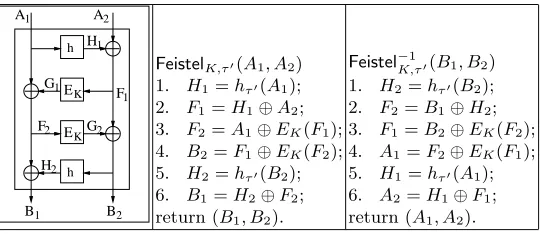
Table 2.A four-round Feistel construction required in Figure 1. Note that if the two input blocks are swapped then decryption can be done using the encryption module (as is usual for Feistel construction).
A1
H1
G1
F2 G2
H2 B1 A2 B2 h h E E K K F1
FeistelK,τ′(A1, A2)
1. H1=hτ′(A1);
2. F1=H1⊕A2;
3. F2=A1⊕EK(F1);
4. B2=F1⊕EK(F2);
5. H2=hτ′(B2);
6. B1=H2⊕F2;
return (B1, B2).
Feistel−1
K,τ′(B1, B2)
1. H2=hτ′(B2);
2. F2=B1⊕H2;
3. F1=B2⊕EK(F2);
4. A1=F2⊕EK(F1);
5. H1=hτ′(A1);
6. A2=H1⊕F1;
return (A1, A2).
Table 3.Different definitions of the hashing keysτ,τ′,β
1 and β2. HereT is ann-bit tweak andℓis the length of
the message (or ciphertext) in bits. The block cipher keyKis chosen uniformly at random from the appropriate key space. Also, inKeyDef2andKeyDef3,τ andτ′ are chosen uniformly at random from{0,1}n.
KeyDef1 KeyDef2 KeyDef3
BC key:K BC key:K; hash keys:τ, τ′BC key:K; hash keys:τ, τ′
1. γ=EK(T);
2. β1=EK(γ⊕binn(ℓ)); 3. β2=φβ1(1);
4. τ=γ; 5. τ′=E
K(φβ1(2)).
1. γ=EK(T);
2. β1=EK(γ⊕binn(ℓ)); 3. β2=φβ1(1).
1. β1=EK(T); 2. β2=φβ1(1).
Table 4.Performance of the new modes of operations. We assume that there arem(full or partial) blocks.
KeyDef1 KeyDef2 KeyDef3
# keys 1[BK] 1[BK]+2[AK] 1[BK]+2[AK] # BC calls m+ 3 m+ 2 m+ 1
Poly BRW
We have modified this idea to separate the processing into two parts – the first two blocks and the rest of the message. An invertible map on the first two blocks is created using the Feistel structure. This involves only the encryption function of the block cipher and due to the propery of the Feistel structure, during decryption also, only the encryption function is required. At the same time, we should mention that even though the idea is simple, it takes a bit of effort to work out the polished form and the exact details of the construction and the proof.
Note that the hash key used in the Feistel structure is different from the hash key used outside this structure, even though the basic XOR-universal hash function h is the same in both cases. Using a single key would have been more convenient, but, then the probability computation in Lemma 2 that we perform later would not go through. This fact forced us to use separate and independent keys.
Alternative structures. The Feistel structure that we have used makes two multiplications and two block cipher calls. There are several other Feistel based constructions with different costs all of which convert ann-bit to n-bit PRF to a 2n-bit SPRP. Conceptually, it is possible to use these structures to replace the Feistel structure that we use; however, one has to be careful with the actual details. Our choice of the particular Feistel structure was based upon simplicity and efficiency.
2.2 Avoiding Decryption: Inefficient Approaches
From a conceptual point of view, there is a generic idea to avoid using the decryption function of the block cipher. As mentioned earlier, Feistel based constructions convert ann-bit ton-bit PRF to a 2n-bit SPRP. Given such an SPRP, previously known constructions can be used to obtain TESs. Any such TES would not require the decryption function of the block cipher. However, such a conversion would also be inefficient. For the encrypt-mix-encrypt type conversions, the cost would be between 4[BC] to 2[BC]+2[M] per block, where [BC] is a block cipher call and [M] is a multiplication over GF(2n). On the other hand, the hash-encrypt-hash type constructions will require 2n-bit multiplications which is about 3 n-bit multiplications, leading to a cost of about 1[BC]+1.5[M] per block.
2.3 Efficiency and Comparison
Performance of the new constructions is given in Table 4. ForBRWpolynomials, the efficiency comes to about 1[BC]+1[M] per block, which is comparable to the best previously known efficiency [18]. The main advantage of the new constructions is that the decryption function of the block function is not required at all. This is an advantage for hardware implementation, since it results in substantial savings in the size of the hardware. One of the main application of TES is disk encryption and the implementation is typically in hardware. For this application, the new construction offers a significant advantage.
The only restriction is that the message length must be greater than 2n bits while in the previous constructions the length was required to be at least n bits. There is no upper bound on the length and messages of varying lengths including partial blocks can be handled quite efficiently. The restriction of more than 2nbits on the message length is not a concern for disk encryption and other practical applications.
key is required (KeyDef2 and KeyDef3). We consider this to be a minor trade-off compared to the fact that it is not required to implement the decryption module at all.
3 Security
We consider information theoretic security and hence without loss of generality the adversary A
is considered to be a deterministic algorithm. See [5] for other notions of security and the relation between computational and information theoretic security.
An adversary A interacts with the encryption and the decryption oracles of the tweakable enciphering scheme and finally outputs either 0 or 1. Oracles are written as superscripts. The encryption oracle Π takes as input (T, P), where T is an n-bit string and P is a string of length greater than 2nand returnsCwhich is of length equal to that ofP. Similarly, the decryption oracle
Π−1 takes as input (T, C) and returnsP. The notation AΠ,Π−1
⇒ 1 denotes the event that the adversaryA, interacts with the oracles Πand Π−1, and finally outputs the bit 1.
Pointless queries: We assume that an adversary never repeats a query, i.e., it does not ask the encryption oracle with a particular value of (T, P) more than once and neither does it ask the decryption oracle with a particular value of (T, C) more than once. Furthermore, an adversary never queries its deciphering oracle with (T, C) if it gotC in response to an encipher query (T, P) for some P. Similarly, the adversary never queries its enciphering oracle with (T, P) if it got P as a response to a decipher query of (T, C) for some C. These queries are called pointless as the adversary knows what it would get as responses to such queries.
We consider an adversary’s advantage in distinguishing a tweakable enciphering scheme from an oracle which simply returns random bit strings. This advantage is defined in the following manner.
Adv±rndΠ (A) = PrhAΠ,Π−1
⇒1i−PrhA$(.,.),$(.,.)⇒1i
where $(., M) returns random bits of length|M|.
The query complexity σn of an adversary is defined to be the total number of n-bit blocks it provides in all its encryption and decryption queries. This includes the plaintext and ciphertext blocks as well as then-bit tweak. ByAdv(σn) (with suitable sub and super-scripts) we denote the maximum advantage of any adversary with query complexityσn.
Theorem 1. Fix n and σn to be positive integers. Suppose that an adversary uses a total of σn blocks in all its queries, where each block is an n-bit string. Then
Adv±Πrnd(σn)≤ 14σ2
n
2n (2)
Here Π is TES[Mode,Hash,KeyDef] withMode, Hash and KeyDef being instantiated by any of the constructions described in Section 2.
The proof of Theorem 1 is described in the next two subsections.
3.1 Internal Variables
A variable ty is used to indicate whether a call to Π or Π−1 is made. If the call is to Π, then
There are two block cipher calls in the Feistel structure and (m −2) block cipher calls in the “mode of operation” part. Denote the inputs and outputs of the Feistel calls by F1, F2 and
G1, G2 respectively and denote the inputs and outputs of the other (m−2) calls byF3, . . . , Fm and
G3, . . . , Gm respectively.
In addition to these, several encryption calls are made in the key definition part. Define
J0 =T;J1 =γ⊕binn(ℓ);J2 =φβ1(2);L0=γ;L1 =β1;L2 =τ
′
.
The quantities F1, . . . , Fm and G1, . . . , Gm can be expressed in terms of the plaintext and
ciphertext blocks. We show how this can be done.
The variables F1, F2 and G1, G2.
F1 =hτ′(A1)⊕A2; F2 =B1⊕hτ′(B2);
G1 =A1⊕F2 =A1⊕B1⊕hτ′(B2); G2 =B2⊕F1=B2⊕A2⊕hτ′(A1); whereMm=padn−r(Pm), Um =padn−r(Cm) and
A1=β1⊕P1⊕hτ(P3, . . . , Pm−1, Mm); A2=β1⊕P2⊕hτ(P3, . . . , Pm−1, Mm);
B1=β2⊕C1⊕hτ(C3, . . . , Cm−1, Um); B2=β2⊕C2⊕hτ(C3, . . . , Cm−1, Um).
The variables F3, . . . , Fm and G3, . . . , Gm. For both the modified counter and the OFB modes, the expressions for G3, . . . , Gm are same but the expressions forF3, . . . , Fm depend on the actual
mode that is used. First we provide the expressions for theGj’s and then the expressions for the Fi’s.
Gi=Pi⊕Ci for 3≤i≤m−1;
Gm = (
Dm⊕(Pm||0n−r) ifty=enc; Vm⊕(Cm||0n−r) if ty=dec;
)
fori=m.
Note that the firstr bits ofGm isPm⊕Cm irrespective of whetherty isencordec. For 3≤i≤m, theFi’s are defined as follows.
MCtr:Fi=M ⊕φβ1(i−3) =A1⊕A2⊕B1⊕B2⊕φβ1(i−3).
OFB:F3 =M and for 4≤i≤m,Fi=Pi−1⊕Ci−1.
Below we prove some results on the probability of certain kinds of collisions.
Lemma 1. Let τ′ and β
1 be chosen independently and uniformly at random from IF. For any
(P1, . . . , Pm−1, Mm) and (C1, . . . , Cm−1, Um), Prτ,β1[F1 =F2] = 1/2
n−1.
Proof.A1 =β1⊕restandB2=β2⊕rest1, whererestand rest1are independent of bothβ1 andβ2.
So,A1=B2 holds if and only if β1⊕β2 =rest⊕rest1. Since β2 =φβ1(1), by the XOR universality
ofφ, the last equation holds with probability at most 1/2n. In other words, Pr[A
1 =B2]≤1/2n.
Pr[F1 =F2] = Pr
τ′,β1[hτ′(A1)⊕A2=hτ′(B2)⊕B1] = Pr
τ′,β1[(hτ′(A1)⊕A2=hτ′(B2)⊕B1)∧((A1 =B2)∨(A1 6=B2))] = Pr
τ′,β1[(hτ′(A1)⊕A2=hτ′(B2)⊕B1)|(A1 =B2)] Prβ1[A1 =B2] + Pr
τ′,β1[(hτ′(A1)⊕A2 =hτ′(B2)⊕B1)|(A1 6=B2)] Prβ1[A16=B2]
≤Pr β1
[A1 =B2] + Pr
τ′ [(hτ′(A1)⊕A2=hτ′(B2)⊕B1)|(A16=B2))]
≤ 2
The last inequality follows from the XOR-universal property ofh. ⊓⊔
Lemma 2. Suppose that τ and τ′ are chosen independently and uniformly at random from IF.
1. If (P1, . . . , Pm−1, Mm)= (P6 1′, . . . , Pm′ −1, Mm′ ), then Prτ,τ′[F1 =F1′]≤ǫm−2+ 1/2n.
2. If (C1, . . . , Cm−1, Um)= (U6 1′, . . . , Um′ −1, Um′ ), then Prτ,τ′[F2=F2′]≤ǫm−2+ 1/2n.
Proof. We prove the first item, the proof of the other one being similar. F1 = hτ′(A1)⊕A2 and F′
1 = hτ′(A′1) ⊕A′2. Suppose that (P3, . . . , Pm−1, Mm) = (P3′, . . . , Pm′ −1, Mm′ ). Then (P1, P2) 6=
(P′
1, P2′). If P1 =P1′ (and so,P2 6=P2′), then A1 =A′1.P2 6=P2′ implies A2 6=A′2 whereby we have
F1 6=F1′. If P2 =P2′ (and so, P1 6=P1′), then A2 =A′2.P1 6=P1′ impliesA16=A′1 whereby F1 =F1′
implies hτ(A1) = hτ(A′1). Since A1 6=A′1, by the XOR-universality of h, the last condition holds
with probability 1/2n.
Suppose now that (P3, . . . , Pm−1, Mm) 6= (P3′, . . . , Pm′ −1, Mm′ ). By the XOR-universality of h, Prτ[A1=A′1]≤ǫm−2. Also, note thatA1, A2, A′1 andA′2 are independent of τ′.
Pr
τ,τ′[F1 =F
′
1] = Prτ,τ′[hτ′(A1)⊕A2 =hτ′(A′1)⊕A′2]
≤Pr
τ [A1 =A
′
1] + Prτ′[hτ′(A1)⊕A2 =hτ′(A′1)⊕A′2|(A1 6=A′1)]
≤ǫm−2+
1 2n.
The last relation holds due to the XOR-universality ofh. ⊓⊔
3.2 Collision Analysis
The adversary makes a total ofq queries of possibly different lengths. We use the superscript(s) to
denote quantities corresponding to the s-th query. For example, the length is ℓ(s); the number of
blocks ism(s); the tweak isT(s); the plaintext blocks areP1(s), . . . , Pm(s()s) and the ciphertext blocks
areC1(s), . . . , Cm(s()s). Similarly, we denote the internal variables.
A query can be either an encryption or a decryption query. The variablety(s)denotes the type of the query, i.e., if the query is an encryption query, thenty(s)=enc, and if the query is a decryption query, then ty(s)=dec.
The responses to the queries are as follows.
Encryption query:(ty(s)
=enc, T(s), P1(s), . . . , Pm(s()s)−1, P (s)
m(s)),
whereℓ(s)= (m(s)−1)n+r(s) and |Pm(s()s)|=r(
s).
1. ChooseC1(s), . . . , Cm(s()s)−1, D (s)
m(s) independently and uniformly at random from{0,1}n.
2. SetCm(s()s) =Firstr(s)(D(
s)
m(s)).
3. Return (C1(s), . . . , Cm(s()s)−1, C (s)
m(s)).
Decryption query:(ty(s)
=dec, T(s), C(s) 1 , . . . , C
(s)
m(s)−1, C (s)
m(s)),
whereℓ(s)= (m(s)−1)n+r(s) and |C(s)
m(s)|=r(s).
1. ChooseP1(s), . . . , Pm(s()s)−1, U (s)
m(s) independently and uniformly at random from{0,1}n.
2. SetPm(s()s) =Firstr(s)(Um(s()s)).
3. Return (P1(s), . . . , Pm(s()s)−1, P (s)
For either encrypt or decrypt query, the internal variables in the key definitions are chosen as in Table 5. Note thatJ0(s)=T(s),J1(s)=γ(s)⊕binn(ℓ(s)),J2(s) =φβ(s)
1
(2); andL(0s)=γ(s),L(1s)=β(1s),
L(2s) = τ′(s). Also, the internal variables F(s) 1 , . . . , F
(s)
m(s) and G (s) 1 , . . . , G
(s)
m(s) are defined from the
Pi’s and the Cj’s as in Section 3.1.
LetD and Rbe two sets of random variables whereD(respR) is the collection of all random variables which occur as an input to (resp. output of) an encryption. These sets are defined as shown in Table 5.
We defineColl(D) to be the event that two distinct random variables inD take the same value which we call a collision. Similarly, we define the event Coll(R) and Coll = Coll(D) ∨Coll(R). Further,Coll denotes the event that there is no collision. For any adversary A, we clearly have
Pr[AΠ,Π−1 ⇒1|Coll] = Pr[A$,$⇒1].
In other words, ifColldoes not occur, then in the real game, i.e. during the interaction withΠ,Π−1, the adversary gets independent and uniform random strings as responses which is the same as it would get while interacting with oracles that return independent and uniform random strings.
Pr[AΠ,Π−1
⇒1] = Pr[(AΠ,Π−1
⇒1)∧(Coll∨Coll)] = Pr[(AΠ,Π−1
⇒1)|Coll] Pr[Coll] + Pr[(AΠ,Π−1
⇒1)|Coll] Pr[Coll]
≤Pr[Coll] + Pr[AΠ,Π−1
⇒1|Coll] = Pr[Coll] + Pr[A$,$ ⇒1].
This gives AdvΠ(A) = Pr[AΠ,Π−1
⇒ 1]−Pr[A$,$ ⇒ 1] ≤ Pr[Coll]. We next show that for any
adversary with query complexityσ, Pr[Coll]≤14σ2/2n which in turn would show thatAdv
Π(σ)≤
14σ2/2n and so would complete the proof of Theorem 1.
The actual collision analysis to upper bound Pr[Coll(D)] depends on the key definition and the mode of operation. We perform this task for KeyDef1 and the modified counter mode of opera-tion. Analysis of the other cases are similar. Consider thes-th and the r-th query. There are two possibilities.
s=r. In this case, we need to consider collision between the following pairs.
(Ji(s), Jj(s)), 0≤i < j ≤2; (Fi(s), Fj(s)), 1≤i < j≤m; (Ji(s), Fj(s)), 0≤i≤2, 1≤j≤m.
From the definition of the Ji’s and Table 5 it is easy to see that Pr[J( s)
i = J
(s)
j ] = 1/2n and Pr[Ji(s)=Fj(s)] = 1/2n. Ifty(s)=enc, thenC(s)
1 is chosen uniformly at random.F (s)
1 is independent
of C1, while F2(s) can be written as C (s)
1 ⊕X, where X is independent of C (s)
1 . So, Pr[F (s)
1 =
F2(s)] = 1/2n. Similarly, ifty(s) =dec, then P(s)
1 is chosen uniformly at random and we again have
Pr[F1(s) =F2(s)] = 1/2n. For 3≤i < j ≤m,F(s)
i and F
(s)
j are distinct. Further, Pr[F
(s)
1 =F
(s)
i ] for i≥3 can easily be seen to be 1/2n and similarly for Pr[F2(s)=Fi(s)].
s6=r. In this case, we need to consider collision between the following pairs.
(Ji(s), Jj(r)), 0≤i, j≤2; (Fi(s), Fj(r)), 1≤i, j ≤m;
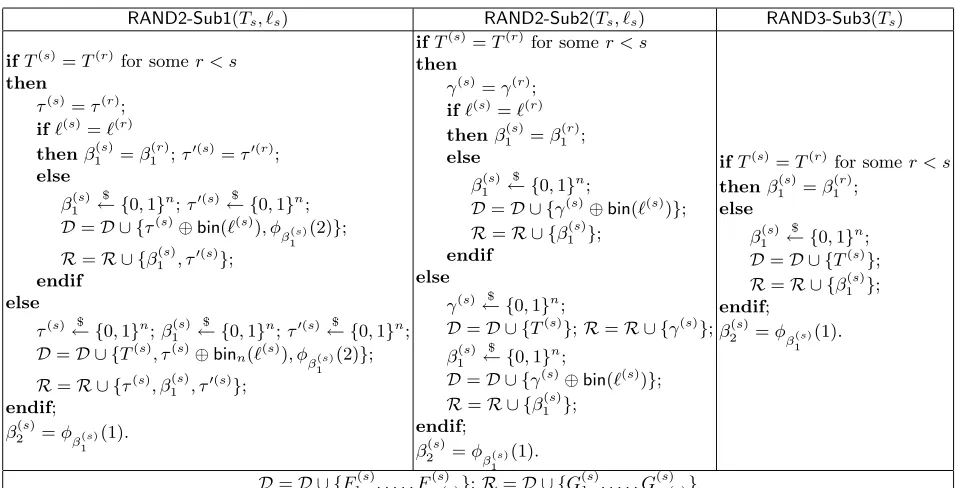
Table 5.Definition of the internal random variables in the key definition and the updation of the setsDandRfor thes-th query. Initially,D=R=∅. InRAND2-Sub1andRAND3-Sub3,τ is chosen uniformly at random at the start ofRAND2and does not change during the game.
RAND2-Sub1(Ts, ℓs) RAND2-Sub2(Ts, ℓs) RAND3-Sub3(Ts)
ifT(s)=T(r)for somer < s
then
τ(s)=τ(r);
ifℓ(s)=ℓ(r)
thenβ1(s)=β(1r);τ′(s)=τ′(r);
else
β1(s)← {$ 0,1}n;τ′(s) $← {0,1}n;
D=D ∪ {τ(s)⊕bin(ℓ(s)), φ
β(s) 1
(2)};
R=R ∪ {β1(s), τ′(s) };
endif else
τ(s) $
← {0,1}n;β(s) 1
$
← {0,1}n;τ′(s) $
← {0,1}n;
D=D ∪ {T(s), τ(s)⊕bin
n(ℓ(s)), φ β(s)
1 (2)};
R=R ∪ {τ(s), β(s) 1 , τ′
(s) };
endif;
β2(s)=φ
β(1s)(1).
ifT(s)=T(r) for somer < s
then
γ(s)=γ(r);
ifℓ(s)=ℓ(r)
thenβ1(s)=β1(r);
else
β1(s)← {$ 0,1}n;
D=D ∪ {γ(s)⊕bin(ℓ(s))}; R=R ∪ {β(1s)};
endif else
γ(s) $← {0,1}n;
D=D ∪ {T(s)
};R=R ∪ {γ(s) };
β1(s)← {$ 0,1}n;
D=D ∪ {γ(s)⊕bin(ℓ(s))}; R=R ∪ {β1(s)};
endif;
β2(s)=φ
β(s)
1 (1).
ifT(s)=T(r)for somer < s
thenβ1(s)=β1(r);
else
β(1s)← {$ 0,1}n;
D=D ∪ {T(s)}; R=R ∪ {β(1s)};
endif;
β(2s)=φ
β(s) 1
(1).
D=D ∪ {F1(s), . . . , F(s)
m(s)};R=D ∪ {G
(s) 1 , . . . , G
(s)
m(s)}
IfT(s)=T(r), thenJ(s)
0 =J
(r) 0 ,butJ
(s)
0 is not put inD. Similarly, forJ (s)
1 andJ
(s)
2 . Thus, there are
no trivial collisions inDand also similarly forR. The analysis of collisions of the type (Fi(s), Fj(r)) is non-trivial, the other types of collisions can be easily seen to hold with probability at most 1/2n.
First note that if (T(s), ℓ(s)) 6= (T(r), ℓ(r)), then β(s)
1 , τ′(s), β (r)
1 and τ′(r) are independent and
uniform randomn-bit strings from which it is possible to argue that Pr[Fi(s) =Fj(r)] = 1/2n. So we consider the situation when (T(s), ℓ(s)) = (T(r), ℓ(r)). In this case, we have τ(s) =τ(r) =
τ (say), β1(s) = β1(r) = β1 (say) and τ′(s) = τ′(r) = τ′ (say). Also, since (T(s), ℓ(s)) = (T(r), ℓ(r)),
ifty(s) =enc then (P1(s). . . , Pm(s()s)) 6= (P (r) 1 , . . . , P
(r)
m(r)); and if ty(s) =dec then (C (s) 1 , . . . , C
(s)
m(s)) 6=
(C1(r), . . . , Cm(r()r)). We consider different cases.
(F1(s), F1(r)), (F2(s), F2(r)): if at least one (say the s-th one) is a decrypt query, then using the randomness ofP2(s) it follows that Pr[F1(s) =F1(r)] = 1/2n. Suppose that both are encrypt queries. Since (P1(s). . . , Pm(s()s))6= (P
(r) 1 , . . . , P
(r)
m(r)), using Lemma 2, we have Pr[F (s)
1 =F
(r)
1 ] =ǫm−2+ 1/2n.
The collision analysis for the pair (F2(s), F2(r)) is similar.
(F1(s), F2(r)), (F2(s), F1(r)): Using Lemma 1, Pr[F1(s) =F2(r)] = Pr[F1(r)=F2(s)] = 1/2n−1.
(F1(s), Fi(r)), (F2(s), Fi(r)), i≥3: let X =P1(r)⊕P2(r)⊕C1(r)⊕C2(r) and note that Fi(r) =X⊕rest
and F1(s) =A(2s)⊕hτ(A1(s)) where X is independent of both rest and F1(s). Irrespective of whether the r-th query is an encryption or a decryption query, we have X to be a uniformly distributed random variable and so Pr[F1(s)=Fi(r)] = 1/2n. Similarly for the pair (F(s)
2 , F
(r)
(Fi(s), Fj(r)) with 3≤i, j≤m: in this case, M(s) and M(r) are independent and uniform random quantities so that Pr[Fi(s) =Fj(r)] = 1/2n.
To summarize, if (T(s), ℓ(s)) = (T(r), ℓ(r)) then the collision probability of pairs of the type
(F1(s), F1(r)), (F2(s), F2(r)) is at mostǫm−2+ 1/2n; collision probability of pairs of the type (F1(s), F (r) 2 ),
(F2(s), F1(r)) is at most 1/2n−1; and for all other possible pairs in D, the collision probability is at
most 1/2n. Suppose that there are qi queries havingmi blocks, 1≤i≤t, where q =q
1+· · ·+qt
and the number of elements inDis at most Pti=1qi(mi+ 2) =σ+q whereσ=Pti=1qi(mi+ 1). The number of pairs of the type (F1(s), F1(r)), (F2(s), F2(r)) in D is at most Pti=1qi(qi−1); and the number of pairs of the type (F1(s), F2(r)), (F2(s), F1(r)) is also Pti=1qi(qi −1). So, the maximum probability of a collision inD is
t X
i=1
i 1
2nǫmi−2
qi(qi−1) + 1 2n−1
t X
i=1
qi(qi−1) + 1 2n
σ+q 2
!
≤ 7σ
2
2n .
In the above we have assumed that ǫm ≤ 2m/2n so that ǫmi−2 + 1/2
n < 2mi/2n. This
corre-sponds to the bound forBRW polynomials which is weaker than the bound forPoly(ǫm≤m/2n). Consequently, the constant 7 holds for both hash functions.
A similar analysis for the random variables inRshows that the probability of Coll(R), i.e., the probability of a collision inRis also upper bounded by 7σ2/2n. So, the probability ofColl, i.e., the
probability of a collision in eitherDorR is at most 14σ2/2n. ⊓⊔
Note. The constant 14 can be reduced by a more careful analysis of the inequalities. Since 14 itself is a small enough constant we did not perform this analysis.
References
1. Daniel J. Bernstein. Polynomial evaluation and message authentication, 2007. http://cr.yp.to/papers.html# pema.
2. Debrup Chakraborty and Palash Sarkar. HCH: A new tweakable enciphering scheme using the hash-counter-hash approach. IEEE Transactions on Information Theory, 54(4):1683–1699, 2008.
3. Shai Halevi. EME*: Extending EME to handle arbitrary-length messages with associated data. In Anne Canteaut and Kapalee Viswanathan, editors,INDOCRYPT, volume 3348 ofLecture Notes in Computer Science, pages 315– 327. Springer, 2004.
4. Shai Halevi. Invertible universal hashing and the TET encryption mode. In Alfred Menezes, editor, CRYPTO, volume 4622 ofLecture Notes in Computer Science, pages 412–429. Springer, 2007.
5. Shai Halevi and Phillip Rogaway. A tweakable enciphering mode. In Dan Boneh, editor,CRYPTO, volume 2729 ofLecture Notes in Computer Science, pages 482–499. Springer, 2003.
6. Shai Halevi and Phillip Rogaway. A parallelizable enciphering mode. In Tatsuaki Okamoto, editor, CT-RSA, volume 2964 ofLecture Notes in Computer Science, pages 292–304. Springer, 2004.
7. Tetsu Iwata and Kaoru Kurosawa. How to construct super-pseudorandom permutations with short keys. IEICE Transactions, 90-A(1):2–13, 2007.
8. Moses Liskov, Ronald L. Rivest, and David Wagner. Tweakable block ciphers. In Moti Yung, editor,CRYPTO, volume 2442 ofLecture Notes in Computer Science, pages 31–46. Springer, 2002.
9. Michael Luby and Charles Rackoff. How to construct pseudorandom permutations from pseudorandom functions.
SIAM J. Comput., 17(2):373–386, 1988.
10. Stefan Lucks. Faster Luby-Rackoff ciphers. In Dieter Gollmann, editor,FSE, volume 1039 ofLecture Notes in Computer Science, pages 189–203. Springer, 1996.
11. David A. McGrew and Scott R. Fluhrer. The extended codebook (XCB) mode of operation. Cryptology ePrint Archive, Report 2004/278, 2004. http://eprint.iacr.org/.
12. David A. McGrew and Scott R. Fluhrer. The security of the extended codebook (XCB) mode of operation. In
13. Moni Naor and Omer Reingold. A pseudo-random encryption mode. Manuscript available fromwww.wisdom. weizmann.ac.il/~naor.
14. Moni Naor and Omer Reingold. On the construction of pseudorandom permutations: Luby-Rackoff revisited.J. Cryptology, 12(1):29–66, 1999.
15. Jacques Patarin. How to construct pseudorandom and super pseudorandom permutations from one single pseu-dorandom function. InEUROCRYPT, pages 256–266, 1992.
16. Sarvar Patel, Zulfikar Ramzan, and Ganapathy S. Sundaram. Luby-Rackoff ciphers: Why XOR is not so exclusive. In Kaisa Nyberg and Howard M. Heys, editors,Selected Areas in Cryptography, volume 2595 ofLecture Notes in Computer Science, pages 271–290. Springer, 2002.
17. Michael O. Rabin and Shmuel Winograd. Fast evaluation of polynomials by rational preparation.Communications on Pure and Applied Mathematics, 25:433–458, 1972.
18. Palash Sarkar. Efficient tweakable enciphering schemes from (block-wise) universal hash functions). IEEE Transactions on Information Theory. to appear.
19. Palash Sarkar. A general mixing strategy for the ECB-Mix-ECB mode of operation. Inf. Process. Lett., 109(2):121–123, 2008.
20. Palash Sarkar. A new universal hash function and other cryptographic algorithms suitable for resource constrained devices. Cryptology ePrint Archive, Report 2008/216, 2008. http://eprint.iacr.org/.