Bonsai Trees, or How to Delegate a Lattice Basis
David Cash∗ Dennis Hofheinz† Eike Kiltz‡ Chris Peikert§ June 14, 2011
Abstract
We introduce a newlattice-basedcryptographic structure called abonsai tree, and use it to resolve some important open problems in the area. Applications of bonsai trees include:
• An efficient, stateless ‘hash-and-sign’ signature scheme in thestandard model(i.e., no random oracles), and
• The firsthierarchicalidentity-based encryption (HIBE) scheme (also in the standard model) that does not rely on bilinear pairings.
Interestingly, the abstract properties of bonsai trees seem to have no known realization in conventional number-theoretic cryptography.
1
Introduction
Lattice-based cryptographic schemes have undergone rapid development in recent years, and are attractive due to their low asymptotic complexity and potential resistance to quantum-computing attacks. One notable recent work in this area is due to Gentry, Peikert, and Vaikuntanathan [GPV08], who constructed an efficient ‘hash-and-sign’ signature scheme and an identity-based encryption (IBE) scheme. (IBE is a powerful cryptographic primitive in whichany stringcan serve as a public key [Sha84].)
Abstractly, the GPV schemes are structurally quite similar to Rabin/Rabin-Williams signatures [Rab79] (based on integer factorization) and the Cocks/Boneh-Gentry-Hamburg IBEs [Coc01, BGH07] (based on the quadratic residuosity problem), in that they all employ a so-called “preimage sampleable” trapdoor function as a basic primitive. As a result, they have so far required the random oracle model (or similar heuristics) for their security analysis. This is both a theoretical drawback and also a practical concern (see, e.g., [LN09]), so avoiding such heuristics is an important goal.
∗
University of California, San Diego. Email:[email protected]. Part of this work was performed while at Georgia Institute of Technology.
†
Karlsruhe Institute of Technology. Email: [email protected]. Part of work performed while at CWI and supported by an NWO Veni grant.
‡
Cryptology & Information Security Group, CWI, Amsterdam, The Netherlands. Email:[email protected]. Supported by the research program Sentinels.
§
Another intriguing open question is whether any of these IBE schemes can be extended to deliver richer levels of functionality, as has been done in pairing-based cryptography since the work of Boneh and Franklin [BF01]. For example, the more general notion ofhierarchicalIBE [HL02, GS02] permits multiple levels of secret-key authorities. This notion is more appropriate than standard IBE for large organizations, can isolate damage in the case of secret-key exposure, and has further applications such as forward-secure encryption [CHK03] and broadcast encryption [DF02, YFDL04].
1.1 Our Results
We put forward a new cryptographic notion called abonsai tree, and give a realization based on hard lattice problems. (Section 1.2 gives an intuitive overview of bonsai trees, and Section 1.4 discusses their relation to other primitives and techniques.) We then show that bonsai trees resolve some central open questions in lattice-based cryptography: to summarize, they remove the need for random oracles in many important applications, and facilitate delegation for purposes such as hierarchical IBE.
Our first application of bonsai trees is an efficient, stateless signature scheme that is secure in thestandard model (no random oracles) under conventional lattice assumptions. Our scheme has a ‘hash-and-sign’ flavor that does not use the key-refresh/authentication-tree paradigm of many prior constructions (both generic [GMR84, NY89] and specialized to lattice assumptions [LM08]), and in particular it does not require the signer to keep any state. (Statelessness is a crucial property in many real-world scenarios, where distinct systems may sign relative to the same public key.) In our scheme, the verification key, signature length, and verification time are all anO(k) factor larger than in the random-oracle scheme of [GPV08], where kis the output length of achameleonhash function, and theO(·)notation hides only a1or2factor. The signing algorithm is essentially as efficient as the one from [GPV08].1The underlying hard problem is the standardshort integer solution(SIS) problem dating back to the seminal work of Ajtai [Ajt96], which is known to be as hard as several worst-case approximation problems on lattices (see also [MR04, GPV08]). Via
SIS, the security of our signature scheme rests upon the hardness of approximating worst-case problems on n-dimensional lattices to within anO˜(√k·n3/2)factor; this is only a√kfactor looser than that of [GPV08].
Our second application is a collection of varioushierarchicalidentity-based encryption (HIBE) schemes, which are the first HIBEs that do not rely on bilinear pairings. Our main scheme works in the standard model, also making it the first non-pairing-based IBE (hierarchical or not) that does not use random oracles or qualitatively similar heuristics. The underlying hard problem is the standardlearning with errors(LWE) problem as defined by Regev, which may be seen as the ‘dual’ ofSISand is also as hard as certain worst-case lattice problems [Reg05, Pei09b];LWEis also the foundation for the plain IBE of [GPV08], among many other recent cryptographic schemes.
Additionally, our HIBE is anonymous across all levels of the hierarchy, i.e., a ciphertext conceals (computationally) the identity to which is was encrypted. Anonymity is a useful property in many applications, such as fully private communication [BBDP01] and searching on encrypted data [BCOP04, ABC+05]. While there are a few anonymous (non-hierarchical) IBEs [BF01, CS07, BGH07, GPV08], only one other HIBE is known to be anonymous [BW06].
1.2 Overview of Bonsai Trees and Applications
The ancient art of bonsai is centered around atreeand the selectivecontrolthereof by an arborist, the tree’s cultivator and caretaker. By combining natural,undirectedgrowth withcontrolledpropagation techniques
1Our signing algorithm performs aboutk
such as wiring and pruning, arborists cultivate trees according to a variety of aesthetic forms.
Similarly, cryptographic bonsai is not so much a precise definition as a collection of principles and techniques, which can be employed in a variety of ways. (The informal description here is developed technically in Section 3.) The first principle is the tree itself, which in our setting is ahierarchy of trapdoor functionshaving certain properties. The arborist can be any of several entities in the system — e.g., the signer in a signature scheme or a simulator in a security proof — and it can exploit both kinds of growth, undirected and controlled. Briefly stated, undirectedgrowth of a branch means that the arborist has no privileged information about the associated function, whereas the arboristcontrolsa branch if it knows a trapdoor for the function. Moreover, control automatically extends down the hierarchy, i.e., knowing a trapdoor for a parent function implies knowing a trapdoor for any of its children.
In our concrete lattice-based instantiation, the functions in the tree are indexed by a hierarchy of public lattices chosen at random from a certain ‘hard’ family (i.e., one having a connection to worst-case problems). The lattices may be specified by a variety of means, e.g., a public key, interaction via a protocol, a random oracle, etc. Their key property is that they naturally form a hierarchy as follows: every lattice in the tree (excepting the root) is ahigher-dimensional superlatticeof its parent. Specifically, a parent lattice inRmis
simply the restriction of its child(ren) inRm 0
(wherem0 > m) to the firstmdimensions. As we shall see shortly, this hierarchical relationship means that a parent lattice naturally ‘subsumes’ its children (and more generally, all its descendants).
Undirectedgrowth in our realization is technically straightforward, emerging naturally from the underly-ing hard average-case lattice problems (SISandLWE). This growth is useful primarily for letting a simulator embed a challenge problem into one or more branches of the tree (but it may have other uses as well).
To explaincontrolled growth, we first need a small amount of technical background. As explored in prior works on lattice-based cryptography (e.g., [GGH97, HPS98, HHGP+03, GPV08, PVW08, Pei09b]), a lattice has a ‘master trapdoor’ in the form of ashort basis, i.e., a basis made up of relatively short lattice vectors. Knowledge of such a trapdoor makes it easy to solve a host of seemingly hard problems relative to the lattice, such as decoding within a bounded distance, or randomly sampling short lattice vectors. As described in [GPV08], these two operations are effectively the inversion algorithms for certain families of injective and ‘preimage sampleable’ trapdoor functions, respectively. The reader may view a short basis for a lattice as roughly analogous to the factorization of an RSA modulus, though we emphasize that there are in generalmany distinctshort bases that convey roughly ‘equal power’ with respect to the lattice.
In light of the above, we say that an arboristcontrolsa branch of a bonsai tree if it knows a short basis for the associated lattice. The hierarchy of lattices is specially designed so that any short basis of a parent lattice can be easilyextendedto a short basis of any higher-dimensional child lattice, with no loss in quality. This means that control of a branch implicitly comes with control over all its offshoots. In a typical application, the privileged entity in the system (e.g., the signer in a signature scheme) will know a short basis for the root lattice, thus giving it control over the entire tree. Other entities, such as an attacker, will generally have less power, though in some applications they might even be given control over entire subtrees.
controlled lattice onto anuncontrolledbranch.2
This whole collection of techniques, therefore, allows an arborist to achieve a primary bonsai aesthetic: a carefully controlled tree that nonetheless gives the appearance of having grown without any outside intervention. As we shall see next, bonsai techniques can reduce the construction of complex cryptographic schemes to the design of simplecombinatorialgames between an arborist and an adversary.
1.2.1 Application 1: Hash-and-Sign without Random Oracles
Our end goal is a signature scheme that meets thede factonotion of security, namely, existential unforgeability under adaptive chosen-message attack [GMR84]. By a standard, efficient transformation usingchameleon hashes[KR00] (which have efficient realizations under conventional lattice assumptions, as we show), it suffices to construct aweakly securescheme, namely, one that is existentially unforgeable under a static attack in which the adversary non-adaptively makes all its queries before seeing the public key.
Our weakly secure scheme signs messages of lengthk, the output length of the chameleon hash. The public key represents abinarybonsai treeTof depthkin a compact way, which we describe in a moment. The secret key is a short basis for the latticeΛεat the root of the tree, which gives the signer control over all
ofT. To sign a stringµ∈ {0,1}k(which is the chameleon hash of the ‘true’ messagem), the signer first
derives the latticeΛµfromT by walking the root-to-leaf path specified byµ. The signature is simply a short
nonzero vectorv∈Λµ, chosen at random from the ‘canonical’ Gaussian distribution, which can be sampled
efficiently using the signer’s control ofΛµ. A verifier can check the signaturevsimply by derivingΛµitself
from the public key, and checking thatvis a sufficiently short nonzero vector inΛµ.
The bonsai treeT is represented compactly by the public key in the following way. First, the root lattice
Λε is specified completely. Then, for each leveli= 0, . . . , k−1, the public key includes two blocks of
randomness that specify how a parent lattice at levelibranches into its two child lattices. We emphasize that all nodes at a given depth use thesametwo blocks of randomness to derive their children.
The proof of security is at heart a combinatorial game on the tree between the simulatorSand forgerF, which goes roughly as follows. The forger gives the simulator a setM ={µ1, . . . , µQ}of messages, andS
needs to cultivate a bonsai tree (represented bypk) so that it controls some set of subtrees thatcoverall of M, yet is unlikely to control the leaf for whatever arbitrary messageµ∗ 6∈M thatFeventually produces in its forgery. If the latter condition happens to hold true, then the forger has found a short nonzero vector in an uncontrolled lattice, in violation of the underlying assumption. (This combinatorial game is closely related to the recent “prefix technique” introduced by Hohenberger and Waters [HW09]; see Section 1.4 for discussion.)
To satisfy the conflicting constraints of the game,Scolors red all the edges on the root-to-leaf paths of the messages inM, and lets all the other edges implicitly be colored blue. The result is a forest of at most Q·kdistinct blue subtrees{B`}, each growing off of some red path by a single blue edge. The simulator
chooses one of these subtreesB`uniformly at random (without regard to its size), guessing that the eventual
forgery will lie inB`. It then cultivates a bonsai tree so that all the growth on the path up to and throughout
B` isundirected(by embedding its given challenge instance as usual), while all the remaining growth in
T\B`is controlled. This can be achieved by controlling one branch at each level leading up toB`(namely,
the branch growing off of the path toB`), and none thereafter.
2
1.2.2 Application 2: Hierarchical Identity-Based Encryption
Bonsai trees also provide a very natural and flexible approach for realizing HIBE. For simplicity, consider an authority hierarchy that is abinary tree, which suffices for forward-secure encryption and general HIBE itself [CHK03]. The master public key of the scheme describes a binary bonsai tree, which mirrors the authority hierarchy. The root authority starts out by controlling the entire tree, i.e., it knows a trapdoor short basis for the lattice at the root. Each authority is entitled to control its corresponding branch of the tree. Any entity in the hierarchy can delegate control over an offshoot branch to the corresponding sub-authority, simply by computing and revealing a short basis of the associated child lattice. In this framework, encryption and decryption algorithms based on theLWEproblem are standard.
For the security proof, the simulator again prepares a bonsai tree so that it controls certain branches (which should cover the adversary’s queries), while allowing the undirected growth of others (corresponding to the adversary’s target identity). This can be accomplished in a few ways, with different advantages and drawbacks in terms of the security notion achieved and the tightness of the reduction. One notion is security against aselective-identityattack, where the adversary must declare its target identity before seeing the public key, but may adaptively query secret keys afterward. In this model, the simulator can cultivate a bonsai tree whose growth toward the (known) target identity is undirected, while controlling each branch off of that path; this setup makes it easy for the simulator to answer any legal secret-key query.
A stronger notion is security against afully adaptiveattack (“full security”), where the adversary may choose its target identity after making its secret-key queries. (See Section 2.2 for a precise definition.) There are generic combinatorial techniques for converting selective-identity-secure (H)IBE schemes into fully secure ones; we show how to apply and optimize these techniques to our HIBE. First, we use the approach of Boneh and Boyen [BB04a] to construct a fully secure HIBE scheme in the random oracle model. The basic idea is to hash all identities; this way, the target identity can be dynamically embedded as the answer to a random oracle query. Secondly, we demonstrate that other tools of Boneh and Boyen [BB04b] can be adapted to our setting to yield a fully secure HIBE schemewithoutrandom oracles. This works by hashing identities to branches of a bonsai tree, where a probabilistic argument guarantees that any given identity hashes to a controlled branch with a certain probability. We can adjust this probability in the right way, so that with non-negligible probability, all queried identities hash to controlled branches, while the target identity hashes to an uncontrolled branch. In our probabilistic argument, we employadmissible hash functions (AHFs), as introduced by [BB04b]. However, as we will explain in Section 5.4.4, their original AHF definition and proof strategy do not take into consideration the statistical dependence of certain crucial events. We circumvent this with a different AHF definition and a different proof.
Based on the above description, the reader may still wonder whether secret-key delegation is actually secure, i.e., whether the real and simulated bases are drawn from the same probability distribution. In fact, they may not be! For example, under the most straightforward method of extending a basis, the child basis actually contains the parent basis as a submatrix, so it is clearly insecure to reveal the child. We solve this issue with an additional bonsai principle ofrandomizing control, using the Gaussian sampling algorithm of [GPV08]. This produces a new basis under a ‘canonical’ distribution, which ensures that the real system and simulation coincide. The randomization increases the length of the basis by a small factor — which accumulates geometrically with each delegation from parent to child — but for reasonable depths, the resulting bases are still short enough to be useful when all the parameters are set appropriately. (See Section 1.3 for more details.)
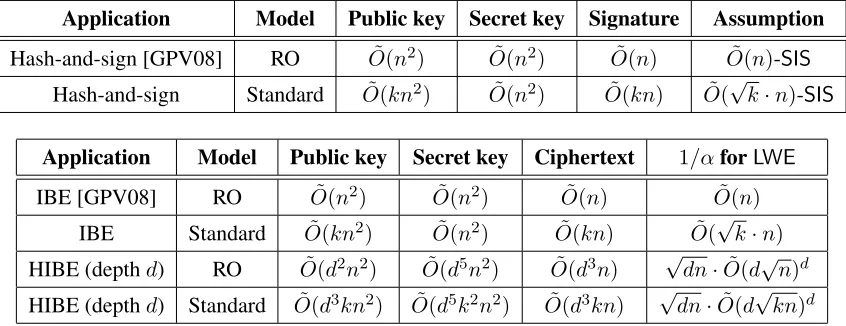
Application Model Public key Secret key Signature Assumption
Hash-and-sign [GPV08] RO O˜(n2) O˜(n2) O˜(n) O˜(n)-SIS
Hash-and-sign Standard O˜(kn2) O˜(n2) O˜(kn) O˜(√k·n)-SIS
Application Model Public key Secret key Ciphertext 1/αforLWE
IBE [GPV08] RO O˜(n2) O˜(n2) O˜(n) O˜(n)
IBE Standard O˜(kn2) O˜(n2) O˜(kn) O˜(√k·n)
HIBE (depthd) RO O˜(d2n2) O˜(d5n2) O˜(d3n) √dn·O˜(d√n)d
HIBE (depthd) Standard O˜(d3kn2) O˜(d5k2n2) O˜(d3kn) √dn·O˜(d√kn)d
Figure 1: Complexity of our bonsai tree applications in comparison with prior work;nis the main security parameter andkis the output length of a chameleon hash function (for the signature scheme) or collision-resistant hash function (for the IBEs). “RO” means random oracle model under fully adaptive attack, while “Standard” means standard model under selective-identity attack (standard-model schemes with adaptive security are omitted). “Public key,” “secret key,” etc. refer to their lengths in bits; for the HIBEs, these quantities are the maximum possible over all levels of the hierarchy. The column labelled “1/αforLWE” refers to the inverse error rate of the underlyingLWEproblem used in the proofs of security.
of exactly the same ‘type’ as those in the recent CCA-secure cryptosystem of [Pei09b], so we can simply plug that scheme into our bonsai tree/HIBE framework. Interestingly, the two approaches result in essentially identical schemes.
1.2.3 Variations
This paper focuses almost entirely on bonsai trees that are related, via worst- to average-case reductions, to generallattices. Probably the main drawback is that the resulting public and secret keys are rather large. For example, the public key in our signature scheme is larger by a factor ofk(the output length of a chameleon hash function) than that of its random-oracle analogue [GPV08], which is already at least quadratic in the security parameter. Fortunately, the principles of bonsai trees may be applied equally well using analogous hard problems and tools forcyclic/ideal lattices(developed in, e.g., [Mic02, PR06, LM06, PR07, SSTX09, LPR10]), with little to no essential changes to the proofs. This approach can ‘miniaturize’ the bonsai trees and most of their associated operations by about a linear factor in the security parameter. The resulting schemes are still not suitable for practice, but their asymptotic behavior is attractive.
1.3 Complexity and Open Problems
Here we discuss some additional quantitative details of our schemes, and describe some areas for further research.
Several important quantities in our bonsai tree constructions and applications depend upon the depth of the tree. The dimension of a lattice in the tree grows linearly with its depth, and the size of the trapdoor basis grows roughly quadratically with the dimension.
of the identity to which it is encrypted. Moreover, the Euclidean length of a user’s trapdoor basis increases geometricallywith its depth in the tree (more precisely, with the length of the delegation chain), due to the basis randomization that is performed with each delegation. To ensure correct decryption, the inverse noise parameter1/αin the associatedLWEproblem, and hence the approximation factor of the underlying worst-case lattice problems, must grow with the basis length. In particular, a hierarchy of depthdcorresponds (roughly) to annd/2approximation factor for worst-case lattice problems, wherenis the dimension. Because lattice problems are conjectured to be hard to approximate to within even subexponential factors, the scheme may remain asymptotically secure for depths as large asd=nc, wherec <1.
Our HIBE scheme that enjoys security under a fulladaptive-identityattack requires large keys and has a somewhat loose security reduction. In particular, the attack simulation partitions an (implicit) bonsai tree into controlled and undirected branches. This is done in the hope that all user secret key queries correspond to controlled branches (so the simulation can derive the corresponding secret key), and that the target identity refers to an undirected branch (so the attack can be converted into one on theLWEproblem). This simulation approach (dubbed ‘partitioning strategy’ in [Wat09]) involves, to a certain extent, guessing the adversary’s user secret key and challenge queries. The result is a rather loose security reduction.
In contrast, recent works have achieved tight reductions (and even small keys, in some cases) for pairing-based (H)IBEs under various assumptions [Gen06, GH09, Wat09], and a variant of the GPV IBE (in the random oracle model) also has a tight reduction, but their approaches do not seem to translate to our setting. The issue, essentially, is that our simulator is required to produce a ‘master trapdoor’ for each queried identity, which makes it difficult to embed the challenge problem into the adversary’s view. In prior systems with tight reductions, secret keys are less ‘powerful,’ so the simulator can embed a challenge while still knowing at least one secret key for every identity (even the targeted one).
A final very interesting (and challenging) question is whether bonsai trees can be instantiated based on other mathematical foundations, e.g., integer factorization. At a very fundamental level, our lattice-based construction seems to rely upon a kind of random self-reducibility that the factorization problem is not known to enjoy.
1.4 Related Techniques and Works
This paper represents a combination of two concurrent and independent works by the first three au-thors [CHK09] and the fourth author [Pei09a], which contained some overlapping results and were accepted to Eurocrypt 2010 under the condition that they be merged.
The abstract properties of bonsai trees, as hierarchies of trapdoor functions, appear to have no known real-ization in conventional number-theoretic cryptography. However, our applications use several combinatorial techniques that are similar to those from several prior works.
messages, and sets up the public key so that it always knows how to sign all of them (and potentially many others). This is done by constructing a forest of subtrees as described in Section 1.2.1.
The structure of our HIBE is also similar, at a combinatorial level, to that of prior pairing-based HIBEs, in that the simulator can ‘control’ certain edges of an implicit tree by choosing certain random exponents itself. However, there are notrapdoor functionsper se in pairing-based constructions; instead, the pairing is used to facilitate key agreement between the encrypter and decrypter. Our approach, therefore, may be seen as a blending of pairing-based techniques and the trapdoor techniques found in [Coc01, BGH07, GPV08].
Following the initial dissemination of our results in [CHK09, Pei09a], several extensions and additional applications have been found. R¨uckert [R¨uc10] modified our signature scheme to make itstronglyunforgeable, and constructed hierarchical identity-based signatures. Agrawal and Boyen [AB09] constructed a standard-model IBE based onLWE, which is secure under a selective-identity attack; their construction has structure similar to ours, but it does not address delegation, nor does it give an efficient signature scheme. Agrawal, Boneh, and Boyen [ABB10] improved the efficiency of our (H)IBE schemes (under a quantitatively stronger
LWEassumption), and Boyen [Boy10] used similar techniques to obtain shorter signatures (under a stronger
SISassumption).
2
Preliminaries
2.1 Notation
For a positive integerk,[k]denotes the set{1, . . . , k};[0]is the empty set. We denote the set of integers modulo an integerq ≥ 1byZq. For a stringx over some alphabet, |x|denotes the length of x. For an
alphabetXand nonnegative integern, defineX≤n=Sn
i=0Xi, andX<nsimilarly. We say that a function
innisnegligible, writtennegl(n), if it vanishes faster than the inverse of any polynomial inn. We say that a probabilityp(n)isoverwhelmingif1−p(n)is negligible.
The statistical distance between two distributions X and Y (or two random variables having those distributions), viewed as functions over a countable domainD, is defined asmaxA⊆D|X(A)− Y(A)|.
Column vectors are named by lower-case bold letters (e.g.,x) and matrices by upper-case bold letters (e.g.,X). We identify a matrixXwith the ordered set{xj}of its column vectors, and letXkX0denote the
(ordered) concatenation of the setsX,X0. For a setXof real vectors, we definekXk= maxjkxjk, where
k·kdenotes the Euclidean norm.
For any (ordered) set S = {s1, . . . ,sk} ⊂ Rm of linearly independent vectors, letSe = {se1, . . . ,sek} denote itsGram-Schmidt orthogonalization, defined iteratively as follows:se1=s1, and for eachi= 2, . . . , k, the vectorseiis the component ofsiorthogonal tospan(s1, . . . ,si−1). In matrix notation, there is a unique QR decompositionS= QRwhere the columns ofQ ∈Rm×kare orthonormal (i.e.,QtQ=I ∈
Rk×k)
andR ∈ Rk×kis right-triangular with positive diagonal entries; the Gram-Schmidt orthogonalization is
e
S=Q·diag(r1,1, . . . , rk,k). Clearly,kseik ≤ ksikfor alli.
2.2 Cryptographic Definitions
The main cryptographic security parameter through the paper isn, and all algorithms (including the adversary) are implicitly given the security parameternin unary.
adversaryAagainst a computational problemPROB(where again the meaning of advantage is part of the problem definition).
Chameleon hash functions. Chameleon hashing was introduced by Krawczyk and Rabin [KR00]. For our purposes, we need a slight generalization in the spirit of “preimage sampleable” (trapdoor) functions [GPV08].
A family of chameleon hash functions is a collectionH={hi :M × R → Y}of functionshi mapping
a messagem∈ Mand randomnessr∈ Rto a rangeY. The randomness spaceRis endowed with some efficiently sampleable distribution (which may not be uniform). A functionhi is efficiently computable
given its description, and the family has the property that for anym ∈ M, forhi ← Handr ← R, the
pair(hi, hi(m, r))is uniform over(H,Y)(up to negligible statistical distance). The chameleon property
is that a randomhi← Hmay be generated together with a trapdoort, such that for any outputy∈ Y and
messagem∈ M, it is possible (usingt) to efficiently sampler ∈ R(under theR’s distribution) conditioned on the requirement thathi(m, r) = y. Finally, the family has the standard collision-resistance property,
i.e., givenhi ← Hit should be hard for an adversary to find distinct(m, r),(m0, r0)∈ M × Rsuch that
hi(m, r) =hi(m0, r0).
In Section 4 we realize chameleon hash functions (in the above sense) using lattices, via bonsai techniques.
Signatures. A signature schemeSIGfor a message spaceMis a tuple of PPT algorithms as follows:
• Genoutputs a verification keyvkand a signing keysk.
• Sign(sk, µ), given a signing keyskand a messageµ∈ M, outputs a signatureσ∈ {0,1}∗.
• Ver(vk, µ, σ), given a verification keyvk, a messageµ, and a signatureσ, either accepts or rejects.
The correctness requirement is: for anyµ ∈ M, generate(vk, sk) ← Genand σ ← Sign(sk, µ). Then
Ver(vk, µ, σ)should accept with overwhelming probability (over all the randomness in the experiment). We recall two standard notions of security for signatures. The first, existential unforgeability understatic chosen-message attack, or eu-scma security, is defined as follows: first, the forgerF outputs a list of query messagesµ1, . . . , µQ for someQ. Next,(vk, sk) ← Genandσi ← Sign(sk, µi) are generated for each
i∈[Q], thenvkandσi (for eachi∈[Q]) are given toF. Finally,F outputs an attempted forgery(µ∗, σ∗).
The advantageAeu-scma
SIG (F)ofF is the probability thatVer(vk, µ
∗, σ∗)accepts andµ∗ 6=µ
ifor alli∈[Q],
taken over all the randomness of the experiment.
Another notion, called existential unforgeability under adaptivechosen-message attack, or eu-acma security, is defined similarly, except thatFis first givenvkand may adaptively choose the messagesµi.
Using a family of chameleon hash functions (as defined above), there is a generic construction of eu-acma-secure signatures from eu-scma-eu-acma-secure signatures; see, e.g., [KR00]. Furthermore, the construction results in anonline/offlinesignature scheme; see [ST01]. The basic idea behind the construction is that the signer chameleon hashes the message to be signed, then signs the hashed message using the eu-scma-secure scheme (and includes the randomness used in the chameleon hash with the final signature).
Key-Encapsulation Mechanism (KEM). We present all of our encryption schemes in the framework of key encapsulation, which simplifies the definitions and leads to more modular constructions. AKEMfor keys of length`=`(n)is a triple of PPT algorithms as follows:
• Encaps(pk)outputs a keyκ∈ {0,1}`and its encapsulation asσ∈ {0,1}∗.
• Decaps(sk, σ)outputs a keyκ.
The correctness requirement is: for(pk, sk)←Genand(κ, σ)←Encaps(pk),Decaps(sk, σ)should output κwith all butnegl(n)probability.
In this work we are mainly concerned with indistinguishability under chosen-plaintext attack, or ind-cpa security. The attack is defined as follows: generate(pk, sk) ← Gen,(κ∗, σ∗) ← Encaps(pk), andκ0 ← {0,1}` (chosen uniformly and independently of the other values). The advantage Advind-cpa
KEM (A) of an
adversaryAis its distinguishing advantage between(pk, σ∗, κ∗)and(pk, σ∗, κ0).
Hierarchical Identity-Based Encryption (HIBE). In HIBE, identities are strings (tuples) over some alphabetID. Hence hierarchical identities of maximal depthd∈Nare of the formID≤d=Sdi=0IDi. A
HIBE for keys of bit length`=`(n)is a tuple of PPT algorithms as follows:
• Setup(1d)outputs a master public keympkand root-level secret keyskε. Heredis the maximal depth
of the hierarchy, specified in unary. (In the following,dandmpkare implicit parameters to every algorithm, and every user secret keyskidis assumed to includeiditself.)
• Extract(skid, id0), given a user secret key for identityid∈ ID<d =
Sd−1
i=0 IDi that is a proper prefix
ofid0 ∈ ID≤d, outputs a user secret keysk
id0 for identityid0.
• Encaps(id)outputs a keyκ∈ {0,1}`and its encapsulation asσ ∈ {0,1}∗, to identityid.
• Decaps(skid, σ)outputs a keyκ.
The correctness requirement is: for any identityid∈ ID≤d, first generate(mpk, skε)←Setup(1d), then
generateskidvia any legal sequence of calls toExtractstarting fromskε, then generate(κ, σ)←Encaps(id).
Then Decaps(skid, σ) should output κ with overwhelming probability (over all the randomness in the
experiment).
There are several attack notions for HIBE. One simple notion in indistinguishability under a chosen-plaintext,selective-identityattack, or sid-ind-cpa security. The attack is defined as follows: first, the adversary A is given 1d and names a target identity id∗ ∈ ID≤d. Next, (mpk, skε) ← Setup(1d), (κ, σ∗) ←
Encaps(id∗), and κ0 ← {0,1}` are generated. Then Ais given (mpk, κ∗, σ∗), where κ∗ is eitherκ or κ0. Finally,Amay make extraction queries, i.e., it is given oracle access toExtract(skε,·), subject to the
constraint that it may not query any identity that is a prefix of (or equal to) the target identityid∗. The adversary’s advantageAdvsid-ind-cpaHIBE (A)is its distinguishing advantage between the two casesκ∗=κand κ∗ =κ0.
A related notion is security against anadaptive-identityattack, known as aid-ind-cpa or “full” security. Here the adversary is first givenmpkand has oracle access toExtract(skε,·)both before and after choosing
its target identityid∗; as above, the adversary may never query any identity that is a prefix of theid∗ it eventually names. Finally, both of the above notions may be extended tochosen-ciphertextattacks in the natural way; since our focus is on chosen-plaintext security, we omit precise definitions.
2.3 Lattices
In this work, we usem-dimensionalfull-rank integerlattices, which are discrete additive subgroups ofZm
the set of all integer linear combinations ofmlinearly independentbasisvectorsB={b1, . . . ,bm} ⊂Zm:
Λ =L(B) =
Bc=X
i∈[m]cibi : c∈Z m
.
Whenm≥2, there are infinitely many bases that generate the same lattice. Every latticeΛ⊆Zmhas auniquecanonical basisH= HNF(Λ)∈
Zm×mcalled itsHermite normal
form(HNF). The only facts about the HNF that we require are that it is unique, and that it may be computed efficiently given an arbitrary basisBof the lattice (see [MW01] and references therein). We writeHNF(B)
to denote the Hermite normal form of the lattice generated by basisB. The following lemma will be useful in our constructions.
Lemma 2.1([MG02, Lemma 7.1, page 129]). There is a deterministic poly-time algorithmToBasis(S,B)
that, given a full-rank set (not necessarily a basis)Sof lattice vectors inΛ =L(B), outputs a basisTofΛ
such thatkteik ≤ kseikfor alli.
2.3.1 Hard Lattices and Problems
We will work with an certain family of integer lattices whose importance in cryptography was first demon-strated by Ajtai [Ajt96]. Letn≥1and modulusq ≥2be integers; the dimensionnis the main cryptographic security parameter throughout this work, and all other parameters are implicitly functions of n. An m-dimensional lattice from the family is specified relative to the additive groupZnq by aparity check(more
accurately, “arity check”) matrixA∈Znq×m. The associated lattice is defined as
Λ⊥(A) =
x∈Zm:Ax=
X
j∈[m]xj·aj =0∈Z n q
⊆Zm.
One may check thatΛ⊥(A)containsqZm (and in particular, the identity0 ∈ Zm) and is closed under
addition, hence it is a full-rank subgroup of (and lattice in)Zm. For anyyin the subgroup ofZnq generated
by the columns ofA, we also define the coset
Λ⊥y(A) ={x∈Zm :Ax=y}= Λ⊥(A) + ¯x,
wherex¯ ∈Zmis an arbitrary solution toAx¯ =y.
It is known (see, e.g., [Reg05, Claim 5.3]) that for any fixed constantC >1and anym≥Cnlgq, the columns of a uniformly randomA∈Zn×m
q generate all ofZnq, except with2−Ω(n)= negl(n)probability.
(Moreover, the subgroup generated byAcan be computed efficiently.) Therefore, throughout the paper we sometimes implicitly assume that such a uniformAgeneratesZnq.
We recall theshort integer solution(SIS) andlearning with errors(LWE) problems, which may be seen as average-case problems related to the family of lattices described above.
Definition 2.2(Short Integer Solution). An instance of theSISq,βproblem (in the`2norm) is a uniformly
random matrixA∈Zn×m
q for any desiredm= poly(n). The goal is to find anonzerointeger vectorv∈Zm
such thatkvk2 ≤βandAv=0∈Znq, i.e.,v∈Λ⊥(A).
Let χbe some distribution overZq. For a vectorv ∈ Z`q of any dimension` ≥ 1,Noisyχ(v) ∈ Z`q
denotes the vector obtained by adding (moduloq) independent samples drawn fromχto each entry ofv
vectora∈Zn
q uniformly at random and outputting(a,Noisyχ(ha,si)). In this work (and most others relating
toLWE),χis always a discretized normal error distribution parameterized by someα ∈ (0,1), which is obtained by drawingx ∈ Rfrom the Gaussian distribution of widthα(i.e., xis chosen with probability
proportional toexp(−πx2/α2)) and outputtingbq·xemodq.
Definition 2.3(Learning with Errors). TheLWEq,χproblem is to distinguish, given oracle access to any
desiredm= poly(n)samples, between the distributionAs,χ(for uniformly random and secrets∈Znq) and
the uniform distribution overZnq ×Zq.
We writeAdvSISq,β(A)andAdvLWEq,χ(A)to denote the success probability and distinguishing
advan-tage of an algorithmAfor theSISandLWEproblems, respectively.
For appropriate parameters, solvingSISandLWE(on the average, with non-negligible advantage) is known to be as hard as approximating certain lattice problems, such as the (decision) shortest vector problem, in the worst case. Specifically, forq ≥ β ·ω(√nlogn), solvingSISq,β yields approximation factors of
˜
O(β·√n)[MR04, GPV08]. Forq ≥(1/α)·ω(√nlogn), solvingLWEq,χyields approximation factors of
˜
O(n/α)(in some cases, via a quantum reduction); see [Reg05, Pei09b] for precise statements.
2.3.2 Gaussians over Lattices
We briefly recall Gaussian distributions over lattices, specialized to the family described above; for more details see [MR04, GPV08]. For anys >0and dimensionm≥1, the Gaussian functionρs:Rm →(0,1]
is defined asρs(x) = exp(−πkxk2/s2). For any cosetΛ⊥y(A), thediscrete Gaussian distributionDΛ⊥ y(A),s
(centered at zero) over the coset assigns probability proportional toρs(x)to eachx∈Λ⊥y(A), and probability zero elsewhere.
We summarize several facts from the literature about discrete Gaussians over lattices, again specialized to our family of interest.
Lemma 2.4. LetSbe any basis ofΛ⊥(A)for someA∈Zqn×mwhose columns generateZnq, lety∈Znq be
arbitrary, and lets≥ keSk ·ω(√logn).
1. [MR04, Lemma 4.4]:Prx←DΛ⊥ y(A),s
[kxk> s·√m]≤negl(n).
2. [PR06, Lemma 2.11]: Prx←DΛ⊥(A),s[x=0]≤negl(n).
3. [Reg05, Corollary 3.16]: a set of O(m2) independent samples fromDΛ⊥(A),s contains a set of m
linearly independent vectors, except withnegl(n)probability.
4. [GPV08, Theorem 3.1]: Forx←DZm,s, the marginal distribution ofy=Ax∈Znq is uniform (up to
negl(n)statistical distance), and the conditional distribution ofxgivenyisDΛ⊥ y(A),s.
5. [GPV08, Theorem 4.1]: there is a PPT algorithmSampleD(S,A,y, s)that generates a sample from DΛ⊥
y(A),s(up tonegl(n)statistical distance).
For Item 5 above, a recent work of Peikert [Pei10] gives an alternativeSampleDalgorithm that is more efficient and fully parallelizable; it works for anys≥σ1(S)·ω(
√
logn), whereσ1(S)is the largest singular
3
Principles of Bonsai Trees
In this section we lay out the framework and main techniques for the cultivation of bonsai trees. There are four basic principles: undirected growth, controlled growth, extending control over arbitrary new growth, and randomizing control.
3.1 Undirected Growth
Undirected growth is useful primarily for allowing a simulator to embed an underlying challenge problem (i.e.,
SISorLWE) into a tree. This is done simply by drawing fresh uniformly random and independent samples
ai ∈Znq from the problem distribution, and grouping them into (or appending them onto) a parity-check
matrixA.
More formally, let A ∈ Zn×m
q be arbitrary for somem ≥ 0, and letA0 = AkA¯ ∈ Zn×m 0
q for some
m0 > mbe an arbitrary extension ofA. Then it is easy to see thatΛ⊥(A0)⊆Zm0
is ahigher-dimensional superlatticeofΛ⊥(A)⊆Zm, when the latter is lifted toZm
0
. Specifically, for anyv∈Λ⊥(A), the vector
v0=vk0∈Zm0 is inΛ⊥(A0)becauseA0v0 =Av=0∈
Znq.
In addition, the columns ofA0may be ordered arbitrarily (e.g., the columns ofA¯ may be both appended and prepended toA), which simply results in the entries of the vectors inΛ⊥(A0)being permuted in the corresponding manner. That is,
Λ⊥(A0·P) =P·Λ⊥(A0)
for any permutation matrixP∈ {0,1}m0×m0, because(A0P)x=A0(Px)∈
Znq for allx=Zm 0
.
3.2 Controlled Growth
We say that an arboristcontrolsa lattice if it knows a relatively good (i.e., short) basis for the lattice. The following lemma says that a random lattice from our family of interest can be generated under control.3 Proposition 3.1([AP09]). There is a fixed constantC >1and a probabilistic polynomial-time algorithm
GenBasis(1n,1m, q)that, forpoly(n)-boundedm≥Cnlgq, outputsA∈Znq×mandS∈Zm×msuch that:
• the distribution ofAis withinnegl(n)statistical distance of uniform,
• Sis a basis ofΛ⊥(A), and
• keSk ≤Le=O( √
nlogq).
3.3 Extending Control
Here we describe how an arborist may extend its control of a lattice to an arbitrary higher-dimensional extension, without any loss of quality in the resulting basis.
Lemma 3.2. There is a deterministic polynomial-time algorithmExtBasiswith the following properties: given an arbitraryA∈Zn×m
q whose columns generate the entire groupZnq, an arbitrary basisS∈Zm×m
ofΛ⊥(A), and an arbitraryA¯ ∈Zn×m¯
q ,ExtBasis(S,A0 =AkA¯)outputs a basisS0 ofΛ⊥(A0)⊆Zm+ ¯m
3
An earlier version of this paper [Pei09a] used a core lemma from [AP09] to directly extend a given random parity-check matrixA(withoutknown good basis) into a random matrixA0=AkA¯ withknown good basis. While using that method can
such thatkSe0k=keSk. Moreover, the same holds even for any given permutation of the columns ofA0(e.g., if columns ofA¯ are both appended and prepended toA).
Proof. Letm0 =m+ ¯m. TheExtBasis(S,A0)algorithm computes and outputs anS0 of the form
S0 =
S W 0 I
∈Zm
0×m0
,
whereI∈Zm¯×m¯ is the identity matrix, andW ∈
Zm×m¯ is an arbitrary (not necessarily short) solution to
AW=−A¯ ∈Zn×m¯
q . Note thatWexists by the hypothesis thatAgeneratesZnq, and it may be computed
efficiently using, e.g., Gaussian elimination. We now analyzeS0. First,
A0S0=ASk(AW+ ¯A) =0∈Zn×m0 q
by assumption onSand by construction ofW, soS0 ⊂Λ⊥(A0). Moreover,S0is in fact abasisofΛ⊥(A0): letv0=vkv¯ ∈Λ⊥(A0)be arbitrary, wherev∈Zmandv¯ ∈
Zm¯. Then
0=A0v0=Av+ ¯Av¯ =Av−(AW)¯v=A(v−Wv¯)∈Znq.
Thusv−Wv¯ ∈Λ⊥(A), so by assumption onSthere exists somez∈Zmsuch thatSz=v−Wv¯. Now
letz0 =zkv¯ ∈Zm+ ¯m. By construction, we have
S0z0 = (Sz+Wv¯)kv¯=vkv¯ =v0.
Becausev0 ∈Λ⊥(A0)was arbitrary,S0is therefore a basis ofΛ⊥(A0).
We next confirm thatkSe0k=keSk. By the design ofS0and the definition of Gram-Schmidt orthogonal-ization, it is easy to check that
e
S0 =
e
S 0 0 I
,
becauseSis full-rank. It follows thatkSe0k= max{keSk,1}=keSk, becausese1 =s1∈Zmis nonzero. For the final part of the lemma, we simply computeS0 forA0 =AkA¯ as described above, and output
S00 =PS0 as a basis forΛ⊥(A0·P), wherePis the given permutation matrix. The Gram-Schmidt lengths remain unchanged, i.e.,kse00ik=kse0ik, becausePis orthogonal and hence the right-triangular matrices in the QR decompositions ofS0andPS0are exactly the same.
3.3.1 An Optimization: Gaussian Sampling via Implicit Extension
In many of our cryptographic applications, a common design pattern is to extend a basisSof anm-dimensional latticeΛ⊥(A)to a basisS0 of a dimension-m0superlatticeΛ⊥(A0), and then immediately sample (one or more times) from a discrete Gaussian over the superlattice. For the construction and analysis of our schemes, it is more convenient and modular to treat these operations separately; however, a naive implementation would be rather inefficient, requiring at least(m0)2 space and time (wherem0 can be substantially larger thanm). Fortunately, the special structure of the extended basisS0, together with the recursive “nearest-plane” operation of theSampleDalgorithm from [GPV08], can be exploited to avoid anyexplicitcomputation ofS0, thus saving a significant amount of time and space over the naive approach.
LetS ∈ Zm×mbe a basis ofΛ⊥(A), and letA0 = AkA¯ for someA¯ ∈Znq×m¯, wherem0 =m+ ¯m.
Consider a hypothetical execution of SampleD(S0,y0, s), where S0 = S W 0 I
described in the proof of Lemma 3.2, andSe0 = eS 0 0 I
. By inspection, it can be verified that a recursive execution ofv0 ←SampleD(S0,y0, s)simply chooses all the entries ofv¯ ∈Zm¯ independentlyfromD
Z,s,
then choosesv←SampleD(S,y0−A¯v¯, s), and outputsv0 =vkv¯. Therefore, the optimized algorithm can perform exactly the same steps, thus avoiding any need to compute and storeWitself. A similar optimization also works for any permutation of the columns ofA0.
In the language of the “preimage sampleable” function fA0(v0) := A0v0 ∈ Znq defined in [GPV08],
the process described above corresponds to sampling a preimage fromfA−01(y0)by first computingy¯ =
fA¯(¯v) = ¯Av¯ ∈Znq in the “forward” direction (for randomv¯←DZm¯,s), then choosing a random preimage
v←fA−1(y0−y¯)under the appropriate Gaussian distribution, and outputtingv0 =vkv¯.4
3.4 Randomizing Control
Finally, we show how an arborist can randomize its lattice basis, with a slight loss in quality. This operation is useful for securely delegating control to another entity, because the resulting basis is still short, but is (essentially) statistically independent of the original basis.
The probabilistic polynomial-time algorithmRandBasis(S, s)takes a basisSof anm-dimensional integer latticeΛand a parameters≥ keSk ·ω(√logn), and outputs a basisS0ofΛ, generated as follows.
1. Leti←0. Whilei < m,
(a) Choosev ← SampleD(S, s). Ifvis linearly independent of{v1, . . . ,vi}, then leti← i+ 1
and letvi =v.
2. OutputS0 =ToBasis(V,HNF(S)).
In the final step, the (unique) Hermite normal form basisHNF(S)ofΛis used to ensure that no information particular toSis leaked by the output; any other publicly available (or efficiently computable) basis of the lattice could also be used in its place.
Lemma 3.3. With overwhelming probability,S0←RandBasis(S, s)repeats Step 1a at mostO(m2)times, andkS0k ≤s·√m. Moreover, for any two basesS0,S1of the same lattice and anys≥max{kfS0k,kfS1k} ·
ω(√logn), the outputs ofRandBasis(S0, s)andRandBasis(S1, s)are withinnegl(n)statistical distance.
Proof. The bound onkS0kand on the number of iterations follow immediately from Lemma 2.4, items 1 and 3, respectively. The claim on the statistical distance follows from the fact that each samplevdrawn in Step 1a has the same distribution (up tonegl(n)statistical distance) whetherS0orS1is used, and the fact
thatHNF(S0) = HNF(S1)because the Hermite normal form of a lattice is unique.
4
Signatures
Here we use bonsai tree principles to construct a signature scheme that is existentially unforgeable under astaticchosen-message attack (i.e., eu-scma-secure). As discussed in Section 2.2, to convert this into an (offline / online) signature scheme that is unforgeable under adaptive chosen-message attack (eu-acma-secure), we need a suitable notion of chameleon hash, which we also construct here.
4
4.1 Chameleon Hash
Letn≥1,q≥2be integers, letm=O(nlogq)andLebe as in Proposition 3.1, lets=Le·ω( √
logn)be a Gaussian parameter, and letk≥1be an integer message length. Define a message spaceM={0,1}k,
randomness spaceR={r∈Zm:krk ≤s·√m}with distributionD
Zm,s(restricted toR, which by Item 1
of Lemma 2.4 changes the distribution by onlynegl(n)statistical distance), and rangeY =Znq.
ForA0 ∈Znq×k,A1 ∈Zqn×m andA=A0kA1, define the hash functionhA:M × R → Y as
hA(m;r) =A·(mkr) =A0m+A1r.
Lemma 4.1. The familyH={hA}(under the uniform distribution overH) is a family of chameleon hash functions, assuming thatSISq,β is hard forβ =
√
k+ 4s2·m.
Proof. It is easy to verify that all of the required properties described in Section 2.2 hold. First, eachhAis efficiently computable givenA, and for everym∈ M, the distribution of(A, hA(m;r))forr←DZm,sis
withinnegl(n)statistical distance of uniform overH × Yby Item 4 of Lemma 2.4.
For the trapdoor property, a uniformly random (up tonegl(n)statistical distance) instancehA=A0kA1
may be selected by choosingA0 at random, and generating(A1,S) ← GenBasis(1n,1m, q), whereSis
a basis ofΛ⊥(A1)andkeSk ≤ L, as described in Proposition 3.1. Then for anye y∈ Znq andm∈ M, by Item 5 of Lemma 2.4 one can use the basisSto efficiently sample randomnessrfrom (a distribution within
negl(n)statistical distance of)DΛ⊥
u(A1),s, whereu=y−A0m∈Z n
q. By Item 4 of Lemma 2.4, this is the
distribution ofr∈ Rconditioned onhA(m;r) =y.
Finally, for the collision-resistance property, note that any collisionmkr6=m0kr0∈ M × RforhA(for uniformly randomA) immediately yields a solutionz= (m−m0)k(r−r0)6=0to the instanceAofSISq,β,
because
Az=hA(m;r)−hA(m0;r0) =0, andkzk2 ≤k+ 4s2·m=β2 by the triangle inequality.
4.2 Signature Scheme
In addition to the mainSISparametersnandq, our signature scheme also involves: • a dimensionm=O(nlogq)and a boundLe =O(
√
nlogq), as per Proposition 3.1;
• a (hashed) message lengthk≥1, which induces a ‘total dimension’m0=m·(k+ 1);
• a Gaussian parameters=Le·ω( √
logn).
The schemeSIGis defined as follows.
• Gen: generate(A0,S0)←GenBasis(1n,1m, q)(see Proposition 3.1), whereA0∈Znq×mis negligibly
close to uniform andS0is a basis ofΛ⊥(A0)withkfS0k ≤L. (Recall that the columns ofe A0generate all ofZnq, with overwhelming probability.)
Then for each(b, j)∈ {0,1} ×[k], choose uniformly random and independentA(jb)∈Zn×m
q . Output
• Sign(sk, µ∈ {0,1}k): letA
µ=A0kA(1µ1)k · · · kA (µk)
k ∈Z n×m0
q . Outputv←DΛ⊥(A
µ),s, via
v←SampleD(ExtBasis(S0,Aµ),0, s).
(In the rare event thatkvk> s·√m0 orv=0(Lemma 2.4, items 1 and 2, respectively), resamplev. Note also that the optimization of Section 3.3.1 applies here.)
• Ver(vk, µ,v): letAµbe as above. Accept ifv6=0,kvk ≤s·
√
m0, andv∈Λ⊥(A
µ); else, reject.
Completeness is by inspection. Note that the matrixA0 can be omitted from the public key (thus making
the total dimensionm·k), at the expense of a secret key that containstwoshort basesS(1b)ofΛ⊥(A(1b)), for b= 0,1. The scheme and its security proof are easy to modify accordingly.
4.3 Security
Theorem 4.2. There exists a PPT oracle algorithm (a reduction)S attacking theSISq,β problem forβ =
s·√m0 such that, for any adversaryFmounting an eu-scma attack onSIGand making at mostQqueries,
AdvSISq,β(S
F)≥Adveu-scma
SIG (F)/((k−1)·Q+ 1)−negl(n).
Proof. LetF be an adversary mounting an eu-scma attack on SIG. We construct a reductionS attacking
SISq,β. The reductionS takes as inputm00 = m·(2k+ 1)uniformly random and independent samples
fromZnq in the form of a matrixA∈Zn×m 00
q , parsingAas
A=A0kU(0)1 kU (1)
1 k · · · kU (0) k kU
(1) k
for matricesA0,U (b) i ∈Zn
×m q .
The reductionSsimulates the static chosen-message attack toF as follows. First,SinvokesFto receive Q0 ≤ Q messagesµ(1), µ(2), . . . , µ(Q0) ∈ {0,1}k. ThenS computes the nonempty set P of all strings
p∈ {0,1}≤khaving the property thatpis a shortest string for which noµ(i)haspas a prefix. Equivalently,P
is the set of maximal subtrees of{0,1}≤k(viewed as a tree) that do not contain any of the queried messages.
Such a set may be computed iteratively as follows. Start withP = {ε}. Then fori= 1, . . . , Q0, do the following: if any elementp∈Pis a prefix ofµ(i)(there will be at most one suchp), then removepfromP, and add toPall thek− |p|elementsp0 ∈ {0,1}≤kof length|p0| ≥ |p|+ 1that agree with the length-(|p0| −1) prefix ofµ(i)on all but the last bit ofp0. By induction, it is straightforward to see that after theith iteration (the one dealing withµ(i)), the set P is correct for the message set{µ(1), . . . , µ(i)}, so the algorithm is
correct. Finally, the size of the output setP is at most(k−1)·Q+ 1, because initially|P|= 1, and in each iteration the size ofP can grow by at mostk−1elements (up tokcan be added, and only if one is removed).
Next,S chooses somepfromP uniformly at random, lettingt=|p|. It then provides anSIGverification keyvk= (A0,{A
(b)
j })toF, generated as follows:
• Uncontrolled growth: for eachi ∈ [t], letA(pi)
i = U (0)
i . For i= t+ 1, . . . , k, andb ∈ {0,1}, let
A(ib)=U(ib).
• Controlled growth: for each i ∈ [t], invoke Proposition 3.1 to generateA(1−pi)
i and basis Si of
Λ⊥(A(1−pi)
Next,Sgenerates signatures for each queried messageµ=µ(j)as follows: leti∈[t]be the first position at whichµi6=pi(suchiexists by construction ofp). ThenSgenerates the signaturev←DΛ⊥(A
µ),s as
v←SampleD(ExtBasis(Si,Aµ),0, s),
whereAµ=ALkA(1
−pi)
i kAR(for some matricesAL,AR) is exactly as in the signature scheme, and has
the form required byExtBasis. (In the event thatv=0orkvk> β=s·√m0, resamplev.)
Finally, ifF produces a valid forgery(µ∗,v∗ 6=0), then we havev∗ ∈Λ⊥(Aµ∗), forAµ∗ as defined
in the scheme. First,Schecks whetherpis a prefix ofµ∗. If not,S aborts; otherwise, note thatAµ∗is the
concatenation ofA0 andkblocksU (b)
i . Therefore, by inserting zeros intov∗,S can generate a nonzero
v∈Zm00
so thatAv=0∈Zn
q. Finally,Soutputsvas a solution toSIS.
We now analyze the reduction. First observe that conditioned on any choice ofp∈P, the verification keyvkgiven toFis negligibly close to uniform, and the signatures given toF are distributed exactly as in the real attack (up to negligible statistical distance), by Lemma 2.4 and the fact thats≥ kSeik ·ω(
√
logn). Therefore,Foutputs a valid forgery(µ∗,v∗ 6=0)with probability at leastAdveu-scmaSIG (F)−negl(n). Finally, conditioned on the forgery, the choice ofp ∈ P is still negligibly close to uniform, sopis a prefix ofµ∗ with probability at least1/|P| −negl(n) ≥1/((k−1)·Q+ 1)−negl(n). In such a case,Av =0and kvk=kv∗k ≤βby construction, hencevis a valid solution to the givenSISinstance, as desired.
5
Hierarchical ID-Based Encryption
5.1 Key Encapsulation Mechanism
For our HIBE schemes, it is convenient and more modular to abstract away the encryption and decryption processes into a key-encapsulation mechanism (KEM). The followingLWE-based KEM from [GPV08] (which is dual to the scheme of Regev [Reg05]) is well-known. To progress to our HIBE systems, it is enough to simply understand the KEM interface (i.e., the forms of the public/secret keys and ciphertexts) and the conditions on the parameters needed for correct decapsulation.
The schemeKEMis parametrized by a modulusq, dimensionm, and Gaussian parametersthat deter-mines the error distributionχused for encapsulation. As usual, all these parameters are functions of theLWE
dimensionn, and are instantiated based on the particular context in whichKEMis used. • Gen: ChooseA← Zn×m
q uniformly at random,x← DZm,sand sety=Ax ∈Znq. Output public
keypk=Aky∈Zqn×(m+1)and secret keysk=x.
• Encaps(pk=Aky): Chooses←Znq and let
b←Noisyχ(Ats) and b0 ←Noisyχ(yts+κ· bq/2c),
whereκ∈ {0,1}is a uniformly random bit. Outputκand encapsulationσ =bkb0∈Zmq+1.
• Decaps(sk=x, σ=bkb0): Computeb0−xtbmodqand output0if the result is closer to0than to bq/2cmoduloq, and1otherwise.
Observe that, conditioned on the public key Aky, the secret decapsulation key x has distribution DΛ⊥
y(A),s. Later on, our HIBE schemes will generate a decapsulation key for a given A and y using
x←SampleD(S,A,y, s), whereSis a suitable basis ofΛ⊥(A). By Item 5 of Lemma 2.4, the behavior of
Lemma 5.1(Correctness and Security). Letm≥Cnlgqfor any fixed constantC >1, letq≥4s(m+ 1), and letχbe the discretized Gaussian with parameterα, where1/α≥s√m+ 1·ω(√logn). ThenDecapsis correct with overwhelming probability over all the randomness ofGenandEncaps. Moreover, there exists a PPT oracle algorithm (a reduction)Sattacking theLWEq,χproblem such that, for any adversaryAmounting
an ind-cpa attack onKEM,
AdvLWEq,χ(S
A)≥Advind-cpa
KEM (A)−negl(n).
As explained in [GPV08], the basic single-bit scheme can be amortized to allow for keys of length `= poly(n)bits, with ciphertexts inZmq+` and public keys inZ
n×(m+`)
q . Here the secret key consists of
`independent samplesxi ← DZm,sfori∈[`], and the public key includes the corresponding syndromes
yi = Axi (along withAitself). Each bit of the KEM key is concealed using a different syndrome, but
using the samesand ‘preamble’b ← Noisyχ(Ats). Furthermore, it is also possible to concealΩ(logn)
encapsulated bits per syndrome by using a smaller error rateα, which yields an amortized expansion factor ofO(1). For simplicity, in this work we deal only with encapsulation of single bits, but all of our schemes can be amortized in the manner described above.
We point out one nice property ofKEM, which is convenient for the security proof of our HIBE schemes: for any dimensionsm≤m0(and leaving all other parameters the same), the adversary’s view for dimension mmay be produced by taking a view for dimensionm0, and truncating the valuesA∈Zn×m
0
q andb∈Zm 0 q
to anymout ofm0of their components (i.e., columns ofAand corresponding entries ofb).
5.2 A Generalized Hierarchical Scheme
In this section we describe a generalized hierarchical identity-based encryption scheme, calledGENHIBE, which we later instantiate in different ways to yield concrete constructions in both the random oracle and standard models. The generalized system captures the essential features of all of our HIBE systems, which are the ability to encrypt to any node in an (implicit) authority tree, and any node’s ability to securely delegate a secret key to any of its descendants.
InGENHIBEthere is an identity tree of depthdover some alphabetID, which is identified with the setID≤din the natural way: the empty stringε ∈ ID≤dis the root of the tree, and an identityid0 is a descendant ofidif and only ifidis a proper prefix ofid0. Each identityidis implicitly assigned a public keypkid=Aidkyidfor theKEMscheme described above in Section 5.1. These public keys must have the
property that ifid0 is a descendant ofid, thenAid0 is an extension ofAid(that is,Aid0 =AidkA¯ for some
¯
A). The secret key for an identityidconsists of a decapsulation keyxidfor itsKEMpublic keyAidkyid, as
well as a relatively short basisSidfor the latticeΛ⊥(Aid). (In our instantiations, the short basis is used only
for delegation, and so it can be omitted for users at the leaves of the hierarchy.)
InGENHIBEwe deliberately leave out theSetupalgorithm, which must be provided by an instantiation. The algorithm should output a master public key mpk and the root-level secret key (Sε,xε), as well a
description of the mapping from an identityidto a KEMpublic keypkid. These are the only aspects of
GENHIBEthat need to be defined when instantiating it. (TheExtract,Encaps, andDecapsalgorithms are common to all the instantiations, and rely on the assignment ofKEMpublic keys to identities.) Looking ahead, an instantiation ofGENHIBEwill assign public keys to identities either via a random oracle, or (in the standard model) by piecing together different parts of the master public key.
• mtis the maximum possible dimension of the identity’s associated lattice, where we requiremj ≤mt
for allj < t. (In our instantiations, all identities at a given depth have the same lattice dimension); • fLtis an upper bound on the Gram-Schmidt lengths of the user’s secret short basis;
• stis the Gaussian parameter used to generate the decapsulation key and (whent≥1) the secret basis,
which must exceedfLj·ω( √
logn)for allj < t.
These parameters, along with the maximum length of any possible delegation chain (which is always at mostd, but can be less in instantiations), determine the modulusqand error rateαused in the underlying
KEM. We instantiate all the parameters after defining theGENHIBEscheme.
Definition ofGENHIBE. The algorithms ofGENHIBEare as follows:
• Extract(skid= (Sid,xid), id0 =idkid¯): ift0 =|id0|> d, output⊥. Otherwise, letpkid0 =Aid0kyid0,
whereAid0 is an extension of theAidcomponent ofpkidby assumption. Sample a decapsulation key
xid0 ←SampleD(ExtBasis(Sid,Aid0),Aid0,yid0, st0),
and a basis
Sid0 ←RandBasis(ExtBasis(Sid,Aid0), st0).
Outputskid0 = (Sid0,xid0).
(Note that as required byRandBasis, we havest0 ≥ fLt·ω( √
logn) ≥ kSfidk ·ω( √
logn), where t=|id|< t0. Note also that if|id0|=t0 =d, we need not generateSid0, because it is only needed for
extracting keys for descendants, not decapsulation.)
• Encaps(id): Output(κ, σ)←KEM.Encaps(pkid).
• Decaps(skid = (Sid,xid), σ): Outputκ←KEM.Decaps(xid, σ).
A multi-bit version ofGENHIBEfollows in the same way from the multi-bitKEMscheme, by using multiple uniform syndromesyi∈Znq and corresponding decapsulation keysxi, one for each bit of theKEMkey.
Instantiating the parameters. Suppose that GENHIBEis instantiated in a setting in which Extractis invoked only on identitiesid0 whose lengths are a multiple of some integerk≥1. (Looking forward, our random-oracle instantiation will usek= 1, and in our standard-model schemeskwill be the output length of some hash function.) Then it is enough to definestandfLtonly for values oftthat are multiples ofk.
Let Lf0 be determined by a concrete instantiation, and let s0 = Lf0 ·ω( √
logn). Fort > 0 that is a multiple ofk, let
st=L]t−k·ω(
p
logn) and fLt=st· √
mt≤st·
√ md.
Note that as required, with overwhelming probabilityfLt ≥ kSfidk when|id| = t, by Lemma 3.3. Now unwind the above recurrences to obtain the bounds
st≤s0·
√ md·ω(
p
logn)t/k−1
and fLt≤Lf0· √
md·ω(
p
Finally, to satisfy the hypotheses of Lemma 5.1 that are needed for completeness, we can let
1/α ≥ sd·
√
md+ 1·ω(
p
logn) = Lf0·O˜(
√
md)d/k, (5.1)
q ≥ 4sd·(md+ 1)
= Lf0·O˜( √
md)d/k+1. (5.2)
(Note also that for each level of the hierarchy it is possible to use a different error rateαt, which varies
inversely withst·mt.)
Extensions: Anonymity and chosen-ciphertext security. With a small modification,GENHIBE(or more accurately, our concrete instantiations of it) may be madeanonymousover all levels of the hierarchy. That is, a ciphertext computationally hides the particular identity to which it was encrypted. The modification is simply to extend thebcomponent of the KEM ciphertext to have length exactly(d+ 1)m, by padding it with uniformly random and independent elements ofZq. (The decapsulation algorithm simply ignores the
padding.) Anonymity then follows immediately from the pseudorandomness of theLWEdistribution. Security under chosen-ciphertext attack also follows directly by a transformation of [BCHK07], from ind-cpa-secure HIBE for depthd+ 1to ind-cca-secure HIBE for depthd.
5.3 Full Security in the Random Oracle Model
Here we construct a fully (i.e., aid-ind-cpa) secure HIBE in the random oracle model. (It is also selec-tively secure under a tighter security reduction.) The scheme can be seen as a generalization of the GPV IBE [GPV08] to hierarchical identities. Essentially, we hash (via a random oracleH) the components of an identity tupleid= (id1, . . . , id`)to dimension-mmatricesAi,id, which are then concatenated to obtain
aKEMpublic keyAidfor the user. In the security proof, the main technical difficulty is that we have to
embed a givenKEMchallenge public key as the user public keyAid∗of the eventual challenge identityid∗,
while at the same time being able to simulate user secret keys for all identities on whichExtractis queried. The problem is that the simulator does not know the challenge identity id∗ in advance when answering random oracle queries. Therefore, our simulator “guesses”id∗(by guessing in whichH-query it appears), and “programs”H’s outputs on the fly, so that it returns parts of theKEMchallenge when queried on the corresponding parts ofid∗, and returns controlled matrices with known trapdoors on all other queries. This allows for a straightforward simulation, provided that we guessid∗ correctly, but needs a programmable random oracle. We remark that due to this guessing strategy, the security reduction loses a factor of roughly QdH in its advantage, whereQH is the number of random oracle queries anddis the depth of the hierarchy.
(In a selective-identity attack, of course, the simulator knows exactly at which query it should embed the
KEMchallenge, which leads to a tight reduction.)
We remark that to obtain a fully secure HIBE in the random oracle model, it is also possible to use a generic transformation of Boneh and Boyen [BB04a], which starts from a selectively secure HIBE and applies hash functions to the identities. (We give a standard-model selectively secure HIBE in Section 5.4.1 below.) Compared to this generic transformation, our specific construction is more efficient, mainly because using the random oracle we can directly encode each identity component as a matrix of dimensionm, instead of dimensionk·mwherekis the output length of the random oracle. Overall, then, the dimension of the lattice associated to an identityidat depth`is`m, instead of(`+ 1)kmwhen using the generic transformation. (We also remark that in the generic transformation, the security reduction also loses a factor of roughlyQd
H