Three Area Network Load Frequency Control with Intelligent
Controllers Including DG
Satyala Pradeep & Kamaraju.Vechalapu
1M-tech Student Scholar Department of Electrical & Electronics Engineering, Sanketika Vidya Parishad Engg. College,
P.M.Palem, Visakhapatnam (DT); A.P, India. E-mail: [email protected]
2
M.TECH Assistant Professor Department of Electrical & Electronics Engineering, Sanketika Vidya Parishad Engg. College,
P.M.Palem, Visakhapatnam (DT); A.P, India. E-mail: [email protected]
Abstract: This paper deals with the automatic generation control of inter connected multi area grid network. The first purpose of the AGC is to balance the full system generation against system load and losses so the specified frequency and power interchange with neighboring systems are maintained. Any pair between generation and demand causes the system frequency to deviate from regular worth. So high frequency deviation could result in system collapse. This necessitates associate correct and quick acting controller to take care of constant nominal frequency. The limitations of the conventional controls are slow and lack of efficiency in handling system non-linearity. This leads to develop a control technique for AGC. In this paper both conventional PI and FUZZY controller approach of automatic generation control has been examined. Fuzzy based AGC has been used for all optimization purposes. System performance has been evaluated at various disturbances such as, load disturbances, grid disturbances and both load and grid disturbances. Various responses due to conventional and proposed FUZZY based AGC controllers have been compared at load disturbances, grid disturbances and both load and grid disturbances.
Key Words: Automatic Generation Control (AGC), proportional integral (PI), Tie-line, Frequency deviation, Control, Fuzzy controller.
I. INTRODUCTION
The ultimate objective of automatic generation control (AGC) is to maintain the balance between power output of the electrical generator and load demand so as to keep the frequency within the acceptable limits, in response to the changes in the system and tie-line loading. This function is normally termed as load frequency control (LFC) [1]. The power systems are widely interconnected for its applicability all over the globe. Interconnection not only enhances system reliability but also improves the system efficiency. Since the system is wide and complex, for the faithful operation, the analysis of the system is of greater importance. Currently system became too complex with addition of more utilities, which may leads to a condition where supply and demand has got a wide gap [2]. Due to heavy load condition in
tie-lines by electric power exchange results in poor damping which may leads to inter-area oscillation. Since the loading conditions are unpredictable, this makes the operation more complex. It has been a topic of concern, right from the beginning of interconnected power system operation. In this context, Automatic Generation Control plays a vital role in the power system operation. Several works have been carried out for the AGC of interconnected power systems for last few decades [3]-[6]. Earlier works in this field proposed many ideas to enhance to system stability when there is sudden drift in the demand.
However these problems can also occurs from the generation side thermal power plants has got its own associated operational constraints, but the scenario changes considering the Distributed Generation (DG) especially Photo Voltaic cells, most of the proposed solutions so far for AGC have not been implemented for Distributed Generations [7]. But a few efforts were made to attenuate the oscillations in system frequency and tie-line power interchange even in Distributed Generation. The use of power electronic devices for power system control has been widely accepted in the form of flexible AC transmission system (FACTS) devices which provide more flexibility in power system operation and control [1]. This extra flexibility permits the independent adjustment of certain system variables such as power flows, which are not normally controllable [7].
rotor, which effectively damp electromechanical oscillations in power system [2]. Use of fast acting storage devices in the system also improves the transient performance by supplying stored energy after the sudden load perturbation. [8-9]. The proposed a fuzzy control strategy for AGC to providing active control of system frequency and thereby to damp the system frequency and tie power oscillations more compared to PI controlled AGC [10]. Considering these viewpoints, the proposed fuzzy control system can be a good tool for LFC of multi-area power system.
II. PROPOSED ALFC FOR FREQUENCY CONTROL
Fig.1.The Schematic representation of ALFC system
Fig.1. shows the schematic diagram for automatic load frequency control (ALFC). In this structure turbine is fed by steam or water input. The input of the turbine can be controlled by valve. A turbine is a rotating mechanical device that extracts energy from a fluid flow and converts it into mechanical energy. A turbine is a turbo machine with at least one rotating part called a rotor, which is a shaft or drum with blades attached. Moving fluid acts on the blades so that they move and impart rotational energy to the rotor. This turbine may be a water turbine, steam turbine, gas turbine or wind turbine. The turbine shaft is mechanically coupling to the alternator. The alternator converts mechanical energy into electrical energy. This electrical energy can be given to grid through an interfacing transformer.
i. Single Area Control
Fig.2. The block diagram representation of single area AGC
Fig.2. shows the block diagram of automatic generation control in single area. This block diagram has two loops i.e. primary loop and supplementary loop. Primary loop achieves the real power balance by adjusting the output of the turbine for matching of change in load demand. All other generating units balance the change in load variations. But this results a supply frequency variations. These frequency deviations can be controlled by another control loop, which is called supplementary loop. In this loop integral controller is used to makes frequency deviation is zero.
III. INTERCONNECTED POWER SYSTEM
The power systems are widely interconnected for its reliability all over the globe. Interconnection not only enhances system reliability but also improves the system efficiency. Since the system is wide and complex, for the faithful operation, the analysis of the system is of greater importance.
Fig.3. Three-area power generation system
Currently system became too complex with addition of more utilities, which may leads to a condition where supply and demand has got a wide gap [2]. Due to heavy load condition in tie-lines by electric power exchange results in poor damping which may leads to inter-area oscillation. Since the loading conditions are unpredictable, this makes the operation more complex. It has been a topic of concern, right from the beginning of interconnected power system operation. The block diagram of interconnected generating system is shown in fig.3.3.These three generating areas are interconnected by tie lines.
In this each area has one ALFC loop, they are combined and shown in fig 4.
ii Three-Area with ALFC
Tie-lines have the benefit of providing inter-area support for abnormal conditions as well as transmission paths for contractual energy exchanges between the areas. The area boundaries are determined by tie-line metering for AGC and contractual billing purposes [3]. In an interconnection where AGC in more than one area is driven solely by a frequency signal, there will be large power oscillations between controlling areas unless regulating actions taken by all areas can be realized simultaneously. Further, the operation of such an interconnection would face a more severe problem if the areas attempting to control frequency had measurement error. An area that measured the frequency at a value higher than others would reduce its generation, while others raised, both attempting to force frequency (as they each measured it to the scheduled value.
Fig.4. AGC for three-area operation
IV. FUZZY LOGIC CONTROLLER
The Fuzzy control is a methodology to represent and implement a (smart) human’s knowledge about how to control a system. A fuzzy controller is shown in Figure.5. The fuzzy controller has several components:
A rule base that determines on how to perform control
Fuzzification that transforms the numeric inputs so that the inference mechanisms can understand.
The inference mechanism uses information about the current inputs and decides the rules that are suitable in the current situation and can form conclusion about system input.
Defuzzification is opposite of Fuzzification which converts the conclusions reached by inference mechanism into numeric input for the plant.
Fig.5 Fuzzy Control System
Fuzzy logic is a form of logic that is the extension of boolean logic, which incorporates partial values of truth. Instead of sentences being "completely true" or "completely false," they are assigned a value that represents their degree of truth. In fuzzy systems, values are indicated by a number (called a truth value) in the range from 0 to 1, where 0.0 represents absolute false and 1.0 represents absolute truth. Fuzzification is the generalization of any theory from discrete to continuous. Fuzzy logic is important to artificial intelligence because they allow computers to answer ‘to a certain degree’ as opposed to in one extreme or the other. In this sense, computers are allowed to think more 'human-like' since almost nothing in our perception is extreme, but is true only to a certain degree.
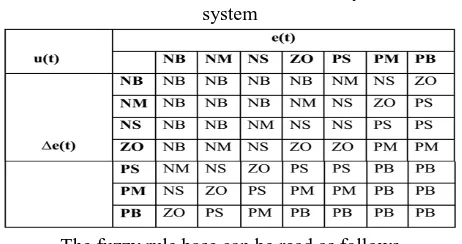
Table 1: IF-THEN rules for fuzzy inference system
The fuzzy rule base can be read as follows
IF e(t) is NB and ∆e(t) is NB THEN u(t) is NB
IF e(t) is <negative big> and ∆e(t) is <negative big>THEN u(t) is <negative big>
V. MATLAB/SIMULINK RESULTS
Fig.6 AGC for three-area operation.
Fig.7 Frequency variation in area 1
Fig.8 Frequency variation in area 2
Fig.9 Frequency variation in area 3
Fig.10 Area 1&2 Tie line power change
Fig.12 Frequency variation of area-1 with PI controller
Fig.13 Frequency variation of area-2 with PI controller
Fig.14 Frequency variation of area-3 with PI controller
Fig.15 Frequency variation of tie-line between area-1 and area-2 with PI controller
Fig.16 Frequency variation of tie-line between area-3 and area-2 with PI controller
Case 3: With Fuzzy logic Controller
Fig.17 Frequency variation of area-1 with Fuzzy controller
Fig.19 Frequency variation of area-1 with Fuzzy controller
Fig.20 Frequency variation of tie-line between area-1 and area-2 with Fuzzy controller
Fig.21 Frequency variation of tie-line between area-3 and area-2 with Fuzzy controller
Case: 4 Three Area LFC Including Dg with Fuzzy Controller
When PV in Area-1
Fug.22 Frequency variation in area 1
Fig.23 Frequency variation in area 2
Fig.25 Area 1&2 tie line power change
Fig.26 Area 2&3 tie line power change
V. CONCLUSION
The Frequency is one of the most important parameter to determine the stability of a system. To improve the overall dynamic performance in the presence of the plant parameters changes and system non linearity’s, the conventional controllers based AGC problem has been formulated as an optimization problem based on system performance index for multiple operating conditions. Solar power plant is included in the system for taking care of continuously increasing load demands and in the view of depleting conventional energy resources. The overall power plant is analyzed in deregulated or restructured scenario. Transient responses has been decreased with the proposed fuzzy logic controller when compared to the conventional proportional integral controller based AGC at load disturbances, grid disturbances and both load and grid disturbances.
REFERENCES