Scholarship@Western
Scholarship@Western
Electronic Thesis and Dissertation Repository
3-24-2017 12:00 AM
MetaFork: A Compilation Framework for Concurrency Models
MetaFork: A Compilation Framework for Concurrency Models
Targeting Hardware Accelerators
Targeting Hardware Accelerators
Xiaohui Chen
The University of Western Ontario Supervisor
Marc Moreno Maza
The University of Western Ontario
Graduate Program in Computer Science
A thesis submitted in partial fulfillment of the requirements for the degree in Doctor of Philosophy
© Xiaohui Chen 2017
Follow this and additional works at: https://ir.lib.uwo.ca/etd
Part of the Algebra Commons, Computer and Systems Architecture Commons, Programming Languages and Compilers Commons, and the Software Engineering Commons
Recommended Citation Recommended Citation
Chen, Xiaohui, "MetaFork: A Compilation Framework for Concurrency Models Targeting Hardware Accelerators" (2017). Electronic Thesis and Dissertation Repository. 4429.
https://ir.lib.uwo.ca/etd/4429
This Dissertation/Thesis is brought to you for free and open access by Scholarship@Western. It has been accepted for inclusion in Electronic Thesis and Dissertation Repository by an authorized administrator of
Parallel programming is gaining ground in various domains due to the tremendous com-putational power that it brings; however, it also requires a substantial code crafting effort to achieve performance improvement. Unfortunately, in most cases, performance tuning has to be accomplished manually by programmers. We argue that automated tuning is necessary due to the combination of the following factors. First, code optimization is machine-dependent. That is, optimization preferred on one machine may be not suitable for another machine. Second, as the possible optimization search space increases, manually finding an optimized configura-tion is hard. Therefore, developing new compiler techniques for optimizing applicaconfigura-tions is of considerable interest.
This thesis aims at generating new techniques that will help programmers develop efficient algorithms and code targeting hardware acceleration technologies, in a more effective manner. Our work is organized around a compilation framework, called MetaFork, for concurrency
platforms and its application to automatic parallelization. MetaForkis a high-level
program-ming language extending C/C++, which combines several models of concurrency including fork-join, SIMD and pipelining parallelism. MetaForkis also a compilation framework which
aims at facilitating the design and implementation of concurrent programs through four key features which make MetaForkunique and novel:
(1) Perform automatic code translation between concurrency platforms targeting multi-core architectures.
(2) Provide a high-level language for expressing concurrency as in the fork-join model, the SIMD paradigm and the pipelining parallelism.
(3) Generate parallel code from serial code with an emphasis on code depending on machine or program parameters (e.g. cache size, number of processors, number of threads per thread block).
(4) Optimize code depending on parameters that are unknown at compile-time.
Keywords: source-to-source compiler, pipelining, comprehensive parametric CUDA ker-nel generation, concurrency platforms, high-level parallel programming.
The work discussed in this dissertation would not have been possible without the constant encouragement and insight of many people.
I must express my deepest appreciation and thanks to my supervisor Professor Marc Moreno Maza, for his enthusiasm and patience during the course of my PhD research. I also would like to thank my friends Ning Xie, Changbo Chen, Yuzhen Xie, Robert Moir and Colin Costello in University of Western Ontario. My appreciation also goes to my IBM colleagues in com-piler group, Wang Chen, Abdoul-Kader Keita, Priya Unnikrishnan and Jeeva Paudel, for their discussions on developing compiler techniques.
Many thanks to the members of my supervisory committee Professor John Barron and Pro-fessor Michael Bauer for their valuable feedbacks. Also my sincere thanks and appreciation go to the members of my examination committee Professor Robert Mercer, Professor Robert Webber, Professor David Jeffrey and Professor Jeremy Johnson for their comments and inspi-ration.
Last but not the least, I am also greatly indebted to my family who deserves too many thanks to fit this page.
Abstract ii
Acknowledgments iii
List of Figures vii
List of Tables xi
List of Appendices xii
1 Introduction 1
1.1 Dissertation Outline . . . 2
1.2 Contributions . . . 3
1.3 Thesis Statement . . . 3
2 Background 4 2.1 Concurrency Platforms . . . 4
2.1.1 CilkPlus . . . 4
2.1.2 OpenMP . . . 5
2.1.3 GPU . . . 5
2.2 Performance Measurement . . . 7
2.2.1 Occupancy and ILP . . . 8
2.2.2 Work-Span Model . . . 9
2.2.3 Master Theorem . . . 9
2.3 Compilation Theory . . . 10
2.3.1 The State of the Art of Compilers . . . 10
2.3.2 Source-to-Source Compiler . . . 11
2.3.3 Automatic Parallelization . . . 12
3 A Metalanguage for Concurrency Platforms Based on the Fork-Join Model 13 3.1 Basic Principles and Execution Model . . . 14
3.2 Core Parallel Constructs . . . 14
3.3 Variable Attribute Rules . . . 18
3.4 Semantics of the Parallel Constructs in MetaFork . . . 20
3.5 Supported Parallel APIs of Both CilkPlusand OpenMP . . . 21
3.5.1 OpenMP . . . 23
3.5.2 CilkPlus . . . 26
3.6.2 Translation from MetaForkto CilkPlus . . . 29
3.6.3 Translation from OpenMP to MetaFork . . . 31
3.6.4 Translation from MetaForkto OpenMP . . . 39
3.7 Experimentation . . . 39
3.7.1 Experimentation Setup . . . 41
3.7.2 Correctness . . . 42
3.7.3 Comparative Implementation . . . 42
3.7.4 Interoperability . . . 43
3.7.5 Parallelism Overheads . . . 49
3.8 Summary . . . 50
4 ApplyingMetaForkto the Generation of ParametricCUDAKernels 52 4.1 Optimizing CUDA Kernels Depending on Program Parameters . . . 53
4.2 Automatic Generation of Parametric CUDA Kernels . . . 55
4.3 Extending the MetaForkLanguage to Support Device Constructs . . . 57
4.4 The MetaForkGenerator of Parametric CUDA Kernels . . . 61
4.5 Experimentation . . . 64
4.6 Summary . . . 67
5 MetaFork: A Metalanguage for Concurrency Platforms Targeting Pipelining 74 5.1 Execution Model of Pipelining . . . 74
5.2 Core Parallel Constructs . . . 75
5.3 Semantics of the Pipelining Constructs in MetaFork . . . 77
5.4 Summary . . . 78
6 MetaFork: The Compilation Framework 79 6.1 Goals . . . 79
6.2 MetaForkas a High-Level Parallel Programming Language . . . 81
6.3 Organization of the MetaForkCompilation Framework . . . 83
6.4 MetaForkCompiler . . . 83
6.4.1 Front-End of the MetaForkCompiler . . . 84
6.4.2 Analysis & Transformation of the MetaForkCompiler . . . 85
6.4.3 Back-End of the MetaForkCompiler . . . 87
6.5 User DefinedPragmaDirectives in MetaFork . . . 87
6.5.1 Registration ofPragmaDirectives in the MetaForkPreprocessor . . . . 88
6.5.2 Parsing ofPragmaDirectives in the MetaForkFront-End . . . 89
6.5.3 AttachingPragmaDirectives to the ClangAST . . . 90
6.6 Implementation . . . 90
6.6.1 Parsing MetaForkConstructs . . . 90
6.6.2 Parsing CilkPlusConstructs . . . 94
6.7 Summary . . . 97
7 Towards Comprehensive ParametricCUDAKernel Generation 98
7.1.2 Hardware Resource Limits and Performance Measures . . . 103
7.1.3 Evaluation of Resource and Performance Counters . . . 104
7.1.4 Optimization Strategies . . . 105
7.1.5 Comprehensive Optimization . . . 105
7.1.6 Data-Structures . . . 106
7.1.7 The Algorithm . . . 107
7.2 Comprehensive Translation of an Annotated C Program into CUDA Kernels . . 112
7.2.1 Input MetaForkCode Fragment . . . 112
7.2.2 Comprehensive Translation into Parametric CUDA Kernels . . . 113
7.3 Implementation Details . . . 114
7.4 Experimentation . . . 116
7.5 Conclusion . . . 122
8 Concluding Remarks 126
Bibliography 128
A Code Translation Examples 141
B Examples Generated byPPCG 153
C The Implementation for Generating ComprehensiveMetaForkPrograms 158
Curriculum Vitae 161
2.1 GPU hardware architecture . . . 6
2.2 Heterogeneous programming with GPU and CPU . . . 7
3.1 Example of a MetaForkprogram with a function spawn . . . 16
3.2 Example of a MetaForkprogram with a parallel region . . . 17
3.3 Example of ameta forloop . . . 18
3.4 Various variable attributes in a parallel region . . . 19
3.5 Example of shared and private variables withmeta for . . . 19
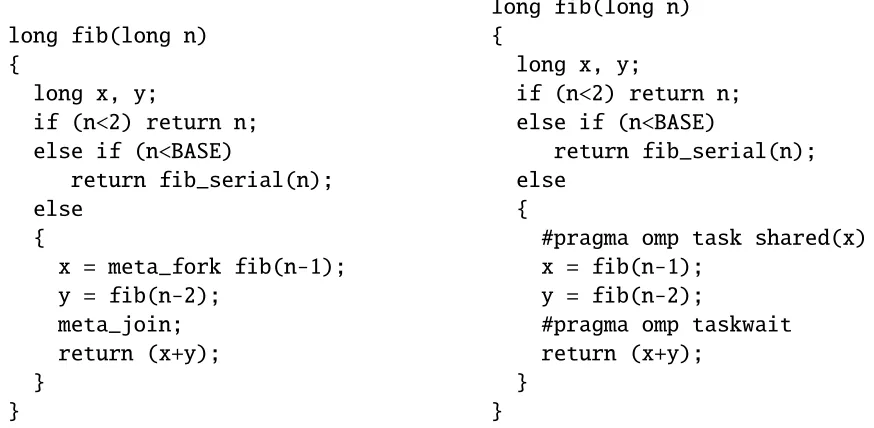
3.6 Parallel fib code using a function spawn . . . 20
3.7 Parallel fib code using a block spawn . . . 20
3.8 OpenMP clauses supported in the current program translations . . . 23
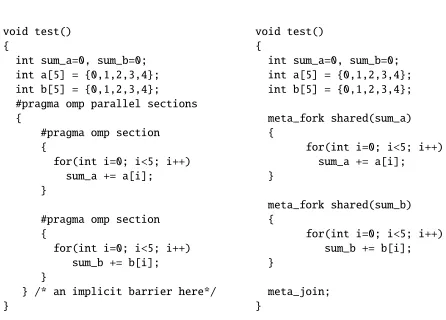
3.9 A code snippet of an OpenMPsectionsexample . . . 25
3.10 A code snippet showing how to exclude declarations which come from included header files . . . 28
3.11 A code snippet showing how to translate a parallel for loop from CilkPlusto MetaFork . . . 28
3.12 A code snippet showing how to insert a barrier from CilkPlusto MetaFork . . 28
3.13 A code snippet showing how to handle data attribute of variables in the process of outlining . . . 32
3.14 A code snippet showing how to translate parallel for loop from MetaForkto CilkPlus . . . 32
3.15 A general form of an OpenMP construct . . . 32
3.16 Translation of the OpenMPsectionsconstruct . . . 34
3.17 An array type variable . . . 36
3.18 A code snippet translated from the codes in Figure 3.17 . . . 36
3.19 A scalar type variable . . . 36
3.20 A code snippet translated from the codes in Figure 3.19 . . . 36
3.21 A code snippet showing the variablemused as an accumulator . . . 36
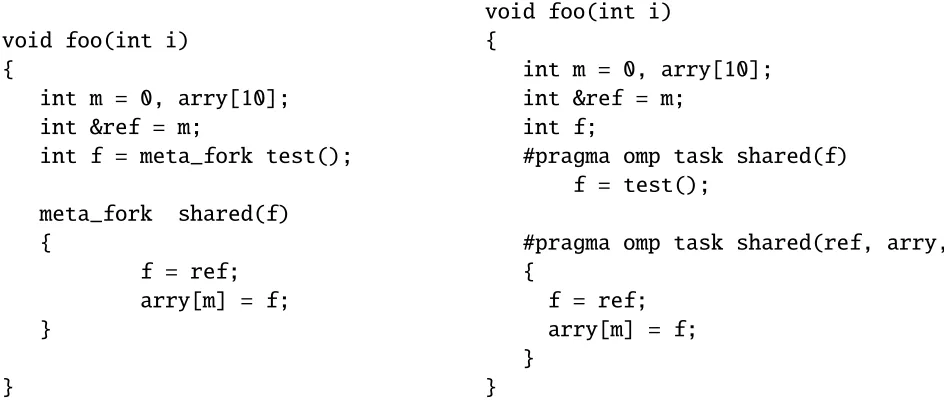
3.22 A MetaForkcode snippet (right), translated from the left OpenMP codes . . . 37
3.23 A code snippet showing how to avoid adding redundant barriers when translat-ing the codes from OpenMP to MetaFork . . . 38
3.24 Example of translation from MetaForkto OpenMP . . . 39
3.25 Example of translating a parallel function call from MetaForkto OpenMP . . . 40
3.26 Example of translating a parallel for loop from MetaForkto OpenMP . . . 40
3.27 A code snippet showing how to generate a new OpenMPmainfunction . . . 40
3.31 Naive Matrix Multiplication : n= 4096 . . . 44
3.32 Speedup curve on Intel node . . . 44
3.33 Speedup curve on Intel node . . . 45
3.34 Speedup curve on Intel node . . . 46
3.35 Speedup curve on Intel node . . . 46
3.36 Running time of Mandelbrot set and Linear system solving . . . 47
3.37 FFT test-cases : FSU version and BOTS version . . . 48
3.38 Speedup curve of Protein alignment - 100 Proteins . . . 48
3.39 Speedup curve of Sparse LU and Strassen matrix multiplication . . . 49
4.1 MetaForkexamples . . . 58
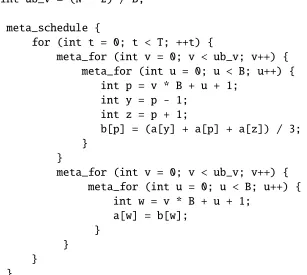
4.2 Usingmeta scheduleto define one-dimensional CUDA grid and thread block 59 4.3 Usingmeta scheduleto define two-dimensional CUDA grid and thread block 59 4.4 Sequential C code computing Jacobi . . . 60
4.5 Generated MetaForkcode from the code in Figure 4.4 . . . 60
4.6 Overview of the implementation of the MetaFork-to-CUDA code generator . . 61
4.7 Generated parametric CUDA kernel for 1D Jacobi . . . 62
4.8 Generated host code for 1D Jacobi . . . 63
4.9 Serial code, MetaForkcode and generated parametric CUDA kernel for array reversal . . . 65
4.10 Serial code, MetaFork code and generated parametric CUDA kernel for 2D Jacobi . . . 67
4.11 Serial code, MetaForkcode and generated parametric CUDA kernel for LU decomposition . . . 69
4.12 Serial code, MetaForkcode and generated parametric CUDA kernel for matrix transpose . . . 70
4.13 Serial code, MetaForkcode and generated parametric CUDA kernel for matrix addition . . . 71
4.14 Serial code, MetaForkcode and generated parametric CUDA kernel for matrix vector multiplication . . . 71
4.15 Serial code, MetaForkcode and generated parametric CUDA kernel for matrix matrix multiplication . . . 72
5.1 Pipelining code withmeta pipeconstruct and its DAG . . . 76
5.2 MetaForkpipelining code and its serial C-elision counterpart code . . . 77
5.3 Computation DAG of algorithms in Figure 5.2 . . . 78
5.4 Stencil code using meta pipe and its serial C-elision counterpart code . . . 78
6.1 MetaForkPragmadirective syntax . . . 81
6.2 A code snippet showing a MetaForkprogram withPragmadirectives . . . 82
6.3 A code snippet showing a MetaForkprogram with keywords . . . 82
6.4 Overall work-flow of the MetaForkcompilation framework . . . 83
6.5 A code snippet showing how to create tools based on Clang’sLibTooling . . 84
6.8 Overall work-flow of the Clangfront-end . . . 88
6.9 A code snippet showing how to create a MetaForkuser definedPragmaHandler 88
6.10 A code snippet showing how to register a new user defined Pragma handler instance to Clangpreprocessor . . . 89
6.11 Convert MetaForkKeywordstoPragmadirectives . . . 91
6.12 A code snippet showing how to annotate a parallel for loop with MetaFork
Pragmadirective . . . 91 6.13 A code snippet showing how to annotate a parallel for loop with MetaFork
keyword . . . 91 6.14 The code snippet after preprocessing the code in Figure 6.13 . . . 92 6.15 Setting thetok::eodtoken . . . 92 6.16 A code snippet showing how to annotate a parallel region with MetaFork
Pragmadirective . . . 92 6.17 A code snippet showing how to annotate a parallel region with MetaFork
key-word . . . 93 6.18 The code snippet after preprocessing the code of Figure 6.17 . . . 93 6.19 Consuming thesharedclause . . . 93 6.20 A code snippet showing how to annotate a join construct with MetaForkPragma
directive . . . 93 6.21 A code snippet showing how to annotate a join construct with MetaFork
Key-words . . . 94 6.22 The code snippet after preprocessing the code of Figure 6.21 . . . 94 6.23 A code snippet showing how to annotate device code with MetaForkPragma
directive . . . 94 6.24 A code snippet showing how to annotate device code with MetaForkKeywords 95
6.25 The code snippet after preprocessing the code of Figure 6.24 . . . 95 6.26 Convert CilkPlusKeywordstoPragmadirectives . . . 95
6.27 A code snippet showing how to annotate a parallel for loop with CilkPlus
Pragmadirective . . . 95 6.28 A code snippet showing how to annotate a parallel for loop with CilkPlus
keyword . . . 95 6.29 The code snippet after preprocessing the code Figure 6.28 . . . 95 6.30 A code snippet showing how to annotate a parallel function call with CilkPlus
Pragmadirective . . . 96 6.31 A code snippet showing how to annotate a parallel function call with CilkPlus
keyword . . . 96 6.32 The code snippet after preprocessing the code of Figure 6.31 . . . 96 6.33 A code snippet showing how to annotate asyncconstruct with CilkPlusPragma
directive . . . 96 6.34 A code snippet showing how to annotate asyncconstruct with CilkPlus
Key-word . . . 96 6.35 The code snippet after preprocessing the code of Figure 6.34 . . . 96
7.2 Comprehensive translation of MetaForkcode to two kernels for matrix addition 100
7.3 The decision tree for comprehensive parametric CUDA kernels of matrix addition101 7.4 Matrix vector multiplication written in C (the left-hand portion) and in MetaFork
(the right-hand portion), respectively . . . 104
7.5 The decision subtree for resource or performance counters . . . 110
7.6 The serial elision of the MetaForkprogram for matrix vector multiplication . . 113
7.7 The software tools involved for the implementation . . . 114
7.8 Computing the amount of words required per thread-block for reversing a 1D array . . . 116
7.9 The first case of the optimized MetaForkcode for array reversal . . . 117
7.10 The second case of the optimized MetaForkcode for array reversal . . . 117
7.11 The third case of the optimized MetaForkcode for array reversal . . . 117
7.12 The first case of the optimized MetaForkcode for matrix vector multiplication 118 7.13 The second case of the optimized MetaForkcode for matrix vector multiplication118 7.14 The third case of the optimized MetaForkcode for matrix vector multiplication 119 7.15 The MetaForksource code for 1D Jacobi . . . 119
7.16 The first case of the optimized MetaForkcode for 1D Jacobi . . . 120
7.17 The second case of the optimized MetaForkcode for 1D Jacobi . . . 120
7.18 The third case of the optimized MetaForkcode for 1D Jacobi . . . 121
7.19 The first case of the optimized MetaForkcode for matrix addition . . . 121
7.20 The second case of the optimized MetaForkcode for matrix addition . . . 122
7.21 The third case of the optimized MetaForkcode for matrix addition . . . 122
7.22 The first case of the optimized MetaForkcode for matrix transpose . . . 122
7.23 The second case of the optimized MetaForkcode for matrix transpose . . . 123
7.24 The third case of the optimized MetaForkcode for matrix transpose . . . 123
7.25 The first case of the optimized MetaForkcode for matrix matrix multiplication 124 7.26 The second case of the optimized MetaForkcode for matrix matrix multiplication124 7.27 The third case of the optimized MetaForkcode for matrix matrix multiplication 125 B.1 PPCG code and generated CUDA kernel for array reversal . . . 153
B.2 PPCG code and generated CUDA kernel for matrix addition . . . 153
B.3 PPCG code and generated CUDA kernel for 1D Jacobi . . . 154
B.4 PPCG code and generated CUDA kernel for 2D Jacobi . . . 154
B.5 PPCG code and generated CUDA kernel for LU decomposition . . . 155
B.6 PPCG code and generated CUDA kernel for matrix vector multiplication . . . 156
B.7 PPCG code and generated CUDA kernel for matrix transpose . . . 156
B.8 PPCG code and generated CUDA kernel for matrix matrix multiplication . . . 157
3.1 BPAS timings with 1 and 16 workers: original CilkPlus code and translated
OpenMP code . . . 50
3.2 Timings on AMD 48-core: underlined timings refer to original code and non-underlined timings to translated code . . . 50
4.1 Speedup comparison of reversing a one-dimensional array between PPCG and MetaForkkernel code . . . 65
4.2 Speedup comparison of 1D Jacobi between PPCG and MetaForkkernel code . 65 4.3 Speedup comparison of 2D Jacobi between PPCG and MetaForkkernel code . 66 4.4 Speedup comparison of LU decomposition between PPCG and MetaFork ker-nel code . . . 68
4.5 Speedup comparison of matrix transpose between PPCG and MetaForkkernel code . . . 68
4.6 Speedup comparison of matrix addition between PPCG and MetaForkkernel code . . . 70
4.7 Speedup comparison of matrix vector multiplication among PPCG kernel code, MetaForkkernel code and MetaForkkernel code with post-processing . . . . 70
4.8 Speedup comparison of matrix multiplication between PPCG and MetaFork kernel code . . . 72
4.9 Timings (in sec.) of quantifier elimination for eight examples . . . 73
6.1 MetaForkconstructs and clauses . . . 90
6.2 CilkPlusconstructs and clauses . . . 95
7.1 Optimization strategies with their codes . . . 116
Appendix A Code Translation Examples . . . 141 Appendix B Examples Generated by PPCG . . . 153 Appendix C The Implementation for Generating Comprehensive MetaForkPrograms . . 158
Introduction
In the past fifteen years, the pervasive ubiquity of multi-core processors has stimulated a con-stantly increasing effort in the development of concurrency platforms, such as CilkPlus [22,
98, 78], OpenMP [117, 14] and TBB [77]. While those programming languages are all based
on the fork-join concurrency model [23], they largely differ in their way of expressing paral-lel algorithms and scheduling the corresponding tasks. Therefore, developing software code combining libraries written with several of those languages is a challenge.
Nevertheless there is a real need for facilitating interoperability between concurrency plat-forms. Consider for instance the field of symbolic computation. The DMPMC library1
pro-vides sparse polynomial arithmetic and is entirely written in OpenMP, meanwhile the BPAS
library2provides dense polynomial arithmetic and is entirely written in CilkPlus. Polynomial
system solvers require both sparse and dense polynomial arithmetic and thus could take advan-tage of a combination of the DMPMC and BPAS libraries. However, CilkPlus and OpenMP
have different run-time systems. In order to achieve interoperability between them, an auto-matic source-to-source translation mechanism was desirable, yielding the original objective for this thesis work.
Another motivation for such a software tool iscomparative implementationwith the objec-tive of narrowing performance bottlenecks. The underlying observation is that the same multi-threaded algorithm, based on the fork-join parallelism model, implemented with two different concurrency platforms, say CilkPlusand OpenMP, could result in very different performance,
often very hard to analyze and compare. If one code scales well while the other does not, one may suspect an inefficient implementation of the latter as well as other possible causes such as higher level of parallelism overheads. Translating the inefficient code to the other language can help narrowing the problem. Indeed, if the translated code still does not scale, one can suspect an implementation issue (say the programmer missed to parallelize one critical portion of the algorithm) whereas if the translated code does scale, then one can suspect a parallelism overhead issue in the original code (say the grain-size of a parallel for-loop is too small).
In the past decade, the introduction of low-level heterogeneous programming models, in particular CUDA [5, 116], has brought super-computing to the level of the desktop
com-1From the TRIP projectwww.imcce.fr/tripdeveloped at theObservatoire de Paris
2From theBasic Polynomial Algebra Subprogramswww.bpaslib.orgdeveloped at the University of Western
Ontario
puter. However, these models bring notable challenges, even to expert programmers. Indeed, fully exploiting the power of hardware accelerators, in particular Graphics Processing Units (GPUs) [106], with CUDA-like code often requires significant code optimization effort. While this development can indeed yield high performance [12], it is desirable for some programmers to avoid the explicit management of device initialization and data transfer between memory levels. To this end, high-level models for accelerator programming have become an important research direction. With these models, programmers only need to annotate their C/C++code to indicate which code portion is to be executed on the device and how data maps between host and device.
As a consequence, it is desirable for our proposed source-to-source translation framework not to restrict itself to programming languages based on the fork-join concurrency model, but also to include the low-level heterogeneous programming model of CUDA which mainly relies on theSingle Instruction Multiple Data (SIMD) paradigm, yielding the second motivation of this thesis work.
As of today, OpenMP and OpenACC [6, 144] are among the most developed
accelera-tor programming models. Both OpenMP and OpenACC are built on a host-centric execution
model. The execution of the program starts on the host and may offload target regions to the device for execution. The device may have a separated memory space or may share memory with the host, so that memory coherence is not guaranteed and must be handled by the pro-grammer. In OpenMP and OpenACC, the division of the work between thread blocks within a
grid and, between threads within a thread block can be expressed in a loose manner, or even ignored. This implies that code optimization techniques may be applied in order to derive effi -cient CUDA-like code. Of course, this is a non-obvious task for a variety of reasons. First of all, for portability reasons, the hardware characteristics of the targeted GPU device should not be assumed to be known in a source code written with a high-level models for accelerator pro-gramming. Secondly, and partially as a consequence, program parameters (like grid and thread block formats) should not be assumed to be known either in that same source code. There-fore, this source code should depend on parameters which are symbolic entities with unknown values at compile time.
Being able to generate (say from annotated C/C++) and optimize such parametric CUDA-like code is the third objective of this thesis work. As we shall see, achieving this objective leads to manipulate systems of non-linear polynomial constraints, which makes this process complex and challenging.
1.1
Dissertation Outline
In this thesis, we propose MetaForkwhich is both a language accommodating several
mod-els of concurrency (fork-join, pipelining, SIMD) and a compilation framework (performing automatic translation from CilkPlusto OpenMP, from OpenMP to CilkPlus, from annotated
C/C++to CUDA, etc.)
In Chapter 3, we present MetaForkas a metalanguage for multithreaded algorithms based
counterparts for widely used parallel constructs of OpenMP. In Chapter 5, we show how the
MetaForklanguage supports pipelining, allowing interoperability with Cilk-P [95].
The implementation of MetaForkas a compilation framework is presented mainly in
Chap-ter 6. However, the software framework that allows automatic generation of CUDA code from annotated MetaForkprograms is discussed in Chapter 4. Finally, Chapter 7 is dedicated to the
question of optimizing parametric CUDA kernels and more generally, optimizing programs depending on parameters whose values are unknown at compile-time.
1.2
Contributions
MetaForkis a high-level programming language extending C/C++, which combines several
models of concurrency including fork-join, SIMD and pipelining parallelism. MetaFork is
also a compilation framework which aims at facilitating the design and implementation of concurrent programs through four key features which make MetaForkunique and novel:
(1) Perform automatic code translation between concurrency platforms targeting multi-core architectures.
(2) Provide a high-level language for expressing concurrency as in the fork-join model, the SIMD paradigm and the pipelining parallelism.
(3) Generate parallel code from serial code with an emphasis on code depending on machine or program parameters (e.g. cache size, number of processors, number of threads per thread block).
(4) Optimize code depending on parameters that are unknown at compile-time.
As of today, the publicly available and latest release of MetaFork, see www.metafork.
org, offers the first three features stated above. The latter is implemented as a proof-of-concept and will be integrated in the public version in a near future.
1.3
Thesis Statement
Chapter 3 is a joint work with Marc Moreno Maza, Sushek Shekar and Priya Unnikrishnan, published as [35].
Chapter 4 is a joint work with Changbo Chen, Abdoul-Kader Keita, Marc Moreno Maza and Ning Xie, published as [29].
Chapters 5 and 6 are essentially my work under the supervision of Marc Moreno Maza and Abdoul-Kader Keita.
Background
This chapter presents the technical background of our topic. Section 2.1 introduces the concur-rency platforms that are relevant to better understand our work. Section 2.2 explains the most commonly used technologies and concepts to give insight into the performance of a parallel al-gorithm. Finally, a brief overview of directions for compiler research is covered in Section 2.3.
2.1
Concurrency Platforms
Nowadays, more and more promising parallel computing platforms are available for high per-formance computing. To gain speedup, programmers are expected to identify parallelism and choose suitable underlying platforms; otherwise, the algorithm developed might not display speedup, or even run slower than the sequential version. In the following sections, we summa-rize the basic properties of several concurrency platforms.
2.1.1
C
ilk
P
lus
CilkPlus is a language extension to the C/C++ programming language, designed for
task-based parallelism in a multithreaded environment. With the keywords introduced by CilkPlus,
a serial program can be easily converted into a parallel program which models a fork-join par-allel control pattern that splits control flow into multiple parpar-allel flows that re-join together later. Precisely, a CilkPlusprogram is derived from a serial program annotated with CilkPlus
keywords indicating where parallelism is allowed. To boost applications, programmers only concentrate on developing the algorithm with ample parallelism, while leaving the underlying CilkPlusrun-time system with the responsibility of efficiently scheduling the computation on
the executing processors. CilkPlus uses a work stealing [24] strategy to schedule the
compu-tational tasks. This method can be efficiently implemented to map a large quantity of parallel tasks onto physical hardware resources at run-time. Moreover, the authors of [59] show that with its work stealing strategy, CilkPlus programs are guaranteed to be time and space
ef-ficient. In particular, the computational tasks are adaptively load-balanced between worker threads in the CilkPlusscheduler [99].
Note that CilkPlus keywords only denote the opportunity for parallel computation, but
parallel computation is not mandatory. For example, thecilk spawnkeyword which permits
the caller running in parallel with the callee, may not actually result in concurrency execution. To carry out such concurrency execution, there must be at least one thread that is idle and looks for computational tasks to steal from other threads. This implies that when a parallel CilkPlus
program runs on a single core machine, the serial semantics of that program is retained.
To ease parallel programming efforts, there are two performance analysis tools, Cilkprof[72,
133] and Cilkscreen[79], designed for programmers that use CilkPlus. The Cilkprof
scala-bility and performance analyzer is used to collect the parallel performance data of a CilkPlus
program. For example, Cilkprofprofiles the work, span and burdened span, which allows the
developers to diagnose performance bottlenecks in CilkPlus programs. The Cilkscreenrace
detector provides the programmers with any data races which are extremely hard to debug with serial programming tools.
2.1.2
O
pen
MP
OpenMP (Open Multi-Processing) is the de-facto standard for programming multithreaded
ap-plications, which is primarily designed for shared memory systems before the release of version 4.0. By annotating a serial program with various OpenMP compiler directives, programmers
can specify fork-join parallelism. Originally, OpenMP only supports implicit tasks for static
parallelism which does not fit well into irregular applications which employ recursive algo-rithms, pointer chasing or load imbalances computation. To efficiently parallelize applications similarly to CilkPlus, OpenMP 3.0 extends its programming model, referred as the OpenMP
tasking model [143], by allowing programmers to dynamically create asynchronous units of work to be scheduled by the run-time. The adoption of this tasking model broadens OpenMP
to parallelize task-based applications as flexibly as CilkPlus.
Furthermore, beyond developing code for single address space parallelism, the OpenMP
language committee has been working on a set of extensions to support heterogeneous compu-tation model using both CPU and accelerators, and this work leads to the release of version 4.0 of the OpenMP specification in July, 2013. This accelerator model of OpenMP builds on a
host-centric execution model. That is, the execution of an OpenMP program starts on the host (i.e.
CPU) and the host may offload a piece of code to an attached accelerator device (e.g. GPU) for execution according to the OpenMP directives. The accelerator may have its separated
mem-ory space or may share memmem-ory space with the host, so that memmem-ory coherence [121] is not guaranteed.
The accelerator model in OpenMP is similar to OpenACC which also accelerates
computa-tion on an external accelerator by adding OpenACC compiler directives. OpenACC has been
developed for several years, so the programming features of OpenACC are rich and stable.
OpenMP, however, is just starting in the heterogeneous programming field, but it is catching
up.
2.1.3
GPU
model to combine the power of CPU and GPU in order to explore massive parallelism. How-ever, this model also introduces notable challenges [108], even for expert programmers, due to the complexity of GPU architectures, including memory hierarchy, thread hierarchy and hard-ware resource limitations. To exploit the computation capabilities efficiently, programmers are required to commit significant efforts in optimizing their algorithms with respect to specific hardware features [135, 84].
Figure 2.1: GPU hardware architecture
GPUHardware Model. A GPU is made up of an array of streaming multiprocessors (SMs ) that perform computations independently of each other, as well as off-chip device memory, as shown in Figure 2.1. As GPU architecture is evolving, the configuration and the number of SMs, and the amount of the device memory vary. Roughly, each SM consists of Scalar Pro-cessors (SPs), on-chip shared memory and register files. Register files and shared memory of each SM are statically and evenly allocated among thread blocks as long as they are active, and when context switching happens, the states of those registers and shared memory do not need to be saved and restored. This can be viewed as a key basis in achieving high throughput. A thread block which is composed of threads, is mapped to an SM and the execution of each thread block is completely independent of every other. Within a thread block, the SM splits the threads into warps of 32 threads which run in SIMD manner on SPs. In fact, from the per-spective of GPUs, a warp is the basic scheduling and execution unit for an SM. Different warps within a thread block are scheduled asynchronously, but can be synchronized if needed. When one warp is stalled, the SM can quickly switch to other warps if they are ready, thereby eff ec-tively tolerating the long latency operations such as memory loads, and maximizing resource utilization.
Figure 2.2: Heterogeneous programming with GPU and CPU
completion of kernel calls, control is returned back to the CPU thread. In order to carry out the computations on the device, the programmer is responsible for organizing the data transfers between the host and device memory, transfers in both directions being handled by the host.
CUDA abstracts execution on the GPU in the form of thousands of concurrent threads which are organized into a two-level thread hierarchy composed of the grid as the top level and thread blocks as the bottom level. The size of the grid and the thread blocks can be configured in multiple dimensions (one, two, or three dimensions) by the special parameters provided at kernel launch time. Note that, the configurations are chosen manually by programmers without the guarantee that they are optimal. CUDA kernels written as a single function, are executed by all threads in the grid; hence, each thread needs to distinguish itself from others and to access unique data portions to operate on. To this end, threads are able to query CUDA built-in variables (e.g. blockId, gridDim and threadIdx) and combbuilt-ine them to compute a unique identifier.
In addition, to achieve high memory bandwidth [150], GPUs offer a region of memory, called shared memory, which is private to every SM and can be used to share data at thread block scope. Compared to the slow off-chip GPU device memory which can be accessed by all the threads, the on-chip shared memory provides a very fast memory access speed which is comparable to the speed of register access. From the perspective of programming, pro-grammers need to explicitly declare variables with the CUDA shared keyword to make variables resident in shared memory.
2.2
Performance Measurement
2.2.1
Occupancy and ILP
A key motivation [36] of GPUs for massive parallelism is to handle a large mount of active warps, i.e. groups of threads executing in SIMD fashion, on each SM. An SM maximizes uti-lization of its SIMD lanes [129] by multiplexing those warps according to their states. That is, when a warp which is running, stalls due to long memory or ALU operations latency, this warp is switched out and marked as pending, while another warp which is eligible will be switched in for execution. When the long latency operations complete, the pending warp that was switched out early becomes eligible for execution. Ideally, if there are sufficiently many warps at each cycle to tolerate latency, full computation resource utilization of the SM is achieved. Hence, utilization of an SM is directly associated with the number of active warps on that SM. The oc-cupancy metric on GPUs is used to formulate this concept. Ococ-cupancy for an SM is defined as the ratio of the number of active warps to the maximum number of warps. A CUDA occupancy calculator tool, included in the CUDA toolkit, helps programmers to compute the occupancy for a kernel, depending on the execution configurations and the nature of the kernel algorithms.
In practice, to improve occupancy, programmers usually configure more thread blocks than SMs, as well as more threads than SPs. However, not all those thread blocks are concurrently active on SMs. To be active, the resources, such as register and shared memory usage, requested by a thread block, must be available. Thus, occupancy for each SM is tightly constrained by the limited amount of SM resources. As reported in [84, 88, 94] , even a slight increase in resource usage, like per-thread register usage and per-block shared memory usage, could deliver a sharp occupancy degradation.
2.2.2
Work-Span Model
In the work-span model, a program’s execution can be seen as a directed acyclic graph (DAG) composed of nodes and edges. A DAG node represents a sequence of instructions without any parallel control instructions, and edges represent dependencies between nodes. The execution of a DAG follows the prescribed order, where a node of the DAG is eligible to run only if all its predecessor nodes have completed. In order to measure the parallelism using the work-span model, two fundamental metrics, work and span, are derived from DAGs. The work, denoted T1, is the total time needed to execute the DAG serially. The span, denotedT∞, is also called the critical path length and is the execution time of the DAG on an ideal machine with an infinite number of processors.
In fact, the work-span model [23] has been used to support the development of the CilkPlus
programming language and its implementation. Two complexity measures, the workT1and the
spanT∞ and one machine parameter, the numberPof processors, are combined in results like the Graham-Brent theorem [23] or the Blumofe-Leiserson theorem (Theorems 13 & 14) [24] in order to compare algorithm running time estimates. We recall that the Graham-Brent theorem states that the running timeTPonPprocessors satisfiesTP ≤T1/P+T∞.
When designing a parallel algorithm, it is desirable to systematically integrate the expected scheduling costs that a given concurrency platform imposes on this algorithm. To this end, a refinement of the fork-join model was proposed by He et al. [72] together with an enhanced version of the Graham-Brent theorem, which actually supports the implementation (on multi-core architectures) of the parallel performance analyzer called Cilkview. In this context, the
running timeTP is bounded in expectation byT1/P+2∆Tc∞, where∆is a constant (called the
span coefficient) andTc∞ is the burdened span. Frigo et al. [59] describe the implementation
of the CilkPlus work-stealing scheduler. They introduce the notions of work overhead and
span overhead. Spoonhower et al. [139] present a theoretical concept of deviation on which
we could rely in order to perform parallelism overhead analysis in the context of schedulers based on other principles than the randomized work-stealing. In particular, and as mentioned by Haque [70], analyzing the burden span may help us discover that an algorithm is not appropriate for an architecture.
2.2.3
Master Theorem
The divide-and-conquer technique, as a classical approach for designing algorithms (either serial or parallel), is widely used [62, 15]. It applies in the case that a task with input size n, can be partitioned into smaller sub-tasks recursively, each with input size n/b, until a base-case problem is reached which is simple enough to be solved directly. Algorithms using this computational pattern can be parallelized efficiently with fork-join platforms, like CilkPlus
and the tasking model in OpenMP, see [60].
The cost of divide-and-conquer algorithms illustrated above, can be represented as a recur-rence relationship which is given by
T(n)=aT(n/b)+ f(n) (2.1)
1. nis the input size of the original task.
2. a≥1 andb>1 are constants. aandn/bpresent the number of sub-tasks and the size of each sub-task, respectively.
3. f(n) is the cost of combining the answers of the sub-tasks. 4. T(n) is the cost of the task with input sizen.
The complexity of the recurrence relationship in 2.1 can be easily solved by the master theo-rem [43] in the form of asymptotic notation. More precisely,T(n) is asymptotically bounded in three common cases as follows:
1. If f(n)=O(nlogba−) for some constant > 0, thenT(n)= Θ(nlogba). 2. If f(n)= Θ(nlogbalogkn) for somek ≥0, thenT(n)= Θ(nlogbalogk+1n).
3. If f(n) = Ω(nlogba+) for some constant > 0, and a f(n/b) ≤ c f(n) for somec < 1 and sufficiently largen, thenT(n)= Θ(f(n)).
Furthermore, the authors in [9] present a method for solving more generalized divide-and-conquer recurrences which can not be handled by master theorem.
2.3
Compilation Theory
Computer hardware is constantly evolving in order to boost the performance. However, by improving compiler techniques, we could also gain many benefits. Generally, compilers serve two purposes: translators which translate programs written in a source programming language into an equivalent program in an object language, and optimizers which perform optimization to make programs more efficient to enable high performance and productivity. In the following sections, we describe a broad range of research into compilers.
2.3.1
The State of the Art of Compilers
We survey two open source compiler frameworks, which are more relevant to industry and academia.
allow it to perform more sophisticated and aggressive inter-procedural optimizations. Finally, the LLVM back-end transforms the LLVM IR into processor specific binary code, or can be used as just in time compilation.
Today, LLVM employs Clang[1] as its front-end for the C, C++, C and
Objective-C++programming languages. Clangaims to deliver fast compiles, useful error and warning
messages, and to provide a platform for building great source code level tools, such as source code analysis tools or source-to-source transformation tools. It is designed to offer a complete replacement to the GNU Compiler Collection (GCC)1. A major design concept for Clangis its
use of a library-based architecture. In this design, various parts of the front-end can be cleanly divided into separate libraries which can then be mixed up for different needs and uses. In addition, the library-based approach encourages good interfaces and reduces the work for new developers to understand and extend the Clangframework.
ROSE. Unlike traditional compilers, ROSE [2, 126, 125] is designed as a source-to-source compiler infrastructure, developed at Lawrence Livermore National Laboratory for building ar-bitrary tools for static analysis, optimization and transformation. ROSE has increasing support in its front-end for multiple programming languages and extensions, including C/C++, Fortran, Python, UPC, OpenMP, PHP and Java. Given input programs, the front-end is responsible for
constructing an Abstract Syntax Tree (AST) which is a graph representation of the programs and lives in memory for fast operations on it. Contrary to Clang, ROSE provides mechanisms
to directly change itsASTto facilitate complex code transformation and optimization. Finally, the back-end generates source code from the transformedASTand calls a vendor’s compiler to run the generated source code.
2.3.2
Source-to-Source Compiler
Source-to-source is an area of compilation technology dedicated to the automatic translation of programs written in a high-level language to another such language. The transformation of an un-optimized C program into an optimized C program is an example of source-to-source compilation. The translation of LATEX document into HTML is another one.
A source-to-source compiler can be used under various situations. One example is with legacy code. Some legacy code is well developed and optimized through many years. Devel-opers can benefit a lot from legacy code if it adapts to modern implementation platforms [118]. Manually rewriting this code is time consuming; what is worse, it may bring potential bugs. Sometimes fully automatic translation is difficult to achieve, which means some extra work by hand is needed; however, one can still take advantage of source-to-source compilation for frag-ments of code. For example, the authors of [120] designed PoCC, a source-to-source compiler, for parallelizing code fragments in static control parts (SCoP) format for multi-core architec-ture using OpenMP. With hiCUDA [69], a high-level directive-based sequential code can be
translated to a CUDA program. In [138], the authors propose a source-to-source C compiler, called Panda, which can automatically generate hybrid MPI + CUDA + OpenMP code that
A second case is debugging multithreaded code [91]. Nowadays programmers have access to many concurrency platforms, but debugging parallel code is often a challenge: if any threads are running concurrently and competing for computer resource acquisition, tracing each thread may not be realistic. The translation of a parallel program into a serial counterpart may help in detecting issues such as data races. Thus, source-to-source compilation can be of the great benefit in such situation.
During the past, source-to-source compilation has been studied by a lot of researchers. For example, several projects offer automatic one-way translation from a concurrency platform running on one hardware architecture to another concurrency platform running on another hard-ware architecture, e.g. OpenMP shared-memory code to MPI distributed-memory code as in
the papers [19] [49] (HOMPI Project). An example of another application of source-to-source compilation appears in an article by Lee et al. [97], where a compiler framework for automatic translation of OpenMP shared-memory programs into CUDA-based GPGPU programs is
pre-sented, thus greatly relieving the programming effort, since coding efficient CUDA program can be quite arduous. Other projects offer extensions of a concurrency platform from one hard-ware architecture to another hardhard-ware architecture, like HOMP [104] or OpenMPC [96] which
allow extended OpenMP code to run on NVIDIA GPUs.
2.3.3
Automatic Parallelization
Thepolyhedron model[65, 55, 81, 17, 25, 16] is a powerful geometrical tool for analyzing the
relations (w.r.t. data locality or parallelization) between the iterations of nested loop programs. Let us consider the case of parallelization. Once the polyhedron representing the iteration
space of a loop nest is calculated, techniques in linear algebra and linear programming, can
transform it into another polyhedron encoding the loop steps in a coordinate system based on time and space (processors). From there, a parallel program can be generated. To be practically efficient, one should avoid a too fine-grained parallelization; this is achieved by grouping loop steps into so-calledtiles, which are generally trapezoids [75]. These extensions lead, however, to the manipulation of system of non-linear polynomial equations and the use of techniques like quantifier elimination by the authors of [67]. They observe, that classical algorithms for QE are not suitable, since they do not always produce conjunctions of atomic formulas, while this format is required in order to generate code automatically. This issue is addressed by re-cent algorithm for computing cylindrical algebraic decomposition [33]. Indeed, this algorithm supports QE in a way that the output of a QE problem has the form of acase discussion: this is appropriate for code generation.
A Metalanguage for Concurrency
Platforms Based on the Fork-Join Model
In this chapter, we present MetaForkas a metalanguage for multithreaded algorithms based
on the fork-join parallelism model and targeting multi-core architectures. By its parallel pro-gramming constructs, the MetaForklanguage is currently a super-set of CilkPlus and offers
counterparts for the widely used OpenMP parallel constructs detailed in Section 3.5.
However, MetaFork does not make any assumptions about the run-time system, in
par-ticular about scheduling strategies (work sharing, work stealing). In fact, MetaFork is not
designed to be a target language, but rather as the internal intermediate representation (IR) of a source-to-source compiler framework for multithreaded languages.
Section 3.1 is going to explain the execution model of MetaForkbased on the fork-join
concurrency model. The syntax and the semantics of MetaFork’s parallel constructs are
spec-ified in Sections 3.2 and 3.4. Since MetaForkis a faithful extension of the C/C++language,
this is actually sufficient to completely define MetaFork. Further, data attributes of the parallel
constructs in MetaForkare discussed in Section 3.3.
Recall that a driving motivation of the MetaFork project is to facilitate automatic trans-lation of programs between concurrency platforms. To date, our experimental framework in-cludes translators between CilkPlus and MetaFork(both ways) and, between OpenMP and
MetaFork(both ways). Hence, through MetaFork, we perform program translations between CilkPlusand OpenMP (both ways).
Despite the fact that it does not support all features of OpenMP, the MetaForklanguage is
rich enough to capture the semantics of large bodies of OpenMP code, such as theBarcelona
OpenMPTasks Suite (BOTS) [53] and translate faithfully to CilkPlus most of the BOTS test
cases. In the other direction, we could translate the BPAS library to OpenMP.
In Section 3.6, we briefly explain how the translators of the MetaForkcompilation
frame-work are implemented. In particular, we specify which OpenMP data-sharing clauses are
cap-tured by the MetaForktranslators. Simple examples of code translation are provided.
In Section 3.7, we evaluate the benefits of the MetaForkframework through a series of
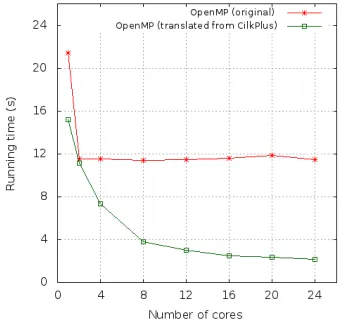
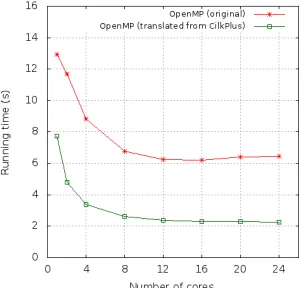
experiments. First, we show that MetaFork can help narrow down performance bottlenecks
in multithreaded programs by means of comparative implementation, as discussed above. Sec-ondly, we observe that, if a native CilkPlus (resp. OpenMP) program has little parallelism
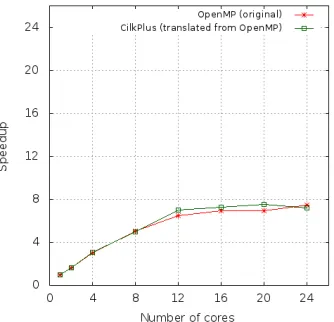
overhead, then the same holds for its OpenMP (resp. CilkPlus) counterpart translated by
MetaFork. We tested more than 20 examples in total for which experimental results can be
found in the technical report [34] and for which code can be found on the website of the MetaForkproject. Moreover, the source code of the MetaForktranslators can be downloaded
from the same website athttp://www.metafork.org.
3.1
Basic Principles and Execution Model
We summarize in this section a few principles that guided the design of MetaFork. First of
all, MetaFork extends both the C and C++ languages into a multithreaded language based
on the fork-join concurrency model. Thus, concurrent execution is obtained by a parent thread creating and launching one or more child threads so that the parent and its children execute a so-calledparallel region. An important example of parallel regions is for-loop bodies. MetaFork
has the following natural requirement regarding parallel regions: control flow cannot branch into or out of aparallel region.
Similarly to CilkPlus, the parallel constructs of MetaForkgrant permission for concurrent
execution but do not command it. Hence, a MetaForkprogram can execute on a single core
machine.
As mentioned above, MetaForkdoes not make any assumptions about the run-time
sys-tem, in particular about task scheduling. Along the same idea, another design intention is to encourage a programming style limiting thread communication to a minimum so as to
- prevent from data-races while preserving a satisfactory level of expressiveness and, - minimize parallelism overheads.
To some sense, this principle is similar to one of CUDA’s principles [116] which states that the execution of a given kernel should be independent of the order in which its thread blocks are executed.
To understand the implication of that idea in MetaFork, let us return to our concurrency
platforms targeting multi-core architectures: OpenMP offers several clauses which can be used
to exchange information between threads (likethreadprivate, copyinandcopyprivate) while no such mechanism exists in CilkPlus. Of course, this difference follows from the fact
that, in CilkPlus, one can only fork a function call while OpenMP allows other code regions to
be executed concurrently. MetaForkhas both types of parallel constructs. But, for the latter,
MetaForkdoes not offer counterparts to the above OpenMP data attribute clauses.
3.2
Core Parallel Constructs
MetaForkhas four parallel constructs: function call spawn, block spawn, parallel for-loop and
synchronization barrier. The first two use the keyword meta fork while the other two use respectively the keywordsmeta forandmeta join. We emphasize the fact thatmeta fork allows the programmer to spawn a function call (like in CilkPlus) as well as a block (like in
OpenMP).
program is run by a single processor, the parent thread is suspended during the execution of the child thread; when this latter terminates, the parent thread resumes its execution after the function call (or block) spawn.
If the program is run by multiple processors, the parent thread may continue its execution1 after the function call (or block) spawn, without being suspended, meanwhile, the child thread executes the function call (or block) spawn. In this latter scenario, the parent thread waits for the completion of the execution of the child thread, as soon as the parent thread reaches a synchronization point.
Spawning a function call with meta fork. Spawning a call to the function f, with the argument sequenceargs, is done by
meta fork f(args)
The semantics is similar to that of the CilkPluscounterpart
cilk spawn f(args)
In particular, all the arguments in the sequenceargsare evaluated before spawning the function call f(args). However, the execution of meta fork f(args) differs from that ofcilk -spawn f(args)on one feature. While there is an implicitcilk syncat the end of theCilk block [78] surrounding this latter cilk spawn, no such implicit barriers are assumed with meta fork. This feature is motivated by the fact that, in addition to the fork-join parallelism, we plan to extend the MetaForklanguage to other forms of parallelism such as parallel
fu-tures[139, 21].
Figure 3.1 illustrates howmeta forkcan be used to define a function spawn. The under-lying algorithm in this example is the classical divide and conquerquicksortprocedure.
Spawning a block with meta fork. The other usage of the meta fork construct is for spawning a basic blockB, which is done as follows:
meta fork { B }
IfBconsists of a single instruction, then the surrounding curly braces can be omitted. We also refer to this construction as a parallel region. There is no equivalent in CilkPlus while it is
offered by OpenMP. Similarly to a function call spawn, this parallel region is executed by a
child thread (once the parent thread reaches themeta fork construct) meanwhile the parent thread continues its execution after the parallel region. Similarly also to a function call spawn, no implicit barrier is assumed at the end of the surrounding region. Hence synchronization points have to be added explicitly, usingmeta join; see the examples of Figures 3.2.
A variable v which is not local to B may be shared by both the parent and child threads; alternatively, the child thread may be granted a private copy of v. Precise rules about data attributes, for both parallel regions and parallel for-loops, are stated in Section 3.3.
Figure 3.2 below illustrates how meta fork can be used to define a parallel region. The underlying algorithm is one of the two subroutines in the work-efficient parallel prefix sum due to Guy Blelloch [20].
1In fact, the parent thread does not participate to the execution of a function call (or block) spawn, but will
#include <algorithm> #include <iostream> using namespace std;
void parallel_qsort(int * begin, int * end) {
if (begin != end) {
--end; // Exclude last element (pivot) from partition int * middle = std::partition(begin, end,
std::bind2nd(std::less<int>(), *end)); using std::swap;
swap(*end, *middle); // move pivot to middle meta_fork parallel_qsort(begin, middle);
parallel_qsort(++middle, ++end); // Exclude pivot and restore end meta_join;
} }
int main(int argc,char* argv[]) {
int n = 10;
int *a = (int *)malloc(sizeof(int)*n); srand( (unsigned)time( NULL ) );
for (int i = 0; i < n; ++i) a[i] = rand();
parallel_qsort(a, a + n); return 0;
}
long int parallel_scanup (long int x [], long int t [], int i, int j) {
if (i == j) {
return x[i]; }
else{
int k = (i + j)/2; int right;
meta_fork {
t[k] = parallel_scanup(x,t,i,k); }
right = parallel_scanup (x,t, k+1, j); meta_join;
return t[k] + right;} }
Figure 3.2: Example of a MetaForkprogram with a parallel region
Parallel for-loops withmeta for. Parallel for-loops in MetaForkhave the following format
meta for (I, C, S) { B }
whereIis theinitialization expressionof the loop,Cis thecondition expressionof the loop,S is thestrideof the loop andBis the loop body. In addition:
- the initialization expression initializes a variable, called the control variablewhich can be of type integer or pointer,
- the condition expression compares the control variable with a compatible expression, using one of the relational operators<, <=, >, >=, !=,
- the stride uses one the unary operators ++, --, +=, -= (or a statement of the form cv = cv + incr whereincrevaluates to a compatible expression) in order to in-crease or dein-crease the value of the control variablecv,
- ifBconsists of a single instruction, then the surrounding curly braces can be omitted. The parent thread will share the work of executing the iterations of the loop with the child threads. An implicit synchronization point is assumed after the loop body. That is, the ex-ecution of the parent thread is suspended when it reaches meta for and resumes when all children threads (executing the loop body iterations) have completed their execution. As one can expect, the iterations of the parallel loop meta for (I, C, S) { B } must execute independently of each other in order to guarantee that this parallel loop is semantically equiv-alent to its serial version for (I, C, S) { B }.
Figure 3.3 displays an example of meta for loop, where the underlying algorithm is the naive (and cache-inefficient) matrix multiplication procedure.
Synchronization point withmeta join. The constructmeta joinindicates a
void multiply_iter_par(int ii, int jj, int kk, int* A, int* B, int* C) {
meta_for(int i = 0; i < ii; ++i) for (int k = 0; k < kk; ++k)
for(int j = 0; j < jj; ++j)
C[i * jj + j] += A[i * kk + k] + B[k * jj + j]; }
Figure 3.3: Example of ameta forloop
reaching this point must wait for the completion of its children tasks but not for those of the subsequent descendant tasks. When the parent thread resumes, execution starts at the point immediately after themeta joinconstruct.
Typically, this construct is used as a communication mechanism to exchange information between different threads. In particular, ameta joinconstruct ensures that all writes to shared memory performed by the threads preceding this meta join construct are seen in the same view by the code after it. This natural property of themeta joinconstruct solves the problem of data inconsistency and contention [54] caused by shared memory programming models.
3.3
Variable Attribute Rules
Variables that arenon-localto the block of a parallel region may be eithersharedby orprivate to the threads executing the code paths where those variables are defined. After a terminology review, we specify the rules that MetaForkuses in order to decide whether such a non-local
variable is shared or private.
Shared and private variables. Consider a parallel region with block Y (or a parallel for-loop with for-loop bodyY). Xdenotes the immediate outer scope ofY. We say thatXis theparent
region ofY and that Y is a child regionof X. A variablev which is defined inY is said to be
local to Y; otherwise we call v a non-localvariable for Y. Let v be a non-local variable for
Y. Assume vgives access to a block of storage before reachingY. We say thatvissharedby
X and Y if its name gives access to the same block of storage in both X andY; otherwise we say that visprivateto Y. In particular, ifY is a parallel for-loop we say that a local variable
w is shared by Y whenever the name of w gives access to the same block of storage in any
loop iteration ofY, which means that all the threads that execute this parallel for-loop share the same variablew; otherwise we say thatwisprivatetoY.
Value-type and reference-type variables. In the C/C++ programming language, a
value-type variablecontains its data directly as opposed to areference-type variable, which contains
static andconsttype variables. In the C/C++programming language, astaticvariable is a variable that has been allocated statically and whose lifetime extends across the entire run of the program. This is in contrast to automatic variables (local variables are generally automatic) whose storage is allocated and deallocated on the call stack and, other variables (such as objects) whose storage is dynamically allocated in heap memory. When a variable is declared with the qualifierconst, the value of that variable cannot typically be altered by the program during its execution.
/* This file starts here ... */ #include<stdio.h>
#include<time.h> #include<stdlib.h> int a;
long par_region(long n){ int b;
int *c = (int *)malloc(sizeof(int)*10); int d[10];
const int f=0; static int g=0; meta_fork{
int e = b; subcall(c,d); }
}
/* ... and continues here ... */
void subcall(int *a,int *b){ for(int i=0;i<10;i++)
printf("%d %d\n",a[i],b[i]); }
int main(int argc,char **argv){ long n=10;
par_region(n); return 0; }
/* ... and finishes here. */
Figure 3.4: Various variable attributes in a parallel region
Variable attribute rules ofmeta fork. A non-local variablevwhich gives access to a block of storage before reachingY is shared between the parentXand the childY whenevervis: (1) a global variable, (2) a file scope variable, (3) a reference-type variable, (4) declared static orconst, or (5) qualifiedshared. In all other cases, the variable vis private to the child. In particular, value-type variables (that are not declared static orconst, or qualified shared ,and that are not global or file scope variables) are private to the child. In Figure 3.4, the variablesa,c,d,fandgare shared, meanwhile thebandeare private.
/* To illustrate variable attributes, three files (a headerfile "a.h" and two source files "a.cpp" and "b.cpp") are used.
This file is a.cpp */
#include<stdio.h> extern int var; void test(int *array) {
int basecase = 100;
meta_for(int j = 0; j < 10; j++) {
static int var1=0; int i = array[j]; if( i < basecase )
array[j]+=var; }
}
/* This file is b.cpp*/ #include<stdio.h> #include<stdlib.h> #include<time.h> #include"a.h" int var = 100;
int main(int argc,char **argv) { int *a=(int*)malloc(sizeof(int)*10); srand((unsigned)time(NULL)); for(int i=0;i<10;i++) a[i]=rand(); test(a); return 0; }
/* This file is a.h*/ void test(int *a);
long fib_parallel(long n) {
long x, y; if (n < 2)
return n; else{
x = meta_fork fib_parallel(n-1); y = fib_parallel(n-2);
meta_join; return (x+y);} }
Figure 3.6: Parallel fib code using a function spawn
long fib_parallel(long n) {
long x, y; if (n < 2)
return n; else{
meta_fork shared(x) {
x = fib_parallel(n-1); }
y = fib_parallel(n-2); meta_join;
return (x+y);} }
Figure 3.7: Parallel fib code using a block spawn
Variable attribute rules ofmeta for. A non-local variable which gives access to a block of storage before reachingY isshared between parent and child. A variable local toY isshared by Y whenever it is declared static, otherwise it is private to Y. In particular, loop control variables are private toY. In the example of Figure 3.5, the variablesarray, basecase, var andvar1, are shared by all threads while the variablesiandjare private.
The shared keyword. Programmers can explicitly qualify a given variable as shared by using thesharedkeyword in MetaFork. In the example of Figure 3.6, the variablenis private
tofib parallel(n-1). In Figure 3.7, we specify the variablexas shared and the variablen is still private. Notice that the programs in Figures 3.6 and 3.7 are semantically equivalent.
3.4
Semantics of the Parallel Constructs in
M
eta
F
ork
Parallel programming allows any order of the program’s execution, which increases the com-plexity of reasoning about their behavior. A few research [26, 100, 82, 131] has been under-taken in the area of modeling the semantics of parallel programming languages so as to avoid non-deterministic. The basic idea is that if a program executed sequentially satisfies a given criterion, parallel execution of that program must meet the same criterion.
The goal of this section is to formally define the semantics of each of the parallel constructs in MetaFork. To do so, we introduce the serial C-elisionof a MetaForkprogramM as a C
programCwhose semantics define those ofM. The programCis obtained from the program
Mby a set of rewriting rules stated through Algorithm 1 to Algorithm 4.
As mentioned before, spawning a function call in MetaFork has the same semantics as
spawning a function call in CilkPlus. More precisely: meta fork f(args) and cilk
-spawn f(args) are semantically equivalent.
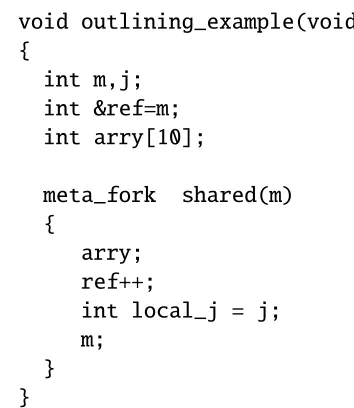
Next, we specify the semantics of the spawning of a block in MetaFork. To this end, we
use Algorithms 2, 3 and 4 which reduce the spawning of a block to that of a function call: - Algorithm 2 takes care of the case where the spawned block consists of a single
- Algorithms 3 and 4 take care of all other cases.
Note that, in the pseudo-code of those algorithms thegeneratekeyword is used to indicate that a sequence of string literals and variables are written to the medium (file, screen, etc.) where the output program is being emitted.
Ameta forloop allows iterations of the loop body to be executed in parallel. By default, each iteration of the loop body is executed by a separate thread. However, using thegrainsize compilation directive, one can specify the number of loop iterations executed per thread2:
#pragma meta grainsize = expression
Nevertheless, in order to obtain the serial C-elision of a MetaForkfor-loop, we require that
themeta forconstruct could be replaced by the C-languagefor- whatever is the grainsize of this MetaForkfor loop - without changing the initialization expression, condition expression
and stride. (Of course, the loop-body must be replaced with its serial C-elision.)
Algorithm 1: Fork region(P,S, R)
Input: R is a statement of the form:
meta fork[shared(Z)] B
where Z is a sequence of variables, B is a piece of code,PandS are lists of shared variables and private variables to B, respectively, determined by the rules in Section 3.3.
Output: The serial C-elision of the above MetaForkstatement.
1 if Bconsists of a single statement which is a function call without left-valuethen
2 generate(B);
3 else if Bconsists of a single statement which is a function call with left-valuethen 4 Function with lvalue(P,S, B);
5 else
6 Block call(P,S, B);
3.5
Supported Parallel APIs of Both
C
ilk
P
lus
and
O
pen
MP
Through MetaFork, we perform program translations between CilkPlus and OpenMP (both
ways). Currently, MetaFork is a super-set of CilkPlus, however, MetaForkdoes not offer
counterparts to all the OpenMP constructs. This section provides an overview of the APIs of
both CilkPlusand OpenMP in our implementation.
Algorithm 2: Function with lvalue(P,S, B)
Input: B is a statement of the form:
G=F(A);
where G is a left-value,Ais an argument sequence, F is a function name,PandS are as in Algorithm 1.
Output: The serial C-elision of the MetaForkstatement below:
meta fork[shared(Z)] G=F(A)
1 /* L is a list consisting of all variables appearing in G */
2 L ← [G]
3 if Lis nota sub-set of S then 4 Block call(P,S, B);
5 else
6 generate(B);
Algorithm 3: Block call(P,S, B)
Input: P,S and B are as in Algorithm 1.
Output: The serial C function call of the above input.
1 (E, H, T, P, O)=Outlining region(P,S, B); 2 /* declare the outlined function */
3 generate(E);
4 /* declare an object, say O, to wrap all the parameters */ 5 generate(T, O);
6 /* initialize all the members (i.e. parameters) in the object O */ 7 generate(P);