
ORBITAL ANGULAR MOMENTUM
HOW TO DEFINE IT AND HOW TO MEASURE IT
Elliot Leader,a
1Imperial College London
Abstract.In the context of the controversy concerning the ambiguities in the definition of quark and gluon angular momentum we explain pedagogically the origin of these ambiguities and stress that there are funda-mentally only three physically relevant variants. We give precise expressions for the sum rules involving them. We consider their measurement, both experimentally and on the lattice, and discuss some attempts to calculate them in models.
1 Introduction
It has been emphasized for a long time that the angular momentum (AM) of a photon cannot be split, in a gauge invariant way, into aspin andorbital(OAM) part. The same is true for gluons, yet many experimental groups believe they are measuring the gluon spin! In 2008 Chen, Lu, Sun, Wang and Goldman [1] claimed, effectively, that all the QED textbooks were wrong, and that it was possible to split the photon angular momentum, in a gauge-invariant way, into a spin part and an orbital part. This unleashed a deluge of papers, most of them very technical, and causing confusion by effectively implying that there are an infinite number of ways of defining the AM. In our recent Physics Report, with C. Lorcé [2] , while covering all the technical developments, we conclude that there are only three physically relevant versions and indicate what parts of our review to read for the essential physical implications. This talk follows the latter, non-technical route, discussing ambiguities or variants in the definition of L, the three fundamental versions, how to measure them experimentally, or on a lattice, and discussing some model calculations.
For simplicity, ambiguities, variants etc will all be illus-trated mainly in QED. Note that throughout we consider a longitudinally polarized nucleon moving alongOZ, and only discussLz.
2 The physically meaningful versions of
the angular momentum
There are two kinds of variants: (1) there is a difference betweencanonicalandkineticangular momentum and (2) there is a difference, depending on the form of dynam-ics being used i.e. betweeninstant form andlight-front
ae-mail: [email protected]
dynamics
The difference between canonical and kinetic has nothing to do with Field Theory. It is hidden in Undergraduate Physics! InClassical Dynamicsthekineticmomentum is defined as mass times velocity
pkin=mu=mx˙. (1)
It follows the motion of the particle and the non-relativistic expression for the kinetic energy is
Ekin= p2kin/2m. (2)
In Quantum Mechanics one has the Heisenberg uncer-tainty relations between position and momentum
[xi,pj]=iδi j. (3)
This pis NOT the kinetic momentum. It is thecanonical momentum, defined as
p=∂L/∂x˙ (4)
whereLis the Lagrangian of the system.
Let’s compare pcanwith pkin . For a particle moving in a potentialV(x)
L=Ekin−V =12mx˙2−V(x) (5)
so that
pcan=mx˙=pkin, (6)
and there is no distinction between kinetic and canonical momentum.
What happens if an electromagnetic field is present? Con-sider a classical problem: a charged particle, say an elec-tron with chargee, moving in a fixed homogeneous exter-nal magnetic field B = (0,0,B). The particle follows a helical trajectory, so that at each instant, the particle ki-netic momentum pkin points toward a different direction. The Lagrangian is given by
L=1 2mx˙
2−ex˙·A (7) DOI: 10.1051/
C
Owned by the authors, published by EDP Sciences, 2015 /201
epjconf 5850100
where Ais the vector potential responsible for the mag-netic fieldB=∇ ×A. It leads to
pcan=pkin[x(t)]−eA[x(t)]. (8)
Under a gauge transformationAchanges, but that does not affect the physical motion of the particle. But, it clearly changespcan.pcanis a gaugenon-invariantquantity, and a key issue in the recent controversy is whether such a quan-tity is measurable? The situation for angular momentum is quite analogous.
Turning now to the present angular momentum contro-versy, consider the QCD sum rule relating the spin of the nucleon to the angular momentum of its constituents
1 2 =S
q
z+Lqz+SGz+LGz (9)
It is totally intuitive; can’t be incorrect. But the operators Lq,G andSG are not gauge invariant. It is based on the QCDcanonicalversion of the angular momentumJ . In QEDq→electron, G→photon
Jcan =
d3xψ†12Σψ
Se can
+
d3xψ†(x×1i∇)ψ
Le can
+
d3xE×A
Sγ can
+
d3x Ei
(x×∇Ai)
Lγ can
(10)
This is nice, because it splitsJγ,GintoSγ,G+Lγ,Gand we claim to measure the gluon spin.
Usually we write Eq. (9) in the Jaffe-Manohar (JM) form:
1 2 =
1
2a0+ ΔG+L q
z+LGz (11)
where
a0=axial charge of nucleon, (12)
but we should write the Jaffe-Manohar sum rule in the more precise the form :
1 2 =
1
2a0+ ΔG+Lqcan,z+LGcan,z. (13)
But this is still not completely accurate: Danger! ΔGis a gauge invariant quantity butSGcan,zis (supposedly) not. However one can show that as the nucleon momentum P→ ∞
Δ
G
=
S
Gcan,z|
GaugeA+=0.
(14)
Thus it isLqcan,z
A+=0 that should appear in the JM sum rule.
There is another subtlety. Jcanwas defined in terms of the generalised angular momentum density tensor Mμνρ(t,x) as
Jcani = 12i jk
d3xM0jk(t,x) (15)
This is theinstant form: an integral over space at fixed time ofM0jk(t,x)
Inlight-frontdynamics, the role of time is played byx+ and the integral is overdx−d2x
⊥of M+jk(x+,x−, ,x⊥). So
there is Jinst
can and Jcanlf and, analogously, L q,inst can and L
q,lf can with, as can be shown,
lim P→∞L
q,inst can =L
q,lf
can. (16)
Thekineticversion, called Belinfante in Field Theory, is
JBel =
d3xψx×1 2(γ
0iD+γiD0) ψ
Je Bel
+
d3xx×(E×B)
Jγ Bel
(17)
where the covariant derivative is given by D=∂+ieA≡
−∇+ieAand D0 = ∂
t +ieA0. Notice that there is no electron spin, no photon spin. But each term is gauge in-variant.
Using the Equations of Motion and discarding a surface term at infinity, coming from integrating a divergence term of the form∇·term, yields the form used by Ji:
JJi =
d3xψ†12Σψ
Se Ji
+
d3xψ†(x×iD)ψ
Le Ji
+
d3xx×(E×B)
JγJi
. (18)
All pieces are gauge invariant, butJJiγ is not split into spin and orbital parts.
These are the instant form expressions. As with the canonical case one can definelight-frontforms, but in this case, in QCD,
Lq,inst
Ji =L
q,lf
Ji (19)
In summary there exist THREE different OAM expecta-tion values of interest
Linstcan,q,z
A+=0 L lf,q can,z
A+=0 L q
Ji,z (20) and, don’t forget, they are renormalization scale depen-dent.
3 Measurement and models of the orbital
angular momentum
3.1 The kinetic version :LJi,zq
(1) The Ji relation [3] relatesJqJi,zto Generalized Parton Distributions (GPDsHandE)
JqJi,z=12 1
−1
dx xHq(x,0,0)+Eq(x,0,0) (21)
Thus
LqJi,z=12 1
−1
dx xHq(x,0,0)+Eq(x,0,0) −12aq0
where aq0 is the contribution to a0 (or g(0)A ), the flavor-singlet axial charge of the nucleon, from a quark plus antiquark of given flavor To utilize this we have input data from two sources:
(1.i) Extraction ofHfrom data on quark PDFs andE from DVCS data, EM Form Factors etc. This is not easy and requires much more data. A recent study by Diehl and Kroll [4] concentrates on the connection with electro-magnetic form factors and thus only provides information about the “valence" GPDs e.g.Eu−Eu. With¯ Jq≡ JJiq,z they find
Juval=0.230+−00..009024 Jvald =−0.004+−00..010016. (23) On the other hand Gonzalez-Hernandez, Liuti, Goldstein and Katuria [5] obtain values
Juval=0.286±0.011 Jdval=−0.049±0.007 (24) which disagree significantly with Diehl and Kroll. Clearly the subject is still in its early stages and much more accurate data will surely emerge soon.
(1.ii) Lattice calculations. The latest results are from Deka et al [6]
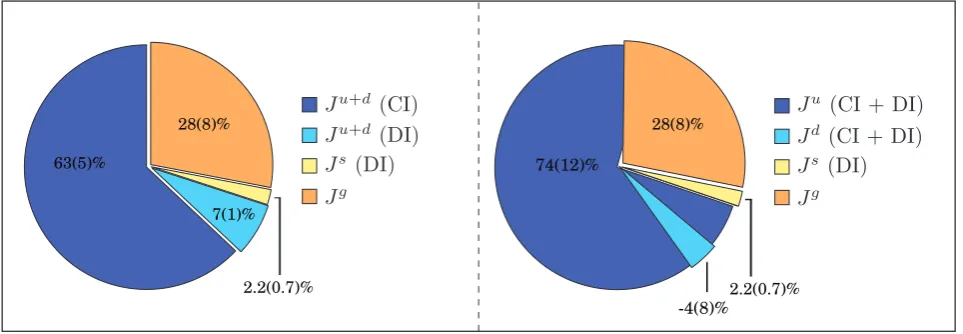
The calculation uses the quenched approximation (no quark-antiquark loops) and includes both connected inser-tions (CI) (current connects only to valence quark lines) and disconnected insertions (DI) (current also connects to quark loops, but not dynamical). The DI contributions turn out to be large. Figs. 1 and 2 show the beautiful Deka et al results for
Lq≡ LqJi,z Jq≡ JJiq,z (25) where, recall,qmeans quark plus antiquark contribution.
Their values for the total AM are
Ju=0.369±0.059 Jd =−0.018±0.042. (26)
The Table shows the various contributions to the orbital angular momentum:
CI DI T otal
Lu −0.11±0.08 0.08±0.005 −0.025±0.080
Ld 0.11±0.08 0.08±0.005 0.19±0.07
NBLu−Ld is negative = −0.22±0.11
This will be a key issue when we come to discuss models. If we make the reasonable, but non-rigorous assertion that for the DI contributions,DI(u) =DI(¯u), DI(d) = DI( ¯d) then we obtain for the valence contributions
Ju
val=0.335 Jvald =−0.052 (27) which are not too far from the values of Gonzalez-Hernandez, Liuti, Goldstein and Katuria [5] given above.
2) The relation to twist-3 GPD Gq2 of Kiptily and Polyakov [7]. One finds
LqJi,z=− 1
−1
dx x Gq2(x,0,0), (28)
a relation which was first obtained by Penttinen, Polyakov, Shuvaev and Strikman in the parton model [8] and later confirmed in QCD by Hatta and Yoshida [9]. To the best of my knowledge this has not yet been used because it is extremely difficult to extract information on such a twist-3 GPD from experiment.
3) The Lorcé and Pasquini [10] relation to Generalized Transverse Momentum Distributions (GTMDs)
LqJi,z=−
dxd2k⊥ k 2 ⊥ M2 F
q
1,4(x,k⊥,Δ =0;Wstraight), (29) where the Wilson lineWstraightconnects the points−2zand
z
2 by a direct straight line. At present there is no clear way of extracting the twist-2 GTMDs from experimental data, but they can be calculated in models.
3.2 The canonical version :Lqcan,z
Lorcé, Pasquini [10] have shown that the canonical version can also be obtained from a twist-2 GTMD, but defined with a different Wilson line
Llfcan,q,z
A+=0=−
dxd2k⊥ k 2 ⊥ M2 F
q
1,4(x,k⊥,Δ =0;WLF), (30) where the staple-like Wilson lineWLFconnects the points −z
2 and z
2 viathe intermediary points− z
2 ± ∞−and z 2 ± ∞− by straight lines. At present it is not clear how one could obtain this GTMD from experiment. It is interesting that in changing the shape of the Wilson line one obtains either the kinetic or the canonical quark orbital angular momentum.
4 Model calculations
There are four types of QCD models: none have genuine gluon degrees of freedom
• Light-Front Constituent Quark Model (LFCQM)
• Light-Front Chiral Quark-Soliton Model (LFχQSM)
• MIT Bag Model
• Myher-Thomas Cloudy Bag Model with OGE
4.1 The sign ofLu−Ld
As will be seen shortly, all models, with the exception of the LFχQSM lead topositivevalues ofLu−Ld.
However, a key question is: at what scale is the model valid?
J
u+d(CI)
J
u+d(DI)
J
s(DI)
J
gJ
u(CI + DI)
J
d(CI + DI)
J
s(DI)
J
g 63(5)%7(1)%
2.2(0.7)% 2.2(0.7)%
74(12)%
28(8)% 28(8)%
-4(8)%
Figure 1.Flavour dependence of the total angular momentum. Courtesy of Keh-Fei Liu
L
u+d(CI)
L
u+d(DI)
L
s(DI)
J
gΔΣ
2
u+d+s
L
u(CI + DI)
L
d(CI + DI)
L
s(DI)
J
gΔΣ
2
u+d+s
25(12)% 28(8)% 25(12)% 28(8)%
32(2)% 14(1)% 39(15)% 14(1)%
1(10)%
-5(16)%
Figure 2.Flavour dependence of the orbital angular momentum. Courtesy of Keh-Fei Liu
forcing the model to agree with ONE measured observ-able. Typically this leads to a scale of 0.16−0.36GeV2. Thomas [11] suggests that the positive values ofLu−Ldat the low scale of the models is not a problem since there is a cross-over inLu−Lddue to evolution. This is shown for the Myher-Thomas model in Fig. 3, where I have inserted the values found by Deka et al; the agreement is very good. A similar evolution, starting with the correct sign Lu−Ld<0 from the LFχQSM at a low scale, as used by Wakamatsu [12], gives poor agreement with the Lattice results after evolution. The problem is: can evolution be trusted at such low scales whereαsis not small???
4.2 Kinetic vs Canonical in models
Recall that
Lq Ji=
d3xψ†(x×iD)ψ (31)
and
Lq can=
d3xψ†(x×1
i∇)ψ. (32)
Since models usually have no gluon degrees of freedom,
D=−∇, so we expect that
Lq Ji=L
q
can. (33)
What do the models calculate?
(i) Expanding the nucleon state in terms of light-front wave functions in the definition of Lqcan restricted to the 3-quark sector,
q
can,z ≡ Llfcan,q,z|model =
{λ}
[dx]3[d2k⊥]3Ψ3∗+({x,k⊥, λ})
×
l,r(q)
(δrl−xl)
kr⊥×1i∇kl⊥
zΨ
+
3({x,k⊥, λ}) (34)
The peculiar structure
l,r(q)
(δrl−xl)
kr⊥×1i∇kl⊥
(35)
Figure 3.Evolution ofLu−Ldin the Myher-Thomas model. Courtesy of Tony Thomas. I have inserted the results of Deka et al [6]
by: RC M=l m
l
M
rl. In relativity the centre of inertia or centre of momentum is is given by
R=
l El
E
rl
fast quark
−−−−−−→
l
xlrl. (36)
The structure referred to is designed to yield the angular momentum about the transverse version of this introduced by Burkardt [13]
R⊥=
3
l=1
xlrl⊥. (37)
Thus one should define theZ-component of intrinsic OAM for a quark qusing −(kq⊥×bq) where bq is the impact parameter
bq = rq,⊥−R⊥ =rq,⊥−
3
l=1 xlrl⊥
=(1−xq)rq,⊥−
lq
xlrl⊥. (38)
In the momentum representation1i∇kl →rl. Thus
l
(δql−xl)
kq⊥×1i∇kl⊥
→(kq⊥×bq) (39)
(ii) One obtains the same result using a model of the GTMD in Eq. (30)
q can,z=−
dxd2k⊥ k 2 ⊥ M2 F
q
1,4(x,k⊥,Δ =0;WLF)| model
(40) (iii) For the kinetic version of the angular momentum, us-ing a model of the GPDs in the Ji relation Eq. (21) one has
q
kin,z≡ LqJi,z|model= 1
−1
dxqkin,z(x) (41)
where
q kin,z(x)=
1 2
xHq(x,0,0)+Eq(x,0,0) −2Sqz(x)
|model (42) (iv) There exists also a so-called “naive" version of
Llfcan,q,zwhich has been evaluated using light-front wave functions
Lq
can,z ≡ L lf,q
can,z|naive,model =
{λ}
[dx]3[d2k⊥]3Ψ3∗+({x,k⊥, λ})
×
r(q)
kr⊥×1i∇kr⊥
zΨ
+
3({x,k⊥, λ}) (43)
Here the factor (δrl − xl) in Eq. (34 is replaced by δrl. Therefore this is the angular momentum about theorigin.
(v) In some models it appears that naiveLqcan,zcan be obtained from the Pretzelosity. She et al [14] and Avakian et al [15] find
Lq can,z=−
dxd2k⊥ k 2 ⊥ 2M2 h
⊥q 1T(x,k
2
⊥) (44)
but Lorce and Pasquini [16] have shown that this is only valid in a restricted class of models. It requires the instant-form wave functionψ({k, σ}) to be a pures-wave and re-lated to the light-front wave functionΨ({x,k⊥, λ}) by just a Wigner rotation.
4.3 Some model results
Model LFCQM LFχQSM
q u d Total u d Total
q
kin,z 0.071 0.055 0.126 −0.008 0.077 0.069 q
can,z 0.131 −0.005 0.126 0.073 −0.004 0.069
Lq
can,z 0.169 −0.042 0.126 0.093 −0.023 0.069 b
In each model the contributions of the u quark to the three versionskin,z,can,z,Lcan,zare different, and similarly for thedquark
But in each model the total contribution of (u+d) to kin,z, can,z,Lcan,zis the same
It is not surprising thatqcan,z Lqcan,z, and, as can be seen from comparing Eqs.(34, 43) one should expect to have the result found, i.e. thatqqcan,z=qLqcan,z
It is puzzling, given that there is noAμ in the models, thatqkin,z qcan,z. Probably this is because the Ji relation forqkin,zuses the QCD energy-momentum tensor, which is different from the one in the models
In that case it may seem surprising that qqkin,z =
qqcan,z. Burkardt, at this Conference, has suggested that this occurs because all models are normalized so that
q
Jkinq ,z= q
Jqcan,z=1/2 (45)
and since the spin term q S q
z in each model doesn’t de-pend on the label “kin" or “can" one will have
q q
kin,z=1/2−
q Sqz =
q q
can,z. (46)
There is a further puzzle. Burkardt and Hikmat [17] calculatedqkin,zvia the Ji relation andqcan,zdirectly from the wave functions in the scalar diquark model, which has noAμ, and they obtained, as was expected,qkin,z=qcan,z But for the density in Bjorken-x they found, contrary to expectations, that
q
kin,z(x) q
can,z(x). (47) This implies that the Ji relation does not hold for the den-sitiesin x-space i.e.
JJiq,z(x) 1 2x
Hq(x,0,0)+Eq(x,0,0) (48)
contrary to claim of Hoodbhoy, Ji and Lu [18]. The re-sults in the latter paper depend on discarding an infinite number of surface terms, each arising from integrating a divergence term, and this is almost certainly unjustified.
5 conclusions
• There exist many other versions of the angular momen-tum, the so called, Gauge Invariant Extensions. They are theoretically interesting, but I believe they contain no new physics.
• There are just three physically relevant versions of the OAM:
Linstcan,q,z
A+=0 L lf,q can,z
A+=0 L q Ji,z
• All these can be related, in principle, to measurable quantities like GPDs and GTMDs, but measuring them from experiment is difficult and is a challenge for the future.
• LqJi,z ≡ Lq can be calculated on a Lattice. Beautiful results have been obtained, in particular by Deka et al, who for the first time include the Disconnected Inser-tions, and find them to be very important. At 2GeV, in theMSscheme, they find Lu−Ld <0.
• Lqcan,zcan be calculated in models where it is called q
can,z. It is important to distinguish about what point the OAM is defined:naiveabout the origin orintrinsic about the transverse centre of momentum.
• LqJi,zcan be calculated in models, where it is called q
kin,z. Almost all giveukin,z−kind ,z>0 at the scale where the model is supposed to be reliable. This is presum-ably a very low scale so that under evolution to the scale 2GeV this result may become compatible with the op-posite sign as found in the Lattice calculations.
• In a model with no Aμ it is found, as expected, that qkin,z = canq ,z, but, surprisingly that qkin,z(x) q
can,z(x), which implies that the Ji relation does not hold at the density level i.e. that JqJi,z(x)
1 2x
Hq(x,0,0)+Eq(x,0,0).
• All in all this is a very exciting and open field, both for theory and for experiment. Lattice calculations disagree with each other, and model calculations disagree with each other and with the Lattice results... a real chal-lenge to theory. On the other hand much extremely in-teresting information can, in principle, be extracted from experiment, but this requires a significant increase in the precision of the data...a tough challenge to experi-ment.
References
[1] X.S. Chen, X.F. Lu, W.M. Sun, F. Wang, T. Goldman, Phys. Rev. Lett.100, 232002 (2008), 0806.3166
[2] E. Leader, C. Lorce, Phys.Rept. (2013),1309.4235 [3] X.D. Ji, Phys. Rev. D55, 7114 (1997),
hep-ph/9609381
[4] M. Diehl, P. Kroll, Eur.Phys.J. C73, 2397 (2013), 1302.4604
[5] J.O. Gonzalez-Hernandez, S. Liuti, G.R. Gold-stein, K. Kathuria, Phys.Rev.C88, 065206 (2013), 1206.1876
[6] M. Deka, T. Doi, Y. Yang, B. Chakraborty, S. Dong et al. (2013),1312.4816
[8] M. Penttinen, M.V. Polyakov, A. Shuvaev, M. Strik-man, Phys.Lett.B491, 96 (2000),hep-ph/0006321 [9] Y. Hatta, S. Yoshida, JHEP 1210, 080 (2012),
1207.5332
[10] C. Lorcé, B. Pasquini, Phys.Rev. D84, 014015 (2011),1106.0139
[11] A.W. Thomas, Phys.Rev.Lett. 101, 102003 (2008), 0803.2775
[12] M. Wakamatsu, Eur.Phys.J.A46, 327 (2010) [13] M. Burkardt, Phys.Rev. D62, 071503 (2000),
hep-ph/0005108
[14] J. She, J. Zhu, B.Q. Ma, Phys.Rev. D79, 054008 (2009),0902.3718
[15] H. Avakian, A. Efremov, P. Schweitzer, F. Yuan, Phys.Rev.D81, 074035 (2010),1001.5467
[16] C. Lorcé, B. Pasquini, Phys.Lett.B710, 486 (2012), 1111.6069
[17] M. Burkardt, B.C. Hikmat, Phys. Rev.D79, 071501 (2009),0812.1605
![Figure 3. Evolution of Lu − Ld in the Myher-Thomas model. Courtesy of Tony Thomas. I have inserted the results of Deka et al [6]](https://thumb-us.123doks.com/thumbv2/123dok_us/8184659.1366858/5.595.115.479.66.278/figure-evolution-myher-thomas-courtesy-thomas-inserted-results.webp)
