Review
1
The Janus Face of NKT Cell Function in
2
Autoimmunity and Infectious Diseases
3
Alessandra Torina1, Giuliana Guggino2, Marco Pio La Manna3-4, and Guido Sireci3-4*
4
1 Istituto Zooprofilattico della Sicilia, Via Marinuzzi 3, 90100 Palermo, Italy e-mail:
5
6
2 Dipartimento Biomedico di Medicina Interna e Specialistica, Sezione di Reumatologia, Università di
7
Palermo, Piazza delle Cliniche 2, 90100 Palermo, Italy e-mail: [email protected]
8
3 Dipartimento di Biopatologia e Biotecnologie Mediche, Sezione di Patologia Generale, Università di
9
Palermo, Via del Vespro 129, 90100 Palermo, Italy e-mail: [email protected],
10
11
4 Central Laboratory Advanced Diagnostic and Biological Research, Azienda Ospedaliera Universitaria
12
Policlinico “Paolo Giaccone”, Via del Vespro 129, 90100 Palermo, Italy
13
* Correspondence: [email protected] ; Tel.: +39 091 6555939
14
Abstract: Natural killer T cells (NKT) are a subset of T lymphocytes bridging innate and adaptive
15
immunity. These cells recognize self and microbial glycolipids bound to non-polymorphic and
16
highly conserved CD1d molecules. Three NKT cell subsets, type I, II and NKT-like expressing
17
different antigen receptors (TCR) were described and TCR activation promotes intracellular events
18
leading to specific functional activities. NKT can exhibit different functions depending on the
19
secretion of soluble molecules and the interaction with other cell types. NKT cells act as regulatory
20
cells in the defence against infections but, on the other hand, their effector functions can be
21
involved in the pathogenesis of several inflammatory disorders due to their exposure to different
22
microbial or self antigens, respectively. A deep understanding of the biology and functions of type
23
I, II and NKT-like cells as well as their interplay with cell types acting in innate (Neuthrophils,
24
Innate Lymphoid cells, Machrophages and Dendritic cells) and adaptive immunity (CD4+,CD8+ and
25
Double Negative T cells) should be important to design potential immunotherapies for infectious
26
and autoimmune diseases.
27
Keywords: microbes; autoimmunity; glycolipids,alpha-GalactosylCeramide; sulfatide; CD1d;
28
NKT.
29
30
Antigen presenting cells displaying the non-classical histocompatibility molecules (CD1 and
31
MR1) bind glycolipids or Vitamin B metabolites; the complex CD1-glycolipids activate NKT cells
32
while MR1-Vitamin B metabolites metabolites are recognized by Mucosal Associated Invariant T
33
(MAIT) cells, another subset of T cells showing innate and adaptive features. TCRs involved in
34
recognition of CD1-glycolipids or MR1-Vitamin B metabolites complexes have a common distinctive
35
characteristic: they display an invariant chain and few chains. In contrast to their reduced
36
antigen receptor repertoire these cells show a marked plasticity in their functions as demonstrated
37
by the production of different cytokines after in vivo stimulation of naïve mice with
38
-GalactosylCeramide (-GalCer) [1]. A small percentage of NKT produce IL10 in human
39
unstimulated Peripheral Blood Mononuclear Cells (PBMC) confirming their immunomodulatory
40
feature [2].
41
1. Distinctive functional activities of types of NKT
42
CD1 molecule is a family of glycoproteins expressed on the surface of several
43
antigen-presenting cells (APC) involved in the presentation of glycolipid antigens to T cells [3].
44
Glycolipids bound to CD1 molecules can generate different types of antigen recognition. Two
45
groups of CD1 molecules were identified depending on their lipid anchoring as described below: i)
46
CD1a, CD1b and CD1c expressed on dendritic, B cells and macrophages ; ii) CD1d mainly expressed
47
on the same APCs of the other forms of CD1. CD1e, an intermediate isoform, is located in the cells
48
and its role is still unclear.
49
In humans CD1 a-c isoforms are able to bound mycobacterial as well as self-antigens [3-10].
50
CD1d activate the majority of NKT cells expressing an invariant T-cell receptor (TCR) chain
51
rearrangement and are called type I NKT or invariant NKT (iNKT). CD1a migrate from endoplasmic
52
reticulum (ER) to cell surface to bind antigens while CD1b,c and d are recycling from ER to
53
membrane and viceversa [3-8]. APC expressing CD1d are widely expressed on different type of cells:
54
dendritic cells, macrophages, monocytes, cortical thymocytes. CD1d presenting glycolipid activate
55
Type I NKT. Type I NKT use TCR constituted by few chains pairing with V14J18 in mice and
56
V24J18 TCR in humans. They were characterized by the ability to induce strong cytotoxic immune
57
response in murine cancer model [11]. Type I NKT recognize in humans and mice a glycolipid
58
obtained by a marine sponge, -GalCer.
59
Another subset of NKT cells, called type II NKT cells, does not react with-GalCer, but binds a
60
self-lipid, sulfatide, highly expressed Central Nervous System (CNS), kidney, pancreas and liver
61
[12,13]. They recognize several self-lipids using oligoclonal TCRs expressing V3 or V1 and V8.1
62
or V3.1. Type II NKT cells can accumulate in the CNS, suggesting their compartmentalization in
63
this tissue respect to Type I NKT (3%/0.6%, respectively) as this tissue display high expression of
64
sulfatide.
65
NKT-like cells are another subset able to express constitutively either T cell surface (TCR) or NK
66
markers (CD16,CD56,CD161) and they were shown to be involved in pulmonary disease [14].
67
A promising role in adoptive immunotherapies of cancer was assigned to another subset of cells
68
called Cytokine Induced Killer (CIK) cells [15]. This subset could be obtained by culturing PBMC
69
with anti CD3 beads plus IFN- and high doses of IL-2. They comprise lymphocytes with different
70
phenotypes: CD3+CD56+,CD3+CD56-,CD3-CD56+ but they are CD16-. CIK cells are a mixture of
71
NKT-like and NK-like cells. These cells are strong cytotoxic subset whose targets are a wide array
72
of tumors and the mechanism of cytolisis is MHC- or non MHC-restricted. They do not exert
73
Antibody Dependent Cell Cytotoxicity (ADCC) because they lost CD16.
74
Type I and II NKT can be involved in autoimmune and infectious diseases.
75
2. Type I NKT in response to microbial antigens
76
V14- or V24-driven NKT cell response may either promote or inhibit immune response to
77
many different microbial pathogens. Type I NKT driven protection to microbial antigens was
78
analyzed by different authors [16-18]. Even if type I NKT expand during various types of infection
79
[19], it was found that the activation of type I NKT by microbial antigens seems to be due at least to
80
two different mechanisms: i) direct binding of microbial antigens to TCR of type I NKT (direct
81
recognition [19,20]); ii) type I NKT expansion mediated by cytokines (IL12-IL18) released by other
82
cells (Antigen Presenting Cells like Dendritic Cells, NK, T cells) during infections (indirect
83
recognition [21,22]). In particular the indirect recognition, mainly due to IL-12 driven activation of
84
microbial structures by type I NKT was described not only in bacterial infections (in LPS induced
85
activation [21,22]) or other infectious diseases [23-26] but also during viral infections and type I NKT
86
activation in virus infected mice seems to be due to an indirect (IL-12-driven) mode of activation
87
[23,27].
88
-GalCer, the exogenous ligand of type I NKT, was characterized as a glycosphingolipid able to
89
activate type I NKT. There are microbial cell wall antigens that have same chemical structure of
90
-GalCer. These glycosphingolipids were described in cell wall of Gram negative LPS-free
91
Sphingomonas species, S. Yanoiuyakey. These bacteria aren’t pathogenic but type I NKT KO mice are
92
exerting a defective clearance of these microbes. Another type of ligand for type I NKT TCR was
93
described in Borrelia burgdorferi, a microbe causing Lime disease. V14 KO mice also manifest a
94
IL-4 [29,30]. B. burgdorferi doesn’t display glycosphingolipids but glycosilated diacylglicerol [31,32]
96
that are weak type I NKT ligands.
97
Helicobacter pylori, the causative agent bacteria of gastritis and peptic ulcers, has cholesteryl
98
phosphatidyl -glucoside. V14 KO mice have a defective clearance of H. pylori but there aren’t
99
evidences that cholesteryl phosphatidyl -glucoside could bind to CD1d [33]. Another microbial
100
source of type I NKT antigens is derived from Entamoeba hystolitica, a pathogen causing abscesses in
101
the gut. It was found a lipopeptidophosphoglycan derived from E. hystolitica that is able to activate
102
iNKT and this event decrease abscesses due to the infection [34].
103
Another interesting observation about type I NKT response in experimental infectious disease
104
describes an early increase of NKT producing IL17 during Rickettsia conorii murine infection. The
105
increase of type I NKT IL17+ was detected after 3 days of infection either ex vivo or after in vitro
106
-GalCer stimulation [35]. In the same study we report an early increase of NK IFN-+ ex vivo,
107
suggesting a cytokine milieu, rich of IL12, derived from DC, and IFN- from NK, that could favour
108
an increase of type I NKT producing IL17 that could be responsible of vasculitis, a pathological
109
feature not only during Rickettsia spp infections but also occurring in autoimmune disorders [36].
110
A novel mechanism of indirect activation of type I NKT was found in an experimental model of
111
infection by Leishmania mexicana [37]. Lipophosphoglycan (LPG),derived from this pathogen,
112
stimulating Toll Like Receptor 2 (TLR2) on the membrane of DC, up-regulate MHC Class II, B7 and
113
IL-12. These effects cause an increase of IFN-by type I NKT and L. mexicana lesions were decreased
114
in the mice. A different pathway of activation of type I NKT (direct) was detected in Leishmania
115
donovani infection [38]. In this model lipophosphoglycan , obtained from the parasite, bind CD1d
116
and stimulate TCR of type I NKT.
117
A direct mechanism of activation of iNKT was reported using a molecule derived from a
118
fungus. A glycosphingolipid, asperamide B, obtained by Aspergillus fumigatus, a saprophytic fungus
119
causing allergic disorders in humans, bound by CD1d, activate iNKT cells in an IL33-ST2 pathway,
120
causing allergy [39].
121
All these studies describe different pathways by which microbes could activate type I NKT
122
subset. Many microbial molecules are able to bind type I NKT TCR directly or these antigens could
123
promote the release of cytokines that induce type I NKT immune responses (indirect pathway of
124
activation). This type of host immune response may exacerbate or protect the host from infections.
125
3. Role of type II NKT in immune responses to different microorganisms
126
Sulfatide-reacting NKT cells (Type II NKT) were shown to exert different effects in
127
experimental infectious diseases. In fact, in Trypanosoma cruzi-infected mice a proinflammatory
128
effect by type II NKT was described [40] while an opposite effect was described in Schistosoma
129
mansoni infection accompanied by secretion of Th2 cytokines was exerted by the same subset [41]. A
130
reduced secretion of TNF- and IL-6 ,due to type II NKT activation in Staphylococcus aureus induced
131
sepsis, protect mice from death [42]. It was shown that glycolipids obtained from Mycobacterium
132
tuberculosis or Corynebacterium glutamicum [43] and phosphatidylglycerol from Listeria monocytogenes
133
[44] could activate type II NKT cells.
134
Controversial effects of type II NKT activation were reported in experimental viral infections. In
135
an experimental model of Hepatitis B Virus (HBV) infection an activation of type II NKT due to
136
NKG2d cause damage to the liver. In particular, phosphatydiletanolamine and
137
lysophosphatydiletanolamine ER-self lipids obtained by HBV infection induce liver type II NKT
138
activation that transactivate type I NKT cells during infection [45]. Sulfatide-induced type II NKT
139
activation occurring in Scid-hu lymphopoiesis was shown to induce type I NKT anergy during HIV
140
infection [46].
141
4. Type I NKT in autoimmune and chronic inflammatory diseases
142
Since NKT can be either pathogenic or protective, studies tried to better define the role of NKT
143
subsets and particularly type I NKT cells appear to have a greater propensity to be more pathogenic
144
disorders. Type I NKT seems to have a role in the regulation of chronic inflammation supporting
146
many autoimmune diseases such as Systemic Lupus Erythematosus (SLE) [47], rheumatoid arthritis
147
(RA) [48] and Sjogren Syndrome (SS) [49]. Despite their “classical” pathogenic role in many of
148
these diseases type I NKT cells can display a protective feature.
149
Reduced numbers of type I NKT cells among PBMC appear to correlate with several
150
autoimmune or inflammatory conditions, together with a possible increase at the anatomical site of
151
inflammation. The reasons for this reduction and compartmentalization, respectively, could be
152
linked in part to differences in the patterns of motility and recirculation of different NKT cells in the
153
blood and target tissues.
154
A perfect model showing the complex role (protective versus pathogenic) was found in SLE
155
patients. In these patients type I NKT quantitative deficiency appear to correlate with the activity
156
of SLE disease [47], and these observation is supported from data obtained in lupus prone animal
157
model [50], where, additionally, lower rate of proliferation to -GalCer was detected. This results
158
were also confirmed in SLE patients with active disease [51,52]. In vitro studies have demonstrated a
159
defective response of type I NKT from SLE patients to -GalCer that could be exacerbated by the
160
compromised expression of costimulatory molecule (CD26 [53]). Impaired activation could also
161
influence the cytokines production and in turn contribute to the progression of SLE. On the other
162
hand, other studies have indicated that iNKT cells can secrete IL-17 and other cytokines in several
163
inflammatory diseases, including SLE, depending on the pro-inflammatory environment occurring
164
in damaged tissues [54,55]. These results clarified that type I NKT were complex and pleiotropic.
165
At the same time protective role of increase of type I NKT in autoimmunity could be due to a
166
suppressive effects of this subset on autoantibodies production [56]; type I NKT can inhibit CD1d+
167
autoreactive B cells in producing autoantibodies [57]. Another interesting observation of the effect of
168
type I NKT activation on autoimmunity report that a protection in autoimmune experimental model
169
of lupus due to a short term in vivo activation by -GalCer increasing a subset of IL-10 producing B
170
cells that could inhibit autoantibodies secretion [58]. The short term in vivo activation of type I NKT
171
by -GalCer derivative is able to induce a tolerogenic state, due to anergy of DC and type I NKT,
172
that cause protection of NOD mice by type I diabetes [59].
173
We could hypothesize a time-dependent type I and II NKT activation that could modulate
174
inflammation occurring in autoimmunity as it happens inshort-term -GalCer in vivo exposure in
175
naive mice [1] (Fig.1). Moreover, several studies [48,55] including patients with RA, showed that
176
NKT cells can affect the differentiation of Th cells, including Th1, Th2, Th17 and Treg, via the
177
production of cytokines or cell contact, suggesting an indirect role of NKT cells, boosting the
178
differentiation of CD4+ T lymphocytes.
179
180
Different types of cytokines are produced depending by the time of exposure of NKT to
182
ligands. Short term activation results in prevalence of anti-inflammatory molecules (i.e. IL10);
183
pro-inflammatory cytokines (i.e. IFN-) are increased in long term (more than 6 hours) activation by
184
NKT ligands.
185
5. Type II NKT in autoimmune and chronic inflammatory diseases
186
Sulfatide-reacting NKT cells were described initially in central nervous system (SNC) where
187
they are more abundant then type I NKT being sulfatide really abundant in this tissue (60).
188
Interestingly, in vivo administration of brain-derived or synthetic sulfatide compounds prevent the
189
onset of Experimental Allergic Encephalomyelitis (EAE) and diabetes in Non Obese Diabetic (NOD )
190
mice [61-63]. It was reported that type II NKT, activated by sulfatide, induce anergy of type I NKT
191
and dendritic Cells (DC) in EAE [63].
192
An opposite role in development was described in ulcerative colitis [64-66]; in these studies, in
193
humans and mice, type II NKT secreting IL13 in response to lyso-sulfatide are increased [64-66] and
194
contribute to inflammation.
195
Thus, type II NKT may display both protective and pro-inflammatory features and these
196
functions seems to be due to the different types of tissue-specific ligands: tolerogenic molecules in
197
SNC and pancreas but inflammatory ligands in the gut.
198
6. CIK cells as players of antimicrobial immune response
199
This hybrid subset of cytotoxic cells, having phenotypes and functional characteristic similar to
200
NKT-like and NK-like subsets, are able to lyse not only many tumors but also other target cells
201
infected by microbes [67]. Cytomegalovirus (CMV) and Epstein Barr Virus (EBV) specific effector
202
memory CD8+ T cells are expanded in CIK cultures obtained by PBMC. Interestingly, CIK could be
203
able to kill either virus infected cells and neoplastic cells. It could have a useful application in the
204
immunotherapies in bone marrow transplanted patients. In these cases CIK infusions could help to
205
eliminate residual leukemic cells and improve the immune response against CMV, EBV or other
206
microbial infections that could frequently cause severe problems in these type of patients. To this
207
end, this type of intervention has feasibility in fact the numbers of CIK cells obtained from small
208
amounts of blood could justify this kind of helpful strategies. As it was shown that CIK cytolysis
209
could be mediated by NKG2D-dependent mechanism [68], CIK could be active in killing of
210
mycobacterial infected cells [69] as well as target cells infected by other pathogens expressing
211
NKG2D.
212
7. Concluding remarks
213
NKT cells represent a subset expressed in low percentages in peripheral blood and tissues in
214
humans and mice. These cells are activated by endogenous or exogenous ligands linked to non
215
polymorphic CD1 molecules and significantly contribute to the onset of infectious or autoimmune
216
diseases. Either type I or type II NKT cells are involved in many infectious or autoimmune disorders.
217
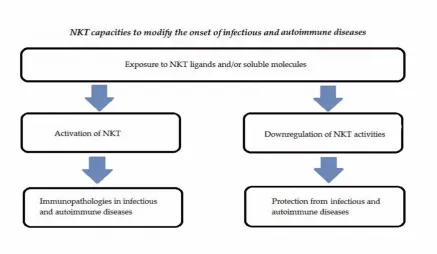
NKT cells may display multiple functions representing a complex system. Figure 2 summarize the
218
220
Figure 2
.
Schematic mechanisms of interaction of NKT in infectious and autoimmune diseases.221
222
Exposure to NKT ligands expressed by microbes or anatomical districts in combination with
223
cytokine milieu could provide promoting or protective effects for these immunopathologies due not
224
only by NKT activities but also by interaction of these cells with other cells (dendritic cells,
225
neutrophils, machrophages, etc..).
226
Self-reactivity of NKT cells may be due to an evolutionary aspect and could be one of the early
227
links between the innate and adaptive immune systems as a way to respond to various antigens,
228
regardless of their source, that could compromise the integrity of the organism’s tissues.
229
Responding to microbial antigens, NKT cells could have evolved to sense when to limit
230
inflammation to prevent self-tissue destruction, a role consistent with their ability to ameliorate a
231
number of autoimmune conditions as we discussed in this paper [57-59]. The rapid immune
232
response elicited by microbial antigens may be seen as a way for the body to protect itself against
233
damage, a function perhaps coopted into the ability of NKT cells to protect the self even when
234
foreign antigens are not present. A common mechanism by which NKT could act in autoimmunity
235
and microbial infection was reported by De Libero et al. [70]. They report that bacterial infections
236
could promote reaction of NKT to self glycosphingolipids that could induce autoreactivity. Other
237
common mechanisms by which NKT could react to microbes as well as autoantigens could be due
238
to superantigens expressed by bacteria that induce polyclonal activation of T cells responsible of
239
autoimmune responses [71] and innate immune response of NKT could initiate and/or promote the
240
inflammatory status by which an autoimmune disease begin [72].
241
Binding -GalCer or Sulfatide, Type I and II NKT secrete cytokines and/or chemokines and
242
their activation can contribute to the onset of several diseases and could modify the outcome of
243
infections and autoimmune disorders. Soluble factors secreted by NKT cells could act modulating
244
directly or indirectly, transactivating other immune cells (NK, machrophages, DCs, neutrophils, B
245
and T cells, etc....) and promoting cascade of events with an immunopathogenic roles. CIK, with its
246
being studied mainly in antitumor immunity but having promising roles in antimicrobial immune
248
response.
249
Hypothetically, NKT expanded from PBMC of patients exposed for few hours to -GalCer
250
could induce antiinflammatory cytokines (IL10) , as previously reported [58,59], downregulating
251
polyclonal activation of T and B cells and related symptoms in autoimmune diseases. CIK cells from
252
patients affected by autoimmune diseases could be transfected with TCRs recognizing autoantigens
253
and injected in patients; they could kill autoreactive cells reacting ameliorating clinical outcome of
254
autoimmune diseases.
255
The plasticity of NKT and cytotoxic activity of CIK cells could be considered as a weapon to
256
build specific immunotherapies.
257
258
Conflicts of interests: The authors declare no conflict of interest.
259
260
Acknowledgements: We are grateful to Prof. Francesco Dieli for revision of the paper and for his
261
helpful criticism. Funded by Italian Ministry of Health RC IZSSI 20/16.
262
References
263
1. Matsuda, J.L.; Gapin, L.; Baron, J.L.; Sidobre, S.; Stetson, D.B.; Mohrs, M.; Locksley, R.M.; Kronenberg,
264
M. Mouse V alpha 14i natural killer cells are resistant to cytokine polarization in vivo. Proc Natl Acad
265
Sci USA2003, 100, 8395–8400.
266
2. Sag, D.; Krause, P.; Hedrick, C.C.;Kronenberg, M.,;Wingender, G. IL-10-producing NKT10 cells are a
267
distinct regulatory invariant NKT cell subset. J Clin Invest2014, 124, 3725–3740 .
268
3. Moody, D.B.; Sugita, M.; Peters, P.J.; Brenner, M.B.; Porcelli, S.A. The CD1-restricted T-cell response to
269
mycobacteria. Res Immunol 1996 147, 550–559.
270
4. Moody, D.B.; Reinhold, B.B.; Guy, M.R.; Beckman, E.M.; Frederique, D.E.; Furlong, S.T.; Ye, S.;
271
Reinhold, V.N.; Sieling, P.A.;Modlin, R.L.; Besra, G.S., Porcelli, S.A. Structural requirements for
272
glycolipid antigen recognition by CD1b- restricted T cells. Science1997, 278,283–286.
273
5. Rosat, J.P.; Grant, E.P.; Beckman, E.M.; Dascher, C.C.; Sieling, P.A.; Frederique, D.; Modlin, R.L.;
274
Porcelli, S.A.; Furlong, S.T.; Brenner, M.B. CD1-restricted microbial lipid antigen-specific recognition
275
found in the CD8+ αβ T cell pool. J Immunol1999, 162, 366–371.
276
6. Shamshiev, A.; Donda, A.; Carena, I.; Mori, L.; Kappos, L.; De Libero, G. Self glycolipids as T-cell
277
autoantigens. Eur J Immunol1999, 29, 1667–1675.
278
7. Moody, D.B.; Guy, M.R.; Grant, E.; Cheng, T.Y.; Brenner, M.B.; Besra, G.S., Porcelli, S.A.
279
CD1b-mediated T cell recognition of a glycolipid antigen generated from mycobacterial lipid and host
280
carbohydrate during infection. J Exp Med 2000, 192, 965–976.
281
8. Moody, D.B.; Ulrichs, T.; Muhlecker, W.; Young, D.C.,; Gurcha, S.S.; Grant, E.; Rosat, J.P.; Brenner,
282
M.B.; Costello, C.E.; Besra, G.S.; Porcelli, S.A. CD1c-mediated T-cell recognition of isoprenoid
283
glycolipids in Mycobacterium tuberculosis infection. Nature2000, 404, 884–888.
284
9. Moody, D.B.; Young, D.C.; Cheng, T.Y.; Rosat, J.P.; Roura-Mir, C.; O’Connor, P.B.; Zajonc, D.M.;
285
Walz, A.; Miller, M.J.; Levery, S.B.; Wilson, I.A.; Costello, C.E.; Brenner, M.B. T cell activation by
286
lipopeptide antigens. Science2004, 303, 527–531.
287
10. Birkinshaw, R.W.; Pellicci, D.G.; Cheng, T.Y.; Keller, A.N.; Sandoval-Romero, M.; Gras, S.; de Jong,
288
A.; Uldrich, A.P.; Moody, D.B.; Godfrey, D.I.; Rossjohn. J. T cell antigen receptor recognition of
289
CD1a presenting self lipid ligands. Nat Immunol2015, 16, 258–266.
290
11. Cui, J.; Shin, T.; Kawano, T.; Sato, H.; Kondo, E.; Toura, I.; Kaneko, Y.; Koseki, H.; Kanno, M.;
291
Taniguchi, M. Requirement for V14 NKT cells in IL-12-mediated rejection of tumors. Science. 1997,
292
12. Arrenberg, P.; Halder, R.; Dai, Y.; Maricic, I.; Kumar, V. Oligoclonality and innate-like features in the
294
TCR repertoire of type II NKT cells reactive to a beta-linked self-glycolipid. Proc Natl Acad Sci U S A
295
2010, 107,10984–10989.
296
13. Jahng, A.; Maricic, I.; Aguilera, C.; Cardell, S.; Halder, R.C.; Kumar, V. Prevention of autoimmunity by
297
targeting a distinct, noninvariant CD1d-reactive T cell population reactive to sulfatide. J Exp Med2004,
298
199, 947–957.
299
14. Hodge, G.; Hodge, S. Steroid resistant CD8+CD28null NKT-like pro-inflammatory cytotoxic cells in
300
chronic obstructive pulmonary disease. Front Immunol2016, 7, 1-6.
301
15. Schmidt-Wolf, IG; Negrin, RS; Kiem, HP; Blume, KG; Weissman, IL. Use of a SCID mouse/human
302
lymphoma model to evaluate cytokine-induced killer cells with potent antitumor cell activity"J Exp
303
Med1991,174 ,139–49.
304
16. Godfrey, D.I.; Kronenberg M. Going both ways: immune regulation via CD1d-dependent NKT cells. J
305
ClinInvest2004, 114,1379–88.
306
17. Kronenberg, M.; Gapin, L. The unconventional lifestyle of NKT cells. Nat Rev Immunol2002, 2, 557–568.
307
18. Tupin, E.; Kinjo, Y.; Kronenberg, M. The unique role of natural killer T cells in the response to
308
microorganisms. Nat Rev Microbiol2007, 5, 405–17.
309
19. Skold, M.; Behar, S.M. Role of CD1d-restricted NKT cells in microbial immunity. Infect Immun2003,
310
71, 5447–5455.
311
20. Zajonc, M.D.; Girardi, E. Recognition of microbial glycolipids by natural killer T cells. Front Immunol
312
2015, 400, 1-11.
313
21. Leite-De-Moraes, M.C.; Hameg, A.; Arnould, A.; Machavoine, F.; Koezuka, Y.; Schneider, E.; Herbelin,
314
A.;Dy, M. A distinct IL-18-induced pathway to fully activate NKT lymphocytes independently from
315
TCR engagement. J Immunol1999, 163, 5871–5876.
316
22. Nagarajan, N.A.; Kronenberg, M. Invariant NKT cells amplify the innate immune response to
317
lipopolysaccharide. J Immunol 2007, 178, 2706-2713.
318
23. Wesley, J.D.; Tessmer, M.S.; Chaukos, D.; Brossay, L. NK cell-like behavior of Vα14i NK T cells during
319
MCMV infection. PLoS Pathog 2008, 4:e1000106.
320
24. Brigl, M.; Bry, L.; Kent, S.C.; Gumperz, J.E.; Brenner, M.B. Mechanism of CD1d restricted natural killer
321
T cell activation during microbial infection. Nat Immunol2003, 4, 1230–1237.
322
25. Paget, C.;Mallevaey, T;Speak, A.O.;Torres, D; Fontaine, J.; Sheehan, K.C.; Capron, M; Ryffel, B.;
323
Faveeuw, C.; Leite de Moraes, M.; Platt, F.; Trottein, F. Activation of invariant NKT cells by toll-like
324
receptor 9-stimulated dendritic cells requires type I interferon and charged glycosphingolipids.
325
Immunity2007, 27, 597–609.
326
26. Brigl, M.; Tatituri, R.V.; Watts, G.F.; Bhowruth, V.; Leadbetter, E.A.; Barton, N.; Cohen NR, Hsu FF,
327
Besra, G.S.; Brenner, M.B. Innate and cytokine-driven signals, rather than microbial antigens, dominate
328
in natural killer T cell activation during microbial infection. J Exp Med 2011 , 208, 1163–1177.
329
27. Tyznik, A.J.; Tupin, E.; Nagarajan, N.A.; Her, M.J.; Benedict, C.A.; Kronenberg, M. Cutting edge: the
330
mechanism of invariant NKT cell responses to viral danger signals. J Immunol2008, 181, 4452–4456.
331
28. Dieli, F.; Sireci, G.; Russo, D.; Taniguchi, M.; Ivanyi, J.; Fernandez, C.; Troye-Blomberg, M.; De Leo, G.;
332
Salerno, A. Resistance of natural killer T cell-deficient mice to systemic Shwartzman reaction. J Exp
333
Med 2000, 192, 1645–1652.
334
29. Olson, C.M. Jr; Bates, T.C.; Izadi, H.; Radolf, J.D.; Huber, S.A.; Boyson, J.E.; Anguita J.Local production
335
ofIFN-gamma by invariant NKT cells modulates acute Lyme carditis. J Immunol2009, 182; 3728–3734.
336
30. Kinjo, Y.; Tupin. E; Wu, D; Fujio, M.; Garcia-Navarro, R.; Benhnia, M.R.; Zajonc, D.M.; Ben-Menachem,
337
G.; Ainge, G.D.; Painter, G.F.; Khurana, A.; Hoebe, K.; Behar, S.M.; Beutler, B.; Wilson, I.A.; Tsuji, M.;
338
Sellati, T.J.; Wong, C.H.; Kronenberg, M. Natural killer T cells recognize diacylglycerol antigens
339
from pathogenic bacteria. Nat Immunol2006, 7, 978–986.
340
31. Ben-Menachem, G.; Kubler-Kielb, J.; Coxon, B.;Yergey, A.; Schneerson, R. A newly discovered
341
cholesteryl galactoside from Borrelia burgdorferi. Proc Natl Acad Sci U S A2003, 100, 7913–7918.
342
32. Schröder, N.W.; Schombel, U.;Heine, H.; Gobel, U.B.; Zähringer, U.; Schumann ,R.R. Acylated
343
cholesteryl galactoside as a novel immunogenic motif in Borrelia burgdorferi sensu stricto. J Biol Chem
344
2003, 278, 33645–33653.
345
33. Ito, Y.; Vela, J.L.; Matsumura, F.; Hoshino, H.; Tyznik, A.; Lee, H.; Girardi, E.; Zajonc, D.M.;
346
Nakayama, J.; Kronenberg, M.; Fukuda, M. Helicobacter pylori cholesteryl alpha-glucosides contribute
348
to its pathogenicity and immune response by natural killer T cells. PLoS One2013, 8:e78191.
349
34. Lotter, H.; Gonzalez-Roldan, N.; Lindner, B.;, Winau, F.; Isibasi, A.; Moreno-Lafont, M.;Ulmer, A.J.;
350
Holst, O.;Tannich, E.; Jacobs, T. Natural killer T cells activated by a lipopeptidophosphoglycan from
351
Entamoeba histolytica are critically important to control amebic liver abscess. PLoS Pathog
352
2009,5:e1000434.
353
35. La Manna, M.P.; Torina, A; Agnone, A.; Blanda, V.; Caracappa, S.; Alongi, A.; Di Marco, V.;, Giudice,
354
E;, Dieli, F.; Sireci, G. Detection of natural killer T cells in mice infected with Rickettsia conorii.
355
TransboundEmerg Dis2013, 60 Suppl 2,80-85.
356
36. Keino, H.; T. Watanabe, W.; Taki, W.; Okada, A. A. Effect of Infliximab on gene expression profiling in
357
Behçet's disease. Invest. Ophth. Vis. Sci.2011, 52, 7681–7686.
358
37. Zamora-Chimal, J.; Fernández-Figueroa, E.A.; Ruiz-Remigio, A; Wilkins-Rodríguez, A.A.; Delgado-
359
Domínguez, J.; Salaiza-Suazo, N.; Gutiérrez-Kobeh, L.; Becker, I. NKT cell activation by Leishmania
360
mexicana LPG: Description of a novel pathway. Immunobiol 2017, 222, 454-462.
361
38. Amprey, J.L.; Im, J.S.; Turco, S.J.; Murray, H.W.; Illarionov, P.A.; Besra, G.S.; Porcelli, S.A.; Späth, G.F.
362
A subset of liver NK T cells is activated during Leishmania donovani infection by CD1d-bound
363
lipophosphoglycan . J Exp Med2004, 200, 895-904.
364
39. Albacker, L.A.; Chaudhary,V.; Chang, Y-J; Kim,H.Y; Chuang, Y.T.; Pichavant, M.; DeKruyff, R.H.;
365
Savage, P.B.; Umetsu, D.T. A Fungal Glycosphingolipid Directly Activates Natural Killer T Cells and
366
Rapidly Induces Airways Disease. Nat Med2013, 19, 1297–1304.
367
40. Duthie, M.S.; Kahn, M.; White, M.; Kapur, R.P.; Kahn, S.J. Critical proinflammatory and
368
anti-inflammatory functions of different subsets of CD1d-restricted natural killer T cells during
369
Trypanosoma cruzi infection. Infect Immun2005, 73, 181–192.
370
41. Mallevaey, T.;Zanetta ,J.P.; Faveeuw, C.; Fontaine, J.; Maes, E.; Platt, F.; Capron, M.; de-Moraes, M.L.;
371
Trottein, F. Activation of invariant NKT cells by the helminth parasite Schistosoma mansoni. JImmunol
372
2006, 176, 2476–2485
373
42. Kwiecinski, J.; Rhost, S.; Lofbom, L.; Blomqvist, M.; Mansson, J.E.; Cardell, S.L.; Jin, T. Sulphatide
374
attenuates experimental Staphylococcus aureus sepsis through a CD1d dependent pathway. Infect
375
Immun2013, 81, 1114–1120
376
43. Tatituri, R. V.; Watts, G. F.; Bhowruth, V.; Barton, N.; Rothchild, A.; Hsu, F. F.; Almeida, C. F.; Cox,
377
L.R.; Eggeling, L.; Cardell, S.; Rossjohn, J.; Godfrey, D.I.; Behar, S.M.; Besra, G.S.; Brenner, M.B.;
378
Brigl, M. Recognition of microbial and mammalian phospholipid antigens by NKT cells with diverse
379
TCRs. Proc Natl Acad Sci USA 2013, 110, 1827–1832.
380
44. Wolf, B. J.; Tatituri, R. V.; Almeida, C.F.; Le Nours, J.; Bhowruth, V.; Johnson, D.; Uldrich, A. P.; Hsu,
381
F. F.; Brigl, M.; Besra, G. S.; Rossjohn, J.; Godfrey, D.I.; Brenner, M.B. Identification of a potent
382
microbial lipid antigen for diverse NKT cells. J Immunol 2015, 195, 2540–2551.
383
45. Zeissig, S.; Murata, K.; Sweet, L; Publicover, J.; Hu, Z.; Kaser, A.; Bosse, E.; Iqbal, J.; Hussain, M.M.;
384
Balschun, K.; Röcken, C.; Arlt, A.; Günther, R.; Hampe, J.; Schreiber, S.; Baron, J.L.; Moody, D.B.; Liang,
385
T.J.; Blumberg, R.S. Hepatitis B virus-induced lipid alterations contribute to natural killer T
386
cell-dependent protective immunity. Nat Med 2012, 18,1060–1068.
387
46. Fernandez, C.S.; Kelleher, A.D.; Finlayson, R.; Godfrey, D.I.; Kent, S.J. NKT cell depletion in humans
388
during early HIV infection. Immunol Cell Biol 2014, 92, 578–590.
389
47. Cho,Y.N.; Kee, S.-J.; Lee, S.-J.; Seo, S.-J.;Kim, T.-J.; Lee, S.-S.; Kim, M.-S.; Lee, W.-W.; Yoo, D.-H.; Kim,
390
N.; Park, Y.-W. Numerical and functional deficiencies of natural killer T cells in systemic lupus
391
erythematosus: their deficiency related to disease activity. Rheumatol2011, 50,1054–1063.
392
48. Gutowska-Owsiak, D.; Birchall, M.A.;.Moots,R.J; Christmas, S.E.; Pazmany, L. Proliferatory defect of
393
invariant population and accumulation of non-invariant CD1d-restricted natural killer T cells in the
394
joints of RA patients. Mod Rheumat 2014, 24,434–442.
395
49. van der Vliet, B. M.; von Blomberg,E.; Nishi, N.; Reijm, M.; Voskuyl, A.E.; van Bodegraven, A.A.;
396
Polman, C.H.; Rustemeyer, T.; Lips, P.;van den Eertwegh, A.J.; Giaccone, G.; Scheper, R.J.; Pinedo,
397
H.M. Circulating V𝛼24+ V𝛽11+ NKT cell numbers are decreased in a wide variety of diseases that are
398
50. Mieza, M.A.; Itoh, T.; Cui, J. Q.; Makino, Y.; Kawano, T.; Tsuchida, K.; Koike, T.; Shirai, T.; Yagita, H.;
400
Matsuzawa, A.; Koseki, H; Taniguchi, M. Selective reduction of V𝛼14+NKTcells associated with
401
disease development in autoimmune-prone mice. J Immunol. 1996, 156, 4035–4040.
402
51. Kojo, S.; Adachi, Y.; Keino, H.; Taniguchi, M; Sumida, T. Dysfunction of T cell receptor AV24 AJ18+,
403
BV11+ double negative regulatory natural killer T cells in autoimmune diseases. Arthritis &
404
Rheumatism 2001, 44, 1127–1138.
405
52. Bai, Y.; Zhang, Y.; Yang Q.; Hou, Y.; Hu, N.; Wang, D.; Sun, H. The aberrant expression of stimulatory
406
and inhibitory killer immunoglobulin-like receptors in NK- and NKT-cells contributes to lupus. Clin
407
Lab 2014, 60, 717–727.
408
53. Wong, P.T.Y.; Wong, C.K.; Tam, L.S.; Li, E.K.; Chen, D.P.; Lam, C.W.K. Decreased expression of T
409
lymphocyte co-stimulatory molecule CD26 on invariant natural killer T cells in systemic lupus
410
erythematosus. Immunol Invest2009, 38,350–364.
411
54. Tang, X.; Zhang, B.; Jarrell, J. A.; Price, J.V.; Dai, H.; Utz, P.J.; Strober, S. Ly108 expression distinguishes
412
subsets of invariant NKT cells that help autoantibody production and secrete IL-21 from those that
413
secrete IL-17 in lupus prone NZB/W mice. J. Autoimm.2014, 50, 87–98.
414
55. Yoshiga, Y.;Goto, D.; Segawa, S.; Ohnishi, Y.; Matsumoto, I.; Ito, S.; Tsutsumi, A.; Taniguchi, M.;
415
Sumida, T. Invariant NKT cells produce IL-17 through IL-23-dependent and -independent pathways
416
with potential modulation of Th17 response in collagen induced arthritis. Internat J Mol Med2013,
417
31,998.
418
56. Green, M.R.J.; Kennell, A.S.M.; Larche, M.J.; Seifert, M.H.; Isenberg, D.A.; Salaman, M.R. Natural killer
419
T cells in families of patients with systemic lupus erythematosus: their possible role in regulation of
420
IgG production. Arthr &Rheumat 2007, 56, 303–310.
421
57. Wermeling, F.; Lind, S.M.; Jordö, E.D.; Cardell, S.L.; Karlsson, M.C.I. Invariant NKT cells limit
422
activation of autoreactive CD1d-positive B cells. J. Exp. Med. 2010, 207, 943–952.
423
58. Yang J.Q.; Kim, P.J.; Singh, R.R. Brief treatment with iNKT cell ligand -galactosylceramide confers a
424
long-term protection against lupus. J. Clin. Immunol2012, 32, 106–113.
425
59. Tohn,R.; Blumenfeld, H.; Haeryfar, S.M.M.; Veerapen, N.; Besra, G.S.; Porcelli, S.A.; Delovitch,T.L.
426
Stimulation of a shorter duration in the state of anergy of invariant natural killer T cell agonist
427
enhances its efficiency of protection from type I diabetes. Clin Exp Immunol2011, 164, 26-41.
428
60. Kumar, V.; Delovitch, T.L. Different subsets of natural killer T cells may vary in their roles in health
429
and disease. Immunology 2014, 142, 321–336.
430
61. Jahng, A.; Maricic, I.; Aguilera, C.; Cardell, S.; Halder, R.C.; Kumar, V. Prevention of autoimmunity by
431
targeting a distinct, noninvariant CD1d-reactive T cell population reactive to sulfatide. J Exp Med
432
2004,199, 947–957.
433
62. Subramanian, L.; Blumenfeld, H.; Tohn, R.; Ly, D.; Aguilera, C.; Maricic, I.; Mansson, J.E.; Buschard, K.;
434
Kumar, V.; Delovitch, T.L. NKT cells stimulated by long fatty acyl chain sulphatides significantly
435
reduce the incidence of type 1 diabetes in nonobese diabetic mice [corrected]. PLoS One2012 7; e37771.
436
63. Maricic, I.; Halder, R.; Bischof, F.; Kumar, V. Dendritic cells and anergic type I NKT cells play a crucial
437
role in sulfatide-mediated immune regulation in experimental autoimmune encephalomyelitis. J
438
Immunol 2014, 193, 1035–1046.
439
64. Fuss, I.J.; Heller, F.; Boirivant, M.; Leon, F.; Yoshida, M.; Fichtner-Feigl, S.; Yang, Z.; Exley, M.; Kitani,
440
A.; Blumberg, R.S.; Mannon, P.; Strober, W. Nonclassical CD1d-restricted NKT cells that produce IL-13
441
characterize an atypical Th2 response in ulcerative colitis. J Clin Invest2004, 113, 1490–1497.
442
65. Fuss, I.J.; Joshi, B.; Yang, Z.; Degheidy, H.; Fichtner-Feigl, S.; de Souza, H.; Rieder, F.; Scaldaferri, F.;
443
Schirbel, A.; Scarpa, M.; West, G.; Yi, C.; Xu, L.; Leland, P.; Yao, M.; Mannon, P.; Puri, R.K.; Fiocchi, C.;
444
Strober, W. IL-13Ralpha2-bearing, type II NKT cells reactive to sulfatide self-antigen populate the
445
mucosa of ulcerative colitis. Gut2014, 63, 1728–1736.
446
66. Liao, C.M.; Zimmer, M.I.; Shanmuganad, S.; Yu, H.T.; Cardell, S.L.; Wang, C.R. Dysregulation of
447
CD1d-restricted type II natural killer T cells leads to spontaneous development of colitis in mice.
448
Gastroenterology 2012, 142, 326–334.
449
67. Pievani, A.; Borleri, G.; Pende, D.; Moretta, L.; Rambaldi, A.; Golay, J.; Introna,M.Dual-functional
450
capability of CD3+CD56+ CIK cells, a T-cell subset that acquires NK function and retains TCR-mediated
451
68. Mehta, B.A.; Schmidt-Wolf, I.G.; Weissman, I.L.; Negrin, R.S. Two pathways of exocytosis of
453
cytoplasmic granule contents and target cell killing by cytokine-induced CD3+ CD56+ killer cells. Blood
454
1995, 86, 3493-3499.
455
69. Vankayalapati, R.; Garg, A.; Porgador, A.; Griffith, D.E.; Klucar, P.; Safi, H.; Girard, W.M.; Cosman, D.;
456
Spies, T.; Barnes, P.F. Role of NK cell-activating receptors and their ligands in the lysis of mononuclear
457
phagocytes infected with an intracellular bacterium. J Immunol2005,175, 4611-4617.
458
70. De Libero, G.; Moran, A.P.; Gober, H.J.; Rossy, E.; Shamshiev, A.; Chelnokova, O.; Mazorra, Z.;
459
Vendetti, S.; Sacchi, A.; Prendergast, M.M.; Sansano, S.; Tonevitsky, A.; Landmann, R.; Mori, L.
460
Bacterial infections promote T cell recognition of self-glycolipids. Immunity2005, 22, 763-772.
461
71. Proft, T.; Fraser, J.D. Bacterial superantigens. Clin Exp Immunol2003, 133, 299-306.
462
72. Shi, F.; Ljunggren, H.G.; Sarvetnick, N. Innate immunity and autoimmunity: from self-protection to