
Review of physics results using jet substructure techniques in LHC Run1
Matteo Negrini1,a
On behalf of the ATLAS and CMS Collaborations
1INFN Sezione di Bologna, Italy
Abstract.The possible existence of phenomena beyond the standard model of particle physics at the TeV scale implies the production of highly boosted heavy objects, whose decay products tend to be collimated and can be reconstructed as jets with large radius parameter. Jet substructure analysis techniques have been developed and successfully applied to LHC Run1 data to perform cross section measurements in the high transverse momentum regime and searches for new physics phenomena. An overview of selected physics results obtained by ATLAS and CMS using jet substructure techniques is presented.
1 Introduction
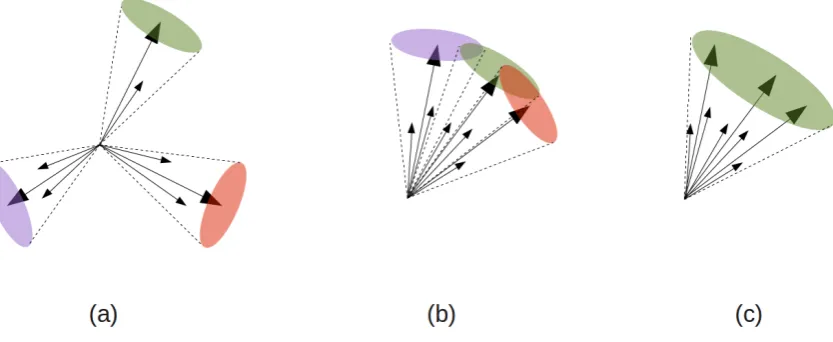
An impressive quantity of results have been obtained by the experiments at the Large Hadron Collider (LHC) in the last few years. These results confirm the validity of the Standard Model (SM) of particle physics at an unprece-dented energy scale, and complete the SM picture with the observation of its last missing piece, the Higgs boson. However some experimental evidences, like the existence of dark matter or the neutrino masses, can not be explained in the context of the SM which needs some extensions (see for example [1]). Several models of beyond-the-SM (BSM) physics have been proposed and searches for BSM physics at the LHC have now reached the TeV scale. At this energy scale SM massive particles (vector bosonsW, Z, top quarkt, and the Higgs bosonH) are produced with a large Lorentz boost, their subsequent decay products tend to be highly collimated and can partially overlap in the reconstruction phase in case of final states characterized by the presence of several jets, like the hadronic decays W/Z/H→qq¯ort→bqq¯1(Fig. 1). In this regime, event
reconstruction techniques employing objects that are well spatially separated in the detector become inefficient.
The decay products of hadronically decaying boosted objects can be contained in a single jet with large
ra-dius parameter R and a large transverse momentum pT.
Cambridge-Aachen (C/A),kT, and anti-kT jet
reconstruc-tion algorithms ([2] and references therein) are applied by ATLAS and CMS. Jet substructure analysis techniques have been developed, with the aims to mitigate the effect of the pile-up on the large-Rjet (grooming techniques, such as trimming [3], pruning [4], and filtering [5]), and to dis-criminate high-pT jets originated by the decay of boosted
massive objects from the ones originated by light quarksq or gluonsg(jet substructure observables and taggers [6]).
ae-mail: [email protected]
1Charge conjugate modes are implicitly included throughout the text.
All these techniques are an active field of research on both experimental and theoretical sides (see for example [7]) and in continuous development.
Jet substructure variables are reconstructed starting from the jet constituents (topological clusters, tracks or sub-jets) and can be computed with or without the
ap-plication of grooming techniques. Examples of used
ones are: the jet mass mjet, defined as the invariant
mass of the jet constituents; the splitting scale2 √d 12 =
min(pT1,pT2)ΔR12, corresponding to the kT distance
be-tween the two proto-jets (indicated with the indices 1 and 2) in the last step of the jet clustering [8]; the momentum balance √yf =min(pT1,pT2)ΔR12/mjet which is the ratio
between the splitting scale and the jet mass; the mass-drop
μ12 =max(m1,m2)/mjet, which is the fraction of mass of
the most massive proto-jet; the N-subjettiness τN, quan-tifying to what degree the jet substructure resembles the one of a jet with N or less sub-jets [9], and the ratios
τi j =τi/τj.
Taggers are more sophisticated algorithms aiming to test the compatibility of a jet with specific scenarios of in-terest [10]. Several techniques have been proposed to tag boosted top quarks, vector bosons, and the Higgs bosons; the performance of some of them are studied and com-pared by ATLAS [11, 12] and CMS [13, 14].
In the following, a selection of physics results obtained by the ATLAS and CMS experiments using with jet
sub-structure techniques on LHC Run1 ppcollision data will
be discussed.
2ATLAS and CMS use a right-handed coordinate system with its
ori-gin at the nominal interaction point in the center of the detector, thex-axis pointing to the center of the LHC ring, and they-axis pointing upwards, and thez-axis directed along the beam axis. Cylindrical coordinates (r,φ) are used in the transverse plane,φbeing the azimuthal angle around the beam pipe. The pseudorapidity is defined in terms of the polar angleθas
η=−ln tan(θ/2). The spatial separation between two objects is defined asΔR=Δφ2+ Δη2.
C
Owned by the authors, published by EDP Sciences, 2015
Figure 1. Schematic representation of the reconstruction of an hadronically decaying top quark in different kinematic regimes: (a) low-pT top quarks can be reconstructed by combining three jets that are spatially separated in the detector; (b) the decay products of high-pT top quarks tend to be collimated and the consequent jets may partially overlap in the reconstruction phase; (c) the decay products of high-pTtop quarks can be contained in a single large-Rjet and discriminated from jets originated by high-pT light quarks and gluons through the analysis of the jet substructure.
2 Measurement of boosted vector bosons
production
The fiducial cross section for high-pT vector bosonV (V
is either aW or aZ) production is measured by ATLAS
reconstructing the hadronic decay V → qq¯ in a single
anti-ktjet with R=0.6, pT >320 GeV and|η|<1.9 [15].
The discrimination of signal from background is obtained by exploiting jet substructure topological variables com-puted in the jet rest frame: V →qq¯ jets tend to assume a "back-to-back" topology, while the ones from the multi-jet QCD background are more isotropically distributed. The jet sphericity, aplanarity and thrust minor are computed using the jets constituents in the centre-of-mass frame of the jet, and combined in a likelihood discriminator. This
technique allows the observation of a V → qq¯ peak in
the jet mass distribution over a background mainly orig-inated by multi-jet QCD events and tt¯production. The multi-jet QCD background presents a shoulder structure, originated by the choice of the jet reconstruction radius, thepT and likelihood requirements, and the internal
kine-matic structure of the selected jets. This structure is well reproduced in the multi-jet QCD MC simulation, obtained
with PYTHIA [16] with different tunings and POWHEG
[17] interfaced with both HERWIG++[18] and PYTHIA
for the parton shower and hadronization. The cross sec-tion for events with an hadronically decayingWorZin the fiducial regionpT >320 GeV and|η|<1.9 is measured to
beσW+Z =8.5±1.7 pb [15], in agreement withW/Z+jets
production computed at the next-to-leading order. The selected event sample, before the likelihood dis-criminator selection, is enriched in hadronically decay-ing W/Z at high pT and is used to test the performance
of grooming techniques. The event sample is processed by applying several jet grooming techniques to all jets se-lected for the cross section measurement, using default
AT-LAS grooming parameter settings so without attempting a specific optimization for this analysis. Grooming removes from the original jet some of its constituents, the likeli-hood discriminator is recomputed after grooming and a cut is applied to obtain the same background rejection as in the nominal analysis. A reduction in the number of se-lected jets by approximately 50% with respect to the un-groomed case is observed for pruning and trimming and by 15% for area subtraction, and the multi-jet QCD back-ground shows the same shoulder structure observed on the ungroomed nominal analysis. The invariant mass distribu-tion for groomed jets show a significantly reduced impact of varying pile-up conditions. The statistical significance of theW+Zsignal remains approximately constant before and after grooming.
3
VV
and
qV
resonance searches
Several models of BSM physics predict the exis-tence of massive resonances decaying to high-pT vector
bosons, like Randall-Sundrum or Kaluza-Klein gravitons (GRS,GKK → WW, ZZ), a heavy partner of theW boson
(W→WZ), or excited quark resonances (q∗ →qV). For large massesmG,mWormq∗theV → qq¯decay products
merge in a single large-Rjet, and the final state turns into a di-jet topology. The discrimination ofV jets fromq/g jets is obtained by ATLAS [12] and CMS [14] using jet substructure techniques.
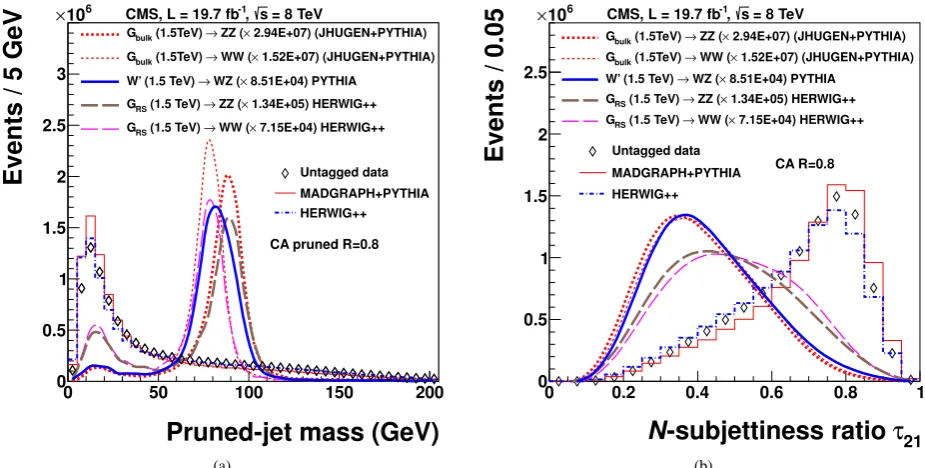
A V jet tagging technique based on the jet mass
computed after the pruning procedure and on the
N-subjettiness ratio τ21 (Fig. 2) is applied by CMS in a
Pruned-jet mass (GeV)
0 50 100 150 200
Events / 5 GeV
0 0.5 1 1.5 2 2.5 3 6 10 × Untagged data MADGRAPH+PYTHIA HERWIG++ 2.94E+07) (JHUGEN+PYTHIA) × ZZ ( → (1.5TeV) bulk G 1.52E+07) (JHUGEN+PYTHIA) × WW ( → (1.5TeV) bulk G 8.51E+04) PYTHIA × WZ ( →
W’ (1.5 TeV)
1.34E+05) HERWIG++ × ZZ ( → (1.5 TeV) RS G 7.15E+04) HERWIG++ × WW ( → (1.5 TeV) RS G
= 8 TeV s ,
-1
CMS, L = 19.7 fb
CA pruned R=0.8
(a)
21
τ
-subjettiness ratio
N
0 0.2 0.4 0.6 0.8 1
Events / 0.05
0 0.5 1 1.5 2 2.5 6 10 × Untagged data MADGRAPH+PYTHIA HERWIG++ 2.94E+07) (JHUGEN+PYTHIA) × ZZ ( → (1.5TeV) bulk G 1.52E+07) (JHUGEN+PYTHIA) × WW ( → (1.5TeV) bulk G 8.51E+04) PYTHIA × WZ ( →
W’ (1.5 TeV)
1.34E+05) HERWIG++ × ZZ ( → (1.5 TeV) RS G 7.15E+04) HERWIG++ × WW ( → (1.5 TeV) RS G
= 8 TeV s ,
-1
CMS, L = 19.7 fb
CA R=0.8
(b)
Figure 2.Distributions for (a)mjetafter pruning and (b)τ21in data (before tagging) andG,W, and QCD multi-jet MC [19].
PYTHIA for Kaluza-Klein gravitons, and PYTHIA forW
and excited quark resonances production.
The di-jet channel allows to reconstructVVresonances when both vector bosons in the final state decay hadroni-cally. At least two jets with pT > 30 GeV and|η| < 2.5
must be present, with a pseudorapidity separation|Δη| < 1.3 to reduce the multi-jet background. A tagging algo-rithm based on pruning is applied to the two highest-pT
jets, reconstructed using the C/A R=0.8 algorithm. Events with two tagged jets are considered in the analysis to test
GandWproduction models, while events with a single
tagged jets are used to search forq∗. High- and low-purity W/Zsamples are selected by applying different cuts onτ21
(τ21<0.5 and 0.5< τ21 <0.75, respectively), events with
two jets are required to have at least one high-purity tag and the event is classified according to the purity of the second jet.
Since a large hadronic background of QCD multi-jet events is present at hadron colliders, the presence of a lep-tonic decay in the event (W → lνl or Z → l+l−, where
l=e, μ) can be effectively exploited to reduce the combi-natorial background. The same jet tagging technique used in the di-jet channel analysis is applied by CMS for the selection of the hadronic V candidate in the lepton+jets channel, in which one of the two vector bosons decays leptonically an the other hadronically. Using 20 fb−1 of
ppcollision data at √s=8 TeV, the sensitivity toG pro-duction in this channel is still limited, so exclusion limits are obtained by interpreting the results with a model inde-pendent approach, for states with varying mass and width [21].
ZV resonances have been searched by ATLAS in the
lepton+jets final state using 20 fb−1of ppcollision data at
√
s = 8 TeV [22]. In this analysis the event selection is
[GeV]
G*
M
400 600 800 1000 1200 1400 1600 1800 2000
Efficiency × Acceptance 0 0.1 0.2 0.3 0.4 0.5 0.6 0.7 0.8 Total Acceptance T Resolved low-p T Resolved high-p Merged region with dilepton isolation Merged region
with nominal lepton isolation ATLAS Simulation Preliminary
= 8 TeV s eeqq → ZZ → G*
Figure 3.Product of signal acceptance and efficiency for the pro-cessG→ZZ→e+e−qq¯. The contribution of the three event se-lection adopted in ATLAS is shown: low-pT resolved (red line), high-pT resolved (blue line), and high-pT merged (green line) [22].
optimized in three different kinematic regions: low-pT
re-solved, high-pT resolved, and high-pTmerged. The
high-pT merged regime is the one with the highest sensitivity
in the high mass region (see Fig. 3). The decay products of boosted vector bosons are reconstructed in a single C/A R=1.2 jet, with pT >100 GeV and limited in the fiducial
region|η| <1.2. Tagging is performed by a splitting and filtering algorithm optimized for the detection of highly boosted boson decays. The results are interpreted on the
basis of theWandGKKmodels, implemented in PYTHIA
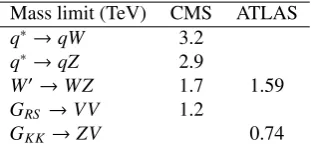
Using LHC Run1 data, no evidence of resonant pro-duction above the SM background has been observed; limits on the masses of resonant objects extracted using boosted objects reconstruction techniques are summarized in Tab. 1.
Table 1.Mass limits at 95% C.L. on resonantVVandqV
production at the LHC, obtained using boosted objects reconstruction techniques on Run1 data.
Mass limit (TeV) CMS ATLAS
q∗→qW 3.2
q∗→qZ 2.9
W→WZ 1.7 1.59
GRS →VV 1.2
GKK→ZV 0.74
4
W
→
tb
searches
Effective models describing theW coupling to fermions can be assumed in order to interpret experimental
searches. W→ tb¯ searches are complementary toW→
lν¯ones and can potentially test different BSM physics sce-narios, with the advantage that in case of hadronic decay of the top quark the final state can be fully reconstructed, allowing to search for a peak in themtbspectrum. Some
BSM theories predict larger couplings of new physics to the third generation than to the first or the second, and from the experimental point of view the presence ofbquarks in the final state provides a useful handle for the the rejec-tion of the leading background contriburejec-tion, represented by multi-jet QCD events. These considerations justify the choice of thetb¯ final state forWsearches. At largemtb
the top quark is produced with a large Lorentz boost and its decay products can be reconstructed in a single large-R jet, and jet substructure analysis can be applied to improve the experimental sensitivity.
The analysis performed at ATLAS reconstructs boosted hadronic top candidates using anti-kT R=1.0 jets.
The discrimination of top jet candidates from q/g initi-ated jets is performed through a cut-based selector on jet substructure variables: the splitting scale √d12 and two
N-subjettiness ratiosτ32andτ21[24].
At CMS jets are reconstructed using the C/A R=0.8 algorithm. After decomposing the original jet into sub-jets, when at least 3 sub-jets are found the original jet is tagged as top candidate based on the jet mass, a minimum pairwise mass of the 3 leading sub-jets larger than 50 GeV (compatible with theW boson mass), and onτ32[25].
Both analysis adopt data-driven techniques to estimate the QCD multi-jet background contribution in the final sample of selected events by means of control regions ob-tained by invertingb-tagging or jet substructure require-ments. The sub-leadingtt¯background contribution is esti-mated with MC simulations. Observations are compatible with the SM background, the derived limits on the mass of right- and left-handedWstates are summarized in Tab. 2.
Table 2.Mass limits at 95% C.L. on right- and left-handed
W→tb¯production at the LHC, obtained using boosted objects reconstruction techniques on Run1 data.
Mass limit (TeV) CMS ATLAS
WR 2.02 1.76
WL 1.94 1.68
5
t
t
¯
resonance searches
Some extensions of the SM predict new particles with large couplings with the top quark, so the observation of resonanttt¯production at the LHC would be a clear indi-cation of new physics. In particular, massive resonances like a leptophobicZor Kaluza-Klein gluonsgKKcould be
observed in thett¯final state.
Top quarks originated from the decay of new parti-cles with masses in the TeV region will be naturally
pro-duced with high-pT and boosted objects reconstruction
techniques are mandatory to increase the signal efficiency and the overall experimental sensitivity to possible new physics effects.
The lepton+jets channel is employed to reconstruct
events where one of the two top quarks decays leptoni-cally (t → blνl, where l = e, μ) and the other
hadroni-cally. The presence of an isolated lepton provides a handle for the rejection of the huge hadronic background that is present at the LHC. These events are also characterized by the presence of a sizable missing transverse energy (from the escaping neutrino) and two jets originated bybquarks. The resulting background after a typical lepton+jets event selection is dominated by SMtt¯production, which can be estimated through MC simulation; other minor contribu-tions come fromW/Z+jets, multi-jet QCD, diboson, and single top production.
At high-pT the decay products of hadronically
decay-ing top quarks can be collected in a sdecay-ingle large-Rjet, typ-ically with a large spatial separation from the leptonic top candidate required by a back-to-back event topology. Re-solved reconstruction techniques are best suited in thett¯ mass region up to the TeV, above this scale boosted ob-jects reconstruction techniques allow to improve the ex-perimental sensitivity and therefore yield more stringent limits on BSM resonances production.
Hadronically decaying top quarks in the boosted regime are reconstructed by ATLAS using anti-kT R=1.0
jets after the application of a trimming procedure [26]. Large-Rjets originated by hadronic top decays at highpT
(pT > 300 GeV) are selected through requirements on
the jet mass (mjet > 100 GeV) and on the splitting scale
(√d12<40). Spatial separation of the large-Rjet from the
leptonic top candidate andb-tagging are also used to im-prove the background rejection. Fig. 4 show the data/MC comparison formjet,
√
d12andpT, where a generally good
agreement is observed for all quantities. The results of a tt¯resonance search in the lepton+jets channel by CMS are reported in [27], and summarized in Tab. 3 together with the ones by ATLAS.
Events / GeV
0 10 20 30 40 50
60 Data tt
Single top Multi-jets
W+jets Z+jets
Diboson
ATLASPreliminary
= 8 TeV s
-1 L dt = 14.2 fb
∫
+ jets
μ
boosted
[GeV] t, had m
100 120 140 160 180 200 220 240 260 280
Data/Bkg
0.5 1 1.5
(a)
Events / GeV
0 10 20 30 40 50
Data tt
Single top Multi-jets
W+jets Z+jets
Diboson
ATLASPreliminary
= 8 TeV s
-1 L dt = 14.2 fb
∫
+ jets
μ
boosted
[GeV] 12 d
40 60 80 100 120 140 160 180 200
Data/Bkg
0.5 1 1.5
(b)
Events / GeV
0 5 10 15 20 25 30
35 DataSingle top tMulti-jetst
W+jets Z+jets
Diboson
ATLASPreliminary
= 8 TeV s
-1 L dt = 14.2 fb
∫
+ jets
μ
boosted
[GeV] T
t,had p
250 300 350 400 450 500 550 600 650
Data/Bkg
0.5 1 1.5
(c)
Figure 4.Data/MC comparison, including background contribu-tions, for some quantities related to the large-Rjet corresponding to the hadronic top candidate [26]: (a)mjet, (b)
√
d12, (c) pT. Plots are for theμ+jets channel.
hadronically. This final state has a larger cross section with respect to the lepton+jets but the huge multi-jet QCD pro-duction cross section at the LHC naturally produces a large contamination in the final sample of selected events, and SMtt¯production becomes a sub-leading background con-tribution. More sophisticated top tagging techniques are therefore necessary to improve the background rejection and the sensitivity of the analysis in this channel.
Boosted top quark candidates are identified by CMS on reconstructed C/A R=0.8 jets by applying a top tagging technique based on the total jet mass (140 <mjet <250
GeV) and on the identification of three sub-jets, with a minimum invariant mass of sub-jet pairs compatible with theWmass (mpair >50 GeV) [28]. Events are selected if
two jets with a back-to-back topology are tagged.
The multi-jet background is estimated by means of data-driven techniques, using a control region containing events with at least two high-pT jets (pT > 400 GeV). A
first background enhanced sample is selected by requiring that one of the two leading jets (randomly chosen) satisfy themjetrequirement, but applying ampair <30 GeV
selec-tion. The mis-tag rate is determined on this sample by ap-plying the top tagging algorithm to the other jet. A second sample is defined by requiring that one of the two leading jets (randomly chosen) satisfy full the top tagging require-ments. The multi-jet contribution is determined by apply-ing the mis-tag rate to the second jet. ATLAS performed a similar analysis for the full-hadronic channel where two different tagging algorithms, HEPTopTagger [29] and Top Template Tagger [30], have been compared [31].
Since no excess with respect to the estimated back-grounds has been observed by ATLAS and CMS, lim-its on leptophobicZandgKKproduction are determined,
as summarized in Tab. 3. The interplay of resolved and boosted reconstruction techniques on the extraction of tt¯ resonance mass limit is summarized in Fig. 5 [32], clearly showing the leading role of boosted objects reconstruction techniques on the experimental sensitivity in the high tt¯ mass region.
Table 3.Mass limits at 95% C.L. on narrowZandgKK production at the LHC obtained using boosted objects
reconstruction techniques on Run1 data. For ATLAS full-hadronic the upper limit of the exclusion region is reported,
some lower mass regions remain in principle not excluded by this analysis.
Mass limit (TeV) lepton+jets full-hadronic
ATLAS CMS ATLAS CMS
Z 1.8 2.1 1.3 1.7
gKK 2.0 2.5 1.6 1.8
6
tH
resonance searches
Some BSM theories predict the existence of heavy vector-likeT quarks, with several possible decay modes (tH,tZ andbW) whose branching ratios are not defined a priori.
] 2 [TeV/c t t M
0.5 1 1.5 2 2.5 3
)[pb]t
t
→
Z'
→
(pp
σ
-2 10
-1 10
1
Combination +jets
μ
Threshold e+ +jets
μ
Boosted e+ Boosted all-hadronic Z' with 1.2% Decay Width = 8 TeV
s , -1 CMS, 19.7 fb
(a)
] 2 [TeV/c t t M
0.5 1 1.5 2 2.5 3
)[pb]t
t
→
Z'
→
(pp
σ
-1 10
1 10
Combination +jets
μ
Threshold e+ +jets
μ
Boosted e+ Boosted all-hadronic
KK Gluon = 8 TeV
s , -1 CMS, 19.7 fb
(b)
Figure 5.Comparison of the expectedt¯tmass resonance limits for the resolved, the boosted lepton+jets, and the boosted full-hadronic selections for (a) narrowZand (b)gKK[32].
channel [33]. The full-hadronic decay mode is character-ized by the presence ofbquarks in the final state, originat-ing from both the top quark and the Higgs boson (branch-ing ratiosBR(t→bqq¯)=0.66 andBR(H→bb¯)=0.56).
Since an hypothetical T can have a very large mass, t
andHcould be produced with a large Lorentz boost and
their subsequent decay products contained in two large-R jets, reconstructed using the C/A R=1.5 algorithm. Events with at least two such jets are selected and jet substruc-ture techniques are applied to separate possible resonant
tHproduction from the huge multi-jet QCD background
inevitably present in the analysis of full-hadronic chan-nels.
Two tagging techniques are applied: HepTopTagger is used to identify hadronic top candidates and a Higgs tagger based on theb-tagging of sub-jets. Two additional variables have been identified to further improve the sig-nal significance after the event selection: the scalar sum of the transverse momenta of selected objectsHT and the
invariant mass of the twob-tagged sub-jetsmH, which are
combined in a likelihood discriminator.
SignalTT¯ samples are simulated using MADGRAPH
[34] interfaced to PYTHIA. Since the twot andH
tag-ging algorithms are uncorrelated, the leading background contribution from QCD multi-jet can be determined di-rectly from data with a matrix method, by inverting the tagging selections. The signal region contains all events with bothtandHjets candidate tagged, and three sideband regions are defined by inverting alternatively each one or both tagger selections. From the relative ratio of the num-ber of events in the four regions it is possible to extract the number of QCD multi-jet events in the signal region. It is checked that the technique applied to simulated events yields consistent results.
After summing thett¯contribution to the background, derived from the simulation, no excess has been observed. The existence ofT states in the mass mass regionmT <
747 GeV is excluded (95% CL) by assuming the branching ratioBR(T →tH)=100%. LowermT values are still
al-lowed by this analysis for smaller values ofBR(T →tH), other analyses tailored to different final states will help in completing the picture.
7 Conclusion
Techniques for jet substructure analysis allow to recon-struct hadronic decays of massive objects in the boosted regime. These techniques have been successfully applied in several measurements and BSM physics searches by ATLAS and CMS on LHC Run1 data. Jet substructure analysis techniques yield results that are complementary to the ones obtained with resolved reconstruction techniques, but usually the higher efficiency in the high-pTregime
en-able to push farther the exclusion limits for the masses of BSM objects.
Jet substructure techniques undergo a very active de-velopment, with a fruitful interplay between theorists and experimentalists. They are extensively tested, validated and applied to LHC Run1 data analyses. Although no evi-dence of BSM physics emerged, they have been proven to provide accurate descriptions of the SM backgrounds.
These techniques will be crucial for the LHC Run2 physics program [35], especially in the increased energy and pile-up environment that will represent a new experi-mental challenge.
References
[1] A. Masiero, this conference.
[2] M. Cacciari, G. P. Salam and G. Soyez, JHEP0804
(2008) 063 [arXiv:0802.1189 [hep-ph]].
[3] D. Krohn, J. Thaler and L. T. Wang, JHEP 1002
(2010) 084 [arXiv:0912.1342 [hep-ph]].
[4] S. D. Ellis, C. K. Vermilion and J. R. Walsh, Phys.
Rev. D 80 (2009) 051501 [arXiv:0903.5081
[5] J. M. Butterworth, A. R. Davison, M. Rubin and
G. P. Salam, Phys. Rev. Lett. 100 (2008) 242001
[arXiv:0802.2470 [hep-ph]].
[6] ATLAS Collaboration, JHEP 1309 (2013) 076
[arXiv:1306.4945 [hep-ex]]. [7] A. Siodmok, this conference.
[8] J. M. Butterworth, B. E. Cox and J. R. Forshaw, Phys.
Rev. D65(2002) 096014 [hep-ph/0201098].
[9] J. Thaler and K. Van Tilburg, JHEP1103(2011) 015
[arXiv:1011.2268 [hep-ph]]. [10] M. Spannowsky, this conference.
[11] ATLAS collaboration, ATLAS-CONF-2013-084. [12] ATLAS collaboration, ATL-PHYS-PUB-2014-004. [13] CMS Collaboration, CMS-PAS-JME-13-007. [14] CMS Collaboration, arXiv:1410.4227 [hep-ex]. [15] ATLAS Collaboration, arXiv:1407.0800 [hep-ex]. [16] T. Sjostrand, S. Mrenna and P. Z. Skands, JHEP0605
(2006) 026 [hep-ph/0603175].
[17] S. Alioli, P. Nason, C. Oleari and E. Re, JHEP1006 (2010) 043 [arXiv:1002.2581 [hep-ph]].
[18] S. Gieseke, D. Grellscheid, K. Hamilton, A. Papaef-stathiou, S. Platzer, P. Richardson, C. A. Rohr and P. Ruzickaet al., arXiv:1102.1672 [hep-ph].
[19] CMS Collaboration, JHEP 1408 (2014) 173
[arXiv:1405.1994 [hep-ex]].
[20] S. Bolognesi, Y. Gao, A. V. Gritsan, K. Melnikov, M. Schulze, N. V. Tran and A. Whitbeck, Phys. Rev.
D86(2012) 095031 [arXiv:1208.4018 [hep-ph]].
[21] CMS Collaboration, JHEP 1408 (2014) 174
[arXiv:1405.3447 [hep-ex]].
[22] ATLAS collaboration, ATLAS-CONF-2014-039. [23] A. Belyaev, N. D. Christensen and A. Pukhov,
Comput. Phys. Commun. 184 (2013) 1729
[arXiv:1207.6082 [hep-ph]].
[24] ATLAS Collaboration, arXiv:1408.0886 [hep-ex]. [25] CMS Collaboration, CMS-PAS-B2G-12-009. [26] ATLAS collaboration, ATLAS-CONF-2013-052. [27] CMS Collaboration, CMS-PAS-B2G-12-006. [28] CMS Collaboration, CMS-PAS-B2G-12-005. [29] T. Plehn, M. Spannowsky, M. Takeuchi and D.
Zer-was, JHEP1010(2010) 078 [arXiv:1006.2833
[hep-ph]].
[30] L. G. Almeida, S. J. Lee, G. Perez, G.
Ster-man and I. Sung, Phys. Rev. D82 (2010) 054034
[arXiv:1006.2035 [hep-ph]].
[31] ATLAS Collaboration, JHEP 1301 (2013) 116
[arXiv:1211.2202 [hep-ex]].
[32] CMS Collaboration, Phys. Rev. Lett. 111 (2013)
21, 211804 [Erratum-ibid.112 (2014) 11, 119903]
[arXiv:1309.2030 [hep-ex]].
[33] CMS Collaboration, CMS-PAS-B2G-14-002. [34] J. Alwall, M. Herquet, F. Maltoni, O. Mattelaer and
T. Stelzer, JHEP1106(2011) 128 [arXiv:1106.0522
[hep-ph]].
![Figure 4.√Plots are for the μ+R to the hadronic top candidate [26]: (a) Data/MC comparison, including background contribu-tions, for some quantities related to the large- jet corresponding m jet, (b)d12, (c) pT.jets channel.](https://thumb-us.123doks.com/thumbv2/123dok_us/8181912.1366421/5.595.59.286.74.650/hadronic-candidate-comparison-including-background-contribu-quantities-corresponding.webp)
![Figure 5. Comparison of the expected tt¯ mass resonance limits for the resolved, the boosted lepton+jets, and the boosted full-hadronicselections for (a) narrow Z′ and (b) gKK [32].](https://thumb-us.123doks.com/thumbv2/123dok_us/8181912.1366421/6.595.72.518.84.258/figure-comparison-expected-resonance-resolved-boosted-boosted-hadronicselections.webp)
