Scholar Commons
Theses and Dissertations
1-1-2013
Three Musical Translations For Trumpet and
Organ Based On Visual Artwork.
John Harrison Bryant
University of South Carolina - Columbia
Follow this and additional works at:https://scholarcommons.sc.edu/etd Part of theMusic Commons
This Open Access Thesis is brought to you by Scholar Commons. It has been accepted for inclusion in Theses and Dissertations by an authorized administrator of Scholar Commons. For more information, please [email protected].
Recommended Citation
Bryant, J. H.(2013).Three Musical Translations For Trumpet and Organ Based On Visual Artwork..(Master's thesis). Retrieved from
by
John Harrison Bryant
Bachelor of Music Indiana University, 2006
Master of Music University of Louisville, 2008
Submitted in Partial Fulfillment of the Requirements
For the Degree of Doctor of Musical Arts in
Music Performance
School of Music
University of South Carolina
2013
Accepted by:
James Ackley, Major Professor Chairman, Examining Committee
Bradley Edwards, Committee Member
Ronald Davis, Committee Member
Sarah Williams, Committee Member
my way though my years of education: John Rommel at Indiana University, Michael
Tunnell at University of Louisville, and James Ackley at University of South Carolina.
These three master educators have instilled in me values and world-class knowledge that
will pass through me in the instruction of the next generation of musicians and scholars. I
will be forever thankful for their help and guidance in helping me complete my
Thanks to James Ackley in his efforts in helping me throughout the completion of
the process of this degree, both professionally and personally. Thanks to the USC brass
faculty, Brad Edwards, Ron Davis, and Robert Pruzin for their guidance in my doctoral
studies. Thanks to Sarah Williams for her first-rate teaching and also for her help in
making this project complete.
Thanks also to Dr. Tom Gibson for re-introducing me to the idea of musical
metaphor and helping me stumble on the idea for this project. My performance, teaching,
and enjoyment of music have benefitted greatly.
Special thanks go to my family. My incredible parents, both outstanding
musicians and world-class teachers have inspired and fostered a true love for music that I
am eternally grateful. Their help from my earliest years and throughout my college
education is nothing short of amazing. My brother Craig, and his wife Crystal,
world-class musicians and best friends. My brother Will, a great soul and model for living life
and best friend. Last, but certainly not least, my wife, and very best friend Mary Beth.
You have helped me become a better man and work side-by-side with me daily to help
works of visual art to write pieces of music for trumpet and organ that sonically reflect
their visual experiences. The main purpose of this document is to explore the unique
“musical translation” the composers made of each respective work of visual art. In
addition to providing valuable commentary and advice for informed performance, this
“It is through metaphor that music best describes and names the unnamable”
DEDICATION ... iii
ACKNOWLEDGEMENTS ... iv
ABSTRACT ... v
PREFACE ... vi
LIST OF FIGURES ... ix
CHAPTER 1: OVERVIEW ... 1
CHAPTER 2: DISCUSSION OF MUSICAL TRANSLATION ... 10
CHAPTER 3: WINDOWS 3.1 A BRIEF BIOGRAPHY OF ARTIST MARC CHAGALL ... 16
3.2 A BRIEF BIOGRAPHY OF COMPOSER PETR EBEN ... 19
3.3 OVERVIEW OF CHAGALL’S JERUSALEM WINDOWS ... 21
3.4 CONCEPTION OF WINDOWS ... 23
3.5 ANALYSIS AND PERFORMANCE SUGGESTIONS FOR PETR EBEN’S OKNA ... 26
CHAPTER 4: FOUR THEMES BASED ON PAINTINGS OF EDWARD MUNCH 4.1 A BRIEF BIOGRAPHY OF ARTIST EDVARD MUNCH ... 52
4.2 A BRIEF BIOGRAPHY OF COMPOSER ANTHONY PLOG ... 54
4.3 OVERVIEW OF THE SELECTED PAINTINGS ... 56
4.4 OVERVIEW OF FOUR THEMES BASED ON PAINTINGS OF EDWARD MUNCH ... 59
5.1 A BRIEF BIOGRAPHY OF COMPOSER JENNIFER MITCHELL ... 73
5.2 OVERVIEW OF THE SELECTED YUGOSLAVIAN MONUMENTS AND THE ARTISTS . 74 5.3 OVERVIEW OF SPOMENIKS ... 5.4 ANALYSIS, DISCUSSION OF TRANSLATION, AND PERFORMANCE SUGGESTIONS FOR SPOMENIKS ... 83
CHAPTER 6: SUMMARY ... 94
REFERENCES ... 95
APPENDIX A – AN INTERVIEW WITH ANTHONY PLOG ... 99
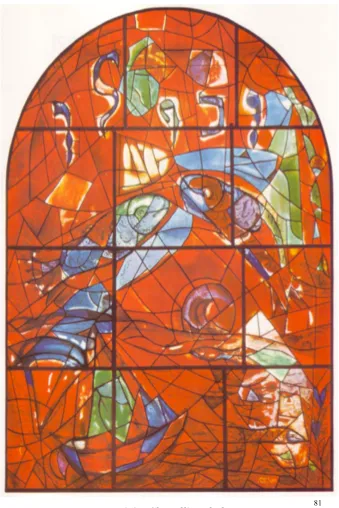
Figure 3.1. Chagall’s Reuben ... 25
Figure 3.2. Notation Clarification ... 29
Figure 3.3. Chagall’s Issachar ... 31
Figure 3.4. The Cry of the Ass in The Green Window ... 33
Figure 3.5. Mute and Character changes in The Green Window ... 34
Figure 3.6. Mute and Character changes in The Green Window ... 35
Figure 3.7. Difficult Organ Interlude in The Green Window ... 36
Figure 3.8. Color Blending Between Organ and Trumpet in The Green Window ... 37
Figure 3.9. Chagall’s Zebulun ... 38
Figure 3.10. The Shofar Theme in The Red Window ... 40
Figure 3.11. Misprint in the Organ Score in The Red Window ... 41
Figure 3.12. Difficult Interlude plus Embellished Shofar Theme in The Red Window ... 43
Figure 3.13. Extended Techniques in in The Red Window ... 44
Figure 3.14. Chagall’s Levi ... 45
Figure 3.15. Troparion and Cadenza Opening in The Gold Window ... 47
Figure 3.16. Quotation of Hymns and Antiphons in The Gold Window ... 48
Figure 3.17. Redemption of Levi in The Gold Window ... 50
Figure 4.1. Munch’s The Sun ... 60
Figure 4.2. Contrapuntal writing in The Sun ... 62
Figure 4.5. Death approaches in The Dance of Life ... 66
Figure 4.6. Ending of The Dance of Life ... 67
Figure 4.7. Munch’s Young Woman Embracing Death ... 68
Figure 4.8. The Skeleton as Depicted by Plog ... 69
Figure 4.9. Munch’s Starry Night ... 71
Figure 5.1. The Flower Monument at Jasenovac ... 83
Figure 5.2. Opening of Jasenovac ... 84
Figure 5.3. Climax of Jasenovac ... 85
Figure 5.4. The Monument at Mount Makljen, Post-Destruction ... 86
Figure 5.5. The Monument at Mount Makljen, Pre-Destruction ... 86
Figure 5.6. Whole Tone versus Diatonic Motif in Makljen ... 87
Figure 5.7. The Monument at Ilirska Bistrica ... 88
Figure 5.8. The opening of Ilirska Bistrica ... 89
Figure 5.9. The Monument at Kadinjaca ... 90
Figure 5.10. Dirge at Opening of Kadinjaca ... 91
Figure 5.11. Trumpet Descant in Kadinjaca ... 92
CHAPTER 1.
Overview
Composers Petr Eben, Anthony Plog, and Jennifer Mitchell were each inspired by
works of visual art to write pieces of music that sonically reflect their visual experiences.
Eben's masterwork Okna was inspired by Marc Chagall's set of stained glass Jerusalem
Windows installed in Hadassah-Hebrew Medical Center in Jerusalem. Plog received his
muse from four different paintings of Edvard Munch. Mitchell's spark of inspiration
occurred after viewing photographs of the Spomeniks monuments of former Yugoslavia.
The main purpose of this document is to explore the unique “musical translation”, a term
that will composers made of each respective work of visual art. In addition to providing
valuable commentary and advice for informed performance, this document offers a
complete formal analysis of each work.
Background
Debates of the unity of the arts have been around for several millennia and have
been discussed by the leading philosophers, musicians, theorist, and historians of every
age. In the days of ancient Greece, philosophers Plato and Aristotle deliberated many
questions that remain unanswered still today. Their discussions of aesthetics, beauty, and
the true meaning and purpose of art are the foundations of what is known as Mimesism.
This philosophy believes that all art is a reaction to the human experience. As a direct
alternative philosophy now referenced as Anti-Mimesism. This ideology, as eloquently
presented by author Oscar Wilde, states that “life imitates art far more than art imitates
life.”1
In the Western Art Music paradigm, unity of the arts, especially visual and
musical, have enjoyed a tightly knit relationship for hundreds of years. As Megan
Stevens discusses in her book, Music and Image in Concert, one can trace this lineage
over the course of more than a thousand years to the Middle Ages.2 During this time,
music was divided into three distinct categories: music of the church, music of the
aristocracy, and music of the peasants.3 In this era, many churches would place singers
and instrumentalists behind screens or in lofts as to remove them from the congregation’s
sight. In turn, this would visually place the church’s icons, altars, and architecture as the
centerpiece of the congregation’s viewpoint. Aristocrats of the Middle Ages would often
have musicians perform in private salons and small chambers, thus creating extremely
up-close-and-personal concert situations. These intimate performances would allow the
patron to view every movement, expression, and breath of the performer, creating a very
unique visual experience for the patron.4 Patrons of taverns, wine sinks, and ale cellars
would also have this type of intimate musical and visual experience with the musicians
hired as entertainment. These traditions uniting the visual with the musical continued
through the Renaissance and into the Baroque era, where they were met with courtly
dances, flamboyant performers, and the advent of opera.
1 Oscar Wilde, The Decay of Lying ([S.l.]: Kessinger Pub. 2004), p. 26
2 Meghan Stevens, Music and Image in Concert. Sydney, Austrailia: Music and Media, 2009. p. 3.
3 Stevens 3.
In the early seventeenth century, Claudio Monteverdi's groundbreaking opera,
L’Orfeo, audiences were treated to a visual experience that included sets, costumes, and
staging in addition to the beautiful and engaging music. This opera not only pays
homage to the tradition of the Greek drama, it also indirectly references the age-old
discussion of life, art, and imitation by combining drama, music, and image. Thus, the
glorification of the arts, as a whole and in various artistic disciplines, was a major part of
the “rebirth” of the Renaissance era.
By the late 18th century, the musical concert had risen to popularity. The
burgeoning middle class provided money and audience to composers who normally
would be in service solely to the church or the court. Composers such as Haydn and
Mozart composed for audiences in myriad stations of life, offering open and public
performances. Most of their venues were small, multi-purpose venues that usually
accommodated less than 300 people.5 Though there were larger audiences than earlier
traditions, a fairly intimate view and perception of the performances were still shared by
audience members. The concert itself was seen as a true spectacle. Audience members
conversed, ate, and drank, often to the detriment of the performance. This informal
concert atmosphere continued into the Romantic period as well.6
The Romantic era met Western Art Music with many new customs. One of the
greatest changes of this era was the construction of grand concert halls and opera houses.
These venues featured beautifully designed spaces, decorated with the finest paintings,
sculptures, and furniture. Not only were concerts attended in greater numbers with
5 William Weber. "Concert (ii)." Grove Music Online. Oxford Music Online. Oxford University Press.Web. 15 Sep. 2013. http://www.oxfordmusiconline.com/subscriber/article/grove/music/06240
greater enthusiasm, but with the advent of the beautiful new halls, the musical
performance was now housed in a work of art itself. The zeitgeist of Romantic era
Europe glorified and placed the arts and artistic expression at the center of society.
Concerts became one the main social events in a city amongst wealthy, middle, and
working class citizens.7
By the middle of the nineteenth century, Richard Wagner had started upon an
artistic quest he dubbed the Gesamtkunstwerk, or complete work of art.8 Wagner believed
that by combining elements from all artistic realms it would thereby create the ultimate in
artistic experiences. This is best evidenced in his monumental opera series Der Ring des
Nibelungen. Wagner ventured so far as having a specially designed opera house built to
be the perfect theater expressly for an optimized viewing of these specific operas. The
result was astounding; a true feast for all senses!
In addition to concert halls, opera houses, and quests for the archetypal artistic
experience, the Romantic era brought about a new type of music known as Programmatic
music. This music is specifically composed to represent or accompany a concept or
narrative, rose to prevalence and became a hallmark of the Romantics.9 While opera and
the art song could vie for classification as programmatic music, the term is usually
applied to only instrumental music.10 Famous examples of programmatic music include
Beethoven’s sixth symphony, Berlioz’s Symphonie Fantastique, and Robert Schumann’s
Carnaval.
7 Stevens 5.
8 Barry Millington, "Gesamtkunstwerk," Grove Music Online, accessed November 20, 2012, www.oxfordmusiconline.com/subscriber/article/grove/music/O011027.
9 Stevens 68.
In the late 19th composers Modest Mussorgsky and Richard Strauss publish their
musical reactions to existing artistic works. Mussorgsky’s Pictures at an Exhibition is a
fifteen-movement work that musically describes twelve different paintings. Strauss
writes his tone poems Also Sprach Zarathustra and Don Quixote as musical reflection to
Nietzsche’s and Cervantes’ respective books of the same titles. Through several hundred
years of artistic evolution, these works emerge not as Mimeistic or Anti-Mimeistic
artistic expressions, but as an artistic expression of a new kind where art imitates art.
In the 20th and 21st centuries, we are now exposed to all types of mixed media
performances. Megan Stevens discusses the effectiveness of visual art as a supplement to
musical performances via development of “musical image theory”.11 This theory seeks to
define the inherent artistic relationship between music and the visual arts tracing its
evolution to the present day.
Justification and Purpose of this Study
The special relationship between music and the visual arts has existed well over
two millennia and continues today. Composers of our time are continuing and furthering
this tradition with programmatic compositions based on landmark works of visual art.
These pieces are unique because the musical compositions would not exist without the
original artwork; thus, the two works are intrinsically linked. When one performs Petr
Eben's Okna, Anthony Plog's Four Themes on Paintings of Edvard Munch, or Jennifer
Mitchell's Spomeniks, the listeners are in effect attending sonic exhibitions of the visual
artwork. Thus, in order for one to effectively perform each piece, a thorough
11 More information on this may be found in Richard Leppert’s books Music and Imageand The Sight of
understanding of the artwork and musical construction is helpful as to transfer of the
original artist's intent and message.
Petr Eben's 1976 composition, Okna (translated to English as Windows)12 has
become a landmark piece for the composer and is considered a masterwork in the trumpet
repertoire. According to the notes written in the score, the work takes its inspiration from
the Jerusalem Windows by artist Marc Chagall13. Today these windows are on display at
Hebrew University's Hadassah-Hebrew Medical Center in Jerusalem, Israel.14 This work
is also considered standard in the trumpet and organ repertoire and is used frequently as a
test piece in many major international competitions, such as the 2008 Ellsworth Smith
Trumpet Competition.15 A doctoral dissertation titled “Time Versus Space: A
Relationship Between Music and the Visual Arts as Revealed in Petr Eben’s Okna and
Marc Chagall’s Jerusalem Windows” written in 2005 by organist and trumpeter Paula
Schwartz Hunter describes the magnitude and influence of this work.16 Using this and
other documents, the current document will provide an effective performer's guide.
Anthony Plog's Four Themes of Paintings of Edward Munch, written in 1987, is a
work that musically translates four selected paintings of the famed Norwegian painter.
The present author discussed the details of the work and compositional process in an
interview with the composer. Recorded by Plog and frequently performed, the piece is
12 Henceforth, all further references to this pieceshall be made as Windows.
13 Petr Eben, Okna. Prague: Praha : Editio Supraphon ; Kassel : Bärenreiter, 1980.
14 Art at Hadassah, accessed October 20, 2012,
http://www.hadassah.org.il/English/Eng_MainNavBar/About/Art+at+Hadassah/.
15 The International Trumpet Guild,2008 Ellsworth Smith International Trumpet Solo Competition(Boston, 2007)accessed October 20, 2012,
www.trumpetguild.org/resources/es2008rules.pdf.
well known within the trumpet and organ repertoire. This document will provide an
effective performer's guide for this piece as well.
Jennifer Mitchell's piece Spomeniks was written in 2012, and will be published
and released for sale in autumn of 2013. This work, commissioned by the present author,
uses many of the same elements as both the works by Plog and Eben. Mitchell selected
photographs of selected concrete and steel monuments that were commissioned and
constructed by the government of former Yugoslavia. While this piece is a new work,
the research of this document will bring awareness to this piece as an exciting new
addition to the trumpet and organ repertoire.
In addition to musical research and performance suggestions, this document
examines, analyzes, and decodes the symbols, intent, and thematic messages present in
Marc Chagall's Jerusalem Windows, the selected paintings of Edvard Munch, and the
monuments of former Yugoslavia. Each piece has been subjected to a similar analysis:
First, a concise biographical sketch of both the artist and composer. Next, a brief
overview of the original artwork and the respective musical composition is offered.
Continuing on, the music is treated to a play-by-play formal theoretical analysis with
description of the sonic translation of the artwork. In addition, notes pertaining to
equipment choices and performance practices will be discussed. Lastly, a brief
comparison of the works, compositional styles, and commonalities concludes this
Research Questions
1. What is the history, inspiration, and influence of these selected works? What is
the original work of art? What inspired the composer to write on these works?
2. How are the works organized and what are their significant elements regarding
form, style, harmonic language, and rhythmic character?
3. What techniques are used in the translation of visual to musical language?
4. Did the composers use similar techniques in making this translation?
5. What strategies yield effective performances of these pieces? What are the
specific equipment choices the performer may wish to consider? (such as mute
CHAPTER 2. DISCUSSION OF MUSICAL TRANSLATION
These three compositions for trumpet and organ are unique and united in the
sense that they are musical reactions to existing works of visual art. Plainly stated, the
musical work would not exist without the preceding visual counterpart. Thus, the works
are intrinsically linked, and the music can never be separated from the works that inspired
them. Therefore, it is imperative to view these works as a cohesive unit, understanding
that the musical composition is merely a sonic translation of the visual artist's intent and
message, transferred from one artist to another.
The vehicle for this transfer of medium is the same vehicle used in all art;
metaphor. Metaphor unites two (or more) unconnected objects or ideas that are
seemingly unconnected. Without the single binding factor, a unique comparison cannot
be made. In his lecture series, The Unanswered Question, Leonard Bernstein studies a
metaphor used in Shakespeare's Romeo and Juliet, “Juliet is the Sun.” He continues, “The
Sun is radiant, and Juliet is radiant, and thus justified, it is proven that Juliet is like the
Sun.”17 The next step to decoding this statement is what Bernstein dubs “transformation
via deletion.”18 “We delete all of those logical, yet necessary steps, built deeply into the
structure of any comparison and wind up with our conclusive simile, Juliet is like the
Sun. We then made the final supreme deletion, and that is the word 'like' and behold, our
17 The Unanswered Question - Six Talks at Harvard by Leonard Berstein. Kultur Video, 2001. 10:00
simile is transferred into a metaphor. Literally stated: this is that.”19 This is the same
process used in this document. By understanding, analyzing, and decoding the message
and intention of the original artwork, the musical translation can be said to be equal in
message and intention; literally stated: this is that.
A type of artistic metaphor artists frequently utilize is the symbol. Father of
modern analytical psychology, Carl Jung, describes “what we call a symbol is a term, a
name, or even a picture that may be familiar in daily life, yet that possesses specific
connotations in addition to its conventional and obvious meaning.”20 One of Jung's main
focuses was researching and understanding man's attachment to symbols via the
unconscious mind, particularly in dreams. Jung contends that as humans with
well-developed senses, man will never fully understand anything, as there are limits to these
senses.21 In addition, Jung states that although man has evolved and has access to myriad
technological devices that may aid these senses, “at some point he reaches the edge of
certainty beyond which conscious knowledge cannot pass.”22 Furthermore, he insists that
there are additional “unconscious aspects of our perception of reality.”23 To use an
analogy in modern terms, humans have beautiful hardware with lackluster software; a
cognitive disconnect to the conscious and unconscious man's mind. Therefore, to bridge
this gap of consciousness, man creates spontaneous symbolic stories, which we call
dreams.24 Man's dreams use images, icons, and archetypes via his own subconscious
19 Bernstein 10:25.
20 Carl Jung,Man and His Symbols, Approaching the Unconscious. (Garden City, NY: Doubleday, 1964) p. 14.
21 Jung 13-14.
22 Jung 14.
23 Jung 14.
associations to communicate ideas, urges, and wishes. In simpler words, man provides
himself spontaneously narrated metaphors to fully express himself to himself.
One of Carl Jung's contemporaries, Aniela Jaffé, wrote of symbols in visual arts.
She describes 20th century art as a “symbol unto itself” and a “symbolic expression of the
psychological condition of the modern world.”25 She uses three recurring motifs as
examples that have been used as artistic symbols throughout man's existence. These
three motifs are the stone, the animal, and the circle.26 Jaffé describes the stone as being
made from God, and thus, it is a relic hand crafted by the creator for man and is to be
prized. The animal is such a powerful symbol because it connects man to his primal
tendencies. Animals are depicted in ancient religions, such as the partially animalistic
gods of the Egyptians. However, the use of animals as symbols in religion still thrives
today in the Christian tradition. Jesus, born in a stable surrounded by animals, is often
depicted as the “lamb of God” and the four gospels feature animalistic associations.
Even God's messengers, the angels, have the wings of an Eagle. The circle, or
circumpunct, frequently represented by the Sun, is often seen as a depiction or symbol of
God. Dr. Marie-Louise von Franz, another Jung contemporary, believes it is a
representation of the whole self.27 These archetypes are still alive and have great
meaning to our culture today as evidenced in their use in modern art.
Marc Chagall, Edvard Munch, and the designers of the Yugoslavian monuments,
used each of these symbols in their works, sometimes in combination. Chagall used
25 Aniela Jaffé,Man and His Symbols, Symbolism in the Visual Arts (Garden City, NY: Doubleday, 1964), p. 201.
animals as symbols of the sons of Jacob in each of the twelve Jerusalem Windows.28
Munch's painting The Sun features a large circumpunct symbolizing self-actualization
and pursuit of a higher state of being.29 The designers of the Yugoslavian monuments
each used concrete (stone) in the creation of their works to pay homage to fallen
comrades.30 Therefore, noting that each of these artists uses these symbols that contain
such powerful conscious and unconscious associations as Jaffé described, one can begin
to dissect meaning and intention of the artist in a selected work.
In his recent online article, “MetaFor Your Music”, Dr. Tom Gibson writes:
As for pure Metaphor, though, nothing beats just pure sound. So, to that end, I decided to "play" some Van Gogh myself. No words, just my instrument. I would study the canvas, allowing myself to experience the image on its own terms....then, play. Have you ever tried such a thing? Impressionistic and abstract artwork is so rich with metaphor, it's simply a matter of letting ideas flow. It can be incredibly cathartic, I recommend it highly. And do it often, to keep the juices flowing. For the player who has never improvised, this might be the best way in. Any image works, obviously, but the works of Kandinsky, van Gogh, Monet, and Pollock, which are so readily available online, are terrific launching pads. Kandinsky can really lend himself to angular articulation and clearly delineated tone colors, while Monet might find you smearing and swirling sounds smoothly into one another with imperceptible boundaries between events. Fascinating, but the eye leads the ear. 31
This passage really speaks to true musical translation, not only of intention and meaning
of the artist, but also the personal reaction to the visual features of each work. This idea
is right in line with Jung's concept of man's senses and ability to perceive the
28 Jaffé206.
29 Jaffé 208.
30 Jaffé 221.
environment that surrounds him. Often times we use such metaphors when studying,
teaching, or analyzing music using terms such as “bright” or “dark” in reference to tone
and timber. By realizing a deep connection to these symbols, shapes, and colors in
context with their intention and message, one could conceivably musically translate any
work of art.
Scholar Megan Stevens’s writings concur with and elaborate on Dr. Gibson’s
work. Stevens states that the visual and musical works must be congruent to be effective.
Stevens describes congruency as “all of the visual characteristics matching the musical
characteristics.”32 Stevens considers works like those discussed in this document to be
the most successful types of programmatic music, because the music is guaranteed to be
congruent to the visual.33 Research indicates that identifying congruency is natural for
most people as evidenced by a study performed by Dr. Peter Peretti.34 This study,
published in the Journal of Research in Music Education, showed participants were
easily able to match specific paintings to specific music inspired by paintings of artist
Paul Klee.35 Thus, scientifically validating the existence of “musical translation.”
The preceding analytical lenses will be applied to the works discussed in this
document as to provide valuable insight to performers, teachers, and scholars. The end
result is not only to provide a solid understanding of the artists, composers, artwork, and
pieces discussed in this document, but to also shed light on the power of metaphor within
music.
32 Stevens 19.
33 Stevens 68.
34 Stevens 129.
CHAPTER 3: WINDOWS
3.1THE LIFE OF MARC CHAGALL
Marc Chagall was born on July 7, 1887 in Vitebsk, Russia (present day Belarus).
His given name was Moishe Segal, a name he later changed this to avoid Jewish
persecution during the difficult struggles in the early 20th century in Europe. 36 In his
book, The Jerusalem Windows, Jean Leymarie describes Vitebsk as a “provincial market
town that had maintained its medieval traditions.”37 Leymarie further describes Chagall's
childhood atmosphere as, “humble craftsmen and shopkeepers of the ghetto, who ignored
everything outside of their own customs and faith.”38 Understanding Chagall's
upbringing in strict Hassidic Russia is key to understanding his life and art.
Chagall began studies as a child a typical Hebrew school, as Jews were not
allowed to attend public institutions at this time. At this school, he was taught the lessons
of the Torah, history of his faith and people, and the Hasidic ideal that “all actions
performed religiously are holy.”39 As with other Hebrew schools, the tales and legends
of the Jewish people were passed down to him, and he embraced these lessons fully.40 As
he completed his studies at Hebrew school, he entered the private studio of Yehuda Pen,
36 Jean Leymarie,The Jerusalem Windows (New York: G. Braziller, 1962), p.viii.
37 Leymarie viii.
38 Leymarie viii.
39 Leymarie viii.
noted painter and artist in Vitebsk. Although his mother was supportive of his passion,
his father was not, citing financial reasons. However, master Yehuda Pen was so
awe-struck by Moishe's use of colors, he offered Chagall free tuition so that he could study
without causing financial hardship to his disapproving father.41
After studying with Yehuda Pen for a year, Chagall set out to St. Petersburg to
continue his studies. He met with tough circumstances, both financially and politically
upon his arrival. St. Petersburg was to be much more regulated regarding the
participation of Jews in society. Although very poor, he would continue his studies with
Leon Bakst at the Zvantseva's School of Drawing and Painting for the next two years.
Professor Bakst instructed him to travel to Paris as to escape the tumultuous political
climate growing in Russia.42 In 1910, Chagall received scholarship funds and left for
Paris.
In Paris, Chagall was exposed to the masterworks of Eugene Delacroix, Paul
Cezanne, Paul Gaugin, Vincent van Gogh, among others. His exhibited work received
great praise, but the outbreak of the First World War forced him to return Russia. He
remained in Russia until 1922, all the while exchanging correspondence with artists in
Paris who continued to praise his work. During this time, Chagall married Bella
Rosenfeld, described as, “his first love, wife and muse.”43
41 "Marc Chagall" Marc Chagall - Paintings, Biography, Photos. Accessed October 20, 2012. Http://www.marcchagallart.net.
42 http://www.marcchagallart.net/
In 1931, he travelled to Palestine and claimed, “It was the most impressive
experience of his adult life.”44 In Jerusalem, Chagall connected to his ancestors and felt a
true kinship to his Jewish roots in their ancient holy land. As Leymarie describes, “at last
Chagall could illustrate the Old Testament, something that would have been impossible
for him with the direct contact necessary for this kind of visionary.”45 After his brief
visit, Chagall continued his travels through Holland, Spain, and Poland.
In 1941, the political climate forced him to leave Europe altogether and he flee to
the United States. In 1944, tragedy befell Chagall as his beloved wife, Bella, died of
Sepsis. Although he remarried sometime later, Bella would always remain his muse and
true love.
Following this painful period, Chagall married Virginia Haggard-McNeil, a
woman who resembled Bella, however, after seven years, she left him citing that his true
love remained with his previous wife. With the money he earned from his great success
in the United States, Marc Chagall returned to France. In 1952 he met his new love,
Valentina Brodskaya, and he married a third time. Throughout, the 1950s, Chagall and
his family travelled the globe, and until the early 1960s, he remained somewhat transient.
After this period of travel, Chagall settled in Provence, France where he would
live the remainder of his years. He is immortalized in his work in the Paris opera house,
myriad galleries, and in various temples and churches throughout the world. He is one of
the few living artists ever to have his work displayed in the Louvre in Paris. He died of
natural causes in the elevator of his studio in 1985 at age 97.
44 Leymarie viii.
3.2 THE LIFE OF PETR EBEN
On January 22, 1929, Petr Eben was born in Žamberk, Bohemia, a small town
close to the Polish border. He is known throughout his illustrious career to be a
world-class composer, virtuoso organist, and celebrated choirmaster. Shortly after his birth in
Žamberk, his family moved and Eben spent most his adolescent years in the South
Bohemian town of Český Krumlov. His father was ethnically Jewish and his mother was
Roman Catholic however, Eben's father chose to raise his son as Roman Catholic. Eben's
father was also an amateur musician and performed in an orchestra conducted by Arnold
Schönberg's professor and mentor, Alexander Von Zemlinsky.46
During World War II, due to his ethnicity and as New Grove cites, “his
'uncooperative' attitude” Petr was sent to Büchenwald concentration camp for two
years.47 This harsh experience solidified a connection to both his Jewish and Catholic
identities. As Dr. Paula Swartz Hunter describes, “Eben’s relationship with his father and
Judaism was foundational for him throughout his life, while he also had a deep respect
for his mother’s Roman Catholic faith.”48 Kateřina Voncrovicová, in her book, Petr
Eben: Leben und Werk, sheds light on another interesting aspect of Eben's dual spiritual
identity through the analysis of his name, by stating: “'Eben' is a Hebrew word that means
rock, and 'Petr' is derived from the Latin term for rock.49 Thus, his name represents 'the
rock' of Jews and Christians alike, via the Old and New Testaments.
46 BBC Article. http://www.bbc.co.uk/music/artists/4d2f57d4-29dd-4e7c-9a1f-fa13c85ff055
47 New Grove Eben. 48 Hunter 5.
After the war, Eben returned to his musical education, studying piano and
composition at the Prague Academy of Musical Arts in 1948. Here he studied piano and
chamber music with famed pianist, František Rauch and composition with Pavel
Bořkovec.50 After his graduation in 1954, Eben launched his career as a pianist and
professor. In the following years he presented over 150 concert tours in Czechoslovakia
and abroad.51 He joined the faculty of Prague University in 1955 where he taught until
1990. From the years 1990 to 1994, he was professor of composition at the Prague
Academy.
In addition to his concert tours and successful teaching career he was awarded
many prizes and decorations. The German Art Guild awarded him the Stamitz Prize in
1993, and the German Conference of Bishops awarded him the 'Art and Culture' prize in
1998. In 1999, he was named an Honorary Member of the Royal Academy of Music and
Honorary Fellow of the Royal College of Organists.
Eben was a deep thinker and true believer in the power of art as evidenced in
much of his works and writings. As depicted in his own words, Eben states,
“Relentlessly confronted with evil during my early youth, I have often returned to the
question of good and evil throughout the course of my life. This theme has always
influenced my artistic creations.”52 Eben's pieces, such as Apologia Sokratusand Job,
act as musical character studies to showcase this pervasive theme. In addition to these
50 Simpson, Adrienne and Cervenková, Katerina. "Eben, Petr." Grove Music Online. Oxford Music
Online. Oxford University Press, Accessed November 2, 2012,
Http://www.oxfordmusiconline.com/subscriber/article/grove/music/08491.
51 Graeme Kay, "Petr Eben," BBC News, section goes here, accessed October 28, 2012, http://www.bbc.co.uk/music/artists/4d2f57d4-29dd-4e7c-9a1f-fa13c85ff055.
landmark works, Eben's most famed works are his cycles for organ, Sunday Music,
Laudes, Windows, Faust and Biblical Dances.5354
3.3 OVERVIEW OF CHAGALL’S JERUSALEM WINDOWS
In early 1960, Marc Chagall received a commission from the Israeli Government
to provide a series of twelve stained glass windows to complete the tower of the temple at
Hadassah-Hebrew University Medical Center. For the next two years Chagall would
work unceasingly to fulfill this commission with some of his most exquisite work. The
windows began as black and white drawings, evolving to watercolor paintings, and
eventually morphing into the windows that Chagall described as “jewels of translucent
fire.”55 The synagogue of the Hadassah-Hebrew University Medical Center is a simple
rectangular building seated in the Western Judean Hills of Jerusalem. Twelve large
windows with rounded arches illuminate the vast, central lantern tower of the building.
The windows are situated with three windows on each side, facing the four cardinal
directions. This symbolic positioning is an allusion to Scripture, whereby Moses’ and the
tribes camped in protection of the Ark of the Covenant.56
The windows represent the twelve tribes who were led by sons of Jacob. Both
Jacob and Moses blessed these twelve sons in the books Genesis and Deuteronomy,
giving allusion to their character, personality, and history. Jacob delivered his blessings
shortly before his death, dividing out their inheritance and prophesying their futures in
the book of Genesis. Moses lends his blessings much later, confirming the prophecies of
53 Simpson and Cervenková.
54 Titles translated to English.
55 René D’Harnoncourt. Jewels for a Crown(New York: McGraw-Hill, 1962), pgs. 7-8
Jacob, after leading the tribes through many trials and tribulations in the tales chronicled
in Exodus. In Deuteronomy, Moses blesses them the final time upon their entrance to
Canaan.
In traditional Jewish art, Mosaic Law prohibits the depiction of the human figure,
as man is created in God's own image. Thus, Chagall uses traditional metaphorical
descriptions of the tribes in his images. As Leymarie states, many times rudimentary
representations of the tribes were reduced to their animal symbols.57 These symbols were
designated to each tribe so as to abide by laws of keeping images of man out of artwork.
According to several authors, including Leymarie, the twelve tribes are relatable (and
according to some, interchangeable) with modern astrological signs.58 This is especially
notable, as the blessings of both Jacob and Moses read as something of a modern
horoscope. At face value, each blessing vaguely describes the members of each tribe as
having certain characteristics that all members of the tribe express without variation.
However, the deeper implication is to see each tribe as a character in a fable or parable,
and express certain archetypes to teach vice, virtue, and expectations of morality; a
metaphor in and of itself. Chagall, having attended a traditional Hebrew school as a child
was most definitely educated with these parables. Priest and scholar, Thomas Tully
published a book, The Sons of Jacob and Their Tribal Blessings Character Studies: A
Series of Sunday Afternoon Addresses, which teaches the twelve tribes in this fashion,
thus demonstrating the prevalence of this thought in Europe around Chagall's lifetime.59
57 Leymarie p. xiii.
58 Leymarie p. xiii.
59 Thomas Tully. The Sons of Jacob and Their Tribal Blessings. Character Studies, Etc.London: Hodder
Using this knowledge as a background, decoding the symbolism in The Jerusalem
Windows becomes a much more manageable task.
The twelve windows are based in four dominant colors: blue, red, green, and
yellow. The windows are also displayed in Hadassah Medical Center in their proper birth
order according to the Torah. The symbolical images used are The Scrolls of Law, The
Torah, The Star of David, and the shofar. Chagall makes use of the fish, the ass, and the
lamb as biblical allusion as well. The end result is a truly magnificent work of art.
3.4 THE CONCEPTION OF WINDOWS
Petr Eben describes the process of composing Windows as the culmination of over
ten years of planning and experimenting. In Eben's words he states, “It was quite
interesting how sometimes one is inspired as a composer by poetry, sometimes by
pictures. It was for me in the year '55 or something like that, somebody invited me
somewhere and showed me these Chagall windows [note: other stained glass windows of
Chagall, not the Jerusalem Windows] from slides, and this was for me something lovely, I
really couldn't forget it.”60 Thus, it is interesting to note that Eben was in awe of
Chagall's other works for some time before the Jerusalem Windows were completed in
1962.
In the Hunter interview, Eben describes first seeing the Jerusalem Windows in
1965 via photographs, “I forgot who showed it to me, where it was, where they invited
me, if it was with some friends, if I was young, I forgot it, but I didn't forget the
windows. I had it very clearly in my mind.”61 Some ten years thereafter, Eben was
commissioned by The Gallery of Fine Art in Cheb, Czechoslovakia to compose a piece
based upon visual art. Eben immediately thought of the Jerusalem windows. He
immediately purchased the book The Jerusalem Windows by Jean Leymarie at the local
museum in Prague. Interestingly, Eben was never able to see the windows in person; he
only composed on them from the ideas and photographs in the Leymarie book. In terms
of writing the music for Windows, Eben studied the book for quite sometime and, “ just
translated it into music.”62 The work was completed and published in Prague in 1976.
However, due to the political climate at the time in Czechoslovakia, Eben was forced to
rename the movements from their biblical names to the color of their windows. In his
interview with Dr. Hunter he stated his wishes to use the names as originally intended.
In Windows, Eben chose four windows, symbolizing four of the twelve sons of
Jacob and their respective tribes; Reuben, Issachar, Zebulon, and Levi, each being a
different dominant color. These four sons of Jacob represent four of the five sons born of
Jacob's first wife, Leah. Using the Torah and Jean Leymarie's book (which features
commentary on Chagall's religious messages) Eben translates the character and
temperament of each chosen son of Jacob from Chagall's windows.
61 Hunter 83.
63
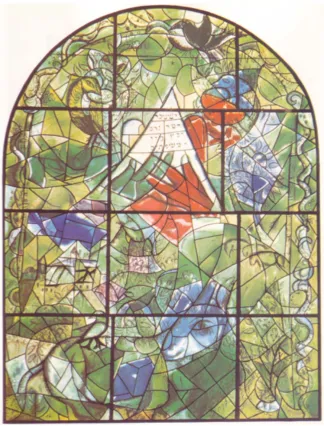
Figure 3.1: Chagall's Rueben
3.5 ANALYSIS AND PERFORMANCE SUGGESTIONS OF PETR EBEN'S OKNA
Reuben, Modré Okno.64
The blessing of Jacob, inscribed upon the window, as translated from Hebrew:
Reuben, you are my firstborn, my might,
thefirst sign of my strength, excelling in honor, excelling in power. Turbulent as the waters. [Genesis 49:3-4]65
The first movement of Windows is Reuben, the Blue Window, and is given a
precise metronome marking of quarter note equals 132 with the directions, Con Moto
Persistente. As inferred in the window's inscription, Eben states in interview that the
music should have driving fluidity that mimics relentlessly rushing water.66 The
comparison of Reuben to water could not be more apt. Noted Old Testament scholar,
Thomas Tully, states that Reuben's character is appropriately comparable to water
because his moral compass is always shifting and ever changing67. Tully also describes
Reuben as “choosing to take the path of least resistance” and details his lack of backbone
as the “Reuben leak”.68 In addition, Tully notes Reuben as being foolhardy and his
greatest flaw is consistently repeating the same error; moral negligence69. Chagall and
Eben both translate these characteristics in their depictions of Reuben.
64 Translated as, “The Blue Window”. Henceforth, all references made shall be in English.
65 Leymarie 5.
66 Paula Swartz Hunter 28.
67 Tully 17. 68 Tully 17.
The first movement is written using a traditional theme and variations form. The
first movement is a theme and variations. The use of this classical form is important for
two reasons. First, this form implies tradition. The Hebrew tradition states that Reuben,
as firstborn shall receive a double-share of inheritance. Due to his illicit affair with the
maid, Bilhah, Reuben defiled his father's bed and his own honor. Second, the variations
form uses the same melodic material in different displays. This is the perfect vehicle to
showcase Reuben's disposition to repeatedly commit the same error. Chagall illustrates
this constant theme in the window by depicting each animal turning away from God's
command, symbolized in the Sun.
From measure 1 to measure 9, the theme (Figure 3.2) is first heralded as an
introduction in the pedals of the organ. The introduction concludes at measure 15, the
organ presents a flowing chromatic fanfare that builds to circle 1. Here is the first use of
an aleatoric technique that provides Windows with a hallmark feature. Due to the
aleatoric passages, the performance decisions create different presentations of the music
each performance. The texture created by this aleatoric technique allows a sense of
freedom for the performers and lends itself to creating a sense of instability and
unpredictability, which is especially helpful in this movement. The organist is instructed
to repeat the material between measure 16 and measure 23 while the trumpet presents the
full theme above the organ's texture.
In the section between circle 1 and circle 2, the trumpet enters as the solo voice.
The theme itself is written in Phrygian mode and according to Eben, is inspired by
Gregorian chant.70 Although there is no specific chant referenced, an unmetered and
freely flowing chant further enhances the allusion to flowing water. In the score, Eben
suggests two repeats through this first aleatoric section between circle 1 and circle 2.
However, Eben recommends an additional (third) pass may be necessary. Eben also
states it is possible for the organist to repeat only a portion of the material until the
trumpet is ready to move to the next passage. Throughout the opening statement of the
theme, the trumpet and organ are both instructed to play at a piano. Careful consideration
should be made to restrain volume and allow an ever-increasing crescendo to build
through the course of the movement.
The first variation on the theme begins at circle 2. Here the organ has shifted to a
different textural pattern, however, the driving triplet ostinato remains intact. In this
variation, the theme is altered in the trumpet, and while the melodic contour is the same,
the intervals are exaggerated. The altering of the theme in this way reinforces the idea of
uncertainty and instability. This technique is described by Dr. Hunter (and approved by
Eben) as “warping”, and is said to mimic the refracted light of window.71 In the trumpet,
the theme is first embellished with four grace notes. These notes occur four times in this
variation and each time should be played with greater fastidiousness as the variation ends
with a trumpet crescendo to mezzo forte.
Arriving at circle 4, the organ is now the soloist and the trumpet is the
accompanist. The organ presents the second variation with a harmonized and unaltered
statement of the theme transposed up a minor third. Meanwhile, the trumpet offers
rhythmic accompaniment that once again alludes to wild, rising and falling seawater. The
organ maintains a full forte dynamic and the trumpet is marked with a conservative, yet
an interactive mezzo forte. Notably in this variation, the stabilized theme in the organ is
juxtaposed and contrasted by the rushing instability of the chromatic trumpet lines
throughout this variation. The continuing capriciousness of the trumpet accompaniment
continues, building in dynamic and intensity leading variation 3.
In the third variation, the trumpet and organ begin with a full poco forte dynamic,
continuing the rise of intensity through the movement. There are two points Eben
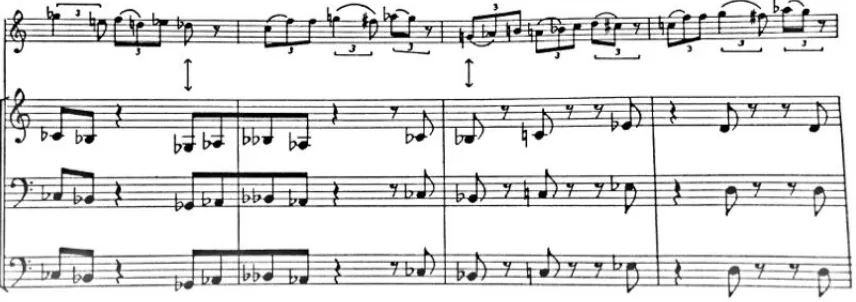
indictates in the score. The notes on beat three of measure 58 and beat one of measure
59, are to be synchronized (Figure 3.2).
Figure 3.2: Note the arrows inferring simultaneous arrival.
Despite the ambiguous notation it is critical that these events occur simultaneously as to
preserve the forward momentum. This texture continues until the trumpet sounds a solo
measure, crescendoing to a full forte at circle 6. Here, a brief organ transition recycles
material from the trumpet's third variation. Afterwards, the organ resumes an
accompanying role with a return to the ostinato triplet rhythm from variation one in the
Circle 7 marks the beginning of variation 4. The trumpet, marked forte sings an
agitated and once again 'warped' version of the theme. The organ, slightly louder than the
trumpet, responds with dialogue in the manuals completing the statement begun by the
trumpet. In measure 71, the organ continues the ostinato, transposed up a fourth. In
measure 72, the trumpet begins a new statement of the warped theme and organ
completes the statement angrily. In the next measure, the organ continues with the triplet
ostinato on tri-tones. This ostinato continues in the pedals through subsequent measures,
as the manuals answer the trumpet. This pattern, which is creating mounting dissonance
and instability, builds and swells to the prescribed synchronized arrival at circle 8, using
the same notation as in Figure 3.3.
From this moment onward, Eben uses the remaining 14 measures as a coda. He
offers the driving triplet ostinato and a “warped” restatement of the theme hidden in the
manuals. Beginning in measure 80 Eben reformulates all variations of the theme in brief
fragments. From circle 9, the organ and trumpet have built in intensity to sound a full
fortissimo dynamic. The theme is presented a diminished fourth higher than the
beginning, then is restated as in variations 3 and 2. For the last three measures, the
trumpet and organ sound on stacked B-flat and D-flat fifths for three beats and finish with
one final measure of the triplet ostinato.
72
72 Leymarie 57.
Issachar, Zelené Okno73
Jacob's blessing to Issachar, inscribed upon the window, translated from Hebrew:
Issachar is a strong ass
Couching down between two burdens: And he saw that rest was good,
And the land that it was pleasant. [Genesis 49:14-15]74
Eben begins the second movement of Windows as a stark contrast of the ending of
The Blue Window. The sounds of Reuben’s rushing waters have calmed as Eben depicts
the relaxed and even-tempered donkey, Issachar. The movement begins with homage to
one of Eben’s favorite music genres, jazz.75 The trumpet is instructed to play with a
“hush hush mute.” The actual existence of this mute is in question, however it is called
for in other solo trumpet literature such as Bernd Alois Zimmerman's Trumpet Concerto
(Nobody Knows de Trouble I See).76 It is known that Eben preferred the employment of
a dark, dampened sound such as the cup mute, so it is this mute that is used in most
performances. The cup mute provides dampening, as well as a rich, velvety sound often
found in jazz performances.
The opening in the organ and trumpet are instructed Andantino Pastorale marked
at a soft, relaxed piano on top of a lush texture of sustained pitches outlining C-sharp
minor. This, too, contrasts the wild motion seen in the previous movement and provides
a sense of stability. This change in texture and move toward harmonic stability aids in
73 Translated as “The Green Window.” Henceforth, all references made shall be in English. 74 Leymarie 55.
75 Hunter 46.
'cleansing the musical palette' and denoting a change of colors from Chagall. Above this
stagnant texture the trumpet adds a slow, jazz-inspired soliloquy.
It is important to note, the Hebrew people of Jacob's time lived in an aniconic
belief system. This meant, according to strict religious laws, depictions of God (and men,
who were created in the image of God) were not allowed.77 Therefore, artistic references
of this culture were to be made through the use of symbolism; most often depicted using
animals as symbols. Chagall and Eben both continued with this tradition. Frequently in
scripture and artwork, Judah is known as 'The Lion'. In the same vein, Issachar is
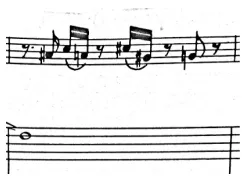
frequently referred to as 'The Ass.' In measure 7, Eben writes a pair of melodic sighs,
which seem to mimic the cry of an ass (Figure 3.4).
Issachar's temperament according to the Torah, and to scholar Tully, is much suited to the
likeness of the ass. In modern times, this may seem as somewhat of an insult, however,
Tully claims that, biblically, this is not seen as an insult.78 In this age, the ass was
personified as hardworking, noble, and shrewd, not as a stubborn work beast.79 This
accurately depicts Issachar, a steadfast homebody, satisfied to lead a calm life of study
77 Yoel Natan,The Jewish Trinity: When Rabbis Believed in the Father, Son and Holy Spirit (CreateSpace Independent Publishing Platform, 2003), Google E-book Edition, pg. 167.
78 Tully 82. 79 Tully 86.
and hard work. The tribe of Issachar had a special arrangement with their neighboring
tribe, Zebulun, allowing Issachar's tribe to live comfortably in the lush green lands,
immersed in study of the Torah and other religious texts, while Zebulun acts as a
defender and strong arm for the neighboring tribe. Chagall depicts the two tribes as being
a symbiotic unit with the two interlocking hands, one green and one red, in the middle of
the window. Eben depicts this widely praised union by placing them juxtaposed in his
cycle.
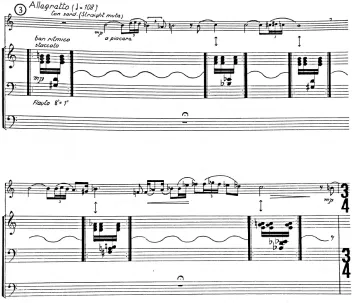
At circle 3, the trumpet is instructed to switch to a brighter and livelier straight
mute (Figure 3.5).
A metal mute is preferred here, to provide a brilliantly shimmering, gem-like sound.
Eben marks an a piacera, to ensure the trumpet does not hurry the passage, keeping it
consistent with the idea of a gentle ass lying in the grass. The organ returns to aleatoric
patterns and acts as a purely accompanying foundation to the glistening trumpet. As the
notation previously in the first movement, it is imperative the trumpet and organ must
arrive at the notated harmonic shifts of aleatoric material together.
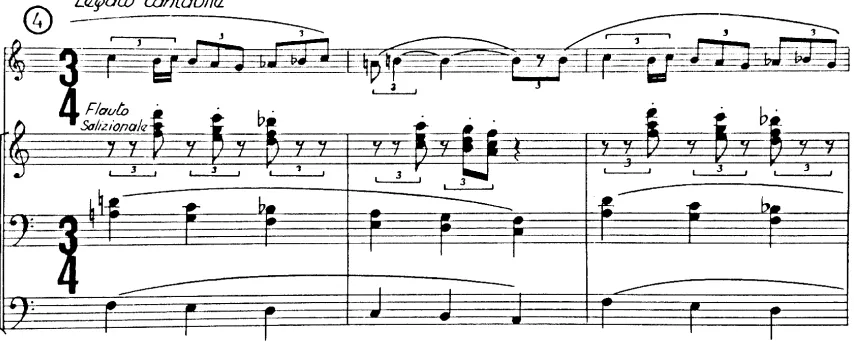
Circle 4 features a marking of Legato Cantabile, a registration change in the
organ, a mezzo piano dynamic and a return to flowing, sustained texture (Figure 3.6).
Figure 3.6: This melody should flow in contrast to the previous section.
Paula Swartz Hunter suggests that there is an error in the score, and the senza sord
marking was omitted.80. However, in recordings by Michael Sachs, Anthony Plog, and
Reinhold Friedrich, the trumpet remains muted until circle 9.
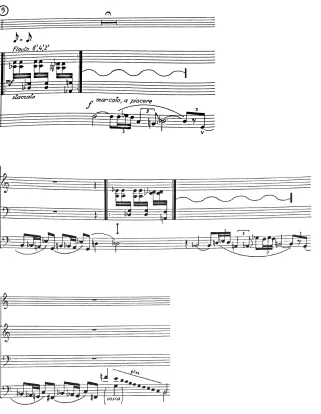
Circle 5 is an extremely difficult solo passage for the organ. The manuals again
perform the aleatoric rhythm as the pedals restate melodic elements from the trumpet line
from circle 3. The hands and feet of the organ are rhythmically independently and only
synchronize harmonically (Figure 3.7). This pattern continues until a rapid glissando
leads to circle 6 where the trumpet returns and a restatement of the theme from circle 3.
Circle 7 is a variation and embellishment of the theme presented at circle 4. As the
intensity mounts the trumpet has an aleatoric passage acting as a background voice,
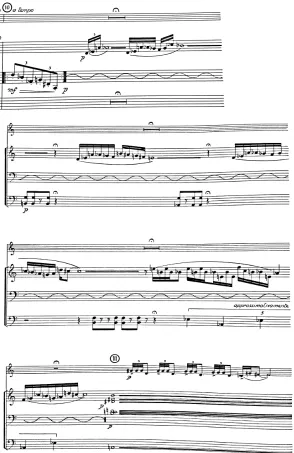
adding tension and excitement to the parallel melody of the organ. As the transition to
circle 8 occurs, the trumpet is instructed to play very softly and to hide within the
sustained chord (Figure 3.8). This allows the organ to seamlessly change without
allowing any silence. It is suggested by the current author to hold this pitch long enough
to give time for the organist to change all necessary registrations and pedals at this
moment.
Figure 3.8: The trumpeter should blend into the sound of the organ and wait, ensuring all registrations necessary are made before proceeding.
The Green Window concludes with a restatement of the melodic material from
circle 4. The trumpet returns to the hush-hush mute and ends in the same blues fashion
as in the beginning. As in the beginning, the organ punctuates and wistfully retires on a
81
81 Leymarie 47.
Zebulun: Cervené Okno82
Inscribed on the window, translated from Hebrew: “Zebulun”83
Although not inscribed upon the window as the others, Jacob's blessing of the tribe of Zebulun:
Zebulun shall dwell at the haven of the sea; And he shall be for a haven of ships;
and his border shall be unto Zidon. [Genesis 49:13]84
The Red Window, the third movement, is divided into seven separate pieces. This
movement is the most wild and passionate of the four, matching with the intense, vibrant
color of the window itself. The vivid colors and ferocious mood of this movement also
align heavily with Zebulun, himself. This movement is divided into seven segments
featuring two distinct voices engaged in a wandering conversation. The first voice,
beginning at circle 1, is aggressive, warlike, and wild. In contrast, the second voice,
which enters at circle 6, is more similar to a folksong, and is calm, relaxed, and
introverted. Through the whole of this movement, these two voices converse until a
rousing finish, where the warlike voice ends the conversation bombastically with twelve
harsh jabs.
The first segment of The Red Window begins with a brief three-measure
introduction for the solo organ. Marked forte, and Risoluto e drammtico, the third
movement begins with shrieking clamor in stark contrast to the calm and relaxed
fade-to-nothing ending of The Green Window. Eben juxtaposes these to display a shift from the
82 Translated as, “The Red Window”. Henceforth, all references made shall be in English.
83 Leymarie 41.
relaxing green and blue hues of Issachar's window to the brilliant and piercing reds and
oranges used in Zebulun's window. As previously discussed, the tribes of Zebulon and
Issachar shared a symbiotic relationship. While Issachar's was traditionally a tribe of
scholars, Zebulun's tribe was a tribe of warriors and adventurers. In addition, Zebulun
would bankroll Issachar's devotion to study and teaching of the Torah in exchange for
education.85 Tully also states that Zebulun had supplied the Issachar tribe with able
military officers to aid in defense of both realms.86Thus, the moniker “Issachar and
Zebulun” came to be used prominently by Jews for anyone in such a symbiotic
relationship.87
The second segment of The Red Window begins at circle 1. The organ has an free
triplet rhythm creating a driving and forward moving sensation. The trumpet enters at
mezzo forte in an ominous fanfare of tri-tones. This trumpet call, which pervades the
entire movement, is likened to the calls of a distorted shofar (Figure 3.10).
Figure 3.10: The shofar motif of Zebulun
The shofar, or ram's horn, is depicted throughout the Torah as an instrument used to rally
soldiers into war, as in the famous depiction at the battle of Jericho. This is especially
important in Eben's musical representation of the tribe as the shofar theme represents
Zebulun's thirst for action and adventure. Zebulun led the charges in several key battles
85 Tully 90.
86 Tully 90.