International Journal of Asian Social Science, 2014, 4(2): 234-241
DEVELOPMENT OF PROGRAM EDUCATIONAL OBJECTIVES (PEO) FOR
ENGINEERING PROGRAM AT UNITEN
Adzly Anuar
†Centre of Engineering Education, College of Engineering, Universiti Tenaga Nasional, Malaysia
Hazlinda Hakimie
Centre of Engineering Education, College of Engineering, Universiti Tenaga Nasional, Malaysia
Miszaina Osman
Centre of Engineering Education, College of Engineering, Universiti Tenaga Nasional, Malaysia
Khairul Salleh Mohamed Saharia
Centre of Engineering Education, College of Engineering, Universiti Tenaga Nasional, Malaysia
ABSTRACT
The College of Engineering (COE) of Universiti Tenaga Nasional (UNITEN), Malaysia has implemented outcome-based education (OBE) in all its engineering programs since 2007 due to the requirement of accreditation body, the Malaysia Engineering Accreditation Council (EAC). Recently EAC has introduced new updates and consequently, COE has developed a new set of PEO (Program Educational Objectives) and PO (Program Outcomes) to fulfil this requirement. A new approach is used in coming up with these objectives and outcomes. This paper describes the process of developing the PEO and PO at college level and how stakeholders’ inputs are being taken into consideration in improving the outcomes. This paper also discusses on how these outcomes are trickled down and implemented at department level.
© 2014 AESS Publications. All Rights Reserved.
Keywords:
Outcome-Based education, Program objectives, Engineering program, Accreditation, Program outcomes, Stakeholder.
1.
INTRODUCTION
One of the main requirements to acquire accreditation from the Engineering Accreditation
Council (EAC) of Malaysia for any engineering program is the implementation of Outcome-Based
Education (OBE). One of the first elements that are required to be developed in the implementation
of OBE is the Program Educational Objectives (PEO). As defined in EAC manual 2012, PEOs are
International Journal of Asian Social Science
ISSN(e): 2224-4441/ISSN(p): 2226-5139
Special Issue:
International Conference on Teaching and
Learning in Education, 2013
a set of goals or target that describes the expected achievement of the graduates in the career a few
years after graduation (EAC (Engineering Accreditation Council), 2012). These goals must be
consistent with the vision and mission of the academic institution, and take into consideration the
need of relevant stakeholder to the program.
At College of Engineering (COE), all engineering programs have implemented OBE since
2007. With the changes in the recent EAC manual 2012, it was decided to review the present PEO
statement and target. Outcomes from PEO attainment from previous years were evaluated and the
feedback from stakeholder was taken into consideration in developing the new PEO.
2.
DEVELOPING PEO AND ASSESSMENT
The development of a degree program and in this case, OBE implementation usually starts
with the development of PEOs. This is when the college or faculty envisage what graduates should
achieve in their career life years after graduation from UNITEN. There are several approaches
proposed in developing the PEOs (Younis, 2003; Al-Attar et al., 2010; Ahmad Basri et al., 2011;
Weisbrook and Schonberg, 2011). Common elements would include the acquirement of
stakeholder inputs, forming a team to evaluate the requirement and formulating the statements and
targets. For PEO assessment, the most common method is through survey (Estell and Williams,
2011; Makinda et al., 2011).
At College of Engineering (COE) the general flow of OBE implementation has been
established since 2011. Minor improvement has been made recently to differentiate between of the
review cycle and data collection cycle, as shown in Figure 1. Developing of PEO statement is part
of PEO planning, the outer-most cycle in OBE implementation. Usually the College Teaching and
Learning Committee (CTLC) will carry out PEO review every 3 to 5 years, or whenever special
needs arise. CTLC consists of Head of Departments and representatives from all departments in the
college. Data collection is conducted annually which mainly consists of acquiring alumni and
industry feedback on alumni achievement through a survey.
2.1. Reviewing Existing PEO
For establishing new PEOs, the process starts with acquiring inputs for the formulation of the
draft of the PEOs. It will be fine-tuned based on stakeholders‟ feedback. Implementation of the new PEOs will only happen upon approval from the university‟s senate.
Since all programs in COE have already implemented OBE, the process starts by reviewing the
existing PEOs, identifying the gap with the new EAC requirement and also the university‟s new
vision and mission. The flow of this process is as shown in Figure 2. All programs under COE have
similar PEO statements.
The PEO achievement review is carried out every 1 to 2 years through alumni survey. The
department will evaluate the results and come up with action plans for continual quality
Figure-1. Overall OBE implementation strategy
Figure-2. Process for developing and reviewing PEO Programme Planning Course Planning PEO Planning Review Cycle1 Stakeholder IAP Ext. Examiner EAC/MOHE Staff Student Alumni Professional level Programme level Course level Implementation (Teaching, Learning, Assessment) Evaluation Improvement Graduates Data Collection Cycle2
4 years3
4 years3/ Annually4 Annually Annually Survey (alumni, industry) Every semester
Direct assessment – PO attainment
Every semester
Direct assessment – CO attainment
3 PEO & PO statements/target review
4Programme level review on attainment results & improvement
Note:
1 Standard duration for review, unless special needs arise.
2Data is collected according to the periodic cycle, and compiled to be used for review.
Develop draft PEO IAP/industry External examiner Alumni Staff Finalised PEO EAC
Vision & Mission
Benchmark other universities Senate Revised PEO Stakeholders’ feedback Stakeholder feedback Previous PEO Output PEO achievement survey Evaluate
result Action plan for improvement
Programme level
Course level PEO statement
Review Cycle: 5 years
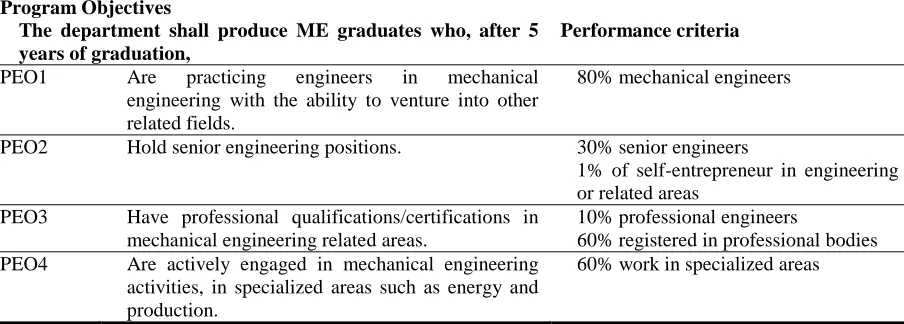
The current PEO statements targeted for Bachelor of Mechanical Engineering (BME) are
shown in Table 1. PEO statements for Bachelor of Electrical and Electronics Engineering (BEEE),
Bachelor of Electrical Power Engineering (BEPE), Bachelor of Computer and Communication
Engineering (BCCE) and Bachelor of Civil Engineering (BCE) are very similar to that of BME in that the difference lies only on the field specific term; for example the term „mechanical‟ is replaced with „civil‟ for BCE.
Table 2 shows the new and previous vision and mission of UNITEN. It can be seen that the
current PEOs do not strongly support the direction of the new vision. Thus, the lack of support
needs to be addressed in the new PEO statements.
Table-1. Current PEO statements for BME
Program Objectives
The department shall produce ME graduates who, after 5 years of graduation,
Performance criteria
PEO1 Are practicing engineers in mechanical
engineering with the ability to venture into other related fields.
80% mechanical engineers
PEO2 Hold senior engineering positions. 30% senior engineers
1% of self-entrepreneur in engineering or related areas
PEO3 Have professional qualifications/certifications in mechanical engineering related areas.
10% professional engineers
60% registered in professional bodies PEO4 Are actively engaged in mechanical engineering
activities, in specialized areas such as energy and production.
60% work in specialized areas
Table-2. Vision and mission of UNITEN
New Previous
Vision
A leading global energy university that shapes a sustainable future
To be a premier University in
Engineering, Information
Technology and Business
Mission We strive to advance knowledge and learning experience through research and innovation that will best serve human society
We are committed to deliver a unique and enriching learning experience that fosters innovation and research
In order to gauge the PEO achievement, alumni survey is conducted. Even though the response
was relatively low, the result can still be used as an indicator for overall achievement of the
program. The result of the survey is shown in Table 3. From the survey, the target for PEO1 and
PEO4 were achieved. However, for PEO2, the percentage of senior engineer is below target. The
target for PEO3 was also not achieved. It is believed that the reason the achievement of PEO2 and
Table-3. Alumni survey result of PEO attainment (BME)
PEO Performance criteria/Target Latest survey result
(no. of respondent = 65)
Comment
PEO1 80% mechanical engineers 89.23% of the respondent work in mechanical or engineering related field
The result is above target.
PEO2 30% senior engineers
1% of self-entrepreneur in engineering or related areas
23% are in senior engineer or managerial positions.
4.6% are self-entrepreneur
The result for senior engineer is also less than the target but the percentage of self-entrepreneur is above target
PEO3 10% professional engineers 60% registered in professional bodies
27.7% are registered with professional bodies
The result is below target.
PEO4 60% work in specialized areas 78% are working in specialized areas
The result is above target.
2.2. Stakeholder Input
Input from the Industry Advisory Panel (IAP) and External Examiner were also acquired. The
summary is as shown in Table 4. These suggestions are to be taken into consideration when
developing the new PEO.
Table-4. Summary of feedback from IAP and External Examiner
Stakeholder Input and feedback
IAP The panel discussed the current PEO in detailed. It was
commented that the current PEO can be maintained and all targets are logical except for PEO 4. The mechanism to capture the attainment of PEO and also the target must be properly set since it is a bit subjective.
External examiner The external examiner has suggested that the first PEO to be modified to incorporate the term „energy‟ in place of others, in view of the new vision and mission of UNITEN. It is also suggested that the last PEO is replaced with “Engages in activities to enhance knowledge in their professional works” in view of the importance of life-long learning in OBE approach.
2.3. Developing New PEOs
Based on the stakeholders‟ input and the attainment results from stakeholder survey, PEO
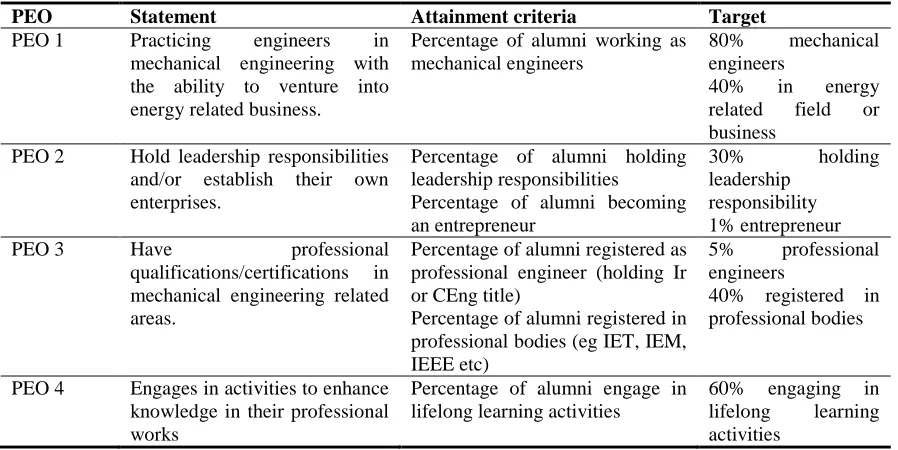
statements and targets were revised. Minor rewordings were made for PEO1, PEO2 and PEO3, while PEO4 has been changed to a totally new objective which is “Engages in activities to enhance knowledge in their professional works”. This is to reflect the importance of life-long learning for our graduates. Table 5 shows the draft statements and attainment criteria for the new PEOs.
In tandem with the development of the new PEOs, a survey was produced as a means of
obtaining feedback from alumni and industries on the relevance and importance of the new PEO
statements. Respondents rated the new PEO statements using the 5-point Likert-type scale, ranging
Table-5. New PEO statements (BME)
PEO Statement Attainment criteria Target
PEO 1 Practicing engineers in
mechanical engineering with the ability to venture into energy related business.
Percentage of alumni working as mechanical engineers
80% mechanical
engineers
40% in energy
related field or business
PEO 2 Hold leadership responsibilities and/or establish their own enterprises.
Percentage of alumni holding leadership responsibilities
Percentage of alumni becoming an entrepreneur
30% holding
leadership responsibility 1% entrepreneur
PEO 3 Have professional
qualifications/certifications in mechanical engineering related areas.
Percentage of alumni registered as professional engineer (holding Ir or CEng title)
Percentage of alumni registered in professional bodies (eg IET, IEM, IEEE etc)
5% professional
engineers
40% registered in professional bodies
PEO 4 Engages in activities to enhance knowledge in their professional works
Percentage of alumni engage in lifelong learning activities
60% engaging in lifelong learning activities
Figure 3 shows the graph of response from alumni survey. For PEO1, 90% of the respondent
indicates that is it either important or very important. For PEO2, PEO3 and PEO4, the results
obtained were 93%, 80% and 91%, respectively, indicating that they are either important or very
important. From these results, it can be seen that most of the alumni are favourable with the new
PEO statements.
Figure 4 shows the graph of response from industry survey. The results obtained were 78%,
86%, 60%, and 90% for PEO1, PEO2, PEO3 and PEO4 respectively.
Figure-3. Graph showing response from alumni survey
0% 10% 20% 30% 40% 50% 60% 70% 80% 90% 100%
PEO 1 PEO 2 PEO 3 PEO 4
P e rc e nt ag e of a lum ni r e spo ns e
Result of alumni survey on PEO importance (n=42)
Figure-4. Graph showing response from industry survey
Target for each PEO is also revised as shown in Table 5. For PEO1, an additional target of “% of alumni working in energy field or business” has been added, consistent with the vision of becoming a leading global energy university. The target for PEO3 has been changed to 5% instead
of 10% following the recommendation from stakeholder and also based on the previous PEO
achievement result.
3.
CONCLUSION
This paper describes the process of reviewing the PEO statements and target for engineering
programs under COE at UNITEN. This review was conducted in line with the new vision and
missions of the university and also the new manual from governing body, in this case the
Engineering Accreditation Council (EAC). Input and feedback from stakeholder were taken into
consideration when drafting the new PEOs. After the new PEO was developed, it is then sent to
alumni and industry to rate their importance. Based on this survey, the majority of the respondent
indicates that the PEOs are either important or very important.
The college has carried out an extensive process in reviewing the PEOs to ensure thatthey reflect
the requirements of stakeholder. The new PEO is submitted to senate for approval and to be
implemented in academic year of 2013/14.
4.
ACKNOWLEDGEMENTS
The authors would like to thank all that involved in the review process.
REFERENCES
Ahmad Basri, N., K. Abu Taib, O. Jaafar, S. Md Zain, F. Suja, A. Kasa, S. Osman and N.E. Shanmugam, 2011. An evaluation of programme educational objectives and programme outcomes for civil
engineering programmes original research article. Procedia – Social and Behavioral Sciences, 18: 56-64.
0% 10% 20% 30% 40% 50% 60% 70% 80% 90% 100%
PEO 1 PEO 2 PEO 3 PEO 4
P
e
rc
e
nt
a
g
e
of
a
lum
ni
r
e
spo
ns
e
Result of industry survey on PEO importance (n=146)
Very important
Important
Neutral
Less important
Not important
Al-Attar, H., B. Abu-Jdayil and M. Al-Marzouqi, 2010. Assessment of educational objectives in chemical and petroleum engineering programs. 3rd International Symposium for Engineering Education,
University College Cork, Ireland.
EAC (Engineering Accreditation Council), 2012. EAC manual 2012. Board of Engineers, Malaysia.
Estell, J. and S. Williams, 2011. Program educational objectives: What constitutes sufficient assessment? American Society of Engineering Education, Paper AC2011-22.
Makinda, J., N. Bolong, L. Gungat and A. Sarman, 2011. Assessment of program educational objectives using
Alumni survey: The UMS experience. Proceeding of 3rd International Congress on Engineering Education (ICEED). pp: 14-17.
Weisbrook, C. and W. Schonberg, 2011. A streamlined approach to developing and assessing program educational objectives and program outcomes. American Society of Engineering Education, Paper AC2011-1179.
Younis, N., 2003. Establishing and assessing educational objectives for engineering programs. Proceedings of 2003 American Society for Engineering Education Annual Conference & Exposition, Session 1360.