Volume 8, No. 5, May – June 2017
International Journal of Advanced Research in Computer Science
RESEARCH PAPER
Available Online at www.ijarcs.info
P3PGA
:
Multi
-
Population 3 Parent Genetic Algorithm and its Application to Routing
in WMNs
Amar Singh
Research Scholar,I.K.Gujral Punjab Technical University, Kapurthala Punjab, India
Sukhbir Singh Walia
I.K.Gujral Punjab Technical University, Kapurthala
Punjab, India
Shakti Kumar*
Computational Intelligence Laboratory, Baddi University of Emerging Sciences & Technology
Baddi, HP, India
Abstract: This paper proposes a new multi-population based global optimization algorithm called Parallel Three Parent Genetic Algorithm (P3PGA). The proposed approach is an extension of 3PGA approach. Performance of the proposed algorithm was evaluated on the eleven CEC-2014 benchmark functions. We compared the performance of proposed P3PGA algorithm with 16 other algorithms. It was observed that out of the 11 benchmarks functions P3PGA outperformed all other 16 approaches on 5 benchmark functions. Out of 5, for 2 functions the best performance of P3PGA was also equaled by few other approaches. For the other 3 functions the performance of P3PGA was unmatched by any of the other 16 algorithms. Further, this paper proposes a new P3PGA based optimal route evaluation approach for routing in Wireless Mesh Networks. The proposed approach was implemented in MATLAB and simulated for various WMN sizes and scenarios. We compared its performance with 8 other approaches namely, Ad-hoc On Demand Distance Vector (AODV) approach, Dynamic Source Routing (DSR), Genetic Algorithm (GA), Biogeography Based Optimization (BBO), Firefly Algorithm (FA), Ant Colony Optimization (ACO), BAT and Big Bang-Big Crunch (BB-BC) based optimal cost route evaluation approaches. The P3PGA based approach outperformed all other 8 approaches for the WMNs sized 1000 nodes and above.
Keywords: global optimization algorithm, P3PGA, WMNs, AODV, DSR, ACO, BBO, FA, BAT, BBBC, optimal cost path routing
I.INTRODUCTION
Genetic Algorithm (GAs) are widely used computer based search and optimization algorithms based on the mechanics of natural genetics and natural selection [ 1]. In the decade between 1950 and 1960 many researchers worked on evolutionary systems with the idea that evolution could be used as optimization approach for many engineering problems [2]. In 1960s Rechenberg introduced the initial work on “Evolutionary Strategies” [ 3]. Prof. Holland of University of Michigan envisaged concept of the genetic algorithms [4].
Apart from general genetic algorithm which is based upon two parent genetic process some literature on multi-parent recombination can also be found in [ 5, 6, 7 8]. Mühlenbein and Voigt [5] presented the concept of gene pool recombination (GPR) and applied it to find solutions in discrete domain. Eiben and Van Kemenade [6] proposed the concept of diagonal crossover as the generalized case of uniform crossover in GA and applied it to numerical optimization problems. Wu et al. [ 7] proposed multiparents orthogonal recombination and applied it to find out the identity of an unknown image contour. Though the crossover operators used in those areas proved to have the good search ability yet they were found to be very much problem dependent. Amar et al. introduced the concept of three parent genetic algorithm (3PGA) [ 9]. Its performance was tested on CEC-2014 test bench and was compared with 16 other algorithms. They successfully proved the supermacy of 3PGA over the other 16 algorithms. 3PGA algorithm was successfully applied to deployment of nodes in WSNs for optimal coverage issue [10].
In this paper we propose an improved 3PGA based new unconstrained global optimization algorithm named “ Parallel Three Parent Genetic Algorithm (P3PGA)”. The work reported in this paper was motivated by two factors. The first one was to evaluate the performance of P3PGA on some standard functions of an established test suite and to compare its performance with few other well-known recent algorithms. The second motivation was to test the performance of proposed algorithm on optimal cost path evaluation for routing in WMNs. WMNs are highly dynamic networks. Routing in WMNs is one of the challenging issues faced by the research community today [11]. Conventional static network shortest path routing approaches are highly unsuitable for application to WMNs due to the fact that shortest path evaluation is quite a difficult task due to dynamic nature of WMNs. Since, in WMNs most or all the network nodes can be mobile.
We have organized this paper into 6 sections. Section I of the paper presents the problem, section II of the paper proposes the P3PGA concept, section III presents the simulation and performance of P3PGA algorithm on 11 functions of CEC-2014 test bench and compares it with the performance of 16 other algorithms. Section IV proposes a new P3PGA based minimal cost path evaluation approach for WMNs. Section V presents its implementation and performance on WMNs. This section also compares the performance of this newly proposed algorithm with 8 other algorithms found in the literature. Section VI presents the conclusions.
neurological problems etc. Mitochondrial diseases are caused by the faulty mitochondria inherited from the parents. In order to eliminate mitochondria based problems researchers proposed various techniques of producing a 3 parent child. Some of the techniques can be found in [ 12, 13, 14, 15]. In one of such techniques called spindle nuclear transfer [12] Dr. Zang Johan Zhang and his colleagues at new fertility Centre in New York city removed the nucleus from defective egg cell of mother and inserted it into the cell body of a donor whose nucleus was removed. The donor’s cell body had healthy mitochondria. The resulting egg cell with nucleus DNA of mother and the healthy mitochondrial DNA from the donor was fertilized with the father’s sperm. This lead to the birth of first 3 parent child with healthy mitochondria on 6th
Begin
April 2016. Based upon the above process Amar et al. [9] proposed 3PGA global optimization algorithm and proved it to be much superior to 16 other optimization algorithms.
P3PGA algorithm is a multi-population algorithm in which evolution process takes place on many populations in parallel. It is based upon the single population three parent genetic algorithm (3PGA) [9]. The pseudocode for the proposed P3PGA algorithm is as given below:
Generate N populations each of size NC candidates randomly, every candidate consisting of NG genes; For Gen = 1 : Number of Generations
For i = 1 : N
Effect Mitochondrial Change to ith
Combine current i
population to Generate new 3 Parent (3-P) population.
//*We perform this process by adding a small random number in every gene of the individual. This is an attempt to produce a healthier offspring. *//
th
Generate new i
two parent (2-P) population with new 3-P population
Evaluate fitness, sort population and choose best ‘NC’ individuals.
Find and record best solution.
th
1. Select fit individuals for recombining/breeding 2. With high probability recombine parents / perform cross-over.
3. With low probability, mutate each offspring. 4. Evaluate fitness.
5. Reinsert (Replace weak individual by stronger offspring keeping pop size fixed at N).
2-P population using general genetic process (using GA) as given below:
Check bounds violation & correct if needed. Select local best candidates ℓbest(i) for i
th
End For
population;
From amongst the local N best candidates select the globally best gbest
for i = 1: N do //* move local best towards global best candidate;
With a given probability replace a gene of ℓbest(i) with the corresponding gene of global best (gbest(i)
End for
) candidate;
End for End
III.SIMULATION, RESULTS AND DISCUSSION
We implemented the proposed P3PGA algorithm in MATLAB and tested its performance on 11 functions of CEC-2014 test bench. The details of selected 11 functions each with 10 dimensions are as given in table 1.
Table 1: CEC-2014 Test bench functions selected for performance evaluation
Function Category
Name of the Function
Unimodal f2: Rotated Bent Cigar Function f3: Rotated Discus Function Simple
Multimodal Functions
f5: Shifted and Rotated Ackley’s Function
f6: Shifted and Rotated Weierstrass Function
f8: Shifted Rastrigin’s Function
f14: Shifted and Rotated HGBat Function
f16: Shifted and Rotated Expanded Scaffer’s F6 Function
Hybrid Function 1
f20: Hybrid Function 4 (N=4) f22: Hybrid Function 6 (N=5) Composition
Functions
f23: Composition Function 1 (N=5) f30: Composition Function 8 (N=3)
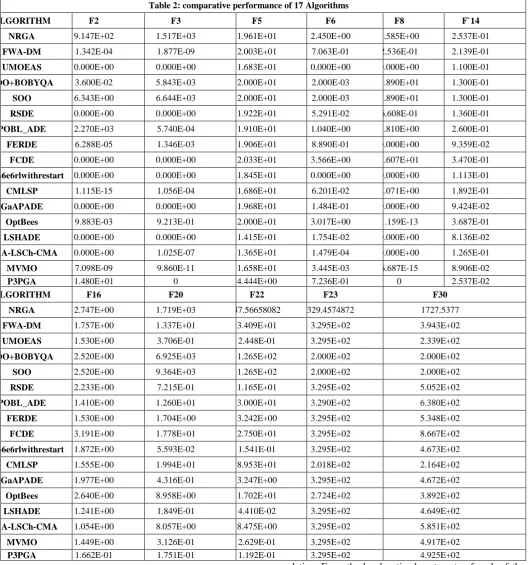
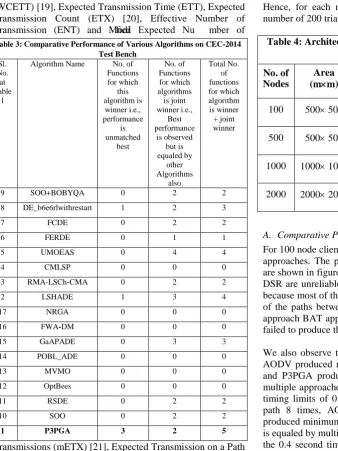
The evaluated performance of P3PGA algorithm along with 16 other algorithms is placed as table 2. We conducted 15 trials for each of the 11 functions. We considered mean error of all the 15 trials as the performance measure. Based upon the data presented in table 2, Table 3 presents the comparative performance of 17 algorithms including P3PGA algorithm. A look at the table 3 clearly indicates that out of 11 functions chosen for comparison P3PGA gave best performance in 5 functions. Out of these 5 functions there are 3 functions namely f5, f14 and f16 for which no other algorithm out of the other 16 algorithms could touch the performance achieved by P3PGA. For the other two function i.e., f3 and f8, P3PGA gave the best performance but this performance was achieved by some other algorithms as well. For f3 the performance of P3PGA was equaled by the performance of UMOEAS, RSDE, FCDE and GaAPADE algorithm as well. In the case of function f8 the performance of P3PGA was matched by the performance of UMOEAS, FERDE, DE_b6e6rlwithrestart, GaAPADE, LSHADE and RMA-LSCh-CMA algorithm. For the given 11 functions, LSHADE algorithm scores the number two position with best performance for 4 functions. Out of the four, LSHADE gave unmatched best performance for one function only and for the 3 functions its best performance was equaled by other algorithms also. The UMOEAS was ranked at number 3. The UMOEAS algorithm also gave best performance for 4 functions, but for all the 4 functions its best performance was matched by some or other algorithms also.
Table 2: comparative performance of 17 Algorithms
LGORITHM F2 F3 F5 F6 F8 F`14
NRGA 9.147E+02 1.517E+03 1.961E+01 2.450E+00 5.585E+00 2.537E-01
FWA-DM 1.342E-04 1.877E-09 2.003E+01 7.063E-01 2.536E-01 2.139E-01
UMOEAS 0.000E+00 0.000E+00 1.683E+01 0.000E+00 0.000E+00 1.100E-01
OO+BOBYQA 3.600E-02 5.843E+03 2.000E+01 2.000E-03 .890E+01 1.300E-01
SOO 6.343E+00 6.644E+03 2.000E+01 2.000E-03 .890E+01 1.300E-01
RSDE 0.000E+00 0.000E+00 1.922E+01 5.291E-02 6.608E-01 1.360E-01
POBL_ADE 2.270E+03 5.740E-04 1.910E+01 1.040E+00 7.810E+00 2.600E-01
FERDE 6.288E-05 1.346E-03 1.906E+01 8.890E-01 0.000E+00 9.359E-02
FCDE 0.000E+00 0.000E+00 2.033E+01 3.566E+00 .607E+01 3.470E-01
b6e6rlwithrestart 0.000E+00 0.000E+00 1.845E+01 0.000E+00 0.000E+00 1.113E-01
CMLSP 1.115E-15 1.056E-04 1.686E+01 6.201E-02 2.071E+00 1.892E-01
GaAPADE 0.000E+00 0.000E+00 1.968E+01 1.484E-01 0.000E+00 9.424E-02
OptBees 9.883E-03 9.213E-01 2.000E+01 3.017E+00 1.159E-13 3.687E-01
LSHADE 0.000E+00 0.000E+00 1.415E+01 1.754E-02 0.000E+00 8.136E-02
MA-LSCh-CMA 0.000E+00 1.025E-07 1.365E+01 1.479E-04 0.000E+00 1.265E-01
MVMO 7.098E-09 9.860E-11 1.658E+01 3.445E-03 6.687E-15 8.906E-02
P3PGA 1.480E+01 0 4.444E+00 7.236E-01 0 2.537E-02
LGORITHM F16 F20 F22 F23 F30
NRGA 2.747E+00 1.719E+03 37.56658082 329.4574872 1727.5377
FWA-DM 1.757E+00 1.337E+01 3.409E+01 3.295E+02 3.943E+02
UMOEAS 1.530E+00 3.706E-01 2.448E-01 3.295E+02 2.339E+02
OO+BOBYQA 2.520E+00 6.925E+03 1.265E+02 2.000E+02 2.000E+02
SOO 2.520E+00 9.364E+03 1.265E+02 2.000E+02 2.000E+02
RSDE 2.233E+00 7.215E-01 1.165E+01 3.295E+02 5.052E+02
POBL_ADE 1.410E+00 1.260E+01 3.000E+01 3.290E+02 6.380E+02
FERDE 1.530E+00 1.704E+00 3.242E+00 3.295E+02 5.348E+02
FCDE 3.191E+00 1.778E+01 2.750E+01 3.295E+02 8.667E+02
b6e6rlwithrestart 1.872E+00 5.593E-02 1.541E-01 3.295E+02 4.673E+02
CMLSP 1.555E+00 1.994E+01 8.953E+01 2.018E+02 2.164E+02
GaAPADE 1.977E+00 4.316E-01 3.247E+00 3.295E+02 4.672E+02
OptBees 2.640E+00 8.958E+00 1.702E+01 2.724E+02 3.892E+02
LSHADE 1.241E+00 1.849E-01 4.410E-02 3.295E+02 4.649E+02
MA-LSCh-CMA 1.054E+00 8.057E+00 8.475E+00 3.295E+02 5.851E+02
MVMO 1.449E+00 3.126E-01 2.629E-01 3.295E+02 4.917E+02
P3PGA 1.662E-01 1.751E-01 1.192E-01 3.295E+02 4.925E+02
IV.P3PGA FOR MINIMAL ROUTE EVALUATION
This section proposes a new optimal route evaluation approach. In this approach first of all an adjacency matrix is created for all the nodes of the network. The adjacency matrix represents the set of nodes that are adjacent to the current node. Using the adjacency matrix, a set of populations, each consisting of a given number of routes is evaluated. Each route is treated as one individual of the population. From the current set of populations, for every population the proposed algorithm evolves a new population and hence, a new set of populations. New path evolution process from a given path is based upon the process as described in [16] [9]. Following the P3PGA process we evolve the optimal cost for each
population. From the local optimal cost route of each of the population we derive the global optimal path of all the populations which is the optimal under given processing time constraint. Once the routes are evaluated, each node of the WMN constructs routing tables. Thereafter, the general data transfer process can take place on the minimal cost routes. Being parallel in nature the convergence rate of this algorithm is expected to be quite small.
We can compute the cost of a route using any existing routing metrics. One can find a large number of routing metrics available in literature.
(WCETT) [19], Expected Transmission Time (ETT), Expected Transmission Count (ETX) [20], Effective Number of Transmission (ENT) and Modified Expected Nu mber of
Transmissions (mETX) [21], Expected Transmission on a Path (ETOP) [22], Bottleneck Link Capacity (BLC) path metric [23] , Metric of Interference and Channel Switching (MIC) [24], interference aware, low overhead routing metric was proposed by Liran Ma et al. [25], cross layer link quality and congestion aware(LQCA) metric [26]. For the WMNs integrated link cost (ILC ) was defined as follows [27, 28, 29]:
ILC = ƒ(throughput, delay, jitter, node_residualenergy)
For our model we used the same route cost evaluation method as given in [29].
V. IMPLEMENTATIONANDPERFORMANCEOFTHE
PROPOSEDAPPROACH
To evaluate the performance of the proposed P3PGA based minimal cost route evaluation approach for WMNs, We implemented all the approaches in MATLAB and simulated for 100, 500, 1000 and 2000 node client WMNs. The architectural detail of the different network scenarios is shown in table 4. To evaluate the performance of all approaches on every network scenario we conducted 10 trial set, one set for a given timing constraint. Each trial set consisted of 20 trials.
[image:4.595.43.382.53.505.2]Hence, for each network scenario we have conducted total number of 200 trials.
Table 4: Architectural Details of Client WMN considered for Simulation
No. of Nodes
Area (m×m)
Radio Range
Timing Constraint (in Seconds)
100 500× 500 150 0.1, 0.2, 0.3, 0.4, 0.5, 0.6, 0.7, 0.8, 0.9, 1.0
500 500× 500 150 0.5, 1.0, 1.5, 2.0, 2.5, 3.0, 3.5, 4.0, 4.5, 5.0
1000 1000× 1000 250 0.5, 1.0, 1.5, 2.0, 2.5, 3.0, 3.5, 4.0, 4.5, 5.0
2000 2000× 2000 250 1.0, 1.5, 2.0, 2.5, 3.0, 3.5, 4.0, 4.5, 5.0, 5.5
A. Comparative Performance Of 100 Node Client WMNs
For 100 node client WMNs we evaluated the performance of 9 approaches. The performance results of the all 9 approaches are shown in figure 1. From results, we observe that ACO, and DSR are unreliable protocols for the given network scenarios because most of the time these protocols failed to discover any of the paths between source-terminal pair. Being a proactive approach BAT approach successfully discovered the paths but failed to produce the minimum cost path in any of the trials.
We also observe that for the timing constraint of 0.1 second AODV produced minimum cost path 7 times, BBBC 5 times and P3PGA produced minimum cost path 3 times. 5 times multiple approaches produced same best performance. On the timing limits of 0.2 second P3PGA produced minimum cost path 8 times, AODV 6 times, BBBC 3 times and BBO produced minimum cost path 1 time. 2 times best performance is equaled by multiple approaches. Further, we observe that for the 0.4 second timing constraints the performance of AODV had started to degrade. On the timing constraint of 0.9 second P3PGA produced minimum cost path 7 times, AODV 4 times, BBBC 3 times, Firefly 2 times, GA, 1 time. 3 times multiple approaches produced same minimum cost path. With timing constraint of 1 second P3PGA produced minimum cost path 5 times, AODV 3 times, Firefly 2 times and BBBC produced minimum cost path 1 time. 9 times multiple algorithms produced same best performance. Thus, from the figure 1, one could say that for 100 node networ ks and for timing constrints less than 0.5 seconds AODV performs better than all other algorithms. For timing constraint of 0.5 seconds and 0.6 seconds the performance of FA is best. For timing constraint of 0.7 seconds FA and P3PGA both give best performance. But as timing constraints is further relaxed it provides more
computing time to P3PGA algorithm. In terms of producing shortest path, for the timing constraint of 0.8, 0.9 and 1.0 second, P3PGA algorithm out scores all other algorithms.
Table 3: Comparative Performance of Various Algorithms on CEC-2014 Test Bench Sl. No. at Table 1
Algorithm Name No. of Functions for which this algorithm is winner i.e., performance is unmatched best No. of Functions for which algorithms is joint winner i.e., Best performance is observed but is equaled by other Algorithms also Total No. of functions for which algorithm is winner + joint winner
9 SOO+BOBYQA 0 2 2
8 DE_b6e6rlwithrestart 1 2 3
7 FCDE 0 2 2
6 FERDE 0 1 1
5 UMOEAS 0 4 4
4 CMLSP 0 0 0
3 RMA-LSCh-CMA 0 2 2
2 LSHADE 1 3 4
17 NRGA 0 0 0
16 FWA-DM 0 0 0
15 GaAPADE 0 3 3
14 POBL_ADE 0 0 0
13 MVMO 0 0 0
12 OptBees 0 0 0
11 RSDE 0 2 2
10 SOO 0 2 2
Figure 1:Performance on 100 Nodes Client WMN
B. Comparative Performance Of 500 Node Client WMNs
[image:5.595.36.289.53.247.2]For 500 nodes client WMNs we evaluated the performance of all given 9 optimal route evaluation approaches. The performance results of the all approaches are given in table 5 and figure 2. From results we observe that on the given WMN scenario upto 3.5 seconds timing constraints the AODV routing protocol outperforms all its competitors. But after 3.5 seconds all other approaches also started to perform. On the timing constraint of 4 second P3PGA produced minimum cost path 9 times, AODV 6 times, BBBC 1 time, Firefly 1 time and GA produced minimum cost path 1 time only. 2 times all approaches except ACO, AODV and DSR produced same minimum cost path. With 5 seconds timing limit P3PGA generated minimum cost path 10 times, AODV 4 times, GA 2 times, BBO 1 time and BBBC produced minimum cost path 3 times.
Table 5: Performance of 500 Node Client Network Timing Constraints
Algo 0.5 1.0 1.5 2.0 2.5 3.0 3.5 4.0 4.5 5.0 AOD
V 16 10 15 14 9 19 11 6 10 4 DSR 0 0 0 0 0 0 0 0 0 0 ACO 0 0 0 0 0 0 0 0 0 0
GA 0 A 1 + B 0 4 + C 0 0 1 +
D 0 2
BBO 0 A 0 0 0 0 0 1 +
D 0 1
BBBC 0 1 +
A 1 2 4 1 2 1 +
D 0 3 FA 0 A 0 1 0 0 1 D 0 0 BAT 0 A 0 0 0 0 0 D 0 0 P3PG
A 4 3 +
A 2 + B 3 2 + C 0 6 9 +
D 10 10 A = 5, B = 1, C = 1, D = 2
Figure 2:Performance on 500 Nodes Client WMN
C. Comparative Performance Of 1000NodeClientWMNs
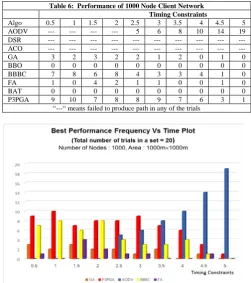
[image:5.595.303.555.468.751.2]Table 6 and figure 3 present the simulation performance for 1000 node client WMNs. From the performance we observe that DSR and ACO approaches failed to discover the path for the given timing constraints in any of the trial set. Upto 2 seconds timing limits AODV also failed to discover any of the routes. As shown in the figure 3, P3PGA outperforms other 8 approaches for the timing constraints of 0.5, 1.0, 1.5, 2.5 and 3.0 seconds. With timing constraints of 2.0 seconds P3PGA and BBBC gave the same best performance. Further, we also observed that after the 3.0 seconds timing constraint the performance of AODV improved considerably to the extent that it outperformed all other 8 approaches. Hence, for the given WMN scenario AODV is unsuitable approach if the network size is 1000 node with allowable computing time less than 3 seconds. If timing constraint could be relaxed beyond 3 seconds then AODV gives the best performance.
Table 6: Performance of 1000 Node Client Network Timing Constraints
Algo 0.5 1 1.5 2 2.5 3 3.5 4 4.5 5 AODV --- --- --- --- 5 6 8 10 14 19 DSR --- --- --- --- --- --- --- --- --- --- ACO --- --- --- --- --- --- --- --- --- --- GA 3 2 3 2 2 1 2 0 1 0 BBO 0 0 0 0 0 0 0 0 0 0 BBBC 7 8 6 8 4 3 3 4 1 0 FA 1 0 4 2 1 1 0 0 1 0 BAT 0 0 0 0 0 0 0 0 0 0 P3PGA 9 10 7 8 8 9 7 6 3 1
“---“ means failed to produce path in any of the trials
[image:5.595.32.293.481.632.2]D. Comparative Performance Of 2000NodeClientWMNs
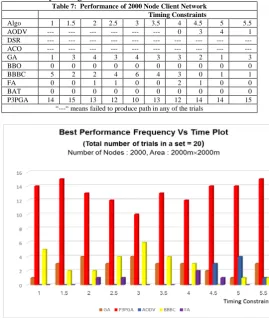
We simulated the performance of all the 9 approaches on the timing constraints of 1.0, 1.5, 2.0, 2.5, 3.0, 3.5, 4.0, 4.5, 5.0 and 5.5 seconds. The performance results of all approaches are shown in figure 4 and table 7. The results clearly indicate the supremacy of P3PGA approach over all the other 8 approaches for the every timing constraint.
Table 7: Performance of 2000 Node Client Network Timing Constraints
Algo 1 1.5 2 2.5 3 3.5 4 4.5 5 5.5 AODV --- --- --- --- --- --- 0 3 4 1 DSR --- --- --- --- --- --- --- --- --- ---ACO --- --- --- --- --- --- --- --- --- --- GA 1 3 4 3 4 3 3 2 1 3 BBO 0 0 0 0 0 0 0 0 0 0 BBBC 5 2 2 4 6 4 3 0 1 1 FA 0 0 1 1 0 0 2 1 0 0 BAT 0 0 0 0 0 0 0 0 0 0 P3PGA 14 15 13 12 10 13 12 14 14 15
“---“ means failed to produce path in any of the trials
Figure 4:Performance on 2000 Nodes Client WMN
E. Overall Performance Considering All The Networks
[image:6.595.33.303.136.456.2]In order to evaluate the performance of all 9 approaches, overall we had conducted total of 800 trials. The overall performance of the 9 approaches are given in figure 5. From the simulation results, we observe that out of total number of 800 trials P3PGA provided minimum cost path 290 times, AODV 221 times, BBBC 111 times, GA 64 times, Firefly 23 times, and BBO 3 times and DSR produced minimum cost path 2 times only. 86 times multiple approaches produced same best performance. Also, ACO and BAT approaches failed to produce the minimum cost path in any of the trials. A look at figure 5 makes it apparent that as the size of the WMN becomes 1000 node P3PGA algorithm gives best performance but the margin is small. As the WMN size touches 2000 node mark the P3PGA gives best performance with a very big performance lead over its counterparts.
Figure 5:Comparative Performance of All Approaches
VI.CONCLUSIONS
This paper proposes a new P3PGA based multi-population global optimization algorithm. The proposed algorithm extended the 3PGA approach by adding the parallel evolution behavior. We implemented the proposed algorithm in MATLAB and simulated its performance on 11 functions of CEC-2014 benchmark. We compared its performance with other 16 algorithms. P3PGA gave best unmatched performance for 3 functions out of the selected 11 functions. On the other two functions the best performance of P3PGA was equaled by few other algorithms. Hence, overall out of the 11 selected function of CEC-2014 test suite, P3PGA given best performance on 5 functions. The performance of P3PGA was followed by LSHADE that gave unmatched best performance on one function and equaled best performance on 3 functions totaling 4 functions with best performance. UMOEAS algorithm followed on the the third place. It also produced the best performance in 4 benchmark functions. But in all the 4 cases this best performance was not unique best; the same best was achieved by few other algorithms as well. This paper also proposed a P3PGA based new optimal cost or near shortest route evaluation approach for WMNs. The approach was compared with other 8 approaches namely AODV, DSR, BBBC, ACO, BBO, BAT, GA and Firefly based optimal cost path evaluation approaches. From the simulation results we conclude that the proposed approach is very suitable for large WMNs with sizes greater than 1000 nodes.
REFERENCES
[1]. Goldberg, D. E. Genetic Algorithms in Search,
Optimization and Machine Learning. Reading,
Massachusetts: Addison-Wesley Publishing Company. 1989.
[2]. Mitchell, Melanie, and Stephanie Forrest. " Genetic algorithms and artificial life." Artificial Life 1.3 (1994): 267-289. doi:10.1162/artl.1994.1.3.267
[3]. I. Rechenberg. Evolutionstrategie: optimierung technischer systeme nach prinzipien der biologischen evolution. Frommann-Holzboog, Stuttgart, 1973
[5]. H. Mühlenbein and H. M. Voigt, “Gene pool recombination in genetic algorithms,” in Proceedings of the Metaheuristics Conference, Kluwer Academic Publishers, Norwell, Mass, USA, 1995.
[6]. A. E. Eiben and C. H. van Kemenade, “Diagonal crossover in genetic algorithms for numerical optimization,”Control and Cybernetics, vol. 26, no. 3, 1997, pp. 447–466. [7]. A. Wu, P. W. M. Tsang, T. Y. F. Yuen, and L. F. Yeung,
“Affine invariant object shape matching using genetic algorithm with multi-parent orthogonal recombination and migrant principle, “Applied Soft Computing Journal, vol. 9, no. 1, 2009, pp. 282–289.
[8]. A. E. Eiben, P.-E. Raué, and Z. Ruttkay, “Genetic algorithms with multi-parent recombination,” in Parallel Problem Solving from Nature—PPSN III, vol. 866 of Lecture Notes in Computer Science, 1994, pp. 78–87. [9]. Amar Singh, Shakti Kumar, Ajay Singh & Sukhbir S.
Walia,“Three Parent GA” A technical report submitted to Computational Intelligence Labortory, Baddi University of Emerging Sciences & Technology (HP) India. Report Reference BUEST/R&D/CILAB/01/16 dated Aug 2016. [10]. Raminder S. Uppal, New Deployment & Dynamic Shortest
Path Routing in Wireless Sensor Networks, Ph.D thesis, Punjab Techical University, Jalandhar, Punjab, INDIA, 2016, pp. 37 - 41.
[11]. Sonia Waharte, Raouf Boutaba, Youssef Iraqi, Brent Ishibashi, “Routing Protocols in wireless mesh networks : Challenges and design considerations”, Multimedia Tools Appli- cations(springer), vol29, issue 3, 6 July 2006, pp 285-303.
[12]. Paula Amato, Masahito Tachibana, Michelle Sparman, and
Shoukhrat Mitalipov, “Three-Parent IVF: Gene
Replacement for the Prevention of Inherited Mitochondrial Diseases”, Fertility and Sterility, 101(1), 2014, pp. 31-35. [13]. Dr Andy Greenfield, “Third scientific review of the safety
and efficacy of methods to avoid mitochondrial disease through assisted conception: 2014 update”, Report provided to the Human Fertilisation and Embryology Authority (HFEA), 2014.
[14]. Hamzelou, Jessica, “Everything you wanted to know about ’3-parent’ babies”, The New Scientist, Retrieved 1st
[15]. Hamzelou, Jessica, “Exclussive: World’s First baby born with new ’3 Parent’ Technique” The New Scientist,
Retrieved 27
Oct 2016, from https://www.newscientist.com/article /2107451everything-you-wanted-to-know-about-3-parent-babies/., 2016-09-28
th
[16]. Shengxiang Yang, Hui Cheng, and Fang Wang, “Genetic Algorithms With Immigrants and Memory Schemes for Dynamic Shortest Path Routing Problems in Mobile Ad Hoc Networks”, IEEE Transactions on Systems, MAN, and Cybernetics-Part C: Applications and Reviews, vol. 40, No. 1, January 2010, pp. 52-63
September 2016, from
https://www.newscientist.com/article/2107219-exclusive-worlds-first-baby-born-with-new-3-parent-technique, 2016-09-28.
[17]. R. Draves, J. Padhye, B. Zill, “Comparisons of routing metrics for static multi-hop wireless networks”, ACM Annual Conference of the Special Interest Group on Data
Communication (SIGCOMM), Portland, Oregon, USA , August 30 - September 03 ,August 2004, pp. 133-144. [18]. A .Adya, P. Bahl, J. Padhye, A.Wolman and L.Zhou, “A
multi radio unication protocol for IEEE 802.11 wireless networks”, International Conference on Broadcast Networks (Broad Nets), San Jose, California, USA, October 25 29, 2004, pp.344- 354
[19]. R. Draves, J. Padhye, B. Zill , “Routing in multi-radio. Multihop wireless Mesh networks”, ACM annual International conference on mobile computing and networking (Mobi Con04), Philadelphia, Pennsylvania, USA, 2004, pp 114-128.
[20]. De Couto DSJ, Aguayo D, Bicket J and Morris R , “A high throughput path metric for multi-hop wireless routing”, InProc. ACM Annual International Conference on Mobile Computing and Networking (MOBICOM), San Diego, CA, USA, September 14 - 19, 2003, pp. 134-146.
[21]. C.E. Koksaland H. Balakrishnan, “Quality-aware Routing Metrics forTime-varying Wireless Mesh Networks”, IEEE Journal on Selected Areas in Communications, vol. 24(11), 2006, pp. 1984-1994.
[22]. G. Jakllari, S. Eidenbenz, N. Hengartner, S. Krishnamurthy and M. Faloutsos, “Link Positions Matter: A Non commutative Routing Metric for Wireless Mesh Networks”, In Proceedings of IEEE Annual Conference on Computer Communications (INFOCOM), nPhoenix, Arizona, USA, April 13 18, 2008, pp. 744-752
[23]. T. Liu and W. Liao, “Capacity-aware Routing in Multi-channel Multi-rate Wireless Mesh Networks”, In Proceedings of IEEE International Conference on Communications (ICC), 2006, pp. 1971-1976.
[24]. Yang Y, Wang J and Kravets, “Interference-aware load balancing for multihop wireless networks”, In Tech. Rep. UIUCDCS-R-2005-2526, Department of Computer Science, University of Illinois at Urbana-Champaign, 2005, pp. 1-16
[25]. L. Ma, Q. Zhang, Y. Xiong and W. Zhu , “Interference Aware Metric for Dense Multi-hop Wireless Network”, In Proceedings of IEEE International Conference on Communications (ICC), 2005, pp. 1261-1265.
[26]. G. Karbaschi and A. Fladenmuller, “A Link Quality and Congestion-aware Cross Layer Metric for Multi-hop Wireless Routing”, In Proceedings of IEEE MASS05, 2005, pp 7-11.
[27]. Shakti Kumar, Brahmjit Singh, Sharad Sharma, “Soft Computing Framework for Routing in Wireless Mesh Networks: An Integrated Cost Function Approach”, International Journal of Electronics, Computer and Communications Technologies (IJECCT), Vol.3, No.3, 2013, pp 25-32.
[28]. Sharad Sharma, Shakti Kumar and Brahmjit Singh, “Hybrid Intelligent Routing in Wireless Mesh Networks: Soft Computing Based Approaches”, I.J. Intelligent Systems and Applications, Modern Education and science press, vol 1, 2014, pp 45-57.
AUTHOR’s PROFILE
Prof. (Dr.) Shakti Kumar did his MS (Electronics & Control) from BITS, Pilani, India and Ph.D. (Electronics& Computer Engg.) from National Institute of Technology, Kurukshetra, India. Presently, he is Vice Chancellor Baddi University of Emerging Sciences and Technology, Baddi (HP), India. His research areas include Communication Networks, Soft Computing and Intelligent Systems. He has publishedmore than 200 research articles in various Journals and Conferences and 7 book chapters. He has organized 7 international and 6 national conferences in the areas of intelligent systems and networks.
Mr. Amar Singh is a research scholar with Punjab Technical University, Kapurthla, Punjab, India. He did his M.Sc. (Computer Science) from Kurukshetra University, Kurukshetra, and M.Tech. (Computer Science & Engg.) from MMU, India. His research areas include Wireless Mesh Networks, Soft Computing and face recognition. He has published 25 articles in various journals and conferences.