707
TOPOLOGY BASED ROUTING PROTOCOLS FOR VANET
AND THEIR COMPARISON WITH MANET
1 KASHIF NASEER QURESHI, 2ABDUL HANAN ABDULLAH
1 Department ofCommunication, Faculty of Computing, Universiti Teknologi Malaysia, Skudai, 81310,
Johor Darul Takzim, MalaysiaAffiliation
E-mail: [email protected]
ABSTRACT
The development in technologies the mobile networks has been rapidly change, especially Mobile Ad-hoc and Vehicular Ad-Hoc networks. Due to nature of the fields, the mobile sensor network replaced the fixed sensor network. In these fields, the topology dynamically changes time by time due to speed and congested environment because of this routing is a crucial and challenging issue. For routing a variety of new routing protocols have been developed. In mobile Ad-hoc networks and Vehicular Ad-Hoc networks the routing protocols are divided into different categorize. They based on topology, position, and network. We discuss the topology based efficient routing protocols and some shed on pros and cons and characteristics and types of these protocols. Moreover, we compare the protocols performance and nature of work.
Keywords: Mobile Ad-hoc networks (MANET), Vehicular Ad-hoc networks (VANET), Topology, Proactive, reactive, Hybrid
1. INTRODUCTION
The development in technologies and transportation sector the new type of wireless communication had made which is Vehicular Ad-hoc Networks (VANET). The various projects are adopted VANET and some of the most popular companies are Toyota, BMW, And Daimler Chryler Etc [1]. Vehicular Ad-hoc networks made a vast improvement in automobiles and changed the faces of transportation. Through these technology vehicles, communication is spontaneously and wirelessly possible. Travelers are more convenient in safety and comfort with application of intelligent transport technology. We discuss the comparison between VANET and MANET environments and discuss protocols of these two fields.
1.1Vehicular Ad-Hoc Networks
In intelligent transportation system, VANET is essential part in architecture of transportation system. VANET uses in many applications of Intelligent Transportation System (ITS) for reduce congestion, road safety, and betterment in traffic flow. A Vehicular Ad-hoc Network (VANET) is an application of Mobile Ad-hoc Network (MANET), it is use for wireless communication between moving vehicles. VANET is different from Mobile Ad-hoc networks (MANET) in various ways such as architectures, characteristics, and applications. VANET contains a collection of nodes with potential of self-organization in a fixed
infrastructure and decentralized manner. They are highly dynamic topologies and fast changeable connectivity, predictable mobility and geographical constrained [2]. VANET using dedicated short-range communication (DSRC) and the 5.9 GHz spectrum band and 75 MHZ of bandwidth has been allocated and the range is 1000m, which is suitable for both vehicle-to-vehicle communication (V2V) and vehicle-to-infrastructure communication (V2I) [3]. Therefore, vehicular Ad-hoc networks are also called Inter-vehicle Communications (IVC) or Vehicle-to-Vehicle (V2V) communications [4].Dedicated short-range communication (DSRC) standard is IEEE 802.11a and then modify in 802.11p standard for low overhead operation. The whole communication stack standardize by IEEE that is 1609 family and referring by WAVE (wireless access in vehicular environments) (ITS-Standards, 1996).VANET works without infrastructure and it is dynamic topology base. It is working when two or more vehicles are in the communication range. Communication and routing in transportation networks is a challenging task due to short lifetime of communication, high speed of vehicles, unpredictable node density, and city environment characteristics [5]. Infrastructure in V2I is fix equipment next to the road called RSU (Roadside Unit) [6].
1.2 Mobile Ad-Hoc Networks
708 in dynamically in any direction or any speed. The MANET not require any fix infrastructure and they are operate on batteries and limited transmission range. The reactive, proactive and hybrid algorithms are working in MANET [7]. The MANET is use in battlefield and especially best in disaster environment, have seen MANETs being use in various fields for end-to-end communication. . MANETs employ the traditional TCP/IP structure to provide end-to-end communication between nodes. Because of dynamic nature, the routing is a challenging task and has received tremendous amount of attention from researchers. This has led to development of many different routing protocols for MANETs. Therefore, it is quite difficult to determine which protocols may perform best under a number of many network scenarios, such as increasing node density and traffic. In this paper, we provide some of topology based protocols which are using in MANET and VANET as well.
1.3 Vehicular and Mobile Network
Characteristics and Architecture
Advancement in Intelligent Transportation System the vehicular communication design and architecture are much more challenging. Vehicular Ad-hoc network technology becoming increasingly popular, and faces some challenges as well for efficient communication, road safety, and improved traffic flow. Some characteristics of VANET and design architecture are described below: VANETs acquire unique network characteristics that differentiate it from other networks. Topology changed frequently due to fast speed and movements of vehicles, due to high-speed mobility models and predictions play a significant role in dissemination and designing of VANET. The chances of disconnections are high because it is a dynamic topology. Mobile wireless networks technologies are using unicast and multicast techniques but the VANETs deals with packets forwarding and based on geographical area. Hence, because of the predictable possible impact of VANETs, a number of researchers have developed unicast routing protocols that are suitable for VANETs[7]. The nodes in vehicular Ad-hoc networks have enough energy and power. In many applications, the hard delay constraints are present because these applications are simpler and less data required[8]. The VANET works through infrastructure and Ad-hoc technology and some time the both technologies works for information distribution. In Vehicular Ad-hoc networks packet is transport by multi-hop method and it is self-organized network.
1.4 Comparison of VANET and MANET
[image:2.612.313.522.288.619.2]Many VANET protocols and techniques are similar with the MANET, but when we compare these types, various characteristics and behavior is not same as much. The main difference between VANET and MANET network is production cost, the VANET production cost is costly when we compare with MANET. The network topology of VANET is frequent, fast, mobility is high because of speed of cars, and other hand the MANET is sluggish and slow. The bandwidth in VANET is more high compare to Mobile Ad-hoc networks. The nodes are moving randomly in MANET but in VANET the nodes are moving regularly. The below figure is shows the difference between VANET and MANET.
Figure 1.Comparison of VANET with MANET.
1.5 Architecture Categories Of Vanet
709 The three categories of VANET protocols we discuss in below cellular, Ad-hoc, Hybrid.
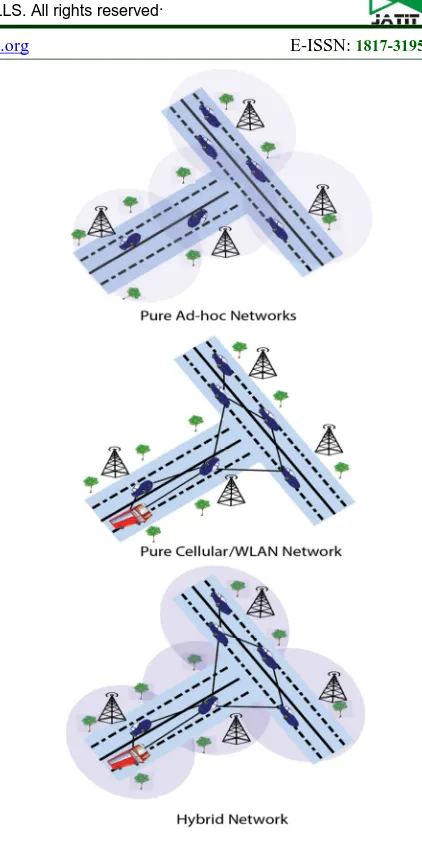
1.5.1 Pure Ad-hoc Networks
The pure Ad-hoc network are use for emergencies environments where, in spite of nonexistent infrastructure. Nodes help each other in conveying information to and for creating the connections. Each node in Ad-hoc networks act like a router. In VANET environment, the communication between Vehicle-to-Vehicle (V2V) is a pure Ad-hoc because of no infrastructure needed for communication between vehicles. Ad-hoc networks are self-organized networks and there is no need for infrastructure but range is limited.
1.5.2. Pure Cellular/WLAN Networks
In Cellular/WLAN category the network is a pure cellular and the access points are connect with internet and collect the information for analyzing. The system is use for Vehicle-to-Infrastructure (V2I) communication for provision of information [8].Cellular or Wireless Local Area Network based vehicular network are use for infotainment, web browsing, parking information. Cellular system still suffers from a main problem of fixed infrastructure deployment. LAN and DSRC are the most considered technologies in V2V and V2I communications.
1.5.3. Hybrid Networks
The Combination of Cellular and Ad-hoc networks is hybrid networks andthe architecture of hybrid network combine the Cellular and Ad-hoc network characteristics [6] . The hybrid network, which uses some vehicles with both WLAN and cellular capabilities as the gateway, and mobile network. Through multi-hop network the vehicles which are not WLAN capable communicate with others. VANETs contain of radio-enabled vehicles, which act as mobile nodes as well as routers for other nodes. Further, the similarities to ad hoc networks, such as short radio transmission range, self-organization and self-management, and low bandwidth, VANETs can be distinguished from other kinds of ad hoc networks.
[image:3.612.309.520.59.480.2]
Fig 1. Three Architectures of VANET Pure Ad-hoc Networks, Pure Cellular /WLAN Networks, Hybrid
Architecture
2. VANET PROTOCOLS
710 The all MANET protocols are not useful in VANET but various types of protocols used in VANET [10].
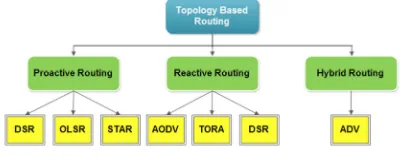
Fig 2. Classification of Topology Based Routing Protocols for VANET
2.1 Topology Based Routing Protocols
Routing Protocols are standards and used for transfer the data in Networks. Efficient Routing protocols make dynamic routing decisions in network. Topology Based Routing Protocols are further divide into Proactive and Reactive. The topology-based routing protocols have limited performance when we are comparing with position based routing protocols [11]. Topology Based Routing schemes generally require additional node topology information during the routing decision process.
2.1.1 Proactive Routing Protocols
The proactive routing protocols maintain tables representing the topology. In these protocols the tables updating regularly and send the information from one node to another. Proactive routing protocols also called the table driven protocols due to its nature. There are two types of updating available in proactive protocols periodic update and triggered update due to broadcast the update tables they waste power and bandwidth in the network[12]. In proactive protocols, table size is increase when nodes are added in networks due to this the load increase. Because of this, the Destination Sequenced Distance Vector (DSDV) and Fisheye State Routing (FSR) protocols are proposed. Proactive protocols are not appropriate for broad network because of overhead in routing tables [13]. These protocols are typically base on shortest path algorithms.
2.1.1.1 Destination Sequence Distance Vector Routing (DSDV)
Destination Sequence Distance Vector Routing (DSDV) is make available loop free routes, use single source to destination, and use distance vector shortest path algorithm. Two types of
packets are sending the protocol Incremental and Full Dump, in full dump type packets are send with routing information, and in incremental packet send the updates due to full dump packets are utilize the decreases the bandwidth and the incremental packets are so frequent and increase the overhead in networks. DSDV protocol not suitable for large networks due to utilizing the bandwidth and updating procedures[14-15].
2.1.1.2 Optimized Link State Routing Protocols (OLSR)
Optimized Link State Routing Protocols (OLSR) is proactive and point-to-point routing protocol based on the traditional link-state algorithm. It is using a technique called multipoint relaying for optimized message and flooding process for route setup or route maintenance. The algorithm minimize the number of active relays for covering the neighbors and it is called Multi-Point Relays( MPR) [16]. The protocol introduced for accuracy and stability for routing the data in network .Optimized Link State Routing protocol (OLSR) has two key concepts, Multipoint Relays (MPRS) algorithm and Optimized State is among one -hop neighbors and cover two-hop neighbors or sending link state information for maintenance of routing. Every node receives updates only once and unselected packets cannot retransmit updates. The major advantage of this protocol is the all routes and destinations are known and maintained before the operation. On the other hand, the nodes are moving fast, due to calculation of optimal node may be impossible in some cases [17].
2.1.1.3 Fisheye state routing protocol (FSR)
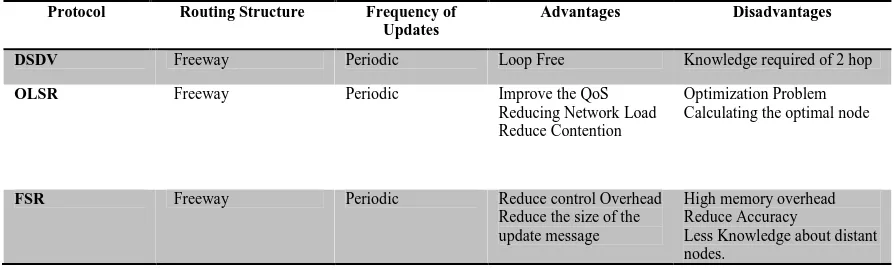
Fisheye state routing protocol (FSR) is maintaining a topology table for nodes and updating the network information to other nodes, which are in network. It is reduces the size of update message. It is scalable for large networks but the problem is scalability and due to scalability, the accuracy is not sufficient and increases the network size the routing table. In Fisheye state routing protocol (FSR) the target node lies out of scope of source node then route discovery fails. The below table No. 2 shows the Comparison of some popular proactive protocols.
2.1.2 Reactive/Ad-hoc based routing
711 discovered route is stored until other node is inaccessible. They deal cache routes and how routes replies handled. The bandwidth of network is low due to route discovery mechanism. Popular Reactive protocols are Dynamic Source Routing (DSR) and Ad-hoc On-Demand Distance Vector routing (AODV).
2.1.2.1 On-Demand Distance Vector routing (AODV)
The AODV protocol is a reactive protocol pure in demand and need based. AODV protocols are based on DSDV and DSR algorithms. The protocols are woks on routing tables and initiate discovery process. In discovery method, the Packet broadcast through source and this packet is Route Request (RREQ) packet and the neighbor nodes onward the packet to their neighbors until active route founds and maximum number of hops achieved. The RREQ packets do not know about activeroute for the requested target before sending the packet to their neighbors. AODV performance and efficiency is best found in many studies due to three metrics :packet delivery ratio, routing overhead and path optimality[18]. The enhancement in On Demand distance routing protocols many other protocols were proposed such as AOMDV, S-AOMDV, RAOMDV, SD-OMDV.
2.1.2.2 Ad-hoc On-demand Multipath Distance Vector Routing (AOMDV) protocol
Ad-hoc On-demand Multipath Distance Vector routing protocol is an addition to AODV protocol. It is for computing disjoint paths and multiple loop-free based on a prominent on demand single path protocol. AOMDV has two advantages. 1) The routing information already available in the underlying AODV protocol, 2) It can maintain multiple loop-free paths with low coordination overhead. The performance of AOMDV is much better when we compare with AODV. The link disjoint technique is more popular and due to this, the protocol is good for high mobility [19]. The routing table of AOMDV structure is different with AODV, the difference is AOMDV store additional information like next hop, last hop, hop count, and expiration timeout. Last hop information is useful in checking the disjointness of alternate paths [20].
Fig 3. Entry Structure of routing table (a) AODV (b) AOMDV
There are many protocols proposed with some new features like S-AOMDV, R-AOMDV (Reliable Ad-hoc On-demand Multipath Distance Vector) and SD-AOMDV [21].
Table.3 Comparison with proposed Protocols with AOMDV
Protocol Difference with AOMDV
S-AOMDV It is make a speed of routing decision and Combining the routing metrics hop.
RAOMDV Hop counts by a routing metric and retransmission counts by MAC Layer. Link quality and delay reduction
SD-AOMDV It is combining the routing metrics and speed for make routing decision and add mobility parameters, speed and direction to hop count.
2.1.2.3 Dynamic Source Routing Protocol DSR
Dynamic Source Routing (DSR) is a similar with AODV it forms route on demand and depend on source routing instead of table. DSR is beacon-less and does not require periodic hello packets. The approach of DSR is flooding the route request packets dynamically in network and through destination node reply the request and carries the route-traversed packet in its header. The complete order list of nodes are allowing packet for routing and avoiding the need for up-to-date routing and loop free information to the intermediate nodes. With the addition of this technique, the route is in the header of each data packet, and other nodes are forwarding and cache the routing for future use [22].
2.2.2.4 Temporally Ordered Routing Algorithm TORA
712 three types of messages use QRY for creation, UPD for creating and maintaining and CLR for erasing the route. TORA is minimize the communication overhead when the topology change. It is efficient for dynamic Ad-hoc networks. TORA performance is better than DSR in network [23].
2.1.3 Swarm Intelligence based routing protocol SWARM
SWARM intelligent technique is a modified form of AODV protocol and it is best in services. Some Swarm based routing protocols we discuss below. SWARM routing protocols performance is high when we compare with AODV and DSR protocols such as throughput and data rate [24].
2.1.3.1 QoSBee Vanet Protocol
Quality of service multipath routing protocol (QoSBee) is a topology based reactive protocol. The protocol based on food source searching technique of bees. QoSBee VANET protocol is inspired from swarm of bee. It is self-configured and distributes protocol and it is use stochastic broadcasting transmit ion for route discovery. Two types of packets are use in the protocol scout and forager. The first packet is used for route request until the finding destination and then it returns to the source node. The second packet use for transmit the data and the packets are line up until the discovery process terminated and then launched to the destination. When we compare with DSDV and AODV then QoSBee is more realistic and QoS
[image:6.612.85.304.381.444.2]guarantees and adequate transmit ion is present [25] Through the simulation results the QoSBee protocol performance in Packet Delivery Ratio, end-to-end delay and Normalized Overhead Load are more high with DSDV and AODV protocols
.
Table 4. Comparison Of Qosbee VANET With DSDV And AODV Simulation Result [25].
End-To-End Delay
Packet Delivery Ratio
Normalized Overhead Load
QoSBee 0.15s 98% 64%
DSDV 1.02s 97% 51%
AODV 1.10s 95% 59%
2.1.3.2 AODV Extension using Ant Colony Optimization
Ant colony optimization (ACO) is a extension of the candidate AODV protocol. The basic idea behind the ACO is met heuristic is taken from the food searching behavior of real ants. This property is integrating dynamic into the path searching process. The combination of ACO with AODV repair strategy for avoiding the frequent path loss, increase the performance and reduce the overhead of routing.Table No 5 shows some popular reactive routing protocols
2.1.3 Hybrid routing
The Hybrid routing is a combination of reactive and proactive protocols characteristics. Reactive feature is protection the more accurate information in the local scope and proactive feature is further distance routing. Hybrid routing protocols are zone based such as the nodes are divided into different zones for route maintenance and discovery. The Hybrid routing protocol reduce the overhead of overall routing protocol and its performance is better in highly dynamically changes. Hybrid routing
protocols are zone based for maintenance and discovery. hybrid structure of routing events is widely deployed in ITS development [26].
2.1.3.1 ZRP: Zone routing protocol
The Zone Routing Protocol (ZRP) decreases the delay and high overhead for discovering the route. Further, the protocol divides into zone distinct and overlapping zones as a group of nodes and the nodes are in zone radius. The zones are creates on the base of hop distance and chosen through topological distribution of nodes. At the edge of zone, the nodes are called peripheral nodes. The size and radius of length is determined by the radius of length α where α is the number of hops to the border of the zone. The function of peripheral nodes are route discovery outside zone and for this a reactive approach is used Intra-zone routing protocol (IERP). A proactive routing protocol is used in inside the zone that is called Intra-zone Routing Protocol (IARP)[27].
3. CHALLENGES IN VANET ROUTING PROTOCOLS
713 many challenges in application, routing, power management etc. There are many challenges in applications of communication for collision warning, road obstacle warning, cooperative driving, intersection collision warning, and lane change assistance etc.
Fig 4. Networking Challenges in VANET [28].
4. CONCLUSION AND FUTURE WORK
This paper presents the survey of topology based routing of vehicular Ad-hoc based networks. Initially, we discussed the characteristics of vehicular Ad-hoc networks and compare with Mobile Ad-hoc networks and along with the protocols. We discussed three types of networks in VANET, Ad-hoc Networks, Pure Cellular /WLAN Networks and Hybrid Architecture. The paper highlights the different topology based routing protocols along with their routing issues
.
Various papers studied shortly about the performance and comparisons of protocols of VANET with MANET but we discussed the protocols in detail and compared with each other. Tables in paper showed pros and cons of popular topology based routing protocols. This work help the researchers for getting the idea of two fields and about the same protocol. Furthermore, in future we are focusing position based routing protocols and comparison with topology based protocols.REFERENCES
[1]. Sun, X. and L. Xia-Miao. Study of the Feasibility of VANET and its Routing Protocols. in Wireless Communications, Networking and Mobile Computing, 2008. WiCOM '08. 4th International Conference on. 2008.
[2]. Gajbhiye, V.A. and R.W. Jasutkar, Study of Efficient Routing Protocols for VANET.
[3]. Bilal, S.M., C.J. Bernardos, and C. Guerrero, Position Based Routing in Vehicular Networks: A Survey. Journal of Network and Computer Applications, 2012.
[4]. Li, F. and Y. Wang, Routing in vehicular ad hoc networks: A survey. Vehicular Technology Magazine, IEEE, 2007. 2(2): p. 12-22.
[5]. Santos, R.A., et al., Performance evaluation of routing protocols in vehicular ad-hoc networks. International Journal of Ad Hoc and Ubiquitous Computing, 2005. 1(1): p. 80-91. [6]. Kumar, R. and M. Dave, A comparative study
of Various Routing Protocols in VANET. arXiv preprint arXiv:1108.2094, 2011. [7]. Park, S. and S.-M. Yoo, An efficient reliable
one-hop broadcast in mobile ad hoc networks. Ad Hoc Networks, 2013. 11(1): p. 19-28. [8]. Sheng-Tzong, C., H. Gwo-Jiun, and C.
Chih-Lun, Using Cellular Automata to Form Car Society in Vehicular Ad Hoc Networks. Intelligent Transportation Systems, IEEE Transactions on, 2011. 12(4): p. 1374-1384. [9]. Perkins, C.E. and E.M. Royer. Ad-hoc
on-demand distance vector routing. in Mobile Computing Systems and Applications, 1999. Proceedings. WMCSA'99. Second IEEE Workshop on. 1999: IEEE.
[10]. Waghdhare, L.K., T. Nagrare, and K. Gudadhe, Review on Routing Protocol for Vehicular Ad-hoc Network. International Journal, 2012. 2(10).
[11]. Marwane, A., et al. HHLS: A Hybrid Routing Technique for VANETs. in IEEE Global Communications Conference, IEEE GLOBECOM'12. 2012.
[12]. Garg, N., K. Aswal, and D.C. Dobhal, A REVIEW OF ROUTING PROTOCOLS IN
MOBILE AD HOC NETWORKS.
International Journal of Information Technology, 2012. 5(1): p. 177-180.
[13]. Ade, S. and P. Tijare, Performance Comparison of AODV, DSDV, OLSR and DSR routing protocols in Mobile Ad hoc Networks. International Journal of Information Technology and Knowledge Management, 2010. 2(2): p. 545-548.
[14]. Abolhasan, M., T. Wysocki, and E. Dutkiewicz, A review of routing protocols for mobile ad hoc networks. Ad Hoc Networks, 2004. 2(1): p. 1-22.
714 Applied Mechanics and Materials, 2013. 303: p. 1968-1973.
[16]. Haerri, J., F. Filali, and C. Bonnet. Performance comparison of AODV and OLSR in VANETs urban environments under realistic mobility patterns. in Proc. of 5th IFIP Mediterranean Ad-Hoc Networking Workshop (Med-Hoc-Net-2006), Lipari, Italy. 2006.
[17]. Santoso, G.Z. and K. Moonsoo. Performance analysis of AODV, DSDV and OLSR in a VANETs safety application scenario. in Advanced Communication Technology (ICACT), 2012 14th International Conference on. 2012.
[18]. Maowad, H. and E. Shaaban. Efficient routing protocol for Vehicular Ad hoc networks. in Networking, Sensing and Control (ICNSC), 2012 9th IEEE International Conference on. 2012.
[19]. Marina, M.K. and S.R. Das, Ad hoc on-demand multipath distance vector routing. SIGMOBILE Mob. Comput. Commun. Rev., 2002. 6(3): p. 92-93.
[20]. Marina, M.K. and S.R. Das, Ad hoc on-demand multipath distance vector routing. Wireless Communications and Mobile Computing, 2006. 6(7): p. 969-988.
[21]. Maowad, H. and E. Shaaban. Enhancing AOMDV routing protocol for V2V communication. in Proceedings of the 6th international conference on Communications and Information Technology, and Proceedings of the 3rd World conference on Education and Educational Technologies. 2012: World Scientific and Engineering Academy and Society (WSEAS).
[22]. Mohapatra, S. and P. Kanungo, Performance analysis of AODV, DSR, OLSR and DSDV Routing Protocols using NS2 Simulator. Procedia Engineering, 2012. 30(0): p. 69-76. [23]. Pirzada, A.A., C. McDonald, and A. Datta,
Performance comparison of trust-based reactive routing protocols. Mobile Computing, IEEE Transactions on, 2006.
5(6): p. 695-710.
[24]. Manvi, S., M. Kakkasageri, and C. Mahapurush. Performance analysis of AODV, DSR, and SWARM intelligence routing protocols in vehicular ad hoc network environment. in Future Computer and Communication, 2009. ICFCC 2009. International Conference on. 2009: IEEE.
[25]. Bitam, S. and A. Mellouk. QoS Swarm Bee Routing Protocol for Vehicular Ad Hoc Networks. in Communications (ICC), 2011 IEEE International Conference on. 2011. [26]. Al-Rabayah, M. and R. Malaney, A New
Scalable Hybrid Routing Protocol for VANETs. Vehicular Technology, IEEE Transactions on, 2012. 61(6): p. 2625-2635. [27]. Shafiq, Z., et al. Zone Routing Protocol: How
does it perform the other way round? in ICT Convergence (ICTC), 2012 International Conference on. 2012: IEEE.
715
Table 5. Comparison of Some Popular Reactive Routing Protocols
Protocol Routing
Structure
Frequency of Updates Advantages Disadvantages
AODV Fre Freeway Unicast & Multicast -Up-to-date path Information -Reduce excessive memory requirement
-Responses to the link failure Use in Large Scale Network
-More time needed for connection setup -Inconsistency in the route -Use extra bandwidth
DSR Freeway Unicast -Beacon less
-Use caching which reduce load on the network
-Periodical update is not required
-Unnecessary flooding burden -Performance is worse in high mobility pattern
-Unable to repair broken links locally
TORA Freeway Unicast & Multicast -DAG (Direct acyclic graph)
creates
-Reduce network overhead -Performance is good in dense Networks
.It is not Scalable -Not use because DSR & AODV perform well than TORA
Table 2. Comparison of Some Popular Proactive Routing Protocols
Protocol Routing Structure Frequency of
Updates
Advantages Disadvantages
DSDV Freeway Periodic Loop Free Knowledge required of 2 hop
OLSR Freeway Periodic Improve the QoS
Reducing Network Load Reduce Contention
Optimization Problem Calculating the optimal node
FSR Freeway Periodic Reduce control Overhead Reduce the size of the update message
High memory overhead Reduce Accuracy
[image:9.612.83.530.329.464.2]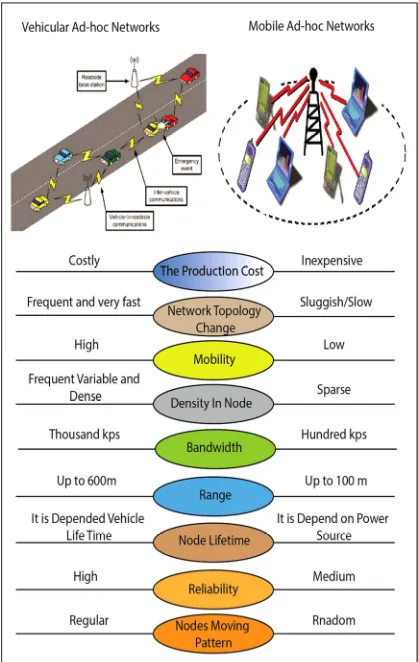
![Table 4. Comparison Of Qosbee VANET With DSDV And AODV Simulation Result [25].](https://thumb-us.123doks.com/thumbv2/123dok_us/8914162.960876/6.612.85.304.381.444/table-comparison-qosbee-vanet-dsdv-aodv-simulation-result.webp)
![Fig 4. Networking Challenges in VANET [28].](https://thumb-us.123doks.com/thumbv2/123dok_us/8914162.960876/7.612.98.295.174.317/fig-networking-challenges-in-vanet.webp)