International Journal of Advanced Research in Computer Science
RESEARCH PAPER
Available Online at www.ijarcs.info
Unsupervised Image Segmentation using ROR
B.Suresh Kumar
Abstract:Image segmentation is a process of segmenting an image into groups of pixels based on some criterions. Image segmentation is the process of partitioning a digital image into multiple segments. The purpose of image segmentation is to partition an image into meaningful regions with respect to particular application. Image segmentation is typically used to locate objects and boundaries (lines, curves, etc.) in images. Previously Adaptive Fuzzy-K-Means (AFKM) clustering for image segmentation which could be applied on general images and/or specific images. The FCM segments images based on the membership value and objective function used in it. Both of these methods work well for images with vast variations in its Pixel values but fails for pixels with slight variations. In order to overcome the disadvantages of various segmentation processes a new method of unsupervised segmentation is proposed using ROR (Robust Outlyingness Ratio). The advantages of proposed method accuracy is more, time is less and the number of iterations always being one.
Keywords: Adaptive Fuzzy-K- Means (AFKM); Fuzzy- K-Means (FKM); Silhouette Measure; Unsupervised Clustering; Threshold; Inter Cluster; Intra Cluster; Tolerance Limit(TL).
I. INTRODUCTION
The clustering algorithms have successfully been applied as a digital image segmentation technique in various fields and applications. However, those clustering algorithms are only applicable for specific images such as medical images, microscopic images etc [1]. There are so many methods are used for segmentations such as compression based methods, thresholding, and clustering. The clustering methods can be divided into two parts namely supervised and unsupervised.
In machine learning, the problem of unsupervised learning is that of trying to find hidden structure in unlabeled data. Since the examples given to the learner are unlabeled, there is no error or reward signal to evaluate a potential solution. This distinguishes unsupervised learning from supervised learning and reinforcement learning.
Unsupervised learning is closely related to the problem of density estimation in statistics [2] However unsupervised learning also encompasses many other techniques that seek to summarize and explain key features of the data. Many methods employed in unsupervised learning are based on data mining methods used to preprocess data.
The advantage of clustering base method
1. Clustering define relation of the pixel which can be used for many applications.
2. User can define the segmentation number 3. More flexible to extract Particular gray values.
Area of operation
The fuzzy C-means (FCM) clustering algorithm was largely used in various medical image segmentation approaches[3]. However, the algorithm is sensitive to both noise and intensity heterogeneity since it does not take into
account spatial contextual information. The traditional clustering algorithm it has limitations of getting number of cluster centers by means of its users.
The Adaptive Fuzzy-K-means (AFKM) clustering for image segmentation which could be applied on general images and/or specific images[4] (i.e., medical and microscopic images), captured using different consumer electronic products namely, for example, the common digital cameras and CCD cameras. The adaptive K-Means clustering algorithm is capable of segmenting the regions of smoothly varying intensity distributions.[5]
II. METHODOLOGY
In order to overcome the disadvantages of various segmentation processes a new method of unsupervised segmentation is proposed using ROR (Robust Outlying-ness Ratio). The proposed unsupervised method involves the following steps in it. cropping it.Resizing image isbased on the cropped area the image is resized to fit to that cropped area. The Sharpening image cropped is adjusted for its contrast and brightness to enhance its appearance and to visualize the layers more perfectly.
B.L. Shivakumaret al, International Journal of Advanced Research in Computer Science, 5 (7), September–October, 2014,217-221
unsupervised approach. Hence this technique is used for unsupervised segmentation. This method assigns values for pixels by taking median of the image to be segmented. ROR method uses a value of 0.6457 as threshold because it is the value obtained by standard normal random variables. The algorithm behind ROR segmentation is given below.
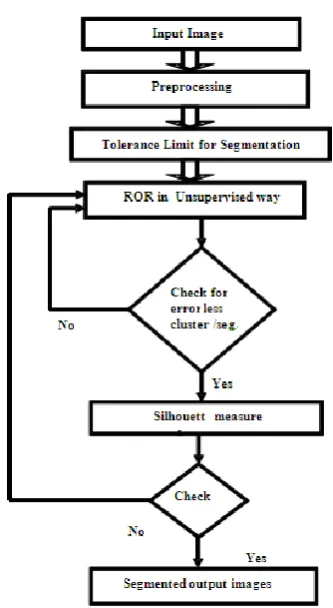
The input image is getting for high frequency noise removal and removal of blurring effect. Then preprocessing enters user defined threshold percentage which depends on accuracy user needed for segmentation. ROR does the segmentation without the user dependency. Silhouette measure is checking for the method of segmented elements. If check is yes then got segmented output image. If no then back to the ROR in unsupervised way.
III. ALGORITHMFORUNSUPERVISED V1=double (V) Now V1 contain integer values of pixels. median=middle value of sorted data. N=even, then
median=average of middle two values. MED= Median (V1) =33. Since N=11.
Step 3: This median value obtained is again subtracted from the integer value of image and again median is taken for the output. Sub_V1=absolute value
(V1-MED); For the above example,
Sub_V1=1,0,18,17,15,50,8,21,55,37,12;For the obtained new data Sub_V1 again a median value is calculated. MED1=Median (Sub_V1) For the above example MED1=18
Step 4: The obtained output is then divided by a value of 0.6457 which is the median of standard Normal random variables. W= MED1 / 0.6457 for the above example it will be, W=27.87 finally a matrix of ROR values is obtained by, ROR = (V1-Median)/W
Step 5: The whole operation is performed for the image values in matrix form. The new output matrix obtained is called ROR value matrix and the values are known as the median absolute deviation or the ROR value.
Step 6: Meeting tolerance is used to check the correctness
being done. The obtained clusters pixel values are determined and the minimum and maximum value of each cluster is obtained. The middle value of each cluster is also obtained. X= mid value (cluster) The tolerance of 60 % is checked for each cluster with a condition as follows,X1= (60 * X)/ 100;X2= X1 + X; Condition (Min Value (cluster) < X1) or Max value (Cluster) > X2)
Step 7: Based on the tolerance limit the accuracy is achieved. The difference in intra-cluster elements is minimal and inter-cluster element is large and both of the conditions are satisfied then the algorithm is termination of the process.
Figure 1: Proposed Methodology
International Journal of Advanced Research in Computer Science
RESEARCH PAPER
Available Online at www.ijarcs.info
Figure 3: ROR Method
ROR Process
OLR
LHS
OLR
RHS
OLR
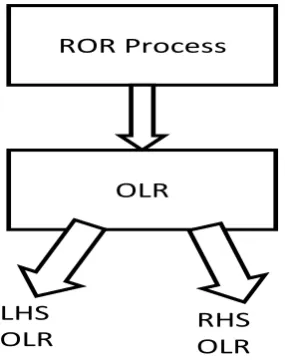
Figure 4: ROR Process
I. RESULTSANDDISCUSSIONS
B.L. Shivakumaret al, International Journal of Advanced Research in Computer Science, 5 (7), September–October, 2014,217-221
Figure 5(a) Original Image
Figure 5(b): Segmented Image
Figure 6(a) Original Image
Figure 6(b) Segmentedl Image
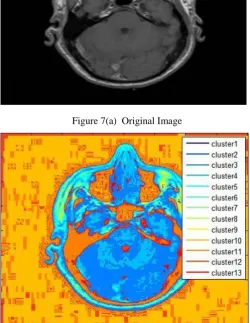
Figure 7(a) Original Image
Figure 8(a) Original Image
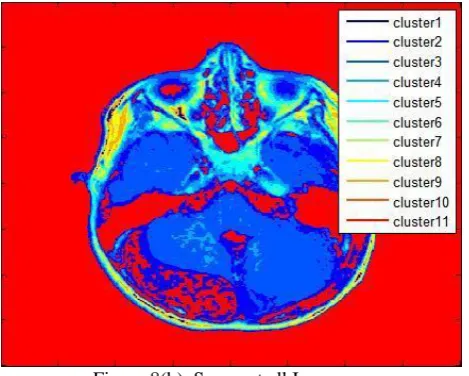
Figure 8(b) Segmentedl Image
TABLE 1 : Shows the comparison result for four image
S.NO IMAGE NAME NO. OF
CLUSTER
TIME
1 Image 1 15 2.95
2 Image 2 10 2.63
3 Image 3 13 2.79
4 Image 4 11 2.59
V . CONCLUSION
In this paper have presented a unsupervised image segmentation using ROR. In certain data set there will need for algorithm which can cluster the data without any initialization. This is the reason used for automatically segment the images. The proposed methods have higher segmentation accuracy in clustering of images based on the Tolerance Limit (TL). The unsupervised using ROR compare with other methods the accuracy is more the time is less. The proposed method is speed of time. In future will enhance the comparison of supervised segmentation and unsupervised segmentation using ROR method.
VI. REFERENCES
[1]. A.M.Fahim,A.M.Salem,F.A.Torkeyand.A.Ramada
n,“An Efficient Enhanced K-Means Clustering
Algorithm”, Journal of Zhejiang University Science ,
Vol.10, No.7, PP.1626-1633, 2006.
[2]. Jordan, Michael I.; Bishop, Christopher M. (2004). "Neural Networks". In Allen B. Tucker. Computer Science Handbook, Second Edition (Section VII: Intelligent Systems). Boca Raton, FL: Chapman & Hall/CRC Press LLC. ISBN 1-58488-360-X.
[3]. Chuang Keh-Shih, Hong-Long Tzeng, Sharon Chen,Jay Wu, TzongJer Chen. (2006). “Fuzzy c -meansclustering with spatial information for image segmentation”. Computerized Medical Imaging and Graphics . 30 9 – 15
[4]. T.S. Huang. "A knowledge-based approach to volumetric medical image segmentation", Proceedings of 1st International Conference on Image Processing ICIP-94, 1994