Available online: http://edupediapublications.org/journals/index.php/IJR/ P a g e | 4 2 5
FACULTY TIME MANAGEMENT USING SMART CARD
M.V.N.Sirisha
1,
K Satya Keerthi
2,
T.Prabhu charan
3,
Dr.V.Goutham
4 1B.Tech C.S.E TKREC Hyderabad Email: [email protected] 2B.Tech C.S.E TKREC Hyderabad Email: [email protected]3B.Tech C.S.E TKREC Hyderabad Email: [email protected]
4Professor, Head Of CSE Dept, TKREC, Hyderabad, TS-India, Email: [email protected]
1.ABSTRACT
In this paper we aim at a system by
which an organization can manage
attendance of the faculty using a smart card which reduces manual work and also reduces the mistakes or misconduct that take place during the evaluation of attendance at certain desired time. The system can reduces manpower. Although there are different methods of tracking student but our system is very easy to
handle and very convenient for
college/university level. This system gives time saving, easy control and reliability. Keywords: Internet of things, Smartcard,
RFid(Radio Frequency identifier),
Smartcard reader, CRM(Customer
Relationship Manger), CMS(Content
Management System).
2.INTRODUCTION
Today there are different types of identification system are present for the detection. The system like Smart-card, Barcode system and Bio-metric technology are present. As compare to them smartcard is faster than rfid and barcode system and cheaper than bio-metric system, Hence we preferred to the smartcard for our Project. Our project is Smart Attendance System using smartcard. In this we are using ` its unique Identifier code, hence chip is identified. Also, a single reader can read the information from many smartcards. So, we are using these properties of smartcard reader and smartcard to monitor the Faculty. The project is aimed at a system by which an organization can manage attendance of the faculty using a smart card which reduces
manual work and also reduces the mistakes or misconduct that take place during the evaluation of attendance at certain desired time. In this System, Smart Attendance System using smartcard can replace the manual system that transformation of information can be delivered without a delay. This system will ease the school/college to monitor the student. The system can reduces manpower. Although there are different methods of tracking student but our system is very easy to
handle and very convenient for
college/university level. This system gives time saving, easy control and reliability. The software is fully integrated with CRM (Customer Relationship management) as well as CMS (Content Management system) solution and developed in a manner that is easily manageable, time saving and relieving one from manual works.
2.1 Objective
The Internet of things (IoT) is the inter-networking of physical devices, vehicles (also referred to as "connected devices" and "smart devices"), buildings,
and other items—embedded with
Available online: http://edupediapublications.org/journals/index.php/IJR/ P a g e | 4 2 6
efficiency, accuracy and economic benefit
in addition to reduced human
intervention.[5][6][7][8][9][10]. Each thing is uniquely identifiable through its embedded computing system but is able to interoperate within the existing Internet infrastructure. Experts estimate that the IoT will consist of almost 50 billion objects by 2020.[11]
As of 2016, the vision of the Internet of things has evolved due to a convergence of multiple technologies, including ubiquitous wireless communication,
real-time analytics, machine learning,
commodity sensors, and embedded
systems.[12]
The concept of a network of smart devices was discussed as early as 1982, with a modified Coke machine at Carnegie Mellon University becoming the first Internet-connected appliance,[14] able to report its inventory and whether newly loaded drinks were cold.[15]
The term "Internet of things" was coined by Peter T. Lewis in a 1985 speech given at a U.S. Federal Communications Commission (FCC) supported wireless session at the Congressional Black Caucus 15th Legislative Weekend Conference. In his speech he states that "The Internet of Things, or IoT, is the integration of people, processes and technology with connectable devices and sensors to enable remote monitoring, status, manipulation and evaluation of trends of such devices."[16]
The concept of the Internet of things became popular in 1999, through the Auto-ID Center at MIT and related market-analysis publications.[17] Radio-frequency identification (RFID) was seen by Kevin Ashton (one of the founders of the original Auto-ID Center) as a prerequisite for the Internet of things at that point.[18] Ashton prefers the phrase "Internet for Things."[19] If all objects and people in daily life were equipped with identifiers, computers could manage and inventory them.[20][21]
3.Proposed work
The system that is existing consists of traditional method of managing faculty using registers. At the desired point of time the registers are analyzed to verify the details of the faculty. This process is time consuming and needs lots of manual work.
This process is vulnerable to manipulation since the handwritten records can be manipulated. Since the data increases as time passes maintaining it may become difficult as the manual records need to be maintained. The space for storing the record also increases and also retrieving of older records becomes difficult.
Apart from manual process we have barcode system, Rfid system, biometric system. But the disadvantages with these systems are if the barcode that is generated is tampered then it cannot be used further. The rfid used can be scanned from about 40feet which may lead to low security. Biometric system is very costly.
Due to the disadvantages of the present existing systems a system is proposed which reduces the manual work, space occupied, difficulty in retrieving or analyzing the data. It also reduces the opportunities to manipulate the data and has security more than rfid and less costly than biometric system.
The system that is proposed helps in managing the faculty details using a smart card. The smart card that is used is a card of size approximately that of a identity card which is made of either plastic or any metal and most preferably plastic due to its less cost. The smart card consists of a chip which is embedded with faculty details like id, name and department.
Available online: http://edupediapublications.org/journals/index.php/IJR/ P a g e | 4 2 7
4.System architecture
Fig System Architecture
The smart card in which the faculty data is embedded is inserted into the smart card reader then the information present in the card such as faculty id, name, department are stored into the database along with this the time and date of insertion is also stored into the database.
Admin who maintains the faculty information is given with a username and password. If the admin wants to view the faculty details he has enter his username and password if the details are correct then otp is sent to his registered email which should be entered then the admin is given access to view the faculty details.The admin needs to select the faculty id, year and month accordingly the details are viewed.
5.Algorithm
Step 1: Faculty inserts the smart card allotted to him
Step 2: The smartcard reader reads the card to detect whether the faculty details in the card are saved to the database. If yes goto step4, if no goto step3
Step 3: Store the faculty details present in the card to database
Step 4: Store the insertion time and date of the card by the faculty into the database Step 5: Admin logs in with his user name and password.
Step 6: The admin will be provided with an otp that will be sent to his email id
Step 7: Enters otp
Step 8: Admin views his home page
Step 9: He can now select the faculty id, year and month to view the respective faculty details.
6.Result analysis
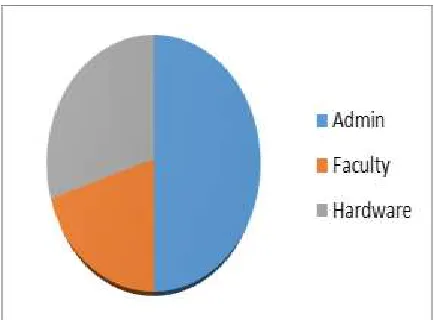
Faculty: Faculty inserts their respective cards into the hardware.
Hardware: Hardware detects the card inserted by the faculty and stores the details Admin: Admin views and analyses the faculty details for further usage
Fig: Pie chart showing the participation of modules in the system
7.Conclusion
Available online: http://edupediapublications.org/journals/index.php/IJR/ P a g e | 4 2 8
accessed. Using this system we can track the activity of the faculty. It would be very easy to find the history of the details since they are available until they are deleted manually.
8.Future Enchancement
In further developments number of times of insertion of the card can be made limited.
The security provided to the system can be increased by using face capture technique while the faculty is inserting the card to make sure that no other person is using or inserting the card.
References
1 Brown, Eric (13 September 2016). "Who Needs the Internet of Things?". Linux.com. Retrieved 23 October 2016.
2 Brown, Eric (20 September 2016). "21 Open Source Projects for IoT". Linux.com. Retrieved 23 October 2016.
3 "Internet of Things Global Standards Initiative". ITU. Retrieved 26 June 2015. 4 "Internet of Things: Science Fiction or Business Fact?" (PDF). Harvard Business Review. November 2014. Retrieved 23 October 2016.
5 Vermesan, Ovidiu; Friess, Peter (2013).
Internet of Things: Converging
Technologies for Smart Environments and Integrated Ecosystems (PDF). Aalborg, Denmark: River Publishers. ISBN 978-87-92982-96-4.
6 "An Introduction to the Internet of Things (IoT)" (PDF). Cisco.com. San Francisco, California: Lopez Research. November 2013. Retrieved 23 October 2016.
7 Santucci, Gérald. "The Internet of Things: Between the Revolution of the Internet and the Metamorphosis of Objects" (PDF).
European Commission Community
Research and Development Information Service. Retrieved 23 October 2016.
8 Mattern, Friedemann; Floerkemeier, Christian. "From the Internet of Computers to the Internet of Things" (PDF). ETH Zurich. Retrieved 23 October 2016.
9 Reddy, Aala Santhosh (May 2014). "Reaping the Benefits of the Internet of Things" (PDF). Cognizant. Retrieved 23 October 2016.
10 Lindner, Tim (13 July 2015). "The Supply Chain: Changing at the Speed of Technology". Connected World. Retrieved 18 September 2015.
11 Evans, Dave (April 2011). "The Internet of Things: How the Next Evolution of the Internet Is Changing Everything" (PDF). Cisco. Retrieved 15 February 2016.
12 Wigmore, I. (June 2014). "Internet of Things (IoT)". TechTarget.
13 "Internet of Things (IoT)". gatewaytechnolabs.com.
14 "The "Only" Coke Machine on the Internet". Carnegie Mellon University. Retrieved 10 November 2014.
15 "Internet of Things Done Wrong Stifles Innovation". InformationWeek. 7 July 2014. Retrieved 10 November 2014.
16 Mattern, Friedemann; Floerkemeier, Christian (2010). "From the Internet of Computers to the Internet of Things" (PDF). Informatik-Spektrum. 33 (2): 107–121. doi:10.1007/s00287-010-0417-7. Retrieved 3 February 2014.
17 Weiser, Mark (1991). "The Computer for the 21st Century" (PDF). Scientific
American. 265 (3): 94–104.
Bibcode:1991SciAm.265c..94W. doi:10.1038/scientificamerican0991-94. Retrieved 5 November 2014.
18 Raji, RS (June 1994). "Smart networks for control". IEEE Spectrum.
19 Pontin, Jason (29 September 2005). "ETC: Bill Joy's Six Webs". MIT
Technology Review. Retrieved 17
November 2013.
Available online: http://edupediapublications.org/journals/index.php/IJR/ P a g e | 4 2 9
2000 ("M-commerce key to ubiquitous internet")