Development of Web-Based Supervisory
Control and Data Acquisition System for
Temperature Control Applications
K.Ranjithkumar 1, M.Mohamed Asfar2 , P.Naveenkumar 3, V.Naveen Kumar4, Krishnamurthy5
AMIE Student, Dept. of ECE, The Institution of Engineers(India), Kolkata, India1
UG Student, Dept. of Mechatronics Engineering, Kongu Engineering College,Erode, Tamilnadu, India2, 3, 4
Dean, Dept. of Mechatronics Engineering, Kongu Engineering College,Erode, Tamilnadu, India5
ABSTRACT:In general, the idea of monitoring of various equipments and devices over the internet is becoming a desirable practice in the process plants industries over the few decades. Over the years, there has been constant increase in the development of industrial automation through remote monitoring and control virtually through computers and internet. The strong emphasize of remote monitoring and control for real time process both online and offline mode is the main focus of this project. The internet based automation is made possible by the use of PLCs (Programmable Logic Controllers), SCADA (Supervisory control and Data Acquisition), Internet and other network elements.
The system is developed using PLC and SCADA, Programmable Logic Controller programmes for controlling real time industrial process. As a result, the system will be more secured with the use of XML (Extensible Markup Language) encoding and the data is protected by using firewall for connection between the server and client. Thus, logging and archive data of the real- time data corresponding to the process plants can be used for further process analysis.
KEYWORDS: PLC, SCADA, Automation, HMI.
I. INTRODUCTION
In general, the idea of monitoring of various equipments and devices over the internet is becoming a desirable practice in the process plants industries over the few decades. Over the years, there has been constant increase in the development of industrial automation through remote monitoring and control virtually through computers and internet. The strong emphasize of remote monitoring and control for real time process both online and offline mode is the main focus of this project. The internet based automation is made possible by the use of PLCs (Programmable Logic Controllers), SCADA (Supervisory control and Data Acquisition), Internet and other network elements.
II. OBJECTIVE
To develop a typical web-based remote monitoring and control system for Temperature process control applications.
III. METHODOLOGY
two nodes in which from one node gateway device is connected through the IP address and the other node is connected to the LAN through a number of data channels.
IV. PROBLEM IDENTIFICATION
Network connectivity problem between PLC and server due to the DHCP. Whenever the either PLC or Server goes to Shutdown and then restart, we have to configure the PLC and Server from the initial stage. The static IP assigned to PLC and server provides solutions for the above said reasons.
V. TOOLS REQUIRED FOR THE PROJECT
The hardware and software used in the study as listed below:
Temperature process control pilot plant
Personal computer
Allen-Bradely PLC (Micrologix 1400 PLC)
SCADA
Network switch
RS Linx Classic
RS Logix 500 Pro
Movicon 11.0
The major using components of the project are:
Thermocouple signal conditioning unit
Allen-bradely plc(micrologix 1400)
SCADA
a. Thermocouple Signal Conditioning Unit
A thermocouple signal conditioner is a device that convert a thermocouple output voltage to PLC analog module read form.
b. Allen- Bradely PLC (Micrologix 1400)
Allen-Bradely PLC (Micrologix 1400) is mostly used for many of the industrial application projects. The features of Micrologix 1400 are as given below:
Ethernet port provides Web server capability, email capability and protocol support for DNP3 protocol support andbuilt-in LCD with backlight lets you view controller and I/O status
Built-in LCD provides simple interface for messages, bit/integer monitoring and manipulation
Expands application capabilities through support for as many as seven 1762 MicroLogix Expansion I/O moduleswith 256 discrete I/O
As many as six embedded 100 kHz high-speed counters (only on controllers with DC inputs)
Two serial ports with DF1, DH-485, Modbus RTU, DNP3 and ASCII protocol support
10 KB words in user program memory with 10 KB words in user data memory)The ladder logix programme of the project is shown in Fig.
Fig.1 Ladder Logic Program for Temperature Process Control Experimental Setup
The input and output of the ladder logic diagram (Fig . 1) is mentioned below with corresponding address
S No. Input Address Output Address
Start I:0.0/0 PUMP O:0.0/1
S No. Input Address Output Address
Manual mode server N7:4/7 Manual Mode Enable N7:4/8
Manual mode Start&stop Pump
I:0.0/5
Manual mode Start&stop Solenoid
I:0.0/6
Thermocouple output I:0.4 Input To Power Controller O:0.5
Set temperature N7:3 Actual Temperature N7:0
c. Supervising Control And Data Acqusation (Scada)
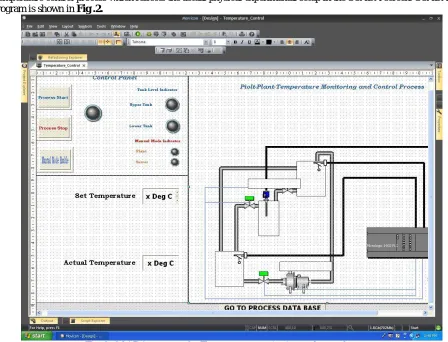
The process experimental setup is monitoring and control through SCADA. SCADA program is developed for the Temperature control process which reflects the actual physical experimental setup in the SCADA screen. SCADA program is shown in Fig .2.
Fig .2 SCADA program for Temperature monitoring and control process
Here, this Fig. 2 describes the Temperature monitoring and control module where in the status of the motor
and Solenoid over a particular time is indicated in the Text boxes (PUMP. SOL ON/OFF). The Fig. 2 also describe
parameter status of set temperature and actual temperature, water level indication and manual mode indication.
user authentication. The data logging of the real-time process Online and Offline is one of the striking features of this system.
VI. CONCLUSION
The Novelty of the system is that an Industrial process can be controlled and monitored from anywhere from the remote location just by giving the host name/IP address of the corresponding system. Also, online data logging of the real time process can also viewed through Internet browser environment The Remote Monitoring system considered here is a temperature monitoring and control process experimental setup, therefore further it develop the same system for the use of Industrial level monitoring. User authentication is provided at different levels through SCADA programs in order restrict unauthorized access, and to enable authorized users to access real-time parameters. Whenever a failure occurs remote diagnosis is done over the Intranet/Internet to the plant operators. The system is not only user-friendly; it is also reliable, flexible and cost effective. Moreover, the existing structure can be adapted to several real –time systems in different laboratory Environment.
VII. SCOPE FOR FUTURE
From the experiments that have been made so far, it is inferred that there are three main considerations of this system namely
• Network communication delay (time latency) • Security of the system
• The interface design of the system.
Further improvements in these areas would improve the efficiency of the system. Also, the number of real-time processes that are controlled and monitored can also be increased and configured accordingly.
ACKNOWLEDGEMENT
The authors are thankful to Kongu Engineering College, Erode for providing necessary facilities to complete this project.
REFERENCES
[1] Frank D.Petruzella “Programmable Logic Controller” (3rd Edition) 2011, TATA McGRAW-HILL EDUCATION PRIVATE LIMITED, NEW DELHI
[2] Stuart A. Boyer “SCADA: Supervisory Control and Data Acquisition” (4th Edition) 2010 International Society of Automation, 2010 [3] Macaulay Tyson, Tyson Macaulay, Bryan Singer “Industrial Control Systems: SCADA, DCS, PLC, HMI, AND SIS” Auerbach Publications
(2011)
[4] Albert W.L. Yao, C.H. Ku, “Developing a PC-based automated monitoring and control platform for electric power systems”, Electric Power Systems Research vol.64, 2003, pp.129-136.