PAPR Reduction Using Companding on
Cyclic Shift PTS
U.V.Ratnakumari1, J.Himabindu2
Associate Professor, Dept. of ECE, UCEK, JNTUK, Kakinada, India1
M.Tech Student, Dept. of ECE, UCEK, JNTUK, Kakinada, India2
ABSTRACT: Orthogonal Frequency Division Multiplexing (OFDM) is an attractive and promising technique in wireless communication. Peak-to-Average power ratio (PAPR) is a major drawback in the application of OFDM communication. A large amount of PAPR leads to loss of data integrity, which can reduce system efficiency. To avoid the occurrence of large peak power of signals various methods for the reduction of PAPR have been developed. Partial Transmit Sequence is one of the best method among various methods. In terms of PAPR reduction Cyclic Shift on PTS is better than conventional PTS. Here PTS and CSS corresponds to reduction of peak power. In this paper, to improve the reduction performance further a new scheme is proposed i.e. µ-law Companding is applied to cyclic shift PTS. Here Companding corresponds to the increase in average power. The simulation results show that the proposed method gives better PAPR reduction compared to previous methods.
KEYWORDS: Orthogonal Frequency Division Multiplexing (OFDM), Partial Transmit Sequence (PTS), Cyclic shift PTS,Peak-to-Average Power Ratio (PAPR), µ-law Companding.
I.INTRODUCTION
proposed in this paper. The reason is µ-law companding[10] technique is used to increase the average power by increasing the small signal power and unchanging the large peak signal power.
II.PROPOSED METHOD
A high-rate data stream is divided into N low-rate streams transmitted simultaneously by subcarriers in an OFDM system. Each of the subcarriers is independently modulated (complex data symbols) by using a typical modulation scheme such as quadrature amplitude modulation (QAM) or phase-shift keying (PSK). The inverse discrete Fourier transform (IDFT) generates transmitted OFDM signal. An OFDM signal in the discrete time domain of N subcarriers can be written as
x(n) = 1
√N∑ X(k) N−1 k=0 e
j2πkn
N 0≤ n ≤ N-1 (1)
where X(k) denotes the input symbols for k = 0, 1, … … , N − 1 and n is the index of discrete time.
To define the PAPR of x(n) in Eq. (1) is the ratio of the maximum instantaneous power to the average power of the PAPR of the transmitted signal is given by
PAPR =Pmax
Pavg =
max0≤n<𝑁|x(n)|2
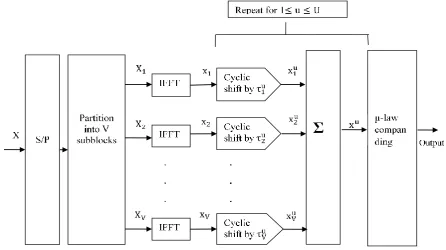
E[|x(n)|2] (2) Figure 1 shows the block diagram of µ-law companding on Cyclic shift PTS. The process involve in this block diagram is discussed below
Step1
The input sequence X is divided into V number of sub blocks X1, X2, . . , XV by using certain partitioning method.
Partitioning methods
There are 3 types of partitioning methods 1 .Interleaved partition
2 .Adjacent partition 3 .Random partition
Interleaved Partition
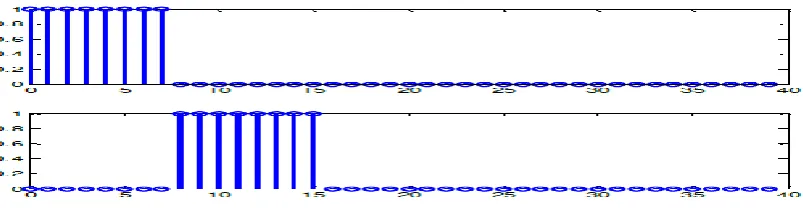
In this partition the input subcarrier (N) into (L) subblocks for each one contains N/V contiguous subcarriers. The main idea of this operation breaks down the high correlation patterns of the input data frames on OFDM signal. Figure2 show the operation of interleaving partition scheme.
Figure2 Interleaved partition scheme
𝐼0 = [𝐼0
(1)0 … . 0𝐼 0
(2)0 … … 0𝐼 0
(𝑉)00 … . ]
(3) 𝐼1 = [0𝐼1
(1)
0 … . 00𝐼1(2) 0 … … 000𝐼1(𝑉)0 … .0] (4) 𝐼𝐿 = [00 … . . 𝐼𝐿
(1)
0 … .00𝐼𝐿(2) 0 … … 0𝐼𝐿(𝑉) ] (5)
Adjacent partition
Adjacent partition is a simple method to implement the partition process, and its performance is better than the interleaving partition scheme. An adjacent partition scheme divides the sequence into (L) sub-block vectors similar to the interleaving partition scheme but each sub-block contains N/V of the consecutive subcarriers.
𝐴0 = [A0 (1)
𝐴(2)0 𝐴(3)0 000 … … … … . . .0] (6)
𝐴1 = [0000 … .0, A1 (1)
𝐴1(2)𝐴1(3)000 … … … . .0] (7) 𝐴𝑉 = [0000 … .0,000 … .00, A0
(1)
𝐴0(2)𝐴0(3)] (8)
Random partition
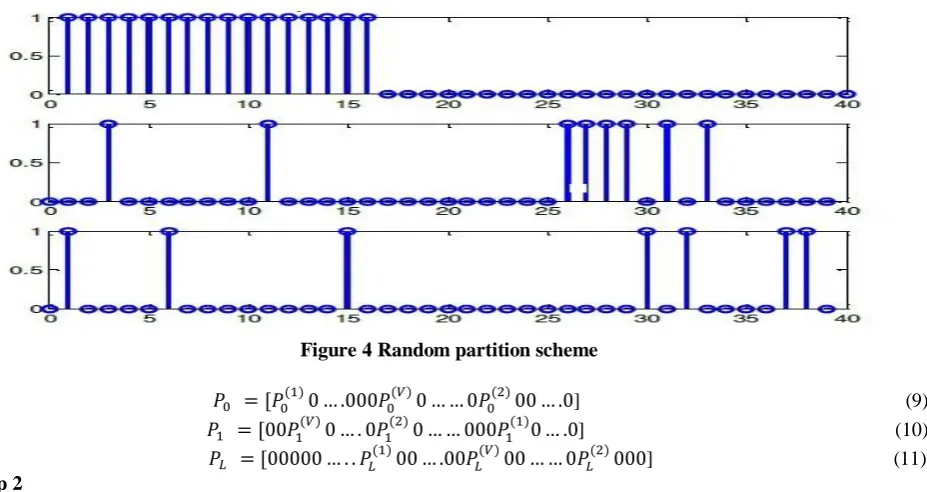
Pseudo-random partition has the best PAPR reduction performance compare with interleaving and adjacent partition schemes. Each subcarrier can be randomly distributed on any position of the sub-block (L).
Figure 4 Random partition scheme
𝑃0 = [𝑃0 (1)
0 … .000𝑃0(𝑉) 0 … … 0𝑃0(2) 00 … .0] (9) 𝑃1 = [00𝑃1
(𝑉)
0 … . 0𝑃1(2) 0 … … 000𝑃1(1)0 … .0] (10)
𝑃𝐿 = [00000 … . . 𝑃𝐿 (1)
00 … .00𝑃𝐿(𝑉) 00 … … 0𝑃𝐿(2) 000] (11)
Step 2
Then IFFT converts V sub blocks in frequency domain to the V OFDM signal subsequences in time domain x1, x2, . . .
, xV, where xv={xv(0), xv(1), . . . ,xv (N − 1)}, 1 ≤ v ≤ V.
Step 3
The time domain OFDM signals are then cyclically shifted by using Shift Value (an integer) and added together to make alternative OFDM signal as
xu
=∑Vv=1xvu (12)
The above equation is for only one u alternative signal in the same way total U alternate signals are generated Where xvu denotes the left cyclic shift of xvby some integer τvu (1≤ v ≤ V) i.e.
xvu={xv(τvu), xv(τvu+ 1), … … … xv(N − 1), xv(0), … … … xv(τvu− 1)} (13)
Here τvu is a shift value and for uth alternate signal the SV set is defined as τ̅u={τ1u, τ2,………..u τVu} similarly the SV
sets for total U alternative signals are (τ̅1,τ̅2, τ̅3 ,………τ̅U).
To select one SV set there are total NV cases. That is τ̅u
={τ1u, τ2……….u τVu} can be varied
from{0,0,………0}to {N-1,N-1,………..N-1}.selection of only U SV sets from NV can be done by using some criterions which can guarantee the PAPR reduction performance of the Cyclic shift PTS scheme without any risk.
To select SV sets the first assumption is that the components in the alternate OFDM signal sequences are mutually orthogonal That is, xv(0), xv(1), . . …. ,xv (N − 1) are mutually independent for all v. If U = 2 and V = 4, we
dependency each other. Instead, it is better to select two SV sets such as τ̅1={0,0,0,0} and τ̅2={0,1,2,3} which leads to increasing statistically independency between two alternative OFDM signal sequences (x1and x2). That is, in order to generate two alternative OFDM signal sequence within dependency, the relative distances τ1v - τv2for all v’s have to be
distinct from each other. When U > 2, this has to be guaranteed for all possible SV set pairs out of U SV sets. Now by using this Criterion 1 is derived.
Criterion1
:
Suppose if U SV sets are considered then for every (i, j) pair out of the U SV sets (i ≠ j), the pair should satisfy the condition that the relative distances τvi − τvj
mod N are distinct from each other for all v’s.
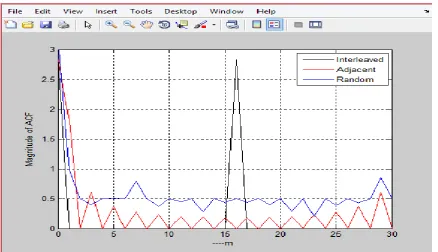
The Criterion 1 is valid when the components in all alternative OFDM signal subsequences are mutually independent. However, actually the OFDM signal subsequence components are not mutually independent. So to know the amount of correlation between components ACF is considered.
ACF of OFDM signal subsequences
Let Svbe the discrete power spectrum of the vth OFDM signal subsequence xv ,thenSv= {p(0), p(1), . . . , p(N
-1) where p(k)=E[|Xv(k)|2], and p(k) can have the value of zero or one. If interleaved partition is used then
S1={10101010} and S2 = {01010101} when N= 8 and V = 2.The ACF is the Inverse Discrete Transform(IDFT) of Sv.
Figure 5 Magnitude of ACF for different partitions
Here only the magnitude of the ACF is considered because the high peak of the OFDM signal sequence is closely related to the magnitude of components. Figure5 shows the ACF among OFDM signal sequences when different partitions are used. So based on this information the SV sets selection is derived for three partition cases as per the amount of correlation. For Figure6 the values are S1={1010…..1010}for an interleaved partition;S1={11……1100……00} for an adjacent random partition.; S1={10010110011111000110101110100000} for a random partition; N=32 and V=2.
For Random Partition:
For Interleaved Partition
In this case, the shape of the ACF is the impulse train. Then cyclic shift by N/V cannot make the OFDM signal subsequence much different. Therefore, Criterion 1 has to be slightly modified as follows.
Criterion 2: Suppose if U SV sets are considered then for every (i, j) pair out of the U SV sets (i ≠j), the pair should satisfy the condition that the relative distances τvi -τv
j
mod N/V are distinct from each other for all v’s.
For Adjacent Partition
In this case, the shape of the ACF is similar to a sinc function. Then cyclic shift by a small integer cannot make the OFDM signal subsequence much different. Instead, cyclic shift by an integer close to N/2 can make the OFDM signal subsequence much different. Therefore, the constraint that the relative distances have to be distinct from each other in Criterion 1 should be changed into a stronger constraint as follows.
Criterion 3: Suppose if U SV sets are considered then for every (i, j) pair out of the U SV sets (i ≠j), the pair should satisfy the condition that the relative distances τvi − τv
jmod N are distinct from each other for all v’s. Furthermore, the
mutual differences of the V relative distances (τ1i− τ1 j
, τ2i−τ2 j
, ……….τVi
− τVjmod N) should be as close to N/2 as possible.
Step4
Finally by using all the above factors the one with minimum PAPR is obtained. To reduce its PAPR further the output of adder is applied to µ-law companding circuit. . µ-law Companding is one of the methods to reduce PAPR of OFDM signal by increasing the average power of the signal with less circuit complexity. In the μ-law Companding, the compressor characteristic is piecewise, made up of a linear segment for low level inputs and a logarithmic segment for high level inputs.if xuis considered as variable S then output is
Output = log (1+µ|S|
log (1+µ)sgn(S) (14)
Where μ is the Companding parameter which controls the amount of compression.
III. RESULTS
Figure 6
.
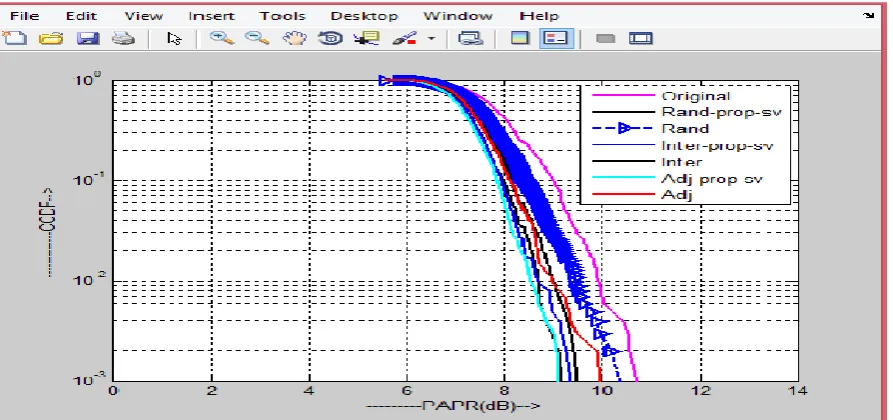
Comparison of the PAPR reduction performance of the CSS scheme for three partition cases, which are random, interleaved, and adjacent partition cases when N= 128, U= 4, and V= 4 according to the used SVFigure 6 shows the need of selection of SV sets and explains that how the Shift Value set shows impact on PAPR reduction. In this the SV sets which are generated according to criterion are shows better performance than not satisfying criterion SV sets.
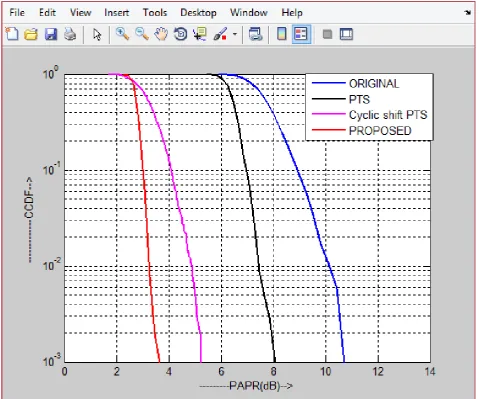
Figure 7. Comparison of PAPR values for different reduction methods
Figure 7 shows the comparison between PTS, Cyclic shift PTS and µ-law companding on cyclic shift PTS. The simulation results clearly shows that the PAPR is reduced 10.6 dB from 4 dB.
IV.CONCLUSION
In this paper a new technique is proposed for PAPR reduction, which combines two classic PAPR reduction
methods the cyclic shift PTS and the Companding method. The Companding technique use μ-law with suitable values
REFERENCES
[1]Y.WU AND W.Y.ZOU,“ORTHOGONAL FREQUENCY DIVISION MULTIPLEXING: A MULTI-CARRIER MODULATION SCHEME,”IEEETRANS.CONSUMER
ELECTRONICS, VOL.41, NO.3, PP.392–399,AUG.1995.
[2] S. H. Müller, R. W. Bauml, R. F. H. Fischer, and J. B. Huber, “OFDM with reduced peak -to-average power ratio by multiple signal representation,” Ann. Telecommun., vol. 52, nos. 1–2, pp. 58–67, Feb. 1997.
[3] J.-Y. Woo, H. S. Joo, K.-H. Kim, J.-S. No, and D.-J. Shin, “PAPR analysis of class-III SLM scheme based on variance of correlation of alternative OFDM signal sequences,”IEEECommun. Lett., vol. 19, no. 6, pp. 989–992, Jun. 2015.
[4] G. R. Hill, M. Faulkner, and J. Singh, “Reducing the peak-to-average power ratio in OFDM by cyclically shifting partial transmit sequences,”Electron. Lett., vol. 36, no. 6, pp. 560–561, Mar. 2000.
[5] G. R. Hill, M. Faulkner, and J. Singh “Cyclic shifting and time inversion of partial transmit sequences to reduce the peak-to-average power ratio in OFDM,” in Proc. IEEE PIMRC, London, U.K., Sep. 2000,pp. 1256–1259.
[6] L. Yang, K. K. Soo, S. Q. Li, and Y. M. Siu, “PAPR reduction using low complexity PTS to construct of OFDM signals without side information,
”IEEE Trans. Broadcast., vol. 57, no. 2, pp. 284–290, Jun. 2011.
[7] K. Long, Y. Fu, and Y. Wang, “The contradiction between channel estimation and PAPR performance in cyclic shift PTS,” in Proc. IEEE BMEI, Chongqing, China, Oct. 2012, pp. 1525–1528.
[8] Kee-Hoon Kim,“On the Shift Value Set of Cyclic Shifted Sequences for PAPR reduction in OFDM System”, IEEE TRANS. Broadcasting,vol. 62,pp.496-500. 2016.
[9] X. B.Wang, T. T. Tjhung, and C. S. Ng, “Reduction of peak -to-average power ratio of OFDM system using a companding technique,” IEEETrans.. Broadcast., vol. 45, no. 3, pp. 303–307, Sep. 1999.
[10]Y. Hsu and H.-c. Liao, "PAPR reduction using the combination of precoding and mu-law companding techniques for OFDM systems, "Signal