Western University Western University
Scholarship@Western
Scholarship@Western
Electronic Thesis and Dissertation Repository
8-23-2012 12:00 AM
A Convexity Theorem For Symplectomorphism Groups
A Convexity Theorem For Symplectomorphism Groups
Seyed Mehdi Mousavi
The University of Western Ontario
Supervisor
Professor Martin Pinsonnault The University of Western Ontario Graduate Program in Mathematics
A thesis submitted in partial fulfillment of the requirements for the degree in Doctor of Philosophy
© Seyed Mehdi Mousavi 2012
Follow this and additional works at: https://ir.lib.uwo.ca/etd
Part of the Analysis Commons, and the Geometry and Topology Commons
Recommended Citation Recommended Citation
Mousavi, Seyed Mehdi, "A Convexity Theorem For Symplectomorphism Groups" (2012). Electronic Thesis and Dissertation Repository. 775.
https://ir.lib.uwo.ca/etd/775
This Dissertation/Thesis is brought to you for free and open access by Scholarship@Western. It has been accepted for inclusion in Electronic Thesis and Dissertation Repository by an authorized administrator of
A Convexity Theorem For
Symplectomorphism Groups
(Spine title: Convexity Theorem For Symplectomorphism Groups)
(Thesis format: Monograph)
by
Seyed Mehdi Mousavi
Graduate Program in
Mathematics
A thesis submitted in partial fulfillment of the requirements for the degree of
Doctor of Philosophy
School of Graduate and Postdoctoral Studies The University of Western Ontario
London, Ontario, Canada
c
Certificate of Examination
THE UNIVERSITY OF WESTERN ONTARIO
SCHOOL OF GRADUATE AND POSTDOCTORAL STUDIES
Chief Advisor: Examining Board:
Professor Martin Pinsonnault Professor Matthias Franz
Advisory Committee: Professor Niky Kamran
Professor Tatyana Barron Professor Hristo Sendov
Professor Rasul Shafikov Professor Gordon Sinnamon
The thesis by
Seyed Mehdi Mousavi
entitled:
A Convexity Theorem For Symplectomorphism Groups
is accepted in partial fulfillment of the requirements for the degree of
Doctor of Philosophy
Date:
Abstract
In this thesis, the topological, algebraic and geometric properties of the sub-group of equivariant symplectomorphisms of a symplectic toric manifold are studied. It is shown that this subgroup is a maximal Abelian and path con-nected “Lie subgroup” of the full symplectomorphism group which is flat and totally geodesic with respect to the canonical weak metric induced by the canonical Kaehler metric. Moreover, an infinite-dimensional version of the Schur-Horn-Kostant convexity theorem is presented which is obtained after an appropriate completion of algebras.
Acknowledgments
It is my pleasure to express my gratitude to the greatest extent to my super-visor, Professor Martin Pinsonnault, for his priceless guidance and supports during my graduate studies at Western. I thank him for introducing me the exciting problem of my thesis. I would like to thank Professor Tatyana Barron for her continuous supports, especially during the first year of my studies at Western. My thanks also go to Professor Andre Boivin, Chair of Department of Mathematics, for his constant supports.
To my late grandparents
Mohammad-Reza
Table of Contents
Certificate of Examination . . . ii
Abstract . . . iii
Acknowledgements . . . iv
Dedication . . . v
Introduction . . . 2
1 Background Material . . . 3
1.1 Riemannian Geometry and Lie Groups . . . 3
1.2 Manifold Structures on Spaces of Maps . . . 8
1.3 Ds(M) as a Lie Group . . . 13
1.4 A Weak Riemannian Metric onDs(M) . . . 15
1.5 Classical Schur-Horn-Kostant Convexity . . . 22
1.6 Symplectic Toric Manifolds . . . 27
2 A Maximal Torus in Symplectomorphism Groups . . . 30
2.1 Topological Properties ofDωs(M, T) . . . 30
2.2 Algebraic Properties of Dωs(M, T) . . . 34
2.3 Geometric Properties ofDωs(M, T) . . . 36
2.4 Further Discussions and Comments . . . 44
3 A Schur-Horn-Kostant Convexity . . . 49
3.1 Doubly Stochastic Operators . . . 50
3.2 The Spectral Theorem . . . 55
3.3 The Diagonalization and Orbit Theorems . . . 56
3.4 The Completion ofHam(M, ω) . . . 58
3.5 The Projectionπ . . . 62
3.6 The Weyl semi-group W . . . 63
3.7 Schur’s Theorem . . . 66
3.8 Horn’s Theorem . . . 68
3.9 The Schur-Horn-Kostant Theorem . . . 75
3.10 Final Remarks . . . 77
Introduction
The study of infinite-dimensional Lie groups was pioneered by V. I. Arnold. In a celebrated paper in 1966, Arnold employed the language of infinite-dimensional groups to study the Euler equation of a perfect fluid [7]. Arnold’s ideas were recast in a rigorous language via Sobolev completions by Ebin and Marsden in 1970 [26]. Ebin and Marsden employed Arnold’s approach to elab-orate further on the existence and uniqueness of solution of some classical equations. Since then, Arnold’s geometric framework has been used effec-tively to study other classical equations and the study of infinite-dimensional Lie groups has been an active area of research.
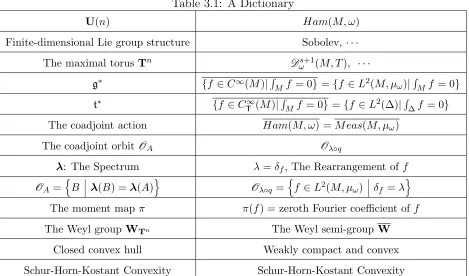
in symplectomorphism groups of toric manifolds, and a proof of an infinite-dimensional version of the Schur-Horn-Kostant convexity theorem.
The first chapter of the thesis is devoted to background material. We recall some of the main techniques and tools from the theory of infinite-dimensional Lie groups that we need.
The crux of this thesis are Chapter 2 and 3. In Chapter 2 we show that the group of all equivariant symplectomorphism, Dωs(M, T), can play the role of a maximal torus in the group of symplectomorphisms of toric mani-folds, Dωs(M). More precisely, we show that Ds(M, T) is a closed, infinite-dimensional and path-connected submanifold of Dωs(M) which is flat and to-tally geodesic with respect to a “canonical” weak Riemannian metric. More-over, it is a maximal Abelian subgroup of Dωs(M). This provides an extension of previous results by Bao and Ratiu [10] and El Hadrami [30].
Finally in the last chapter, following [12], we prove a Schur-Horn-Kostant convexity theorem for Dωs(M, T) ,→ Dωs(M) after an appropriate completion of algebras. In doing so, we relax the hypothesis that was originally assumed in the work of Bloch, Flaschka and Ratiu [12]. The sharper version of the convex-ity theorem states that the image of the orbit of the semi-groupHam(M, ω) (a certain completion of the group of Hamiltonian symplectomorphisms) through the “spectrum” λ of a function f ∈ Lp(M, νω) under an averaging map is
Chapter 1
Background Material
In this chapter we present background material. We begin with a review of Riemannian geometry and its applications to Lie groups. Then we briefly review aspects of differential geometry on spaces of mappings, and the classical Schur-Horn-Kostant convexity theorem.
1.1
Riemannian Geometry and Lie Groups
In this section we review some classical facts from Riemannian geometry on Lie groups. The material of this section can be found in standard references on Riemannian geometry like [66] and [22]. The material about the connection map can be found in complete detail in [66] and we follow notation of this book closely.
LetM be ann-dimensional manifold. We denote the space of all smooth (C∞) vector fields on M by X(M). If for each p ∈ M we assign an inner product gp : TpM ×TpM −→ R such that depends smoothly on p, then we
say (M, g) is a Riemannian manifold and g is called a smooth Riemannian metric on M.
Definition 1.1.1. A linear connection ∇ : X(M)×X(M) −→ X(M), is a bilinear map that satisfies the following conditions for every f ∈ C∞(M,R)
• ∇f XY =f∇XY.
• ∇Xf Y =f∇XY + (Xf)Y.
We recall the following theorem which is called the fundamental theorem of Riemannian geometry.
Theorem 1.1.2. [Fundamental Theorem of Riemannian Geometry] Let(M, g)
be a Riemannian manifold, then there is a unique linear connection ∇ on M
that satisfies the following conditions:
(1) ∇ is torsion free, that is
∇XY − ∇YX = [X, Y].
(2) ∇ is compatible with g in the sense that
Xg(Y, Z) = g(∇XY, Z) +g(Y,∇XZ).
(3) g(∇XY, Z) = 1 2
ß
Xg(Y, Z) +Y g(Z, X)−Zg(X, Y)
+g([X, Y], Z)−g([Y, Z], X) +g([Z, X], Y)
™ .
This linear connection is called the Levi-Civita connection of g. Ob-serve that the third formula can be considered as the explicit definition of the connection.
Locally, any connection∇onT M is characterized by its Christoffel sym-bols Γkij which, on a chart ÄU, ϕ= (x1, . . . , xn)ä, are defined by the equation
∇∂
i∂j =
n X
k=1
One can easily see that
(∇XY) U =
n X
k=1 Å
X(Yk) + ΓkijXiYj ã
∂k
where X = Pn
i=1Xi∂i and Y =Pnj=1Yj∂j. The Christoffel symbols can be
computed explicitly as follows
Γkij = 1 2 n X `=1 gk` Å
∂igj`+∂jgi`−∂`gij ã
.
Any connection on T M gives rise to a decomposition of T T M into ver-tical and horizontal subbundles. First, note that TpM = π−M1(p) is a
sub-manifold ofT M whose tangent space is T(p,u)TpM =Ker(T(p,u)πM), which is
called the vertical subspace at (p, u), and which is denoted by V(p,u). With respect to the chart ÄU , ϕ = (xi;yi;ξi;ηi)ä of T T M obtained from a chart
Ä
U, ϕ= (x1, . . . , xn)äof M we have
V(p,u)=
ß
(xi(p);yi(p); 0;ηi) η
i ∈
R ™
and the isomorphism ι(p,u) :T(p,u)TpM −→TpM is given by
ι(p,u) Å
xi(p);yi(p); 0;ηi ã
= (xi(p);ηi).
Now we find a natural complement H(p,u) to V(p,u) in T(p,u)T M using the Levi-Civita connection ∇. Define the vector fields E1, . . . , En onπM−1(U) by
Ek =∂xk − X
i,j=1
yi(Γjki◦πM)∂yj.
called the horizontal space. Similar to V(p,u) one can easily see that
H(p,u)=
ßÅ
xi(p);yi(p);ξi;− n X
j,k=1 Ä
Γijk(p)yk(p)ξjäã ξ
i ∈
R ™
.
By construction H(p,u) ∩V(p,u) = 0 and T(p,u)T M = V(p,u) ⊕H(p,u). Hence any η∈T(p,u)T M can be written uniquely as η=ηv+ηh , whereηv is
the vertical component and ηh is the horizontal component of η.
Definition 1.1.3. The connection map (or connector), K : T T M −→ T M, of the Levi-Civita connection ∇ is the projection to the vertical component
V(p,u) 'TpM, that is, K(η) = ι(p,u)(ηv) where πT M(η) = (p, u).
In local coordinates we can representK as
K(xi;yi;ξi;ηi) =Äxi;ηi+
n X
j,k=1
Γijkykξjä.
and a simple computation reveals the following relation between K and ∇
K(T X(u)) =∇uX
where X ∈X(M) and u∈T M.
Recall that any compact connected Lie group G can be endowed with a biinvariant metric g [16, See Corollary 3.7]. The Levi-Civita connection ∇
compatible with (G, g) evaluated on left invariant vector fields X, Y ∈ X(M) satisfies
which follows from the third formula in the Fundamental theorem of Rieman-nian Geometry 1.1.2. Now if we consider a maximal torus T ,→ G then it follows that T is flat with respect to biinvariant metrics on G, i.e., the cur-vature tensor vanishes since t is Abelian. Next, we show that T is totally geodesic, and in fact that any closed Lie subgroup is totally geodesic. This is a direct consequence of the fact that Lie-theoretic exponential coincides with the Riemannian exponential of biinvariant metrics. However, since this is not the case for the infinite-dimensional groups that we will later consider we pre-fer to give a direct argument. We need to show that for everyt ∈T andv ∈t, the geodesic passing throught at times= 0 with speedv remains inT. First, note that c(s) = expG(sv), the integral curve through the identity of the left invariant vector fieldV generated by v, is a geodesic since
˙
c(s) = V(c(s))
=⇒ ∇c˙c˙ = ∇VV (1.1.1) = 1
2[V, V] = 0
On the other hand, for anyh∈G the left translationLh is an isometry so any geodesic passing through h at time s = 0 can be written as c(s) =
hexpG(su) for someu∈g. In particular, ifh∈T then ˙c(0)∈ThT if and only if u∈t and hence expG(su) = expT(su)∈T for every s. This implies thatT
is a totally geodesic submanifold ofG with respect to biinvariant metrics. Finally, we gather all the main properties of the maximal torusT ,→G
in the following theorem.
Theorem 1.1.4. Let G be a compact connected Lie group and T ,→ G a
• Topologically: is a path-connected, finite-dimensional, smooth and closed
submanifold of G.
• Algebraically: is a maximal Abelian subgroup of G and its Weyl group,
W =N(T) /T is finite.
• Geometrically: is a totally geodesic and flat Riemannian submanifold of
G with respect to biinvariant metrics on G.
Our goal in chapter 2 will be to find an analog of a maximal torus in the group of symplectomorphisms of toric manifolds that have most of these properties.
1.2
Manifold Structures on Spaces of Maps
Let us begin with recalling theory of Sobolev spaces for a domain Ω⊂Rn en-dowed with the Lebesgue measure. For more detailed discussion about Sobolev spaces one can look into [31, 47]. Ebin, Marsden and Fischer’s paper [47] con-tains a full discussion about Sobolev spaces on manifolds and other relevant material about manifolds of maps. Given a function u ∈ L1(Ω) and a multi-index α the distributional derivative of u,Dαu, satisfies
hDαu, ρi= (−1)|α|
Z
Ω
uDαρ
for every smooth compactly supported functionρ∈Cc∞(Ω). A distribution Ξ is called an Lp distribution if there is an f ∈Lp(Ω) such that
hΞ, ρi=
Z
for every ρ∈Cc∞(Ω). For given k, p ∈N we define
Wkp(Ω) =n u∈Lp(Ω)
∀ |α| ≤k, D
αu∈Lp(Ω) o .
Here the derivatives are taken in the distributional sense. The space Wkp can be turned into a Banach space with the norm
kukWp k
= X
|α|≤k
kDαukLp.
In particular, for p = 2, Wk2(Ω) is a Hilbert space and is denoted by Hk(Ω). We can also define Wkp as the completion of the set of all smooth function
u ∈ C∞ÄΩä for which kukWp k
< ∞, provided that Ω is a compact manifold with boundary [4]. By the Sobolev Embedding Theorem there is a continuous linear inclusion Hs(Ω) ,→CkÄΩä for everys > k+n/2. These results can be easily extended to the space of vector valued Sobolev functionsHs(Ω,Rm).
Now we turn our attention to manifolds. Suppose M and N are d and
` dimensional manifolds possibly with boundary. In addition, suppose M is compact. A map f : M −→ N is called of class Hs, s > d/2, if for any
m∈M there is a chart (U, ϕ) of M aroundmand a chart (V, ψ) of N around
f(m) such that f(U) ⊂ V and ψ ◦f ◦ϕ−1 ∈ HsÄϕ(U),R`ä. We denote by
Hs(M, N) the set of all Hs mapsf :M −→N. We claim that this definition does not depend on the choice of the charts. This can be easily checked using the following local ω-Lemma.
Theorem 1.2.1. [Local ω-Lemma, [47]] Let U be a an open, bounded subset
of Rp, and suppose h : Rn −→ Rm is C∞-smooth. Then for s > p/2, ωh :
We remark that it is necessary to assume that M is compact in order for the definition of Hs maps to be independent of the choice of Riemannian metrics on M [31]. It is also important to assume s > d/2 to ensure indepen-dence on the choice of the charts [47]. Now we explain how we can construct a chart for Hs(M, N), provided that N is compact and without boundary. First we need to find a candidate for our modelling space, and as in the finite-dimensional setting the modelling space can be chosen to be the tangent space to Hs(M, N) at any given point. So we look for a candidate for the tangent space to Hs(M, N) at point η ∈ Hs(M, N). For simplicity, take a smooth path (t, m) ∈ (−, )×M 7−→ ηt(m) ∈ N, such that at t = 0 it coincides
with η. Hence dtd
t=0ηt(m) ∈ Tη(m)N, this suggests that a tangent vector Xη ∈TηHs(M, N) is a map Xη :M −→T N such thatXη(m)∈Tη(m)N, so
TηHs(M, N) := Hs(η∗T N →M)
= nX ∈Hs(M, T N)
πN ◦X =η o
whereHs(η∗T N →M) is the space of allHs sections of the pull-back bundle
η∗T N →M. Hs(η∗T N →M) is a Hilbertable or Hilbertian space, that is, it can be turned into a Hilbert space but not in a canonical way [47, 24].
Now to construct a chart forHs(M, N), we choose a Riemannian metric onN and we consider its associated exponential map expp:TpN −→N which
is defined as follows. Given vp∈TpN, there is a unique geodesic γvp through p whose speed at p is vp. The exponential map is defined by expp(vp) = γvp(1). It is known that the exponential map is a diffeomorphism from a
neighbourhood of 0 in TpN to a neighbourhood of p in N. However, by
This map can be extended to a map exp : T N −→ N such that exp(vp) =
expp(vp). We use this map to define a map expη :TηHs(M, N)−→Hs(M, N)
as follows
X 7−→exp◦X.
To check that this map takes values inHs(M, N) one can use the Local
ω-Lemma 1.2.1. To show that the transition maps for the charts are smooth we need the following Global ω-Lemma [55, See Theorem 11.3].
Theorem 1.2.2. [Global ω-Lemma, [55]] Let M be compact and E, F be two
vector bundles over M and h : E −→ F be a smooth fiber-preserving map. Then for s > d/2, the map ωh:Hs(E →M)−→Hs(F →M)
ωh(z) =h◦z
is a smooth map and its Fr´echet derivatives are given byDkωh =ω
zkh, where
zkh denotes the k-th fiber derivative of h.
We can similarly show thatCk(M, N) is a smooth Banach manifold with tangent space at η ∈Ck(M, N) given by
TηCk(M, N) =Ck(η∗T N →M).
Finally we remark that ifs > k+d/2 the Sobolev Embedding Theorem holds, that is, there is a smooth inclusion
Assume M is a oriented compact without boundary then Hs(M, M) is an infinite-dimensional manifold which contains several natural submanifolds. By CDk(M) we denote the set of all orientation preserving diffeomorphisms of M of class Ck, and we write Ds(M) = Hs(M, M)∩CD1(M) for the set of all orientation preserving diffeomorphisms of M of Sobolev class s, where
s > d/2 + 1. It is known that
Ds(M) = n
η∈Hs(M, M)
η is a bijection and η
−1 ∈Hs(M, M) o
see [26]. Moreover,Ds(M) is a topological group which is open inHs(M, M). As Ds(M) is open its “Lie algebra” TeDs(M) is Xs(M) := Hs(T M → M)
which is the set of allHs vector fields onM. In the case one needs to consider manifolds with boundary, one needs to first construct the boundaryless double,
›
M, in order to define Ds(M) = Hs(M,M›)∩ CD1(M). Then Ds(M) is a submanifold of Hs(M,M›) and TeDs(M) = Xsk(M), where Xsk(M) is the set
of allHs vector fields that are parallel to the boundary [26].
If we endowM with a volume formν, or with a symplectic formω, then we can consider the subgroups of volume preserving diffeomorphismsDνs(M), and of symplectomorphisms Dωs(M). It can be shown, using the Submersion Theorem, thatDνs(M) and Dωs(M) are submanifolds ofDs(M) whose tangent spaces at the identity are given by
TeDνs(M) = Xsν(M), TeDωs(M) =Xsω(M)
respectively, where Xsν(M) is the set of all divergence free vector fields and
at the identity consist of vector fields that are parallel to the boundary [26]. Finally we remark that D(M), the full group of C∞ diffeomorphisms, can be endowed with the structure of a Fr´echet Lie group. We will not consider Fr´echet manifolds in our work. However, some of our results do hold in the Fr´echet category. We refer to [43] for a complete treatment of differential calculus on Fr´echet spaces.
1.3
D
s(
M
)
as a Lie Group
The group Ds(M) is a differentiable Hilbert manifold so it is natural to ask if the composition and the inversion maps are smooth with respect to this differentiable structure. Let µ:Ds(M)×Ds(M) −→Ds(M) be the compo-sition map. To compute the tangent map T(η,ξ)µ:TηDs(M)×TξDs(M)−→ Tη◦ξDs(M) at the point (η, ξ), we choose smooth paths η(t), ξ(t) in Ds(M) such that η(0) = η, ξ(0) = ξ and ˙η(0) = Vη ∈ TηDs(M), ˙ξ(0) = Wξ ∈ TξDs(M). Then
T(η,ξ)µ(Vη, Wξ) = d dt
t=0µ(η(t), ξ(t))
= d
dt
t=0[η(t)◦ξ(t)]
= Vη ◦ξ+T η◦Wξ.
Theorem 1.3.1. [25, 27, 47, 26] Let M be a compact, connected, and
ori-entable manifold possibly with boundary.
(1) (Ds(M),◦) is a topological group.
(2) (Global α-Lemma) If η ∈Ds(M), then the right translation
Rη :Ds(M)−→Ds(M), Rη(ζ) =ζ◦η
is smooth.
(3) (ω-Lemma) If η∈Ds+`(M), then the left translation
Lη :Ds(M)−→Ds(M), Lη(ζ) = η◦ζ
is of class C`.
(4) (Composition) More generally, the composition map
µ:Ds+`(M)×Ds(M)−→Ds(M), µ(η, ζ) =η◦ζ
is of class C`.
(5) (Inversion) The inversion map
ν :Ds+`(M)−→Ds(M), ν(η) =η−1
is of class C`.
For example, since the right-multiplication is smooth we can identify each tangent space TηDs(M) with TeDs(M) = Xsk(M) and so Xsk(M) can serve
as the Lie algebra of Ds(M). Similarly, we can talk about right-invariant vector fields on Ds(M). If u ∈ Xks+`(M) then by the ω-Lemma, the map
uR :Ds(M)→TDs+`,uR(η) =u◦η, defines a right-invariant vector field of class C` on Ds(M). Conversely, if ue is a right invariant vector field of class C` then ue(e) ∈X
s+`
k (M), and we see that the space of right-invariant vector
fields of class C` onDs(M) is isomorphic to Xsk+`(M) [26].
Let ` ≥ 1 then for any u, v ∈ gs+` := Xsk+`(M) we define their Lie bracket by
[u, v]g:= [uR, vR]Ds(e).
It follows that [uR, vR]Ds(e) = [u, v]M so the Lie bracket on the Lie algebra
Xsk(M) induced from the differential structure on Ds(M) is the same as the usual Lie bracket on Xsk+l(M). Note that [u, v] ∈/ Xsk+`(M) due to a loss of derivative, it is in Xsk+`−1(M).
Finally, we remark that it is possible to define the Lie group exponen-tial map for Ds(M) but it is not a local diffeomorphisms, contrary to finite-dimensional Lie groups [26, 47].
1.4
A Weak Riemannian Metric on
D
s(
M
)
and one can consider the exponential map of this metric. We have seen that the Lie group exponential map is the same as the exponential map of any biinvariant metric onG. In the case ofDs(M) there is a right invariant metric which is not left invariant and so the two exponential maps will generally not coincide. The existence of general biinvariant metrics on diffeomorphism groups has been studied by Smolentsev, see [71] for a comprehensive survey of this problem. However, if we are looking for “nice” biinvariant metrics on
Ds(M), nice in the sense that it is biinvariant and it has a compatible
Levi-Civita connection that admits a smooth geodesic spray, then it seems unlikely that such metrics exist if we do not impose specific condition onM. The main point is that the existence of such a metric implies that both the Lie theoretic exponential and the Riemannian exponential must coincide. Hence they have to have the same regularity. In general, the former is merely continuous and into, while the latter is smooth and onto [47].
Let (M,h,i) be a compact and orientable Riemanniann-manifold with-out boundary. Given a point p∈M, we denote by h,ip the inner product on
TpM. Now we define a metric on Ds(M) as follows. For any η∈Ds(M) and
any u, v ∈TηDs(M) we define
(u, v)η =
Z
M
hu(p), v(p)iη(p)dν. (1.4.2)
Obviously, this is a symmetric bilinear form on each tangent space
TηDs(M), but it is not right invariant. The topology induced by this
in-ner product is theH0 topology which is clearly weaker that the Hs topology. Hence the metric is called a weak Riemannian metric. This metric is smooth in the sense that it is a smooth section of the vector bundle of bounded bi-linear maps, BÄTηDs(M), TηDs(M)
ä
smooth section that belongs to BÄTηDs(M), TηDs(M) ä
simply follows from
ω-Lemma 1.2.2.
It is interesting to see that there is a Levi-Civita connection compatible with this Riemannian metric. One may try to mimic the finite-dimensional argument to prove the existence of such a connection but as the Riemannian metric is weak this just shows the uniqueness of such a connection and no conclusion can be made about the existence. We now recall the existence of the Levi-Civita connection compatible with (,) that is established in [26]. A more detailed discussion also can be found in [27].
Let∇ be the Levi-Civita connection of (M,h,i). We know that there is a corresponding connection map K :T T M −→T M. Recall that the relation between K and ∇ is given by
∇uX =K(T X(u)).
We define a connection map K : T TDs(M) −→ TDs(M) as follows. Note that
TDs(M) = n X ∈Hs(M, T M)
πM ◦X ∈D s
(M)o
T TDs(M) = n Y ∈Hs(M, T T M)
πT M ◦Y ∈TD s
(M) o
and set K :T TDs(M) −→TDs(M) as K(Y) = K◦Y. Since K is smooth, by the ω-Lemma 1.2.2 K is also a smooth map. As in the finite-dimensional setting we define
∇XY =K(T Y(X))
previous formula induces a genuine connection, namely
Theorem 1.4.1. [26]∇is the Levi-Civita connection compatible with the weak
Riemannian metric (,) on Ds(M).
It is very interesting to consider two smooth (C∞) right invariant vector fieldsue andve onD
s(M), corresponding tou, v ∈X(M), and compute ∇ e vue at η∈Ds(M). This gives
ï ∇
e vue
ò
(η) =
ï
K(Tue(ve))
ò
(η) =
ï
K◦T u◦v ò
(η) =
ï
K(T u(v))
ò ◦η
=
ï ∇vu
ò ◦η
One should compare the above formula to the corresponding formula for finite-dimensional Lie groups.
We can restrict the weak Riemannian metric 1.4.2 to Dνs(M), where ν
is the volume of the metric on M. This metric is going to be right invariant and one should expect to have an induced compatible Levi-Civita connection onDνs(M). But this is not true in general as we only have a weak Riemannian structure. Nevertheless, the Hodge decomposition will make it possible to construct a Levi-Civita connection on Dνs(M).
LetHs(Ωk(M)) be the space of allk-forms on M of Sobolev classs and recall that we have the exterior derivative operator
which is a first order differential operator, that is, it drops the differentiability degree by 1. Also, the Hodge star operator
∗:Hs(Ωk(M))−→Hs(Ωn−k(M))
is defined by
α1 ∧ ∗α2 =α1, α2 ν,
where α1, α2 ∈ Hs(Ωk(M)). Here ν = »
det(gij)dx1 ∧. . .∧dxn is the
Rie-mannian volume on (M,h,i) and if αi =P
m`αmi 1...mkdxm1∧. . .∧dmk then α1, α2 = Pm`n`gm1n1. . . gmknkα1m1...mkαn21...nk is the induced inner
product by h,i on the space ofk-forms.
The adjoint ofd with respect to the inner product
{α, β}=
Z
M
α∧ ∗β =
Z
M
α, β ν
on Hs(Ωk(M)) is δ : Hs+1(Ωk(M)) −→ Hs(Ωk−1(M)) and is given by δ = (−1)n(k+1)+1∗d∗. Given any vector fieldX ∈Xs+1(M), its divergencediv(X) can be computed in terms ofδ as
div(X) = −δ(X[)
where [ : X(M) −→ Ω1(M) is the pairing induced by the metric on M and whose inverse is denoted by ].
can be found in [44].
Ak-form α is called harmonic if ∆α= 0. It turns out that all harmonic forms are smooth [47].
Theorem 1.4.2. [Hodge Theorem, [47]] Let M be a compact orientable n
-manifold without boundary. Then any k-form α ∈Hs(Ωk(M)) can be written as
α=dβ+h+δγ,
where β ∈ Hs+1(Ωk−1(M)), γ ∈ Hs+1(Ωk+1(M)), and h is a harmonic smooth k-from. Moreover, dβ, δγ, and h are mutually H0-orthogonal and
hence, are determined uniquely.
Now let X be an Hs vector field on M, s ≥ 0, and consider X[. By the Hodge Theorem 1.4.2, X[ can be decomposed as X[ =dα+h+δβ. Here as k = 1, α is a function of Sobolev class (s + 1) and obviously we have
δ(h+δβ) = 0. Hence, if we put p = α and Y = (h+δβ)] then we have the following
Lemma 1.4.3. [47] Let X ∈Hs(T M →M), s≥0. Then there is an unique divergence free Hs vector field Y and a gradient vector field grad(p) such that
X =Y +grad(p).
Moreover, putting P(X) =Y, P is a bounded linear operator in H0 topology.
Observe that the Hodge decomposition can be performed in the stronger
Now we return to (Dνs(M),(,)) to define a Levi-Civita connection com-patible with the right invariant metric (,) obtained by restriction to Dνs(M). Using 1.4.3, for any η ∈ Dνs(M) we can define an H0-orthogonal projection map Pη :TηDs(M)−→TDνs(M) by setting
Pη(u) = TeRη ◦P ◦TηRη−1(u).
Indeed we have
TηDs(M) = TηDνs(M)⊕ î
gradÄHs+1(M,R)äó◦η
Theorem 1.4.4. [26] The orthogonal projection P : TDs(M)
Ds
ν(M)
−→
TDνs(M) defined on each fiber by Pη is a smooth vector bundle morphism.
As it is in the case of finite-dimensional Riemannian geometryc∇=P◦∇
is the Levi-Civita connection on (Dνs(M),(,)).
Theorem 1.4.5. [26] Let M be a compact and orientable manifold without
boundary. The c∇ is the Levi-Civita connection compatible with the right
in-variant metric (,) on Dνs(M).
Similar results hold for the case thatM has smooth boundary [26]. More detailed discussion about the Hodge decomposition on manifolds with bound-ary can be found in [68].
Given any compact symplectic manifold (M, ω) without boundary, there is a compatible almost complex structure J on T M such that h−,−iJ :=
ω(−,J−) defines a Riemannian metric on M [46, See Proposition 4.1]. Given this fact and the Hodge decomposition 1.4.2, we can construct the H0 -ortho-gonal complement of the tangent space TeDωs and hence we can construct a
compatible Levi-Civita connection on (Dωs(M),(,)), where (,) is obtained by integrating h,iJ. We will denote the corresponding projection and connection in this case by P“and f∇:=P“◦ ∇, respectively.
1.5
Classical Schur-Horn-Kostant Convexity
A well known result of Schur, proven in 1923, states that the diagonal a = (a11, . . . , ann) of a hermitian matrixA with spectrumλ= (λ1, . . . , λn) is
con-tained in the convex hull of Sn·λ, where Sn acts on Rn by permutation of
of Schur-Horn convexity theorem. A good exposition of Schur’s and Horn’s Theorems can be found in [11, See Theorem 6.2 ]. We will follow [11] and [49] and notations therein.
The closed convex hull of finitely many points inRnis called a polytope. A vertex of a polytope Υ, is a point in Υ that cannot be written as a convex combination of two distinct points in Υ.
Definition 1.5.1. Letκ∈Sn, be a permutation of n letters. The permutation
matrix Xκ = [xκij] is the n×n matrix defined by
xκij =
1 κ(j) =i
0 otherwise.
(1.5.3)
Definition 1.5.2. An n×n matrix A= [aij] is called doubly stochastic if
(1) ∀i, j : aij ≥0, i.e., A is a non-negative matrix.
(2) The sum of entries in each row and in each each column is 1. That is
∀j :X
i
aij = 1 (⇐⇒ Ae=e) , ∀i:X
j
aij = 1 (⇐⇒ e|A=e|).
where e = [1, . . . ,1]|.
All n×n doubly stochastic matrices form a polytope which is called the Birkhoff polytope of order n, and which is denoted by Bn. The following
theorem characterizes all extreme points of Bn [11, See Theorem 5.2].
Theorem 1.5.3. [Birkhoff-von Neumann Theorem, [11]] The vertices of the
Definition 1.5.4. Let x∈Rn. Then the permutation polytopeΥ(x)is defined by
Υ(x) :=Convnκ·x
κ∈Sn o
.
Next we establish a relation between Υ(x) and doubly stochastic matri-ces. This is done through the theory of majorization [49]. For anyu ∈Rn the decreasing rearrangement of u, denoted by u∗, is obtained by reordering the entries of u in a decreasing order.
Definition 1.5.5. Let u,v∈Rn, we say umajorizes vand we write v≺uif
(1) for all k ≤n, Pk
i=1vi∗ ≤ Pk
i=1u∗i.
(2) Pn
i=1vi∗ =Pni=1u∗i.
The following characterization of doubly stochastic matrices through ma-jorization will enlighten the definition of doubly stochastic operators later [49, See Chapter 2 Theorem A.4.].
Theorem 1.5.6. [49] An n×n matrix P is doubly stochastic if and only if
Pu≺u for all u ∈Rn.
Conversely, we can characterize majorization using doubly stochastic matrices [49, See Chapter 2 Theorem B.2.].
Theorem 1.5.7. [49] Let u,v ∈ Rn, then v ≺ u if and only if there is a
doubly stochastic matrix P such that Pu =v.
From Birkhoff-von Neumann Theorem 1.5.3, and these two characteri-zations it follows that
Υ(x) = nu∈Rn u≺x o
Hence Υ(x) is the closed convex hull of{y∈Rn | y∗ =x∗}. This fact will be interesting when we construct orbits in the infinite-dimensional analog of the Schur-Horn-Kostant convexity.
For proof of Horn’s theorem we need the following definition of orthos-tochastic matrices.
Definition 1.5.8. An n ×n matrix B = [bij] is called an orthostochastic matrix if there is an orthogonal matrix Q= [qij] such that aij =q2ij.
Finally, we mention the following theorem about characterizing ma-jorization via orthostochastic matrices which will be used in the proof of Schur-Horn theorem [49, See Chapter 2 Theorem B. 6.].
Theorem 1.5.9. [49] Let u,v ∈ Rn, then v ≺ u if and only if there is an
orthostochastic matrix Q such that Qu=v.
Now we are ready to state the classical Schur-Horn Theorem [11, See Theorem 6.2].
Theorem 1.5.10. [Schur-Horn Theorem, [11]] Let n be a fixed positive
inte-ger, and λ1, . . . , λn be real numbers. Assume λ= (λ1, . . . , λn).
(1) Schur’s Theorem: Let A= [aij] be a complex Hermitian matrix with eigenvalues λ1, . . . , λn. Then the diagonal a= (a11, . . . , ann) belongs to
the permutation polytope Υ(λ).
(2) Horn’s Theorem: Leta∈Υ(λ), then there is ann×n real symmetric matrix A with eigenvalues λ1, . . . , λn and the diagonal a.
linear algebra we know that A is unitarily diagonalizable. That is, there is an unitary matrix U such thatU∗AU =λ. Hence we have
amm = n X
i=1
|umi|2λi.
But U∗U =U U∗ =In and hence [|uij|2] is a doubly stochastic matrix. This
concludes the Schur’s Theorem. To prove Horn’s Theorem note that by The-orem 1.5.9 we can reverse the proof of Schur’s TheThe-orem. We can write the Schur-Horn Theorem in the Kostant formulation which will become more handy later on. Letπ:Rn2 −→Rnbe the map that projects each matrix onto its diagonal, and let Hλ be the set of all Hermitian matrices with the given spectrum λ. The Schur-Horn Theorem 1.5.10 can be written in the Kostant formulation as
π(Hλ) = Υ(λ).
We can even do better. Let U(n) be the set of unitary n×n matrices and
Tn =S1 ×. . .×S1
| {z }
n times
be a maximal torus insideU(n). The Lie algebra ofU(n),
u(n), can be identified with the space of Hermitian matrices,H. The adjoint of the inclusion tn = Rn ,→u(n)' H, induced from the inclusion Tn ,→U(n), isπ
H:H −→ R
n with respect to the canonical inner product on
Rn and the
following inner product on H
hA, BiH=tr(AB∗).
WTn =Sn. Hence we can rewrite the Kostant formulation of the Schur-Horn
convexity as
π(OA) =Conv(WTn·λ).
We can obtain Schur-Horn-Kostant convexity theorem by applying the Atiyah-Guillemin-Sternberg convexity theorem. The action ofU(n) on the co-adjoint orbitHλ is Hamiltonian and its moment map is given by the inclusion
ι:Hλ ,→u(n)' H. The restricted action of the maximal torusTn,→U(n) is also Hamiltonian and its moment map is given byπ :Hλ−→Rn. By Atiyah-Guillemin-Sternberg convexity the image of π is the closed convex hull of the image of the fixed points of theTn-action. But the fixed pints of theTn-action are exactly the diagonal matrices inHλ, henceπ(Hλ) = Conv(Sn·λ). Observe that the symplectic approach to Schur-Horn theorem leads to a slightly weaker statement since it only guarantees the existence of unitary matrices (instead of symmetric) with a given spectrum and diagonal. However, the original statement can be recovered from a stronger version of the convexity theorem that holds in the presence of an anti-symplectic involution [23].
1.6
Symplectic Toric Manifolds
In this section we briefly review symplectic toric manifolds. A detailed discus-sion about symplectic toric manifolds can be found in [8, 21].
Let (M, ω) be a symplectic manifold and T be the n-torus. If T acts on
M in a symplectic way such that there is a map µ : M −→ Rn satisfies the following conditions
• For any u∈Rn, the component of µ along u, µu :M −→R defined by µu(x) =hµ(x),uiRn is a Hamiltonian of the fundamental vector fieldU
onM obtained from u.
then we say that the action ofT onM is Hamiltonian andµis called the mo-ment map. A 2n-dimensional symplectic manifold endowed with an effective Hamiltonian action of an n-torusT is called a symplectic toric manifold.
Let (M, ω, T, µ) be a compact connected symplectic toric manifold. The celebrated Atiyah-Guillemin-Stenberg convexity theorem states that the image ∆ = µ(M) of the moment map is the convex hull of the image of the fixed points MT. Conversely, Delzant’s theorem asserts that any convex polytope satisfying some mild integrability properties is the moment image of a toric manifold which is unique up to equivariant symplectomorphisms.
Two important properties of toric manifolds are especially important in our work. First, the preimage of the interior of ∆ can be endowed with a global coordinate system, the so called action-angle coordinates, that defines a diffeomorphism
µ−1(˚∆) '˚∆×T (1.6.5) Moreover, this diffeomorphism is symplectic, that is, the symplectic form can be written as
ω=
n X
i=1
dzi∧dθi
Chapter 2
A Maximal Torus in
Symplectomorphism Groups
In this chapter, we investigate the properties of a certain maximal torus in the symplectomorphism groups of symplectic toric manifolds. We show that the set of all equivariant symplectomorphisms, Dωs(M, T), has many of the properties of a finite-dimensional maximal torus mentioned in Theorem 1.1.4. Hence it can be considered as a good candidate for an analog of maximal torus in the infinite-dimensional setting.
2.1
Topological Properties of
D
ωs(
M, T
)
Let (M, ω, T, µ) be a 2n-dimensional compact connected toric manifold with-out boundary and let Dωs(M) be the set of all Sobolev symplectomorphisms of (M, ω), where s > n+ 1. We denote by Dωs(M, T) the set of all equivari-ant symplectomorphisms of Sobolev class s. Ebin and Marsden showed that
Ds
ω(M) is a Hilbert submanifold of Ds(M) [26, See Theorem 4.2]. We will
mimic their argument to show that Dωs(M, T) is a submanifold of Dωs(M). The main ideas of our proof are as follows:
(2) We will show that Dωs(M, T) is a submanifold of Ds(M, T), and hence that it is a submanifold of Ds(M).
(3) Finally, the fact thatDωs(M, T) is a submanifold ofDωs(M) will follow as a simple application of the following 3-inclusion Lemma [30, See Lemma 3.2.5].
Lemma 2.1.1. [3-inclusion Lemma, [30, 10]] Let A, B and C be such that A ,→ C and B ,→ C are submanifolds of C. If A ⊆ B then A ,→ B is a
submanifold of B.
We remark that the proof of the 3-inclusion Lemma given in [30] seems to be erroneous, but the proof can be corrected using the Immersion Theorem [2, See Theorem 3.5.6].
Theorem 2.1.2. Ds(M, T) is a submanifold of Ds(M).
Proof. Note thatDs(M) is open inHs(M, M) and charts forHs(M, M) are constructed using exponential map of a Riemannian metric on M, see section 1.2. As the manifolds structure of Hs(M, M) is independent of the choice of the metric, we choose a metric on M which is invariant with respect to theT-action. This implies that exponential map and theT-action commute. Hence, for every k∈T and X ∈Xs(M) which is in some open neighbourhood of the zero section we have
k∗(X) = X ⇐⇒ Tpk(X(p)) = X(k·p)
It follows that expe(X) ∈ Ds(M, T) if and only if X ∈ Xs(M, T) which is a closed subspace of Xs(M). Hence we have a chart for Ds(M, T) around the
identity.
Following the idea of [26] we define the subset of 2-forms
[ω]sT−1 =ω+dHsÄΩ1T(M)ä
It follows from the invariant version of the Hodge Theorem 1.4.2 that [ω]sT−1 is a closed affine subspace of Hs−1ÄΩ2T(M)ä. We define
Gs=nη∈Ds(M, T) η
∗(ω)∈[ω]s−1
T o
Note that the cohomology class of η∗(ω) depends on the homotopy class of η, i.e., the cohomology class of η∗(ω) depends only on the connected component of Ds(M, T) that contains η. Note also that if η∗(ω) = ω +dα for some
α ∈ HsÄΩ1(M)ä then by averaging this equation over T we can assume, without loss of generality, that α is T- invariant. Hence Gs is a collection of connected components of Ds(M, T) and hence it is open in Ds(M, T).
Theorem 2.1.3. Dωs(M, T) is a submanifold of Ds(M, T).
Proof. We follow the proof of Theorem 4.2 of [26]. We define the map
Note that Φω is smooth [27] and that the preimage ofω isDωs(M, T). We will
show that it is a submersion. The tangent map TeΦω is given by
TeΦω :Xs(M, T) −→ dHs Ä
Ω1T(M)ä
X 7−→ LXω =dιXω.
In order to show that Φω is a submersion it is enough to show that [ω :
Xs(M, T) −→ HsÄΩ1T(M)ä defined by [ω(X) := ιXω is onto. As ω is
non-degenerate we need to show that [ω(X) ∈ Hs Ä
Ω1T(M)ä if and only if X ∈
Xs(M, T). Let k ∈T and X ∈Xs(M, T) be arbitrary then we have
k∗([ω(X)) = [ω(X) m
∀p∈M, ∀Y ∈TpM : ω k·p
Ç X
k·p, Tpk(Y)
å =ω p Ç X p, Y
å
m
(k∗(ω))
p Ç X p, Y
å = ω p Ç X p, Y
å
The last equality holds since k∗(ω) = ω. The converse of the statement can
be proven similarly.
Theorems 2.1.2 and 2.1.3 together imply thatDωs(M, T) is a submanifold of Ds(M). It is also known that Dωs(M) is a submanifold of Ds(M) and obviouslyDωs(M, T) is insideDωs(M). Hence a simple application of 3-inclusion Lemma 2.1.1 implies the following final result.
Theorem 2.1.4. Dωs(M, T) is a submanifold of Dωs(M).
setting we recall the main steps. Since the fibers of the moment map µ :
M −→ Rn are the orbits of the T-action any element in Dωs(M, T) is of the form Ψφ(p) := exp[φ◦µ(p)]·p, whereφ: ∆ −→RnisHs. Moreover, Ψφdefines a symplectomorphism if and only ifφhas a symmetric Jacobian. The fact that
φ is Hs follows from local normal form [8, See Proposition IV.4.21]. Since we can take the path γ : [0,1] −→ Dωs(M) defined by γ(t) := Ψtφ, Dωs(M, T) is path-connected and sits inside (Dωs(M))e, the connected component ofDωs(M) containing the identity.
2.2
Algebraic Properties of
D
ωs(
M, T
)
For a compact Lie group, a maximal torus can be characterized as a path-connected maximal Abelian Lie subgroup. We have seen that Dωs(M, T) is a path-connected “Lie subgroup” of Dωs(M). Here we show that Dωs(M, T) is a maximal Abelian subgroup of Dωs(M).
Theorem 2.2.1. Dωs(M, T) is a maximal Abelian subgroup of Dωs(M).
Proof. Note that Dωs(M, T) is indeed the centralizer of T considered as a subgroup of Dωs(M). So we just need to show that it is Abelian and the maximality will follow automatically. On toric manifolds we have action-angle coordinates on the pre-image of the interior of the Delzant polytope ∆ =µ(M) [8, See Remark IV.4.19]. Note thatµ−1(˚∆) is dense inM and that it is preserved by any equivariant symplectomorphism. So we just need to show that any two elements inDωs(M, T) commute overµ−1(˚∆). We write an equiv-ariant symplectomorphism η ∈ Dωs(M, T) restricted to µ−1(˚∆) ' ∆˚ ×T as (z,θ)7→(H1(z,θ), . . . , Hn(z,θ), A1(z,θ). . . , An(z,θ)). Herez= (z1, . . . , zn)
is the coordinate system on ˚∆ and θ = (θ1, . . . , θn) is the coordinate system
(1) η is equivariant which means that for any i we have
Hi(z,θ+α) = Hi(z,θ)
Ai(z,θ+α) = Ai(z,θ) +αi+ki
whereki ∈Z are constants. These imply thatHi’s are only functions of
z and Ai(z,θ) = θi+ϕi(z).
(2) ηis a symplectomorphism, which imposes conditions on theHi’s and the Ai’s . The symplectic form can be written in the action-angle coordinates asω =P
idzi∧dθi so
η∗ω =ω ⇐⇒ X
i
dHi∧dAi =X
i
dzi∧dθi
⇐⇒ X i Ñ (X j ∂Hi
∂zjdzj)∧(dθi+ X
l ∂ϕi
∂zl dzl) é
=X
i
dzi∧dθi
⇐⇒ ∂Hi ∂zi = 1 ∂Hi
∂zj = 0, i6=j P
i Å
(P j ∂H∂zi
jdzj)∧(
P l
∂ϕi ∂zldzl)
ã = 0 ⇐⇒
Hi(z) =zi+ci ∂ϕi
∂zl − ∂ϕl
∂zi = 0, ∀i, l
Since ∆ is compact the constants ci’s are zero. The second condition means that ϕ(z) = (ϕ1(z), . . . , ϕn(z)) : ˚∆7→Rn has a symmetric
Jaco-bian which can be consider as the Hessian of some function φ : ˚∆7→ R
for which ϕ=∇φ.
Now choose two equivariant symplectomorphismsη1: (z,θ)7→(z,θ+∇φ1(z)) andη2 : (z,θ)7→(z,θ+∇φ2(z)) thenη2◦η1 : (z,θ)7→(z,θ+∇(φ1+φ2)(z)) which is the same as η1 ◦η2.
2.3
Geometric Properties of
D
ωs(
M, T
)
For a compact Lie group endowed with a biinvariant metric we have seen that a maximal torus is flat and totally geodesic (see Theorem 1.1.4). Flatness followed from the fact that the curvature is tensorial and that the Levi-Civita connection on left invariant vector fields is given by ∇XY = 12[X, Y]. The fact that a maximal torus of a finite-dimensional Lie group is totally geodesic followed from a direct computation, see the discussion before the computa-tion 1.1.1. There is another equivalent criterion to show that a submanifold is totally geodesic. Indeed, a submanifold is totally geodesic if and only if its second fundamental form vanishes [22, See Proposition 2.9] and [41].
We endow Dωs(M) with the right invariant metric obtained by integrat-ing the “canonical” toric metric onM coming from Delzant’s construction. To prove that the infinite-dimensional torusDωs(M, T) is flat and totally geodesic with respect to this weak Riemannian structure we use three facts. First, we know that the Levi-Civita connection on Dωs(M) evaluated on right invariant vector fields has a “very nice” form. Second, the curvature and the second fun-damental form are tensorial. Third, for an arbitrary toric manifold Guillemin’s result about the matrix representation of the canonical metric in symplectic coordinates allows to carry out computations.
the metric h−,−iJ := ω(−,J−) on M and we construct the corresponding weak Riemannian metric, (,) on Dωs(M). A good exposition of Guillemin’s result can be found in [8], we will follow this reference and notations therein.
We begin by describing the Delzant polytope ∆ by a set of inequalities
hx,vriRn ≥ar, r = 1,2, . . . , d
wherevr are the primitive elements in the latticeZn ⊂Rn that are normal to
the r-th face of ∆ and inward-pointing. Now, we define functions`r : ˚∆→R
by
`r(x) =hx,vriRn−ar, r= 1,2, . . . , d
Since x∈˚∆ if and only if∀ 1≤r≤d : `r(x)>0. The functionh: ˚∆→R
defined by
h(x) = 1 2
d X
r=1
`r(x) ln`r(x)
is smooth. With the above notations we have the following result about the canonical compatible almost complex structureJ.
Theorem 2.3.1. [34, 8] The canonical compatible toric complex structure J
on (M, ω, T, µ) in the action-angle coordinates (x,θ) on µ−1(˚∆) ' ˚∆×T is given by
J=
0 ... −H−1 · · · ·
H ... 0
where H=Hessx(h).
It follows that the matrix of the canonical Riemannian metric G :=
h−,−iJ in the action-angle coordinates is given by
G=
H ... 0
· · · ·
0 ... H−1
Next, we turn our attention to the geometric properties of Dωs(M, T). First, we define a right invariant weak Riemannian metric, defined on the Lie algebraXsω(M) ofDωs(M) as follows
(X, Y) =
Z
M
G(X, Y)ωn (2.3.1)
We have pointed out in Section 1.4 that there is a Levi-Civita connection f∇
compatible with this weak metric on the symplectomorphism group Dωs(M). To study the geometric properties of the inclusion of the torus Dωs(M, T) ,→ Ds
ω(M) we need to show that the induced metric onDωs(M, T) admits a
com-patible Levi-Civita connection. The existence of such a Levi-Civita connection is not guaranteed in general, as we are working on a weak Riemannian man-ifold. Hence existence of an H0-orthogonal complement for the Lie algebra
Xsω(M, T) of Dωs(M, T) is essential. We will find the H0-orthogonal comple-ment to the Lie algebra ofDωs(M, T) which is the setXsω(M, T) of T-invariant locally Hamiltonian vector fields.
com-putation shows that
rs=
ß
X ∈Xsω(M)
Z
T
k∗(X)dk = 0 ™
is the H0-orthogonal complement of Xsω(M, T) insideXsω(M). One can write
Xsω(M) = Xsω(M, T)⊕rs
so for every η∈Dωs(M) we have
TηDωs = Å
[Xsω(M, T)]◦η ã
⊕ Å
[rs]◦η ã
This means that we have an H0-orthogonal decomposition of the bundle
TDωs(M) into closed subbundles
TDωs =X¤ωs(M, T)⊕r“s (2.3.2)
where the fibers of X¤sω(M, T) and r“s at any η ∈ Dωs are Xsω(M, T)◦η and
rs◦η, respectively. So we have a projection
Á
P :Xsω(M) −→ Xsω(M, T)
X 7−→
Z
T
k∗(X)dk
which induces a projection
Á
Pη :TηDωs(M) −→ TηDωs(M, T)
for every η ∈ Dωs(M, T). Finally, we can define a projection map, P‹ :
TDωs(M)
Ds
ω(M,T)
−→TDωs(M, T) which is defined on each fiber by PÁη. The
compatible Levi-Civita connection of the restriction of the metric 2.3.1 on
Ds
ω(M, T) is then given byı∇=P‹◦f∇.
Before studying the geometric properties of ÄDωs(M, T),(,),ı∇ä, we re-call the second fundamental form which is a bilinear symmetric map defined as follows
IIη :TηDωs(M, T)×TηDωs(M, T) −→ [TηDωs(M, T)]⊥
(X, Y) 7−→ f∇‹
XY‹−ı∇XÙYÙ
(η)
where on the right hand side of the definition the vector fieldsX,f Y‹ are
exten-sions ofX, Y toDωs(M) while X,ı YÙ are extensions of X, Y toDωs(M, T). It is known that the second fundamental form does not depend on the extensions of X, Y, i.e., it is tensorial.
It is known that the odd cohomology groups of toric manifolds are zero [21, See Theorem 3.3.1]. Hence Xsω(M) is the space of globally Hamilto-nian vector fields and Xsω(M, T) is the space of T-invariant globally Hamilto-nian vector fields.
We need the following technical lemma in order to prove thatDωs(M, T) is flat and totally geodesic. The proof given in [10] for the case ofA= [0,1]×S1
contains the main idea of the proof for other cases, i.e., one needs to look at the Christoffel symbols of the Levi-Civita connection ∇ on (M,G) and evaluates
∇X
fXg for f, g : [0,1] −→ R, which turns out to be zero. For the case of
complex projective spaces Pi,i= 1,2, this is not true anymore as it has been observed by El Hadrami [30]. In the next step, one can naturally look into
H0-orthogonal decomposition of ∇X
noticed that ∇X
fXg is orthogonal to all Xh ∈ X
s
ω(M) with respect to the
weak Riemannian metric and hence f∇ XR
f
XgR = 0 [30, See Lemmas 3.4.1 and 5.4.1]. We extend his idea to all toric manifolds using Guillemin’s result 2.3.1.
Lemma 2.3.2. For any Xf ∈Xsω(M) and Xh
1, Xh2 ∈X
s
ω(M, T) we have Å
Xf,∇X
h2Xh1
ã
= 0 (2.3.3)
where ∇ is the the Levi-Civita connection compatible with the canonical
Rie-mannian metric G on M.
Proof.
Å
Xf,∇X
h2Xh1
ã
= 0 ⇐⇒ Z
M
G Å
Xf,∇X
h2Xh1
ã
= 0
⇐⇒ Z
µ−1(˚∆) G
Å
Xf,∇X
h2Xh1
ã
= 0
We note that onµ−1(˚∆)'∆˚×T we have the action-angle coordinates (x,θ) for which we have descriptions of ω and G, and elements ofXsω(M, T) can be described as
Xh∈Xsω(M, T) ⇐⇒ h is an invariant function
⇐⇒ h is a function of x
=⇒ Xh
µ−1( ˚∆) =− n X
j=1
∂xjh ∂θj
Let Γαβγ be the Christoffel symbols of∇ then
∇X
h2Xh1 =
n X
i,j,k=1
∂xkh2 ∂xjh1
Γji+n,k+n ∂xi+ Γji++nn,k+n ∂θi
Next, we compute Christoffel symbols in equation 2.3.4 using the matrix ofG in Theorem 2.3.1
Γij+n,k+n = 1 2
n X
`=1
gi`∂θ
j gk+n,`+∂θk gj+n,`−∂x` gj+n,k+n
+ 1 2 n X `=1
gi,`+n∂θ
j gk+n,`+n+∂θk gj+n,`+n−∂θ` gj+n,k+n
= −1
2
n X
`=1
gi`∂x` gj+n,k+n
Γij++nn,k+n = 1 2
n X
`=1
gi+n,`∂θ
j gk+n,` +∂θk gj+n,` −∂x` gj+n,k+n
+ 1 2 n X `=1
gi+n,`+n∂θ
j gk+n,`+n+∂θk gj+n,`+n−∂θ` gj+n,k+n
= −1
2
n X
`=1
gi+n,`∂x` gj+n,k+n
= 0
Substituting the values of Christoffel symbols into equation 2.3.4 we get
∇X
h2Xh1 =
n X
i,j,k,`=1
gi`∂xkh2 ∂xjh1 ∂x`gj+n,k+n∂xi.
Hence we have
Å
Xf,∇X
h2Xh1
ã = Z ˚ ∆ Z T
G(Xf,∇Xh
2Xh1)
= n X i,j,k,`=1 Z ˚ ∆
gi`∂xkh2 ∂xjh1 ∂x`gj+n,k+n Z
T
G Ä
Xf, ∂xi ä = n X j,k,`=1 Z ˚ ∆
∂xkh2 ∂xjh1 ∂x`gj+n,k+n Z
T ∂θ
`f
Finally we prove the following theorem regarding the geometric proper-ties of Dωs(M, T).
Theorem 2.3.3. Dωs(M, T)is a flat and totally geodesic submanifold ofDωs(M)
with respect to the weak right invariant metric
(X, Y) =
Z
M
G(X, Y)ωn.
Proof. We will show that the curvature and the second fundamental form vanish using the fact that these two are tensorial. LetX, Y ∈Xsω+2(M, T) and consider their right invariant extensions Xr, Yr to Dωs(M, T) and also their right invariant extensions XR, YR to Dωs(M). Note that for every η ∈ Ds
ω(M, T) we have
f
∇XRYR(η) =ı∇XrYr(η) +II(X◦η, Y ◦η) (2.3.5)
On the other hand f∇ XRY
R(η) = P“(∇
XY)) (η), where “
P :TeDs(M) Ds
ω(M)
−→TeDωs(M) (2.3.6)
2.4
Further Discussions and Comments
In this section we put all the properties of Dωs(M, T) together to show how strong the analogy with the finite-dimensional setting is. We also discuss other smooth structures that one may be interested in, e.g., Fr´echet and ILH Lie group structures. Finally we will compare our “maximal torus” Dωs(M, T) to the one considered by Bao and Ratiu for the case of the finite cylinder and by El Hadrami in the case of Pi, i= 1,2.
Theorem 2.4.1. Let(M, ω, T, µ)be a2n-dimensional compact connected toric manifold without boundary. Then for s > n+ 1, Dωs(M, T)
• Topologically: is a real, infinite-dimensional, smooth, path-connected and
Hs-closed submanifold of Dωs(M).
• Algebraically: is a maximal Abelian subgroup of Dωs(M) and its Lie alge-bra is given byXsω(M, T),T-invariant symplectic vector fields. Moreover its normal bundle is given by rs =
ß
X ∈Xsω(M)
Z
T
k∗(X)dk = 0 ™
.
• Geometrically: is a flat and totally geodesic Riemannian submanifold of
Ds
ω(M) with respect to the canonical weak right invariant metric Ä
X, Yä=
Z
M
G(X, Y)ωn
when s > n+ 2.
We can endow Dω(M), the group of smooth symplectomorphisms, with
a smooth regular Fr´echet manifold structure [43, See Theorem 43.12]. We can consider Dω(M, T), the group of smooth equivariant symplectomorphisms,
Weinstein idea of Lagrangian submanifolds [74] can be modified such that we obtain an T-equivariant chart for Dω(M) for which Dωs(M, T) is modelled on
the space of invariant closed 1-forms onM. Algebraic and geometric properties can be proven along the same lines as the Sobolev completion case.
There is an intermediate setting between Sobolev completions and Fr´echet structures introduced by Omori which is called ILH Lie group structure [52]. We recall the definition of an ILH Lie group [52, See Theorem 1.2.1].
Definition 2.4.2. [52] A topological groupGis called an ILH Lie group
mod-elled on nE, Er
r≥r0 o
if there is a collection nGs
s ≥r0 o
of topological
groups which satisfies the followings
(1) Gs is a smooth Hilbert manifold modelled on a Hilbert space Es.
(2) There is a smooth inclusion Gs+1 ,→Gs and Gs+1 is a dense subgroup of Gs.
(3) G=T
sGs with the inverse limit topology.
(4) The group multiplicationG×G−→Gextends to aCk mapGs+k×Gs Gs.
(5) The inversion map G−→G extends to a Ck map Gs+k Gs.
(6) The right multiplication Rη :Gs −→Gs is smooth for all η ∈Gs.
(7) Let gs be the tangent space of Gs at identity and T Gs the tangent bundle of Gs. dR :gs+k×Gs −→ T Gs defined by dR(u, η) = TηR(X)
is a Ck map.
It immediately follows from this definition and our construction that
The existence of an infinite-dimensional analog of maximal torus has been studied by Bao and Ratiu for the group of volume preserving diffeomor-phisms of the annulus A = [0,1]×S1 [10]. They showed that the set of all “pure twist” maps
Ts =nηφ
ηφ(z, θ) = (z, θ+φ(z)), φ: [0,1]→R is H so
has all the properties of a finite-dimensional maximal torus stated in the The-orem 1.1.4, including that its Weyl group is finite. The maximal torusTs can be viewed as the set of all symplectomorphisms that preserve the level sets of the moment map pr1 : [0,1]×S1 −→ [0,1], the projection onto the first component. This interpretation of Ts allowed El Hadrami to generalize this definition to all toric manifolds and to conjectured that the subgroup
Ts =n
η ∈Dωs(M)
µ◦η=µ o
has many of the properties of the finite-dimensional maximal torus and hence can be viewed as an analog of maximal torus in the symplectomorphism group of a toric manifold [30]. He studied the set of twist maps Ts for special cases of complex projective spacesM =Pi, i= 1,2. A glance through El hadrami’s thesis reveals that the substantial difference between his argument and the one given by Bao and Ratiu is in the proof that Ts is a submanifold of Dωs(M). In an straightforward argument Bao and Ratiu showed that the subgroup of twist mapsTs form a submanifold of Ds(A). Indeed, they used the fact that the level sets of the moment mappr1 are geodesics of the metric induced from
R3 to show that the map Ψ : Hs([0,1],R)→ Ds(A) defined by Ψ(φ) = ηφ is
geodesics of the canonical toric metric in the case of Pi, El Hadrami produced a delicate argument employing the Submersion Theorem and transversality. However a gap in his argument has been discovered later [57]†.
We compare the equivariant symplectomorphisms and symplectomor-phisms that preserve the Lagrangian foliation of M by Lagrangian tori, i.e., we compare Dωs(M, T) and Ts. One can readily see that for the annulus
A = [0,1]×S1, the two subgroups Ts and Ts coincide. Surprisingly, the set of all equivariant symplectomorphisms Dωs(A,S1) also coincides with Ts. Hence for general toric manifolds we still have two a priori different subgroups, namely, Dωs(M, T) and Ts. Naturally, one may ask about the connection be-tween Dωs(M, T) and Ts. The following lemma provides an answer to this question.
Lemma 2.4.4. For all s > n+ 1, Ts=Dsω(M, T).
Proof. It is easy to see that
η∈Ts+1⇐⇒η∗(Xµi) =Xµi
where µi’s are components of the moment map µ and Xµi’s are the
corre-sponding Hamiltonian vector fields. AssumeF lµi(t, p) is the flow of the vector
field Xµi then
η∗(Xµi) =Xµi ⇐⇒F lµi(t, η(p)) =η(F lµi(t, p))
As the components of µ form an integrable system we have [Xµi, Xµj] = 0,
equivalently F lµi(t, F lµj(s, p)) = F lµj(t, F lµi(s, p)). Hence we can define an
Rn-action which reduces to a torus action and the torus action defined this
way is exactly the T-action on M. Hence
η∗(Xµi) =Xµi ⇐⇒η∈Dωs(M, T).
The main advantage of our definition of the maximal torus compared to El Hadrami’s definition is that the proofs of the topological properties of the maximal torus become a lot simpler. Our approach also allows the study of the maximal torusDω(M, T) as a Fr´echet submanifold ofDω(M) and enables
us to construct a chart for this submanifold. Finally, an important fact which is missing in El Hadrami’s work, is the existence of the normal bundlers which is crucial to define the compatible Levi-Civita connection, since our manifolds are only weakly Riemannian.
Following Smolentsev [70] it is very tempting to define our maximal torus as the subgroup
Dω(M,Xµ) = n
η∈Dω(M)
∀ 1≤i≤n : η∗(Xµi) = Xµi o
and try to use the Frobenius Theorem for ILH Lie groups [52] to prove that this subgroup is a genuine submanifold. However this approach leads to difficulties that have not been resolved yet.
Chapter 3
A Schur-Horn-Kostant Convexity
3.1
Doubly Stochastic Operators
We begin with a review of classical results about rearrangements, majorization and doubly stochastic operators on the space of functions. These are the key notions needed in the infinite-dimensional formulation of Schur-Horn convexity theorem. Our main reference for the material of this section is [19]. We should mention that the definition of doubly stochastic operators and their main properties have been studied rigorously for the first time by J. Ryff [63, 64, 65]. We restrict our attention to finite measure spaces which are easier to work with in rearrangement theory and which are sufficient for our purposes.
Definition 3.1.1. [19] Let(X,Λ, ν)be a finite measure space, the distribution function df of f ∈M(X, ν) is defined by
df(t) = ν({x∈X :f(x)> t}), (3.1.1)
where t∈R.
The distribution function df is decreasing and right-continuous. Now we consider the right inverse δf of df on [0, ν(X)].
Definition 3.1.2. [19, See Definition 5.1] Let f ∈M(X, ν). The decreasing rearrangement of f is defined by
δf(t) = infnx∈R
df(x)≤t o
, (3.1.2)
where t∈[0, ν(X)].