ISSN (Print) : 2320 – 3765 ISSN (Online): 2278 – 8875
I
nternational
J
ournal of
A
dvanced
R
esearch in
E
lectrical,
E
lectronics and
I
nstrumentation
E
ngineering
(An ISO 3297: 2007 Certified Organization)
Vol. 4, Issue 3, March 2015
A New Approach in Design and Fabrication of
Passive Solar Still
Lingeswaran.K, K.Prakash, S.P.Vijayaragavan
Assistant Professor, Department of EEE, Bharath University, Chennai, Tamil Nadu, India
Associate Professor, Department of EEE, Bharath University, Chennai, Tamil Nadu, India
Assistant Professor, Department of EEE, Bharath University, Chennai, Tamil Nadu, India
ABSTRACT: In this communication, an attempt has beenmade to find out the effect of blue metal stone on heat
transfer coefficient for a passive single-slope distillation system in summer climatic condition. The experiments have been conducted on a south facing, single slope, solar still of 10° inclination of condensing cover, in summer climatic condition for 24 h on different five days for different three sizes of blue metal stone from 6mm to 20mm and this is finally compared by using the basin ,without any absorbing material.
KEYWORDS: Heat transfer coefficient, Absorbing material, solar radiation
I. INTRODUCTION
Solar desalination is a process of separation of pure water from saline or sea water by using solar energy.[1] The use of solar still is a cheap method of providing clean water. The solar assisted desalination system can be classified as: (i) passive (conventional) solar still and (ii) active (modified) solar still. The simple or conventional solar still consists of a black-painted copper or steel basin to receive solar radiation in which saline or sea water is kept. The basin is placed in a trapezoidal wooden box, which is covered by a glass cover at an angle between 10° - 25° to the horizontal to retain the solar thermal energy inside the still due to green house effect. That solar thermal energy is utilized to heat the saline or sea water. [2-3]The space between the basin and wooden box is packed with glass wool insulation to reduce the heat loss through the sides and bottom of the still. Due to the existence of phase equilibrium between the saline water surface and air space, the air just over the water surface will be saturated with water vapour corresponding to the water temperature. With the solar radiation incident on the saline water, its surface temperature increases which causes the increase of saturated pressure of water vapour near the water surface corresponding to the water temperature.[4-5] At that time the partial pressure of water vapour near the glass surface will be less as the temperature of the inner surface of the glass cover is lower than that of the water surface. The temperature difference between the water and inner glass surface causes the difference in partial pressures of water vapour which causes the transfer of water vapour from the basin water surface to glass surface and the condensation on the inner surface of the glass. The rate of evaporation of water vapour from the water surface depends on the rate of condensation of water vapour in the glass cover. Even in the areas of higher solar intensity, the annual performance of the still per square meter of aperture is limited to an average
of about 2.5 - 3.0 L day -1. Interest in the conventional solar still has been due to its simple design, construction and
ISSN (Print) : 2320 – 3765 ISSN (Online): 2278 – 8875
I
nternational
J
ournal of
A
dvanced
R
esearch in
E
lectrical,
E
lectronics and
I
nstrumentation
E
ngineering
(An ISO 3297: 2007 Certified Organization)
Vol. 4, Issue 3, March 2015
II. EXPERIMENTAL SETUP
Two single basin solar stills are fabricated and tested under field condition at the testing field of the School of Energy
PSG College of technology, Coimbatore, Tamilnadu, India. The basin liner is made of galvanized iron sheet of 0.5 1
m2 with maximum height of 288mm, and 1.4 mm thickness. The basin surfaces are painted with black paint to absorb
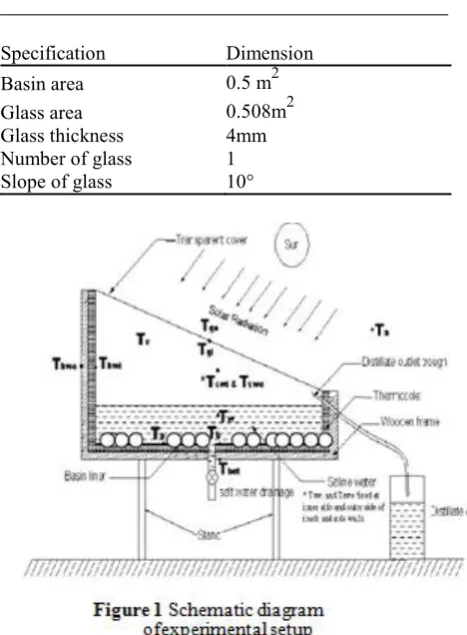
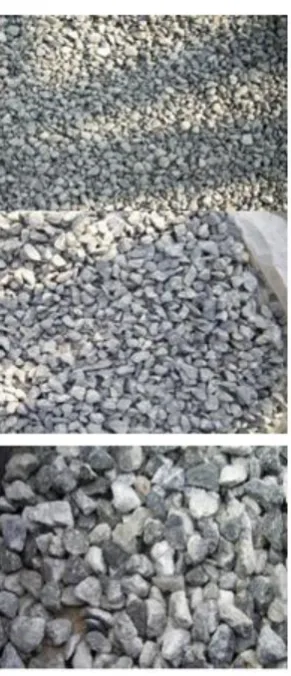
the maximum amount of solar radiation incident on them. The condenser surface of the still is made of glass with 4mm thickness and angle of inclination is 10° with horizontal. There are certain specifications needed for the used glass cover in the still, and they are (a) Minimum amount of absorbed heat, (b) Minimum amount of reflection for solar radiation energy, (c) Maximum transmittance for solar radiation energy, and (d) high thermal resistance for heat loss from the basin to the ambient. [7]Glass covers have been framed with wood and sealed with silicon rubber which plays an important role to promote efficient operation as it can accommodate the expansion and contraction between dissimilar materials. A collecting trough made by G.I. sheet is used in the still to collect the distillate condensing on the inner surfaces of the glass covers and to pass the condensate to a collecting flask. Steel rule is fixed along with inside wall for measuring water depths.[8] The bottom and sides are insulated with 25mm thick thermocole and 12.5mm thick wood with thermal conductivity 0.015 W/mK and 0.055 W/mK respectively. The still technical specifications are shown in Table 1, and Fig.1. Fig 2, show the pictorial views of the various sizes absorbing materials.Fig 3 shows the snap shot of the experimental setup
Table 1 Technical specification of the solar still
Specification Dimension
Basin area 0.5 m2
Glass area 0.508m2
Glass thickness 4mm
Number of glass 1
Slope of glass 10°
ISSN (Print) : 2320 – 3765 ISSN (Online): 2278 – 8875
I
nternational
J
ournal of
A
dvanced
R
esearch in
E
lectrical,
E
lectronics and
I
nstrumentation
E
ngineering
(An ISO 3297: 2007 Certified Organization)
Vol. 4, Issue 3, March 2015
at 9 AM local time and lasted for 24 h. In each day experiment constant water depth of 30mm was used. During experimentation when switching over from one absorbing material to another the still was left idle, minimum for a day to attain steady state condition
Figure 2
pictorial views of blue metal stone invarious sizes of 6, 12,20mmISSN (Print) : 2320 – 3765 ISSN (Online): 2278 – 8875
I
nternational
J
ournal of
A
dvanced
R
esearch in
E
lectrical,
E
lectronics and
I
nstrumentation
E
ngineering
(An ISO 3297: 2007 Certified Organization)
Vol. 4, Issue 3, March 2015
Prior to start of the experiment for next absorbing material till the completion of experiments for all three absorbing material. The following parameters were measured every hour for a period of 24 h for fixed inclinations and for fixed
water depth
.
•
Basin temperature•Back wall temperature
•Side wall temperature
•Water temperature
•Glass temperature
•Moist air temperature
•Ambient temperature
•Air velocity
•Solar radiation
•Distillate output
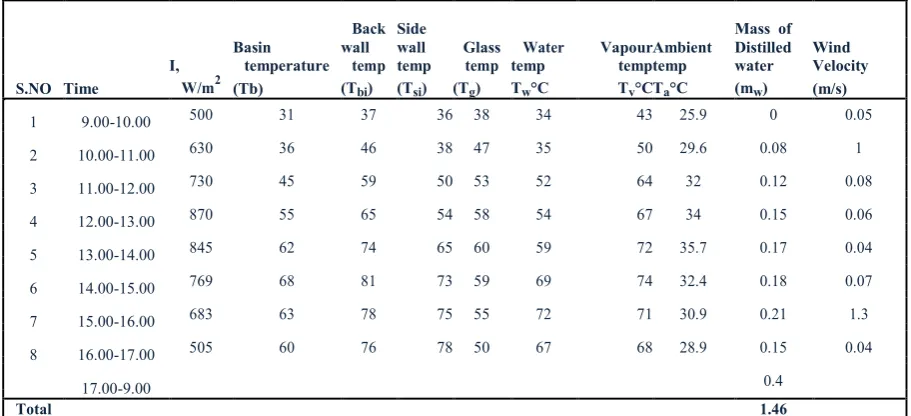
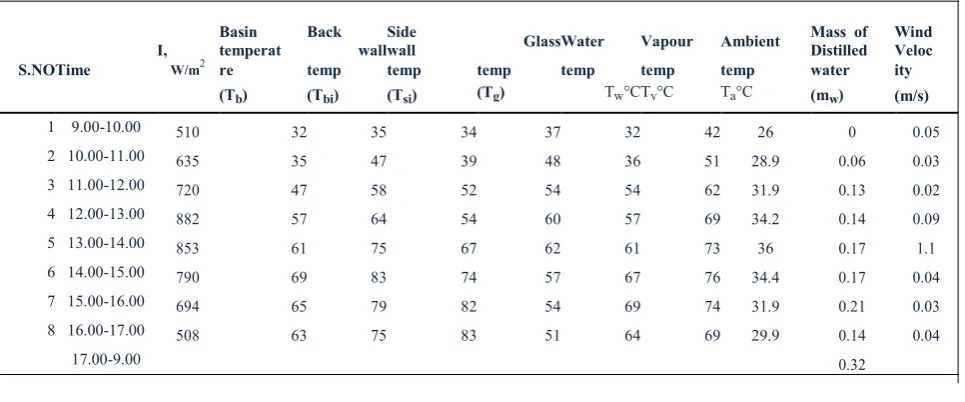
Water, Basin, glass and vapor temperatures were recorded with the help of k-type thermocouples and a digital temperature indicator having a least count of 0.1°C. Solar radiation is measured using pyranometer and the wind velocity is measured using digital anemometer. And a 30mm steel rule is fixed inside wall used to measure water depth. And the readings were shown in table 2-5.[10]
III .THERMAL ANALYSIS OF SOLAR STILL
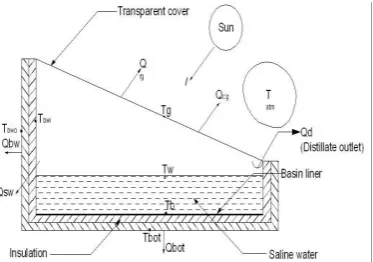
The performance analysis is achieved by energy balance of the still. Fig.3.1 shows the energy transfer processes for various components in the still, which have a direct effect on the output. For simplifying the analysis, the following assumptions are considered:
The level of water in the basin is maintained constant level. [12-13]
The condensation that occurs at the glass trough is a film type.
The heat capacity of the glass cover, the absorbing material, and the insulation material are negligible. [14]
No vapor leakage in the still;
The heat capacity of the insulator (bottom and side of the still) is negligible.
ISSN (Print) : 2320 – 3765 ISSN (Online): 2278 – 8875
I
nternational
J
ournal of
A
dvanced
R
esearch in
E
lectrical,
E
lectronics and
I
nstrumentation
E
ngineering
(An ISO 3297: 2007 Certified Organization)
Vol. 4, Issue 3, March 2015
We can obtain collecting efficiency of the still from writing energy balance equation for solar still, referring fig 1
I
Q
d
Q
rg
Q
cg
Q
bw
Q
sw
Q
bot(1)Qd, the amount of heat taken by distilled water, the expression is
Q
d
m
w.
h
fg (2)Where mw, mass of output distilled water and hfg, latent heat of evaporation of water = 2382x103 J/kg Qcg, the
convective heat transfer from glass to ambient is,
Q
cg
h
cgA
g(
T
g−
T
a)
(3)Where, hcg, convective heat transfer coefficient between glass material and ambient. It is mainly depends on wind
velocity, the expression is,
h
cg
2
3.8
V
(4)Where, Qrg is the radiative heat transfer from glass to atmosphere, is equal to,
Q
rg
ε
g
A
σ
(
T
g
4
−
T
4)
(5)g s
where εg, emissivity of the glass material, σ, Ag, surface area of glass exposed to atmosphere, Stefan Boltzmann
constant, 5.67 x 10⁻⁸ K-4 , hrg, radiation heat transfer coefficient between glass and air and Ts, sky temperature, is less
than (such as 6°C) ambient temperature
Qbw, the heat transfer from inside to atmosphere through back wall, the expression is,
Q
bw
A
bw*U*(T
bwi-T
a)
(6)Where Abw – Area of back wall,
U - Overall heat transfer coefficient Qsw, the heat transfer from inside to atmosphere through side walls, the expression is,
Q
sw
A
sw*U*(T
swi-T
a)
(7)Where Asw – Area of side wall
Where Qbot is the heat transfer rate from basin liner to atmosphere through bottom wall, and It is expressed with
composite wall conduction equation, the expression is,
Q
bot
A
b*U*(T
b-T
a)
(8)ISSN (Print) : 2320 – 3765 ISSN (Online): 2278 – 8875
I
nternational
J
ournal of
A
dvanced
R
esearch in
E
lectrical,
E
lectronics and
I
nstrumentation
E
ngineering
(An ISO 3297: 2007 Certified Organization)
Vol. 4, Issue 3, March 2015
The overall efficiency of the solar still is
η
o
Q
d(9)
I
IV. OBSERVATION READING
Table 2 Without using any blue metal stone
Back Side Mass of
Basin wall wall Glass Water VapourAmbient Distilled Wind
I, temperature temp temp temp temp temptemp water Velocity
S.NO Time W/m2 (Tb) (Tbi) (Tsi) (Tg) Tw°C Tv°CTa°C (mw) (m/s)
1 9.00-10.00 495 34 37 38 39 32 44 26 0 0.09 2 10.00-11.00 605 38 44 40 45 37 50 28.2 0.06 0.07 3 11.00-12.00 710 49 56 49 53 49 62 32 0.1 0.05 4 12.00-13.00 890 54 62 55 58 54 66 34.4 0.14 0.09 5 13.00-14.00 850 60 69 63 63 59 68 35 0.13 1.1 6 14.00-15.00 785 65 75 72 61 66 73 33.2 0.17 1.2 7 15.00-16.00 690 61 74 76 59 68 70 31 0.23 0.03 8 16.00-17.00 520 58 69 78 54 66 66 30.9 0.14 0.06
17.00-9.00 0.28
Total 1.25
Table 3 Using 12mm blue metal stone
Back Side
Mass of
Basin wall wall Glass Water VapourAmbient Distilled Wind
I, temperature temp temp temp temp temptemp water Velocity
S.NO Time W/m2 (Tb) (Tbi) (Tsi) (Tg) Tw°C Tv°CTa°C (mw) (m/s)
1 9.00-10.00 500 31 37 36 38 34 43 25.9 0 0.05 2 10.00-11.00 630 36 46 38 47 35 50 29.6 0.08 1 3 11.00-12.00 730 45 59 50 53 52 64 32 0.12 0.08 4 12.00-13.00 870 55 65 54 58 54 67 34 0.15 0.06 5 13.00-14.00 845 62 74 65 60 59 72 35.7 0.17 0.04 6 14.00-15.00 769 68 81 73 59 69 74 32.4 0.18 0.07 7 15.00-16.00 683 63 78 75 55 72 71 30.9 0.21 1.3 8 16.00-17.00 505 60 76 78 50 67 68 28.9 0.15 0.04
17.00-9.00 0.4
ISSN (Print) : 2320 – 3765 ISSN (Online): 2278 – 8875
I
nternational
J
ournal of
A
dvanced
R
esearch in
E
lectrical,
E
lectronics and
I
nstrumentation
E
ngineering
(An ISO 3297: 2007 Certified Organization)
Vol. 4, Issue 3, March 2015
Table 4 Using 6mm blue metal stone
Basin Back SideGlass Water Vapour Ambient Mass of Wind
I, wall wall Distilled
S.NO Time W/m2 temperature temp temptemp temp temp temp water Velocity
(Tb) (Tbi) (Tsi)(Tg) Tw°C Tv°C Ta°C (mw) (m/s)
1 9.00-10.00 490 33 35 39 37 33 42 26.5 0 0.07 2 10.00-11.00 630 38 43 41 45 38 51 29 0.08 0.04 3 11.00-12.00 700 51 56 56 55 50 63 32.2 0.13 1.1 4 12.00-13.00 900 53 64 58 57 54 67 34.5 0.14 0.04 5 13.00-14.00 865 62 71 64 69 61 70 35.4 0.15 0.05 6 14.00-15.00 780 66 75 79 65 67 77 33.1 0.17 0.08 7 15.00-16.00 675 61 72 83 61 68 75 31.9 0.23 1.1 8 16.00-17.00 535 60 70 84 59 64 68 30.8 0.15 0.02
17.00-9.00 0.37
Total 1.42
Table 5 Using 20mm blue metal stone
Basin Back Side GlassWater Vapour Ambient Mass of Wind
I, temperat wallwall Distilled Veloc
S.NOTime W/m2 re temp temp temp temp temp temp water ity
(Tb) (Tbi) (Tsi) (Tg) Tw°CTv°C Ta°C (mw) (m/s)
1 9.00-10.00 510 32 35 34 37 32 42 26 0 0.05 2 10.00-11.00 635 35 47 39 48 36 51 28.9 0.06 0.03 3 11.00-12.00 720 47 58 52 54 54 62 31.9 0.13 0.02 4 12.00-13.00 882 57 64 54 60 57 69 34.2 0.14 0.09 5 13.00-14.00 853 61 75 67 62 61 73 36 0.17 1.1 6 14.00-15.00 790 69 83 74 57 67 76 34.4 0.17 0.04 7 15.00-16.00 694 65 79 82 54 69 74 31.9 0.21 0.03 8 16.00-17.00 508 63 75 83 51 64 69 29.9 0.14 0.04
17.00-9.00 0.32
ISSN (Print) : 2320 – 3765 ISSN (Online): 2278 – 8875
I
nternational
J
ournal of
A
dvanced
R
esearch in
E
lectrical,
E
lectronics and
I
nstrumentation
E
ngineering
(An ISO 3297: 2007 Certified Organization)
Vol. 4, Issue 3, March 2015
ISSN (Print) : 2320 – 3765 ISSN (Online): 2278 – 8875
I
nternational
J
ournal of
A
dvanced
R
esearch in
E
lectrical,
E
lectronics and
I
nstrumentation
E
ngineering
(An ISO 3297: 2007 Certified Organization)
Vol. 4, Issue 3, March 2015
VI. RESULT AND CONCLUSION
The results and discussions for the behavior and performance of the solar desalination system presented here in the form of graphs and tables. Experiments have been conducted from 9:00 hrs to 17:00 hrs. Experiments are conducted by considering a wide range of parameters such as temperatures of basin water, temperature of glass cover, hourly yield, temperature of inside walls (back and side wall) and bottom side temperature. At this particular condition, experiments were conducted for a number of days, so that analysis and comparison could be done fairly under the same climatic
condition and to get concurrent results.And the amount of energy required to produce the distilled water (Qd) is very
high in all cases during 3 o clock.The mass of distilled water produced during the off sunshine hours is more while using 12mm absorbing medium,this says that 12mm material has high latent heat storage and releases it during the half peak hours. Heat losses from water surface to ambient through side wall and heat loss from water surface to ambient through bottom surface(Qsw and Qbot) is similar in all cases. All the heat losses goes on increasing as the time varies. And in this its concluded that 12mm absorbing material has more thermal efficiency when compared with the other materials. This means that 12mm material is more effective in converting saline water into distilled output and this material has better heat storage capacity when compared with other materials.
REFERENCES
[1] M.A.S. Malik, A. Kumar and M.S. Sodha, Solar Distillation, Pergamon Press, Oxford, UK, 1982.
[2] T. Kiatsiriroat, P. Wibulswas and S.C. Bhattacharya, Performance analysis of multiple effect vertical solar still with a fiat plate solar collector, J. Solar Wind Technol., 4(4) (1987) 451.
[3] Subha Palaneeswari M., Abraham Sam Rajan P.M., Silambanan S., Jothimalar, "Blood lead in end-stage renal disease (ESRD) patients who were on maintainence haemodialysis", Journal of Clinical and Diagnostic Research, ISSN : 0973 - 709X, 6(10) (2012) pp.1633-1635.
[4] Sharmila S., Rebecca L.J., Saduzzaman M., "Effect of plant extracts on the treatment of paint industry effluent", International Journal of Pharma and Bio Sciences, ISSN : 0975-6299, 4(3) (2013) pp.B678-B686.
[5] G.M. Zaki, A. A1-Turki and M. AI-Fatani, Experimental investigation on concentrator assisted solar stills. J. Solar Energy, 11 (1992) 193-199. [6] G.N. Tiwari, Recent Advances in Solar Distillation, Wiley Eastern, New Delhi, India, 1992, Chap. 2.
[7] Jeyanthi Rebecca L., Dhanalakshmi V., Sharmila S., "Effect of the extract of Ulva sp on pathogenic microorganisms", Journal of Chemical and Pharmaceutical Research, ISSN : 0975 – 7384 , 4(11) (2012) pp.4875-4878.
[8] Sharmila D., Saravanan S., "Efficacy of lead on germination growth and morphological studies of Horse Gram (Dolichos biflorus Linn)", Journal of Chemical and Pharmaceutical Research, ISSN : 0975 – 7384 , 4(11) (2012) pp.4894-4896.
[9] S. Kumar and G.N. Tiwari, Estimation of convective mass transfer in solar distillation systems, Solar Energy, 57 (1996) 459.
[10]G.N. Tiwari, S.K. Shukla and I.P. Singh, Computer modeling of passive/active solar stills by using inner glass temperature, Desalination, 154 (2003) 171.
[11]G.N. Tiwari, H.N. Singh and R. Tripathi, Present status of solar distillation, Solar Energy, 75(5) (2003) 367-373. [12]E. Delyannis, Historic background of desalination and renewable energies, Solar Energy, 75(5) (2003) 357-366.
ISSN (Print) : 2320 – 3765 ISSN (Online): 2278 – 8875
I
nternational
J
ournal of
A
dvanced
R
esearch in
E
lectrical,
E
lectronics and
I
nstrumentation
E
ngineering
(An ISO 3297: 2007 Certified Organization)
Vol. 4, Issue 3, March 2015
[14]Saduzaman M., Sharmila S., Jeyanthi Rebecca L., 'Efficacy of leaf extract of Moringa oleifera in treating domestic effluent", Journal of Chemical and Pharmaceutical Research, ISSN : 0975 – 7384, 5(2) (2013) pp.139-143.
[15] B.Vamsi Krishna, A New Technique for Elimination of Harmonics Using Three Phase Shunt Active Filter, International Journal of Advanced Research in Electrical, Electronics and Instrumentation Engineering, ISSN (Online): 2278 – 8875,pp 5596-5602, Vol. 2, Issue 11, November 2013 [16] P.Thamarai, B.Karthik, ARM Based Automatic Meteorological Data Acquisition System, International Journal of Advanced Research in Electrical, Electronics and Instrumentation Engineering, ISSN (Online): 2278 – 8875,pp 6461-6465, Vol. 2, Issue 12, December 2013
[17] M.Bharathi,Effective Transfer Function Approach for Decentralized Controller,International Journal of Advanced Research in Electrical, Electronics and Instrumentation Engineering, ISSN 2278 - 8875 , pp 21-27, Vol. 1, Issue 1, July 2012.
[18] Vijayan T ,Energy-efficient MAC for Wireless Sensor Networks,International Journal of Advanced Research in Electrical, Electronics and Instrumentation Engineering,ISSN 2278 - 8875, pp 51-57,Vol. 1, Issue 1, July 2012.