Analysis of Performance Characteristics for
Face Recognition Based on Multimodal Image
Registration
Kirubakaran S1, Aravind A2, Jagadeesan K3
Assistant Professor, Dept. of ECE, Bannari Amman Institute of Tech, Erode, Tamilnadu, India 1
UG Student, Dept. of ECE, Bannari Amman Institute of Tech, Erode, Tamilnadu, India 2
UG Student, Dept. of ECE, Bannari Amman Institute of Tech, Erode, Tamilnadu, India3
ABSTRACT: Whenever a periodic change of a particular scene or motion is to be recorded, determining the internal
consistencies is a herculean task. Image registration is one of the principle methods in change analysis. Whenever the scene is captured using different sensing equipments, multi-modal image registration has to be performed. Measuring the similarities/dissimilarities provides upright findings with the changes occurring in the scene. Generally for biometric applications like palm and face detection image registration is not widely used. With increasing need for security and biometric applications, in this paper face based image registration is performed based on the conventional control point method and the structural method. Image registration has been generally done by utilizing the intensity, point and surface values. Structural features are extracted by utilizing the complex phase and gradient magnitude in this work rather than the conventional methods of registration. Comparison of the registered image through the structural method and the control point method is established. This has been performed using the MATLAB 2013a package.
KEYWORDS: Image registration, structural method, control point method, multimodal, face detection.
I.INTRODUCTION
In the field of change analysis, medical imaging and environmental change analysis are the major areas where image registration is carried out. When the scene is captured by same modalities then the registration process is referred to as mono-modal image registration. However when constant change or if the scene is captured by different modalities then the process of registration is referred as multimodal image registration. Medical imaging is the area where registration is constantly applied, for example CT-MRI are merged for revealing major information altogether. Registration is generally the process of geometrical transformation of the varying (moving) image with accordance to the reference (fixed) image. This enables to constantly analyse and compare them. Moreover this can be applicable to both 2-dimensional and 3-2-dimensional images. Recent research has been carried out on multimodal images and there are many problems posed to it and especially in the way of representing using different intensity mappings.
Cross-correlation is the match measure that was employed in the earlier times but with the findings of improvised results using the normalized cross-correlation, the former has become obsolete. This has significant applications especially in the area of template matching which is an application of image registration. Conventional methods of image registration are based on several point based methods, surface based methods and intensity based methods. All these have been extensively used for biomedical image analysis, environmental change analysis, super resolution, and computer assisted surgery. Intensity based methods are the most extensively used ones where different similarity measures are applied.
in MATLAB.
Increasing needs for improved security purpose face detection systems are applied at various centres. The concept of image registration for these face database has been applied to enhance the recognition process and also to bring down the dataset.
II.RELATED WORK
There has been major works pertaining to image as well as video registration. Majority of works have been carried out employing the intensity based methodology. The similarity measures employed are sum-of-squared-differences (SSD) and cross-correlation coefficient. These methods have been quite extensively used in the earlier works and have paved the way for newer techniques. Mutual Information which was the metric for calculating the rate of registration was replaced by TRE down the lane. All these were based on the conventional intensity or point based methods. In these work they have many limitations which have been listed
a) The main limitation of these papers is they may not be suitable for images obtained from different modalities
at all instances.
b) Computation time is also a major concern as far these complex processes are concerned.
c) Conventional methods were used only for medical diagnosis and other fields excluding a vast insight into face
and palm based registration.
d) The ordinary recognition methods call for increase in the data set pertaining to recognition, whereas registration allows the data set to be reduced to halve of the original data set.
e) None of the methods take structural features in to consideration, which has been valuable in the recognition
process as demonstrated by [1] and in this work.
III.CONTROL-POINT METHOD OF FACE REGISTRATION
In the conventional control point method of image registration which is available in the image processing toolbox, the fixed and moving images are taken for selection of similarity points. The aspect ratio can be selected using the same dialog box and points of similarity are selected on the corresponding images. Whenever sufficient control points are selected, the points are saved to the workspace.
The images are taken from ORL face database, where the moving (reference) and fixed (unregistered) images are as below:
(a) (b)
Fig 1: (a) Fixed Image and (b) Moving Image
Fig 2: Selection of control points on accordance to similar information
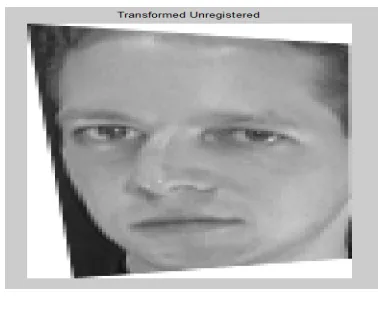
Fig 3: Transformed moving image
Fig 4: Fixed image made transparent
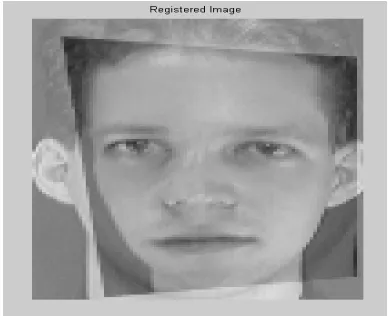
Finally the registration is done by transforming the moving image in concordance with the fixed image that has been made transparent. Thus the registered image from the reference and moving image has been obtained as shown in figure 4.
Fig 5: Final registered image
IV.PROPOSED WORK
A. Registration using structural features:
Image registration process here is carried out by adopting these structural features as explained in [1]. These structural features generally correspond to complex phase information and the gradient magnitude. When these components are computed for both the fixed as well as moving images then the distinction in the intensity values corresponds to the variation/ dissimilarities in the image. Thus on examination of the resulting features, the images can be taken as those from same intensity mappings. Normalization of both the fixed and moving images along with each of their phase and magnitude components is done. This is usually followed by the histogram equalization. Then both of the extracted phase components and gradient magnitude components from the moving and fixed images are combined to form a single image with phase and gradient separable image. These images are then sent for intensity based automatic image registration.
B. Structural components being extracted:
1. Phase Information: As per evidence based on psychology from [2], the model that is derived from the phase information is similar in the interpretation of the human vision for detection of features. Thus from this [2] work, odd and even wavelets are computed from the Log-Gabor complex wavelet transform. The transformation has each point x which is represented by the complex form h(x), where the signal is being processed as separable amplitude and phase components. This is generally computed on the point x on the nth scale.
Thus the phase calculated finally is computed from,
Phase information = Energy Amplitude
Similarly the local energy from the coefficients is computed from the responses of the even and odd wavelet filters over all scales.
2. Gradient magnitude: The magnitude is the information that is revealed by the gradient information in the image. This is also highly influential in addition to the phase of the image to reveal informative features. The convolution masks is the conventional way to determine the gradient. Here sobel operator has been preferred over the prewitt operator to get away from the problem arising to the localization at the center.
Thus the gradient magnitude is computed from the partial derivatives along the x and y directions as, G =(G 2 + G 2)1/2
C. Image registration
The information that has been obtained from the phase and magnitude of the moving and fixed images are being normalized with respect to the intensity. This process enables the information to be coimbined at first. The combination is similar to the [1] but the values of α and β seems to differ largely, thus changing the expression overall.
Then the combined information is being sent for histogram normalization.
Then the process of registration is progressed on the basis of automatic registration. Numerous transformations are available like affine, rigid, similarity. In this paper, similarity transformation has been used as this is where the dimesnsions has corresponded well. The changes in the characteristics of the optimizer has corresponded well to the registered image.
V. SIMULATION RESULTS AND COMPARISON
The simulated results are shown according to each step and this is as below:
Fig 6: Initial steps during extraction of structural features for the fixed image.
Fig 7: Initial steps during extraction of structural features for the moving image.
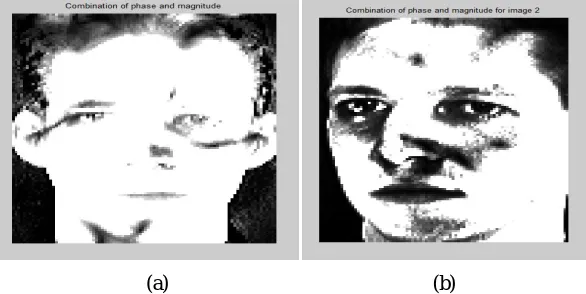
Further, the combination of the phase and magnitude of the moving images with that of the fixed images are given as below. A more enhanced look is obtained from the initial image. This can be seen as below:
(a) (b)
Fig 8: (a) and (b) Combination of phase and magnitude for fixed and moving images respectively.
Fig 9: Normalized Cross-Correlation plot
The registration didn’t seem to work well with the default optimizer initial radius and performs best only when the value of initial radius is 0.003. The output of the default and enhanced registration is as below:
(a) (b)
Thus the areas of green and gray represent equal amplitudes and the colour magenta corresponds to different amplitude. Clearly it can be determined that the initial radius plays a key role in the registration process.
VI. CONCLUSION
The simulation result of this registration process has been the key in understanding the necessity of going for structural and control point methods of image registration as far as face database is concerned. For alarming security risks, this method can be effective in allowing authenticated access during the matching process and also the data set is reduced. In addition to this, the importance of the optimizer metric is also identified, (here) initial radius of the optimizer deign in an automatic image registration process. This method of face based image registration can be applied in various security applications.
REFERENCES
[1] Kasiri K; Dept. of Syst. Design Eng., Univ. of Waterloo, Waterloo, ON, Canada; Clausi, D.A; Fieguth, P, “Multi-Modal Image Registration Using Structural Features”, IEEE Chicago,IL ISSN: 1557-170X Page: 5550 – 5553, 26-30 Aug. 2014.
[2] P. Kovesi, “Image features from phase congruency” Videre: Journal of Comput. Vision Research, vol. 1, pp. 1-26, 1999.
[3] Model.Sandro I. De Zanet, Carlos Ciller, Tobias Rudolph, Philippe Maeder, Francis Munier, Aubin Balmer.“Landmark Detection for Fusion of Fundus and MRI Toward a Patient-Specific Multimodal Eye”. IEEE Vol. 62, Issue: 2, 2015, pp. 532- 540.
[4] A. Myroneko and X. Song, “Intensity-based image registration by minimizing residual complexity,” IEEE Trans. Med. Imag., vol. 29, no. 11, pp. 1882-1891, 2010.
[5] D. De Nigris, D. L. Collins, and T. Arbel, “Multi-modal image registration based on gradient orientations of minimal uncertainty,” IEEE Trans. Med. Imag., vol. 31, no. 12, pp. 2343- 2354, 2012.
[6] R. C. Gonzalez, R. E. Woods, and S. L. Eddins, Digital image processing using MATLAB, Pearson Educ. India, 2004.
[7] D. Loeckx, P. Slagmolen, F. Maes, D. Vandermeulen, and P. Suetens, “Nonrigid image registration using conditional mutual information,” IEEE Trans. Med. Imag., vol. 31, no. 12, pp. 2343-2354, 2012.