ISSN (Print) : 2320 – 3765 ISSN (Online): 2278 – 8875
I
nternational
J
ournal of
A
dvanced
R
esearch in
E
lectrical,
E
lectronics and
I
nstrumentation
E
ngineering
(A High Impact Factor, Monthly, Peer Reviewed Journal)
Website: www.ijareeie.com
Vol. 8, Issue 2, February 2019
Fruit Quality Analysis Using GLCM
Algorithm in Image Processing
Prof. G.Vijayakumari[1], G.Prithipa[2], S.Rithvedha[2], S.Santhiya[2]
Assistant Professor, Department of ECE, Builders Engineering College, Tirupur, Tamilnadu, India[1]
UG Student, Department of ECE, Builders Engineering College, Thirupur, Tamilnadu, India[2]
ABSTRACT: Nowadays, an identification system is needed in the food processing industries to boost the efficiency of production so as to meet up with demand in the society. Manual approach is often used in product grading and quality control, and this unfortunately could lead to uneven products, higher time expense, and fatigue by the human operators. Therefore, we propose in this project, an automatic system for classification of fruit whether it is healthy for production or not. Such a system is faster, accurate and also relieves the stress that an operator may have. Our system uses GLCM texture feature analysis to extract the features required for training and testing models namely support vector machine (SVM). A classification performance comparison is drawn between the different classification models, and the obtained experimental results indicate that such intelligent grading systems may be efficiently used in real life applications for similar tasks in food processing industries.
KEYWORDS: GLCM algorithm, SVM algorithm, Disease identification, Ripeness status , Gradinsystem.
I. INTRODUCTION
In order to improving fruits quality and production efficiency, reduce labor intensity, it is necessary to research non-destructive automatic detection technology. Fruit non-destructive detection is the process of detection fruits’ inside and outside quality without any damage, using some detection technology to make evalution according some standard rules fig(2). Nowdays, the quality of fruit shape, default, color and size andso on cannot evaluate on line by the traditional methods. With the development of image processing technology and computer software, it becomes more attractive to detect fruits’quality by using vision detecting technology.
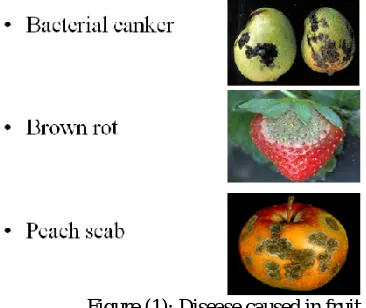
Figure (1): Disease caused in fruit.
ISSN (Print) : 2320 – 3765 ISSN (Online): 2278 – 8875
I
nternational
J
ournal of
A
dvanced
R
esearch in
E
lectrical,
E
lectronics and
I
nstrumentation
E
ngineering
(A High Impact Factor, Monthly, Peer Reviewed Journal)
Website: www.ijareeie.com
Vol. 8, Issue 2, February 2019
Figure(2);Block diagram.
1. IMAGE ACQUISITION
The RGB colour model is an additive colour model in which red, green and blue light are added together in various ways to reproduce a broad array of colours.The name of the model comes from the initials of the three additive primary colours, red, green and blue.In photography and computing, a grayscale or greyscale digital image in which the value of each pixel is a single sample, that is, it carries only intensity information. Images of this sort, also known as black-and-white, are composed exclusively of shades of gray , varying from black at the weakest intensity to white at the strongest.
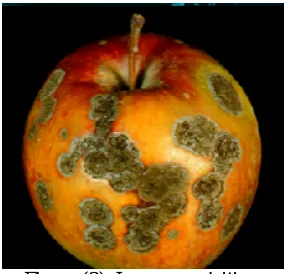
Figure (3): Image acquisition.
In photography and computing, a grayscale or greyscale digital image is an image in which the value of each pixel is a single sample,that is,it carries only intensity information.Images of this sort,also known as black-and-white,are composed exclusively of shades of gray varying from black at the weak intensity to whit at the strong intentensity Fig(3).
2. GRAY IMAGE:
ISSN (Print) : 2320 – 3765 ISSN (Online): 2278 – 8875
I
nternational
J
ournal of
A
dvanced
R
esearch in
E
lectrical,
E
lectronics and
I
nstrumentation
E
ngineering
(A High Impact Factor, Monthly, Peer Reviewed Journal)
Website: www.ijareeie.com
Vol. 8, Issue 2, February 2019
Figure (4): Gray image.
Grayscale images are often the results of measuring the intensity of light at each pixel in a single band of the electromagnetic spectrum (e.g.infrared, visible light, ultraviolet, etc.),and in such cases they are monochromatic proper when only a given frequency is captured.But also they can be synthesized from a full colour image;see the section about converting grayscale.
3. FILTERING:
In image processing filters are mainly used to suppress either the high frequencies in the image,or the low frequency,i.e.enhancing or detecting edges in the image.
Figure (5): Filter.
The median filter is normally used to reduce noise in an image, somewhat like the median filter.However,i t often does a better job than the mean filter of preserving useful detail in the image.
4. SEGMENTATION:
ISSN (Print) : 2320 – 3765 ISSN (Online): 2278 – 8875
I
nternational
J
ournal of
A
dvanced
R
esearch in
E
lectrical,
E
lectronics and
I
nstrumentation
E
ngineering
(A High Impact Factor, Monthly, Peer Reviewed Journal)
Website: www.ijareeie.com
Vol. 8, Issue 2, February 2019
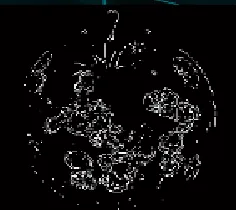
At first, the pixels are clustered based on their color and spatial features, where the clustering process is accomplished. Then the cluster blocks are merged to a specific number of regions.Using this two step procedure, it is processible to increase the computational efficiency avoiding feature extraction for every pixel in the image of fruits fig (6).Although the color is not commonly used for defect segmentation,it produces a high discriminative power for different regions of image.The experimental results clarify the effectiveness of proposed opproach to improve the defect segmentation quality.
5. FEATURE EXTRACTION
In GLCM matrix the relation between two adjacent pixels at a time is considered out of which one pixel is called as reference pixel and the other is called as its neighbour pixel. Now to calculate the texture information it requris a symmetricle matrix. A symmetrical matrix is made up of exactly similar parts or values on opposite sides of the diagonal.In the next step the GLCM is converted in to this form for futher processing.The GLCM is created by calculating how many times the pixel with intensity vale i ocuurs horizontally adjacent to a pixel with value j .Here we can specify the distance between the pixel value of interest and its neighbour which can be called as offset.Different offses and angles or directions around the pixels of interest can be calculated the GLCM.
ENERGY: Provides the sum of squared elements in the GLCM.Aslo known as uniformly or the angular second moment.
Energy:
2,
,
i jP
i
j
HOMOGENEITY: Measures the closeness of the distribution of elements in the GLCM to the GLCM diagonal.
Homogeneity :
i
j
P
i
j
j i
,
1
1
, 2
CONTRAST: Measures the local variations in the gray level co-occurrence matrix. Contrast :
j
i,
P
i
,
j
log
P
i
,
j
CORRELATION: Measure the joint probability occurrence of the specified pixel pairs.
Correlation:
i
j
P
i
j
j
i, 2
,
6.CLASSCIFICATION OF SVM
Another statistical classifier is SVM, which first non-linearly maps data to a high-dimensional space by kernels and then tries to find the hyper plane that separates data with maximum margin in that new space . Originallyproposedfor2-classproblems, SVM can be easily extended to multiclass problems by one-against-one or one-against all strategies, where the latter is used in this work. Several features are extracted using GLCM methodology. In this scenario only 6 features are taken to classify the AO. One is area and remaining textural features. The SVM classifier is employed to infect fruits in the images.
The selected features feed as input to SVM classification parameters and it classifies the normal and abnormal categories. Also the classification stage is applied to define the grade of fruits based on the defects occur on the surface. This procedure is carried out to differentiate the fruit diseases.
II. RESULT AND CONCLUSION
ISSN (Print) : 2320 – 3765 ISSN (Online): 2278 – 8875
I
nternational
J
ournal of
A
dvanced
R
esearch in
E
lectrical,
E
lectronics and
I
nstrumentation
E
ngineering
(A High Impact Factor, Monthly, Peer Reviewed Journal)
Website: www.ijareeie.com
Vol. 8, Issue 2, February 2019
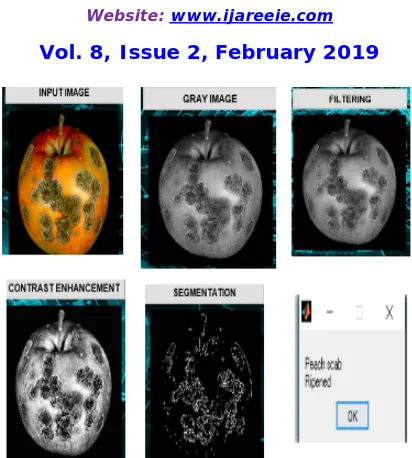
Figure (7); Output for the fruit quality analysis
In the third step training and classification are performed on a SVM algorithm. We have used three types of diseases namely: bacterial canker , peach scab and brown rot. Our experimental results indicate that the proposed system can significantly support detection and classification of fruit diseases. The fruit disease detection system is developed by using the Matlab application.
REFERENCES
[1] Carlos S.Pereira, Raul Morais, “Recent advances in image processing techniques for automated harvesting purposes,” Intelligent systems conference, 2017 .
[2] Shiv Ram Dubey, Anand Singh Jalal , “Detection and classification of apple fruit diseases using complete local binary patterns,” third international conference,2012.
[3] Basavaraj Tigadi, Bhavana Sharma, “Banana Fruit Disease Detection and Grading Using Image Processing” [June 2016]. International Journal of Engineering science and Computing Vol 6, No 6, pp 6512-6516.
[4] O.Kleynen, V.Leemans, and M.F.Destain, “Developement of a multi-spectral vision system for the detection of defects on apples,” Journal of food Engineering, vol.69, pp.41-49,2005.
[5] B. S. Bama, T. Harinie, I. J. Chellam, S. Raju, and V. Abhaikumar, “3d color co-occurrence texture features as tool to evaluate quality of fruits,” Journal of Scientific and Industrial Research, vol. 70, pp. 912– 917, 2011.
[6] S. Sengupta and W. S. Lee, “Identification and determination of the number of immature green citrus fruit in a canopy under different ambient light conditions,” Biosystems Engineering, vol. 117, pp. 51 – 61, 2014, image Analysis in Agriculture. [Online]. Available: http://www.sciencedirect.com/science/article/pii/S1537511013001141.
[7]. B. Lurstwut and C. Pornpanomchai , “Plant seed image recognition system (PSIRS),” International Journal of Engineering and Technology, vol. 3, no. 6, pp. 600 – 605, 2011. [11] N. Valliammal and S. Geethalakshmi, “A hybrid method for enhancement of plant leaf recognition,” World of Computer Science and Information Technology, vol. 1, no. 9, pp. 370 – 375, 2011.