ISSN 2286-4822 www.euacademic.org
Impact Factor: 3.4546 (UIF) DRJI Value: 5.9 (B+)
A Conceptual Model of Electronic Service for the
Developing Countries: Iraq as a Case Study
MOHAMMED MORAD ANAD Faculty of Education for Pure Sciences University of Thi-Qar Thi-Qar, Iraq
Abstract:
Across the world, the modernization of the public services through the adoption of information and communication technologies (ICTs) is in motion. Recently, almost all the developing and developed governments sought to shift toward modern electronic public services (e-services or e-government services). Electronic government services can increase the convenience and accessibility of government services and information to citizens and other stakeholders. Despite the benefits of e-government services, the failure of the utilizing the ICT in public sector is highly in the developing countries. In the same vein, Iraq is lagging behind in e-government and compared to neighboring countries, Iraq e-government initiatives (whether in federal level or local level) is one of the lowest amongst its neighboring countries. In order to investigate the issues behind this decline, this study first sought to propose a conceptual model based on the Diffusion of Innovations theory (DOI) and Technology Acceptance Model (TAM), plus additional factors. In the next research work, the researcher will seek to examine this model in the real world to highlighting on the significant factors that affecting on the intention to using this initiative.
Introduction
With the revolutionary changes that ICTs is bringing to our global society, government around the world continue to develop more sophisticated ways to digitize its routines and practices so that they can offer the public access to government services in more effective and efficient ways (Bohatyrets & Zoriy, 2014). 173 of 190 developed and developing countries across the world sought to utilize from the Information and communication technologies to deliver government services for their citizens (Shajari & Ismail, 2013).
Indeed, the governments across the world play a crucial role in administrating the societies and citizens’ use of the ICTs in many aspects of their lives. Used the ICT in the public sector (or called e-Government) increases the convenience and accessibility of government services and information to public (Carter & Bélanger, 2005). In fact, utilizing electronic services in the public sector are beneficial to both citizens and government. Moreover, Furuholt and Wahid (2008) stated, the main opportunities for e-government in general, for instance cost reductions and improved efficiency for the government agencies, while citizens receive faster, more convenient services. In the developing countries the e-government services has become priority for them after reaching in developed countries (Ali & Sunitha, 2007). In the same context, Kanaan (2009) also said, e-government has become a popular focus of government efforts in many developed countries and, more recently, in several developing countries. Chaijenkij (2010) pointed out, the implementation of e-government has the potential to improve the lives of 80% of the world’s population living in developing countries.
key barriers that would effective on the e-Government services (Al-Khafaji, Shittuline & Osman, 2012).
Problem Identification
Heeks (2006) stated that, the rate of the failure e-government implementation is highly, especially in in developing countries. As well as, the vast majority of developing countries lag behind the developed countries in the use of online services in the public sector. Pudjianto (2009) also referred, approximately 60 percent of e-government implementation fail or cannot reach expected outcomes. Moreover, in the developing countries the take-up of e-Government services by citizens is low (Ionica, Edelhauser and Dima, 2013). According to Qamruzzaman (2014) the potential for e-government in developing countries, however, remains largely unexploited, even though ICT is believed to offer considerable potential for the sustainable development of e-government. In addition, Basu (2004) explained that developing countries can overcome the barriers with the help of new and innovative technology. Whereas, based on the recent survey conducted by United Nations E-Government (2012) the rank of the e-government in Iraq still in the bottom for the list among Western Asia countries, as shown in Table 1 below.
E-gov. development index World e-gov. development
ranking
Country 2012 2010 2012 2010
Israel 0.8100 0.6552 16 26
United Arab Emirates 0.7344 0.5349 28 49
Bahrain 0.6946 0.7363 36 13
Saudi Arabia 0.6658 0.5142 41 58
Cyprus 0.6508 0.5705 45 42
Qatar 0.6405 0.4928 48 62
Kuwait 0.5960 0.5290 63 50
Oman 0.5944 0.4576 64 82
Georgia 0.5563 0.4248 72 100
Turkey 0.5281 0.4780 80 69
Lebanon 0.5139 0.4388 87 93
Jordan 0.4884 0.5278 98 51
Syrian Arab Republic 0.3705 0.3103 128 133
Iraq 0.3409 0.2996 137 136
Yemen 0.2472 0.2154 167 164
Table 1: E-government development in Western Asia (source: United Nations E-Government Survey, 2012)
Since 2004 some e-government policies has been issued by the government but in facts year by year, the global rank of e-government services as well as regional rank of Iraq still in low rank (United Nations E-Government Survey, 2012)
Additionally, there are very paucity of the publications and the empirical studies conducted on the electronic government in developing countries in general (Hassan, Mahdi, & Al-Khafaji, 2014) and in Iraq in particular. Thus, these arguments motivating the researcher to concentrate on the e-government services in Iraq, and also because nowadays Iraqi government seek to shift most of the services in the government agencies from the traditional means (papers) to use more sophisticated technologies to deliver the services for the citizens and also to sharing the information among the agencies.
Theoretical Background
Electronic government Concept
Iraq it is called “electronic government” (Al-Dabbagh, 2013; Venkatesh, Sykes & Venkatraman, 2014; Waller, Irani, Lee & Weerakkody, 2014).
There are many variety definitions of e-government from many different perspectives. For instance, Cook, LaVigne, Pagano, Dawes and Pardo (2002) defined the e-government as: “E-government has four dimensions in relation to major functions and activities of governments: e-services (delivery of government information electronically), e-management (use of ICTs to improve management and communication within and outside government structures), e-democracy (use of ICTs to enhance citizen participation in democratic activities), and e-commerce (online transaction of goods and services).” Cook et al. (2002) define e-government in terms of the relationships between the government and different stakeholders (e-services, e-management, e-democracy and e-commerce).
to citizens and businesses for the purpose of reducing corruption, strengthening accountability, reducing time and cost, and increasing transparency.” West (2001) and Deloitte Research (2000) also define e-government based on the technology point of view. Where, West (2001) refers to e-government as “the delivery of e-government information and services online through the Internet or other digital means” Deloitte Research definition focuses exclusively on the delivery of services and forgoes any aspirations of increasing citizen participation. He said that “Using the technology for delivering better services to the citizens, businesses, and employees.”
E-government categories
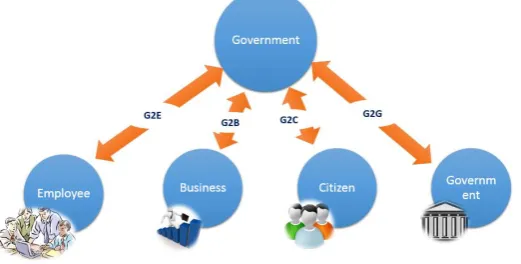
As electronic government can be viewed as involving interactions and relationships between the government and different entities, there are four major but sometimes overlapping types of e-government, namely Government to Citizen (G2C), Government to Employees (G2E), Government to Business (G2B), and Government to Government (G2G). Figure 1 illustrate four categories of e-government (Huang & Bwoma, 2003; Al-khafaji, Shittu, & Osman, 2012; Al-khafaji, Shittu & Osman, 2014; Das, Patnaik & Misro, 2011).
Government to Citizen (G2C)
In this type of e-government is keeps the relationship between government and citizens. The mission of e-government here is to provide appropriate support for citizens anywhere and at any time by allowing them to perform online activities, such as applying online for jobs, searching for contact detail of public departments, voting online, and participation in polls. Chaijenkij (2010) stated, with G2C services, public organisations provide information, contact details and general services online. Where the most important purpose of these applications is to offer people different options and communication channels for public transactions (AlShihi, 2006), in addition, some e-Government advocates suggest that one of the goals of implementing these initiatives should be to create a “one-stop shopping” site where citizens can carry out a variety of tasks, especially those that involve multiple agencies, without requiring the citizen to initiate contacts with each agency individually. A good example of G2C in Iraq is e-Iraq (http://www.egov.gov.iq), but this application not include all the important services for the citizens. As well as, low the interaction among the citizens and government. In sum up, the objectives of the G2C relationship can be summarised as follows (Kostopoulos, 2004; Pappa & Stergioulas, 2006; Yong & Koon, 2003):
Individually provide one-stop online access to services and information. Citizens should be able to find what they require easily and quickly, and to access the information in minutes or seconds, instead of days or hours;
Disintermediation of civil service staff delivering services directly to citizens;
Making content and services available online;
Building and enhancing trust.
Government to Government (G2G)
In G2G, government bodies or agencies work together and provide services to one another. This kind of interrelationship may bring gains in the management and utilization of public resources. Indeed, G2G enables all the levels of government to work together more easily to better serve the needs of citizens and businesses. In 2004, Dhi-Qar Province with help from Italian government seeks to implement the information sharing (or so-called interaction) among the local agencies. But, still this initiative faces many challenges to complete and participate all the local agencies. In general, the objectives of G2G can be summarised as follows (Chavan & Rathod 2009; Heeks, 2006; Siau & Long, 2005):
Enabling all levels of government to work together more easily to effectively serve the needs of citizens and businesses;
Reducing the fractured nature of individual departments and agencies, moving towards a coherent and interconnected government organisation;
Changing the culture of the civil service from reactive to proactive;
Having an open and accountable government; and Providing cost-effective procurement.
Government to Business (G2B)
practically yet. The overall objectives of the G2B relationship are summarised below (Awan, 2008; Miranda, 2000):
Reducing the loads on the interactions between businesses and government;
Providing a one-stop entry point of information to facilitate business development;
Increasing the ability of businesses to identify, examine and remark on government regulations and rules;
Reducing the time required of businesses to fulfill the obligations outlined in regulations, complete necessary paperwork etc;
Eliminating the paper trail and reducing the number of steps required in the communication process between government and business; and
Enhancing the national economy within global markets.
Government to Employee (G2E)
This is an online relationship between government bodies and their employees. G2E services encompass G2C services as well as specialized services that cater only for government employees, such as the provision of human resource training and development that improves the bureaucracy‟s day to day functions and dealing with citizens (Al-rajehi, 2007). G2E in Iraq need more understanding, as well to highlights the activities between the government agencies or ministers and their staff. Additionally, there is very dearth of the studies concentrates on the point of view of the employees in Iraq to adoption or utilize the new technology in their work. In summary, basic G2E applications provide (Chanana, 2007):
Information to compute retirement advantages; Access to essential content and applications;
The ability to easily gather information from the field; Collaboration with other government employees
Opportunities for more effective cross-agency initiatives; and
Improved intra-agency information-sharing and team collaboration.
Electronic Government in developing Countries
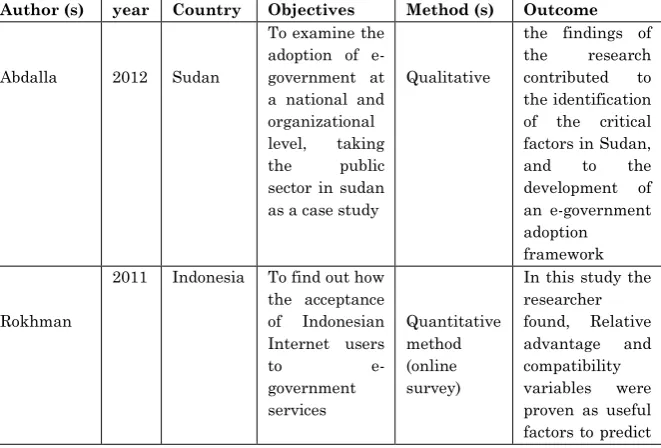
It is now widely recognized the need of ICT to enhance opportunities for economic development and plays a great role in competitiveness enhancement and productive improvement in developing countries. The use of ICTs can connect government, citizens and businesses and support processes and activities. However ICT is also a high risk for developing counties in term of deepen the digital divide and to future marginalize with networking revolution. Countries which fail to use ICT tools for development will face some disadvantages and the gap between economics status and competitiveness. Table 2 depicted the former studies on e-government in developing countries.
Table 2: Previous of studies on the e-government in Developing Countries
Author (s) year Country Objectives Method (s) Outcome
Abdalla 2012 Sudan
To examine the adoption of e-government at a national and organizational level, taking the public sector in sudan as a case study
Qualitative
the findings of the research contributed to the identification of the critical factors in Sudan, and to the development of an e-government adoption framework
Rokhman
2011 Indonesia To find out how the acceptance of Indonesian Internet users
to
e-government services Quantitative method (online survey)
intention of use of e-government
Al Hujran, Aloudat and Altarawneh
2013
Jordan
To develop a conceptual framework that is based on previous literature of TAM in order to examine the relationships between certain factors (trust of government, service quality and citizens satisfaction) and citizen adoption of e-government.
Quantitative method (survey)
The findings indicate that perceived usefulness, perceived ease of use, citizen satisfaction and trustworthiness are significant predictors of the Jordanian intention to use an e-government service.
Tohidi 2011 Iran
This study prepares an overall description of e-government and the various aspects and concepts related to that and also criticizes the E-government using in Iran
Qualitative
The author offers some solutions for the full realization and
implementation of e-government and related issues in Iran.
Alateyah, Crowder and Wills
2013 Saudi Arabia
To identify the factors that may affecting the Citizens Intention to
Adopt
E-government in Saudi Arabia
Qualitative
Identify the influential factors, such as quality of service, diffusion of innovation, computer and information literacy, culture,
lack of
and security, that affect the citizens’
intention to
adopt
E-government services in Saudi Arabia.
Khan, Khan
and Zhang 2010 Pakistan
To analyzes the Global e-Government Readiness with a focus on e-government readiness Index of Pakistan
Qualitative
The findings of this study, the researchers suggested numerous of the issues must focus on it by the government to improve the e-government initiative
Table 3: Main differences between developed and developing countries
Developed Countries Developing Countries
History and Culture
Government and economy
developed early,
immediately after independence
Economy growing at a constant rate, productivity increasing, high standard of living
Relatively long history of democracy and more transparent government policy and rule
Government usually not specifically defined; economy not increasing in productivity
Economy not growing or increasing productivity; low standard of living Relatively short history of
democracy and less transparent government policy and rule
Technical Staff
Has a current staff, needs to increase technical abilities and hire younger professionals.
Has outsourcing abilities and financial resources to outsource; current staff would be able to define
requirements for
development.
Does not have a staff, or has very limited inhouse staff.
Does not have local outsourcing abilities and rarely has the financial ability to outsource; current staff may be unable to define specific requirements.
Infrastructure
Good current
infrastructure.
High Internet access for employees and citizens.
Bad current
infrastructure.
Low Internet access for employees and citizens
Citizens
High Internet access and computer literacy; still has digital divide and privacy issues
Relatively more experienced in democratic system and more actively participate in governmental policy-making process
Low Internet access and citizens are reluctant to trust online services; few citizens know how to operate computers.
Relatively less
experienced in democratic system and less active participation in governmental policy-making process
Government Officers
Decent computer literacy and dedication of resources; many do not place e-government at a high priority
Barriers to E-Government Implementation in Developing Countries
E-government is a crucial application of the internet which is used by powers to promote extensive computerised functions and to facilitate interactions among citizens, businesses and government agencies (Foley & Alfonso 2009). Developing countries like many developed countries, including Arab countries (Kanaan, 2009), which represent 5% of the world population, now have initiatives for implementing e-government. Dubai, Jordan, Egypt, Kuwait, Bahrain, Saudi Arabia and Iraq, for example, have such initiatives and have developed e-government services.
Developing the e-government may help these countries to promote accountability and transparency, and at the same time contribute to enhancing competitiveness. While the majority of e-government initiatives in developing countries fail, a scarce of them have achieved partial success (Heeks, 2006). In India for example, has a payment system of property taxes and issue of land registration which takes five minutes instead of 15 days (Schware & Deane, 2003). Also in Kuwait, it has a civil service recruitment portal. While, Bahrain is the first country to have held a successful Internet election (Moores, 2003; Mishrif & Selmanovic, 2010). Whereas, other countries faces a numerous of challenges to development of e-government and also continue to develop. However, there are variety of barriers that affect e-government in developing countries that are maybe similar to those in developed countries. For example, Lam (2005) has classified the barriers in to four stages.
Strategy Barriers, these barriers involve: (1) Lack of common
Technology Barriers, these barriers encompass: (1) Lack of architecture integration and Infrastructure; (2) Deficiency of data standards; (3) Deficiency of data standards; and (4) Lack of resources.
Policy Barriers, these barriers include: (1) Apprehension over citizen privacy; (2) Data possession; and (3) E-government policy execution.
Organization Barriers, these barriers involve: (1) Lack of organization motivation; (2) Lack of organization motivation; (3) Lack of internal management and technical ability; and (4) Change Management.
Moreover, Ndou (2004) pointed out that, the lack of ICT skills in the public sector is a major challenge to an e-government initiative in developing countries, where the continual lack of qualified staff and inadequate human resources training has been a problem for years. While, Schware and Deane (2003) discuss the impact of infrastructure on the deployment and continuity of e-government programmes in developing countries. In Iraq, especially the currently the managing conflict and lack of financial support may also effect the development of e-government.
Electronic Government in Iraq
strategy was put by the United States Agency for International Development (USAID) and Iraq Ministry of Science and Technology to complete the e-government in 2010 as final date.
Figure 2: Pathway to e-Government in Iraq 2007-2010 (Sharief, Graul, & Ian, 2007)
After more than ten years from the beginning of the e-government project in Iraq, in spite of the efforts made by the concerned authorities to try to ensure the success of this project, but unfortunately, it is still taking its first steps (Ibrahim, 2014), whether in ministries level or local level. Compared with the efforts and the amount of money and the length of time spent by the Iraqi government in order to ensure the success of this project, this stage is not satisfactory stage. As well as, various government agencies and Ministries in developing countries provide information on website. Generally these websites are not design in proper manner, not updated, and Iraq not far from this disadvantage.
The Technology Acceptance Model (TAM)
The development of TAM is examined by considering the relationship between two perceptual variables: Perceived Usefulness (PU) and Perceived Ease of Use (PEOU). Davis defines PU as “the degree to which a person believes that using a particular system would enhance his or her job performance” and PEOU as “the degree to which a person believes that using a particular system would be free of effort”. Legris, Ingham and Collerette (2002) claim that “TAM is used to provide a basis for tracing the impact of external variables on internal beliefs, attitudes and intention” and they also suggest that perceived ease of use and perceived usefulness are very important factors in system use. The basis for adopting the model of TAM was the Theory of Reasoned Action (TRA) as developed by Fishbein and Ajzen (1975).
Electronic Government and the Technology Acceptance Model
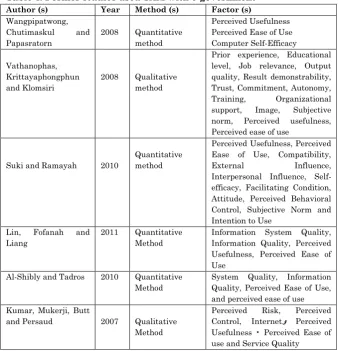
investigating the factors that affecting on the acceptance of the e-government services, see Table 4.
Table 4: Former studies used TAM with e-government
Author (s) Year Method (s) Factor (s)
Wangpipatwong, Chutimaskul and Papasratorn
2008 Quantitative method
Perceived Usefulness Perceived Ease of Use Computer Self-Efficacy
Vathanophas, Krittayaphongphun and Klomsiri
2008 Qualitative method
Prior experience, Educational level, Job relevance, Output quality, Result demonstrability, Trust, Commitment, Autonomy, Training, Organizational support, Image, Subjective norm, Perceived usefulness, Perceived ease of use
Suki and Ramayah 2010
Quantitative method
Perceived Usefulness, Perceived Ease of Use, Compatibility, External Influence, Interpersonal Influence, Self-efficacy, Facilitating Condition, Attitude, Perceived Behavioral Control, Subjective Norm and Intention to Use
Lin, Fofanah and Liang
2011 Quantitative Method
Information System Quality, Information Quality, Perceived Usefulness, Perceived Ease of Use
Al-Shibly and Tadros 2010 Quantitative Method
System Quality, Information Quality, Perceived Ease of Use, and perceived ease of use Kumar, Mukerji, Butt
and Persaud 2007 Qualitative Method
Perceived Risk, Perceived Control, Internetو Perceived Usefulness • Perceived Ease of use and Service Quality
The Diffusion of Innovation theory
society". An innovation is an idea or object that is perceived to be new.
According to DOI, the rate of diffusion is affected by an innovation’s relative advantage, complexity, compatibility, trialability and observability. Rogers (1995) defines relative advantage as “the degree to which an innovation is seen as being superior to its predecessor”. Complexity, which is comparable to TAM’s perceived ease of use construct, is “the degree to which an innovation is seen by the potential adopter as being relatively difficult to use and understand”. Compatibility refers to “the degree to which an innovation is seen to be compatible with existing values, beliefs, experiences and needs of adopters”. Trialability is the “degree to which an idea can be experimented with on a limited basis”. Finally, observability is the “degree to which the results of an innovation are visible”.
On the other hand, Tornatzky and Klein (1982) conclude that relative advantage, compatibility and complexity are the most relevant constructs to adoption research. This element of the model is based on Roger’s model of Diffusion of Innovation. Subsequently Carter and Belanger (2004) have been made a modification by adopting compatibility, relative advantage and complexity, and excluding trialability and observability to replace it by image. Therefore, we will include these factors in this study.
Electronic Government and the Diffusion of Innovation
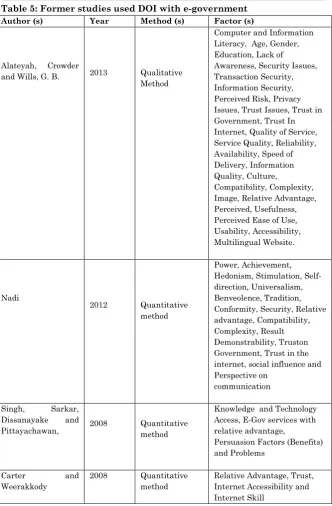
Table 5: Former studies used DOI with e-government
Author (s) Year Method (s) Factor (s)
Alateyah, Crowder
and Wills, G. B. 2013 Qualitative Method
Computer and Information Literacy, Age, Gender, Education, Lack of
Awareness, Security Issues, Transaction Security, Information Security, Perceived Risk, Privacy Issues, Trust Issues, Trust in Government, Trust In Internet, Quality of Service, Service Quality, Reliability, Availability, Speed of Delivery, Information Quality, Culture,
Compatibility, Complexity, Image, Relative Advantage, Perceived, Usefulness, Perceived Ease of Use, Usability, Accessibility, Multilingual Website.
Nadi
2012 Quantitative method
Power, Achievement, Hedonism, Stimulation, Self-direction, Universalism, Benveolence, Tradition, Conformity, Security, Relative advantage, Compatibility, Complexity, Result Demonstrability, Truston Government, Trust in the internet, social influence and Perspective on
communication
Singh, Sarkar, Dissanayake and
Pittayachawan, 2008 Quantitative method
Knowledge and Technology Access, E-Gov services with relative advantage,
Persuasion Factors (Benefits) and Problems
Carter and
Weerakkody
2008 Quantitative method
Conceptual Model for Electronic Government Services in Iraq
Electronic government is more than just a government website on the Internet. Especially in developing countries, there are many internal and external factors that may affect on the e-government initiative. With respect to this section, a numerous of the previous studies successfully integrated DOI into TAM to investigate users’ technology acceptance behavior (Hardgrave, Davis & Riemenschneider, 2003; Wu & Wang, 2005; Chang & Tung, 2008). Therefore, based on the evidences mentioned earlier, this study sough to propose a conceptual model for e-government in Iraq building on these theories as well as add also factors that consider important for the intention to use e-government in developing countries. Figure 3 illustrate a conceptual model.
Conclusion
This paper sought to propose a conceptual model for e-government services in Iraq based on the literature review and two theories (technology acceptance model and the diffusion of innovation theory). In the future research study, the researcher seek to empirical research. The questionnaires will be used to validation the proposed conceptual model and the structure equation modelling may be employed for statistical inference. Afterwards, we will find out the factors effective on the e-Government services in the public sector.
REFERENCES
Abdalla, S. (2012). An e-government adoption framework for developing countries: A case study from Sudan. The degree of PhD, Cranfield University, Cranfield, UK.
Al-Hujran, O., Aloudat, A., & Altarawneh, I. (2013). Factors influencing citizen adoption of e-government in developing countries: The case of Jordan. International Journal of Technology and Human Interaction (IJTHI), 9(2), 1-19.
Al-Shibly, H. H., & Tadros, I. H. (2010). Employee’s perceptions towards electronic government in Jordan. European Journal of Scientific Research, 48(2), 169-176.
Alateyah, S., Crowder, R. M., & Wills, G. B. (2013). Factors Affecting the Citizen’s Intention to Adopt E- government in Saudi Arabia. International Journal of Social, Human Science and Engineering, 7(9), 80-85.
Al-Dabbagh, M. (2013). “Electronic Government in Iraq: Challenges of development and implementation. Swedish Business School, Örebro University,(6 April 7.
Master Thesis, Luleå University of Technology, Luleå, Sweden.
Al-khafaji, N. J., Shittu, A. J. K., & Osman, W. R. Z. S. (2014, 6-8 May 2014). G2G interaction among local agencies in developing countries based on diffusion of innovations theory. Paper presented at the 2014 Fourth International Conference on Digital Information and Communication Technology and its Applications (DICTAP).
Al-Khafaji, N. J., Shittuline, A. J. K., & Osman, W. R. B. S. (2012). The effect of resistance to change in the application of e-Government in Iraq. Paper presented at the International Journal of Advances in Computer Science and its Applications (IJCSIA).
AL-Naimat, A. M., Abdullah, M. S., & Ahmad, M. K. (2013). The critical success factors for e-government implementation in Jordan. Paper presented at the Proceedings of the 4th International Conference on Computing and Informatics, ICOCI.
Al-rajehi, J. S. (2007). Critical success factors for E-Government in GCC. University of Salford.
Alshehri, M., Drew, S., & Alfarraj, O. (2012). A Comprehensive Analysis of E-government services adoption in Saudi Arabia: Obstacles and Challenges. Higher education, 6, 8.2. AlShihi, H. (2006). Critical Factors in the Adoption and
Diffusion of E-government Initiatives in Oman. Victoria University.
Awan, M. A. (2008). Dubai e-government: an evaluation of G2B websites. Journal of Internet Commerce, 6(3), 115-129. Azeez, H. H. (2014). Using Social Exchange Theory to Identify
Bashar, M. R., Razael, K. M., & Grout, V. (2011). E-Government vs. Ordinary Bureaucratic E-Government: A Comparative Study. E-Government, 9, 1-2011.
Basu, S. (2004). E‐government and developing countries: an overview. International Review of Law, Computers & Technology, 18(1), 109-132.
Bohatyrets, V., & Zoriy, Y. (2014). Analiza Wpływu Cyberprzestrzeni Na Rzeczywistość Ukraińską (W Kontekście Wydarzeń Na Euromajdanie). Acta Scientifica Academiae Ostroviensis. Sectio A, 74.
Bose, R. (2004). E-government: infrastructure and technologies for education and training. Electronic Government, an International Journal, 1(4), 349-361.
Carter, L., & Belanger, F. (2004). Citizen adoption of electronic government initiatives. Paper presented at the International Conference on System Sciences, 2004. Proceedings of the 37th Annual Hawaii.
Carter, L., & Bélanger, F. (2005). The utilization of e‐government services: citizen trust, innovation and acceptance factors. Information systems journal, 15(1), 5-25. Carter, L., & Weerakkody, V. (2008). E-government adoption: A
cultural comparison. Information Systems Frontiers, 10(4), 473-482.
Chaijenkij, S. (2010). Success factors in E-government policy development and Implementation: the e-Revenue Project in Thailand. RMIT University.
Chanana, L. (2007). Outsourcing of G2E Applications–The Next Potential Wave for Public Private Partnership Initiatives in India. Paper presented at the 5th International Conference on E-governance (ICEG'07), Hyderabad. India.
Chavan, G. R., & Rathod, M. L. (2009). E-Governance and its Implementation. SRELS Journal of Information Management, 46(1), 17-24.
Chen, Y., Chen, H., Huang, W., & Ching, R. K. (2006). E-government strategies in developed and developing countries: An implementation framework and case study. Journal of Global Information Management, 14(1), 23-46. Cook, M. E., LaVigne, M. F., Pagano, C. M., Dawes, S. S., &
Pardo, T. A. (2002). Making a case for local e- government: Center for Technology in Government, University at Albany, SUNY.
Das, R. K., Patnaik, S., & Misro, A. K. (2011). Adoption of cloud computing in e-governance Advanced computing (pp. 161-172): Springer.
Davidrajuh, R. (2004). Planning e-government start-up: a case study on e-Sri Lanka. Electronic Government, an International Journal, 1(1), 92-106.
Davis, F. D. (1989). Perceived usefulness, perceived ease of use, and user acceptance of information technology. MIS quarterly, 319-340.
Deloitte Research. (2000) At the Dawn of E-government, the
Citizen as Customer. Available at
http://www.egov.vic.gov.au/pdfs/e-government.pdf. Date of access 19 April 20014.
Farzali, E., Kanaan, G., Kanaan, R. K., & Atieh, K. (2012). E-Government in Syria: Obstacles and Interoperability Framework. Handbook of Research on E-Government in Emerging Economies: Adoption, E- Participation, and Legal Frameworks: Adoption, E-Participation, and Legal Frameworks, 212.
Fishbein, M., & Ajzen, I. (1975). Belief, attitude, intention and behavior: An introduction to theory and research: Addison-Wesley, Boston.
external variables. Understanding attitudes and predicting social behavior, 173-195.
Foley, P & Alfonso, X, (2009). e-Government and the Transformation Agenda, Public Administration, vol. 87, no. 2, pp. 371-96.
Hardgrave, B. C., Davis, F. D., & Riemenschneider, C. K. (2003). Investigating determinants of software developers' intentions to follow methodologies. Journal of Management Information Systems, 20(1), 123-151.
Hassan, I. M., Mahdi, A. A., & Al-Khafaji, N. J. (2014). Theoretical Study to Highlight the Smart Government Components in 21st Century. International Journal of Computer Science and Mobile Computing, 3(12), 333-347.
Heeks, R. (2006). Understanding and measuring eGovernment: international benchmarking studies. Paper presented at the UNDESA workshop, “Participation and E-Government: Understanding the Present and Creating the Future”, Budapest, Hungary.
Ho, K. K., Calvin, C. Y., & Lai, M. C. (2014). Engaging and Developing the Community Through Social Media: A Pragmatic Analysis in Policing Context in Hong Kong Government e-Strategic Planning and Management (pp. 263-285): Springer.
Huang, Z., & Bwoma, P. O. (2003). An overview of critical issues of e-government. Issues of Information Systems, 4(1), 164-170.
Ibrahim, T. E. (2014). A Road Map to a Successful Application of E-Government in Iraq. Çankaya University.
Ionica, A., Edelhauser, E., & Dima, L. L. (2013). An Exploratory Study on e-Government Systems Success in Romania. Global Journal on Technology, 4(2).
Doctor of Philosophy De Montfort University, Leicester, United Kingdom.
Khan, F., Khan, S., & Zhang, B. (2010). E-Government Challenges in Developing Countries: A Case Study of Pakistan. Paper presented at the 2010 Fourth International Conference on Management of e-Commerce and e-Government (ICMeCG).
Khasawneh, R., Rabayah, W., & Abu-Shanab, E. (2013). E-Government Acceptance Factors: Trust And Risk. Paper presented at the The 6th International Conference on Information Technology (ICIT 2013).
Kostopoulos, G. K. (2003). E-government in the Arabian Gulf: a vision toward reality. Paper presented at the Proceedings of the 2003 annual national conference on Digital government research.
Kumar, V., Mukerji, B., Butt, I., & Persaud, A. (2007). Factors for successful e-government adoption: a conceptual framework. The electronic journal of e-government, 5(1), 63-76.
Lam, W. (2005). Barriers to e-government integration. Journal of Enterprise Information Management, 18(5), 511- 530. Lee, J.-K., Braynov, S., & Rao, R. (2003). Effects of public
emergency on citizens' usage intention toward e-Government: a study in the context of war in Iraq. ICIS 2003 proceedings, 83.
Legris, P., Ingham, J., & Collerette, P. (2003). Why do people use information technology? A critical review of the technology acceptance model. Information & Management, 40(3), 191-204.
Miranda, R. (2000). The building blocks of a digital government strategy. Government Finance Review, 16(5), 9-14.
Mishrif, A., & Selmanovic, S. (2010). E-government in the Middle East and North Africa: The role of international organizations in the experience of Egypt and Morocco. Paper presented at the 2010 International Conference on Public Administration.
Mohammad, M., & Lan, Y.-C. (2013). Overcoming the Barriers to Accessing Government Online Services in Australia: The Case of Selected Non-English Speaking Migrants. International Journal of E-Services and Mobile Applications (IJESMA), 5(3), 1-24.
Moore, G. C., & Benbasat, I. (1991). Development of an instrument to measure the perceptions of adopting an information technology innovation. Information systems research, 2(3), 192-222.
Nadi, I. K. A. (2012). Influence of Culture on e-Government Acceptance in Saudi Arabia: Griffith University.
Nation, U. (2012). United Nations E-Government Survey 2012: E-Government for the People. Published by the Department of Economic and Social Affairs, Division for Public Administration and Development Management, United Nations, New York.
Ndou, V. (2004). E-government for developing countries: opportunities and challenges. The Electronic Journal of Information Systems in Developing Countries, 18.
OJO, J. S. (2014). E-governance: An imperative for sustainable grass root development in Nigeria. Journal of Public Administration and Policy Research, 6(4), 77-89.
Pappa, D., & Stergioulas, L. (2006). G2C AND C2G: Emerging Principles and Architectures in government and E-participation'. Government Workshop ‘06 (eGOV06) Brunel University, West London.
Bangladesh. International Journal of Emerging Trends in Science and Technology, 1(02).
Rehman, M., Esichaikul, V., & Kamal, M. (2012). Factors influencing e-government adoption in Pakistan. Transforming Government: People, Process and Policy, 6(3), 258-282.
Rokhman, A. (2011). e-Government adoption in developing countries; the case of Indonesia. Journal of Emerging Trends in Computing and Information Sciences, 2(5), 228-236.
Schware, R., & Deane, A. (2003). Deploying e-government programs: The strategic importance of “I” before “E”. Info, 5(4), 10-19.
Seifert, J. W. (2003). A primer on e-government: Sectors, stages, opportunities, and challenges of online governance.
Shajari, M., & Ismail, Z. (2013). Testing an Adoption Model for E-Government Services Using Structure Equation Modeling. Paper presented at the 2013 International Conference on Informatics and Creative Multimedia (ICICM).
Sharief, M., Graul, B., & Ian, M. (2007). Government of Iraq Egovernment Strategy. USAID.
Siau, K., & Long, Y. (2005). Synthesizing e-government stage models-a meta-synthesis based on meta-ethnography approach. Industrial Management & Data Systems, 105(4), 443-458.
Singh, M., Sarkar, P., Dissanayake, D., & Pittayachawan, S. (2008). Diffusion of E-Government Services in Australia: Citizens' Perspectives. Paper presented at the ECIS.
Tohidi, H. (2011). E-government and its different dimensions: Iran. Procedia Computer Science, 3, 1101-1105.
Tornatzky, L. G., & Klein, K. J. (1982). Innovation characteristics and innovation adoption-implementation: A meta-analysis of findings. Engineering Management, IEEE Transactions on (1), 28-45.
Vathanophas, V., Krittayaphongphun, N., & Klomsiri, C. (2008). Technology acceptance toward e-government initiative in Royal Thai Navy. Transforming Government: People, Process and Policy, 2(4), 256-282.
Venkatesh, V., Sykes, T. A., & Venkatraman, S. (2014). Understanding e‐Government portal use in rural India: role of demographic and personality characteristics. Information systems journal, 24(3), 249-269.
Waller, P., Irani, Z., Lee, H., & Weerakkody, V. (2014). Lessons on Measuring e-Government Satisfaction: An Experience from Surveying Government Agencies in the UK. International Journal of Electronic Government Research (IJEGR), 10(3), 37-46.
Wangpipatwong, S., Chutimaskul, W., & Papasratorn, B. (2008). Understanding citizen’s continuance intention to use e-government website: A composite view of technology acceptance model and computer self-efficacy. The electronic journal of e-government, 6(1), 55-64.
Wu, J.-H., & Wang, S.-C. (2005). What drives mobile commerce? An empirical evaluation of the revised technology acceptance model. Information & Management, 42(5), 719-729.