Volume 2010, Article ID 521571,12pages doi:10.1155/2010/521571
Research Article
Beamforming-Based Physical Layer Network Coding for
Non-Regenerative Multi-Way Relaying
Aditya Umbu Tana Amah
1and Anja Klein
21Graduate School of Computational Engineering and Communications Engineering Laboratory, Technical University Darmstadt, Darmstadt 64283, Germany
2Communications Engineering Laboratory, Technische Universit¨at Darmstadt, Darmstadt 64283, Germany
Correspondence should be addressed to Aditya Umbu Tana Amah,[email protected]
Received 31 January 2010; Revised 15 May 2010; Accepted 6 July 2010
Academic Editor: Christoph Hausl
Copyright © 2010 A. U. T. Amah and A. Klein. This is an open access article distributed under the Creative Commons Attribution License, which permits unrestricted use, distribution, and reproduction in any medium, provided the original work is properly cited.
We propose non-regenerative multi-way relaying where a half-duplex multi-antenna relay station (RS) assists multiple single-antenna nodes to communicate with each other. The required number of communication phases is equal to the number of the nodes,N. There are only one multiple-access phase, where the nodes transmit simultaneously to the RS, andN−1 broadcast (BC) phases. Two transmission methods for the BC phases are proposed, namely, multiplexing transmission and analog network coded transmission. The latter is a cooperation method between the RS and the nodes to manage the interference in the network. Assuming that perfect channel state information is available, the RS performs transceive beamforming to the received signals and transmits simultaneously to all nodes in each BC phase. We address the optimum transceive beamforming maximising the sum rate of non-regenerative multi-way relaying. Due to the nonconvexity of the optimization problem, we propose suboptimum but practical signal processing schemes. For multiplexing transmission, we propose suboptimum schemes based on zero forcing, minimising the mean square error, and maximising the signal to noise ratio. For analog network coded transmission, we propose suboptimum schemes based on matched filtering and semidefinite relaxation of maximising the minimum signal to noise ratio. It is shown that analog network coded transmission outperforms multiplexing transmission.
1. Introduction
The bidirectional communication channel between two nodes was introduced in [1]. Recently, as relay communi-cation becomes an interesting topic of research, the work in [1] was extended by other works, for example, those in [2–
7], for bidirectional communication using a half-duplex relay station (RS).
Bidirectional communication using a half-duplex RS can be realised in 4-phase [2, 8], 3-phase [9–11], or 2-phase communication [2,7,8]. The latter was introduced as two-way relaying protocol in [2], which outperforms the 4-phase (one-way relaying) communication in terms of the sum rate performance. This is due to the fact that two-way relaying uses the resources more efficiently. In two-way relaying, the two communicating nodes send their data streams simultaneously to the RS in the first communication phase, the multiple-access (MAC) phase. In the second phase, the
broadcast (BC) phase, the RS sends the superposition of the nodes’ data streams to the nodes. After applying self-interference cancellation, each node obtains its partner’s data streams. Two-way relaying adopts the idea of network coding [12], where the RS uses either analog network coding [2–4] or digital network coding [2,5–7].
It is widely known from many publications, for example, [14,15], that the use of multiple antennas improves the spec-tral efficiency and/or the reliability of the communication systems. A multi-antenna RS, which serves one bidirectional pair using two-way relaying, is considered in [16–18] for a regenerative RS and in [8,19, 20] for a non-regenerative RS. For the non-regenerative case, while [8, 19] assume multi-antenna nodes, [20] assumes single-antenna nodes. Their works consider optimal beamforming maximising the sum rate as well as linear transceive beamforming based on Zero Forcing (ZF) and Minimum Mean Square Error (MMSE), and in [8] also Maximisation of Signal to Noise Ratio (MSNR) criteria.
Multi-user two-way relaying, where an RS serves more than one bidirectional pair, is treated in [21–23] for a regenerative RS and in [24,25] for a non-regenerative RS. In [21], all bidirectional pairs are separated using Code Division Multiple Access. Every two nodes in a bidirectional pair have their own code which is different from the other pairs’ codes. In contrast to [21], in [22,23], the separation of the pairs in the second phase is done spatially using transmit beamforming employed at the RS. For the non-regenerative case, the multi-antenna RS performs transceive beamforming to separate the nodes [24] or the pairs [25]. In [24], ZF and MMSE transceive beamforming for multi-user two-way relaying is designed and the bit error rate performance is considered. Different to [24], in [25] pair-aware transceive beamforming is performed at the RS. The RS separates only the data streams from different pairs and, thus, each node has to perform self-interference cancellation. The sum rate performance is considered and it is shown that the pair-aware transceive beamforming outperforms the ZF one. Additionally, [25] addresses the optimum transceive beamforming maximising the sum rate of the non-regenerative multi-user two-way relaying.
In recent years, applications such as video conference and multi-player gaming are becoming more popular. In such applications, multiple nodes are communicating with each other. AnN-node multi-way channel is one in which each node has a message and wants to decode the messages from all other nodes [26]. Until now, there are only few works on such a multi-way channel, for example, the work of [26,27], where [1] is a special case when the numberNof the nodes is equal to two.
A multi-way relay channel, where multiple nodes can communicate with each other only through an RS, is con-sidered in [28]. A duplex communication, where duplex nodes communicate with each other through a full-duplex RS, is assumed. However, full-full-duplex nodes and relays are still far from practicality and half-duplex nodes and relays are more realistic [2,29]. Therefore, efficient communication protocols to perform multi-way communication between half-duplex nodes with the assistance of a half-duplex RS are needed.
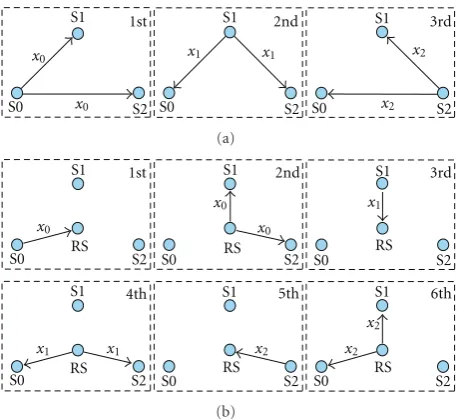
In multi-way communication, if all N nodes are half-duplex and there are direct links between them, the required number of communication phases in order for each node to obtain the information from all other nodes isN, as depicted in Figure 1(a) for the case of N = 3, namely, nodes S0,
Figure1: Multi-way communication: (a) with direct link; (b) with the assistance of a relay station using the one-way relaying protocol.
S1 and S2. Assuming that there are no direct links between the nodes, and that they communicate only through the assistance of an RS, if the RS applies the one-way relaying protocol, the required number of phases is 2N, as shown in
Figure 1(b)for the case ofN=3.
Recently, the authors of this paper proposed a multi-way relaying protocol where a half-duplex regenerative RS assists multiple half-duplex nodes to communicate with each other in [30]. A transceive strategy which ensures that the RS is able to transmit with the achievable MAC rate while minimising the transmit power is proposed. The required number of communication phases for the multi-way relaying is onlyN. Different to [30], in this paper, we propose non-regenerative multi-way relaying where the required number of phases is also N. There is only one MAC phase, where all nodes transmit simultaneously to the RS and there are N−1 BC phase, where the RS transmits to the nodes. The RS is equipped with multiple antennas to spatially separate the signals received from and transmitted to all nodes. Our work is a generalisation of the non-regenerative two-way relaying; that is, if N = 2, we have the non-regenerative two-way relaying case.
It is assumed in this paper that perfect channel state information (CSI) is available, such that the multi-antenna RS can perform transceive beamforming. We first derive the achievable sum rate and then address the optimum transceive beamforming maximising the sum rate of non-regenerative multi-way relaying. Because the optimisation problem is nonconvex, it is too complex to find the optimum solution. Therefore, we propose suboptimum but practical signal processing schemes at the RS, namely, subopti-mum Spatial Multiplexing Transceive Beamforming (SMTB) schemes for multiplexing transmission and suboptimum Analog Network Coding Transceive Beamforming (ANCTB) schemes, which are specially designed for analog network coded transmission. Three suboptimum SMTB algorithms are designed, namely, Zero Forcing (ZF), Minimum Mean Square Error (MMSE) and Maximisation of Signal to Noise Ratio (MSNR). Two suboptimum ANCTB algorithms are designed, namely, Matched Filter (MF) and semidefinite relaxation (SDR), which is based on the semidefinite relax-ation of maximising the minimum signal to noise ratio pro-blem. The performances of these schemes are analysed and compared.
This paper is organised as follows.Section 2explains the protocol and the transmission methods. The system model is provided in Section 3. Section 4 explains the achievable sum rate. Section 5 describes the transceive beamforming.
Section 6provides the performance analysis.Section 7 con-cludes the work.
Notations. Boldface lower- and upper-case letters denote vectors and matrices, respectively, while normal letters denote scalar values. The superscripts (·)T, (·)∗, and (·)H stand for matrix or vector transpose, complex conjugate, and complex conjugate transpose, respectively. The operators modN(x), E{X}and tr{X}denote the moduloN ofx, the expectation and the trace ofX, respectively, andCN(0,σ2)
denotes the circularly symmetric zero-mean complex normal distribution with varianceσ2.
2. Protocol and Transmission Methods
In this section, the communication protocol and the trans-mission methods for N-phase non-regenerative multi-way relaying are described. We first explain the protocol for multiplexing transmission followed by the explanation of the protocol for analog network coded transmission.
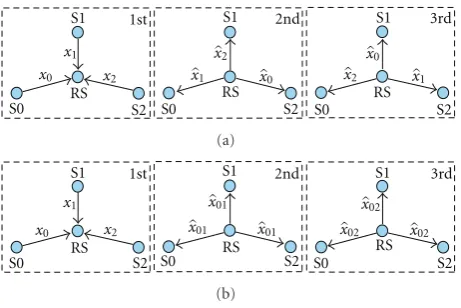
2.1. Multiplexing Transmission. InN-phase non-regenerative multi-way relaying with multiplexing transmission, in the first phase, the MAC phase, allN nodes transmit simulta-neously to the RS. The followingN−1 phases are the BC phases where the RS transmits to all nodes simultaneously. Using multiplexing transmission, in each BC phase, the RS transmits N data streams simultaneously to all nodes, one data stream for each node. For that purpose, the RS separates the received data stream spatially and in each BC phase transmits to each node one data stream from one of the other N−1 nodes. In each BC phase, each node receives a different
Figure2: Multi-way relaying: (a) multiplexing transmission; (b) analog network coded transmission.
data stream from a different node, in such a way that after N−1 BC phases, each node receives theN−1 data streams from the otherN−1 nodes.
Figure 2(a) shows an example when three nodes com-municate with each other with the help of an RS. In the first phase, S0 sends x0, S1 sends x1 and S2 sends x2 simultaneously to the RS. The RS performs transceive
beamforming to spatially separate the data streams. As a result, xi is obtained as the output of the transceive beamforming at the RS, which is the data stream from node iplus the RS’s noise and depends on the employed transceive beamforming. In the second phase, the RS forwardsx0to S2,
x1 to S0 andx2 to S1. In the third phase, the RS forwards
x0to S1,x1to S2 andx2to S0. After completing these three
communication phases, each node receives the data streams from all other nodes.
2.2. Analog Network Coded Transmission. As for multiplexing transmission,N-phase non-regenerative multi-way relaying with analog network coded transmission also consists of one MAC phase and N −1 BC phases. However, instead of spatially separating each data stream received from and transmitted to the nodes, using analog network coded transmission, in each BC phase the RS superposes two data streams out of theNdata streams. The two data streams to be superposed are changed in each BC phase, in such a way that afterN−1 BC phases, each node receivesN−1 superposed data streams which contain the N−1 data streams from the other N−1 nodes. In each BC phase, the superposed data stream is then transmitted simultaneously to the nodes. Therefore, there is no interstream interference as in the case of multiplexing transmission. Consequently, each node has to perform interference cancellation.
Figure 2(b)shows an example of non-regenerative multi-way relaying with analog network coded transmission for the case of N = 3. In the first phase, all nodes transmit simultaneously to the RS, S0 sendsx0, S1 sends x1 and S2
sendsx2. In the second phase, the RS sendsx01to all nodes.
The transmitted data streamx01is a superposition of the data
S1 perform self-interference cancellation, so that S0 obtains x1 and S1 obtains x0. Node S2 cannot yet perform
self-interference cancellation, sincex01does not contain its data
stream. In the third phase, the RS transmitsx02to all nodes.
Both nodes S0 and S2 perform self-interference cancellation so that S0 obtains x2 and S2 obtains x0. Since S1 knows x0 from the second phase, it performs known-interference
cancellation to obtainx2 in the third phase. For S2, since it
knowsx0from the third phase, it obtainsx1by performing
known-interference cancellation to the received data stream
x01 in the second phase. Thus, S2 needs to wait until it
receives the data stream containing its own data stream. After performing self-interference cancellation, it performs known-interference cancellation to obtain the other data stream. After three phases, all nodes obtain the data streams from all other nodes.
Non-regenerative multi-way relaying with analog net-work coded transmission is a cooperation between the RS and the nodes to manage the interference in the network. Since the nodes can perform the self- and known-interference cancellations, the RS does not need to suppress interference signals which can be canceled at the nodes. Thus, there is no unnecessary loss of degrees of freedom at the RS to cancel those interference signals. Hence, it can be expected that there is a performance improvement when using analog network coded transmission compared to multiplexing transmission.
3. System Model
In this section, the system model of non-regenerative multi-way relaying is described. There areNsingle-antenna nodes which want to communicate with each other through a multi-antenna RS withM antenna elements. It is assumed that perfect CSI is available so that the RS can employ transceive beamforming. Although in this paper we only consider single-antenna nodes, our work can be readily extended to the case of multi-antenna nodes. We first describe the overall system model for non-regenerative multi-way relaying. Afterwards, we explain the specific parameters required for each of the two transmission meth-ods: multiplexing transmission and analog network coded transmission.
In the following, let H ∈ CM×N = [h
0,. . .,hN−1]
denote the overall channel matrix, with hi ∈ CM×1 =
(hi,1,. . .,hi,M)T,i∈I,I= {0,. . .,N−1}, being the channel
vector between nodeiand the RS. The channel coefficient
hi,m,m ∈ M,M = {1,. . .,M}, follows CN(0,σh2). The
vectorx ∈CN×1denotes the vector of (x
0,. . .,xN−1)T, with
xibeing the signal of node iwhich followsCN(0,σx2). The
additive white Gaussian noise (AWGN) vector at the RS is denoted as zRS ∈ CM×1 = (zRS1,. . .,zRSM)T, where zRSm
followsCN(0,σ2
zRS). It is assumed that all nodes have fixed and equal transmit power.
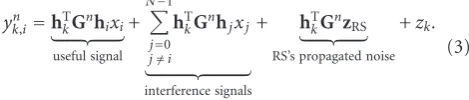
In non-regenerative multi-way relaying, in the first phase, the MAC phase, all nodes transmit simultaneously to the RS. The received signal at the RS is given by
rRS=Hx+zRS. (1)
The non-regenerative RS performs transceive beamforming to the received signals and transmits to the nodes simulta-neously. We assume that in each BC phase the RS transmits with powerqRS. Assuming reciprocal and stationary channels
in theN phases, the downlink channel from the RS to the nodes is simply the transpose of the uplink channelH.
LetGn,n ∈N,N = {2,. . .,N}, denote then-th phase
transceive beamforming matrix. The received signal vector of all nodes in then-th BC phase can be written as
ynnodes=HTGn(Hx+z
RS) +znodes, (2)
whereznodes=(z0,. . .,zN−1)Twithzkbeing the AWGN at a
receiving nodekwhich followsCN(0,σ2
zk). Accordingly, the received signal at nodekwhile receiving the data stream from nodeiin then-th BC phase is given by
yn
k,i=hTkGnhixi useful signal
+
N−1
j=0
j /=i
hTkGnhjxj
interference signals
+ h TkGnzRS
RS’s propagated noise
+zk.
(3)
In this paper, we propose multiplexing transmission and analog network coded transmission for non-regenerative multi-way relaying. In the following, we define the relation-ship of the BC phase index n,n ∈ N, the receiver index k,k∈Iand the transmitter indexi,i∈I, whose data stream shall be decoded in then-th BC phase by the receiving node kfor both transmissions.
Multiplexing Transmission. If the RS is using multiplexing transmission, the relationship is defined by
i=modN(k+n−1), (4)
Figure 2(a)shows the example of multiplexing transmission for three nodes.
Analog Network Coded Transmission. If the RS is applying analog network coded transmission, in each BC phase, each node needs to know which data streams from which two nodes have been superposed by the RS. This might increase the signaling in the network. Thus, assuming that each node knows its own and its partners’ indices, we propose a method for choosing data streams to be network coded by the RS which does not need any signaling. We choose the data stream from the lowest index node Sv,v=0, and superpose this data stream with one data stream from another node Sw,w ∈ I\ {0}, which is selected successively based on the relationship defined byw =n−1,n ∈N. In then-th phase, the RS sends x0w to all nodes simultaneously. Node
Sk,k=0, receives the data stream from node Si,i=w, and it simply performs self-interference cancellation to obtainxw. The same applies to node Sk,k = w, it simply performs self-interference cancellation to obtainx0. Node S0 needs to
their data stream to obtain x0 and, after knowing x0, they
perform known-interference cancellation by canceling x0
from each of the received data streams that are received in the other BC phases. Therefore, the relationship can be written as
i=
Figure 2(b) shows the example of analog network coded transmission for 3 nodes.
Even thoughx0is transmittedN−1 times to the nodes, it
does not increase the information rate ofx0at the otherN−1
nodes. Oncex0is decoded and known by the nodes, there is
no uncertainty ofx0in the other data streams.
The general rule for the superposition of two data streams in each BC phase is that we have to ensure that the data stream from each node has to be superposed at least once. ForN = 3, assuming reciprocal and stationary channel in theNphases, there are three options which fulfill the general rule. The first one is as explained above, namely,
x01 andx02. The other two options are by superposingx01
and x12 or by superposing x12 and x02. For each of the
possible superposition options, exchanging the superposed data streams to be transmitted in the BC phases will result in the same performance due to the assumption of the stationarity of the channel. The higher the N, the more options for superposing the data streams which fulfill the general rule.
4. Achievable Sum Rate
In this section, we explain the achievable sum rate of non-regenerative multi-way relaying. We define the achievable sum rate in the network as the sum of all the rates received at all the nodes. We begin this section with the definition of the Signal to Interference and Noise Ratio (SINR), which is needed to determine the achievable sum rate of non-regenerative multi-way relaying. Afterwards, the achievable sum rate expressions for two different cases, namely, asymmetric and symmetric traffic cases, are given.
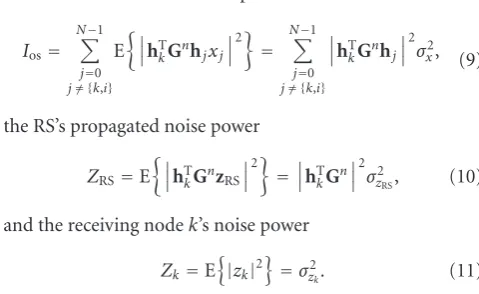
4.1. Signal to Interference and Noise Ratio. In this section, we derive the SINR, first for multiplexing transmission and then for analog network coded transmission. For multiplexing transmission, given the received signal in (3), the SINR for the link between receive node Sk and transmit node Si is given by
γn
muxk,i=
S
Is+Ios+ZRS+Zk, (6)
with the useful signal power
S=EhTkGnhixi
the other-stream interference power
Ios=
the RS’s propagated noise power
ZRS=E
and the receiving nodek’s noise power
Zk=E|zk|2=σ2
zk. (11)
In then-th BC phase, nodekmay perform interference cancellation. It subtracts the a priori known self-interference as well as other-stream interference known from the previous BC phases. Once the nodes have decoded other nodes’ data streams in the previous BC phases, they may use them to perform known-interference cancellation in a similar fashion to self-interference cancellation. With interference cancellation, the SINRγnk,ifor multiplexing transmission can be rewritten as
is the interference power without self-interference and other-stream interference that have been decoded in the previous BC phases, withB = {b | b =modN(k+o−1), ∀o,o =
{2,. . .,n−1}}, the set of the nodes whose data streams have
been decoded in the previous BC phases.
When the RS is using analog network coded transmis-sion, the SINR is given by
γn
ANCk,i=
S
Isok+ZRS+Zk, (14)
whereIsokis the interference at a receiving nodekwhich can
be either self-interference or known interference.
In each BC phase, the RS transmits xvw which is a superposition of the data streams from nodes Sv and Sw. Both nodes Sv and Sw need to perform self-interference cancellation. In this case, the receiving node Sk,k = v, receives from node Si,i=w, and the receiving node Sk,k= w, receives from node Si,i=v. Other nodes which knowxv
from the previous BC phase can apply known-interference cancellation to obtain xw. In this case, the receiving node Sk,k /=v,k /=w, receives the data stream from node Si,i=w. Therefore,Isokis either a self-interference power from (8) or
a known-interference power given by
SinceIsokcan and should be canceled at each node, the SINR
γn
k,i for analog network coded transmission with self- and
known-interference cancellation is given by
γn
k,i= S
ZRS+Zk.
(16)
4.2. Sum Rate for Asymmetric Traffic. Given the SINRγkn,ias inSection 4.1, the information rate when nodekreceives the data stream from nodeiis given by
Rk,i=log2
1 +γnk,i. (17)
Since all nodes transmit only once, each transmitting nodei needs to ensure that its data stream can be decoded correctly by the otherN−1 receiving nodesk,k∈I\ {i}. Thus, the information rate transmitted from nodeiis defined by the weakest link between node iand all otherN−1 receiving nodesk,k∈I\ {i}, which can be written as
Ri= min
k∈I\{i}Rk,i. (18)
Finally, the achievable sum rate of non-regenerative multi-way relaying is given by
SRasym=
1
N(N−1)
N−1
i=0
Ri. (19)
The factor N −1 is due to the fact that there are N −1 receiving nodes which receive the same data stream from a certain transmitting nodei. The scaling factor 1/N is due to Nchannel uses for the overallNcommunication phases.
One note regarding the achievable sum rate with analog network coded transmission is that, by having (18) for transmitting node Si,i=v, we ensure that node Svtransmits xv with the rate that can be decoded correctly by all other N−1 nodes. Thus, having decodedxvcorrectly, all otherN−1 nodes can use it to perform known-interference cancellation in a similar fashion to their self-interference cancellation.
4.3. Sum Rate for Symmetric Traffic. In certain scenarios, there might be a requirement to have a symmetric traffic between all nodes. All nodes communicate with the same data rate defined by the minimum of Ri, i ∈ I. The achievable sum rate becomes
SRsymm=
1
N(N−1)N
min
i∈I Ri
. (20)
5. Transceive Beamforming
In this section, the transceive beamforming employed at the RS is explained. It is assumed that the number of antennas at the RS is higher than or equal to the number of nodes, that is, M≥N, since we will derive low complexity linear transceive beamforming algorithms to be employed at RS. In the first subsection, we explain the optimum transceive beamforming maximising the sum rate of non-regenerative multi-way relaying. The following two subsections explain suboptimum but practical transceive beamforming algorithms for both multiplexing and analog network coded transmission.
5.1. Sum Rate Maximisation. In this subsection, the opti-mum transceive beamforming maximising the sum rate of non-regenerative multi-way relaying for asymmetric traffic is addressed. It is valid for both multiplexing and analog network coded transmissions. Asymmetric traffic is consid-ered since it provides higher sum rate than that symmetric traffic. The optimisation problem for finding the optimum transceive beamforming maximising the sum rate of non-regenerative multi-way relaying for asymmetric traffic can be written as
max
Gn
i
k
Rk,i
s.t. trGnHRxHH+RzRS
GnH=qRS,
(21)
where RzRS = E{zRSz
H
RS} is the covariance matrix of the
RS’s noise, Rx = E{xxH} is the covariance matrix of the
transmitted signal andqRSis the transmit power of the RS.
In this paper, we assume that the transmit power at all nodes is equal and fixed. In order to improve the sum rate, we can have the transmit power at the nodes as variables to be optimised subject to power constraint at each node. However, since there is only one MAC phase, we have to find the optimum transmit power at each node and, simultaneously, the transceive beamforming for all BC phase, Gn,∀n ∈ N. This joint optimisation problem will further increase the computational effort.
The optimisation problem in (21) is nonconvex and it can be awkward and too complex to solve. Thus, in the following subsections we propose suboptimum but practical transceive beamforming algorithms for both multiplexing transmission and analog network coded transmission.
5.2. Suboptimum Spatial Multiplexing Transceive Beamform-ing. In this subsection, we explain the design of subopti-mum Spatial Multiplexing Transceive Beamforming (SMTB) algorithms for multiplexing transmission. We decompose then-th BC phase transceive beamformingGninto receive beamforming GRc, permutation matrix Πn and transmit
beamformingGTx; that is,Gn=GTxΠnGRc.
The receive beamforming is only needed to be computed once and can be used for all BC phases’ transceive beam-forming since there is only one MAC phase. In this paper, we assume reciprocal and stationary channels within theN phases. Therefore, the transmit beamforming should also be computed only once and can be used for all BC phases’ transmission. Nevertheless, the transceive beamforming in each BC phase should be different from one BC phase to another, since the RS has to send different data streams to an intended node. In order to define which data stream should be transmitted by the RS to which node in then-th BC phase, a permutation matrix is used.
for Figure 2(a), the permutation matrices Π2 =
. Regarding the receive and transmit beamforming, in this paper, we consider three different algorithms, namely ZF, MMSE and MSNR. Receive and transmit beamforming algorithms with those criteria have been derived in [8, 19] for the case of two-way relaying. The optimisation problem with those criteria for multi-way relaying can be written as in [8,19]. Therefore, in this paper, we use the solution for receive and transmit beamforming from [8,19] and extend them to suit non-regenerative multi-way relaying by using the permutation matrix as explained above. In the following, we explain the receive and transmit beamforming for the three SMTB algorithms.
5.2.1. Zero Forcing. For multi-way relaying, the minimi-sation of mean square error subject to the zero forcing constraint can be written as
min solution of such a problem is derived.
Using the result from [8,19], the ZF receive beamforming for multi-way relaying is given by
GRc=
HHR−zRS1H
−1
HHR−zRS1 (23)
and the ZF transmit beamforming is given by
GTx=
5.2.2. Minimum Mean Square Error. For multi-way relaying, the minimisation of mean square error can be written as
min for the case of one-way and two-way relaying. Using the result from [8, 19], the MMSE receive beamforming for multi-way relaying is given by
GRc=RxHHΥ−Rc1, (28)
and the MMSE transmit beamforming is given by
GTx=
nodes}is the covariance matrix of the
noise vector of all nodes.
5.2.3. Maximisation of Signal to Noise Ratio. For multi-way relaying, the maximisation of the signal to noise ratio can be written as
The same optimisation problem for two-way relaying can be found in [8].
Using the result from [8], the MSNR receive beamform-ing for multi-way relaybeamform-ing is given by
GRc=RxHHΥ−Rc1, (33)
and the MSNR transmit beamforming is given by
GTx=
proposed beamforming-based PLNC to the PLNC proposed for two-way relaying in [6,31].
Then-th BC phase transceive beamforming of ANCTB is decoupled into receive and transmit beamforming. The receive beamforming of ANCTB is basically performing the PLNC by separating two data streams xv and xw from the other data streams and superposing them. The receive beamforming is designed based on the ZF Block Diagonalization (ZFBD), which has been proposed in [32] for downlink spatial multiplexing transmit beamforming. Firstly, we use ZFBD to compute the equivalent channel of the two nodes whose data streams will be superposed by the RS. Secondly, we compute the receive beamforming based on the equivalent channel. The superposed data stream needs to be transmitted simultaneously toNnodes. Therefore, we design the transmit beamforming for ANCTB in the same way as designing single-group multicast beamforming. Since we consider reciprocal and stationary channel, the multicast transmit beamforming needs only to be computed once. In the following, we explain the equivalent channel to be used for computing the receive beamforming. Afterwards, the two subsections explain the ANCTB algorithms, that is, Matched Filter and Semidefinite Relaxation, respectively.
Equivalent Channel for Receive Beamforming. In the n-th phase, letHT
vwn ∈ C2×M andHvwT n ∈ C(N−2)×M denote the channel matrix of two nodes Sv and Sw and the channel matrix of the other N −2 nodes, respectively. Given the singular value decomposition
HvwT n =UnSnV(1)n,V(0)n, (36)
we compute the equivalent channel matrix of the two nodes Sv and Sw,H(eq)n ∈ C2×(N−r) = HT
vwnV(0) n
, which assures that the interference signals from the otherN−2 nodes are suppressed. The matrixV(0)n ∈CM×(N−r)contains the right
singular vectors ofHT
vwn, withrdenoting the rank of matrix
HT
vwn.
5.3.1. Matched Filter. Having the equivalent channel for the two data streams to be superposed, for Matched Filter (MF), we first perform a receive matched filtering to improve the received signal level. Afterwards, we superpose both data streams by simply adding both matched filtered signals which can be expressed by multiplying the matched filtered signals with a vector of ones. Thus, the MF receive beamforming can be written as
mnRc=H(eq)nH1
2 (37)
with12=[1, 1]T.
In order to transmit to all nodes, we need single-group multicast beamforming. Low complexity transmit beamforming algorithms for single-group multicast are treated in [33]. It is shown in [33] that the MF outperforms other linear single-group multicast transmit beamforming,
for example, ZF and MMSE. Therefore, we consider the MF for the transmit beamforming given by
mTx=H∗1N. (38)
5.3.2. Semidefinite Relaxation. Since in multi-way relaying all nodes want to communicate with each other, we propose a fair transceive beamforming, Semidefinite Relaxation (SDR). The receive beamforming of SDR tries to balance the signal to noise ratios (SNRs) between the two nodes whose data streams are going to be superposed. Therefore, we need to maximise the minimum SNR between the two nodes based on the equivalent channel. This optimisation problem can be written as
which leads to a fair receive beamforming withh(eq)i n being the equivalent channel of node Si whose data stream is going to be superposed. Such an optimisation problem is proved to be NP-hard in [34]. Nonetheless, such noncon-vex quadratically constrained quadratic program can be approximately solved using SDR techniques. Some works have used SDR techniques for approximately solving max-min SNR problems, for example, [34] for single-group multicast and [35] for multigroup multicast, where [34] is a special case of [35] when the number of groups is one. As in [34], we rewrite the problem into a semidefinite program and make a relaxation by dropping the rank-one constraint. As a consequence, the solution might be higher rank [34]. However, good approximate solutions can be obtained using randomisation techniques as in [34]. Bounds on the approximation error of the SDR techniques have been developed in [36], which was motivated by the work in [34]. HavingX=mnRcHmnRcandQi=h(eq)i nh(eq)i nH/σ2
zRS, and using semidefinite relaxation, we can rewrite (39) into
max
X i∈{minv,w}tr{(XQi)}
s.t tr{X} =1,
X0.
(40)
After introducing slack variables and rewriting (40) as in [34], we find the approximate solution of (39) using SeDuMi [37].
For SDR transmit beamforming, we consider a fair trans-mit beamforming which solves the optimisation problem of maximising the minimum SNR of
Similar to (39), (41) can be approximately solved with semidefinite relaxation techniques using a solver such as SeDuMi [37].
As mentioned before, the n-th BC phase ANCTB is decoupled into receive beamforming and transmit beam-forming. The ANCTB receive beamforming matrix in then -th phase is given by
GnRc=
V(0)nmnRc
T
, (42)
and the ANCTB transmit beamforming in then-th phase is given by
GTx=[mTx]Γ1/2 (43)
with the power loading matrixΓ∈R+given by
Γ=mean|HTm Tx|
−1
, (44)
where the modulus operator| · |is assumed to be applied element wise and the mean function returns the mean of a vector. In order to satisfy the transmit power constraint at the RS, a normalisation factorβ∈R+is needed with
β=
qRS
trGTxGnRc
HRxHH+RzRS
GnRcHGHTx
. (45)
Finally, the ANCTB is given by
Gn=βGTxGnRc. (46)
6. Performance Analysis
In this section, we analyse the sum rate performance of non-regenerative multi-way relaying in a scenario where N =
3 single-antenna nodes communicate to each other with the help of a non-regenerative RS with M = 3 antenna elements. We setqRS = 1,σz2RS = σ
2
zk = 1, for allk,k ∈ I andσ2
x = 1.We use an i.i.d. Rayleigh channel and set the
SNR equal to the channel gain. We assume reciprocal and stationary channels within N communication phases. We start by analysing the case of multiplexing transmission with SMTB for the symmetric and asymmetric traffic cases. We then compare the analog network coded transmission with multiplexing transmission for the case of asymmetric traffic.
Figure 3shows the sum rate performance for the sym-metric traffic case of multiplexing transmission with SMTB as a function of SNR in dB. MMSE outperforms ZF and MSNR as expected. However, to compute the transmit beamforming, MMSE needs the information of the noise variance at the nodes which increases the signaling effort in the network. In the high-SNR region, ZF converges to MMSE, while, in the low-SNR region, MSNR converges to MMSE. If the RS applies ZF transceive beamforming, there is no performance improvement even if the nodes apply interference cancellation. This is due to the fact that the interference has been canceled already at the RS. MMSE is able to obtain a slight performance improvement if interference cancellation is applied at the nodes. The highest
0 5 10 15 20 25 30
0 2 4 6 8 10 12 14
Without interference cancellation With interference cancellation
ZF MMSE
MSNR
SNR (dB)
A
ver
age
sum
ra
te
(b/s/Hz)
Figure3: Sum rate performance of three-way relaying for multi-plexing transmission with SMTB and symmetric traffic.
0 5 10 15 20 25 30
0 2 4 6 8 10 12 14
Without interference cancellation With interference cancellation
ZF Approximate maximum sum rate
MSNR MMSE
SNR (dB)
A
ver
age
sum
ra
te
(b/s/Hz)
Figure4: Sum rate performance of three-way relaying for multi-plexing transmission with SMTB and asymmetric traffic.
performance improvement due to interference cancellation at the nodes is obtained when the RS uses MSNR. MSNR does not manage the interference, thus, if the nodes are able to perform interference cancellation, the performance is significantly improved.
0 5 10 15 20 25 30 0
2 4 6 8 10 12 14
ANCTB: SDR opt ANCTB: SDR ANCTB: MF opt
ANCTB: MF SMTB: MMSE SMTB: ZF SNR (dB)
A
ver
age
sum
ra
te
(b/s/Hz)
Figure 5: Sum rate performance of three-way relaying with asymmetric traffic: SMTB versus ANCTB.
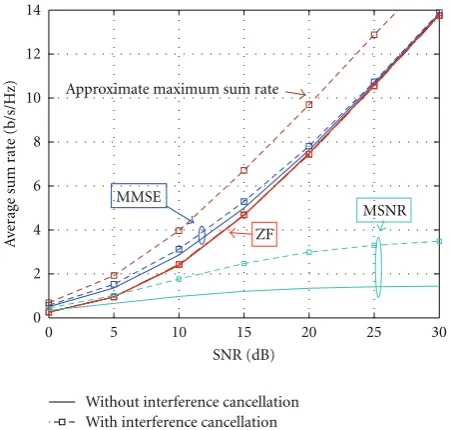
MMSE performs the best and ZF converges to MMSE in the high-SNR region and MSNR converges to MMSE in the low-SNR region. The performance gain for both MMSE and MSNR when the nodes apply interference cancellation is higher than in symmetric traffic case. Furthermore, a curve termed approximate maximum sum rate is shown in Figure 4. For that curve, the maximisation of the sum rate in (21) is solved numerically using fmincon from MATLAB to provide an approximated maximum sum rate of multiplexing transmission. Since the problem in (21) is nonconvex, fmincon only guarantees a locally optimum solution. Moreover, the solution depends on the chosen starting point. In this paper, we use the values of MMSE transceive beamforming as the starting point. As can be seen, there is a gap between the approximated maximum sum rate and the suboptimum transceive beamforming algorithms. Despite the performance gap, the suboptimum transceive beamforming algorithms are easier to be implemented, and thus, are practically interesting.
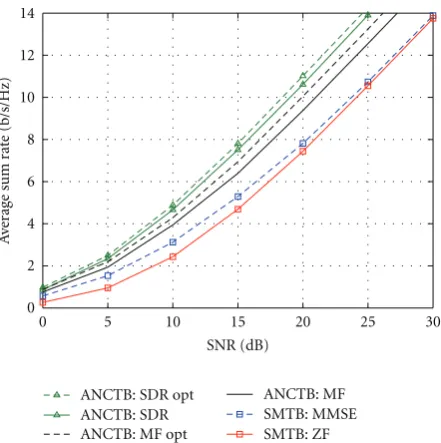
Figure 5 shows the sum rate performance comparison of multiplexing transmission and analog network coded transmission for the asymmetric traffic case. It can be seen that the analog network coded transmission with ANCTB outperforms multiplexing transmission with SMTB, which shows the benefit of beamforming-based PLNC for non-regenerative multi-way relaying. The ANCTB SDR outper-forms ANCTB MF with the penalty of having higher compu-tational complexity to find the solution of the optimisation problem. Moreover, ANCTB SDR needs feedback channels to obtain the information of the noise variance of the nodes to compute the transmit beamforming.
In this paper, we propose a method to superpose two data streams out of N data streams which does not need any signaling in the network. The corresponding curves are
indicated by ANCTB: MF and ANCTB: SDR. InSection 3, we addressed the general rule for the superposition of the two data streams for analog network coded transmission. We also provided the possible superposition options for N =3. InFigure 5, we provide the curves ANCTB: MF opt and ANCTB: SDR opt, where the RS searches the optimum superposition among all possible options. It can be seen that, in the case of N = 3, the performance of the proposed suboptimum superposition method is not far away from the optimum one, especially in the case of fair transceive beamforming ANCTB-SDR and/or in the low-SNR region. Therefore, the suboptimum method offers a good trade off between the performance and the required signaling in the network.
In this paper, we assume that M ≥ N and an i.i.d. channel, and, therefore, the proposed suboptimum algo-rithms works well. IfM < Nand/or when there are channel correlations, one can expect a performance degradation. We also assume that perfect CSI is available so that the RS is able to perform transceive beamforming. However, in order to obtain the CSI, there are additional resources needed for the RS and the nodes to estimate the channels. It is still an open issue on how to obtain the CSI at the RS and at all the nodes for non-regenerative multi-way relaying. One approach that can be used is to extend the channel estimation methods for non-regenerative two-way relaying in [38,39].
7. Conclusion
In this paper, we propose non-regenerative multi-way relaying where a multi-antenna non-regenerative RS assists N nodes to communicate to each other. The number of communication phases is equal to the number of nodes, N. Two transmission methods are proposed to be applied at the RS, namely, multiplexing transmission and analog network coded transmission. Optimum transceive beamforming maximising the sum rate is addressed. Due to the nonconvexity of the optimisation problem, sub-optimum but practical transceive beamforming are pro-posed, namely, ZF, MMSE, and MSNR for multiplex-ing transmission, and MF and SDR for analog network coded transmission. It is shown that analog network coded transmission with ANCTB outperforms multiplex-ing transmission with SMTB, which shows the benefit of beamforming-based PLNC for non-regenerative multi-way relaying.
Acknowledgments
References
[1] C. E. Shannon, “Two-way communication channels,” in
Proceedings of the 4th Berkeley Symposium on Mathematical Statistics and Probability, vol. 1, pp. 611–644, 1961.
[2] B. Rankov and A. Wittneben, “Spectral efficient protocols for half-duplex fading relay channels,”IEEE Journal on Selected Areas in Communications, vol. 25, no. 2, pp. 379–389, 2007. [3] S. Katti, S. Gollakota, and D. Katabi, “Embracing wireless
interference: analog network coding,” in Proceedings of the ACM Special Interest Group on Data Communication (SIG-COMM ’07), pp. 397–408, Kyoto, Japan, 2007.
[4] P. Popovski and H. Yomo, “Wireless network coding by amplify-and-forward for bi-directional traffic flows,” IEEE Communications Letters, vol. 11, no. 1, pp. 16–18, 2007. [5] P. Popovski and H. Yomo, “The anti-packets can increase the
achievable throughput of a wireless multi-hop network,” in
Proceedings of the IEEE International Conference on Commu-nications, vol. 9, pp. 3885–3890, Istanbul, Turkey, 2006. [6] S. Zhang, S. C. Liew, and P. P. Lam, “Physical-layer network
coding,” in Proceedings of the 12th Annual International Conference on Mobile Computing and Networking (MOBI-COM ’06), pp. 358–365, Los Angeles, Calif, USA, September 2006.
[7] T. Oechtering, Spectrally efficient bidirectional decode-and-forward relaying for wireless networks, Ph.D. dissertation, TU Berlin, Berlin, Germany, 2007.
[8] T. Unger, Multi-antenna two-hop relaying for bi-directional transmission in wireless communication systems, Ph.D. disser-tation, TU Darmstadt, Darmstadt, Germany, 2009.
[9] S. Katti, H. Rahul, W. Hu, D. Katabi, M. Medard, and J. Crowcroft, “XORs in the air: practical wireless network coding,”IEEE/ACM Transactions on Networking, vol. 16, no. 3, pp. 497–510, 2008.
[10] Y. Wu, P. A. Chou, and S.-Y. Kung, “Information exchange in wireless networks with network coding and physical-layer broadcast,” Tech. Rep. MSR-TR-2004-78, Microsoft, 2004.
[11] P. Larsson, N. Johansson, and K.-E. Sunell, “Coded bi-directional relaying,” inProceedings of the 5th Scandinavian Workshop on Ad Hoc Networks, Stockholm, Sweden, May 2005. [12] R. Ahlswede, N. Cai, S.-Y. R. Li, and R. W. Yeung, “Network information flow,”IEEE Transactions on Information Theory, vol. 46, no. 4, pp. 1204–1216, 2000.
[13] S. Simoens, J. Vidal, and O. Mu˜noz, “Compress-and-forward cooperative relaying in MIMO-OFDM systems,” in Proceed-ings of the IEEE Workshop on Signal Processing Advances in Wireless Communications (SPAWC ’06), pp. 1–5, Cannes, France, 2006.
[14] E. Biglieri, R. Calderbank, A. Constantinides, A. Goldsmith, and H. V. Poor,MIMO Wireless Communication, Cambridge University Press, Cambridge, UK, 2007.
[15] D. Tse and P. Viswanath,Fundamentals of Wireless Communi-cation, Cambridge University Press, Cambridge, UK, 2005. [16] I. Hammerstr¨om, M. Kuhn, C. Es¸li, J. Zhao, A. Wittneben, and
G. Bauch, “MIMO two-way relaying with transmit CSI at the relay,” inProceedings of the IEEE Workshop on Signal Processing Advances in Wireless Communications (SPAWC ’07), pp. 1–5, Helsinki, Finland, June 2007.
[17] T. J. Oechtering, R. F. Wyrembelski, and H. Boche, “Multi-antenna bidirectional broadcast channels—optimal transmit strategies,”IEEE Transactions on Signal Processing, vol. 57, no. 5, pp. 1948–1958, 2009.
[18] T. J. Oechtering, E. A. Jorswieck, R. F. Wyrembelski, and H. Boche, “On the optimal transmit strategy for the MIMO bidirectional broadcast channel,”IEEE Transactions on Com-munications, vol. 57, no. 12, pp. 3817–3826, 2009.
[19] T. Unger and A. Klein, “Duplex schemes in multiple antenna two-hop relaying,” EURASIP Journal on Advances in Signal Processing, vol. 2008, Article ID 128592, 14 pages, 2008. [20] Y.-C. Liang and R. Zhang, “Optimal analogue relaying with
multiantennas for physical layer network coding,” in Proceed-ings of the IEEE International Conference on Communications (ICC ’08), pp. 3893–3897, Beijing, China, 2008.
[21] M. Chen and A. Yener, “Multiuser two-way relaying for interference limited systems,” in Proceedings of the IEEE International Conference on Communications (ICC ’08), pp. 3883–3887, Beijing, China, May 2008.
[22] C. Es¸li and A. Wittneben, “One-and two-way decode-and-forward relaying for wireless multiuser MIMO networks,” in
Proceedings of the IEEE Global Telecommunications Conference (GLOBECOM ’08), pp. 1–6, New Orleans, La, USA, December 2008.
[23] A. U. T. Amah, A. Klein, Y. C. B. Silva, and A. Fernekeß, “Multigroup multicast beamforming for multiuser two-way relaying,” inProceedings of the International ITG Workshop on Smart Antennas, Berlin, Germany, 2009.
[24] J. Joung and A. H. Sayed, “Multiuser two-way relaying method for beamforming systems,” inProceedings of the IEEE Work-shop on Signal Processing Advances in Wireless Communications (SPAWC ’09), pp. 280–284, Perugia, Italy, 2009.
[25] A. U. T. Amah and A. Klein, “Pair-aware transceive beam-forming for non-regenerative multiuser two-way relaying,” in
Proceedings of the IEEE International Conference on Acoustics, Speech, and Signal Processing, Dallas, Tex, USA, 2010. [26] K. Eswaran and M. Gastpar, “Achievable rates for conferencing
multiway channels,” inProceedings of the IEEE International Symposium on Information Theory (ISIT ’08), pp. 1398–1402, Toronto, Canada, 2008.
[27] E. C. van der Meulen, “Survey of multi-way channels in information theory,”IEEE Transactions on Information Theory, vol. 23, no. 1, pp. 1–37, 1977.
[28] D. G¨und¨uz, A. Yener, A. Goldsmith, and H. V. Poor, “The multi-way relay channel,” inProceedings of the IEEE Interna-tional Symposium on Information Theory (ISIT ’09), pp. 339– 343, Seoul, korea, July 2009.
[29] S. Simoens,Cooperative MIMO communications, information theoretical limits and practical coding strategies, Ph.D. disserta-tion, TU Catalonia (UPC), 2009.
[30] A. U. T. Amah and A. Klein, “A transceive strategy for regener-ative multi-antenna multi-way relaying,” inProceedings of the 3rd IEEE International Workshop on Computational Advances in Multi-Sensor Adaptive Processing (CAMSAP ’09), pp. 352– 355, Aruba, The Netherlands, December 2009.
[31] T. Koike-Akino, P. Popovski, and V. Tarokh, “Optimized con-stellations for two-way wireless relaying with physical network coding,”IEEE Journal on Selected Areas in Communications, vol. 27, no. 5, pp. 773–787, 2009.
[32] Q. H. Spencer, A. L. Swindlehurst, and M. Haardt, “Zero-forcing methods for downlink spatial multiplexing in mul-tiuser MIMO channels,”IEEE Transactions on Signal Process-ing, vol. 52, no. 2, pp. 461–471, 2004.
[34] N. D. Sidiropoulos, T. N. Davidson, and Z.-Q. Luo, “Transmit beamforming for physical-layer multicasting,”IEEE Transac-tions on Signal Processing, vol. 54, no. 6, pp. 2239–2251, 2006. [35] E. Karipidis, N. D. Sidiropoulos, and Z.-Q. Luo, “Quality of
service and Max-min fair transmit beamforming to multiple cochannel multicast groups,” IEEE Transactions on Signal Processing, vol. 56, no. 3, pp. 1268–1279, 2008.
[36] Z.-Q. Luo, N. D. Sidiropoulos, P. Tseng, and S. Zhang, “Approximation bounds for quadratic optimization with homogeneous quadratic constraints,”SIAM Journal on Opti-mization, vol. 18, no. 1, pp. 1–28, 2007.
[37] J. F. Sturm, “Using sedumi 1.02, a matlab toolbox for optimisation over symmetric cones,” Optimisation Methods and Software, vol. 11-12, pp. 625–653, 1999.
[38] F. Roemer and M. Haardt, “Tensor-based channel estimation (tence) for two-way relaying with multiple antennas and spa-tial reuse,” inProceedings of the IEEE International Conference on Acoustics, Speech and Signal Processing, pp. 3641–3644, Taipei, Taiwan, April 2009.