doi:10.1155/2009/781579
Research Article
An Exponentially Fitted Method for Singularly
Perturbed Delay Differential Equations
Fevzi Erdogan
Department of Mathematics, Faculty of Sciences, Yuzuncu Yil University, 65080 Van, Turkey
Correspondence should be addressed to Fevzi Erdogan,[email protected]
Received 4 November 2008; Accepted 16 January 2009
Recommended by Istvan Gyori
This paper deals with singularly perturbed initial value problem for linear first-order delay differential equation. An exponentially fitted difference scheme is constructed in an equidistant mesh, which gives first-order uniform convergence in the discrete maximum norm. The difference scheme is shown to be uniformly convergent to the continuous solution with respect to the perturbation parameter. A numerical example is solved using the presented method and compared the computed result with exact solution of the problem.
Copyrightq2009 Fevzi Erdogan. This is an open access article distributed under the Creative Commons Attribution License, which permits unrestricted use, distribution, and reproduction in any medium, provided the original work is properly cited.
1. Introduction
Delay differential equations play an important role in the mathematical modelling of various practical phenomena in the biosciences and control theory. Any system involving a feedback control will almost always involve time delays. These arise because a finite time is required to sense information and then react to it. A singularly perturbed delay differential equation is an ordinary differential equation in which the highest derivative is multiplied by a small parameter and involving at least one delay term1–4. Such problems arise frequently in the mathematical modelling of various practical phenomena, for example, in the modelling of several physical and biological phenomena like the optically bistable devices5, description of the human pupil-light reflex6, a variety of models for physiological processes or diseases and variational problems in control theory where they provide the best, and in many cases the only realistic simulation of the observed phenomena7.
ways to derive such methods consists of using an exponentially fitted difference schemesee, e.g.,10for motivation for this type of mesh, which are constructed a priori and depend of the parameter ε, the problem data and the number of corresponding mesh points. In the direction of numerical treatment for first-order singularly perturbed delay differential equations, several can be seen in4,7,11.
In order to construct parameter-uniform numerical methods, two different techniques are applied. Firstly, the numerical methods of exponential fitting type fitting operators
see9, which have coefficients of exponential type adapted to the singular perturbation problems. Secondly, the special mesh approach see 11, 12, which constructs meshes adapted to the solution of the problem.
In the works of Amiraliyev and Erdogan11, special meshesShishkin meshhave been used. The method that we propose in this paper uses exponential fitting schemes, which have coefficients of exponential type.
2. Statement of the Problem
Consider a model problem for the initial value problems for singularly perturbed delay differential equations with delay in the intervalI 0,T:
εut atut btut−r ft, t∈I,
ut ϕt, t∈I0,
2.1
whereI 0, T mp1Ip,Ip{t:rp−1 < t≤rp}, 1≤p≤mandrssr, for 0≤s≤mandI0 −r,0 for simplicity we suppose thatT/ris integer. 0< ε≤1 is the perturbation parameter,
at ≥ α > 0,bt,ft, and ϕtare given sufficiently smooth functions satisfying certain
regularity conditions to be specified andris a constant delay. The solutionutdisplays in general boundary layers at the right side of each pointst rs0 ≤ s ≤ mfor small values ofε.
In this paper, we present the completely exponentially fitted difference scheme on the uniform mesh. The difference scheme is constructed by the method of integral identities with the use of exponentially basis functions and interpolating quadrature rules with weight and remainder terms integral form10. This method of approximation has the advantage that the schemes can also be effective in the case when the continuous problem is considered under certain restrictions.
In the present paper, we analyze a fitted difference scheme on a uniform mesh for the numerical solution of the problem 2.1. In Section 2, we describe the problem. In
Section 3, we state some important properties of the exact solution. InSection 4, we construct a numerical scheme for solving the initial value problem2.1 based on an exponentially fitted difference scheme on a uniform mesh. InSection 5, we present the error analysis for approximate solution. Uniform convergence is proved in the discrete maximum norm. A numerical example in comparison with their exact solution is being presented inSection 6. The approach to construct discrete problem and error analysis for approximate solution is similar to those ones from10,11.
3. The Continuous Problem
Here, we show some properties of the solution of2.1, which are needed in later sections for the analysis of appropriate numerical solution. Let, for any continuous function g,g∞,I denotes a continuous maximum norm on the corresponding interval.
Lemma 3.1. Leta, b, f ∈ C1I,ϕ ∈ C1I
0. Then, for the solutionutof the problem2.1the following estimates hold
ut∞,Ip ≤Cp, 1≤p≤m, 3.1
where
C1α−1f∞,I1
1 α−1b
∞,I1
ϕ∞,I0,
Cpα−1f∞,Ip
1 α−1b∞,IpCp−1, p2,3, . . . , m.
3.2
Proof. see11.
4. Discretization and Mesh
In this section, we construct a numerical scheme for solving the initial value problem2.1 based upon an exponential fitting on a uniform mesh.
We denote byωN0the uniform mesh onI:
ωN0
tiiτ, i0,1,2, . . . , N0; τ r
N, pNN0
, 4.1
which containsNmesh points at each subintervalIp1≤p≤m:
ωN,p
ti:p−1N 1≤i≤pN , 1≤p≤m, 4.2
and consequently
ωN0
m
p1
ωN,p. 4.3
To simplify the notation, we set gi gti for any function gt, and moreover yi denotes an approximation ofutatti. For any mesh function{wi}defined onN0,we use
wt,i wi−wi−1
τ ,
w∞,N,pw∞,ωN,p :p−1maxN≤i≤pNwi, 1≤p≤m.
The approach of generating difference methods through integral identity
with the exponential basis functions
ψit exp
We note that functionψitis the solution of the problem
−εψ
The relation4.5is rewritten as
χiτ−1ε
Taking into account4.5and using interpolating rules with the weightsee10, we obtain the following relations:
where
and a simple calculation gives us
θi
As a consequence of the 4.11, we propose the following difference scheme for approximation2.1:
Lyi:εθiyt,i aiyi biyi−Nfi, 1≤i≤N0,
yiϕi, −N≤i≤0,
4.14
whereθiis defined by4.13.
5. Analysis of the Method
To investigate the convergence of the method, note that the error functionziyi−ui, 0≤i≤
N0, is the solution of the discrete problem
εθizt,i aizi bizi−NRi, 1≤i≤N0,
ziϕi, −N≤i≤0.
5.1
whereRiandθiare given by4.10and4.13, respectively.
Lemma 5.1. Letyibe approximate solution of 2.1. Then the following estimate holds
y∞,ωN,p ≤ ϕ∞,ωN,0Qp α−1
Lemma 5.2. Letzibe solution of 5.1. Then following estimate holds
Lemma 5.3. Under the above assumptions ofSection 2andLemma 3.1, for the error functionR, the following estimate holds
R∞,ωN,p≤Cτ, 1≤p≤m. 5.5
Proof. To this end, it suffices to establish that the functionsRik k 1,2,3, involved in the expression forRi, admit the estimate
Rk
∞,ωN,p≤Cτ, k1,2,3. 5.6
Using the mean value theorem, we get
and after replacingsξ−rthis reduces to
R2
∞,ωN,p≤C ti−r
ti−1−r
usdsC0
−r
ϕsds ti ti−1
usds, 5.12
which yields
R2∞,ωN,p ≤Cτϕ1,0 Cp
Oτ. 5.13
The same estimate is obtained forRi3in the similar manner as above.
Combining the previous lemmas we get the following final estimate, that is, uniformly convergent estimate.
Theorem 5.4. Let ube the solution of 2.1 and y be the solution of 4.14. Then the following estimate holds
y−u∞,ωN,p ≤Cτ, 1≤p≤m. 5.14
6. Numerical Results
We begin with an example from Driver2for which we possess the exact solution.
εut ut ut−1, t∈0, T,
ut 1 t, −1≤t≤0. 6.1
The exact solution for 0≤t≤2 is given by
ut
⎧ ⎪ ⎨ ⎪ ⎩
−ε t 1 εe−t/ε, t∈0,1,
−1−2ε t 1 εe−t/ε
ε−1
ε
1 1
ε
t
e1−t/ε, t∈1,2. 6.2
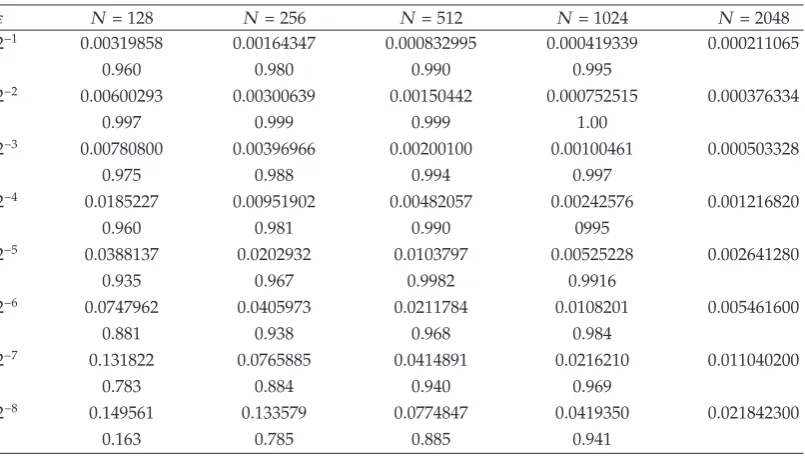
We define the computed parameter-uniform maximum erroreN,pε as follows:
eN,pε y−u∞,ωN,p, p1,2, 6.3
whereyis the numerical approximation toufor various values ofN, ε. We also define the computed parameter-uniform convergence rates for eachN:
rN,plneN,p/e2N,p
ln 2 , p1,2. 6.4
Table 1:Maximum errorseN,ε 1and convergence ratesrN,1onωN,1.
ε N128 N256 N512 N1024 N2048 2−1 0.0033688 0.0016866 0.000843849 0.000422062 0.000211065
0.998 0.999 0.999 0.999
2−2 0.00381473 0.00191236 0.000957428 0.000479026 0.000239591
0.996 0.996 0.998 0.999
2−3 0.00386427 0.00194230 0.000973693 0.000487882 0.000243900
0.992 0.996 0.998 0.999
2−4 0.00382489 0.00193278 0.000971476 0.00048701 0.000243823
0.984 0.992 0.996 0998
2−5 0.00374366 0.00191245 0.000966391 0.000485738 0.000243505
0.969 0.984 0.992 0.996
2−6 0.00358208 0.00187183 0.000956223 0.000433195 0.000242869
0.936 0.969 0.984 0.992
2−7 0.00326581 0.00179104 0.000935915 0.000477811 0.000241598
0.866 0.936 0.969 0.984
2−8 0.00268346 0.0016329 0.00895519 0.00467957 0.000239057
0.716 0.866 0.936 0.969
Table 2:Maximum errorseN,ε 2and convergence ratesrN,2onωN,2.
ε N128 N256 N512 N1024 N2048 2−1 0.00319858 0.00164347 0.000832995 0.000419339 0.000211065
0.960 0.980 0.990 0.995
2−2 0.00600293 0.00300639 0.00150442 0.000752515 0.000376334
0.997 0.999 0.999 1.00
2−3 0.00780800 0.00396966 0.00200100 0.00100461 0.000503328
0.975 0.988 0.994 0.997
2−4 0.0185227 0.00951902 0.00482057 0.00242576 0.001216820
0.960 0.981 0.990 0995
2−5 0.0388137 0.0202932 0.0103797 0.00525228 0.002641280
0.935 0.967 0.9982 0.9916
2−6 0.0747962 0.0405973 0.0211784 0.0108201 0.005461600
0.881 0.938 0.968 0.984
2−7 0.131822 0.0765885 0.0414891 0.0216210 0.011040200
0.783 0.884 0.940 0.969
2−8 0.149561 0.133579 0.0774847 0.0419350 0.021842300
0.163 0.785 0.885 0.941
These convergence rates are increasing asNincreases for any fixedε. Tables1and2
References
1 R. Bellman and K. L. Cooke,Differential-Difference Equations, Academic Press, New York, NY, USA, 1963.
2 R. D. Driver,Ordinary and Delay Differential Equations, vol. 2 ofApplied Mathematical Sciences, Springer, New York, NY, USA, 1977.
3 B. J. McCartin, “Exponential fitting of the delayed recruitment/renewal equation,” Journal of Computational and Applied Mathematics, vol. 136, no. 1-2, pp. 343–356, 2001.
4 H. Tian, “The exponential asymptotic stability of singularly perturbed delay differential equations with a bounded lag,”Journal of Mathematical Analysis and Applications, vol. 270, no. 1, pp. 143–149, 2002.
5 M. W. Derstine, H. M. Gibbs, F. A. Hopf, and D. L. Kaplan, “Bifurcation gap in a hybrid optically bistable system,”Physical Review A, vol. 26, no. 6, pp. 3720–3722, 1982.
6 A. Longtin and J. G. Milton, “Complex oscillations in the human pupil light reflex with “mixed” and delayed feedback,”Mathematical Biosciences, vol. 90, no. 1-2, pp. 183–199, 1988.
7 M. C. Mackey and L. Glass, “Oscillation and chaos in physiological control systems,”Science, vol. 197, no. 4300, pp. 287–289, 1977.
8 P. A. Farrell, A. F. Hegarty, J. J. H. Miller, E. O’Riordan, and G. I. Shishkin,Robust Computational Techniques for Boundary Layers, vol. 16 ofApplied Mathematics and Mathematical Computation, Chapman & Hall/CRC, Boca Raton, Fla, USA, 2000.
9 H.-G. Roos, M. Stynes, and L. Tobiska,Numerical Methods for Singularly Perturbed Differential Equations, Convection-Diffusion and Flow Problems, vol. 24 ofSpringer Series in Computational Mathematics, Springer, Berlin, Germany, 1996.
10 G. M. Amiraliyev, “Difference method for the solution of one problem of the theory dispersive waves,”Differentsial’nye Uravneniya, vol. 26, pp. 2146–2154, 1990.
11 G. M. Amiraliyev and F. Erdogan, “Uniform numerical method for singularly perturbed delay differential equations,”Computers & Mathematics with Applications, vol. 53, no. 8, pp. 1251–1259, 2007. 12 E. P. Doolan, J. J. H. Miller, and W. H. A. Schilders,Uniform Numerical Methods for Problems with Initial