R E S E A R C H
Open Access
Efficient Bayesian compressed
sensing-based channel estimation techniques
for massive MIMO-OFDM systems
Hayder AL-Salihi
*and Mohammad Reza Nakhai
Abstract
Efficient and highly accurate channel state information (CSI) at the base station (BS) is essential to achieve the potential benefits of massive multiple input multiple output (MIMO) systems. However, the achievable accuracy that is attainable is limited in practice due to the problem of pilot contamination. It has recently been shown that compressed sensing (CS) techniques can address the pilot contamination problem. However, CS-based channel estimation requires prior knowledge of channel sparsity to achieve optimum performance, also the conventional CS techniques show poor recovery performance for low signal to noise ratio (SNR). To overcome these shortages, in this paper, an efficient channel estimation approach is proposed for massive MIMO systems using Bayesian compressed sensing (BCS) based on prior knowledge of statistical information regarding channel sparsity. Furthermore, by utilizing the common sparsity feature inherent in the massive MIMO system channel, we extend the proposed Bayesian algorithm to a multi-task (MT) version, so the developed MT-BCS can obtain better performance results than the single task version. Several computer simulation based experiments are performed to confirm that the proposed methods can reconstruct the original channel coefficient more effectively when compared to the conventional channel estimator in terms of estimation accuracy.
Keywords: Massive multiple input multiple output (MIMO), Channel estimation, Bayesian compressed sensing (BCS), Pilot contamination, Channel state information (CSI), Multi-task Bayesian compressed sensing (MTBCS)
1 Introduction
The main activity of recent research has identified that the major targets for the next generation of mobile cations, the so-called fifth generation of mobile communi-cations, are to achieve 1000 times the system capacity and 10 times the spectral efficiency, energy efficiency and data rate, and 25 times the average cell throughput [1]. From a high-level perspective, there is a promising technol-ogy that enables reaching higher fifth generation targets, called a massive multiple input multiple output (MIMO). A massive MIMO can be defined as a system using a large number of antennas at the base station; accordingly, a significant beamforming can be achieved and the system capacity can serve a large number of users [2].
*Correspondence: [email protected]
King’s College London, Department of Informatics, London, Strand, WC2R 2LS, London, UK
When comparing massive MIMO to the conventional MIMO systems, massive MIMO shows several advanta-geous aspects. Firstly, as the number of the antennas at the base station goes to high values, the simplest coherent combiner and linear precoder turn out to be optimal. Sec-ondly, by exploiting the features of the channel reciprocity, additional antennas increase the network capacity signifi-cantly without the need for additional feedback overhead. Thirdly, enabling the power reduction in the uplink and in the downlink can provide the potential for small-cell size shrinking [3].
The major limiting factor in massive MIMO is the avail-ability of accurate, instantaneous channel state informa-tion (CSI) at the base stainforma-tion. The CSI is typically acquired by transmitting predefined pilot signals and estimating the channel coefficients from the received signals by applying an appropriate estimation algorithm [1–3].
Channel estimation accuracy depends on having per-fect orthogonal pilots allocated to the users; however,
to achieve high spectral efficiency, the same carrier fre-quency should be used in the neighbouring cells by fol-lowing a specific reuse pattern. This leads to the creation of a spatially correlated inter-cell interference, known as pilot contamination, which reduces the estimation perfor-mance and spectral efficiency [1–3].
The pilot contamination problem was analyzed in [4] and it has shown that the precoding downlink signal of the base station in the serving cell contaminated the received signal of the users roaming in other cells. The authors of [5] analyzed the pilot contamination problems in multi-cell massive MIMO systems relying on a large antennas at the base station, and demonstrated that the pilot contam-ination problem persisted in large-scale MIMO [6].
However, pilot contamination could be reduced by reducing the number of pilots. A multi-user scenario therefore needs to reduce the number of pilots with-out affecting the channel impulse response (CIR) quality. Hence, the development of efficient channel estimation techniques for massive MIMO that are computationally less complex and require a fewer number of pilots is a challenge that should be thoroughly addressed [7].
Recently, compressed sensing (CS) techniques have received attention since they can recover the unknown signals from only a small number of measurements, thus using significantly far fewer samples than is possible via the conventional Nyquist rate, which is the signal recov-ery scheme developed for CS to exploit the sparse nature of signals (that is, only a small number of components in a signal vector are non-zero). CS allows for accurate system parameter estimation with fewer pilots; thereby, address-ing the pilot contamination problem and improvaddress-ing the bandwidth efficiency [8, 9]. However, classical CS algo-rithms require prior knowledge of channel sparsity, which is usually unknown in practical scenarios. In addition, to apply CS algorithms, the sampling matrix must satisfy the restricted isometry property (RIP) for guaranteeing reli-able estimators. Such a condition cannot be easily verified because it results computational demanding [10, 11].
To overcome the scarcity of CS-based channel estima-tion in massive MIMO systems, in this paper, we propose an improved channel estimation scheme based on the the-ory of Bayesian CS (BCS) that introduces relevance vector machines (RVM) and statistical learning information (SLI) into standard CS; whereby, probabilistic a priori infor-mation regarding the channel sparsity can be exploited for more reliable channel recovery to mitigate the pilot contamination problem. Also, the sampling matrix con-dition is efficiently overcome based on probabilistic formulation [12–14].
Compared with the classical based scheme, our simula-tion results indicate that the proposed channel estimasimula-tion methods provide improved estimation accuracy and can address the pilot contamination problem.
Furthermore, by exploiting the common statistical spar-sity inherent in different multipath signals, we extend the BCS algorithms to a multi-task version for simulta-neously reconstructing multiple signals, thus leading to MT-BCS [15, 16].
The main contributions of this paper are summarised as follows:
• The BCS-based channel estimation algorithm has been proposed for massive MIMO to address the pilot contamination problem.
• We have also proposed to enhance the performance of the BCS-based estimator through the principle of thresholding to select the most significant taps to improve the channel estimation accuracy.
• In addition, we have exploited the common statistical sparsity distribution to enhance the estimation accuracy performance through the proposed MT-BCS-based estimator.
• To provide the benchmark for the minimum performance error of the BSC and MT-BCS, the Cramer Rao bound (CRB) has been drawn for BCS and it has been derived and drawn for MT-BCS.
The remainder of this paper is organized as follows. The multi-cell massive MIMO system model is presented in Section 2. The BSC-based and the MT-BSC based channel estimation details are reviewed in Sections 3 and 4, respectively. In section 5, we provide the Cramer-Rao bound analysis. Section 6 presents the simulation results. Finally, the final conclusions are drawn in Section 7.
The following notation is adopted throughout the paper:
Cdenotes the complex number field. ForA∈C, we have A = AR+ jAI, where j =
√
2 Massive MIMO system model
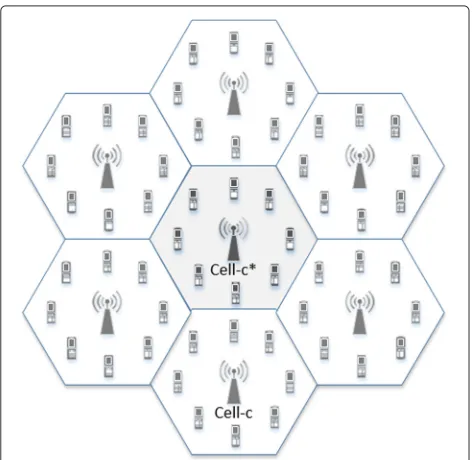
We consider a time division duplexing (TDD) multi-cell massive MIMO system withC cells as shown in Fig. 1. Each cell comprises ofMantennas at the BS andN sin-gle antenna users. To improve the spectral efficiency, orthogonal frequency division multiplexing (OFDM) is adopted [17, 18].
At the beginning of the transmission, all mobile sta-tions in all cells synchronously transmit OFDM pilot sym-bols to their serving base stations. Let the OFDM pilot symbol of user n in the c-th cell be denoted by xnc = [Xcn[ 1] Xcn[ 2]· · ·Xcn[K] ]T, whereKis the number of sub-carriers. The OFDM transmission partition the multipath channel between the user and each antenna of the BS intoKparallel independent additive white Gaussian noise (AWGN) sub-channels in the frequency domain. Each sub-channel is associated with a subcarrier. LetHcn∗,c,i[k] denote thek-th sub-channel coefficient between then-th user in thec-th cell and thei-th antenna of the BS of cell c∗in the uplink.
The received signalYc∗,iby thei-th antenna element of the cellc∗at thek-th subcarrier can be expressed as
Yc∗,i[k]= N
n=1
Hcn∗,c∗,i[k]Xcn∗[k]
+
C
c=1,c=c∗ N
n=1
Hcn∗,c,i[k]Xcn[k]+Vc∗,i[k] , (1)
for all 1 ≤ i ≤ Mand 1 ≤ c ≤ C, whereVc∗,i[k] is the AWGN at thei-th antenna of the BS in cellc∗at thek-th
Fig. 1Illustration of the system model of a multi-cell multi-user massive MIMO
subcarrier. Lettingyc∗,i =[Yc∗,i[ 1]· · ·Yc∗,i[K] ]T, we can write (1) for all subcarriers at thei-th antenna of the BS in cellc∗in the compact form as
yc∗,i= N
n=1
Xnc∗hnc∗,c∗,i+
C
c=1,c=c∗ N
n=1
Xnchnc∗,c,i
+vc∗,i, (2)
whereXnc∗ = diag{xnc∗},hnc∗,c,i =[Hcn∗,c,i[ 1]· · ·Hcn∗,c,i[K] ]T and vc∗,i =[Vc∗,i[ 1]· · ·Vc∗,i[K] ]T∼ CN(0,σv2). Let gnc∗,c,i =[gcn∗,c,i[ 1]· · ·gcn∗,c,i[]· · ·gcn∗,c,i[L] ]T collect the samples of the sampled multipath CIR between then-th user of thec-th cell and thei-th antenna of the BS in cell c∗, whereLis the number of the channel taps andgcn∗,c,i[] corresponds to the -th channel tap. The K frequency domain channel coefficients, i.e.,hnc∗,c,i, can be calculated as theK-point DFT of the CIR samples, i.e.,gnc∗,c,i∈CL×1, e.g., [18].
Hence,
hnc∗,c,i=Fgcn∗,c,i, (3)
whereF ∈ CK×K represents the discrete Fourier trans-form (DFT) matrix, whose element in rowsand column r is given by [√1
Ke
−j2π∗(K−r)(K−s)/K], 1 ≤ r ≤ K and
1≤s≤Kandgcn∗,c,i∈ CK×1isgnc∗,c,i ∈CL×1augmented withK−Lzeros. Using (3) in (2), we get
yc∗,i= N
n=1
Xnc∗Fgcn∗,c,i+
C
c=1,c=c∗ N
n=1
XncFgcn∗,c,i
+vc∗,i. (4)
The channel coefficient is modelled as gnc∗,c,i[]=
φc∗,c,i[]ψc∗,c,i[] for 1 ≤ ≤ L, where φc∗,c,i model the path-loss and shadowing (large-scale fading), while the termψc∗,c,iis assumed to be independent identical distri-bution (i.i.d) of unknown random variables withCN(0, 1) (small-scale fading) [3].
The received signal of (4) can be re-written as
yc∗,i= N
n=1
Xnc∗Fgcn∗,c,i+zc∗,i, (5)
where the termzc∗,i = Cc=1,c=c∗
N
plus the receiver noise, the variance interferenceσI2of the inter-cell interference term caused during pilot transmis-sion can be expressed as
σ2
I =E
⎧ ⎨ ⎩ ⎛
⎝ C
c=1,c=c∗ N
n=1
XncFgcn∗,c,i
⎞ ⎠
×
⎛
⎝ C
c=1,c=c∗ N
n=1
XncFgcn∗,c,i
⎞ ⎠
H⎫ ⎬
⎭. (6)
We define the measurement matrixAnc∗ = Xnc∗F, then (5) can be rewritten as
yc∗,i= N
n=1
Anc∗gcn∗,c,i+zc∗,i. (7)
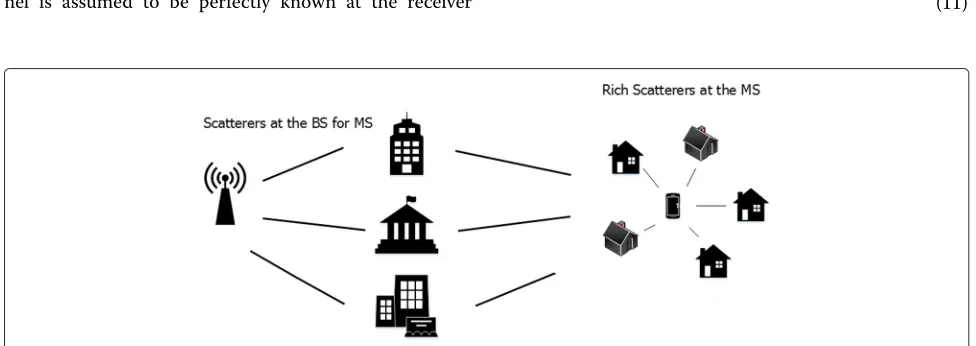
Based on the physical properties of outdoor electromag-netic propagation, the CIR in wireless communications usually contain a few significant channel taps as can be shown in Fig. 2, i.e., the CIR are sparse; hence, the num-ber of non-zero taps of the channel is much smaller than the channel length, then the CS techniques can be applied for sparse channel estimation. This sparse property can be exploited to reduce the necessary channel parameters to be estimated. In this case, we can address the pilot contamination problem by using fewer pilots than the unknown channel coefficients [7, 19, 20].
3 BCS-based channel estimation
In common literature, channel estimation methods are classified into parametric and Bayesian approaches. A standard parametric approach is the best linear unbiased estimator, which is often referred to as least squares chan-nel estimation. In contrast to parametric methods, the Bayesian approach treats the desired parameters as ran-dom variable with a-priori known statistics. Clearly, the a priori probability density function (PDF) of the chan-nel is assumed to be perfectly known at the receiver
[21, 22]. Based on the Bayesian channel estimation phi-losophy, the estimation of unknown parameters is the expectation of the posterior probabilistic distribution that is proportional to the prior probability and the likelihood of the unknown parameters.
In this section, BCS-based channel estimation is pre-sented in the context of massive MIMO channel estima-tion. Following the general procedure of BCS in [23] and [24], the full posterior distribution over unknown param-eters of interest for the problem at hand can be given as
Pgcn∗,c∗,i,β,σ2|yc∗,i
=P
yc∗,i|gcn∗,c∗,i,β,σ2
Pgcn∗,c∗,i,β,σ2
P(yc∗,i)
,
(8)
whereβrepresents the hyperparameters that control the sparsity of the channel whileσ2is the net sum of the noise variance and interference variance.
However, the probability of the observation vector, P(yc∗,i), is defined by the following equation
P(yc∗,i)=
P(yc∗,i|gcn∗,c∗,i,σ2,β)
P(gcn∗,c∗,i,β,σ2)dg dβdσ2, (9) cannot be computed analytically. So, the posterior distri-bution can be decomposed as
Pgcn∗,c∗,i,β,σ2|yc∗,i
≡Pgcn∗,c∗,i|yc∗,i,β,σ2
Pβ,σ2|yc∗,i. (10) The first term of (10), Pgcn∗,c∗,i|yc∗,i,β,σ2, the pos-terior distribution over the channel coefficient can be expressed based on Bayes’ rule as
Pgcn∗,c∗,i|yc∗,i,β,σ2=
Pyc∗,i|gcn∗,c∗,i,σ2Pgcn∗,c∗,i|β Pyc∗,i|β,σ2
.
(11)
The posterior distribution given above is Gaussian
dis-The estimated channel based on Bayesian estimation approaches to minimize the mean square error (MSE) is the expectation ofPgcn∗,c∗,i|yc∗,i,β,σ2
, so the estimated channel can be expressed as
ˆ
gcn∗,c∗,i=EPgcn∗,c∗,i|yc∗,i,β,σ2=μnc∗,c∗,i. (14) Now, to obtain the estimated channelgˆcn∗,c∗,i, we need to find the heyparmarpaterσ2 andβthat can be obtained from the second term on the right-hand side of (10) by applying a type−II maximum likelihood procedure by operating a RVM.
Based on Bayes’ theorem, the posterior distribution Pβ,σ2|yc∗,i is proportional Pyc∗,i|β,σ2 [23], Then, the type−II maximum likelihood is applied to the log marginal likelihood as follows
P(yc∗,i|β,σ2)=
Based on the assumption of the RVM approach in [23], the termP(gcn∗,c∗,i|β)follows zero-mean Gaussian distri-bution and can be expressed as
Pgcn∗,c∗,i|β=(2π)−
while the Gaussian likelihood function ofyc∗,i according to the probability theory, can be written as
Pyc∗,i|gcn∗,c∗,i,σ2
By substituting (16) and (17) into (15), marginal likeli-hoodP(yc∗,i|β,σ2)can be expressed as
βcan be obtained by differentiating the log marginal like-lihood with regard toσ2, and equating it to zero and it can be given as
Whileσ2is obtained by differentiating (19) with regard to β and set these derivations to zero and can be expressed as
(σ2)ii = ||yc∗,i−Anc∗gcn∗,c∗,i||22
(M−I+Kk=1βk)
. (20)
Theβk andσk2 which maximize the log marginal like-lihood are then found iteratively by settingβ andσ2to initial values and then finding values forμnc∗,c∗,iandnc∗,c∗,i from (12) and (13). These values are then repeatedly used to calculate a new estimate for βk and σ2 and until a convergence criteria is met.
Further details of the BCS algorithm can be found in [23, 24]. The procedure for implementation of the proposed technique is summarized in Algorithm 1.
Algorithm 1BCS-Based Channel Estimation Algorithm INPUTS:
1) Pilot signalxnc∗.
2) observation matrixAnc∗=xnc∗F. Initial Configuration:
In contrast to the conventional BCS-based estimator, it can also improve the performance of the BCS estima-tor based on the principle of thresholding, which can be applied to keep the most significant taps. The proposed algorithm applies a threshold approach by retaining the channel taps that have energy above a threshold value of and set the other taps to zero. The value ofis the energy of the channel impulse response.
4 Multi-task BCS based channel estimation
With a high probability of user movements, the mas-sive MIMO system channel may vary. Consequently, the channels at different time instants/locations are differ-ent but share the same common statistical property. As a result, to estimate the current channel, we can exploit the previous compressive vectors in addition to the current compressive vector [15].
Given the system model in II, the received signals of (7) can have the following formulation
yc∗,i,j= ces,channel vector and the noise vector, respectively [15].
The main target is to estimate the channelgcn∗,c∗,i,jwhich can be computed based on Bayesian channel estimation philosophy as the mean of the channel posterior distribu-tion that can be represented as
ˆ
gcn∗,c∗,i,j=E(P(gcn∗,c∗,i,j|yc∗,i,j,j,ξ0)), (22) whereξ0represents the inverse of the net sum of the noise variance and interference variance, whilejrepresent the hyperparameters that control the sparsity of the chan-nel. Based on Bayes’ rule the posterior distribution can be given as
the mean and covariance can be given by
μn based on the received signalyc∗,i,jand can be expressed as
P
The channel coefficients gcn∗,c∗,i,j are assumed to be drawn from a product of zero-mean Gaussian distribu-tions that are shared by all tasks as follow
Pgcn∗,c∗,i,j|j
To obtain the estimated channel, we need to estimate j andξ0 by applying the same procedure in Section 3 to the posterior distributionPyc∗,i,j|,j,ξ0
Now, by maximizing the log marginal likelihood and then differentiating with respect tojandξ0and setting to zero yields
Further information on MT-BCS can be found in [16].
5 CRB for BCS-based estimator
In this section, we analyse the CRB for the proposed BCS and MT-BCS based channel estimation techniques to pro-vide a benchmark for the minimum estimation error that can be achieved by the proposed algorithm. The CRB on the covariance of any estimatorθˆcan be given as
whereJ(θ)is the Fisher information matrix (FIM) corre-sponding to the observationf, and can be given as
J(θ)=E
∂
∂θlogl(θ,f)
∂
∂θlogl(θ,f) T
, (32)
wherel(θ,f) is the likelihood function corresponding to the observationf, parameterized byθ[25].
Therefore, given the system model in 2, the closed form expression of the Bayesian CRB (BCRB) for the proposed BCS can be given as
J(gcn∗,c∗,i)≥
1
β +
Anc∗(Anc∗)H
σ2 −1
. (33)
Theorem 1Given(28), the closed form expression of the BCRB for the proposed MT-BCS can be given as
J
gcn∗,c∗,i,j
≥
⎛ ⎜ ⎝1
j+ Anc∗,j
Anc∗,j
H
ξ0 ⎞ ⎟ ⎠
−1
. (34)
ProofSee Appendix 1.
6 Simulation results
To verify the accuracy of our analytical results, the sim-ulation parameters can be summarized as follows: the number of antennas is 100, the number of users is 100, the number of the channel taps is 500, the number of subcarrierK is 4096 and the convergenceδis 10−6. The simulation results are obtained by averaging over 1000 realizations.
To compare the accuracy of the channel estimation techniques, the normalized (MSE) is used for perfor-mance evaluation and is computed as
MSE= ||ˆg n
c∗,c,i,j−gcn∗,c,i,j||22
||gcn∗,c,i,j||22
. (35)
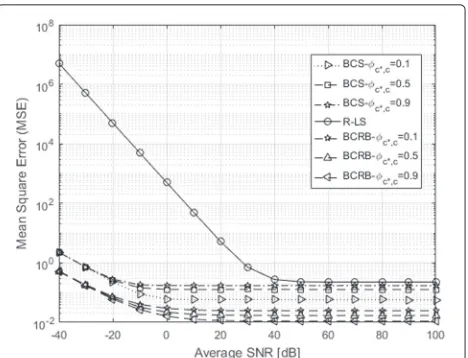
Figure 3 shows the MSE performance comparison among a BCS-based channel estimation of three scenar-ios under small pilot contamination (φc∗,c∗,i = 1 and
φc∗,c,i = 0.1), strong pilot contamination (φc∗,c∗,i = 1 and
φc∗,c,i =0.5), very strong pilot contamination (φc∗,c∗,i=1 andφc∗,c,i = 0.9), regularized least square (RLS)-based estimator with no pilot contamination as a benchmark and the BCRB for BCS as a reference line. The results have shown significant improvement in estimation accu-racy and addressing the pilot contamination problem for SNR values of−40 to 40 dB for the proposed technique compared with R-LS. This is a result of exploiting the prior statistical of channel sparsity. Furthermore, the results still show enhanced estimation performance for high SNR.
Figure 4 shows the (MSE) performance versus SNR with a different value of setting to the number of
subcar-Fig. 3MSE performance comparison between BSC, BCRB for φc∗,c,i= {0.1, 0.5, 0.9}and R-LS versus SNR
rier K = {100, 200 and 300}, so the compression ratio (CR) (i.e., L/K) is to be CR = {0.2, 0.1and 0.06}, while the experiment is run under small pilot contamination (φc∗,c∗,i = 1 and φc∗,c,i = 0.1). The results prove that the estimation accuracy is better performed by decreasing the values of the number of subcarriers, accordingly with increasing CR.
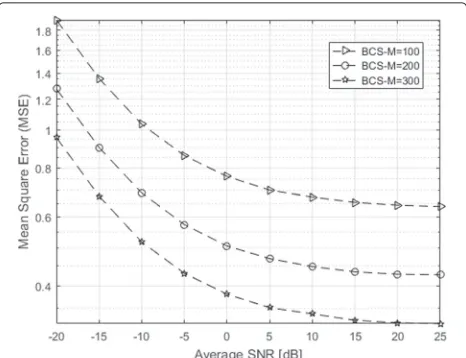
Figure 5 demonstrates the MSE of the BSC-based chan-nel estimation versus SNR for three scenarios of different settings to the number of antennas at the base station M = {100, 200, and 300}, the system under strong pilot contamination (φc∗,c∗,i = 1 andφc∗,c,i = 0.7). The results show that the estimation accuracy of the proposed algo-rithm is enhanced by increasing the number of antennas.
Fig. 5MSE of BSC forM= {100, 200, and 300}versus SNR
Thus, according to the law of large numbers, more coor-dinated BS antennas could provide more accurate support estimation.
Figure 6 shows the (MSE) performance versus SNR for BCS with different values for the number of pilots: 1000, 500, 100, 50, and 25, where the number of subcarrierKis 4096. The number of the CIR path is 500 while the exper-iments run under strong pilot contamination. For cases of the number of the pilots is greater than the number of channel taps (i.e., 1000 and 500), the BCS provides ineffi-cient estimation accuracy, while for the other cases of the number of the pilot of (100, 50, and 25), which is less than 500, the estimation accuracy is enhanced significantly. In addition, there is no significant improvement for the cases of the number of the pilots 100, 50, and 25. In these cases, we can address pilot contamination by employing small values for the number of the pilot, i.e., 25.
Fig. 6MSE performance comparison of BSC based estimator for different values of the number of the pilot 100, 50, and 10 versus SNR
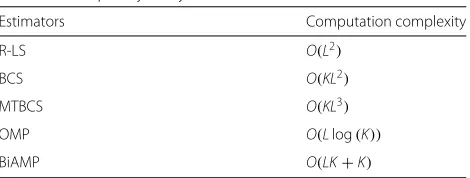
Figure 7 compares the (MSE) performance versus SNR among BCS, threshold-BSC, MT-BCS, LS, OMP and the Bilinear Approximate Message Passing (Bi-AMP) [26]. The number of subcarrier K is 1024 and the number of the CIR path is 100. Results show the proposed MT-BCS enjoys significant performance improvement over all the other estimators as a result of exploiting the sta-tistical prior information on a large scale. However, this advantage is at the expense of a relatively high com-plexity of BCS and MT-BCS over other estimators as depicted in Table 1, which compares the computational complexity Bi-AMP [26], BCS [23], OMP [27], LS [28], and the MT-BCS [16]. Also, the results showed that the thresholding approach enhances the estimation accu-racy of the conventional BCS, as the CIR contains so many taps with no significant energy. By setting the threshold and neglecting these taps, a huge part of the noise and interference from pilot contamination will be eliminated.
7 Conclusions
To address the pilot contamination problem in mas-sive MIMO systems, we proposed a BCS-based chan-nel estimation algorithm for the multi-cell multi-user massive MIMO. The simulation results have revealed that the BCS-based channel estimation algorithm has tremendous improvement over conventional-based chan-nel estimation algorithms and can address the pilot con-tamination problem. Furthermore, the proposed tech-nique can be enhanced by thresholding the CIR to a certain value and also by exploiting the common spar-sity feature inherent in the system channel. In addi-tion, the number of antennas and the compression ratio should be selected wisely to achieve optimum estimation accuracy.
Table 1Complexity analysis
Appendix 1: Proof of Theorem 1
Following Section 5, we can write the FIM as
J(yc∗,i,j)≥ −E
Based on Bayes’ rule in (32), the FIM can be decom-posed into two terms
−E
using (28), the first term can be computed as follow
−∂
By applying the same procedure in (38 and 39) to the second term of (37) gives
E
This work is supported by the Iraqi Higher Committee of Educational Development (HCED). The authors would like to acknowledge its financial support.
Competing interests
The authors declare that they have no competing interests.
Received: 3 October 2016 Accepted: 12 December 2016
References
1. C-X Wang, et al, Cellular architecture and key technologies for 5G wireless communication Networks. IEEE Comm. Mag.52(2), 122–130 (2014) 2. V Jungnickel, K Manolakis, W Zirwas, B Panzner, V Braun, M Lossow, M
Sternad, R Apelfrojd, T Svensson, The role of small cells, coordinated multipoint, and massive MIMO in 5G. IEEE Commun. Mag.52(5), 44–51 (2014)
3. H Zhang, S Gao, D Li, H Chen, L Yang, On superimposed pilot for channel estimation in multi-cell multiuser MIMO uplink: large system analysis. IEEE Trans. Vehicular Technol.65, 99 (2015)
4. J Jose, A Ashikhmin, TL Marzetta, et al, Pilot contamination problem in multi-cell TDD systems. Proc. IEEE Int.Symp. Inf. Theory, Seoul.28, 2184–2188 (2009)
5. J Jose, A Ashikhmin, TL Marzetta, et al, Pilot contamination and precoding in multi-cell TDD systems. IEEE Trans. Wireless Commun. 10(8), 2640–2651 (2011)
6. J Zhang, B Zhang, S Chen, X Mu, M El-Hajjar, L Hanzo, Pilot contamination elimination for large-scale multiple-antenna aided OFDM systems. IEEE J. Selected Topics Signal Process.8(5), 759–772 (2014)
7. M Masood, L Afify, TY Al-Naffouri, Efficient coordinated recovery of sparse channels in massive MIMO. IEEE Trans. Signal Process.63(1), 104–118 (2015)
8. N Sinh. Compressive sensing for multi-channel and large scale MIMO networks. PhD. thesis, Dept. of Elect. And Comp. Eng., Concordia Univ., (Montreal, 2014), p. 13
9. C Qi, G Yue, L Wu, Y Huang, A Nallanathan, Pilot design schemes for sparse channel estimation in OFDM systems. IEEE Trans. Veh. Technol. 64(4), 1493–1505 (2015)
10. M Carlin, P Rocca, G Oliveri, F Viani, A Massa, Directions-of-arrival estimation through Bayesian compressive sensing strategies. IEEE Trans. Antennas Propagat.61(7), 3828–3838 (2013)
11. RG Baraniuk, Compressive sampling. IEEE Signal Process. Mag.24(4), 118–124 (2007)
12. Z Fan, Z Lu, Y Han, in2014 IEEE International Symposium on Broadband Multimedia Systems and Broadcasting (BMSB). Accurate channel estimation based on Bayesian compressive sensing for next-generation wireless broadcasting systems, (Beijing, 2014), pp. 1–5
13. Z Fan, Z Lu, Y Han,Reliable channel estimation based on Bayesian compressive sensing for TDS-OFDM systems, (Macau, 2014), pp. 620–624 14. X Cheng, YL Guan, G Yue, S Li, inProc. IEEE GLOBECOM. Enhanced
Bayesian compressive sensing for ultra-wideband channel estimation, (California, 2012), pp. 4065–4070
15. X Cheng, M Wang, Y Guan, Ultra wideband channel estimation: a Bayesian compressive sensing strategy based on statistical sparsity. IEEE Trans. Vehicular Technol.64(5), 1819–1832 (2015)
16. S Ji, D Dunson, L Carin, Multi-task compressive sensing. IEEE Trans. Signal Process.57(1), 92–106 (2009)
17. X Guo, S Chen, J Zhang, X Mu, L Hanzo, Optimal pilot design for pilot contamination elimination/reduction in large-scale multiple-antenna aided OFDM systems. IEEE Trans. Wireless Commun.15(11), 7229–7243 (2016)
18. MR Nakhai, Multicarrier transmission. IET Signal Process.2(1), 114 (2008) 19. W Ding, F Yang, W Dai, J Song, Time–frequency joint sparse channel
estimation for MIMO-OFDM systems. IEEE Commun. Lett.19(1), 58–61 (2015)
20. C Qi, G Yue, L Wu, Y Huang, A Nallanathan, Pilot design schemes for sparse channel estimation in OFDM systems. IEEE Trans. Veh. Technol. 64(4), 1493–1505 (2015)
21. A Scherb, K Kammeyer, inProc. IEEE Workshop Smart Antennas. Bayesian channel estimation for doubly correlated MIMO systems, (Vienna, 2007) 22. SM Kay,Fundamentals of Statistical Signal Processing: Estimation Theory.
(PTR Prentice-Hall, Englewood Cliffs, 1993)
23. S Ji, Y Xue, L Carin, Bayesian compressive sensing. IEEE Trans. Signal Process.56(6), 2346–2356 (2008)
24. ME Tipping, Sparse Bayesian learning and the relevance vector machine. J. Mach. Learn. Res.1, 211–244 (2001)
26. JT Parker, P Schniter, V Cevher, Bilinear generalized approximate message passing. IEEE Trans. Signal Process.62(22), 5839–5853 (2014)
27. JA Tropp, AC Gilbert, Signal recovery from partial information via orthogonal matching pursuit. IEEE Trans. Inf. Theory.53(12), 4655–4666 (2007) 28. OO Oyerinde, Reweighted regularised variable step size normalised least
mean square-based iterative channel estimation for multicarrier-interleave division multiple access systems. IET Signal Process.10(8), 947–954 (2016)
Submit your manuscript to a
journal and benefi t from:
7Convenient online submission 7Rigorous peer review
7Immediate publication on acceptance 7Open access: articles freely available online 7High visibility within the fi eld
7Retaining the copyright to your article