R E S E A R C H
Open Access
On the use of ordered statistics decoders
for low-density parity-check codes in space
telecommand links
Marco Baldi
1,2*, Nicola Maturo
1,2, Enrico Paolini
3and Franco Chiaraluce
1,2Abstract
The performance of short low-density parity-check (LDPC) codes that will be included in the standard for
next-generation space telecommanding is analyzed. The paper is focused on the use of a famous ordered statistics decoder known as most reliable basis (MRB) algorithm. Despite its complexity may appear prohibitive in space applications, this algorithm is shown to actually represent a realistic option for short LDPC codes, enabling significant gains over more conventional iterative algorithms. This is possible by a hybrid approach which combines the MRB decoder with an iterative decoding procedure in a sequential manner. The effect of quantization is also addressed, by considering two different quantization laws and comparing their performance. Finally, the impact of limited memory availability onboard of spacecrafts is analyzed and some solutions are proposed for efficient processing, towards a practical onboard decoder implementation.
Keywords: Low-density parity-check codes, Most reliable basis algorithm, Ordered statistics decoding, Space missions, Telecommand links
1 Introduction
Wireless communication links in space missions exten-sively use error-correcting codes in order to improve transmission reliability [1–4]. There are two types of space links: telemetry (TM) links from space to ground and telecommand (TC) links from ground to space. The pur-pose of a TM link is to reliably and transparently convey remote measurement information to users located on Earth. For such a purpose, several coding schemes are employed. In particular,
• convolutional codes, • Reed–Solomon codes, • parallel turbo codes,
• low-density parity-check (LDPC) codes.
A comprehensive description of all these families of codes can be found, for example, in [5].
*Correspondence: [email protected]
1Dipartimento di Ingegneria dell’Informazione, Università Politecnica delle Marche, Ancona, Italy
2Consorzio Nazionale Interuniversitario per le Telecomunicazioni (CNIT), Parma, Italy
Full list of author information is available at the end of the article
A TC link, in turn, is used to initiate, modify, or termi-nate equipment functions onboard (O/B) of space objects. From the communication viewpoint, TCs have a number of distinctive features. Among them,
• the data rates (measured inbits/s) are usually very low compared with TM links,
• TCs are originated and assembled on the ground.
The first above feature implies milder requirements for the error-correcting code. Similarly, because of the sec-ond feature, fewer limits and constraints are imposed on the available transmitted power. Recommendations for TC space links are issued traditionally by two organiza-tions: the Consultative Committee for Space Data Systems (CCSDS) and the European Cooperation for Space Stan-dardization (ECSS). The only error-correcting code so far included in these recommendations [6, 7] is a Bose– Chaudhuri–Hocquenghem (BCH) code. This linear block code is characterized by a codeword lengthn = 63 bits, an information block lengthk = 56 bits and is typically decoded O/B via hard-decision decoding.
Reliable space telecommanding is of fundamental importance as the success of a mission may be com-promised because of an error corrupting a TC message. This imposes strict constraints on the maximum tolerable error rates. In particular, the codeword error rate (CER) is defined as the ratio of the number of decoding failures to the total number of received codewords. Requirements are often specified in terms of average CER, and a typical value is CER≤10−5.
TC links are currently evolving to include new and more challenging mission profiles, characterized by much more demanding requirements. Compliance with these new requirements imposes the use of more advanced coding techniques than the BCH(63, 56) code. In space telecom-manding, it is always of fundamental importance to ensure the integrity of very short emergency commands, with a very low data rate and limited latency. Such constraints impose the adoption ofshort codes.
The mentioned BCH code is short enough, but its per-formance is far from meeting the requirements of next generation missions. In the following analysis, we will refer to a classical binary phase shift keying (BPSK) mod-ulation over an additive white Gaussian noise (AWGN) channel. This model is particularly suitable to describe deep-space communications. Using the standard BCH(63, 56) code with hard-decision decoding, the signal-to-noise ratio required to achieve CER≈10−5isEb/N0≈9.1 dB,
where Eb is the energy per information bit and N0 the
one-sided noise power spectral density. This value of
Eb/N0 can be reduced, so improving performance, by
applying soft-decision decoding. For example, by using a decoder based on the BCJR algorithm [8], a gain of about 2.1 dB with respect to the hard-decision decoder can be achieved. TheseEb/N0values, however, remain too large
for space missions of next generation. These missions shall be characterized by a significant increase of the supported data rate and/or maximum distance with respect to the present scenarios. Both these factors degrade the signal-to-noise ratio and impose to achieve the target CER over a worse channel.
In order to achieve higher coding gains, new advanced coding schemes have been designed and evaluated [9]. After a long campaign of simulations and comparisons, two short binary LDPC codes have emerged as the most attractive candidates. Most of the steps necessary for their inclusion in the standard for space TC have already been completed, so that they will certainly be employed in next-generation missions.
LDPC codes can be decoded through classical soft-decision iterative algorithms (IAs), such as the sum-product algorithm (SPA) [10] or its simplified versions, e.g., min-sum (MS) [11] or normalized min-sum (NMS) [12]. As regards SPA, throughout this paper, we will refer to its log-likelihood ratio (LLR) implementation. By using
LDPC codes with IAs, the coding gain is larger than with the BCH code, although the performance remains relatively far from the theoretical limits.
More substantial improvements can result from the adoption of algorithms based on ordered statistics decod-ing (OSD) [13]. In this paper, in particular, we consider the well-known most reliable basis (MRB) algorithm [14]. MRB is a non-iterative soft-decision decoding algorithm able to approach the performance of a maximum likeli-hood (ML) decoder. The latter is optimal, in the sense of minimizing the decoding error probability. The main drawback of MRB is represented by its complexity, which makes its use problematic in TC links where decoding is performed O/B with very limited computational and memory resources. As mentioned, however, the length of the TC LDPC codes is small, namely, n = 128 bits and
n = 512 bits, which makes MRB a potential candidate especially for the shorter code.
Complexity can be reduced by resorting to a hybrid solution, which combines MRB with IAs. More pre-cisely, the hybrid approach consists of performing low-complexity decoding through an IA, at first, and invok-ing the MRB algorithm only when the IA is not able to find any valid codeword (detected error). The hybrid decoder has recently been used to decode also LDPC codes constructed on non-binary finite fields [15], which represent another option for space TC links [16, 17]. Due to their higher decoding complexity, however, non-binary LDPC codes are less attractive than their non-binary counterparts.
CER value at the working point must be at least as low as 10−5, the UCER value at the same point must be at least as low as 10−9[18]. Consequently, the MRB decoder is not invoked in a very few number of cases where it should be, and the advantage offered by the SPA-LLR to sporadically correct a (relatively) large number of errors dominates.
While ensuring excellent error rate performance, the hybrid decoder is characterized by a significantly lower average complexity than MRB decoding used alone. More-over, such a performance is not seriously affected by prac-tical issues like, for example, quantization, on condition that suitable quantization rules are applied.
Motivated by the above considerations, in this paper, a thorough analysis of the performance of the MRB algo-rithm, used individually or in hybrid form, is developed with reference to space TC applications. While a pre-liminary version of this analysis has been considered in [19], the study is here deepened by addressing all tech-nical issues in a more complete way. Among them, we investigate the impact of limited memory availability (a typically very stringent constraint in O/B processing), with the aim to discuss also the problems arising in practical implementations. In fact, while the presence of enough O/B memory would help fast convergence of the decoding algorithm, memories are usually considered not reliable in hostile environments like the one charac-terizing space missions, so that their usage is generally minimized. As a consequence, “on-the-fly” computations are preferred to memory accesses. Therefore, we extend the analysis in [19] by addressing both the case of a lim-ited amount of memory and the case of total absence of memory. We also study a parallel implementation for controlling other important variables, like the decoding latency.
The organization of the paper is as follows. In Section 2, the considered error-correcting codes are described. In Section 3, the various decoding procedures are presented and expressions for computing their complexities are pro-vided. The performance of these schemes is then assessed in Section 4, also taking into account the quantization issues. Section 5 is devoted to the analysis of the impact of
limited memory and to the latency evaluation. Concluding remarks are given in Section 6.
2 LDPC codes for space telecommand links
The two considered LDPC codes are described in detail in [16]. The first code has information block lengthk =
64 bits and codeword length n = 128 bits. The sec-ond code has information block lengthk = 256 bits and codeword length n = 512 bits. Hence, both codes have code rate Rc = k/n = 1/2. A short overview of their main features is reported in the following. In particular, in Section 2.1, their structure is described, by specifying their parity-check matrices, while in Section 2.2, their weight spectrum properties are addressed.
2.1 Parity-check and generator matrices
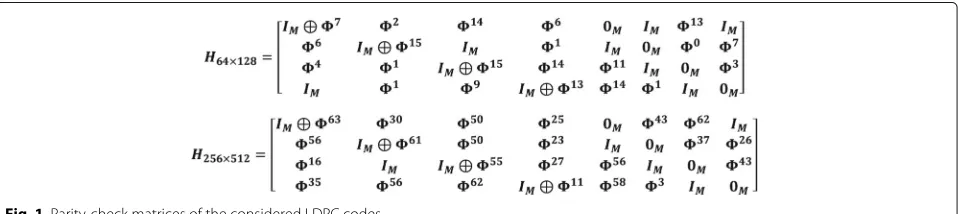
For the codes we consider, the parity-check matrixHis an array ofM×Msquare submatrices, whereM = k/4 =
n/8. This is specified, for both codes, in Fig. 1.
In the figure,IMand0Mdenote theM×Midentity and zero matrices, respectively, andis the first right circular shift ofIM. This means thathas a non-zero entry at row iand columnjif and only ifj=(i+1) modM. Moreover,
2represents the second right circular shift ofI
M, that is,
2has a non-zero entry at rowiand columnjif and only
ifj=(i+2)modM, and so on. The⊕operator indicates element-wise modulo-2 addition.
As an alternative representation, a k × n generator matrixGcan be obtained from the parity-check matrix H. The length-ncodewordccorresponding to a
length-kinformation blockucan be then generated asc = u G. The matricesGfor the two considered codes are reported in [16].
2.2 Weight distribution properties
The Hamming weight of a codeword is defined as the number of its nonzero elements. The performance of a linear block code under optimum ML decoding is gov-erned by its weight spectrum, that is the number of codewords of Hamming weight w for all integer 0 ≤
w ≤ n. Unfortunately, even when the weight spectrum is perfectly known (which is a very favorable condition,
normally unverified for LDPC codes), it is not possible to find an exact analytical expression of the error rate achieved by the ML decoder, even for very simple commu-nication channel models. Thus, it is a common practice resorting to analytical bounds, an example of which is rep-resented by the union bound, that establishes an upper bound on the error rate of the considered code under ML decoding [20].
For a binary linear block code over the AWGN channel and BPSK modulation, let us denote byAwthe multiplicity of the weight-wcodewords and by dmin the code
mini-mum distance. Then, the expression of the union bound for the CER is [21]
The first term of the sum, corresponding tow = dmin,
is also known as the “error floor.” For sufficiently high values of Eb/N0, the error floor provides an excellent
approximation of the performance of ML decoding. In this sense, it represents a first benchmark for any sub-optimum decoding algorithm: the closer the error rate offered by the decoding algorithm to the error floor, the smaller the gap between the sub-optimum decoder and the optimum ML decoder. As from (1), the computation of CERUBrequires the knowledge of the complete weight
spectrum of the code. It is known that for LDPC codes this may be a non-trivial task. For the considered codes, however, much work has been done to overcome this issue.
In particular, the first and most significant terms of the weight distribution for the LDPC(128, 64) code have been specified as
A(x)|64×128=16x14+528x16+5632x18+35968x20 +123888x22+364944x24+. . . (2)
where the presence of the termAwxwmeans that there are Awcodewords with Hamming weightw. The multiplici-tiesA14,A16andA18are exact [22]; this part of the weight
spectrum has been obtained through computer searches using a carefully tuned “error impulse” technique [23]. The other multiplicities are lower bounds on the actual values and have been obtained by using the approach proposed in [24]. The overall estimate is anyway sufficiently stable and allows to draw a reliable union bound, as will be done in Section 4.
The most accurate evaluation, at least till now, of the weight distribution of the LDPC(512, 256) code has been reported in [22], where the estimated first terms of the spectrum have been specified as
A(x)|256×512=64x40+704x42+6336x44
+44736x46+. . . (3)
The multiplicitiesA40andA42appear to be exact, while
A44andA46are approximate and, in general, there is not
yet sufficient confidence on the reliability of the estimate, even as regards the value ofdmin. This does not allow to
draw a sufficiently reliable union bound for the LDPC(512, 256) code.
3 Decoding algorithms
As decoding algorithms we consider one OSD (the MRB algorithm) and three IAs (SPA, MS, and NMS). We inves-tigate their performance when used alone or combined in the aforementioned hybrid decoding scheme.
3.1 MRB decoder
Let us denote by 1the length-nvector with all coordi-nates equal to 1. Then, letc= (c0,c1,. . .,cn−1)andx =
(x0,x1,. . .,xn−1)=1−2c∈ {−1,+1}nbe the transmitted
codeword and its baseband BPSK-modulated version (that is, before being modulated with the carrier frequency), respectively. Moreover, let y = (y0,y1,. . .,yn−1) ∈ Rn
be the corresponding received vector of soft values after transmission over the AWGN channel and BPSK demod-ulation. The MRB decoder relies on a transformation from the original generator matrix, G, to a new matrix, G, based on thek most reliableindependent bits correspond-ing to y. Upon reception of y, the reliability of a bit is measured in terms of the magnitude of its a priori LLR. More specifically, the a priori LLR for theith codeword bit is defined as
where σ2 is the variance of the Gaussian thermal noise. The reliability of bitciis then defined as|L(ci)|.
The MRB algorithm of orderi may be summarized as follows:
• Upon receiving the signal from the AWGN channel and demodulating it into the sequencey, find thek most reliable received bits and collect them in a length-k vectorv.
• Perform Gauss-Jordan elimination on the matrixG, with respect to the positions of thek most reliable bits, to obtain a systematic generator matrixG corresponding to such bits.1
• Encodevto obtain acandidate codewordc=vG. • Consider all (or an appropriate subset of)test error
Calculatev˜=v+e.
Encodev˜to obtain a codewordc˜= ˜v G. If the Euclidean distance betweenx˜=1−2c˜
andyis smaller than the one between
x =1−2candy, then update the candidate codeword asc← ˜c.
At the end of the process, the algorithm delivers the codeword c which minimizes the Euclidean distance fromy, limited to the codeword set associated with the considered TEP set.
Hereafter, we denote by MRB(i) an instance of the algo-rithm with order i. Clearly, MRB(k) coincides with ML decoding, which is intractable in practice. Actually, the maximum number of TEPs to be tested, for each received sequencey, is equal toNTEPmax = iw=0wk, and this num-ber tends to become very large even for i k. So, in practice, only very small values ofican be considered.
There exist several possible strategies to reduce the complexity of the MRB(i) decoder. Among them, our simulations confirm the effectiveness of the following sub-optimal strategies to stop the TEP analysis before it reachesNTEPmax:
1. The number of patterns to be tested is reduced by properly choosing a reliability thresholdA such that, if the distance between the current candidate codeword andyis lower thanA, then the decoding algorithm outputs the candidate codeword without testing the remaining TEPs.
2. The TEPs are commonly generated in ascending weight order. However, it is possible to precompute a list of most likely TEPs [25], that is, a list containing the TEPs ordered according to the probability to yield codewords at small distances fromy, regardless of their weightw≤i. The threshold criterion at the previous point can then be applied to the ordered list.
One or both approaches allow to test an average number of patterns, denoted by NTEP in the following,
signifi-cantly smaller thanNTEPmax. As we will see in Section 3.3, this may have a significant impact on the decoding complexity.
There are also other tricks that may be used to reduce the MRB decoder implementation complexity. A very effective one is based on the observation that a large number of TEPs have overlapping supports, where the support of a TEP is defined as the set of its nonzero coordinates. Due to the code linearity, we can compute the XOR of two TEPs and encode it through G. The resulting vector can then be added to the test code-word corresponding to the first TEP, in order to obtain the codeword corresponding to the second TEP. Since, for the small values of the order i we consider, the XOR of the two TEPs has a small Hamming weight,
computing the corresponding codeword requires to sum a small number of rows of G, thus reducing the com-putational burden. The procedure can be, obviously, iterated.
3.2 Hybrid decoder
The complexity of the MRB(i) algorithm, with an orderi
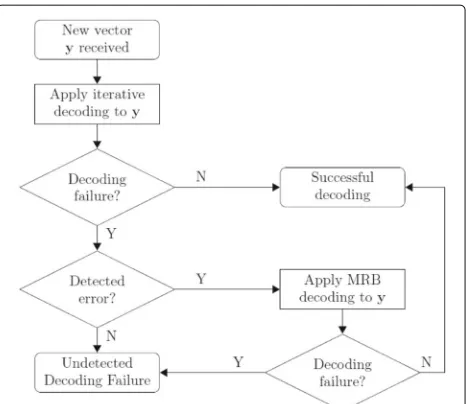
that allows to achieve good performance, may result too high for practical implementation. In this case, it is possi-ble to resort to a hybrid approach, which consists of apply-ing the MRB decoder downstream the iterative decoder, by invoking it only when the iterative decoder terminates reporting a failure, as it was not able to find any codeword [26]. The procedure is summarized by the flow-chart in Fig. 2. We note that two possible error events characterize an iterative LDPC decoding algorithm, namely, detected error and undetected error. A detected error occurs when the decoder reaches the maximum number of iterations without converging to any valid codeword. On the other hand, an undetected error occurs when the decoder con-verges to a codeword different from the transmitted one. Note also that every failure of the MRB decoder yields an undetected error, since a codeword is always found by this decoder (i.e., the MRB decoder is com-plete, as opposed to LDPC iterative decoders which are
incomplete).
As from Fig. 2, contrary to similar proposals appeared in previous literature, the MRB decoder is applied on the received sequence y and not on the output of the IA decoder. This permits us to circumvent the effects of the deteriorated soft values after a failure of the IA.
3.3 Decoding complexity
As mentioned in the previous sections, besides the error rate, another fundamental parameter for measuring the efficiency of a decoding algorithm is complexity. In case of the MRB algorithm, it is even the factor conditioning the applicability of the method.
A possible definition of complexity is in terms of the average number of binary operations required for decod-ing a sdecod-ingle codeword. More practical issues, like chip area requirements, power consumption, number of look-up tables, number of flip-flops, and memory occlook-upation, should be considered as well. These factors, however, are strongly dependent on the hardware architecture and design choices, while we aim at performing a more gen-eral complexity assessment, for which the number of operations turns out to be a suitable metric.
The average number of binary operations required by the MRB algorithm can be expressed by the following formula
In (4), we have taken into account that some of the oper-ations are performed on real values; so,qis the number of quantization bits used to represent a real number. As we can see, the third term on the right-hand side (r.h.s.) is proportional to the number of TEPs; therefore, usingNTEP
instead of NTEPmax, as permitted by the application of the speed-up procedures described in Section 3.1, can yield a significant advantage.
Equation (4) results from the evaluation of the computa-tional effort required by the steps described in Section 3.1. In detail, the basic MRB decoding algorithm needs
• To ordern real values.
• To perform Gauss-Jordan elimination on thek×n
original generator matrixGto obtain the generator matrixGin systematic form, in which the
information bits coincide withv.
• To perform the vector-matrix multiplicationvG. • To generate, on average,NTEPTEPs and perform the
relevant calculations.
Next, the average complexity of the hybrid approach results in
CHybrid=CIA+αCMRB (5)
where CIA is the complexity of the IA preceding the
(possible) MRB decoding attempt, whileαrepresents the fraction of decoding instances in which MRB is invoked, i.e., the rate of the calls to MRB. This is because, in the hybrid approach, the MRB algorithm is invoked only when the IA fails. To be more precise, looking at the flow-chart
of the hybrid decoder in Fig. 2, it should be noted that the rate of calls to the MRB decoder equals thedetected error rateof the IA. In fact, when an undetected error occurs for the IA, decoding terminates unsuccessfully without any call to MRB. So, in principle,αis different from the CER, as the latter captures both detected and undetected errors. However, since the undetected error rate of an IA is usu-ally orders of magnitude smaller than the detected one (unless the minimum distance of the code is very poor— this is not the case for the codes considered in this paper), we can assume α ≈ CER, this way making a negligible error.
The expression of CIAin (5) depends on the adopted IA
and can easily be obtained from the algorithm specifica-tion (details are omitted for saving space). For SPA, MS, and NMS, we have
CSPA=Iaven q(8dv+12Rc−11)+dv
respectively, whereIaveis the average number of iterations
anddvis the average column weight of the parity-check matrix. The considered codes are both characterized by
dv = 4. Finally, it must be noted that, starting from the previous expressions, the corresponding decoding com-plexities per information bit can be obtained by dividing the r.h.s. of (4)–(8) byk.
4 Error rate versus complexity tradeoff evaluation
In this section, the CER/complexity tradeoff offered by each of the decoding algorithms considered in Section 3 is assessed, when used to decode the two LDPC codes described in Section 2. As previously stated, the modu-lation format is BPSK. Moreover, a maximum number of iterations Imax = 100 has been used for each iterative
algorithm. This value has been determined, from sim-ulations, for the considered codes, as capable to obtain the best possible performance from the adopted IAs. This means that no significant extra gain is achievable by using a value of Imax larger than 100. An explicit
example will be presented in Section 4.2. On the other hand, by using (6), (7), and (8), but withImax in place of
Iave, we see that the complexity in the worst case (that
is, when the decoder reaches the maximum number of iterations) grows linearly with Imax. As we will show in
Section 5, the worst case complexity determines the worst case latency, the latter quantity being another design parameter that must be properly limited. As another argu-ment to justify the limited gain induced by an increase in the maximum number of iterations, we can observe that in the region of medium/low error rates, Iave is
usually much lower than Imax, thus confirming that the
determines the maximum latency in the sense specified above).
4.1 LDPC(128,64)code
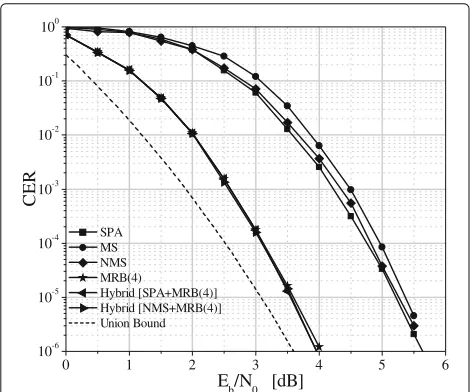
The CER curves for the LDPC(128, 64) code are shown in Fig. 3 in the ideal case in which all involved soft reli-ability values are unquantized, i.e., are represented with a very high precision (e.g., 32-bit floating point for each reliability value). The best performance is exhibited by the MRB algorithm with orderi = 4, either employed alone or in hybrid form. For the latter, we observe that perfor-mance is practically independent of the adopted IA; in fact, the CER curves by using SPA + MRB(4) or NMS + MRB(4) are superposed in the region of interest. The use of MRB allows to achieve a gain in the order of 1.6 dB at CER = 10−5, over the IAs. Moreover, the gap to the
union bound is very limited, in the order of 0.5 dB. The union bound has been plotted making use of (1) and (2) (i.e., including the terms up to weight 24).
To confirm the goodness of the hybrid algorithm, we have realized a further experiment, by simulating the per-formance of a mixed (purely theoretical and impractical) decoder that feeds the received sequence to the inputs of both decoders but keeps only the output of the success-ful decoder. We have verified that the CER performance of this “ideal” decoder is practically coincident with that of the “real” hybrid decoder over the whole range of error rate values of interest.
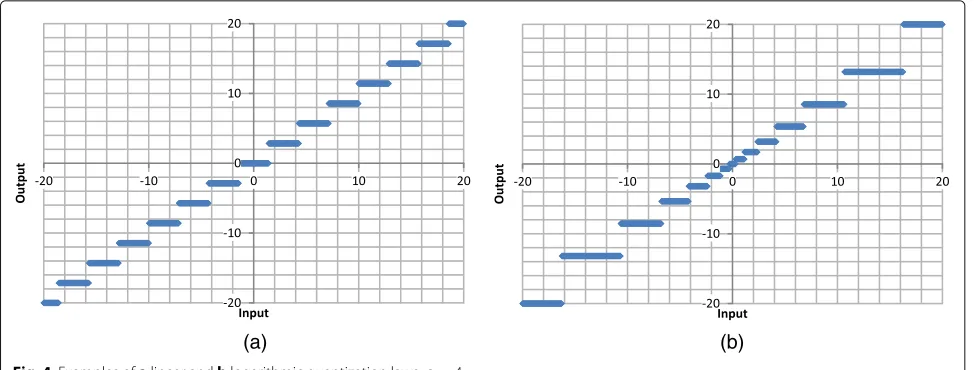
To analyze the impact of quantization on the perfor-mance curves shown in Fig. 3, two quantization rules have been adopted, namely, a linear rule and a logarithmic rule. The input/output characteristics of these two quantizers are shown, with an example, in Fig. 4a, b, respectively.
0 1 2 3 4 5 6
10-6 10-5
10-4 10-3
10-2 10-1 100
SPA MS NMS MRB(4)
Hybrid [SPA+MRB(4)] Hybrid [NMS+MRB(4)] Union Bound
CER
Eb/N0 [dB]
Fig. 3Performance comparison among the considered decoding algorithms for the LDPC(128, 64) code: unquantized case
While the linear quantization law is obvious, some expla-nations and comments about the logarithmic one are reported in the Appendix. Further details can be found in [27]. Due to the large number of possible combinations of IA, quantization law, and number of quantization bits, we do not report the simulation curves for all considered decoding algorithms.
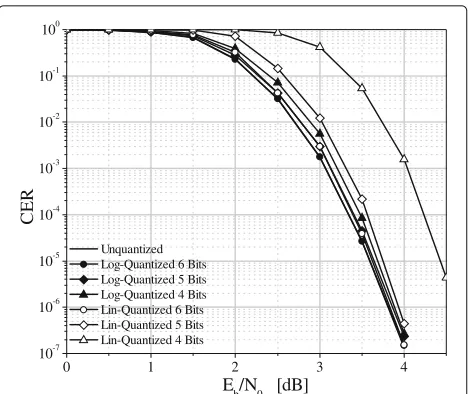
In Fig. 5, the impact of quantization is shown forq ∈
{4, 5, 6} when using the hybrid algorithm, based on the SPA + MRB combination. The corresponding curves for the NMS algorithm are reported in Fig. 6. Looking at the figures, it is possible to conclude that q = 6 is suffi-cient to reach practically the same CER of the ideal (i.e., unquantized) case. Ifq < 6, the NMS algorithm exhibits a slightly lower sensitivity to quantization than the hybrid algorithm. This reflects into a smaller performance degra-dation: looking at Fig. 6 only the linear law withq = 4 shows a significant loss while, for example, assumingq=
5 with the linear law orq = 4 with the logarithmic law does not cause any loss. In Fig. 5, in contrast, the same choices yield a limited, yet visible, loss (in the order of 0.15 dB). We can conclude that adopting the logarithmic law instead of the linear one allows, for hybrid decoding, to achieve the same CER but saving one quantization bit.
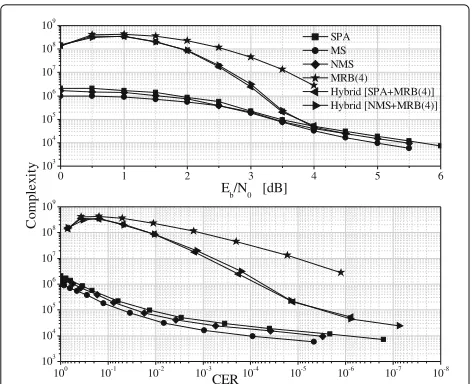
As mentioned previously, another fundamental issue to be addressed is complexity. Figure 7 shows the average number of operations required by the various decoding algorithms by assuming q=6. These curves have been obtained by using the expressions reported in Section 3.3. For better evidence, the figure illustrates the dependence on both the signal-to-noise ratio Eb/N0 and the CER.
As expected, the MS algorithm exhibits the lowest com-plexity, followed by the NMS algorithm and the SPA. On the opposite, the MRB algorithm is characterized by the highest complexity.
The hybrid algorithm, which invokes MRB only upon a detected IA failure, has a complexity comparable with that of the plain MRB algorithm in the lowEb/N0regime
(or, equivalently, in the high CER regime). By increas-ing Eb/N0 (or, equivalently, by decreasing the CER), its
complexity is gradually reduced, until it becomes com-parable with that of the IA alone, in the high Eb/N0
regime. At CER = 10−5, the average number of
oper-ations required by the hybrid algorithm is still about one order of magnitude larger than that of the corre-sponding IA alone. Such a higher complexity, however, is compensated by the extra-gain ensured by the hybrid approach.
4.2 LDPC(512,256)code
(a) (b)
Fig. 4Examples ofalinear andblogarithmic quantization laws;q=4
such a value gives the best trade-off between perfor-mance and complexity. Actually, Fig. 9 shows the impact of this parameter for some values of Imax ∈[100, 500],
by assuming the SPA for decoding. From the figure, we see that a very limited addional gain (less than 0.1 dB at CER = 10−5) is achieved by moving fromImax = 100 to
Imax = 200. No significant further gain results instead
from the adoption of Imax > 200. On the other hand,
as mentioned above, doubling the maximum number of iterations the latency in the worst case is doubled as well and, taking into account typical design constraints (see Section 5 for details), the disadvantage is more significant than the advantage.
As regards the MRB algorithm, the simulations have been performed with an orderi= 3, when the algorithm is used alone, as a larger order becomes too complex to
0 1 2 3 4
10-6
10-5
10-4
10-3
10-2
10-1
100
Unquantized Log-Quantized 6 Bits Log-Quantized 5 Bits Log-Quantized 4 Bits Lin-Quantized 6 Bits Lin-Quantized 5 Bits Lin-Quantized 4 Bits
CER
E
b/N0 [dB]
Fig. 5Impact of quantization on the performance of the hybrid algorithm (SPA + MRB(4)) for the LDPC(128, 64) code
manage for k = 256 andn = 512. This limited MRB order has a negative impact on the error rate performance, which turns out to be unsatisfactory. On the contrary, when the MRB algorithm is employed in the framework of the hybrid decoder, it is possible to increase its order up toi= 4 with beneficial effects in terms of CER. Con-sequently, the performance of the hybrid decoder (here implemented with the SPA) reveals to be the best one, although the gain over the SPA or the NMS algorithms used alone is much less remarkable than for the short code—being now in the order of 0.15 dB.
Similarly to Figs. 5 and 6, in Figs. 10 and 11, the CER curves for the LDPC(512, 256) code are shown for a finite number of quantization bits. Specifically, Fig. 10 is rel-evant to the hybrid algorithm and Fig. 11 to the NMS algorithm, respectively. In both figures, results are shown
0 1 2 3 4 5 6
10-6
10-5
10-4
10-3
10-2
10-1
100
Unquantized Log-Quantized 6 Bits Log-Quantized 5 Bits Log-Quantized 4 Bits Lin-Quantized 6 Bits Lin-Quantized 5 Bits Lin-Quantized 4 Bits
CER
E
b/N0 [dB]
0 1 2 3 4 5 6
Fig. 7Average number of binary operations per decoding attempt for the LDPC(128, 64) code in the caseq= 6
for the two considered quantization laws withq∈ {4, 5, 6}. The conclusions we can draw from this analysis are simi-lar to those valid for the LDPC(128, 64) code. In this case, however, the loss resulting from the adoption of the lin-ear law withq = 4 is more pronounced (in the order of 0.8 dB). Hence, usingq = 4 is not advisable in this case, whileq ≥5 is enough to ensure a negligible loss. We also note that the NMS algorithm exhibits a sensitivity on the number of quantization bits that is slightly more evident than for the LDPC(128, 64) code.
The complexity curves for the LDPC(512, 256) code, by assuming q = 6, are illustrated in Fig. 12. The gap between the hybrid algorithm and the IAs obviously exist
0 1 2 3 4 5
Fig. 8Performance comparison among the considered decoding algorithms for the LDPC(512, 256) code: unquantized case
0.0 0.5 1.0 1.5 2.0 2.5 3.0 3.5 4.0
Fig. 9CER for the LDPC(512, 256) code, with SPA decoding in the unquantized case, by assuming different values of the maximum number of iterationsImax
also in this case, but it is relatively less evident. In par-ticular, at CER = 10−5, the hybrid algorithm and the SPA need almost the same average number of binary opera-tions. At lowEb/N0(or, equivalently, high CER), the MRB
algorithm used alone is less complex than the hybrid algo-rithm. This is because, for the LDPC(512, 256) code, the plain MRB decoder uses order 3 while the hybrid decoder, for which the MRB algorithm is invoked more intensively when the channel quality is poor, uses order 4.
5 Impact of limited memory
The results presented in Section 4 have been obtained under the assumption that no constraints are put on the
0 1 2 3 4 Log-Quantized 6 Bits Log-Quantized 5 Bits Log-Quantized 4 Bits Lin-Quantized 6 Bits Lin-Quantized 5 Bits Lin-Quantized 4 Bits
CER
E
b/N0 [dB]
0 1 2 3 4 Log-Quantized 6 Bits Log-Quantized 5 Bits Log-Quantized 4 Bits Lin-Quantized 6 Bits Lin-Quantized 5 Bits Lin-Quantized 4 Bits
CER
Eb/N0 [dB]
Fig. 11Impact of quantization on the performance of the NMS algorithm for the LDPC(512, 256) code
O/B available memory. Actually, in the optimal imple-mentation of the MRB algorithm, an ordered TEP list is required. The size of this list can be very large, as it depends on the maximum number of TEPs that for the LDPC(128, 64) code and i = 4, for example, results in
NTEPmax = 679, 121. Such a large number of TEPs requires the availability of more than 2.7 MB of memory (thanks to the sparse character of the TEPs, it is convenient to store only the positions of the set bits). This value may be signif-icantly larger than the memory available for decoding O/B of a spacecraft: looking at recent missions, a typical size of the O/B memory is in fact 0.5 MB. For this reason, it is
0 1 2 3 4 5
Fig. 12Average number of binary operations per decoding attempt for the LDPC(512, 256) code in the caseq= 6
of paramount importance to investigate the performance degradation resulting from:
• the adoption of a non-ordered list (that occurs when the TEP list is generated on-the-fly, rather than storing it in a memory);
• the adoption of an incomplete list (that occurs when only part of the list can be stored).
In the following, we consider the hybrid decoding algo-rithm, as it is more suitable (than plain MRB) in view of practical implementation. For the sake of simplicity, the numerical analysis is focused on the LDPC(128, 64) code under the assumption of using an MRB decoder of order
i = 4. Moreover, according to the sub-optimal mecha-nisms described in Section 3.1, we use a stopping thresh-old A = 24.5. Such a value ofAhas been heuristically optimized for the considered code.
As first step of the analysis, we investigate the tradeoff between performance and complexity with and without the ordered TEP list. This is done in Fig. 13, by neglect-ing the impact of quantization, by considerneglect-ing the NMS + MRB(4) hybrid algorithm, and by assuming that all TEPs can potentially be tested. It is clear from the figure that ordering has no impact on the performance if all the TEPs can be considered as possible candidates. This is because the order of the TEPs in the ordered TEP list turns out to be not substantially different from the order in which they are generated on-the-fly. More precisely, generating the TEPs on-the-fly, they are typically organized in “ascend-ing weight,” that is from the smallest weight to the highest weight. Ordering, instead, looks at the TEPs probability to be chosen, organizing them from the highest probability
0 1 2 3 4 Without TEP list
CER
Eb/N0 [dB]
to the lowest probability. The procedure for doing this is reported in [25].
In practice, ordering can be seen as a perturbation of the ascending weight rule that can cause some TEPs of weight j + z, with z integer greater than 0, but with a higher probability, to be processed before some TEPs of weight j. An explicative example is reported below.
Example 1In case of i = 4, the ordered TEP list is a collection of vectors with length 4, whose nonzero elements represent the positions of the symbols 1 in each TEP. Let us suppose that a portion of the ordered TEP list is
. . . .
We see that patterns of weight 2, that is, with two nonzero coordinates, are intermingled with those of weight 1. For example, the pattern(63 64 0 0)is considered before the pattern(9 0 0 0). Similarly, the weight-1 pattern(8 0 0 0)
is considered after some weight-2 patterns.
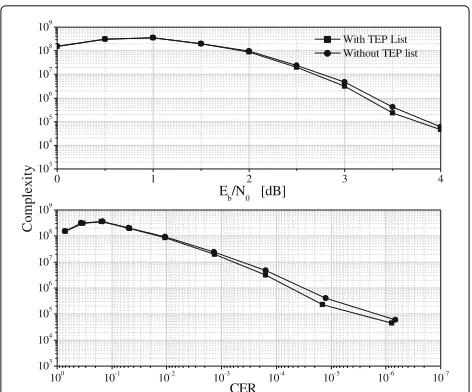
The result shown in Fig. 13 is not surprising since, when the complete TEP list is considered, the perturba-tion induced by ordering does not affect the error rate performance (the assumption is that, potentially, all TEPs can be tested both with and without ordering). However, it may have an impact on the complexity. The latter state-ment is confirmed in Fig. 14, where the curve without TEP list ordering exhibits complexity values higher than those in the presence of ordering.
Related with the complexity issue, it is also interesting to have a preliminary evaluation of the latency due to the MRB decoder. Latency is a measure of the time required for decoding and its value is normally subjected to restric-tions, which are expected to be particularly severe when the TC link is used in emergency conditions.
To have a first estimate of the average latency, let us consider (4), which provides the average complexity for the MRB algorithm, and remove from it the parameterq
(number of quantization bits). This is because we realis-tically suppose that, in hardware implementation, during
0 1 2 3 4 Without TEP list
Co
Fig. 14Average number of binary operations per decoding attempt for the LDPC(128, 64) code in the caseq=6 with and without ordered TEP list; the NMS + MRB(4) algorithm is used for decoding
each clock cycle a vector ofqbits is simultaneously pro-cessed. The first two terms in the resulting equation are due to the received word sorting and G computing; as such, they are performed only once per decoding attempt. We call these terms the “fixed cost.” The third term, instead, depends on the number of TEPs and may be dif-ferent for each decoding operation. We call this term the “variable cost.” As variable cost operations have to be per-formed for each TEP, they can be parallelized by assuming the availability of a number, noted by NTeu, of different
“TEP evaluation units.” This way, the average number of vector operations to be performed at each unit results in
OPeu=nlog2n+
where · represents the ceiling function. Denoting by
fclock the clock frequency, the average latency can be
estimated as
L= OPeu fclock
. (10)
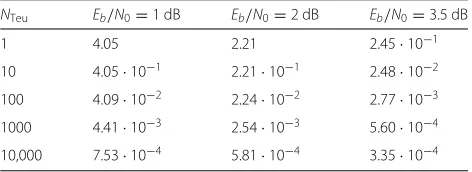
Examples of average latency estimates are reported in Table 1, assuming fclock = 100 MHz, for three
differ-ent values ofEb/N0. From the last column we see that at
Eb/N0 = 3.5 dB (which, according to Fig. 5, is sufficient
Table 1Average latency (in seconds) due to the MRB decoding process, by assumingfclock=100 MHz
NTeu Eb/N0=1 dB Eb/N0=2 dB Eb/N0=3.5 dB
1 4.05 2.21 2.45·10−1
10 4.05·10−1 2.21·10−1 2.48·10−2 100 4.09·10−2 2.24·10−2 2.77·10−3 1000 4.41·10−3 2.54·10−3 5.60·10−4 10,000 7.53·10−4 5.81·10−4 3.35·10−4
feasible in a field-programmable gate array (FPGA) imple-mentation. In absence of parallelization, i.e.,NTeu=1, the
average latency is about two orders of magnitude larger. As previously pointed out, another case that deserves investigation is the one where we have a reduced number of TEPs. Even in this case, it is interesting to distinguish the case when we use an ordered list stored in memory from the case when the TEPs are progressively generated, starting from the ones with the lowest weight. Figure 15 shows the CER, under hybrid decoding (NMS + MRB(4)), when exploiting the ordering; Fig. 16 illustrates the corre-sponding results in the absence of ordering. The number of TEPs is assumed to be variable between 10,000 and
NTEPmax = 679, 121. As expected, while the performance is independent of ordering when the complete list is con-sidered (as shown in Fig. 13) this is no longer true for a reduced list size. More precisely, when an ordered TEP list is adopted, considering 200,000 TEPs is enough to ensure that practically no loss occurs. On the contrary, if the list is non-ordered, the same result is achieved by using 400,000 TEPs or more, whereas if the maximum number of TEPs is set equal to 200,000, there is a loss in the order of 0.25 dB.
0 1 2 3 4 5
10-6
10-5
10-4
10-3
10-2
10-1
100
All (679121) 10K 17.5K 25K 50K 75K 100K 150K 200K 400K
CE
R
E
b/N0 [dB]
Fig. 15CER performance of the LDPC(128, 64) code with hybrid decoding for different sizes of the ordered TEP list (K=103)
0 1 2 3 4 5
10-6
10-5
10-4
10-3
10-2
10-1
100
All (679121) 10K 17.5K 25K 50K 75K 100K 150K 200K 300K 400K
CER
Eb/N0 [dB]
Fig. 16CER performance of the LDPC(128, 64) code with hybrid decoding for different numbers of non-ordered TEPs (K=103)
The maximum number of TEPs can be used, in turn, to estimate the maximum latency (i.e., the latency in the worst case), according to the method described before. In this case, there is no dependence on theEb/N0value, as
the worst-case latency occurs when all TEPs are needed for a single decoding operation. Table 2 reports the max-imum latency, considering fclock = 100 MHz, for both
the cases with and without ordering, by assuming 200,000 TEPs and 400,000 TEPs respectively.
ForNTeu = 100, when the list is ordered the latency is
at most about 84 ms while, when the list is non-ordered, it is at most about 170 ms. By tolerating a maximum latency of this size, it is possible to generate the TEPs on-the-fly with a minimum impact on the performance.
In Table 2, the worst-case latency has been determined by considering the MRB algorithm only. In the hybrid approach, the latency due to the IA must be taken into account as well. For fixing the ideas, in the following we suppose to apply the SPA but, obviously, the analysis can be repeated for any other IA.
Table 2Worst-case latency (in seconds) due to the MRB decoding process, with and without ordered list, by assuming fclock=100 MHz and a reduced number of TEPs
NTeu Ordered list - 200,000 TEPs Non-ordered list - 400,000 TEPs
1 8.40 16.79
10 8.40·10−1 1.68
100 8.43·10−2 1.68·10−1
Combining (9) with (6), where a generic number of iterationsI(i.e., not necessarily the average value) is con-sidered and the numberqof quantization bits is omitted, for the reasons explained above, the total latency results in
LTOT=LIA+LMRB=
1
fclock{
[In(9dv+12Rc−11)]
+
nlog2n+
k
2
3
+
NTEP
NTeu
2i+ n−k
2 +
nk
2
(11)
whereLIArepresents the contribution due to the IA and
LMRBthe contribution due to the MRB algorithm.
Let us denote the worst-case latency byLwTOTand let us suppose that, because of mission constraints, it is forced to not exceed a maximum valueLmax, i.e.,
LwTOT≤Lmax. (12)
When SPA is used alone, (12) is satisfied by assuming the maximum admissible number of iterations, even larger thanImax = 100, although in Section 4.2 we have shown
this may yield a negligible improvement. For the hybrid algorithm, instead, in order to satisfy (12), besidesI we can choose the value ofNTEPas well as the parallelization
parameterNTeu. A numerical example is reported next.
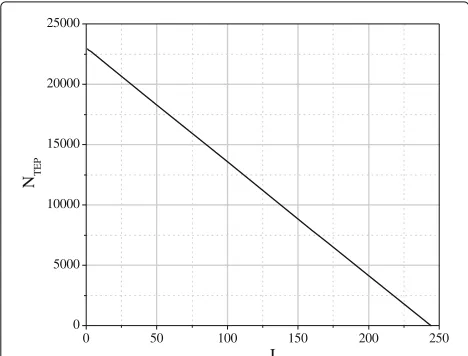
Example 2Let us assume Lmax = 10−2 seconds and
NTeu = 100. Figure 17 shows the trade-off between I and NTEPwhich allows to have LwTOT ≈ Lmax. The maximum
admissible number of iterations, for the assigned value of Lmax, is I = 244which corresponds to apply only the IA,
since no margin exists for invoking MRB. According to(11), Fig. 17 can be used also for different NTeu’s by properly scaling the values of NTEP.
0 50 100 150 200 250
0 5000 10000 15000 20000 25000
NTE
P
I
Fig. 17CombinationsI−NTEPwhich allows to haveLwTOT≈10−2 seconds
The degrees of freedom offered by the choice ofIand
NTEP, for a given value ofNTeu, can be used to optimize
the error rate performance. In other words, we can search for the combination which allows obtaining the minimum value of Eb/N0 for a given target CER. An example is
reported next.
Example 3As in Example 2, let us assume Lmax=10−2
seconds. Moreover, we fix CER = 10−5. Table 3 reports the minimum values of Eb/N0we have found, through a
numerical search, for the case of NTeu = 1and NTeu = 100, respectively, together with the corresponding optimal choice of I and NTEP. The choice of using SPA alone is also reported for the sake of reference.
From the table, we see that the usage of the hybrid algo-rithm is advantageous with respect to the SPA used alone for both the considered cases, with a gain in the order of 0.35 dB when NTeu=1and more than 1 dB when NTeu= 100.
6 Conclusions
We have investigated the advantages resulting from the application of the MRB algorithm, used alone or in hybrid form, to the new short LDPC codes for TC space links. We have discussed the impact of quantization, showing that rather small numbers of quantization bits are neces-sary to obtain performance very close to that of the ideal, unquantized case.
Special attention has been devoted to the evaluation of the complexity, expressed as the average number of binary operations required per each decoded codeword. Closed form expressions have been adopted for such a purpose. Our investigation has revealed that, as opposed to the common belief, the hybrid algorithm is a realistic and appealing option, and that it allows achieving, for both codes, the best known performance with an acceptable complexity.
An optimal implementation of the MRB algorithm would require the availability of an ordered TEP list and a rather large memory, which may be unavailable O/B. Therefore, we have also investigated the implications of using a non-ordered list and/or an incomplete list. We have shown that an “on-the-fly” implementation is even possible with limited loss and estimated the required decoding latency.
Table 3Values ofEb/N0 required to achieve CER = 10−5for different decoder configurations
NTeu=1 NTeu=100 SPA used alone
Eb/N0[dB] 4.75 4.09 5.10
I 170 20 244
-Although the proposed analysis refers to a very spe-cific application, that is, space TC links, many findings are usual in a wider sense, e.g., for the application of short codes to machine-to-machine communication or for ultra-reliable communication with short codes.
Endnote
1SinceGis a full rank matrix by definition, itsk rows
being linearly independent vectors of lengthn > k, the Gauss-Jordan elimination always succeeds. However, in case the k columns of G corresponding to the initial k
most reliable positions are not linearly independent, it may be necessary to replace some of the most reliable bits invwith some other bit outside the initial set.
Appendix
Given a real number x, its logarithmic quantization is performed by using the following rule
xnuq=xs
exp Qu(x,q,T)
−1
F (13)
where F is the so-called log-quantization factor. In our simulations, we have setF=0.67. Moreover
xs = sign(x)
beingT the clipping threshold (i.e., the maximum value admitted) anddthe quantization step. BothT anddare related to the number of quantization bits,q. The main advantage of the logarithmic rule, against the uniform one, is in the fact that the quantization levels are denser for small input values. Since the LLR values close to 0 are responsible for maximum decoder uncertainty, it is evi-dent that reducing the quantization error on these values allows to reduce the decoding errors. Further details can be found in [27].
Acknowledgements
The authors wish to thank Dr. Kenneth Andrews for helpful discussion on the weight spectrum estimation. They also wish to thank Prof. Ioannis Chatzigeorgiou for having suggested the test with the ideal decoder. This work was supported in part by the European Space Agency (ESA/ ESTEC) under the contract 4000111690/14/NL/FE “Next Generation of Uplink Coding Techniques – NEXCODE”. The final goal of the NEXCODE Project is the hardware and software implementation of LDPC decoding schemes for TC.
Competing interests
The authors declare that they have no competing interests.
Author details
1Dipartimento di Ingegneria dell’Informazione, Università Politecnica delle Marche, Ancona, Italy.2Consorzio Nazionale Interuniversitario per le Telecomunicazioni (CNIT), Parma, Italy.3Department of Electrical, Electronic, and Information Engineering “G. Marconi,” University of Bologna, Cesena, Italy.
Received: 16 April 2016 Accepted: 9 November 2016
References
1. JL Massey, inAdvanced Methods for Satellite and Deep Space Communications (Ed. J. Hagenauer), Lecture Notes in Control and
Information Science, ed. by J Hagenauer. Deep-space communications
and coding: a marriage made in heaven, vol. 182 (Springer, Heidelberg and New York, 1992), pp. 1–17
2. GP Calzolari, M Chiani, F Chiaraluce, R Garello, E Paolini, Channel coding for future space missions: new requirements and trends. Proc. IEEE.
95(11), 2157–2170 (2007)
3. T de Cola, E Paolini, G Liva, GP Calzolari, Reliability options for data communications in the future deep-space missions. Proc. IEEE.99(11), 2056–2074 (2011)
4. F Chiaraluce, inProc. 22nd Conference on Software, Telecommunications
and Computer Networks (SoftCOM 2014). Error correcting codes in
telecommand and telemetry for European Space Agency missions: an overview and new perspectives, (Split, 2014)
5. TK Moon,Error Correction Coding: Mathematical Methods and Algorithms. (Wiley, Hoboken, 2005)
6. CCSDS, TC synchronization and channel coding. Blue Book. CCSDS 231.0-B-2 (2010)
7. ECSS, Space data links—telecommand protocols, synchronization and channel coding. ECSS-E-ST-50-04C (2008)
8. LR Bahl, J Cocke, F Jelinek, J Raviv, Optimal decoding of linear codes for minimizing symbol error rate. IEEE Trans. Inf. Theory.IT-20(2), 284–287 (1974)
9. M Baldi, F Chiaraluce, R Garello, N Maturo, I Aguilar Sanchez, S Cioni, Analysis and performance evaluation of new coding options for space telecommand links—Part I: AWGN channels. Int. J. Sat. Commun. Netw.
33(6), 509–525 (2015)
10. J Hagenauer, E Offer, L Papke, Iterative decoding of binary block and convolutional codes. IEEE Trans. Inf. Theory.42(2), 429–445 (1996) 11. M Fossorier, M Mihaljevic, H Imai, Reduced complexity iterative decoding
of low-density parity check codes based on belief propagation. IEEE Trans. Commun.47(5), 673–680 (1999)
12. J Chen, MP Fossorier, Near optimum universal belief propagation based decoding of low-density parity check codes. IEEE Trans. Commun.50(3), 406–414 (2002)
13. M Fossorier, S Lin, Soft-decision decoding of linear block codes based on ordered statistics. IEEE Trans. Inf. Theory.41(5), 1379–1396 (1995) 14. Y Wu, CN Hadjicostis, Soft-decision decoding using ordered recodings on
the most reliable basis. IEEE Trans. Inf. Theory.53(2), 829–836 (2007) 15. M Baldi, F Chiaraluce, N Maturo, G Liva, E Paolini, A hybrid decoding scheme for short non-binary LDPC codes. IEEE Commun. Lett.18(12), 2093–2096 (2014)
16. CCSDS, Short block length LDPC codes for TC synchronization and channel coding. Orange Book CCSDS 231.1–O–1 (2015)
17. M Baldi, M Bianchi, F Chiaraluce, R Garello, I Aguilar Sanchez, S Cioni, in
Proc. IEEE 78th Vehicular Technology Conference (VTC Fall 2013). Advanced
channel coding for space mission telecommand links, (Las Vegas, 2013) 18. M Baldi, N Maturo, G Ricciutelli, F Chiaraluce, inIEEE 21st IEEE Symposium
on Computer and Communications (ISCC 2016). On the error detection
capability of combined LDPC and CRC codes for space telecommand transmissions, (Messina, 2016), pp. 1105–1112
19. M Baldi, N Maturo, F Chiaraluce, E Paolini, inProc. 6th International
Conference on Information and Communication Systems (ICICS 2015). On
the applicability of the most reliable basis algorithm for LDPC decoding in telecommand links, (Amman, 2015)
21. GC Clark, JB Cain,Error Correction Coding for Digital Communications. (Plenum Press, New York, 1981)
22. K Andrews, Weight enumerators for LDPC codes. CCSDS 2015 spring meetings presentation, Pasadena (2015)
23. D Declercq, M Fossorier, inProc. IEEE International Symposium on
Information Theory (ISIT 2008). Improved impulse method to evaluate the
low weight profile of sparse binary linear codes, (Toronto, 2008), pp. 1963–1967
24. X-Y Hu, MPC Fossorier, E Eleftheriou, inProc. 2004 IEEE International
Conference on Communications (ICC 2004). On the computation of the
minimum distance of low-density parity-check codes, vol. 2, (Paris, 2004), pp. 767–771
25. A Kabat, F Guilloud, R Pyndiah, inProc. IEEE Global Telecommunications
Conference (GLOBECOM ’07). New approach to order statistics decoding of
long linear block codes, (Washington, 2007), pp. 1467–1471 26. M Fossorier, Iterative reliability-based decoding of low-density parity
check codes. IEEE J. Select. Areas Commun.19(5), 908–917 (2001) 27. M Baldi, F Chiaraluce, G Cancellieri, Finite-precision analysis of demappers
and decoders for LDPC-coded M-QAM systems. IEEE Trans. Broadcast.
55(2), 239–250 (2009)
Submit your manuscript to a
journal and benefi t from:
7 Convenient online submission 7 Rigorous peer review
7 Immediate publication on acceptance 7 Open access: articles freely available online 7 High visibility within the fi eld
7 Retaining the copyright to your article