_____________________________________________________________________________________________________
*Corresponding author: E-mail: [email protected];
www.sciencedomain.org
Assessment of School Health Instruction
Implementation in Primary Schools in a Local
Community in South-East Nigeria: A Comparative
Study between Private and Public Schools
Osuorah DI. Chidiebere
1*, Ulasi O. Thomas
1, Ebenebe Joy
1,
Ekwochi Uchenna
2, Onah K. Stanley
1, Ndu K. Ikenna
2and Asinobi N. Isaac
21
Department of Paediatrics, Nnamdi Azikiwe University Teaching Hospital, Nnewi Anambra, Nigeria. 2
Department of Paediatrics, Enugu State University of Science and Technology, Enugu State, Nigeria.
Authors’ contributions
This work was carried out in collaboration between all authors. Authors ODIC, UOT and EJ conceived the study idea and designed the study protocol. Author ODIC managed the data collection and did the analyses of the data. Authors EU, OKS, NKI and ANI contributed in the literature search and writing of the first draft of the manuscript. Authors UOT and EJ supervised and reviewed the final draft of the manuscript. All authors read and approved the final manuscript.
Article Information
DOI: 10.9734/BJMMR/2016/23737 Editor(s): (1)Rui Yu, Environmental Sciences & Engineering, Gillings School of Global Public Health, The University of North Carolina at Chapel Hill, USA.
Reviewers: (1)Imran Aslan, Bingol University, Turkey. (2)Avik Chatterjee, Brigham and Women’s Hospital, Boston, USA. Complete Peer review History:http://sciencedomain.org/review-history/13123
Received 19th December 2015 Accepted 8th January 2016 Published 30th January 2016
ABSTRACT
Schools have the responsibility to educate their students and encourage them to live healthy and hygienic behavior. This descriptive cross-sectional study aimed to determine the status of the school health instruction in 56 randomly selected schools in Nnewi North Local Government area of Anambra state using the school health program evaluation scale. It also assessed the extent of implementation of provisions of school health instruction in these schools. Forty six (78.6%) of the 56 schools surveyed had adequate implementation of school health instruction. The proportion of school that met the requisite score (16) for adequate implementation of school health instruction was not significantly different between private and public schools [24(73%) vs. 20(87%), P=0.389]. There was also no significant difference in mean scores attained for school health instruction
between private and public schools (17.6±4.4 vs. 17.6±3.6; P=0.939). Private school had more non classroom related heath activity compared to public schools (75.8% vs. 21.7%, P=0.000) while public schools, had significantly more qualified health instructors, ten (43.5%) compared to private schools six (18.2%), P=0.040. Training and retraining of primary school teachers coupled with effective school health policies would be essential in ensuring adequate and optimal implementation of school health instructions in primary schools.
Keywords: Health instruction; primary schools; private schools; public schools; Nnewi.
1. INTRODUCTION
Education of pupils on issues of health and hygiene through health education form part of the School Health Programme [1]. Some areas covered by health education instruction include; personal hygiene and sanitation, prevention against communicable diseases, HIV and AIDS prevention education, guidance and counseling for older pupils on puberty issues, anti-drugs and mental health education, healthy food and nutrition, sports and physical education, environment education, life skills based education etc. [2] Allensworth and Kolbe [3] encouraged the promotion of school health education on international and national levels, arguing that school health programmes that coordinate delivery of health education and health services could become one of the most efficient means to significantly improve the well-being of young people. In Nigeria, health education programs are implemented in many schools to increase levels of knowledge, influence attitudes and encourage healthy behaviors among school students. The positive effect of school health instruction on students has been reported on several studies within and outside Nigeria [4-6]. For successful implementation of school health education in schools, well qualified and trained teachers are expedient. In view of this, the WHO has advocated for the training of school teachers in particular health subjects with emphasis on the head teachers who have been proposed as a catalyst in the implementation of school health programme [7]. This study assessed the status of school health instruction in primary schools in Nnewi North local government area of Anambra State and compared the extent of its implementation between private and public schools in the community.
2. METHODOLOGY
2.1 Study Area
This study was conducted in Nnewi North Local Government Area (NNLGA), one of the 21 local
government areas in Anambra State over a 6 months period. Nnewi, the only town in the LGA is a semi-urban town with rural villages on its periphery. It is the 2nd largest city in Anambra State and has an estimated population of 391,227 according to the 2007 national census with a surface area of 2,789 km2 giving a population density of about 140/km2. It is a fast growing town, often referred to as the industrial and commercial hub of South-Eastern Nigeria. Its people are predominantly Igbo and mainly Christians [8]. A number of health facilities are located in the LGA and notable among them is the Nnamdi Azikiwe University Teaching Hospital, which serves as a referral center for patients from within and outside the state [9].
2.2 Study Design and Sampling
Technique
This was a descriptive cross-sectional and comparative study of public and private primary schools in Nnewi North LGA. The study used a sampling ratio of 50% to enlist 56 schools out of the 110 primary schools in Nnewi North LGA of Anambra State [10]. A multi-stage sampling technique was used in selecting the schools employed in the study. In the first stage, the schools were stratified into two categories i.e. public and private schools based on ownership. In each category, a sampling ratio of 50% was applied in obtaining the number of schools that were enrolled for the study. In the second stage the schools visited in each category were chosen from a list of schools obtained from the educational authority in the local government area. A simple random selection technique using balloting was used to select 33 private and 23 public schools from the sampling frame of 65 private and 45 public schools respectively. Only primary schools 6 years and above registered with the State Primary School Education Board were included in this study.
2.3 Data Collection
The validated scale consists of 4 parts that includes school health services, school health instruction, healthy school environment and community participation. The scale also included a section for some information on the school such as school location, school population, school foundation age, and presence of health educators in the surveyed schools. The section on school health instruction had item scored based on presence of certain health instruction activities within each school curricular. The maximum obtainable score and minimum score indicative of acceptable school health instruction implementation was 32 and 16 respectively. The evaluation scale was completed by the principal investigator and research assistants that interviewed the head teacher and/or health staff and inspection of various facilities related to health instruction within each school. Other information obtained from the evaluation included time allocated to health instruction categorized as < 2 hours per week and ≥2 hours per week;
scope of health education i.e. physical, mental,
sexual, community health etc. Teaching methods
adopted during health instruction and type of instructors that teaches health subjects categorized as ordinary where teachers without training or qualification in a health subject takes health subjects, trained where teachers without a formal qualification but trained in teaching in health-related subjects and qualified where teachers with a formal qualification in health related subject takes health instruction in the school. These elements of the school health services were allocated scores based on the school health evaluation scale and the total score calculated for each school. None of the schools was notified prior to visit to minimize bias.
2.4 Data Analysis
Data obtained in the study was analyzed using the statistical package SPSS version 19. The total score for each school was collated and the mean and standard deviation for both public and private schools computed. Student t-test was used to compare the means while relationship between categorical data was determined using chi-square and Fischer’s exact test. Statistical significance was set at p < 0.05.
2.5 Ethical Clearance and Permission
Written permission was obtained from the State Primary school education Board [ASUBEB] through the Nnewi North L.G.A Education Authority. The Nnamdi Azikiwe University
Teaching Hospital Ethical committee gave its approval to carry out this study. Informed consent was also obtained from every teacher before interviews were conducted.
3. RESULTS
3.1 Characteristics of Schools Surveyed
Of the 56 schools surveyed, 33(58.9%) were private and 23(41.1%) were public schools. Table 1 shows the summary characteristics of schools enlisted for this study. Private and public schools differed significantly in school location, population, foundation age, and number of health educators with qualification in health related subjects.
3.2 School Health Instruction
3.2.1 Time allocated to health instruction
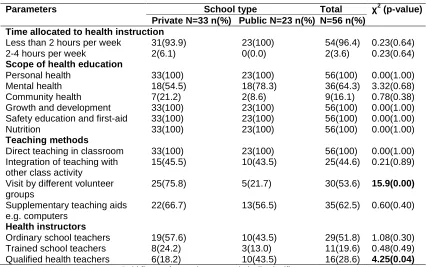
All the schools surveyed had health and health-related subject in their curriculum. Fifty-four, (96.4%) of the 56 surveyed schools assigned less than 2 hours to health instruction amounting to less than 4 periods per week (one period is approximately 30 minutes). Thirty-one (93.9%) of these 54 schools were private and 23(100%) were public schools. Two (6.1%) private schools devoted between 2-4 hours to health instruction per week. There was no significant difference between private and public schools in the proportion of time allocated to health instruction (p = 0.640) (Table 2).
3.2.2 Scope of health education
Personal health, growth and development, safety education and first aid, and nutrition were taught by all schools surveyed, not as separate subjects but integrated into Health Education. Eighteen private (54.5%) and public (78.3%) schools also incorporated mental health in personal health while seven (21.2%) and 2(8.6%) public schools taught community health in addition. The scope of the health related subject taught in both school types were not significantly different (Table 2).
3.2.3 Teaching method
activities such as play, concert and practical class room activity during health education (p=0.884). In addition to these, occasional health talks to pupils by medical and other volunteer groups also took place in 25(75.8%) private and
5(21.7) public schools (p=0.001). Supplementary teaching aids such as film, television shows, computers etc, were used in 22(66.7%) private schools compared to 13(56.5%) public schools (Table 2).
Table 1. Characteristics of surveyed schools
School characteristics School Type Х2(P)
Private n (%) Public n (%)
School location N=33 N=23
Rural 4(12.1) 11(47.8) 7.1(0.008)
Urban 29(87.9) 12(52.2)
School population N=33 N=23
Less than 500 27(87.9) 9(39.1) 10.1(0.001)
500 or more 6(18.2) 14(60.9)
School foundation age N=33 N=23
Less than 10 8(24.2) 0(0) 38.8(0.001)
10 or more 25(75.8) 23(100)
School staff N=395 N=698
Teaching 331(83.7) 576(82.5) 0.21(0.687)
Non teaching 64(16.2) 122(17.5)
Health educator N=33 N=23
Yes 29(87.9) 21(91.3) 0.17(0.683)
No 4(12.1) 2(8.7)
Health educator with qualification N=33 N=23
Yes 10(34.5) 16(76.2) 8.49(0.004)
No 19(65.5) 5(23.8)
Bold p-values are statistically significant
Table 2. Health instruction parameters in surveyed schools
Parameters School type Total χ2 (p-value)
Private N=33 n(%) Public N=23 n(%) N=56 n(%) Time allocated to health instruction
Less than 2 hours per week 2-4 hours per week
31(93.9) 2(6.1)
23(100) 0(0.0)
54(96.4) 2(3.6)
0.23(0.64) 0.23(0.64)
Scope of health education
Personal health Mental health Community health Growth and development Safety education and first-aid Nutrition
33(100) 18(54.5) 7(21.2) 33(100) 33(100) 33(100)
23(100) 18(78.3) 2(8.6) 23(100) 23(100) 23(100)
56(100) 36(64.3) 9(16.1) 56(100) 56(100) 56(100)
0.00(1.00) 3.32(0.68) 0.78(0.38) 0.00(1.00) 0.00(1.00) 0.00(1.00)
Teaching methods
Direct teaching in classroom Integration of teaching with other class activity
Visit by different volunteer groups
Supplementary teaching aids e.g. computers
33(100) 15(45.5)
25(75.8)
22(66.7)
23(100) 10(43.5)
5(21.7)
13(56.5)
56(100) 25(44.6)
30(53.6)
35(62.5)
0.00(1.00) 0.21(0.89)
15.9(0.00)
0.60(0.40)
Health instructors
Ordinary school teachers Trained school teachers Qualified health teachers
19(57.6) 8(24.2) 6(18.2)
10(43.5) 3(13.0) 10(43.5)
29(51.8) 11(19.6) 16(28.6)
1.08(0.30) 0.48(0.49)
4.25(0.04)
3.2.4 Health instructors
Qualifications of health instructors in surveyed schools included Bachelor degree, diplomas or certificates in health related subjects such as Biology, Home Economics, Health Education, Physical Education, Health Promotion and Community Health Education. Qualified teachers were health instructors in 6 (18.2) and 10 (43.5%) private and public schools respectively (p= 0.04).
3.2.5 Total score for school health instruction evaluation
Of the schools surveyed, 9 (27.0%) of private schools and 3 (13.0%) of public schools scored below the minimum acceptable score of 16. The proportion of private vs. public schools (73% vs. 87%, P=0.389) that scored above the minimum required score and their mean score (17.6±4.4 vs. 17.7±2.2, P=0.939) was not significantly different for school health instruction.
4. DISCUSSION
The study showed that school health instruction as contained in the national school health policy of Nigeria was present in the surveyed schools [11]. Both the private and public school surveyed attained the minimum required scores with regards to school health instruction assessment. Also, the scope of health instructions taught in the schools surveyed showed no significant difference. This may be due to the uniform educational curriculum specified by the state educational authority. This finding is in contrast to that of Toma [12] who reported that all the schools surveyed in Jos North LGA scored below the minimum acceptable scores. The author explained that the poor scores were due to poor teacher’s qualification. Although the time allocated to health instruction in both the private and public was not significantly different, it was not in line with the guideline by the National Council for Curriculum and Assessment [13] that recommends at least 2 hours (i.e. 4
periods) per week. A study by Akani [14] in Obi-akpor LGA of River State noted that while 71% of schools surveyed allocated two
periods (about one hour), less than a fifth of surveyed schools allocated 3 periods (about 1.5 hours) per week to health-related subjects. This inadequate allocation of time to health education was also reported in another study in Edo state where 70% of surveyed teachers were of the opinion that the time allocated to health education in their respective schools was inadequate [15].
Teachers with the requisite qualifications taught health instruction in only a small proportion of the schools surveyed, with public school having a significantly higher number of qualified health educators. This observation contrasts with Akani’s [14] report which showed that none of the 28 schools surveyed had qualified health instructor. This may be related to the worsening unemployment rate in Nigeria today as opposed to the 1990s when Akani carried out the study. Today, due to limited job opportunities, many graduates take up teaching posts just to earn a living. The higher proportion of qualified health teachers seen in this study may also be related to the Universal Basic Education scheme introduced in 1999 by the Obasanjo’s administration which has laid emphasis on training and retraining for primary school teachers across the nation [16]. Although no consensus seems to exist on the positive effect of teacher’s qualification on student performance, several authors [17-20] believe that strengthening teachers training might be a key factor for achieving good learning outcome in health and other subject area. Idehen and Oshodin in their study noted that the lack of health education teachers and relevant health education textbooks were factors central to the poor state of health instruction in Edo State secondary schools [15].
The findings of inadequate time allocation to health instruction and poor training in health related subjects of teachers may deprive pupil’s the knowledge and skills needed to keep healthy. This in turn may result in poor educational achievement and increased morbidity and mortality among them. This stresses the need for continued professional development and retraining of teachers in order to improve their knowledge and skills in activities related to impacting health knowledge to pupils.
5. CONCLUSION
There is need for sustained improvement in the school health instruction delivery in primary schools in Nnewi and other primary schools across the nation through continued teachers training and regular evaluation of policies in other to meet best global standards.
DECLARATION
COMPETING INTERESTS
Authors have declared that no competing interests exist.
REFERENCES
1. Nkinyangi A, Vander V. Child Health, Nutrition and Educational Participation. UNESCO; 1985.
2. UNESCO School Health Programme. A Strategic approach for improving health and education in Pakistan. 2010;6-10. 3. Allensworth DD, Kolbe LJ. The
comprehensive school health programme: Exploring an expanded concept. J Sch Hlth. 1987;409-412.
4. Fawole IO, Asuzu MC, Oduntan SO, Brieger WR. A school-based AIDS education program for secondary school students in Nigeria: A review of effectiveness. Hlth Ed Res – Theory & Pract. 2004;675-683.
5. IIika AL, Obionu CO. Personal hygiene practice and school based health education of children in Anambra State, Nigeria. The Nig Postgrad Med J. 2002;79-82.
6. Sexual and Reproductive Health of Adolescent and Youths in Mongolia: Review of Literature and Project. 2002;22-27.
7. Akani N, Nkanginieme KEO. The role of the school teacher especially the head teacher. In: Akani N, Nkanginieme KEO, eds. Introduction to School Health Programme. Sunray Books Ltd, Port-Harcourt. 1996;11-18.
8. National Population Commission. Population and Housing Census 2006- Priority table volume IV, Abuja; 2010. 9. Health Services Department. Health
Establishment records, Nnewi North LGA; 2008.
10. Ministry of Education, Anambra State. Anambra State Universal Basic Education Board Records; 2008.
11. Federal Ministry of Education Nigeria: National School Health Policy. Federal Secretariat Complex, Maitama Abuja; 2006.
12. Toma BO. Evaluation of the Status of School Health Programme in Primary School in Jos North L.G.A. A Dissertation submitted to the West African College of Physician (Paed.); 2004.
13. National Council for Curriculum and Assessment (NCCA). Primary School Curriculum for Social, Personal and Health Education. Irish National Teachers’ Organization Dublin. 1999;246-248. 14. Akani NA. The effect of a short training of
head teachers on the implementation of school health programme in primary schools in Obio-Akpor Local Government Area, Rivers State: A dissertation submitted to the National Postgrad Med College of Nigeria; 1994.
15. Idehen CO, Oshodin OG. Factors affecting health instruction in secondary schools in Edo State, Nigeria. Ethno Med. 2008;2(1): 61-66.
16. Universal Basic Education commission 2005. Basic Education data.
Available:http://ubeconline.com/about_ube c.html (Accessed on 17/12/2013)
17. Darling-Hammond L, Berry B, Thorenson A. Does teacher certification matter? Evaluating the evidence. Educational Evaluation Policy and Analysis. 2001;23: 57-77.
18. Ashton P, Crocker L. Systematic study of planned variation: The essential focus of teacher education reform. J Teacher Ed. 1987;3:2-8.
19. Everston CW, Hawley W, Zlotnik M. Making a difference in educational quality through teacher education. J Teacher Ed 1985;36:2-12.
20. Ferguson P, Womack ST. The impact of subject matter and education coursework on teaching performance. J Teacher Ed. 1993;44:155-163.
_________________________________________________________________________________ © 2016 Chidiebere et al.; This is an Open Access article distributed under the terms of the Creative Commons Attribution License (http://creativecommons.org/licenses/by/4.0), which permits unrestricted use, distribution, and reproduction in any medium, provided the original work is properly cited.
Peer-review history: