On the performance of certain Private Set Intersection protocols
∗Emiliano De Cristofaro1 and Gene Tsudik2
1 PARC 2 UC Irvine
April 7, 2012
Abstract
Private Set Intersection (PSI) is a useful cryptographic primitive that allows two parties (client and server) to interact based on their respective (private) input sets, in such a way that client obtains nothing other than the set intersection, while server learns nothing beyond client set size. This paper considers one PSI construct from [DT10] and reports on its optimized implementation and performance evalua-tion. Several key implementation choices that significantly impact real-life performance are identified and a comprehensive experimental analysis (including micro-benchmarking, with various input sizes) is presented. Finally, it is shown that our optimized implementation of this RSA-OPRF-based PSI protocol markedly outperforms the one presented in [HEK12].
1
Introduction
Private Set Intersection (PSI) is a primitive that allow two parties (client and server), to interact on their respective input sets, such that client only obtains the intersection of the two sets, whereas, server learns nothing beyond the size of client input set. PSI is appealing in many real-world settings: common application examples include national security/law enforcement [DT10], Intelligence Community systems [DJL+10], healthcare and genomic applications [BBD+11], collaborative botnet detection techniques [NMH+10], lo-cation sharing [NTL+11] as well as cheating prevention in online gaming [BLHB11]. Motivated by prac-tical relevance of the problem, the research community has considered PSI quite extensively and devised a number of techniques that vary in costs, security assumptions and adversarial models, e.g., [FNP04,KS05, HL08, JL09, DSMRY09,DT10, HN10,JL10, DKT10,ADT11]. (Notable PSI protocols are reviewed in AppendixA.)
In this paper, we focus on a specific RSA-OPRF-based PSI protocol from [DT10] that currently offers the most efficient operation. It achieves linear computational and communication complexity and improves overall efficiency (over prior work) by reducing the total cost of underlying cryptographic operations. Al-though [DT10] actually presents two PSI protocols, this paper focuses on the second – RSA-OPRF-based, in Figure 4 of [DT10] – which is the more efficient of the two. Hereafter, it is referred to asDT10-v4.
Objectives: We discuss our implementation ofDT10-v4and experimentally assess its performance. Our goal is twofold: (1) Identify implementation choices that impact overall protocol performance, and (2) Provide a comprehensive performance evaluation.
Organization: Next section overviewsDT10-v4. Then, Section3and Section4describe, respectively, its implementation and performance evaluation. Finally, performance analysis of our optimized implementation is contrasted with that in [HEK12].
∗
2
The DT10-v4 PSI Protocol
We now review the PSI protocol presented in Figure 4 in [DT10], from here on denoted asDT10-v4. First, we introduce some notation, present actual construction, and, finally, discuss settings where (server-side) precomputation is possible/recommended.
2.1 Notation
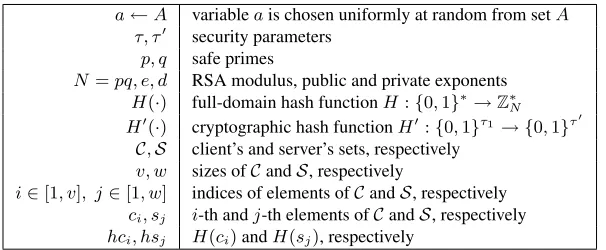
Notation used in the rest of this paper is reflected in Table1below:
a←A variableais chosen uniformly at random from setA τ, τ0 security parameters
p, q safe primes
N =pq, e, d RSA modulus, public and private exponents
H(·) full-domain hash functionH :{0,1}∗→Z∗N
H0(·) cryptographic hash functionH0:{0,1}τ1→ {0,1}τ0 C,S client’s and server’s sets, respectively
v, w sizes ofCandS, respectively
i∈[1, v], j∈[1, w] indices of elements ofCandS, respectively
ci, sj i-th andj-th elements ofCandS, respectively
hci, hsj H(ci)andH(sj), respectively
Table 1:Notation
2.2 Protocol Specification
Figure1shows the operation ofDT10-v4below.
Client, Server,
on inputC={c1, . . . , cv} on inputp, q, d,S={s1, . . . , sw}
∀i= 1, . . . , v: ∀j= 1, . . . , w:
(1) ri←ZN (1) ksj= (hsj)dmodN
(2) µi=hci·riemodN (2) tsj=H0(ksj)
(3)
{µ1, . . . , µv}
/
/ (3)
∀i= 1, . . . , v: (4) µ0i= (µi)dmodN (4)
{ts1, . . . , tsw} {µ01, . . . , µ
0
v}
o
o
∀i= 1, . . . , v:
(5) kci=µ0i/rimodN (6) tci=H0(kci)
(7) If∃js.t.tci=tsjoutputci∈ C ∩ S
Figure 1:DT10-v4executes on common input:N, e, H(·), H0(·).
Correctness:Ifci ∈ C ∩ S, then∃js.t.:kci =µ0i/ri = (hci·rie)d/ri =hsjd=ksj =⇒tci=tsj.
paradigm.1 Thus, security ofDT10-v4may actually hold in the presence of a malicious client and a semi-honest server. Further, security against a malicious server also seems easy to obtain: RSA signatures have the desirable property of verifiability, thus, client can easily verify server’s adherence to the protocol with respect to the computation ofµ0i = (µi)dmodN. Also, client’s message to server (i.e., the first round) does
not depend on any information from latter, which, in fact, produces no output. However, server would need to prove that its RSA parameters are generated correctly, and it could do so using, for example, techniques from [CM99] or [HMRT11]. Nonetheless, we leave as part of future work formal proofs for malicious security ofDT10-v4.
Communication Complexity: DT10-v4communication complexity amounts to2vgroup elements andw hash outputs. Specifically, in the first round, client sendsvelements inZN, whereas, in the second, server
transfersvelements inZN andwoutputs ofH0(·). For 80-bit security, SHA-1, which has 160-bit outputs,
may suffice.
Computational Complexity:We note that server workload can be dramatically reduced if exponentiations
(·)dmodNare optimized using theChinese Remainder Theorem(CRT)2, since server knows factorization
ofN. Specifically,DT10-v4’s computational complexity is as follows. Servercomputes: w full-domain hashes;2w+ 2vmodular exponentiations with(|N|/2)-bit exponents and(|N|/2)-bit moduli (using CRT); w invocations ofH0(·). Client computes: v full-domain hashes; v exponentiations with|e|-bit exponent and|N|-bit modulus (in practice, one can select e = 3); v modular inverses of |N|-bit integers modulo
|N|bits;2vmodular multiplications of|N|-bit integers modulo|N|bits;vinvocations ofH0(·). Thus, on server side, computational complexity is dominated byO(w+v) CRT exponentiations, whereas, client’s computation is dominated byO(v)modular multiplications and inverses. Since client does not performany expensive cryptographic operation (i.e., no modular exponentiations), DT10-v4is particularly suited for scenarios whereclient runs on a resource-poor device, e.g., a smart-phone.
2.3 Precomputation
One beneficial feature ofDT10-v4, as well as some other PSI techniques in [HL08], [JL09], [JL10], is that server computation over its own input does not depend on any client input. Therefore:
1. Server does not need to wait for client to perform itswexponentiations to computeksj =H(hsj)dmod
N (forj = 1, . . . , w). These operations can be done as soon as server set is available. In the absolute worst case, server can perform these operations in parallel with receiving client’s first message.
2. Results of server computation over its own set can be re-used in multiple protocol instances. Thus, unless server’s set changes frequently, the overhead is negligible.
In light of the above, [DT10] suggests to divide the protocol into two phases:off-lineandon-line. This way, computational complexity of the latter is dominated by O(v) CRT exponentiations, while off-line phase overhead amounts toO(w)CRT exponentiations. This makesDT10-v4particularly appealing for scenarios where server input set is not“very dynamic”.
3
Implementing DT10-v4
This section presents our implementation ofDT10-v4PSI construction from [DT10]. We discuss some design choices that may affect overall performance, present our prototype implementation, and discuss
1
Specifically, the proof constructs of an (adaptive) ideal world simulatorSIMcfrom a malicious real-world clientC∗, and
shows that the views ofC∗in the real game with the real-world server and in the interaction withSIMcare indistinguishable. 2
additional techniques to optimize performance.
3.1 Important Design Choices
We now identify and discuss some factors that significantly affect overall performance of DT10-v4
implementation. We begin with straightforward issues and then turn to some less trivial strategies. (Note: for the sake of generality, we assume below that server does NOT perform precomputation.)
1. Small RSA public exponent: Recall from Section 2.2, that the only modular exponentiations per-formed by client are those in step (2), specifically, raising random values ri-s to the e-th power
(mod N). Therefore, the choice of RSA public exponentedirectly influences client run-time. Com-mon choices ofeare: 3,17, and 216+1= 65537. The cryptography research community has often raised concerns related to possible attacks when usinge= 3for RSA encryption [Bon98,FKJM+06]. However, although further careful consideration is needed, such concerns do not seem to apply in this setting, sinceri-s are generated anew, at random.
2. Chinese Remainder Theorem: On server side, the most computation-intensive operations are expo-nentiations(·)dmodN – in steps(1)and(4). As discussed in Section2.2, these can be optimized
using (CRT). Specifically, it is well known that using CRT can make exponentiations 4 times faster.
3. Pipelining: While we describeDT10-v4as a sequence of steps, pipelining can be used to maximize overall efficiency by minimizing wait times. A good start is to implement computation and communi-cation in separatethreads, such that independent operations can be performed in parallel. (Note that this does not presume that underlying hardware has multiple cores). Specifically:
a) Server can computetsj =H0((hsj)dmodN),j= 1, . . . , w(i.e., steps(1)-(2)), as soon as (sj’s)
are available, i.e., even before starting interaction with client, or, in the worst case, as soon as client starts transmitting. This is as simple as implementing server’s steps(1)-(2)in a dedicated thread.
b) Server does not need to wait forµi+1, . . . , µvto arrive in order to computeµi0 = (µi)dmodN.
To minimize waiting, we simply need to implement exponentiations in a separate thread drawing input from a shared buffer, where the thread listening on the channel pushes received values.
c) Similarly, client can computeri−1(needed to computeµi/rimodN) in step(5)in parallel with
steps(2)-(4).
d) Finally, client does not need to wait forµ0i+1, . . . , µv to arrive to computetci =H0(µ0i/ri mod
N), i.e., steps(5)-(6).
4. Threading in Multi-Core Settings: Structuring the code in multiple threads allows us to further im-prove overall performance. For example, on server side, we can create two threads for step(1)and step(4), respectively. Thus, if multiple cores are available (or the computing architecture using ag-gressive pipelining), these operations are performed in parallel, thus, lowering overall run-time. Once again, we note that parallel thread execution is transparent to application developers and normally incurs no extra costs.
1024-bit 2048-bit 3072-bit
C/GMP 0.60ms 4.44ms 14.08ms
C/OpenSSL 0.81ms 6.12ms 20.89ms
Java (v1.6.0 23) 3.33ms 24.47ms 76.91ms
Ratio Java/GMP 5.55 5.51 5.46
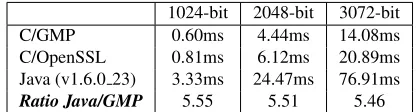
Table 2:Benchmarking of modular exponentiations with increasingly large moduli.
3.2 Prototype Implementation
We now report on the design of a prototype implementation for theDT10-v4PSI protocol. It is imple-mented in C, using the GMP library for large integer arithmetic and OpenSSL for key generation and hash function implementation. Motivated by the design choices above, we use multi-threading and the GMP library for operations on large integers, e.g., modular exponentiations, multiplications, and inverses.
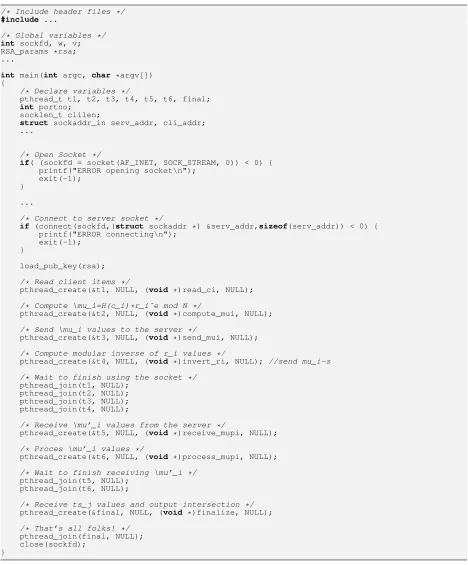
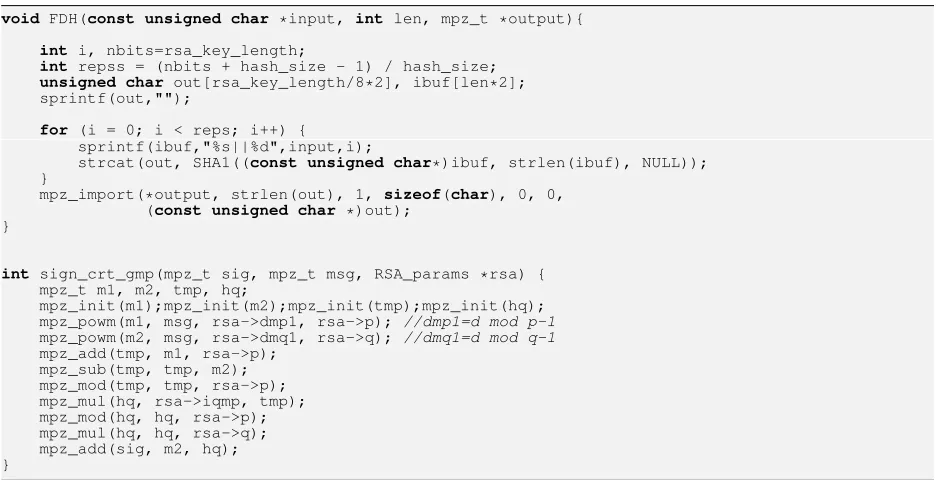
Remark: The reported pseudo-code does not describe by any means a working implementation. Our goal is to outline an intuition of our prototype design following the discussion in Section 3.1. Nonetheless, it mirrors the software used in our experiments, presented in Section4, which can be obtained upon request from the authors.
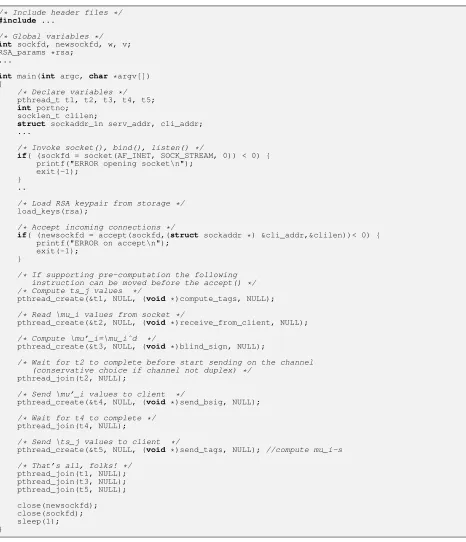
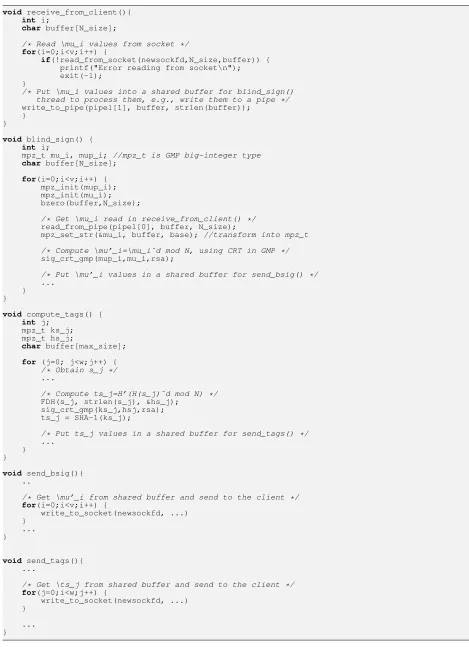
Pseudo-code: Figure 12 and Figure 13 overview DT10-v4 PSI server software. The client side is only sketched, in Figure14, and detailed subroutines are not outlined to ease presentation. Figure15describes some of the auxiliary functions used by our prototype. (Figures appear at the end of the report).
3.3 Additional Performance-optimizing techniques
Besides design choices discussed in Section 3.1 above – all of which can be easily adopted – there are some less obvious aspects that can help us further optimize implementation of DT10-v4. Although we discuss them below, we defer their implementation to the next version of the prototype, since these optimizations appeal to specific settings. Whereas, this paper focuses on the general PSI scenario.
1. Bottleneck identification: In settings where the PSI protocol is executed over the Internet and com-munication takes place over slow links, comcom-munication overhead is likely to become the bottleneck. For instance, consider a scenario, where server runs on an Intel Xeon CPU at 3.10GHz. Using GMP, it takes, on average, 0.15ms to perform(·)dmodN exponentiations, with 1024-bit moduli,
using CRT. Therefore, one can estimate the link speed at which the bottleneck becomes transmis-sion of the{µi}vi=1 and{tsj}wj=1 values, respectively. Specifically, if network speed is lower than:
|µ0i| time =
1024bits
0.15ms = 7.31Mbps, it takes longer to transmitµ0i than to compute it. Whereas, if network
speed is lower than: |tsj|
time = 1600.15bitsms = 1.14Mbpsthen it takes longer to sendtsj than to compute it.
These estimates could be useful for further protocol optimizations; see below.
2. Exploiting parallelism: Many modern desktops and laptops have multiple cores. Thus, if the bottle-neck is computation of(·)dexponentiations, the server-side thread in charge of receiving{µ
i}vi=1will
push them into the buffer faster than the thread computing{(µi)d}vi=1 can pull them. With multiple
cores, exponentiations of multiple values in the buffer could be done in parallel. Similarly, computa-tion of{(hsj)d}wi=j does not depend on any other information; thus, it could be parallelized too.
4
Performance Evaluation
We now present a detailed performance evaluation of ourDT10-v4implementation.
Experimental Setup. Experiments are performed on the following testbed: PSI server ran on a Linux computer, equipped with an Intel Xeon E31225 CPU (running at 3.10GHz). PSI client ran on a Mid-2011 13-inch Apple Macbook Air, with an Intel Core i5 (running at 1.7GHz). Server and client are connected through a 100Mbps Ethernet LAN. The code was written in C using the GMP library for modular arithmetic operations and OpenSSL for other cryptographic operations (such as, random numbers and key generation, hash function invocations). Finally, note that we used 1024-bit, 2048-bit, or 3072-bit RSA moduli and SHA-1 to instantiate theH0(·)function.
4.1 Protocol Total Running Time
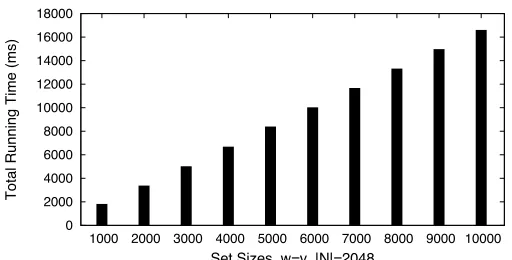
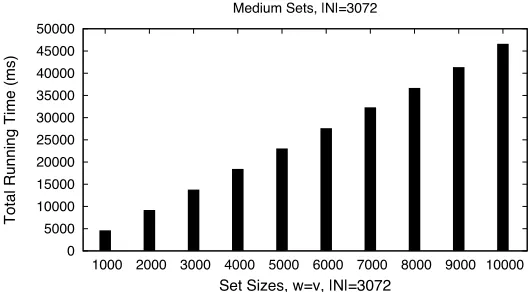
In Figures2and3, we report total run-times forDT10-v4protocol running on, respectively, small (100 to 1000) and medium (1000 to 10000) sets, using 1024-bit moduli.3 Next, Figures4,5,6, and7, respectively, report total run-time for small and medium sets, using 2048-bit and 3072-bit moduli, respectively.
Time is measured as the difference between system time read when the protocol starts and time read when the protocol ends. Specifically, we consider the protocol asstartedwhenever client initiates protocol execution (i.e., it opens a connection on server’s listening socket), whereas, the protocol ends whenever client outputs the intersection (if any). In other words,we do not perform precomputationand, on a con-servative stance, we do not allow the server to start computation of{(hsj)dmodN}wj=1(its step(1)) until
client establishes a connection on the listening socket.
The only cryptographic operation performed ahead of time (thus, not included in run-time) is RSA key generation, since server executes it only once for all possible clients and all executions. Finally, protocol execution time does not count time spent by server waiting for an incoming connection, since the listening socket is created only once, for all possible clients and all protocol executions.
4.2 Micro-benchmarking
We now analyze performance of specific operations performed by client and server during DT10-v4
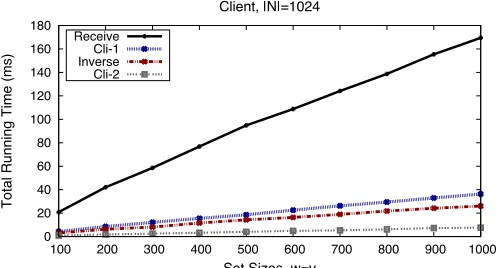
protocol execution. We start withClient. In Figure8(resp., Figure 10), we measure the time spent by the process executingDT10-v4client, using 1024-bit (resp., 2048-bit) moduli, for the following operations:
1. Label ‘Receive’ corresponds to the time spent to wait/receive the{µ0i}v
i=1 and{tsj}wj=1values from
server.
2. Label ‘Cli-1’ corresponds to the time needed to compute{µi =hci·riemodN}vi=1.
3. Label ‘Inverse’ corresponds to the time to compute{r−i 1 modN}v i=1.
4. Label ‘Cli-2’ corresponds to the time needed to compute{tci =H0(µi0/ri modN)}vi=1.
Next, we look atServer. In Figure9, (resp., Figure11)), we measure the time spent by the process executing
DT10-v4server, using 1024-bit (resp., 2048-bit) moduli, for the following operations:
1. Label ‘Receive’ corresponds to the time spent to wait/receive the{µi}vi=1values from client.
2. Label ‘BlindSig’ corresponds to the time to compute{µ0i = (µi)dmodN}vi=1.
3
0 50 100 150 200 250 300 350 400
100 200 300 400 500 600 700 800 900 1000
Total Running Time (ms)
Set Sizes, w=v Small Sets, |N|=1024
Figure 2:DT10-v4total run-time for small sets (100to1000items), using 1024-bit moduli.
0 500 1000 1500 2000 2500 3000 3500 4000
1000 2000 3000 4000 5000 6000 7000 8000 9000 10000
Total Running Time (ms)
Set Sizes, w=v Medium Sets, |N|=1024
Figure 3:DT10-v4total run-time for medium sets (1000to10000items), using 1024-bit moduli.
0 200 400 600 800 1000 1200 1400 1600 1800 2000
100 200 300 400 500 600 700 800 900 1000
Total Running Time (ms)
Set Sizes, w=v Small Sets, |N|=2048
Figure 4:DT10-v4total run-time for small sets (100to1000items), using 2048-bit moduli.
0 2000 4000 6000 8000 10000 12000 14000 16000 18000
1000 2000 3000 4000 5000 6000 7000 8000 9000 10000
Total Running Time (ms)
Set Sizes, w=v, |N|=2048 Medium Sets, |N|=2048
0 500 1000 1500 2000 2500 3000 3500 4000 4500 5000
100 200 300 400 500 600 700 800 900 1000
Total Running Time (ms)
Set Sizes, w=v
Small Sets, |N|=3072
Figure 6:DT10-v4total run-time for small sets (100to1000items), using 3072-bit moduli.
0 5000 10000 15000 20000 25000 30000 35000 40000 45000 50000
1000 2000 3000 4000 5000 6000 7000 8000 9000 10000
Total Running Time (ms)
Set Sizes, w=v, |N|=3072 Medium Sets, |N|=3072
Figure 7:DT10-v4total run-time for medium sets (1000to10000items), using 3072-bit moduli.
3. Label ‘Sig’ corresponds to the time to compute{tsj =H0((hsj)dmodN)}wj=1.
It is interesting to observe that, using 1024-bit moduli, client actually spends less time to receive all the values from server than vice versa, despite the former actually needs to receive more. This is a good opportunity to see multi-threading in action: client’s thread responsible to send the {µi} values has to
wait for them to be available, thus, causing some waiting time to server’s thread that receives them. In other words, by looking at the micro-benchmarking one can identify different “bottlenecks” in the different settings.
5
Comparison to [
HEK12
]
In this section, we focus on the performance evaluation of theDT10-v4PSI protocol presented in [HEK12]. The work in [HEK12] presents a few novel Private Set Intersection constructions based on garbled circuits [Yao82]: the main intuition is that, by leveraging theOblivious Transfer(OT) extension [IKNP03], the complexity of such protocols is essentially tied to a number of OTs (thus, public-key operations) equal to the security parameter k. In fact, OT extension achieves an unlimited number of OTs at the cost of (essentially) k OTs. Therefore, for very large security parameters, the number of public-key operations with this technique may grow more gracefully than with custom protocols. Finally, [HEK12] compares the efficiency of newly proposed constructions to an implementation of “custom” PSI protocols from [DT10].
0 20 40 60 80 100 120 140 160 180
100 200 300 400 500 600 700 800 900 1000
Total Running Time (ms)
Set Sizes, w=v Client, |N|=1024
Receive Cli-1 Inverse Cli-2
Figure 8:Micro-benchmarking client’s operations inDT10-v4(small sets), using 1024-bit moduli.
0 50 100 150 200 250
100 200 300 400 500 600 700 800 900 1000
Total Running Time (ms)
Set Sizes, w=v Server, |N|=1024
Receive BlindSig Sig
Figure 9:Micro-benchmarking server’s operations inDT10-v4(small sets), using 1024-bit moduli.
0 200 400 600 800 1000 1200
100 200 300 400 500 600 700 800 900 1000
Total Running Time (ms)
Set Sizes, w=v Client, |N|=2048
Receive Cli-1 Inverse Cli-2
Figure 10:Micro-benchmarking client’s operations inDT10-v4(small sets), using 2048-bit moduli.
0 200 400 600 800 1000 1200 1400
100 200 300 400 500 600 700 800 900 1000
Total Running Time (ms)
Set Sizes, w=v Server, |N|=2048
Receive BlindSig Sig
compared to performance results presented in [HEK12] for same protocols. Finally, we highlight some open questions regarding comparison between techniques in [HEK12] and those in [DT10].
5.1 Performance Comparison
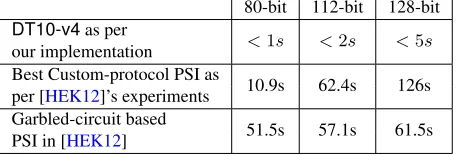
We start by noticing that the run-time of the PSI protocol in [DT10] is reported to be around 10 seconds in a setting where|S| = |C|= 1024, the security parameter is 80-bit (thus, RSA moduli are 1024-bit), no precomputation is allowed at server, and communication between server and client is over a 100Mbps LAN. It is not clear whether this measure is the sum of server and client execution time or represents the time for the protocol to complete. On a conservative stance, we assume the former. On a comparable hardware,4 and using the parameters discussed above, our measure forDT10-v4protocol never exceeded 1 seconds (and DT10-v4 is actually not reported as the fastest protocol – see Section 5.2). Similarly, evaluation in [HEK12] reports 62 seconds (resp., 126 seconds) using 2048-bit (resp., 3072-bit) moduli; whereas, our implementation ofDT10-v4never exceeds 2 seconds (resp., 5 seconds).
In Table3below, we summarize running times forDT10-v4as per our implementation, and compare to those for garbled-circuit based techniques presented in [HEK12] and reported in Fig. 11 of [HEK12]. We argue that our implementation ofDT10-v4markedly outperforms PSI protocols based on garbled circuits, in all the three security-parameter settings that we consider (and that are realistic today), in stark contrast to what has been claimed in [HEK12].
80-bit 112-bit 128-bit
DT10-v4as per
<1s <2s <5s
our implementation Best Custom-protocol PSI as
10.9s 62.4s 126s
per [HEK12]’s experiments Garbled-circuit based
51.5s 57.1s 61.5s
PSI in [HEK12]
Table 3:Summary of PSI running times (with|S|=|C|= 1024).
5.2 The choice of protocols from [DT10]
Authors of [HEK12] argue that the protocol in Figure 3 of [DT10], based on the One-More-DH as-sumption, is more efficient than that in Figure 4 (based on the One-More-RSA assumption and denoted as
DT10-v4) in scenarios where server-side precomputation is not possible. Our analysis below shows that this is wrong.
In the following, aiming at 80-bit security, we use: a 1024-bit RSA modulusN, an RSA public exponent e = 3, CRT-optimized exponentiations, a 1024-bit primep, a 160-bit prime q, and SHA-1 hash function. Also recall that w = |S| andv = |C|. We also usem to denote a modular multiplication of 1024-bit integers. Consequently, we say that exponentiations modulo 1024 bits require, on average,O(1.5·|exp|)·m, where|exp|denotes exponent size. Modular exponentiations with 512-bit moduli count for approximately O(1.5· |exp|) ·m/4. As we discussed earlier in the paper, the computational complexity of protocol in Figure 4 in [DT10] (DT10-v4) is clearly determined by2w+ 2v exponentiations with 512-bit exponents and moduli, thus,(2w+ 2v)(1.5·512)m/4, i.e.,(384w+ 384v)·m. Whereas, the computational complexity of protocol in Figure 3 of [DT10] comes down tow+ 3vexponentiations with 160-bit exponents and 1024-bit moduli, thus,(w+ 3v)·(1.5·160)·m, i.e.,(240w+ 720v)·m.
If one allows precomputation, then protocol in Figure 4 (DT10-v4) is straightforwardly more efficient than the Figure 3 counterpart, since online complexity goes down to(384v)·m. But if one does not allow
4In [HEK12] both server and client run on 3GHz CPU, whereas, in our experiments, server runs on a 3.1GHz CPU and client
precomputation (as in [HEK12]), then it would seem that Figure 3 protocol would outperformDT10-v4
for settings where approximately wv < 104 — a setting that is anyway never tested in [HEK12], which always assumes w = v. Nonetheless, when precomputation is not possible, then the analysis of Figure 3’s complexity should actually account forw+v additional exponentiations needed to evaluate theH(·)
function, which is of thehash-into-the-groupkind, i.e.,H(x) = x(p −1
q )modp, thus, protocol in Figure 3
appears to be always slower than Figure 4 (i.e.,DT10-v4.) Therefore, the protocol in [DT10]’s Figure 4 is always more computational efficient than the one in Figure 3.
5.3 Evaluation Criteria
Once again, note that it is out of the scope of this paper to provide a definite explanation as to why our implementation ofDT10-v4 achieves run-times several times lower than those reported by [HEK12] (see section 7 thereof). Similarly, we do not analyze the validity of the conclusions drawn by the authors of [HEK12] regarding whether or not DT10-v4PSI protocol is more efficient than garbled circuits-based constructions in all settings. However, we make some observations regarding implementation ofDT10-v4
by Huang et al. [HEK12] and also argue that a comprehensive comparison should take into account several settings (we sketch those below and leave the task of addressing them as an interesting open problem).
1. As discussed earlier, several design factors (e.g., pipelining, CRT, etc.) significantly impact overall performance of custom PSI protocols (see Section3.1) and it is unclear whether they were taken into account in [HEK12].
2. [HEK12] implements techniques from [DT10] and in [HEK12] in Java. Java usually offers slower performance than other programming languages (such as C/C++). Nonetheless, this choice might seem irrelevant, since both techniques are implemented in Java. However, we believe it remains to be seen if the use of Java penalizes techniques from [DT10] that perform a higher number of public-key operations. For instance, as mentioned earlier, a CRT-based RSA exponentiation takes
5.55times longer in Java than in C/GMP. Does this slowdown occur,in the same measureforallJava operations (e.g., symmetric-key)? If not, then the choice of Java might not be fair, as constructions in [HEK12] heavily rely on symmetric-key operations.5Also, it would also be interesting to measure memory overhead for increasing set sizes incurred by all techniques. We believe that performance and scalability could be tremendously affected by, for example, inability to keep an entire circuit in memory.
3. [HEK12] employs techniques that are fundamentally and markedly different from those used by cus-tom protocols. Thus, a different choice of parameters can significantly favor one while penalizing the other. We mention just a few:
a) Techniques in [HEK12] are tested in settings where|S| = |C|. As a result, we believe that a more thorough comparison would include scenarios where |S| 6= |C|. Also, comparisons in [HEK12] are given only for|S|=|C|= 1024. It remains unclear how performance of protocols in [HEK12] would scale for higher set sizes, since at least some of them involve non-linear complexities, as opposed to their counterparts in [DT10].
b) Some protocols in [HEK12] incur higher communication complexity than protocols in [DT10]. Therefore, we argue that a more thorough comparison must include (realistic) settings where the subject protocol is executed on the Internet, and not only over fast 100Mbps LANs. (Complexity
5
is not analyzed asymptotically but authors of [HEK12] report, on page 13, that the SCS-WN protocol consumes more bandwidth: 147–470MB, depending on the security level, versus 0.4– 2.0MB.)
c) Experiments in [HEK12] measure run-times as a total execution time. However, we believe that more details – ideally, a benchmark of sub-operations – should also be provided to better un-derstand if the testing setting and implementation choices penalize one technique while favoring another.
Finally, while research on custom PSI protocols reached the point where malicious security can be achieved efficiently – at the same asymptotic complexity as semi-honest security [HN10,JL10,DKT10] – efficiency of garbled-circuit-based techniques secure in the malicious model remains unclear.
6
Conclusion
This paper presented an optimized implementation and performance evaluation of the currently fastes PSI protocol from [DT10]. We analyzed implementation choices that impact overall performance and presented an experimental analysis, including micro-benchmarking, with different set sizes. We showed that resulting run-times appreciably outperform those reported in [HEK12]. Achieved speed up is significantly higher than what one would obtain by simply porting [HEK12] implementation ofDT10-v4from Java to C. Finally, we identified some open questions with respect to comparisons of custom PSI protocols with generic garbled-circuit based constructions.
Acknowledgments. We gratefully acknowledge Yanbin Lu, Paolo Gasti, Simon Barber, and Xavier Boyen for their help and suggestions. We would also like to thank the authors of [HEK12] for their valuable feedback.
References
[ADT11] G. Ateniese, E. De Cristofaro, and G. Tsudik. (If) Size Matters: Size-Hiding Private Set Intersection. InPKC, 2011.
[AL07] Y. Aumann and Y. Lindell. Security Against Covert Adversaries: Efficient Protocols for Realistic Ad-versaries. InTCC, 2007.
[BBD+11] P. Baldi, R. Baronio, E. De Cristofaro, P. Gasti, and G. Tsudik. Countering gattaca: efficient and secure testing of fully-sequenced human genomes. InCCS, 2011. Available from http://arxiv.org/
abs/1110.2478.
[BCC+09] M. Belenkiy, J. Camenisch, M. Chase, M. Kohlweiss, A. Lysyanskaya, and H. Shacham. Randomizable Proofs and Delegatable Anonymous Credentials. InCRYPTO, 2009.
[BLHB11] E. Bursztein, J. Lagarenne, M. Hamburg, and D. Boneh. OpenConflict: Preventing Real Time Map Hacks in Online Games. InIEEE Security and Privacy, 2011.
[BNPS03] M. Bellare, C. Namprempre, D. Pointcheval, and M. Semanko. The one-more-RSA-inversion problems and the security of Chaum’s blind signature scheme. Journal of Cryptology, 16(3), 2003.
[Bon98] D. Boneh. Twenty years of attacks on the RSA cryptosystem. Notices of the AMS, 46(2), 1998.
[CM99] J. Camenisch and M. Michels. Proving in zero-knowledge that a number is the product of two safe primes. InEUROCRYPT, 1999.
[DJL+10] E. De Cristofaro, S. Jarecki, X. Liu, Y. Lu, and G. Tsudik. Automatic Privacy Protection Program – UC Irvine Team Web Site. http://sprout.ics.uci.edu/projects/iarpa-app, 2010.
[DKT10] E. De Cristofaro, J. Kim, and G. Tsudik. Linear-Complexity Private Set Intersection Protocols Secure in Malicious Model. InASIACRYPT, pages 213–231, 2010.
[DSMRY09] D. Dachman-Soled, T. Malkin, M. Raykova, and M. Yung. Efficient Robust Private Set Intersection. In ACNS, 2009.
[DT10] E. De Cristofaro and G. Tsudik. Practical Private Set Intersection Protocols with Linear Complexity. InFinancial Cryptography and Data Security, 2010. available fromhttp://eprint.iacr.org/
2009/491.
[DT12] E. De Cristofaro and G. Tsudik. Experimenting with fast private set intersection. InTRUST, 2012.
[ElG85] T. ElGamal. A public key cryptosystem and a signature scheme based on discrete logarithms. IEEE transactions on Information Theory, 31(4), 1985.
[FIPR05] M.J. Freedman, Y. Ishai, B. Pinkas, and O. Reingold. Keyword search and oblivious pseudorandom functions. InTCC, 2005.
[FKJM+06] P.A. Fouque, S. Kunz-Jacques, G. Martinet, F. Muller, and F. Valette. Power attack on small rsa public exponent. Cryptographic Hardware and Embedded Systems-CHES 2006, 2006.
[FNP04] M.J. Freedman, K. Nissim, and B. Pinkas. Efficient private matching and set intersection. In EURO-CRYPT, 2004.
[GGM86] O. Goldreich, S. Goldwasser, and S. Micali. How to construct random functions. Journal of the ACM, 33(4), 1986.
[HEK12] Y. Huang, D. Evans, and J. Katz. Private Set Intersection: Are Garbled Circuits Better than Custom Protocols? InNDSS, 2012.
[HL08] C. Hazay and Y. Lindell. Efficient protocols for set intersection and pattern matching with security against malicious and covert adversaries. InTCC, 2008.
[HMRT11] C. Hazay, G.L. Mikkelsen, T. Rabin, and T. Toft. Efficient rsa key generation and threshold paillier in the two-party setting. Cryptology ePrint Archive,http://eprint.iacr.org/2011/494, 2011.
[HN10] C. Hazay and K. Nissim. Efficient Set Operations in the Presence of Malicious Adversaries. InPKC, 2010.
[IKNP03] Y. Ishai, J. Kilian, K. Nissim, and E. Petrank. Extending oblivious transfers efficiently.CRYPTO, 2003.
[JL09] S. Jarecki and X. Liu. Efficient Oblivious Pseudorandom Function with Applications to Adaptive OT and Secure Computation of Set Intersection. InTCC, 2009.
[JL10] S. Jarecki and X. Liu. Fast secure computation of set intersection. InSCN, 2010.
[KL08] J. Katz and Y. Lindell.Introduction to modern cryptography. Chapman & Hall/CRC, 2008.
[KS05] L. Kissner and D. Song. Privacy-preserving set operations. InCRYPTO, 2005.
[MVOV97] A. Menezes, P. Van Oorschot, and S. Vanstone.Handbook of Applied Cryptography. CRC, 1997.
[NMH+10] S. Nagaraja, P. Mittal, C.Y. Hong, M. Caesar, and N. Borisov. BotGrep: Finding Bots with Structured Graph Analysis. InUsenix Security, 2010.
[NP06] M. Naor and B. Pinkas. Oblivious polynomial evaluation.SIAM Journal on Computing, 1–35(5), 2006.
[NTL+11] A. Narayanan, N. Thiagarajan, M. Lakhani, M. Hamburg, and D. Boneh. Location Privacy via Private Proximity Testing. InNDSS, 2011.
[RS60] S. Reed and G. Solomon. Polynomial codes over certain finite fields.Journal of the Society for Industrial and Applied Mathematics, 8(2), 1960.
[Sha79] A. Shamir. How to Share a Secret.Communications of ACM, 22(11), 1979.
[Yao82] A.C. Yao. Protocols for secure computations. InFOCS, 1982.
A
Survey of PSI Techniques
In this appendix, we survey research work on Private Set Intersection (PSI). This appendix is organized in chronological order: we first overview work prior to [DT10], then, after discussing the work in [DT10], we present recent results.
A.1 Work prior to [DT10]
Once again, recall that PSI is a protocol involving a server and a client, on inputsS ={s1, . . . , sw}and
C={c1, . . . , cv}, respectively, that results in client obtainingS ∩ C. As a result of running PSI, set sizes are
reciprocally disclosed to both server and client. In the variant calledPSI with Data Transfer(PSI-DT), each item in server set has an associated data record, i.e., server’s input isS ={(s1, data1),· · · ,(sw, dataw)},
and client’s output is defined as{(sj, dataj)∈ S | ∃ci∈ Cs.t. ci =sj}.
We distinguish between two classes of PSI protocols: one based on Oblivious Polynomial Evaluations (OPE) [NP06], and the other based on Oblivious Pseudo-Random Functions (OPRF-s) [FIPR05].
Freedman, Nissim, and Pinkas [FNP04] introduce the concept of Private Set Intersection and and pro-pose a protocol based on OPE. They represent a set as a polynomial, and elements of the set as its roots. A client encodes elements in its private set C as the roots of a v-degree polynomial over a ring R, i.e., f = Qv
i=1(x−ci) =
Pk
i=0αixi. Then, assumingpkC is client’s public key for any additively
homo-morphic cryptosystem (such as Paillier’s [Pai99]), client encrypts the coefficients withpkC, and sends them
to server. The latter homomorphically evaluates f at eachsj ∈ S. Note that f(sj) = 0 if and only if
sj ∈ C ∩ S. For eachsj ∈ S, returnsuj =E(rjf(sj) +sj) to client (whererj is chosen at random and
E(·) denotes additively homomorphic encryption underpkC). If sj ∈ C ∩ S then client learnssj upon
decrypting. Ifsj ∈ C ∩ S/ thenuj decrypts to a random value. To enable data transfer, server can return
E(rjf(sj) + (sj||dataj)), for eachsj in its private setS. The protocol in [FNP04] incurs the following
complexities: The number of server operations depends on the evaluation of client’s encrypted polynomial withvcoefficients onwpoints (inS). Using Paillier cryptosystem [Pai99] and a 1024-bit modulus, this costs O(vw)of1024-bit mod 2048-bit exponentiations.6 On the other hand, client computesO(v+w)of 1024-bit mod 2048-bit exponentiations. However, server computation can be reduced toO(wlog logv) using: (1) Horner’s rule for polynomial evaluations, and (2) a hashing-to-bins method (see [FNP04] for more details). If one does not needdata transfer, it is more efficient to use the Exponential ElGamal cryptosystem [ElG85] (i.e., an ElGamal variant that provides additively homomorphism).7 Such a cryptosystem does not provide efficient decryption, however, it allows client to test whether a ciphertext is an encryption of “0”, thus, to learn that the corresponding element belongs to the set intersection. As a result, efficiency is improved, since in ElGamal the computation may make use of: (1) very short random exponents (e.g., 160-bit) and (2) shorter moduli in exponentiations (1024-bit). The PSI protocol in [FNP04] is secure against honest-but-curious adversaries in the standard model, and can be extended to malicious in the Random Oracle Model (ROM), at an increased cost.
6Encryption and decryption in the Paillier cryptosystem [Pai99] involve exponentiations modn2: if|n| = 1024bits, then
|n2|= 2048bits (wherenis the public modulus).
7In the Exponential ElGamal variant, encryption of messagemis computed asE
g,y(m) = (gr, yr·gm)instead of(gr, m·yr),
Hazay and Nissim [HN10] present an improved construction of [FNP04], in the presence of malicious adversaries without ROM, using zero-knowledge proofs to let client demonstrate that encrypted polynomials are correctly produced. Perfectly hiding commitments, along with an Oblivious Pseudo-Random Function evaluation protocol, are used to prevent server from deviating from the protocol. The protocol in [HN10] incursO(v+w(log logv+m))computational andO(v+w·m)communication complexity, wheremis the number of bits needed to represent a set element.
Kissner and Song [KS05] also propose OPE-based protocols involving (potentially) more than two players. They present one technique secure in the standard model against semi-honest and one – against malicious adversaries. The former incurs quadratic – O(vw) – computation (but linear communication) overhead. The latter uses expensive generic zero-knowledge proofs to prevent parties from deviating to the protocol. Also, it is not clear how to enabledata transfer.
Dachman-Soled, et al. [DSMRY09] also present an OPE-based PSI construction, improving on [KS05]. Their protocol incorporates a secret sharing of polynomial inputs: specifically, as Shamir’s secret shar-ing [Sha79] implies Reed-Solomon codes [RS60], generic (i.e., expensive) zero-knowledge proofs can be avoided. Complexity of resulting protocol amounts toO(wk2log2(v))in communication andO(wvklog(v)+ wk2log2(v))in computation, wherekis a security parameter.
Other techniques rely onOblivious Pseudo-Random Functions(OPRF-s), introduced in [FIPR05]. An OPRF is a two-party protocol that securely computes a pseudo-random functionfk(·)on keykcontributed
by the sender and inputxcontributed by the receiver, such that the former learns nothing from the interaction and the latter learns only the valuefk(x). Most prominent OPRF-based protocols are presented below. The
intuition behind OPRF-based PSI protocols is as follows: server and client interact invparallel execution of the OPRFfk(·), on inputkandci,∀ci ∈ C, respectively. As server transfersTs:j =fk(sj),∀sj ∈ Sand
client obtainsTc:i =fk(ci),∀ci ∈ C, client learns the set intersection by finding matching(Ts:j, Tc:i)pairs,
while it learns nothing about valuessl∈ S \ S ∩ C, sincefk(sl)is indistinguishable from random, iffk(·)
is a pseudo-random function.8
Hazay and Lindell [HL08] propose the first PSI construction based on OPRF-s. In it, server generates a secret random key k, then, for each sj ∈ S, computes uj = fk(sj), and sends client the set U =
{u1,· · ·, uw}. Next, client and server engage in an OPRF computation offk(ci)for eachci ∈ C. Finally,
client learns thatci ∈ C ∩ S if (and only if)fk(ci) ∈ U. [HL08] introduces two constructions: one secure
in the presence of malicious adversaries with one-sided simulatability, the other – in the presence of covert adversaries [AL07].
Jarecki and Liu [JL09] improve on [HL08] by constructing a protocol secure in the standard model against both malicious parties, based on the Decisional q-Diffie-Hellman Inversion assumption, in the Com-mon Reference String (CRS) model, where a safe RSA modulus must be pre-generated by a trusted party. The OPRF in [JL09] is built using the Camenisch-Shoup additively homomorphic cryptosystem [CS03] (CS
for short). However, this technique can be optimized, leading to the work by Belenkiy, et al. [BCC+09]. In fact, the OPRF construction could work in groups of 160-bit prime order, unrelated to the RSA mod-ulus, instead of (more expensive) composite order groups [JL09]. Thus improved, the protocol in [JL09] incurs the following computational complexity: server needs to performO(w)PRF evaluations, specifically, O(w)modular exponentiations ofm-bit exponents modn2, wheremthe number of bits needed to represent set items andn2 is typically 2048-bit long. The client needs to computeO(v)CSencryptions, i.e.,O(v) m-bit exponentiations mod 2048 bits, plus O(v) 1024-bit exponentiations mod 1024 bits. The server also computes O(v) 1024-bit exponentiations mod 1024 bits andO(v) CS decryptions – i.e., O(v) 1024-bit exponentiations mod 2048 bits. Complexity in malicious model grows by a factor of 2. The input domain size of the pseudo-random function in [JL09] is limited to be polynomial in the security parameter, since the security proof requires the ability to exhaustively search over input domain.
A.2 Protocols in [DT10]
The work in [DT10] presented two linear-complexity PSI protocols, both secure in the Random Oracle Model in the presence of semi-honest adversaries. Specifically, in [DT10], they present:
1. One protocol (Figure 3) secure under the One-More-Gap-DH assumption [BNPS03]. It imposes O(w+v)shortexponentiations on server, andO(v)– on client. Note that the term “short” exponen-tiation refers to the fact that exponenexponen-tiations can be of 160-bit exponents modulo 1024 bits (for 80-bit security).
2. Another protocol (Figure 4) secure under the One-More-RSAassumption [BNPS03], whose imple-mentation we have presented and analyzed in this paper. Recall that, in this protocol, server computa-tional overhead amounts toO(w+v)RSA signatures using CRT optimization (i.e., 512 bits modulo 512 bits exponentiations for 80-bit security). Whereas, client complexity is dominated byO(v)RSA encryptions, i.e., in practice,O(v)modular multiplications if a short RSA public exponent is selected.
Both protocols incur the following communication overhead: client and server need to send and receive O(v)group elements (i.e., 1024-bit); additionally, server sends clientO(w)hash outputs (e.g., 160-bit using SHA-1).
A.3 Recent results
Shortly after [DT10], Jarecki and Liu [JL10] also propose a PSI protocol with linear complexity and fast exponentiations. (Remark that some of the proofs in [DT10] are based on that of Jarecki and Liu.) This protocol is based on a concept related to OPRFs, i.e.,Unpredictable Functions(UPFs). One specific UPF, fk(x) = H(x)k, is used as a basis for two-party computation (in ROM), with server contributing the key
kand client – the argumentx. The client picks a random exponentαand sendsy =H(x)αto server, that replies withz=yk, such that client recoversfk(x) =z1/α. By using a zero-knowledge discrete-log proofs
of knowledge, the protocol in [JL10] can obtain malicious security and implement secure computation of (Adaptive) Set Intersection, under theOne-More-Gap-DH assumption in ROM [BNPS03]. Therefore, the computational complexity of the UPF-based PSI in [JL10] also amounts toO(w+v) exponentiations with short exponents at server side and O(v)at client side (e.g., 160-bit mod 1024-bit). Communication complexity is also linear is input set size, i.e.,O(w+v).
De Cristofaro, et al. [DKT10] present another linear-complexity short-exponent PSI construction secure in ROM in the presence of maliciousadversaries. However, compared to [JL10], its security relies on a weaker assumption – DDH vs One-More-Gap-DH. Then, Ateniese, et al. [ADT11] introduce the concept of Size-HidingPrivate Set Intersection (SHI-PSI). Besides the standard privacy features guaranteed by the PSI primitive, SHI-PSI additionally providesunconditional(i.e., not padding-based) hiding of client’s set size. The security of this novel protocol is under the RSA assumption in ROM, in the presence of semi-honest adversaries. Server’s computational complexity amounts to onlyO(w)exponentiations in the RSA setting, thus, it is independent of size of client’s input. Whereas, client’s overhead is in the order ofO(v·logv)
exponentiations. Communication complexity is limited toO(w), i.e., it is also independent of size of client’s input.
/* Include header files */
#include ...
/* Global variables */
int sockfd, newsockfd, w, v;
RSA_params *rsa; ...
int main(int argc, char *argv[])
{
/* Declare variables */
pthread_t t1, t2, t3, t4, t5;
int portno;
socklen_t clilen;
struct sockaddr_in serv_addr, cli_addr; ...
/* Invoke socket(), bind(), listen() */
if( (sockfd = socket(AF_INET, SOCK_STREAM, 0)) < 0) {
printf("ERROR opening socket\n"); exit(-1);
} ..
/* Load RSA keypair from storage */
load_keys(rsa);
/* Accept incoming connections */
if( (newsockfd = accept(sockfd,(struct sockaddr *) &cli_addr,&clilen))< 0) {
printf("ERROR on accept\n"); exit(-1);
}
/* If supporting pre-computation the following instruction can be moved before the accept() */
/* Compute ts_j values */
pthread_create(&t1, NULL, (void *)compute_tags, NULL);
/* Read \mu_i values from socket */
pthread_create(&t2, NULL, (void *)receive_from_client, NULL);
/* Compute \mu’_i=\mu_iˆd */
pthread_create(&t3, NULL, (void *)blind_sign, NULL);
/* Wait for t2 to complete before start sending on the channel (conservative choice if channel not duplex) */
pthread_join(t2, NULL);
/* Send \mu’_i values to client */
pthread_create(&t4, NULL, (void *)send_bsig, NULL);
/* Wait for t4 to complete */
pthread_join(t4, NULL);
/* Send \ts_j values to client */
pthread_create(&t5, NULL, (void *)send_tags, NULL); //compute mu_i-s
/* That’s all, folks! */
pthread_join(t1, NULL); pthread_join(t3, NULL); pthread_join(t5, NULL);
close(newsockfd); close(sockfd); sleep(1); }
void receive_from_client(){
int i;
char buffer[N_size];
/* Read \mu_i values from socket */
for(i=0;i<v;i++) {
if(!read_from_socket(newsockfd,N_size,buffer)) {
printf("Error reading from socket\n"); exit(-1);
}
/* Put \mu_i values into a shared buffer for blind_sign() thread to process them, e.g., write them to a pipe */
write_to_pipe(pipe1[1], buffer, strlen(buffer)); }
}
void blind_sign() {
int i;
mpz_t mu_i, mup_i; //mpz_t is GMP big-integer type
char buffer[N_size];
for(i=0;i<v;i++) {
mpz_init(mup_i); mpz_init(mu_i); bzero(buffer,N_size);
/* Get \mu_i read in receive_from_client() */
read_from_pipe(pipe1[0], buffer, N_size);
mpz_set_str(&mu_i, buffer, base); //transform into mpz_t
/* Compute \mu’_i=\mu_iˆd mod N, using CRT in GMP */
sig_crt_gmp(mup_i,mu_i,rsa);
/* Put \mu’_i values in a shared buffer for send_bsig() */
... } }
void compute_tags() {
int j; mpz_t ks_j; mpz_t hs_j;
char buffer[max_size];
for (j=0; j<w;j++) {
/* Obtain s_j */
...
/* Compute ts_j=H’(H(s_j)ˆd mod N) */
FDH(s_j, strlen(s_j), &hs_j); sig_crt_gmp(ks_j,hsj,rsa); ts_j = SHA-1(ks_j);
/* Put ts_j values in a shared buffer for send_tags() */
... } }
void send_bsig(){
..
/* Get \mu’_i from shared buffer and send to the client */
for(i=0;i<v;i++) {
write_to_socket(newsockfd, ...) }
... }
void send_tags(){
...
/* Get \ts_j from shared buffer and send to the client */
for(j=0;i<w;j++) {
write_to_socket(newsockfd, ...) }
... }
/* Include header files */
#include ...
/* Global variables */
int sockfd, w, v;
RSA_params *rsa; ...
int main(int argc, char *argv[])
{
/* Declare variables */
pthread_t t1, t2, t3, t4, t5, t6, final;
int portno;
socklen_t clilen;
struct sockaddr_in serv_addr, cli_addr; ...
/* Open Socket */
if( (sockfd = socket(AF_INET, SOCK_STREAM, 0)) < 0) {
printf("ERROR opening socket\n"); exit(-1);
}
...
/* Connect to server socket */
if (connect(sockfd,(struct sockaddr *) &serv_addr,sizeof(serv_addr)) < 0) {
printf("ERROR connecting\n"); exit(-1);
}
load_pub_key(rsa);
/* Read client items */
pthread_create(&t1, NULL, (void *)read_ci, NULL);
/* Compute \mu_i=H(c_i)*r_iˆe mod N */
pthread_create(&t2, NULL, (void *)compute_mui, NULL);
/* Send \mu_i values to the server */
pthread_create(&t3, NULL, (void *)send_mui, NULL);
/* Compute modular inverse of r_i values */
pthread_create(&t4, NULL, (void *)invert_ri, NULL); //send mu_i-s
/* Wait to finish using the socket */
pthread_join(t1, NULL); pthread_join(t2, NULL); pthread_join(t3, NULL); pthread_join(t4, NULL);
/* Receive \mu’_i values from the server */
pthread_create(&t5, NULL, (void *)receive_mupi, NULL);
/* Proces \mu’_i values */
pthread_create(&t6, NULL, (void *)process_mupi, NULL);
/* Wait to finish receiving \mu’_i */
pthread_join(t5, NULL); pthread_join(t6, NULL);
/* Receive ts_j values and output intersection */
pthread_create(&final, NULL, (void *)finalize, NULL);
/* That’s all folks! */
pthread_join(final, NULL); close(sockfd);
}
void FDH(const unsigned char *input, int len, mpz_t *output){
int i, nbits=rsa_key_length;
int repss = (nbits + hash_size - 1) / hash_size;
unsigned char out[rsa_key_length/8*2], ibuf[len*2]; sprintf(out,"");
for (i = 0; i < reps; i++) {
sprintf(ibuf,"%s||%d",input,i);
strcat(out, SHA1((const unsigned char*)ibuf, strlen(ibuf), NULL));
}
mpz_import(*output, strlen(out), 1, sizeof(char), 0, 0,
(const unsigned char *)out); }
int sign_crt_gmp(mpz_t sig, mpz_t msg, RSA_params *rsa) {
mpz_t m1, m2, tmp, hq;
mpz_init(m1);mpz_init(m2);mpz_init(tmp);mpz_init(hq);
mpz_powm(m1, msg, rsa->dmp1, rsa->p); //dmp1=d mod p-1
mpz_powm(m2, msg, rsa->dmq1, rsa->q); //dmq1=d mod q-1
mpz_add(tmp, m1, rsa->p); mpz_sub(tmp, tmp, m2); mpz_mod(tmp, tmp, rsa->p); mpz_mul(hq, rsa->iqmp, tmp); mpz_mod(hq, hq, rsa->p); mpz_mul(hq, hq, rsa->q); mpz_add(sig, m2, hq); }