Study on Challenges in Excavation during
Construction and Methods
Vasim Khan Gori
1, Ravi Shankar Bordiya
2, Leevesh Kumar
31,2
B. Tech, Civil Engineering, 4
thYear, Career Point University, Kota, Rajasthan, India.
3
Assitant Professor, Civil Engineering, Career Point University, Kota, Rajasthan, India.
ABSTRACT
During the construction of a highway or bridge, existing materials may be required to be removed. These materials occupy the space in which a new highway or bridge is planned. Therefore, they are removed or excavated. In general, excavation means to loosen and take out materials leaving space above or below ground. Sometimes in civil engineering term earthwork is used which include backfilling with new or original materials to voids, spreading and leveling over an area. It is an important part of constructing homes, businesses, roadways, bridges, and other structures. Construction companies use several different methods of excavation. Each type of excavation is classified by the material being excavated or the specific purpose of the excavation. Excavation work can occur anywhere, including excavation on construction sites, business premises and in public areas. Excavation work includes open excavations, potholing, pit excavations, trenches and retaining walls, shafts and drives. Trenching and excavation work presents serious hazards to all workers involved. Cave-ins pose the greatest risk and are more likely than some other excavation-related incidents to result in worker fatalities. One cubic yard of soil can weigh as much as a car. An unprotected trench can be an early grave. Employers must ensure that workers enter trenches only after adequate protections are in place to address cave-in hazards. Other potential hazards associated with trenching work include falling loads, hazardous
atmospheres, and hazards from mobile equipment.
Keywords
:- Competent Person, Excavation, Rock, Trenching, Underground, etc.I.
INTRODUCTION:
Excavation is among the most hazardous construction operations. Excavation is defined as any man made cut,
cavity, trench, or depression in the earth’s surface formed by earth removal. A trench is defined as a narrow
underground excavation that is deeper than its width. During the construction of a highway or bridge, existing
materials may be required to be removed. These materials occupy the space in which a new highway or bridge is
planned. So the excavation of these materials is required for the construction process.
The types of excavation methods are:
a)
Common Excavation
Common excavation is the most frequently encountered type of excavation. The Specifications state that,
"Common excavation shall consist of all excavation not included as rock excavation or excavation which is
otherwise classified and paid for, including asphalt type pavement and all rip-able materials". Common
excavation is the excavation of soil materials from within the contract limits; however, this excavation is not
limited to soil materials and may include existing HMA pavement. This HMA pavement includes HMA
mixtures, crushed stone, bricks, cinders, etc. If the material is indicated on the plans and is not a concrete
pavement or another defined excavation, then the material is considered common excavation. Section 203
further defines embankment construction as the excavation, hauling, and disposal or compaction of all material.
Because compaction of the material is included in common excavation, soil samples are required to be obtained.
These samples are submitted to the appropriate testing laboratory for determining maximum densities and
moistures.
b)
Rock Excavation
Rock excavation consists of the excavation of igneous, metamorphic, and sedimentary rock, and boulders or
detached stones having a volume of ½ yd3 or greater. The material for this type of excavation is removed by
blasting, by power shovel with a bucket that has a minimum capacity of 1 yd3, or by other equivalent powered
equipment. Unless otherwise specified or directed, the following criteria is used in excavating the material.
c)
Unclassified Excavation
Unclassified excavation consists of the excavation and proper disposal of any type of material that is
encountered during the progress of the work.
The following types come under unclassified excavation-
• Waterway Excavation
• Class Y Excavation
• Class X Excavation
• Wet Excavation
• Dry Excavation
• Foundation Excavation
II.
VARIOUS EXCAVATION METHODS:
There are various methods used in construction and to choose the appropriate method, we need to consider the
a)
Factors Affecting Selection of Excavation Methods
Construction budget
Availability of construction equipment
Existence of adjacent excavation
Condition of adjacent buildings
Type of foundation of neighboring structure
Construction site area
The following methods can be used for excavation after considering all the important factors.
b) Full Open Cut Method
It is divided into two major types including sloped full open cut and cantilever full open cut. The former is
assumed to be economical since the side of excavation would be sloped and does not need any support to held
foundation wall. However, if the slope is considerably gentle or the excavation is largely deep, it will costly.
The latter needs retaining wall to support foundation wall soil and prevent collapse of foundation wall but it
neither require backing nor slopes. Therefore, it cannot categorically be claimed that which method is more cost
effect. The economical method may be distinguished based on analysis, design, and evaluation results.
Fig.1 – Sloped open cut.
c) Bracing Excavation Method:
Bracing excavation as shown in Fig. 2 is the placement of horizontal struts in front of retaining wall to held
excavation wall material pressure. Bracing system consist of wale, strut, center posts, end braces, and corner
reduce wale span without increasing strut number. Center posts prevent the failure of struts due to their own
weight.
Fig. 2 – Bracing excavation method
c) Anchored Excavation Method:
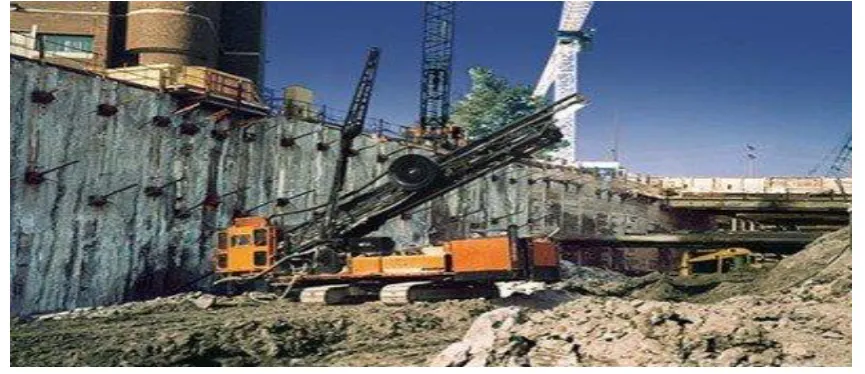
In this technique, anchors as shown in Figure 3 are installed to counter act against earth pressure. Configuration
and components of anchored excavation technique are illustrated in Figure 4. Bonded portion of the anchor
provides anchoring force that works against earth pressure whereas unbounded part of the anchored transfer
pressure to the anchor head. Anchor head transfer loads to the retaining wall. The anchoring force is greatly
based on the soil strength. The higher the soil strength the greater the anchoring forces. This technique is not
suitable for clay and granular soil with high ground water table. Lastly, it require short time to complete
excavation with great efficiency and suitable for large areas and shallow depth.
Fig. 4 - Anchor
d) Top-Down Excavation Method
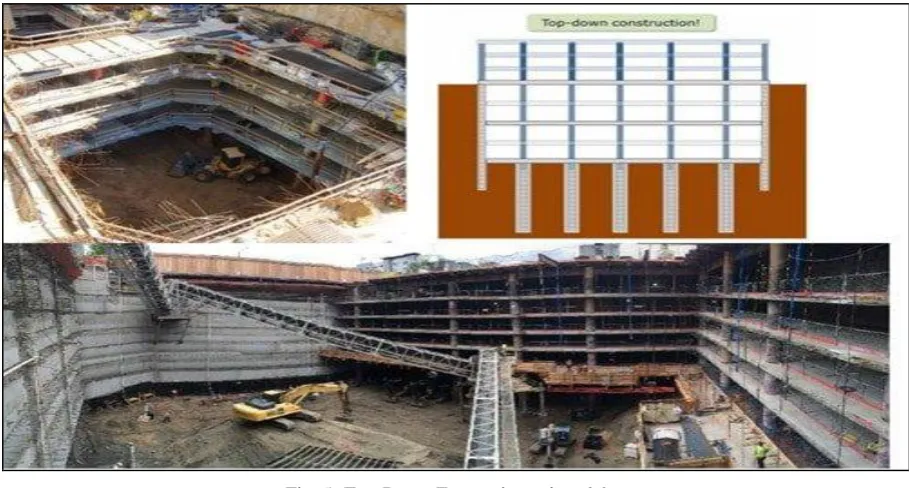
In this method, construction begins from the top to the bottom of excavation and superstructure construction
starts after the construction of the first slab is completed. So, slabs are constructed after each stage of excavation
is finished. The slabs play the same role as struts in holding earth pressure. Construction process order include
retaining wall construction, pile construction under column of superstructure, placing columns on piles, and
installing formwork for the first slab at the top then other slabs would be constructed after each excavation.
This technique would need short construction time, but the cost is higher compare to other methods. Another
e) Island Excavation Method
In this method, the center of excavation area is dug and excavated material placed close to the retaining wall to
create a slope. After that, the major part of the structure would be constructed at the center of the excavation.
Then, the sloped soil will be excavated and struts will be placed between retaining wall and the main structure.
Finally, the struts will be removed and remaining parts of the structure will be constructed. Sometimes, it might
be required to use anchored or braced technique to removed slopes soil material, specifically when the
excavation is too deep.
Fig. 6 – Excavation Using Island
f) Cofferdams
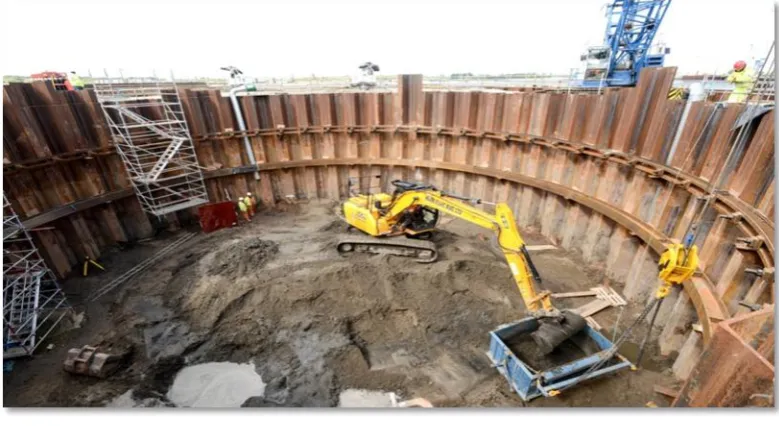
Cofferdam is one of the useful excavation techniques that contractors employ for waterlogged areas. Also, they
use this method when the excavated site has a great probability of collapsing
III.
CHALLENGES & SAFETY PRECAUTIONS
Excavation is among the most hazardous construction operations. Excavation is defined as any man made cut,
cavity, trench, or depression in the earth’s surface formed by earth removal. A trench is defined as a narrow underground excavation that is deeper than its width. So, the following points should be kept in mind before
starting the excavation process.
a) Hazards of Excavation
Cave-ins pose the greatest risk and are much more likely than other excavation related accidents to result in
worker fatalities. Other potential hazards include falls, falling loads, hazardous atmospheres and incidents
involving mobile equipment. Trench collapses cause dozens of fatalities and hundreds of injuries each year.
b) Self -Protection
Do not enter an unprotected trench! Trenches 5 feet (1.5 meters) deep or greater require a protective system
unless the excavation is made entirely in stable rock. Trenches 20 feet (6.1 meters) deep or greater require that
the protective system be de-signed by a registered professional engineer or be based on tabulated data prepared
and/ or approved by a registered professional engineer.
c) Protective Systems
There are different types of protective systems. Sloping involves cutting back the trench wall at an angle
inclined away from the excavation. Shoring requires installing aluminum hydraulic or other types of supports to
prevent soil movement. Shielding protects workers by using trench boxes or other types of supports to prevent
soil cave-ins. Designing a protective system can be complex because you must consider many factors: soil
classification, depth of cut, water content of soil, changes due to weather or climate, surcharge loads (eg., spoil,
other materials to be used in the trench) and other operations in the vicinity.
d) Competent Person
The trenches should be inspected daily and as conditions change by a competent person prior to worker entry to
ensure elimination of excavation hazards. A competent person is an individual who is capable of identifying
existing and predictable hazards or working conditions that are hazardous, unsanitary or dangerous to
employees. The person is authorized to take prompt corrective measures to eliminate or control these hazards
and conditions.
e) Additional Hazards and Protections
employers to take certain precautions. For example, employers must, Protect workers from excavated or other
materials or equipment that could pose a hazard by falling or rolling inside the excavation by placing and
keeping such materials or equipment at least 2 feet (0.61 meters) from the edge and/or by using a retaining
device to keep the materials or equipment from falling or rolling into the excavation. Provide a warning system
(such as barricades, hand or mechanical signals, or stop logs) when mobile equipment is operated adjacent to an
excavation, or when such equipment must approach the edge of an excavation, and the operator does not have a
clear and direct view of the edge. Provide a warning system (such as barricades, hand or mechanical signals, or
stop logs) when mobile equipment is operated adjacent to an excavation, or when such equipment must
approach the edge of an excavation, and the operator does not have a clear and direct view of the edge.
IV.
CONCLUSION
Due to the rapid increases in urbanization throughout the world, especially since World War II, have brought
many problems, including congestion, air pollution, loss of scarce surface area for vehicular ways, and major
traffic disruption during their construction. Some cities relying principally on auto transport have even found
that nearly two-thirds of their central land area is devoted to vehicular service (freeways, streets, and parking
facilities), leaving only one-third of the surface space for productive or recreational use. During the past decade
there has been a growing awareness that this situation could be alleviated by underground placement of a large
number of facilities that do not need to be on the surface, such as rapid transit, parking, utilities, sewage and
water-treatment plants, fluid storage, warehouses, and light manufacturing. The overriding deterrent, however,
has been the greater cost underground—except in Sweden, where energetic research has reduced underground
costs to nearly equal the surface alternates. Hence planners have rarely dared to propose underground
construction except where the surface alternate was widely recognized as intolerable. Underground construction
in urban areas has, thus, generally been limited to situations without a viable surface alternate; as a result,
additional increases in surface construction have further aggravated the problem. At the same time, the low
volume of underground construction has provided insufficient incentive for the development of innovative
technology. So the need of new technologies in excavation and earthwork is generated.
V.
FUTURE SCOPE
.For rock excavation, improved cutters are generally considered the key for expanding economic ability of
moles to include harder rock. Much effort is being devoted to improving current mechanical cutters, including
technical advances based upon space metallurgy, geometry of cutter shape and arrangement, mechanics of
cutting action, and research in pre-softening rock. Concurrently, there is an intensive search for entirely new
rock-cutting methods (some nearing a pilot application), including high-pressure water jets, Russian water
cannon (operated at high pressures), electron beam, and flame jet (often combined with abrasive powder). Other
REFERENCES
[1] Van Horn, D.M.; J. R. Murray; R. S. White (1986). "Some Techniques for Mechanical Excavation in
Salvage Archaeology". Journal of Field Archaeology. 13 (2): 239–244.
[2] Roosevelt; Cobb; Moss; Olson; Ünlüsoy (2015). "Excavation is Destruction Digitization: Advances in
Archaeological Practice". Journal of Field Archaeology.
[3] Fargo, V. and O'Connell, K. (1978). Five Seasons of Excavation at Tell el-Hesi (1970-77). The Biblical
Archaeologist, 41(4), p.165.
[4] Holliday Jnr., J. (2012). Method and Theory in Syro-Palestinian Archaeology. In: S. Richard, ed., Near
Eastern Archaeology: A Reader, 2nd ed. Winona Lake: Eisenbrauns, p.36.
[5] Ross, J., Sellers, O., Funk, R., McKenzie, J., Lapp, N. and Lapp, P. (1972). The 1957 Excavation at
Beth-Zur. Journal of the American Oriental Society, 92(2), p.302.
[6] https://www.designingbuildings.co.uk/wiki/Types_of_excavation
[7] https://en.wikipedia.org/wiki/Dredging
[8] https://www.state.in.us/
[9] https://www.britannica.com/technology/tunnel/Future-trends-in-underground-construction.