Strongly interacting matter under rotation
YinJiang1,,Zi-WeiLin2,3,,Xu-GuangHuang4,5,, andJinfengLiao6,
1School of Physics and Nuclear Energy Engineering, Beihang University, Beijing 100191, China.
2Department of Physics, East Carolina University, Greenville, NC 27858, USA.
3Key Laboratory of Quarks and Lepton Physics (MOE) and Institute of Particle Physics, Central China
Nor-mal University, Wuhan 430079, China.
4Physics Department and Center for Particle Physics and Field Theory, Fudan University, Shanghai 200433,
China.
5Key Laboratory of Nuclear Physics and Ion-beam Application (MOE), Fudan University, Shanghai 200433,
China.
6Physics Department and Center for Exploration of Energy and Matter, Indiana University, 2401 N Milo B.
Sampson Lane, Bloomington, IN 47408, USA.
Abstract.The vorticity-driven effects are systematically studied in various aspects. With
AMPT the distributions of vorticity has been investigated in heavy ion collisions with different collision parameters. Taking the rotational polarization effect into account a
generic condensate suppression mechanism is discussed and quantitatively studied with NJL model. And in chiral restored phase the chiral vortical effects would generate a new
collective mode, i.e. the chiral vortical wave. Using the rotating quark-gluon plasma in heavy ion collisions as a concrete example, we show the formation of induced flavor quadrupole in QGP and estimate the elliptic flow splitting effect forΛbaryons.
1 Introduction
Pseudovector field-driven effects have attracted more and more interests recently [1–4]. As a
parity-even and time-reversal-odd field, numbers of novel and non-trivial phenomena would be driven by it,such as chiral magnetic effect [1, 2, 5, 6]. As another pseudovector field which is familiar to us,
vor-ticity plays an important role in our daily life as well as in the high energy physics [7, 8]. In relativistic heavy ion collision experiments, the typical collision events are off-central and the created QCD
mat-ter will carry a nonzero angular momentum on the order of 104∼105with local angular velocity
in the range 0.01 ∼0.1GeV [9, 10]. There has also been impressive progress to study the rotating QCD matter using lattice gauge theory simulations [11]. Both first principle calculations and model studies suggest that vorticity would drive the phase transition [12] and anomalous transport [13–15]. In the following we will first simulate the collisions to extract the vorticity with AMPT model in the particle scenario [10]. With the results we would see the vorticity is so remarkable that we could
e-mail: [email protected] e-mail: [email protected]
not simply neglect its impact on the phase transition and chiral transport. Hence we discuss the ro-tational polarization effects for quark pairings, which would change the chiral restoration and color
superconductivity critical behaviors [12]. In chiral restored phase the vorticity would also induce two anomalous chiral transport relations for the left and right-handed quarks respectively [13, 14]. Com-bining these two effects there is a new collective mode called chiral vortical wave(CVW) [15]. The
CVW would reshuffle the final state hadrons’ distributions so that provide a new contribution to the
elliptic flow splitting of hadrons.
2 Vorticity in heavy ion collisions
As a transport model AMPT would output trajectories of all the partons in the phase space during collisions. For a large enough system after proper coarse-graining (e.g. like the fluid being made of many fluid cells), it can be considered as a continuous medium characterized by a series of locally defined quantities like momentum density, energy density and particle number densityp(r),(r) and
n(r) respectively. Here we define the 3-velocity field asv(r) = p(r)/(r). And the non-relativistic vorticityω =∇ ×vis adopted in this work. The detailed patterns of vorticity shown in [10] could be roughly understood by a radial flow profilevthat can be well parameterized in the formv(ρ, φ, η)=
ˆ
eρv0(ρ, η)[1+2c2(ρ, η) cos 2φ], where ˆeρis the unit vector along the transverse radial direction,ρand
φare transverse radial and azimuthal coordinates. Noting that this flow profile has no global rotation. It suggests that, to extract the component of local vorticity that is truly associated with the global rotation, one needs to perform an average over the fireball. Upon such averaging, the background flow contributions to local vorticity would cancel out, and what remains can be attributed to the rotational motion. The averaged vorticity over the whole fireball depends on the weight we choose. In the
0 2 4 6 8
0.00 0.02 0.04 0.06 0.08 0.10 0.12
|〈
ωy
〉|
(fm
-1)
Time (fm/c)
1 fm 3 fm 5 fm 7 fm 9 fm
(a)
0 2 4 6 8
0.02 0.04 0.06 0.08 0.10 0.12 0.14
|〈
ωy
〉|
(fm
-1 )
Time (fm/c) 39 GeV 62 GeV 100 GeV 150 GeV 200 GeV
(b)
Figure 1.Averaged vorticityωyfrom the AMPT model as a function of time at various impact parameterbfor
fixed beam energy √sNN =200 GeV. (a). Averaged vorticityωyfrom the AMPT model as a function of time
at varied beam energy√sNNfor fixed impact parameterb=7 fm. (b).
following we chooseW(r)=ρ2(r). Different weights dependence has also been investigated in [10].
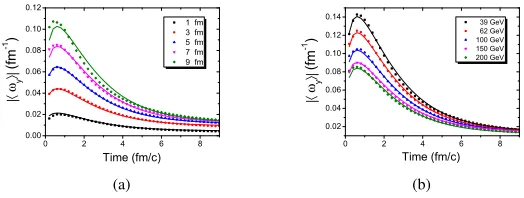
The centrality dependence ofωyat given beam energy √sNN =200 GeV: see Fig. 1(a). Theωy
briefly increases with time which is most likely due to parton scatterings during the early stage (when the transverse radial expansion is not developed yet) that in certain way decrease the fluid moment of inertia. The averaged vorticity reaches peak value at an almost universal time around 1 fm/c and then
not simply neglect its impact on the phase transition and chiral transport. Hence we discuss the ro-tational polarization effects for quark pairings, which would change the chiral restoration and color
superconductivity critical behaviors [12]. In chiral restored phase the vorticity would also induce two anomalous chiral transport relations for the left and right-handed quarks respectively [13, 14]. Com-bining these two effects there is a new collective mode called chiral vortical wave(CVW) [15]. The
CVW would reshuffle the final state hadrons’ distributions so that provide a new contribution to the
elliptic flow splitting of hadrons.
2 Vorticity in heavy ion collisions
As a transport model AMPT would output trajectories of all the partons in the phase space during collisions. For a large enough system after proper coarse-graining (e.g. like the fluid being made of many fluid cells), it can be considered as a continuous medium characterized by a series of locally defined quantities like momentum density, energy density and particle number density p(r),(r) and
n(r) respectively. Here we define the 3-velocity field asv(r) = p(r)/(r). And the non-relativistic vorticityω =∇ ×vis adopted in this work. The detailed patterns of vorticity shown in [10] could be roughly understood by a radial flow profilevthat can be well parameterized in the formv(ρ, φ, η)=
ˆ
eρv0(ρ, η)[1+2c2(ρ, η) cos 2φ], where ˆeρis the unit vector along the transverse radial direction,ρand
φare transverse radial and azimuthal coordinates. Noting that this flow profile has no global rotation. It suggests that, to extract the component of local vorticity that is truly associated with the global rotation, one needs to perform an average over the fireball. Upon such averaging, the background flow contributions to local vorticity would cancel out, and what remains can be attributed to the rotational motion. The averaged vorticity over the whole fireball depends on the weight we choose. In the
0 2 4 6 8
0.00 0.02 0.04 0.06 0.08 0.10 0.12
|〈
ωy
〉|
(fm
-1 )
Time (fm/c)
1 fm 3 fm 5 fm 7 fm 9 fm
(a)
0 2 4 6 8
0.02 0.04 0.06 0.08 0.10 0.12 0.14
|〈
ωy
〉|
(fm
-1 )
Time (fm/c) 39 GeV 62 GeV 100 GeV 150 GeV 200 GeV
(b)
Figure 1.Averaged vorticityωyfrom the AMPT model as a function of time at various impact parameterbfor
fixed beam energy √sNN =200 GeV. (a). Averaged vorticityωyfrom the AMPT model as a function of time
at varied beam energy√sNNfor fixed impact parameterb=7 fm. (b).
following we chooseW(r)=ρ2(r). Different weights dependence has also been investigated in [10].
The centrality dependence ofωyat given beam energy √sNN =200 GeV: see Fig. 1(a). Theωy
briefly increases with time which is most likely due to parton scatterings during the early stage (when the transverse radial expansion is not developed yet) that in certain way decrease the fluid moment of inertia. The averaged vorticity reaches peak value at an almost universal time around 1 fm/c and then
follows a steady decrease with time. The decrease is due to the system’s expansion which increases total moment of inertia at the price of reduced vorticity due to the constraint of constant angular momentum. The results also clearly demonstrate that the averaged vorticity increases from central to peripheral collisions: this trend is different from the angular momentum. Such difference again can be
understood as follows: while the vorticity increases withb, the fluid moment of inertia (pertinent to rotation) in the fireball decreases withb, thus the angular momentum shows a non-monotonic behavior due to the two competing trends.
We next show the beam energy dependence of ωyat given impact parameterb = 7 fm: see
Fig. 1(b). Similar time evolution patterns are observed at all energies. We notice that the averaged vorticity increases with decreasing beam energy, in quite the opposite trend to the angular momen-tum. This may be understood as follows: with increasing beam energy, the fluid moment of inertia (pertinent to rotation) increases more rapidly than the decrease of vorticity, thus the total angular mo-mentum is still increasing. We have numerically checked that this is indeed the case. And the trend has also been observed in STAR’s results [9]
3 Rotation-induced phase transition
From the simulation we have already seen that the local vorticity can be several tens or one hundred of MeV. Considering the polarization effect the quark energy shift should beE±ω·Jwhich behaves as a chemical potential. Therefore it would induce the non-negligible modification to the fermi surface of the quarks, which further affects the pairing probability. Theoretically it is more intuitive to study
a fermionic system under a global rotationω to show the generic rotation-induce effect.
In this proceeding we only consider the J = 0 pairing cases. For a pair of spin-12 fermions,
there are different ways of forming a spin-0 pairing state: either, the pair could have both nonzero
orbital angular momentumL and nonzero total spinS, withLandS being opposite thus resulting in totalJ =0; or the pair could have zero orbital angular momentum, and have opposite individual
spin configurations for the two fermions. When such a system is under rotation, there will be a generic rotational suppression effect on the scalar pairing states. Intuitively this can be understood
as follows. The global rotation, implying a nonzero macroscopic angular momentum of the whole system, will induce arotational polarization effect which tends to “force” all microscopic angular momentum to be aligned with the global angular momentum. So for a pair of fermions, their relative orbital angular momentumLas well as their individual spins would prefer to be parallel to the global angular momentum rather than to arrange themselves into a scalar state with zero angular momentum. This therefore leads to a generic suppression effect on the scalar pairing states. It also implies that
pairing states with nonzero angular momentum could become more favorable. In the following, we quantitatively demonstrate this effect in the Nambu–Jona-Lasinio model for the chiral condensate (of
quark-anti-quark pairing states withL =S =1 butJ =0). And the diquark condensate (of
quark-quark pairing state withL=S =0) case could be referred to [12].
In the chiral condensate case, the mean-field approximation gives the grand potential as
Ω =
d3r(M−m)2
4G − NfNc
16π2
n
dk2
t
dkz× [Jn(ktr)2+Jn(ktr)2]
×Tln1+e(n−µ)/T+ln1+e−(n−µ)/T +ln1+e(n+µ)/T+ln1+e−(n+µ)/T (1)
In the above the mean-field quasiparticle dispersionnis given byn =
k2
z+k2t +M2−(n+12)ω.
Note that because of the rotation around the z-axis, theO(3) symmetry has been broken intoO(2) here. The mean-field chiral condensate (or equivalently the mass gapM) at given values of temperatureT, chemical potentialµand rotation ω, can then be determined from the usual gap equation through minimization the potential: δΩ
δM(r) =0 and δ 2Ω
δM(r)2 >0. We will numerically solve the gap equation for
the case ofNf =2 andNc=3 and present the results below. For the parametersG,Gdand a cutoff
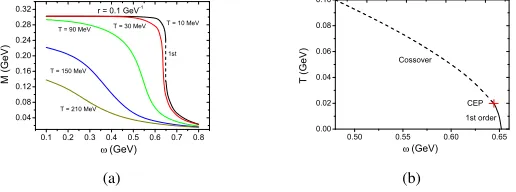
The chiral restorations are observed in Fig 2(a) as the angular velocity increases at different
tem-peratures. It is tempting to envision a new phase diagram of the chiral phase transition on theT−ω parameter space: see Fig. 2(b) (as computed from the present model). It features a chiral-symmetry-broken phase at low temperature and slow rotation while a chiral-symmetry-restored phase at high temperature and/or rapid rotation. A smooth crossover transition region at highT and lowT and a
first-order transition line at lowT and highωare connected by a newcritical end point. Given the present model parameters, this critical point is located atTCEP =0.020GeV andωCEP =0.644GeV.
As already discussed previously, the “rotational suppression” of the scalar condensate is a quite generic effect. It is conceivable that similar phase transition behaviors under rotation would also
occur in other dynamical models for studying chiral condensate. In [12] we also studied the diquark
0.1 0.2 0.3 0.4 0.5 0.6 0.7 0.8 0.04
0.08 0.12 0.16 0.20 0.24 0.28 0.32
T = 10 MeV T = 30 MeV T = 90 MeV
T = 210 MeV
M
(G
eV
)
ω (GeV)
T = 150 MeV
1st
r = 0.1 GeV-1
(a)
0.50 0.55 0.60 0.65 0.00
0.02 0.04 0.06 0.08 0.10
T
(G
eV
)
ω (GeV)
Cossover
1st order CEP
(b)
Figure 2. The mean-field mass gapM(at radiusr =0.1GeV−1) as a function ofωfor various fixed value of T(a). The phase diagram onT-ωplane (b).
condensate case. As our analysis in above the rotational suppression would emerge again in that sys-tem. It should be mentioned that the rotational movement would always try to push matters far away from the center, which means it would be an inhomogeneous system. The radial distance-induced phase transition, which can not be smooth enough, is being studied self-consistently.
4 Chiral vortical wave
The CVW is the direct result of Chiral vortical effects
JV = 1
π2µµ5ω, JA = 1
6T2+ 1
2π2(µ2+µ25)
ω . (2)
Using the chiral basis and considering the current conservation relations for the left and right-handed quark currentsJL/R= 12(JV∓JA), we would obtain the wave equations
∂tnL/R=± 1
4π2ω∂x(µ2L/R)=±
ωµL/R
2π2 ∂xµL/R, (3)
where the background vorticity isω =ωxˆand CVW speed isVΩ =
µ0ω 2π2χµ
0 in the linearized
approxi-mation. Theχµ0is the susceptibility andµ0the background chemical potential. Obviously the CVW
will transport charges along or against the vorticity direction. The detailed process depends on the initial condition [15]. If the initial condition is a purely axial charge density fluctuationFA
i(x) att=0,
acharge dipole momentwould be generated eventually with the size (δn)V
t ≈ [−∂xFAi(x)]VΩt. On the other hand a purely vector charge density fluctuationFV
i(x) att =0 would result a vector charge
quadrupole (δn)V
The chiral restorations are observed in Fig 2(a) as the angular velocity increases at different
tem-peratures. It is tempting to envision a new phase diagram of the chiral phase transition on theT −ω parameter space: see Fig. 2(b) (as computed from the present model). It features a chiral-symmetry-broken phase at low temperature and slow rotation while a chiral-symmetry-restored phase at high temperature and/or rapid rotation. A smooth crossover transition region at highT and lowT and a
first-order transition line at lowT and highωare connected by a newcritical end point. Given the present model parameters, this critical point is located atTCEP =0.020GeV andωCEP =0.644GeV.
As already discussed previously, the “rotational suppression” of the scalar condensate is a quite generic effect. It is conceivable that similar phase transition behaviors under rotation would also
occur in other dynamical models for studying chiral condensate. In [12] we also studied the diquark
0.1 0.2 0.3 0.4 0.5 0.6 0.7 0.8 0.04 0.08 0.12 0.16 0.20 0.24 0.28 0.32
T = 10 MeV T = 30 MeV T = 90 MeV
T = 210 MeV
M
(G
eV
)
ω (GeV)
T = 150 MeV
1st
r = 0.1 GeV-1
(a)
0.50 0.55 0.60 0.65 0.00 0.02 0.04 0.06 0.08 0.10 T (G eV )
ω (GeV)
Cossover
1st order CEP
(b)
Figure 2. The mean-field mass gapM(at radiusr =0.1GeV−1) as a function ofωfor various fixed value of T (a). The phase diagram onT-ωplane (b).
condensate case. As our analysis in above the rotational suppression would emerge again in that sys-tem. It should be mentioned that the rotational movement would always try to push matters far away from the center, which means it would be an inhomogeneous system. The radial distance-induced phase transition, which can not be smooth enough, is being studied self-consistently.
4 Chiral vortical wave
The CVW is the direct result of Chiral vortical effects
JV = 1
π2µµ5ω, JA= 1
6T2+ 1
2π2(µ2+µ25)
ω . (2)
Using the chiral basis and considering the current conservation relations for the left and right-handed quark currentsJL/R= 12(JV∓JA), we would obtain the wave equations
∂tnL/R =± 1
4π2ω∂x(µ2L/R)=±
ωµL/R
2π2 ∂xµL/R, (3)
where the background vorticity isω =ωxˆand CVW speed isVΩ=
µ0ω 2π2χµ
0 in the linearized
approxi-mation. Theχµ0is the susceptibility andµ0the background chemical potential. Obviously the CVW
will transport charges along or against the vorticity direction. The detailed process depends on the initial condition [15]. If the initial condition is a purely axial charge density fluctuationFA
i(x) att=0,
acharge dipole momentwould be generated eventually with the size (δn)V
t ≈ [−∂xFiA(x)]VΩt. On the other hand a purely vector charge density fluctuationFV
i(x) att=0 would result a vector charge
quadrupole (δn)V
t ≈FiV(x)+[∂2xFVi(x)/2](VΩt)2.
To find possible experimental manifestation, we consider the rotating quark-gluon plasma created in off-central heavy ion collisions. In such a QGP, CVW occurs for each light flavors, e.g. u,d
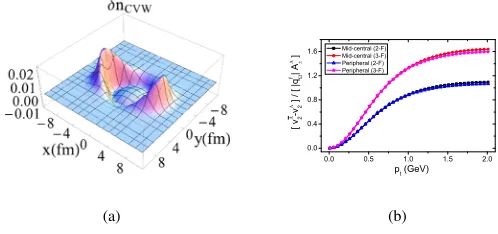
quarks and possiblysquarks as well. The global rotation points in the out-of-plane direction. Given initial fluctuations in their respective vector densities, each flavor develops its CVW alongω. This transports flavor charges toward the two “tips” of the QGP fireball, thus leading to a quadrupole charge distribution on the transverse plane, which is shown in Fig. 3(a). In [15] we made the first estimate of such effect. The measurement may be done by the elliptic flow splitting of identified
(a)
0.0 0.5 1.0 1.5 2.0 0.0
0.4 0.8 1.2
1.6 Mid-central (2-F)
Mid-central (3-F) Peripheral (2-F) Peripheral (3-F)
[ v
Λ-v2
Λ ] 2
/ [
|q
f| AΩ Λ ]
pt (GeV)
(b)
Figure 3. CVW-induced flavor charge density profile (a). Normalized ¯Λand Λelliptic flow splitting, [vΛ¯
2 −
vΛ
2]/[|qΩf|A Λ
±], for symmetric 2-flavor(2-F) and 3-flavor(3-F) cases. The mid-central and the peripheral correspond
to for 15−30% and 60−92% centrality class (see [17]) (b).
particles/anti-particles with nonzero baryonic charges. Flavor quadrupole implies more quarks on
the out-of-plane tips of fireball and less on the in-plane equator , and therefore more baryons will be formed on the tips than on the equator. The stronger in-plane radial flow will thus translate the quadrupole into baryon/anti-baryonv2splitting. This mechanism is in analogy to the electric charge
quadrupole induced by CMW [6]. To quantify such baryon flow spitting, one needs to combine quarks of varied flavors into hadrons. Suppose at the freeze-out, the flavor-wise chemical potential for quarks contains the CVW-induced quadrupole contributionδµf ∝2qΩf cos(2φs) (withf =u,d,s). The
corresponding chemical potential for a given type of hadron can be determined from its constituent quark content, e.g. forΛbaryon δµΛ ∝ 2(quΩ+q
d
Ω+q
s
Ω) cos(2φs). We particularly propose to use
Λbaryon which is electric charge neutral thus unaffected by possible CMW effect. We then use the
STAR blast-wave model [17] to compute the resulting differential flow splitting. As it is unclear how
much thesquark mass may reduce their chiral effects, we consider two extreme cases: a symmetric
two-flavor (2-F) case qu
Ω = q
d
Ω = q
f
Ω with q
s
Ω = 0, or a symmetric three-flavor (3-F) case q
u
Ω =
qd
Ω = q
s
Ω = q
f
Ω. From Cooper-Frye scheme it is easy to see∆v2 = v
¯
Λ
2 −vΛ2 ∝ |q
f
Ω|A Λ
± withAΛ± =
(NΛ−NΛ¯)/(NΛ+NΛ¯) theΛ-asymmetry that is directly related to background densityµ
0(in analogy
to a similar relation in CMW case [6]). The results for normalized flow splitting∆v2/[|qΩf|A Λ
±] are
shown in Fig.3(b). Such effect in heavy ion collisions could be quantitatively investigated in the
framework of anomalous fluid dynamics similarly to the recent development for the study of chiral magnetic effect [18].
5 Summary
In summary we systematically studied the vorticity-induced effects in various aspects. With AMPT it
re-markable global rotation speed. Motivated by the large vorticity and taking the rotational polarization effect into account the spin zero condensate would be suppressed. As a generic suppression
mech-anism it may have non-negligible impacts in both QCD phase diagram and numbers of low energy systems. Finally in the chiral restored phase the vorticity would excite the chiral vortical wave. Using the rotating quark-gluon plasma in heavy ion collisions as a concrete example, we show the formation of induced flavor quadrupole in QGP and estimate the elliptic flow splitting effect forΛbaryons. Such
proposal could be tested with future experimental data.
Acknowledgments. This material is based upon work supported by the U.S. Department of En-ergy, Office of Science, Office of Nuclear Physics, within the framework of the Beam Energy Scan
Theory (BEST) Topical Collaboration. The work is also supported in part by the NSF Grant No. PHY-1352368 (JL), by the DFG Collaborative Research Center “SFB 1225 (ISOQUANT)” (YJ), by the NSFC of China under Grants No. 11628508(ZWL), by Young 1000 Talents Program of China, NSFC with Grant No.11535012 and No.11675041, and the Scientific Research Foundation of State Education Ministry for Returned Scholars(XGH).
References
[1] D. Kharzeev and A. Zhitnitsky, Nucl. Phys. A797, 67 (2007).
[2] D. E. Kharzeev, L. D. McLerran and H. J. Warringa, Nucl. Phys. A803, 227 (2008).
[3] D. E. Kharzeev, J. Liao, S. A. Voloshin and G. Wang, Prog. Part. Nucl. Phys. 88, 1 (2016) doi:10.1016/j.ppnp.2016.01.001 [arXiv:1511.04050 [hep-ph]].
[4] J. Liao, Pramana84, no. 5, 901 (2015) doi:10.1007/s12043-015-0984-x [arXiv:1401.2500
[hep-ph]].
[5] D. E. Kharzeev and H. U. Yee, Phys. Rev. D83, 085007 (2011) doi:10.1103/PhysRevD.83.085007
[arXiv:1012.6026 [hep-th]].
[6] Y. Burnier, D. E. Kharzeev, J. Liao and H. U. Yee, Phys. Rev. Lett. 107, 052303 (2011); arXiv:1208.2537 [hep-ph].
[7] L. P. Csernai, V. K. Magas, H. Stocker and D. D. Strottman, Phys. Rev. C 84, 024914 (2011) doi:10.1103/PhysRevC.84.024914 [arXiv:1101.3451 [nucl-th]].
[8] L. P. Csernai, D. D. Strottman and C. Anderlik, Phys. Rev. C 85, 054901 (2012) doi:10.1103/PhysRevC.85.054901 [arXiv:1112.4287 [nucl-th]].
[9] L. Adamczyk et al. [STAR Collaboration], Nature 548, 62 (2017) doi:10.1038/nature23004
[arXiv:1701.06657 [nucl-ex]].
[10] Y. Jiang, Z. W. Lin and J. Liao, Phys. Rev. C94, no. 4, 044910 (2016) Erratum: [Phys. Rev. C 95, no. 4, 049904 (2017)] doi:10.1103/PhysRevC.94.044910, 10.1103/PhysRevC.95.049904
[arXiv:1602.06580 [hep-ph]].
[11] A. Yamamoto and Y. Hirono, Phys. Rev. Lett. 111, 081601 (2013) doi:10.1103/PhysRevLett.111.081601 [arXiv:1303.6292 [hep-lat]].
[12] Y. Jiang and J. Liao, Phys. Rev. Lett. 117, no. 19, 192302 (2016) doi:10.1103/PhysRevLett.117.192302 [arXiv:1606.03808 [hep-ph]].
[13] D. T. Son and P. Surowka, Phys. Rev. Lett.103, 191601 (2009). [14] D. E. Kharzeev and D. T. Son, Phys. Rev. Lett.106, 062301 (2011). [15] Y. Jiang, X. G. Huang and J. Liao, Phys. Rev. D92, no. 7, 071501 (2015).
[16] S. P. Klevansky, Rev. Mod. Phys.64, 649 (1992). doi:10.1103/RevModPhys.64.649