MINING BIG DATA: STUDY OF TOOLS OF OPEN
SOURCE REVOLUTION
Ms. Palak Vaish
1, Dr. Saurabh Srivastava
21
Research Scholar, Mewar University, Chittorgarh, Rajasthan, (India)
2
Department of Mathematical Sciences and Computer Applications,
Bundelkhand University, Jhansi, U.P (India)
ABSTRACT
Big data is a term that describes the large volume of structured and unstructured data that inundates a business on a day-to-day basis. It is a pool of large and complex data sets that are difficult to process using usual database management tools. Big Data mining is the ability of extracting useful information from huge streams of data or datasets that can be analyzed for insights that lead to better decisions and strategic business moves. The challenges include data capture, storage, search, sharing, analysis, and visualization. With this difficulty, a new platform of "big data" tools has arisen to handle sense making over large quantities of data, as in the Apache Hadoop Big Data Platform. This paper argues on Big Data, modern databases supporting it and Big Data Mining. The challenges, architecture and analytical tools of Big data and Big data mining are also taken into account.
Keyword:
Architecture, Big Data, Big Data Mining, Hadoop
I. INTRODUCTION
The use of the data is rapidly changing the nature of communication, shopping, advertising, entertainment, and
relationship management. Data sets grow in size in part because they increasingly gathered by widespread radio
frequency identification readers, remote sensing, information-sensing mobile, software logs, microphones,
cameras, and wireless sensor networks. For some organizations, facing hundreds of gigabytes of data for the
first time may generate a need to reconsider data management alternatives. Gartner [1] summarizes this in their
definition of Big Data in 2012 as “high volume, velocity and variety information assets that demand
cost-effective, innovative forms of information processing for enhanced insight and decision making”. It is described
by majorly following Vs:
Volume- data from business transactions, social media and information from sensor or machine-to-machine
data [2].
Velocity- Sensors RFID tags, and smart metering is driving the need to deal with torrents of data in
near-real time.
Variety- from structured, numeric data in traditional databases to unstructured video, text documents,
Variability-Daily, seasonal and event-triggered peak data loads can be challenging to manage. Even more
so with unstructured data.
Value- Resulting insights that for trends and patterns, difficult analysis based on graph algorithms, machine
learning and statistical modeling. These analytics overtake the results of querying, reporting and business
intelligence [3].
An analyzed Big Data can open new markets, deliver new business insights, and create competitive advantages.
The real value of data is observed after analyzing i.e. after finding patterns, deriving meanings and making
decisions. The importance of big data doesn’t revolve around how much data you have, but what you do with it.
Its analysis can lead to new product development, cost reductions, smart decision making, time reductions and
optimized offerings.
There are many applications of Big Data that allow people to have better customer experiences, better services,
and also be healthier, as personal data will permit to prevent and detect illness much earlier than before [4].
Technology: reducing process time from hours to seconds
Business: churn detection and customer personalization
Smart cities: cities focused on high quality of life and sustainable economic development with proper
management of natural resources
Health: mining DNA of each person, to discover, examine, study, monitor and improve health aspects of
every one
II.
ARCHITECTURE OF BIG DATA
The big data landscape is comprised of four layers:
Infrastructure as a Service (IaaS): This includes the servers, storage, network and distributed file systems.
Platform as a Service (PaaS): This layer provides the logical model for the raw, unstructured data stored in the
files.
Data as a Service (DaaS): This includes entire array of tools available for integrating with the PaaS layer using
integration adapters, search engines, batch programs etc.
Big Data Business Functions as a Service (BFaaS): This layer includes packaged applications that serve a
specific business need and leverage the DaaS layer for cross-cutting data functions like ecommerce, health,
Fig. 1 Layered Architecture of Big Data
III.
BIG DATA ANALYTICS IN MODERN DATABASE LANDSCAPE
With the evolving volume of data, new techniques are needed to analyze it for which new data-warehousing and
technologies are a solution [5]. The Big Data phenomenon is intrinsically related to the open source software
revolution. Large companies as Yahoo!, Facebook, LinkedIn, and Twitter benefit and contribute working on
open source projects. Working with volumes of structured data has always been simple by using a relational
database but if the volume or velocity of the data denies using a relational database, then the problem is called
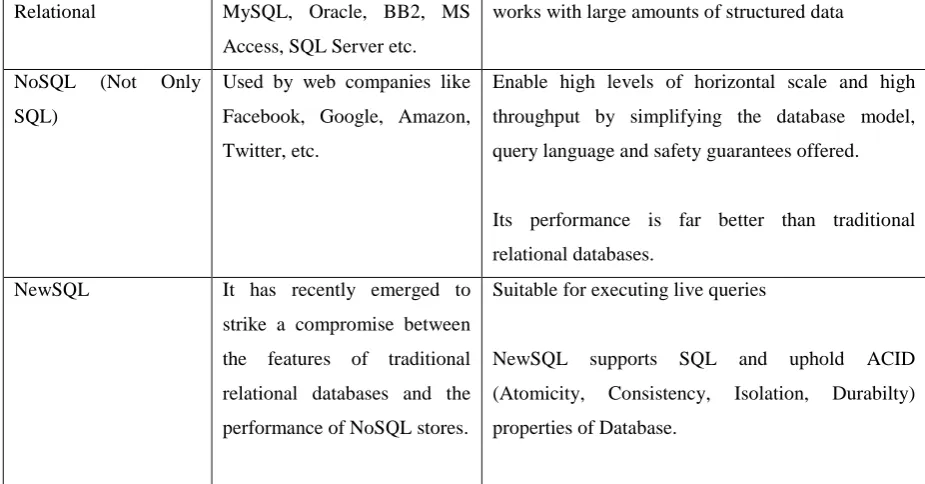
“Big Data Problem”. Following table provides a broad perspective of this modern database landscape with a
selection of the main systems in each family [6].
TABLE 1: Tools for Big Data Mining and Analytics
Relational MySQL, Oracle, BB2, MS
Access, SQL Server etc.
works with large amounts of structured data
NoSQL (Not Only
SQL)
Used by web companies like
Facebook, Google, Amazon,
Twitter, etc.
Enable high levels of horizontal scale and high
throughput by simplifying the database model,
query language and safety guarantees offered.
Its performance is far better than traditional
relational databases.
NewSQL It has recently emerged to
strike a compromise between
the features of traditional
relational databases and the
performance of NoSQL stores.
Suitable for executing live queries
NewSQL supports SQL and uphold ACID
(Atomicity, Consistency, Isolation, Durabilty)
Distributed Analytical
Frameworks
Hadoop, MapReduce,
They offer an alternative to
databases for analytics
MapReduce framework was introduced by Google
in 2004 as an abstraction for executing
batch-processing tasks over large-scale at data
(unindexed/raw files) in a distributed setting [4].
A MapReduce job divides the input dataset into
independent subsets that are processed by map tasks
in parallel.
MapReduce is proprietary and kept closed by
Google.
It is considered as one of the core Big Data
technologies.
Apache Hadoop [7] is an open source project which
offers a mature implementation of the MapReduce
framework and a distributed file system called
Hadoop Distributed Filesystem (HDFS).
It is used for data intensive distributed applications
and allows writing applications that rapidly process
large amounts of data in parallel on large clusters of
compute nodes.
Apache Hadoop related projects [8]: Apache Pig,
Apache Hive, Apache HBase, Apache ZooKeeper,
Apache Cassandra, Cascading, Scribe and many
others.
Pregel/ Graph
These are both MapReduce
style frameworks designed
specifically for abstraction of
graph-based analytics as
clustering, shortest
Pregel was first introduced by Google in 2009
suitable for distributed computation on very large
graphs [9].
Apache Graph is an open source implementation of
MapReduce style frameworks built on top of
path, computing connected
components, centrality
measures etc.,
Both are a message passing
system between vertices in a
graph
Object databases Allow for storing data in the
form of objects as per object
oriented programming
languages.
support a query language and other features,
including versioning, constraints,
triggers, etc.
XML databases data are stored in an XML-like
Data structure.
Store XHTML, RSS, ATOM feeds and SOAP
messages etc. in a native format that enables them to
be queried directly through languages such as
XQuery, XPath or XSLT.
RDF databases Provides query functionality
over data represented in the
core Semantic Web data
model.
Use SPARQL query language
Big Data Mining Tools
R It was designed by Ross Ihaka and Robert
Gentleman at the University of Auckland, New
Zealand beginning in 1993 and is used for statistical
analysis of very large data sets [10].
It is an open source software environment and
programming language designed for statistical
computing and visualization.
MOA It is a stream data mining open source software to
perform data mining in real time [11].
It started as a project of the Machine Learning group
of University of Waikato, New Zealand, famous for
the
Vowpal Wabbit It is an open source project started at Yahoo!
Research and now used at Microsoft Research [13].
It is used to design a fast, scalable, useful learning
algorithm from tera feature datasets. When doing
linear learning, it can exceed the throughput of any
single machine network interface through parallel
learning.
Apache Mahout It is scalable data mining and machine learning open
source software [14] based mainly in Hadoop.
It is widely used for classification, clustering,
frequent pattern mining. and collaborative filtering.
Big Graph mining
GraphLab high-level graph-parallel system built without using
MapReduce.
It computes over dependent records which are stored
as vertices in a large distributed data-graph [15].
Pegasus It is a big graph mining system built on top of
MapReduce [16].
It allows finding patterns and anomalies in massive
real-world graphs [17].
Big Data technologies primarily focus on the challenges of velocity and data volume. NoSQL scales by by
supporting query languages more lightweight than SQL, distributing data management over multiple machines
and relaxing traditional ACID guarantees. However, NewSQL aims to seek a balance by supporting ACID/SQL
as per traditional relational databases while trying to compete with the performance and scale of NoSQL
systems.
IV.
CHALLENGES IN BIG DATA ANALYTICS AND MINING
Despite of so many advantages, there are many future important challenges in Big Data management, mining
and analytics based on the nature of data and diversity [18]. There are some challenges to be met in the future
[19] as-
Big data is so big that it is very difficult to find user-friendly visualizations of photographs, infographics
How the Analytics Architecture to deal with historic data and with real-time data at the same time. An
interesting proposal is the Lambda architecture [20].
Big Data mining techniques should be able to adapt with evolving time and in some cases to detect changes
first.
How to manage statistical significance accurately as it’s always easy to go wrong with huge data sets and
thousands of questions to answer simultaneously.
Dealing with Big Data, the storage quantity is very relevant. There are two main approaches for it-
compression we may take more time and less space but can be considered as a transformation from time to
space. However, using using sampling, we are loosing information, but the gains in space may be in orders
of magnitude.
Not allow Distributed mining techniques to paralyze as to have distributed versions of some methods, a lot
of research is needed with theoretical and practical analysis to provide new methods.
Since new data is largely file based, untagged and unstructured, large quantities of useful data are getting
lost. However, currently only 3% of the potentially useful data is tagged, and even less is analyzed as per
The 2012 IDC study on Big Data [21].
V.
CONCLUSION
Big data is going to be more diverse, larger, and faster in future as it’s becoming the new Final Frontier for
scientific data research and for business applications [22]. Driven by key industrial stakeholders and real-world
applications, managing and mining Big Data is yet a challenging yet and compelling task. Big Data is
autonomous with distributed and decentralized control, huge with heterogeneous and diverse data sources and
complex and evolving in data and knowledge associations. High performance computing platforms are required
to support Big Data mining, which impose systematic designs to use the full power of the Big Data. Different
sources and ways of data collection often result in data with complicated conditions, such as missing/uncertain
values. Privacy concerns, noise and errors can be introduced into the data, to produce altered data copies. So,
developing a safe and sound information sharing protocol is a major challenge. Thus, Big Data as an emerging
trend and the need for Big Data mining is arising in all science and engineering domains
REFERENCES
[1]. Gartner, http://www.gartner.com/it-glossary/bigdata, 2012.
[2]. Bloem, J. Doorn, M. V. Duivestein, S. Manen & Ommeren, “Creating clarity with Big Data”, Sogeti,
2012.
[3]. Vinayak Borkar, Michael J. Carey, Chen Li, “Inside “Big Data Management”: Ogres, Onions, or
Parfaits?”, EDBT/ICDT 2012 Joint Conference Berlin, Germany, 2012.
[4]. Intel. Big Thinkers on Big Data, http://www.intel.com/content/www/us/en/bigdata/
[5]. J. Dean and S. Ghemawat. MapReduce: Simpli_ed Data Processing on Large Clusters. In OSDI, pages
137{150, 2004.Russom, “Big Data Analytics”, TDWI Research, 2011.
[6]. F. Chang, J. Dean, S. Ghemawat, W. C. Hsieh, D. A. Wallach, M. Burrows, T. Chandra, A. Fikes, and R.
E. Gruber. Bigtable: A Distributed Storage System for Structured Data. ACM Trans. Comput. Syst., 26(2),
2008.
[7]. Apache Hadoop, http://hadoop.apache.org.
[8]. P. Zikopoulos, C. Eaton, D. deRoos, T. Deutsch, and G. Lapis. IBM Understanding Big Data: Analytics
for Enterprise Class Hadoop and Streaming Data. McGraw-Hill Companies,Incorporated, 2011.
[9]. G. Malewicz, M. H. Austern, A. J. C. Bik, J. C. Dehnert, I. Horn, N. Leiser, and G. Czajkowski. Pregel: a
system for large-scale graph processing. In SIGMOD Conference, pages 135-146, 2010.
[10].R Core Team. R: A Language and Environment for Statistical Computing. R Foundation for Statistical
Computing, Vienna, Austria, 2012. ISBN 3-900051-07-0.
[11].C. Bockermann and H. Blom. The streams Framework. Technical Report 5, TU Dortmund University, 12
2012.
[12].A. Bifet, G. Holmes, R. Kirkby, and B. Pfahringer. MOA: Massive Online Analysis http://moa.
cms.waikato.ac.nz/. Journal of Machine Learning Research (JMLR), 2010.
[13].J. Langford. Vowpal Wabbit, http://hunch.net/~vw/, 2011.
[14].Apache Mahout, http://mahout.apache.org.
[15].Y. Low, J. Gonzalez, A. Kyrola, D. Bickson, C. Guestrin, and J. M. Hellerstein. Graphlab: A new parallel
framework for machine learning. In Conferference on Uncertainty in Artificial Intelligence (UAI),
Catalina Island, California, July 2010.
[16].D. Laney. 3-D Data Management: Controlling Data Volume, Velocity and Variety. META Group
Research Note, February 6, 2001.
[17].R. Smolan and J. Erwitt. The Human Face of Big Data. Sterling Publishing Company Incorporated, 2012.
[18].C. Parker. Unexpected challenges in large scale machine learning. In Proceedings of the 1st International
Workshop on Big Data, Streams and Heterogeneous Source Mining: Algorithms, Systems, Programming
Models and Applications, BigMine '12, pages 1{6, New York, NY, USA, 2012. ACM.
[19].V. Gopalkrishnan, D. Steier, H. Lewis, and J. Guszcza. Big data, big business: bridging the gap. In
Proceedings of the 1st International Workshop on Big Data, Streams and Heterogeneous Source Mining:
Algorithms, Systems, Programming Models and Applications, Big- Mine '12, pages 7{11, New York, NY,
USA, 2012. ACM.
[20].N. Marz and J. Warren. Big Data: Principles and best practices of scalable realtime data systems. Manning
Publications, 2013.
[21].J. Gantz and D. Reinsel. IDC: The Digital Universe in 2020: Big Data, Bigger Digital Shadows, and
Biggest Growth in the Far East. December 2012.
[22].Kataria. M, Mittal. P, “Big Data: A Review”, International Journal of Computer Science and Mobile