Vol. 3, Issue 1, January 2015
Zigbee Sensor Network Integrated with 4G
Using Tree Routing for IoT Applications
K. Kalaivani
Student, Dept. of Embedded System, Sathyabama University, Chennai, India
ABSTRACT: Internet of Things (IoT) is identifiable objects uniquely and their representations of an IoT are like
structures. The concept of IoT is to develop the information in sense. And the device interacts without the need of human. Zigbee is a communication protocol and it is used to transmit data over long distances by passing data through the intermediate devices to cover longer distant. ZigBee is the emerging standard for ad hoc networks based on IEEE 802.15.4. It provides secure networking and can be used anywhere at any time. It can be easily implemented with any type of wireless generation and It requires less power to operate. 4G (Fourth Generation) is the next generation of wireless networks and it can secure data transfer. Speed of 4G provides fast and it can be achieved by OFDM modulation. World Wide Interoperability for Microwave Access (WiMAX) is wireless technology and it provides wireless data over longer distance. It provides a media access control (MAC) and the proposes is full range of security features to secured the data exchange. It nearly transmits the data at 70 Mbps. In this paper, Zigbee Wireless sensor nodes real time data transmission integrated with 4G Technology using tree routing for long distance Secure Communication with high mobility and it is proposed and analysed by using OPNET. Tree routing is used to find the next hop knob for a given destination address without routing tables. Still, a sender cannot know that the destination is situated close by or if it is not in the sub-tree. Even though the tree routing is capable in the observation point of memory usage. The concert such as Jitter, data sent, delay and packet delay variation and end-to-end delay are simulated.
KEYWORDS: WiMAX; 4G; IoT; Zigbee; Wireless sensor network; Tree routing.
I. INTRODUCTION
Two technologies which find a fast and a enormous growth at present are Cloud Computing and after that is Internet of Things (IoT). The next epoch of computing will be owing to the present traditional computing, where the computers will be capable to access the data not including any human interaction on the field. IoT represents a vital part of the upcoming internet. IoT can be realized into three paradigms as IP (Internet Protocol) oriented (middleware), things oriented (sensors) and semantic-oriented (knowledge). Zigbee is the Wireless sensor based technologies that address the single needs of most remote applications. It supports for several network topologies such as point, point-to-multipoint and mesh networks [1]. Zigbee networks grant security using 128 bit symmetric encryption keys and it uses Direct Sequence Spread Spectrum (DSSS). Zigbee module is a wireless sensor network (WSN) platform which is based on the IEEE 802.15.4, 2.4 GHz standard. 4G is a technology which supports high feature audio and video streaming end to end IP. It supports bandwidth in a scope of 5 to 20 MHz and supports both the TDD and FDD duplexing. 4G system targets tip data rates of approximately 100 Mpbs for high mobility and 1Gbps for low mobility forces [2].
It uses orthogonal frequency division multiplexing (OFDM) access for WiMAX UL, LTE DL, and WiMAX DL. WiMAX is an IEEE 802.16 standard which is highly professional and suitable for long range applications. WiMAX base station offer wireless coverage of about 5 miles in a line of sight transmission. Zigbee uses two types of commands for communication- (i) API Commands and (ii) AT commands and it can be used as an end device, router or coordinator. Zigbee also uses as serial communication protocol for the transfer of data and operates at a Range of 3.3V DC. PAN is the combination of a one or more routers, end devices and single coordinator. To cover huge area more number of PAN is used. The end devices and router can commune with the coordinator inside the PAN [3].
.
Vol. 3, Issue 1, January 2015
digital subscriber lines. WiMAX meeting mission is to support and verify interoperability and compatibility of broadband wireless products. WiMAX is based on the radio frequency (RF) technology called Orthogonal Frequency Division Multiplexing (OFDM) and it is a successful way for transferring the data other than carrier width of 5MHz and below the carrier width of 5MHz CDMA based 3G system is enough. WiMAX provides WMAN connectivity through the speed of 70 Mbps and its base station covers a normal distance of 5 to 10 km. WIMAX is a standard-based wireless technology. It provides communication path between a core network and a subscriber site and it offers high throughput broadband connections. ZigBee stack is embedded and it is small and inexpensive micro-controller units because tree routing does not need any routing tables to transmit the packet to the destination. Tree routing can be used in ZigBee end devices that have limited resources. On the other hand, tree routing has the problem that the packets track the tree topology to the destination still if the destination is located nearby [4].
So we propose the tree routing protocol to decrease the routing cost of ZigBee tree routing by using the neighbour table. In this paper Zigbee wireless sensor is integrated with 4G using tree routing for data and video transmission. Here both transmissions are considered and analysed. The scenarios and challenges of next generation wireless communication are discussed [5].
The rest of the paper is organized as follows. The section II discuss about proposed Zigbee, Tree routing and WiMAX network for an IoT. In Section III Performance analysis of the propose work is discussed. Section IV concludes the paper.
II. MOTIVATION AND PROPOSED SYSTEM
A. Zigbee Tree Routing And Wireless Network Integration:
Vol. 3, Issue 1, January 2015
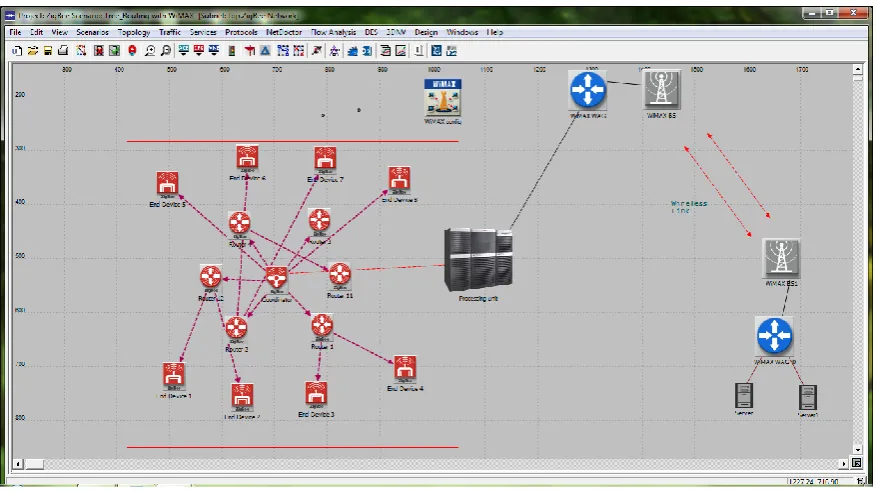
architecture contains singe PANs.PAN is the combination of a one or more routers, end devices and single coordinator.
These are connected by using tree topology, so many topologies are used Example: Ring, tree, star, and mesh topology. The mobile node is configured to coverage the area of the PANs. This architecture is considered to cover large area with well-organized data traffic. The traffic on every node except mobile node is configured as Random destination and the mobile node is configured to send traffic to its parent node. In this architecture only one coordinator is used, in that so many routers and end devices is connected as tree, thus it is called as tree routing The controller is associated or connected to WiMAX base station (BS) through wireless access gateway (WAG). This will act as transmitter part of the proposed architecture. The receiver part is also consists of WiMAX-BS along with WAG where the corresponding application server is present. This will transmit the signal directly to the WiMAX base station, by using wireless link it receives the signal at another WiMAX base station. At first PAN sends multimedia information with the help of Coordinator through end user which is located at the long distance. Since the Coordinator communicates with 4G Base station and transmit the multimedia information to the receiving WiMAX base station. Finally Application servers receive the teleconferencing messages which are sent by Zigbee sensor nodes using tree routing.
III.SIMULATIONRESULTS
In performance analysis data, voice applications, teleconfercing and multimedia are analyzed for zigbee network integrated with 4G for long distance communication with high mobility. In X axis time period in seconds and in Y axis parameter is taken. The simulation time period is taken as 2000seconds.
Fig.2. Tele Video Conferencing Traffic received and transmits for Zigbee integrated with 4G using tree routing
Vol. 3, Issue 1, January 2015
Fig.4. Voice packet end to end delay, voice traffic received, voice traffic sent for zigbee network integrated with 4G.
Fig.5. Zigbee 802_15_4 MAC data traffic received MAC delay for zigbee senor integrated with 4G.
The figure 2 shows that Televideo conferencing stream traffic received and sent and video traffic sent and received is same. It shows there is minimum delay with large throughput. This graph shows that proposed architecture output performs well. The figure 3 shows that the voice jitter and packet delay variations is very less. Jitter is nothing but variation in delay and data is sent to all sensor nodes. This shows that the proposed architecture performs well with less delay traffic. MOS (Mean Opinion Score) value is used to judge the voice quality measurements. The typical MOS value for 4G network is 4 but here it is 3.9. Voice packet delay variations are also less for the proposed architecture.
The Figure 4 shows that Voice Packet end-to-end delay and it is very less for the received voice traffic of 650,000 bytes per seconds and it shows global coverage with minimum delay. Voice traffic received is extra or fewer same as voice traffic sent. There is only one minimum packet loss. The voice end-to-end delay is also very less for the architecture. This shows that the proposed Zigbee sensor Node integrated with 4G network using tree routing performs well even for real time voice.
The figure 5 shows that the zigbee 802_15_4 MAC data traffic received and MAC delay can be used to integrate. If anyone PAN group fails to transmit data, It identifies and informs to the corresponding coordinator to retransmit the data copy. Thus mobile node movement is sensed and captured by controlling unit. It transmits the stored data via 4G network. In the receiving side also again data is received through 4G using application servers. With the help of QoS (Quality of service). Finally It cooperates to sends data to controller unit which in turn connected with 4G WiMAX .
Vol. 3, Issue 1, January 2015
REFERENCES
1. L. Atzori, A. Iera, G. Morabito, “The Internet of Things: A survey,” Computer Networks 54 (2010) 2787–2805. 2. K. Ashton, That „„Internet of Things‟‟ thing, RFID Journal (2009).
3. Dr. J. Jayakumari, MIMO-OFDM for “4G wireless system,” IEEE IJSCT, vol. 2(7), 2010, 2886-2889. 4. J.J. Garcia-Luna-Aceves et al. Wireless Internet Gateway(WINGS),IEEE MILCOM‟97, November 1997. 5. J. S. Lee, “An Experiment on Performance Study of IEEE 802.15.4 Wireless Networks,” IEEE, 2005.
6. Rathod K, Parikh N, Parikh A, Shah V, “Wireless automation using Zigbee protocols,” Ninth International Conference on IEEE, Wireless and Optical Communications Networks (WOCN), 2012.
7. Specifications for Low Rate Wireless Personal Area Networks (WPANs), IEEE Std. 802.15.4, 2003. 8. M.Steenstrup, “Routing in Communication Networks”,1995.
9. S. Chatterjee, W. A. C Fernando, M. K.. vasantha, “Adaptive modulation based MC-CDMA systems for 4G wireless consumer applications,” Consumer Electronics, IEEE Transactions on, vol. 49, issue. 4, Nov. 2003, pp. 995 – 1003.
10. C.Perkins, “Ad-Hoc On Demand Distance Vector Routing” draft-ietf-manet-aodv-00.txt,1997.
11. J.J.Garcia-Luna-Aceves and M.Spohn, Scalable link-state Internet routing, IEEE International C onference on N etwork Protocols(ICNP 98) October 1998.
12. P. Harrop and R. Das, “WIreless sensor network” 2010–2020, IDTechEx Ltd, Cambridge, U.K., 2010.
13. G. Song and Y. Li, “Cross-layer optimization for OFDM wireless networks. Part I:Theoretical framework," IEEE Trans. Wireless Com., vol.4, no. 2, pp. 614-6 24, 2005.
14. Mudit bhalla. & Anand bhalla, “Generation of mobile wireless technology”: A survey, IEEE Trans. (0975-8887) vol. 5- No.4, August 2010. 15. R. Szewczyk, J. Polastre, A.Mainwaring, and D. Culler, “Lessons from a sensor network expedition,” Wireless Sensor Netw., pp. 307–
322,2004.
16. Hujun Yin and Siavash Alamouti, “OFDMA – A Broadband Wireless Access Technology,” IEEE Proc. of Sarnoff Symposium, March 2006. 17. Mauri Rao, “4G wireless technology,” NCNTE-2012 AT C.R.I.T., Vashi, Navi Mumbai, Feb. 24-25, 2012.
18. K. Romer and F. Mattern, “The design space of wireless sensor networks,”IEEE Wireless Commun., vol. 11, no. 6, pp. 54–61, Dec. 2004.
BIOGRAPHY
Kalaivani K is a Student in the Embedded System Department, Sathyabama University. She pursuing Master degree of