Optimization Studies on the Removal of Metal
Ions Using Modified Cation Exchange Resin
J.Muhamed Ali
Assistant Professor, Department of Science and Humanities, Sasurie College of Engineering, Tiruppur, Tamilnadu,
India
ABSTRACT: Heavy metal pollution has become one of the most serious environmental problems today. The treatment of heavy metals is of special concern due to their recalcitrance and persistence in the environment. In recent years, various methods for heavy metal removal from wastewater have been extensively studied. This paper reviews the current methods that have been used to treat heavy metal wastewater and evaluates these techniques. These technologies include ion-exchange, adsorption methods. The present ion exchanges are mainly based on petroleum compounds and it is very high cost in order to reduce the cost of commercial ion exchangers by substituting sulphonated carbon present in plant waste material. This work was first done by Dima et al in 1960. It is evident from the literature survey articles that ion-exchange, adsorption and membrane filtration are the most frequently studied for the treatment of heavy metal wastewater.Also, ion exchanges is convenient way to concentrate, remove and recover the valuable metals like Cu, Zn, and Cr.
I. INTRODUCTION
membrane filtration, electrochemical treatment technologies, etc. The present review article deals with the current techniques for the removal of heavy metal ions from wastewater. Their advantages and limitations in application are
also evaluated. * Corresponding author. E-mail address: [email protected] (F. Fu). Contents lists available at
ScienceDirect Journal of Environmental Management journal homepage: www.elsevier.com/locate/jenvman 0301-4797/$ e see front matter _ 2010 Elsevier Ltd. All rights reserved. doi:10.1016/
II. ION EXCHANGE
Ion-exchange processes have been widely used to remove heavy metals fromwastewater due to their many advantages, such as high treatment capacity, high removal efficiency and fast kinetics (Kanget al., 2004). Ion-exchange resin, either synthetic or natural solid resin, has the specific ability to exchange its cations with the metals in the wastewater. Among the materials used in ion-exchange processes, synthetic resins are commonly preferred as they are effective to nearly remove the heavy metals from the solution (Alyüz and Veli, 2009). The most common cation exchangers are strongly acidic resins with sulfonic acid groups (eSO3H) and weakly acid resins with carboxylic acid groups (eCOOH). Hydrogen ions in the sulfonic group or carboxylic group of the resin can serve as exchangeable ions with metal cations. As the solution containing heavy metal passes through the cations column, metal ions are exchanged for the hydrogen ions on the resin. The uptake of heavy metal ions by ion-exchange resins is rather affected by certain variables such as pH, temperature, initial metal concentration and contact time (Gode and Pehlivan, 2006). Ionic charge also plays an important role in ion-exchange process. The influence of ionic charge on the removal of
Ce4þ, Fe3þ and Pb2þ from aqueous systems by cation-exchange resin purolite C100 was tested by Abo-Farha et al.
(2009). They found that the metal ions adsorption sequence can be given as Ce4þ > Fe3þ > Pb2þ. Similar results for
Co2þ, Ni2 þ and Cr3þ on an Amberlite IRN-77 cationexchange resin were previously obtained by Kang et al. (2004).
Besides synthetic resins, natural zeolites, naturally occurring silicate minerals, have been widely used to remove heavy metal from aqueous solutions due to their low cost and high abundance. Many researchers have demonstrated that zeolites exhibit good cation-exchange capacities for heavy metal ions under different experimental conditions (Motsi et al., 2009; Ostroski et al., 2009; Taffarel and Rubio, 2009). Clinoptilolite is one of the most frequently studied natural
zeolites that have received extensive attention due to its selectivity for heavy metals. Table 2 shows the efficiency of
clinoptilolite for removing heavy metal ions. Recently, some researchers reported that the surface of clinoptilolite loaded with amorphous Fe-oxide species would significantly improve the exchange capacity of clinoptilolite (Doula and Dimirkou, 2008; Doula, 2009). Doula (2009) employed clinoptiloliteeFe system to simultaneously remove Cu, Mn and Zn from drinking water. He found that the system has very large metal adsorption capacity and for most of the cases the treated water samples were suitable for human consumption or agricultural use. Though there are many reports on the use of zeolites and montmorillonites as ion-exchange resin to remove heavy metal, they are limited at present compared with the synthetic resins. And the application of zeolites is on the laboratory experiments scale. More work is needed for the application of zeolites at an industrial scale.
III. EXPERIMENTAL
MATERIALS
The chemicals used in the present study are either procured commercially or collected locally.
Resorcinol ( Density: 1.057 gm-1, BDH reagent)
Formaldehyde ( 37 – 40% solution, SD Fine reagent)
Concentrated Sulphuric acid (Specific gravity = 1.82)
Plant (raw) material used for the preparation of sulphonated charcoal viz, Hybanthus enneaspermus (L. ) F.
IV. METHODOLOGY & MATERIALS
1. Formaldehyde ( 37 – 40% solution, SD Fine reagent)
2. resorcinol ( Density: 1.057 gm-1, BDH reagent)
3. Concentrated sulphuric acid (Specific gravity = 1.82)
Plant (raw) material used for the preparation of sulphonated charcoal vizHybanthus enneaspermus (L. ) F. v. Muell (NILAPPIRANTAI STEM)
V. EXPERIMENTAL
Preparation of Phenol – HCHO resin:
* Rexor+ Con.H2SO4Resorl sulphuric acid (RSA) Resornol-HCHO ( RFR)
Preaparation of condensate resins:
RFR + * SC (calc. amount 10,20,etc) RFR mixture Condensate resin
10%, 20%, 30%, 40% and 50% Required percentage =
Where, ‘y’ is the mass in grams of pure resin (PFR) and ‘x’ is the mass in grams of the sulphonated Hybanthus enneaspermus (L. ) F. v. Muell (NILAPPIRANTAI STEM) required to achieve the required percentage (w/w) of SC in the composite. SC blended with RFR in order to obtain 10,20,30,40 and 50% (w/w) condensate resins (samples A,B,C,D, & E) by using the formula
Required Percentage = [ b / ( a + b ) ]
Where,
a = mass of RFR (in g)
b = mass of the SC required (in g) for blending
x
y
x
(RESORCINOL – FORMALDEHYDE SULPHONIC ACID CATION RESIN)
RESORCINOL – FORMALDEHYDE SULPHONIC ACID CATION RESIN (RFR) (Macro Polymer)
CATION EXCHANGE capacity (CEC) in meq g-1 for various metal ions at 350C
(for 0.1m solution)
Sample % of HESC in resin (w/w) Ca+ Mg2+ Zn2+ Pb2+ Ni2+ Cu2+
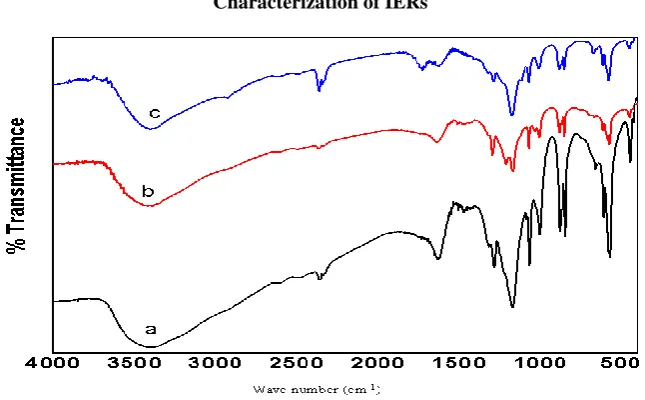
Characterization of IERs
Table -2 IR spectral studies (ν in cm-1)
Group Pure
PFR(A) 30% SAMC(D) Pure SAMC(G)
S=O 1068
1070 1068
SO2 1170
1176 1176
C-S 572
574 576
Bonded OH str 3398
3410 3402
CH2-def 1473
1473 1464
C-C str 1635
1629 1627
C-H def 887 887 887
60% loss in weight in blend with 30 % (w/w) of HESC was observed. Porosity: (SEM)
The high macroporous carbon obtained from HES charcoal form the reservoir in which the resorcinol-formaldehyde sulphonic acid particles are deposited.
SEM AN ALYSIS OF RFR WITH 30% CONDENSATE.
Regeneration of IERs
[FIG.5 Regeneration level for PFR,its composite,and SAMC by using Nacl,after exchange with Ni2+ ions]
VI. CONCLUSION
straight forward approximation to data analysis. Graphical presentation is facilitated with such results from designed
experiments. The variable such as % ( w/w ) of HESC in condensate, particle size and initial concentration of Ca2+ ions
are proved to be the most significant parameters for the maximum CEC for Ca2+ ions as evidenced from the MLR
equations. The results obtained could be used for better designing cost-effective IERs for effluent / water treatment plant, for the economic removal of metal ions general and in particular by ion exchange process. Recorcinol – formaldehyde ion exchange resin could be blended by sulphonated charcoal obtained from Hybanthus enneaspermus upto 30% ( w/w ) without affecting its physical, chemical, thermal, spectral and column capacity such blended macro reticular composite ion exchange resin could be employed as low cost materials in the water softening process waste water treatment process, especially for the removal of meta ions.
The Composite containing Hybanthus enneaspermus (L.) F. v. Muell charcoal of 30% is found to have high density values than the pure RFR, which is contrary effect with the already reported resins. It’s a good swelling behavior comparable attritional resistance efficient column and absolute capacities sufficient thermal stability, and is particularly macro-porous and cheap
REFERENCES
1. S.C. Deb, ‘Environmental managements, Jaico Publishing House, Mumbai, p.79 2. (2003).
3. P.C. Jain, Engineering Chemistry, 14th edition, New Delhi (2001).
4. F.Mc Garvey and A.Siber, Removal and Recovery of metals by Ion Exchange, 23rd
5. Annual Liberty Bell Corrosion Course (1985).
6. A.C.Vogel, Textbook of Quantitative Chemical Analysis,5th edition ELBUS, UK,
7. 1989.
8. K.N.Duggal, Environmental Chemistry, 5 th Edition New Dehi 2000.
9. B.A.Adams and E.L.Holmes,J.Soc.Chem.Ind.,54, 1-6 (1935). 10. M.Dima., Bul.Inst.Politeen lasi., 6, 117 (1960).
11. O.Liebknecht., U.S.Patent, 2, 206, 007 (1940). 12. W.C.Barman., Ind.Eng.Chem., 38, 46 (1946).