Copyright to IJIRSET www.ijirset.com 125
Comparative Analysis of Image Compression Using
Wavelet and Ridgelet Transform
Thaarini.P1, Thiyagarajan.J2
PG Student, Department of EEE, K.S.R College of Engineering, Thiruchengode, Tamil Nadu, India 1 Assistant Professor, Department of EEE, K.S.R College of Engineering, Thiruchengode, Tamil Nadu, India2
ABSTRACT: Image Compression reduces the number of bits required to represent an image. Content based image compression become more significant in the field of medical and multimedia compression in order to preserve the important region in an image. Images when transmitted as whole, reduces the resources in the device and also causes many problems during transmission. For efficient transmission of images, optimized amount of storage space and bandwidth are required. Many compression standards are existing. But still there is a scope for higher compression with quality reconstruction. In this paper an attempt have been made to analyse wavelet and ridgelet technique for image compression. Initially, the principle of seam carving is applied on image. Haar wavelet, Daubechies wavelet, Symlet wavelet, Coiflet wavelet, Biorthogonal wavelet and Ridgelet Transform have been applied to the retargeted image and results have been compared in terms of PSNR values, MSE and Compression ratio.
KEYWORDS: Image Compression, Seam Carving, Wavelet Transform, Ridgelet Transform
I. INTRODUCTION
Image Compression is the representation of an image in digital form with few bits while maintaining an acceptable level of image quality. Due to rapid increase in multimedia and medical applications it requires to reduce the amount of information for the purpose of efficient storage and transmission. There are many multimedia devices with different display. As the size of multimedia devices is continually changing the quality of the shared content also gets reduced. One solution to this problem is to reduce the volume of content without losing important information in an image so that more images can stored in the given space. Content based image compression with less computational complexity and to retarget the image with optimal solution. In this paper, the principle of seam carving is used along with wavelet and ridgelet to compress the image. The proposed method is useful for obtaining high compression ratio with less complexity in most of the applications.
Existing image compression method based on discrete wavelet transform (DWT) [1] such as SPIHT [2], JPEG 2000 [3] etc, can meet high quality to the decompressed image. This compresses image as a whole so it does not support content based image compression. In edge based inpainting [4] which skips some information during encoding process so the compression can achieve but complexity is high. Same way data pruning [5] based image compression method compress the image by pruning it to the smaller size before the transmission. These methods do not support content based color image compression. SPIHT [6] can compress effectively, which is a wavelet based compression technique. Efficient image compression cannot be achieved with SPIHT alone. Image compression based on concentration and dilution [7] uses the principle of seam carving for image concentration and interpolation for image resizing at the receiving end. Wavelets is good for piecewise smooth functions in one dimension but not in the case of two dimension [8]. Wavelet fails to represent efficiently singularities along lines or curves and geometrical structure in smooth edges of images. To overcome the weakness of wavelets, Candes developed a ridgelet analysis [9].
ISSN (Online) : 2319 - 8753
ISSN (Print) : 2347 - 6710
I
nternationalJ
ournal ofI
nnovativeR
esearch inS
cience,E
ngineering andT
echnologyAn ISO 3297: 2007 Certified Organization Volume 3, Special Issue 2, April 2014
Second National Conference on Trends in Automotive Parts Systems and Applications (TAPSA-2014)
On 21st & 22nd March, Organized by
Sri Krishna College of Engineering & Technology, Kuniamuthur, Coimbatore-641008, Tamilnadu, India
Copyright to IJIRSET www.ijirset.com 126
II. SEAMCARVING
Seam carving is an effective image resizing method [10]. Standard image resizing techniques such as scaling and cropping are not efficient for displaying images on a variety of display devices of different resolutions. A seam is defined as a continuous path of pixels running from the top to the bottom of an image in the case of a vertical seam, while a horizontal seam is a continuous line of pixels spanning from left to right in an image. Seam carving is mainly for content based image compression. It produces high quality in retargeted image. It removes the low energy pixels from an image.
If
t
i be thei
th part of seam, thent
ixandt
iybe the horizontal and vertical aspects. A vertical seam is defined as,
T
X
{t }
ix Ni1
{x(i),i}
iN1 (1)where x is a mapping of x :[1,....,N ] [1,....,M]. Similarly we can write for horizontal seam. The importance of pixels is defined by an energy function. The first step in calculating a seam for removal or insertion involves calculating the gradient image for the original image. The gradient image is a common image that is used in both horizontal and vertical seam calculation. From this we need to calculate the energy map to indicate importance of pixel in image that is to be calculated separately for horizontal and vertical seams. For each pixel (i,j) in the gradient image, the value at (i,j) in the energy map is the sum of the current value at (i,j) from the gradient image and the minimum of the three neighbouring pixels in the previous row [11].
Then remove the low energy pixel from the image. The method to identify seam is the minimum value in the last row saving the pixel location for use in removal, then working backwards by finding the minimum of the three neighbouring pixels of (i,j) in the (i-1)th row and saving that pixel to the seam path.This process is repeated until the first row is reached.
Optimal seam is found out by using,
*
1
arg min
[ ( )]
J
i i
t
E I t
(2)Where E[.] denotes the energy function. A cumulative energy cost for vertical seam C(i,j) is calculated as,
C(i,j) = E(i,j) + min{C(i-1,j-1),C(i-1,j),C(i-1,j+1)} (3) The energy cost is calculated for three connected path of neighbouring pixels.
III.WAVELETTRANSFORM
Image Compression is one of the applications of wavelet. Wavelets are localized in both time and frequency domain. Wavelet involves pair of transform: one to represent the high frequencies or detailed parts of an image and one for the low frequencies or smooth parts of an image.
A. Discrete Wavelet Transform
The Discrete Wavelet Transform (DWT) refers to Wavelet Transforms for which the wavelets are discretely sampled. A Transform which localizes a function both in space and scaling and has some desirable properties compared to the Fourier Transform. DWT decomposes an image into coefficients called sub-bands and then the resulting coefficients are compared with a threshold. Coefficients below the threshold are set to zero.
B. Wavelet Families
Several families of wavelets are included in the wavelet toolbox. Haar, Daubechies, Symlet, Coiflet and Biorthogonal wavelets has used in this paper.
a. Haar Wavelet
Fig.1 Haar Wavelet Function Waveform
b. Daubechies Wavelet
Ingrid Daubechies constructed the orthonormal wavelet of compactly supported functions DbN, N=1, 2,.The Db1wavelet is the same as haar wavelet. The wavelet functions of the next members are the family is shown here in Figure 2.
Fig.2 Daubechies Wavelet Function Waveform
c. Coiflet Wavelet
The Coiflet wavelet is near symmetric. The wavelet functions has 2N moments equal to 0 and the scaling function has 2N-1 moments equal to 0 and has been used in many applications.
Fig.3 Coiflet Wavelet Function Waveform
d. Symlet Wavelet
ISSN (Online) : 2319 - 8753
ISSN (Print) : 2347 - 6710
I
nternationalJ
ournal ofI
nnovativeR
esearch inS
cience,E
ngineering andT
echnologyAn ISO 3297: 2007 Certified Organization Volume 3, Special Issue 2, April 2014
Second National Conference on Trends in Automotive Parts Systems and Applications (TAPSA-2014)
On 21st & 22nd March, Organized by
Sri Krishna College of Engineering & Technology, Kuniamuthur, Coimbatore-641008, Tamilnadu, India
Fig.4 Symlet Wavelet Function Waveform
e. Biorthogonal Wavelet
Biorthogonal wavelets exhibits the property of linear phase, which is useful for image reconstruction. Biorthogonal bases uses two wavelets instead of one, one for decomposition and another for reconstruction. Some of the members of biorthogonal wavelets is shown in the Figure5.
Fig.5 Biorthogonal Wavelet Function Waveform
IV.RIDGELETTRANSFORM
The success of Wavelets is mainly due to the good performance for piecewise smooth functions in one dimension. Unfortunately, such is not the case in two dimensions. While simple, these methods work very effectively, mainly due to the property of the Wavelet Transform that most image information is contained in a small number of significant coefficients around the locations of singularities or image edges. Therefore, new image processing schemes called Ridgelet Transform which are based on true two-dimensional (2-D) Transforms are expected to improve the performance over the current Wavelet-based methods [9].
The continuous Ridgelet Transform function f(x) is given by
, ,
(a, b, )
( ) ( )
f a b
R
CRT
x f x dx
(4)The Figure 6 shows the ridgelet function oriented at an angle
and constant along the linesx
1cos
x
2sin
const
Fig.6 Ridgelet Function
V. RESULTANDDISCUSSION
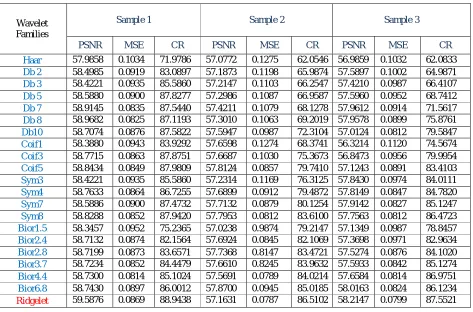
This section discusses the simulation results of wavelet and ridgelet methods. Experiments are conducted in MATLAB. Input image is first resized using seam carving algorithm and retargeted image is transformed using wavelet and ridgelet techniques. Quantitative analysis have been performed by measuring PSNR, MSE and Compression ratio. Comparitive analysis of various families of wavelet and ridgelet are also presented. We have analysed wide range of images.
.
Sample 1 Sample 2 Sample 3
Fig.7 Input images
ISSN (Online) : 2319 - 8753
ISSN (Print) : 2347 - 6710
I
nternationalJ
ournal ofI
nnovativeR
esearch inS
cience,E
ngineering andT
echnologyAn ISO 3297: 2007 Certified Organization Volume 3, Special Issue 2, April 2014
Second National Conference on Trends in Automotive Parts Systems and Applications (TAPSA-2014)
On 21st & 22nd March, Organized by
Sri Krishna College of Engineering & Technology, Kuniamuthur, Coimbatore-641008, Tamilnadu, India
Copyright to IJIRSET www.ijirset.com 130
Table 1: Parameter Comparison Using Wavelet Families and Ridgelet Transform
Wavelet Families
Sample 1 Sample 2 Sample 3
PSNR MSE CR PSNR MSE CR PSNR MSE CR
Haar 57.9858 0.1034 71.9786 57.0772 0.1275 62.0546 56.9859 0.1032 62.0833 Db 2 58.4985 0.0919 83.0897 57.1873 0.1198 65.9874 57.5897 0.1002 64.9871 Db 3 58.4221 0.0935 85.5860 57.2147 0.1103 66.2547 57.4210 0.0987 66.4107 Db 5 58.5880 0.0900 87.8277 57.2986 0.1087 66.9587 57.5960 0.0952 68.7412 Db 7 58.9145 0.0835 87.5440 57.4211 0.1079 68.1278 57.9612 0.0914 71.5617 Db 8 58.9682 0.0825 87.1193 57.3010 0.1063 69.2019 57.9578 0.0899 75.8761 Db10 58.7074 0.0876 87.5822 57.5947 0.0987 72.3104 57.0124 0.0812 79.5847 Coif1 58.3880 0.0943 83.9292 57.6598 0.1274 68.3741 56.3214 0.1120 74.5674 Coif3 58.7715 0.0863 87.8751 57.6687 0.1030 75.3673 56.8473 0.0956 79.9954 Coif5 58.8434 0.0849 87.9809 57.8124 0.0857 79.7410 57.1243 0.0891 83.4103 Sym3 58.4221 0.0935 85.5860 57.2314 0.1169 76.3125 57.8430 0.0974 84.0111 Sym4 58.7633 0.0864 86.7255 57.6899 0.0912 79.4872 57.8149 0.0847 84.7820 Sym7 58.5886 0.0900 87.4732 57.7132 0.0879 80.1254 57.9142 0.0827 85.1247 Sym8 58.8288 0.0852 87.9420 57.7953 0.0812 83.6100 57.7563 0.0812 86.4723 Bior1.5 58.3457 0.0952 75.2365 57.0238 0.9874 79.2147 57.1349 0.0987 78.8457 Bior2.4 58.7132 0.0874 82.1564 57.6924 0.0845 82.1069 57.3698 0.0971 82.9634 Bior2.8 58.7199 0.0873 83.6571 57.7368 0.8147 83.4721 57.5274 0.0876 84.1020 Bior3.7 58.7234 0.0852 84.4479 57.6610 0.8245 83.9632 57.5933 0.0842 85.1274 Bior4.4 58.7300 0.0814 85.1024 57.5691 0.0789 84.0214 57.6584 0.0814 86.9751 Bior6.8 58.7430 0.0897 86.0012 57.8700 0.0945 85.0185 58.0163 0.0824 86.1234
Ridgelet 59.5876 0.0869 88.9438 57.1631 0.0787 86.5102 58.2147 0.0799 87.5521
VI.CONCLUSION
Seam Carving and Ridgelet method provides better result than wavelet for image compression in mobile multimedia applications and medical image. In case of multimedia applications content based color image compression is achieved with low computational complexity and retarget the images with optimal resolution. In this paper, the various parameters PSNR, MSE and CR for each wavelet and ridgelet are compared. The Ridgelet Transform is more suitable for the color image data to represent the line singularities properly than Wavelet Transform. Hence Ridgelet Transform can be effectively used for the compression of color images with high quality reconstruction.
REFERENCES
[1] Abbate, A., DeCusatis, C.M. and Das, P.K. “Wavelets and Subbands: Fundamentals and Applications”, 2002.
[2] Said, A. and Pearlman, W.A. “A new, fast and efficient image codec based on set partitioning in hierarchical trees”, IEEE Transcation on Circuits System and Video Technology, 1996,Vol. 6, No. 3, pp. 243–250.
[3] Cruz, D.S., Ebrahimi, T. and Grosbois, R. “JPEG 2000 performance evaluation and assessment”, Signal Processing Image Communication, 2002, Vol. 17, No. 1, pp. 113– 130.
[4] Liu, D., Sun, X.Y. Wu, F., Li, S.P. and Zhang, Y.Q. “Image compression with edge-based inpainting”, IEEE Transcation on Image Processing, 2004,Vol. 17, No. 9, pp. 247–249.
[6] Sandeep, K. and Sanjay, S. “Image compression based on improved SPIHT and Region of Interest”.
[7] Achanta. R., Estrada, F., Hemami, S. and Susstrunk, S. “Frequency tuned salient region detection” IEEE International Conference on Pattern Recognition, 2009,pp. 1597-1604.
[8] Joshi. M., Manthalkar, R., Joshi, V. “Color Image Compression Using Wavelet and Ridgelet Transform”, Seventh International Conference on Information Technology, 2010.
[9] Kaleka, Jashanbir ,“Performance Analysis of Haar, Symlets and bior wavelet on image Compression using DWT”, International Journal of Computer and Distributed Systems, 2012, Vol.1.
[10] Minh. N., Martin, V. “The Finite Ridgelet Transform for image Representation”, IEEE Transcation on Image Processing”, 2003,Vol. 12.