A Comprehensive Study on Data Hiding In
Audio Signals Using DWT and EMD with
Synchronisation Code
Aswathy G1 , Lenin Joseph2
Student, Dept of Electronics and Communication, Sree Buddha College Engineering for Women, Elavumthitta ,Pathanamthitta, Kerala, India1
Assistant Professor, Dept of Electronics and Communication, Sree Buddha College Engineering for Women, Elavumthitta, Pathanamthitta, Kerala, India2
ABSTRACT: Watermarking has become a major solution for protection of multimedia data with copyright. Many approaches have been developed to prevent the unauthorised copying and sale of copyright protected data. Audio watermarks are special signals embedded into digital audio. These signals are extracted by detection mechanisms and decoded. The efficiency of various methods can be evaluated in terms of signal to noise ratio (SNR), bit error rate (BER), etc. This paper reviews the watermarking scheme on audio signal based on Discrete Wavelet Transform (DWT), and Empirical mode decomposition (EMD) with the help of synchronisation code(SC).
KEYWORDS: - Data embedding, Discrete wavelet transform (DWT), Empirical mode decomposition (EMD), Synchronisation code (SC).
I. INTRODUCTION
Watermarking or information hiding is a technique that emerged as a result of security concerns. With the advancements in internet technology multimedia files are widely manipulated for many purposes. Any files available in the web can be copied or downloaded and sometimes duplicated for private benefits. This has become an issue of concern for the owner’s of the original file. Thus a mechanism that has been deployed for the protection of copyright protected data is Digital watermarking. Watermarking provides a potential solution for the security of digital multimedia data such as image, audio, or video files. They are designed in such a way that the extra information that is hidden in the host signal (which can be any multimedia file) is completely invisible for image files or inaudible for audio files. Watermark bits which are placed in the host signal must be extractable to prove the ownership of the data. Different types of watermarking schemes available in multimedia data. The most challenging is the method of audio watermarking, since it requires less number of samples to represent the signal. Thus in an audio signal the amount of data that can be inserted is very less. Implementation of efficient watermarking schemes thus becomes a challenge.
II. REQUIREMENTSOFAWATERMARKINGSCHEME
A. Robustness to signal processing
The watermark in the audio signal should survive various digital signal processing such as lossy compression, shifting, cropping and various malicious attacks.
B. Transparency.
The watermark should be imperceptible. And it should produce no audible distortions in the signal
.
C. Signal to noise ratio.
The signal to noise ratio (SNR) of an audio watermarked signal should be more than 20 %.This requirement of SNR is based on the recommendations of International Federation of the Photographic Industry (IFPI).
D. Bit rate
This is the amount of watermark data that may be reliably embedded within the host signal per unit time or space. A higher bit rate may be desirable in some application to embed copyright information. Reliability is measured using BER (bit error rate).
E. Efficiency
The audio watermarking scheme should be implemented with low cost with the use of fewer amounts of resources.
III. TYPESOFAUDIOWATERMARKING
The two main types of watermarking schemes are: time domain and transform domain approaches.
A. Time Domain Audio Watermarking: -
In time domain technique, watermark is embedded without applying any transformation & watermark can be easily destroyed. It is very easy to implement & requires less computation as compared to frequency domain techniques. It is useful in medical applications & ownership protection applications. The different time domain embedding techniques for digital audio signal are Least Significant Bit (LSB) replacement, Echo hiding, phase coding and Spread Spectrum methods. But these techniques show poor robustness against common signal processing operations like cropping, low pass filtering, re-quantization, compression, etc.
B. Transform Domain Method:-
In the transform domain approach the high quality watermarked image can be produced by first transforming the original image into the frequency domain by the use of transforms such as Fourier, Discrete Cosine Transform (DCT) or Discrete Wavelet transforms (DWT) etc. Thus the watermarks are added to the values of its transform coefficients. Then inverse transforming the marked coefficients forms the watermarked audio. The use of frequency based transforms allows the direct understanding of the content of the audio; therefore, characteristics of the human visual system (HVS) can be taken into consideration more easily when it is time to decide the intensity and position of the watermarks to be applied to a given audio.
IV.DISCRETEWAVELETTRANSFORMWATERMARKING
The synchronization codes (SC) are embedded along with the hidden informative data so that the hidden data have the self-synchronization ability. Both the synchronization codes and informative bits are embedded into the low frequency sub-band coefficients in DWT domain to achieve strong robustness against common signal processing procedures, noise corruption, and attacks. By exploiting the time-frequency localization capability of DWT, this technique reduces computational load occurring in searching synchronization codes and thus resolves the contending requirements between the robustness and low computational complexity[4].
Before embedding, the synchronization codes and watermark should be arranged into a binary data sequence denoted by {mi}. Then split the original composite audio data into proper segments and perform DWT on every segment. The sequence {mi} is embedded successively into the low-frequency subband of segments[5]. The length of audio segment depends on the amount of data that need to be embedded and the number of DWT decomposition levels. It should large enough to accommodate at least one synchronization code and some informative bits. Specifically, the rule for embedding {mi} is as follows:
(1)
Where {ci} and {ci’} are the DWT coefficients of the low-frequency subband of the original audio data and the
corresponding watermarked audio data respectively; indicates the floor function; and S denotes the embedding strength. The value of S should be as large as possible under the constraint of imperceptibility.
B. Data Extraction
When extracting the hidden data, split the test audio into segments (at least one synchronization code should be included in a segment) and then perform DWT on each segment in the same manner as in embedding. Let {ci*} denote the coefficients of low-frequency subband of each segment, we extract the sequence {mi*} from {ci*} by using the following rule:
(2)
Before extracting the informative watermark, we need to search the synchronization codes in the sequence {mi*} bit by bit. With the found synchronization codes, the embedding locations of the watermark are then determined. Note that if no synchronization code is found, then we need to redo the segmenting. The original coefficients {ci} are not required in the extracting process and thus the algorithm is blind. By (1) and (2), we can know that
if {c
i*} = c
i+ and,
(-S/4 ,S/4) then {m
i*}= {m
i}.
V. AUDIOWATERMARKINGUSINGEMD
Watermarking of audio signals done with use of empirical mode decomposition (EMD) is a blind watermarking scheme. The synchronization codes along with the watermarks are added into the extrema of the intrinsic mode functions, which are obtained by a signal decomposition method of EMD.
A. Watermark Embedding
Before embedding, SCs are combined with watermark bits to form a binary sequence denoted by the bit of watermark. Procedure of this watermark embedding is detailed as follows:
Step 1: Split original audio signal into number of frames. Step 2: Decompose each frame into IMFs.
Step 3: Embed P times the binary sequence [mi] into extrema of the last IMF by QIM by using the following equation.
(3)
where ei and ei* are the extrema of IMFs of the host audio signal and the watermarked signal respectively. Sgn function is equal to “ +” if ei is a maxima, and “ -” if it is a minima. └ ┘denotes the floor function, and S denotes the embedding
Step 4: Reconstruct the frame (EMD-1) using modified IMFC and concatenate the watermarked frames to retrieve the watermarked signal[1].
B. Watermark Extraction
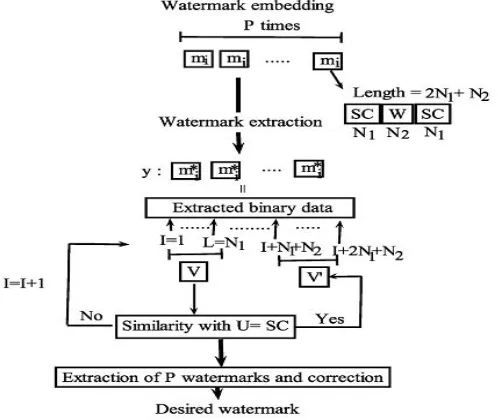
For watermark extraction, host signal is spitted into frames and EMD is performed on every one as in embedding. We tend to extract binary information victimization rule given by (4). We tend to then seek for SCs within the extracted information. This procedure is perennial by shifting the chosen section (window) one sample at time till a SC is found. With the position of SC determined, we are able to then extract the hidden information bits that follow the SC. Let y= [mi*] denote the binary information to be extracted and U denote the first SC. To find the embedded watermark we have to search the SCs within the sequence mi* bit by bit. The extraction is performed without the help of original audio signal. Basic steps involved within the watermarking extraction, are given as follows:
Step 1: Split the watermarked signal into number of frames. Step 2: Decompose every frame into IMFs.
Step 3: Extract the extrema of each IMF. Step 4:Extract from using the following rule :
(4)
Step 5: Set the beginning index of the extracted information y, to I =1 and select L=N1 samples (sliding window size). Step 6: Check the similarity between the extracted section V=y (I:1) and U bit by bit. If the similarity is ≥λ, then V is taken because the SC and move to Step 8 .Otherwise go to succeeding step.
Step 7: Increase I by one and slide the window to the next L=N1 samples and go to Step 6.
Step 8: valuate the similarity between the second extracted section V’= y (I+N1+N2:I+2N1+N2) and U bit by bit. Step 9: I←I+N1+N2 of the new worth is adequate to sequence length of bits, move to Step 10 else repeat Step 7. Step 10: Extract the watermarks and build comparison bit by bit between these marks, for correction, and at last extract the specified watermark. Watermarking embedding and extraction processes are summarized in fig 3.1.
VI. APPLICATIONS AND DISCUSSIONS
Audio watermarking has a number of applications, some of which are discussed below:
Copyright protection: Helps to authenticate copyright owners by a secret key for reading a secret watermark. Monitoring copying: Watermark embedding allows to trace illegal copying.
Fingerprinting: In point-to-point distribution environments, information about authenticated customers can be embedded as secret watermarks prior to secure delivery of the data.
Detection of content manipulation: Determining whether content manipulation of the authorized state has occurred.
Information carrier: A public watermark embedded in the data stream can act as a link to external databases storing information about copyright and license conditions.
Depending on the kind of watermark and its intended use, watermarking techniques have various properties. In EMD the synchronisation code used is a 16 bit Barker sequence 1111100110101110. Because of the limited embedding strength in time domain, the synchronization codes are not robust enough owing to the imperceptibility constrain. On the other hand, if the synchronization codes are embedded in frequency domain, such as DCT and DFT (discrete Fourier transform) domains, the robustness of the synchronization codes will increase but the computational cost in searching synchronization codes will increase greatly at the same time.
The synchronization codes can be embedded into either time domain or frequency domain. Water marking based on DWT is a type of frequency domain approach and the one based on EMD is a time approach of watermarking. The advantage of embedding in time domain is its low cost in searching synchronization codes. However, at the same time, the robustness is low due to the limitation of embedding strength under imperceptibility constraint. When the synchronization codes are embedded into frequency domain, such as DFT and DCT domain, the robustness will be improved but the searching cost will greatly increase at the same time. Synchronization codes and watermarks are embedded into low-frequency subband in DWT domain, thus achieving good robustness performance against common signal processing procedure and noise corruption. The time-frequency localization capability of DWT is exploited to improve the efficiency in searching synchronization codes.
Watermarked schemes performed in the wavelets domain have been mainly used to improve the bit rate. The limitation of wavelet approach is that the basis functions are fixed, and thus they do not necessarily match all real signals. To overcome this limitation, signal decomposition method referred to as Empirical Mode Decomposition (EMD) has been introduced for analyzing non-stationary signals derived or not from linear systems in totally adaptive way[2]. A major advantage of EMD relies on no a priori choice of filters or basis functions.
VI. CONCLUSION
REFERENCES
[1] Kais Khaldi and Abdel-Ouahab Boudraa ,” Audio Watermarking Via EMD,” IEEE Transactions on audio and language processing, , VOL. 21, NO. 3, MARCH 2013 675
A. N. K. Zaman, K. M. I. Khalilullah, Md. W. Islam, and Md. K. Molla, “A robust digital audio watermarking algorithm using empirical mode decomposition,” in Proc. IEEE CCECE, 2010, pp. 1–4.
[2] K. Khaldi and A. O. Boudraa, “On signals compression by EMD,”Electron. Lett., vol. 48, no. 21, pp. 1329–1331, 2012.
[3] S. Wu, J. Huang, D. Huang, and Y. Q. Shi, “Efficiently self-synchronized audio watermarking for assured audio data transmission,” IEEE
Trans. Broadcasting, vol. 51, no. 1, pp. 69–76, Mar. 2005.