INBREEDING IN MAN
GUNNAR DAHLBERG Uppsala, Sweden
Received September 29, 1928
TABLE O F CONTENTS
INTRODUCTION . . . ; . . . . . . . Effects of consanguineous marriage on a population.. . .
The frequency of chance consanguineous marriages. . . Empirical occurrence of consanguineous marriages. . . Hereditary constitution of offspring in consanguineous marriages. . . Conclusions . . . The influence of consanguineous marriage on relatives of character bearers, The risk of individual consanguineous marriage. . .
PAGE
. . . 421
. . . 423
. . . 424
. . . 428
. . . 429
. . . 434
. . . 444
. . . 447
INTRODUCTION
I n investigations on human populations from the point of view of hered- ity a primary assumption generally is that of random crossing, that is panmixie. Undoubtedly in many cases this assumption is sufficiently accurate. Various problems concerning the hereditary composition of populations previously have been treated on this basis by the prtsent author (DAHLBERG 1926, HULTKRANTZ and DAHLBERG. 1927).
However, panmixie does not always prevail. Deviations from the re- sults that would arise from random crossing, may be caused in several ways. First, deviations may be caused by selection. Hereditarily differing individuals, may differ in their rate of reproduction. The effect of selec- tion in regard to heredity, has been ,treated from a mathematical point: of view in the works just quoted and b y several other authors. Especially thorough areHALDANE’S works. Another cause of departure from partmixie is the existence of isolating and mixing processes within a population. This problem has been treated in a recent paper by WAHLUND 1928.
A third cause.of deviation from the conditions a t random crossing, is consanguineous marriage. Other causes of deviation might be conceived. Character bearers of a certain kind may marry each other with particular frequency, and so forth. I n practice however, the three causes mentioned surely are the,most important. The purpose of the present’ work is to investigate consanguineous marriage in man from the hereditary point of view.
The effects of inbreeding of animals and plants, have been mathema- tically treated by several authors. (Compare H. FEDERLEY, 1927. This
work gives an exhaustive list of authors). One has started with a cross of a certain kind, for example, between two heterozygotes and then proceeded on the assumption of an extreme of inbreeding, self-fertilization, crossing between sibs etc. I n some works, also, selection has been assumed, pre- vention of reproduction of non-desirable character bearers, as a rule recessive homozygotes, etc. I n human populations conditions differ in all these respects. Consanguineous marriage in man is of more accidental character, never reaches such extreme degrees, and is not always com- bined with systematic selection. No thorough theoretical inquiry into the effects on consanguineous marriage in man exists, though, of course, certain conclusions have been drawn from analogous. conditions in the animal and vegetable realms. I n principle, obviously, the chances of homozygosity arising through the coincidence of recessive genes, are in- creased through marriage between relatives, consequently the frequency of recessive character bearers is increased by these marriages. But so far we have had no measure for the strength of this influence, that is, the effect of marriage between relatives, and consequently no measure for the relative importance under given conditions of different kinds of con- sanguineous marriage. Obviously marriage between close relatives heigh- tens the chances for homozygosity more than does marriage between in- dividuals more distantly related. But having no conception of the degree of influence exerted by inbreeding, one has not been able to draw the line between the kinds of consanguineous marriage that have any practical importance, and the kinds that may under certain conditions be expected to have no appreciable importance, and so may be left out of account. The limits of what is to be considered as consanguineous marriage also are very differently placed by different authors, which, under these con- ditions, is not surprising. My present object is to get some more definite measure for the degree of influence that from different points of view is to be ascribed to consanguineous marriage.
With a view to the methods of research in regard to heredity in man, LENZ (1919) has calculated the frequency of consanguineous marriage that is to be expected among the parents of recessive character bearers a t greater or less frequency of character bearers in the population. This work has proved very important in regard to methods of genetic research. Consanguineous marriage, however, may be of importance, in yet other respects.
I n regard to heredity a human population may be viewed from the following aspects:
INBREEDING IN MAN 423
how far a certain frequency of consanguineous marriage changes the com- position of the population as compared with panmixie.
2. One character bearer may be taken as the starting-point, and his nearest {surroundings in the population examined, the object being to find how'far a certain frequency of consanguineous marriage changes the hereditary qualities' of his, relations as compared with panmixie.,(and how often consanguineous marriage occurs among his parents-see above):
3. An individual may be taken, assuming among his relatives a certain number of character bearers, a certain number of non-character bearers, and a certain number of relatives of unknown quality, the object being to find what risk he runs, if marrying a non-relative, of his children being character bearers, and further what the risk is in the case of his marrying a relative.
These problems will be treated f& the most part under the assumption of mono-hybrid inheritance.
I
EFFECTS OF CONSANGUINEOUS MARRIAGE O N A POPULATION
I n drawing up formulas for the occurrence of heterozygotes and reces- sive, or dominant homozygotes for a simple Mendelian character in a population, the nature of the gametes may conveniently be used as starting-point. Assume that a recessive factor,
R,
occurs with a frequency of r in a population, and that the corresponding dominant factor,D ,
occurs in the gametes of the population with a frequency of d, obviously in that case r + d = 1. Under the assumption that theR-
andD -
gametes are fortuitously brought together, the three different combina- tions of zygotes must have the following frequencies:Recessive homozygotes
(RR).
. . . .r2Heterozygotes
(RD)
. . . ZrdDominant homozygotes
(DD).
. . . d2-These expressions make possible a calculation of the composition of a population when the proportion of recessive or dominant character bearers in a population is known. Concerning these conditions, see further the above-mentioned work by HULTKRANTZ and DAHLBERG (1927).
The above formulas, however, postulate random mating. This implies that a certain amount of inbreeding will occur. Theoretically the assump- tion is that marriage may be entered even between brother and sister, d i d bttween parent and child. I n reality, of course;,these crossings prac- tically never occur. Other consanguineous marriages, for example mar- riage between cousins, on the other hand, possibly are commoner than
would be the case if the individuals of the population met purely by chance. A priori i t is known that consanguineous marriage tends to in- crease the number of homozygotes and to reduce the number of hetero- zygotes, consequently, from the point of view of the character bearers, to increase the number of recessive character bearers, and reduce the num- ber of dominant ones. Thus non-occurrence of marriages between brother and sister and parent and child, causes a reduction of the number of re- cessive character bearers. An over-representation of other consanguineous marriages, on the contrary, would entail an increase of the number of recessive character bearers. These two factors, therefore, to a certain extent cancel each other. I n order to gain an understanding of the effects in this respect, i t is necessary first to have an idea, how often random consanguineous marriage ought to occur. Then we shall have to form a conception of the actual frequency of consanguineous marriage, and to get a measure for the different kinds of effects of such marriages, and finally to attempt a conclusion from these data.
The frequency of chance consanguineous marriages
As families and other kinds of relationship exist within a population, consanguineous marriage must with greater or less frequency occur, if it is assumed that marriages are concluded at random. Our first object is to form a conception as to the frequency of the different degrees of con- sanguineous marriage under that condition.
Assume that the population consists of a number of individuals =n, and that the average number of children per marriage is = c. Here natural- ly, only the individuals that marry have to be counted, as the object is to calculate the marriage frequency. Taking a chance individual from the population, he has c - 1) : 2 sibs which he might marry. The individual, of course, can only marry a sib of opposite sex, and we assume the same number of male and female individuals in the population. ,'The whole number of individuals which he might marry is n - 1) : 2, and the probabil- ity of his marrying a sib under these conditions is
c- 1
n - l
-.
It will be seen that the difference of sex can be left o u t of account. Sex difference acts as a selective moment, preventing marriage in the case of relatives as well as regarding individuals in the population at large, and therefore can be neglected.
INBREEDING IN MAN 425
under the assumption that the parent generation consists of a number of individuals =nl. If the number of children =c, is unchanged from gen- eration to generation, the number of individuals in the children’s gen- eration will be - nlc and consequently
2
n+-=n. 2 nlc
Thus
2 2+c
The parents’ generation therefore is - of the whole population, and the children’s generation - L of the population.
2+c
Thus taking a chance individual from the population, the probability
of his belonging to the parents’ generation is - 2 and the probability of 2+c
his marrying one of his children is
-.
However, the possibility also has n- 1to be reckoned with that he belongs to the children’s generation, and that he marries an individual from the parent’s generation. The probability of marriage between children and parents therefore must be doubled, or
C
2c (2+c)(n- 1)
The probability of marriage between parents’ sibs and children is calculated in the same way. The probability of an individual belonging to
2 the parents’ generation is
-
2+c The individual has (c- 1) sibs, and con- sequently c(c
-
1) sibs’ children, thus the probability of marriage between parents’ sibs and sibs’ children is2 .
2. 2c(c- 1) (2+c)(n- 1)
Obviously, in this case also, the double possibility must be reckoned with, that of the individual belonging to the older generation and marrying one of the younger generation, and that of the individual belonging to the younger generation and marrying one of the older.
The probability of marriage between cousins, finally, is calculated in the following way. A chance individual has 2c(c- 1) cousins. The total number of individuals which he can marry is (n
-
1). Therefore the prob- ability of marriage between cousins is2c(c- 1)
~.
n - l
The probability of other consanguineous marriages is calculated in the same way. Thus the probability of marriage between cousins and cousins' children is
k * ( c - 1) 2
. " " .
(2fc)(n- 1)
The probability of marriage between cousins' children is F.., 4Cyc- 1)
(n- 1)
"
.
The general formula for marriages between relatives belonging to the
same generation is . .
2w(c - 1) (n- 1)
where the number of children = c, the number of individuals in the popula- tion =n, and the number of generations between the relatives and the common ancestors=g, not counting the ancestors and their own genera- tion. The general formula for the frequency of marriages between relatives separated by one generation (except between parents and children, see above)
,
is.___--
2 W ( C - 1)
(c+2)(n-- 1).
2
.
-
~
-where the number of generations separating the last generation from the common ancestors=g, not counting their own generation and that of the ancestors.
INBREEDING I N MAN 42 7
tions, reaches impossible values. This conclusioil may also be said to be implied in the evolution theory. Consequently panlizixie necessarily must be the primary assumption, if a point for comparison of the effect".of a certain degree of inbreeding is to be found. Obviously i t is not possible to make comparisons with a population without inbreeding, as au fond all marriages are consanguineous: "
The above formulas express the probability under schematic conditions
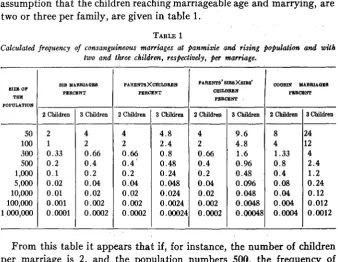
(age diflerences being, left out) of consanguineous marriage of differing degrees under the assumption of random crossing. A common character- istic of the formulas for the higher degrees of consanguinity, is that when the number of children compared to the population is very small, the probability of chance consanguineous marriages approaches zero. How- ever, in the case of a limited population the figures are not so low that they can be a priori omitted. Figures for the frequency of some different kinds of consanguineous marriage a t varying size of population, and under the assumption that the children reaching marriageable age and marrying, are two or three per family, are given in table 1.
, i ; , ,
TABLE 1
Calculated frequency of consanguineous marriages at panmixie and rising population and d h two and three children, respectively, per marriage.
8173 O I TEE POPULATION 50 100 300 500 5,000 10,000 100,OOO 1ooO,000 1
SIB WARBUQES
PERCENT
2 Children 3 Children ~~ 2 0.33 2 1 4 0.0002 o.Ooo1 0.002 0.001 0.02 0.01 0.04 0.02 0.2
0 . 1
0.4 0.2 0.66
2 Children
4 2 0.66 0.4' 0.2 0.04 0.02 0.002 0.0002 ~.
3 children
4.8 2.4 0.8 0.48 0.24 0.048 0.024 0 . 0024 0. OOO24
mmNT
2 Children 3 Children
" 4 4.8 2 9.6
o.oO041
0.0002 0.0048 0.0020.048 0.02 0.096 0.04 0.48 0.2 0.96 0.4 1.6 0.66
COUSIN M A W A O E B P l B O N T
2 Children 3 Children
" 8 12 4 24 0.0012
o.oO04
0.012 0.004 0.12 0.04 0.24 0.08 1.2 0.4 2.4 0.8 4 1.33a t 3 , the corresponding figures are, for sibs 0.02 percent, for parents and children 0.024 percent, for parents’ sibs and sibs’ children 0.048 percent, and for cousins 0.12 percent. These figures prove that when the population is not of very considerable size, under panmixie consanguineous marriages have to be reckoned with in percentages that are not quite insignificant. In principle these conclusions should not be invalidated by our not having taken the age of the individuals into account. It will be evident from our formulas that the frequency of consanguineous marriage in a population under otherwise equal conditions, depends on the average size of the families.
Empirical occurrence of consanguineous marriage
Proceeding to a review of the available data as to the actual occurrence of consanguineous marriage in different populations, our intention is not to give an exhaustive survey of the existing statistics, only to obtain a moderately secure basis for our calculations.
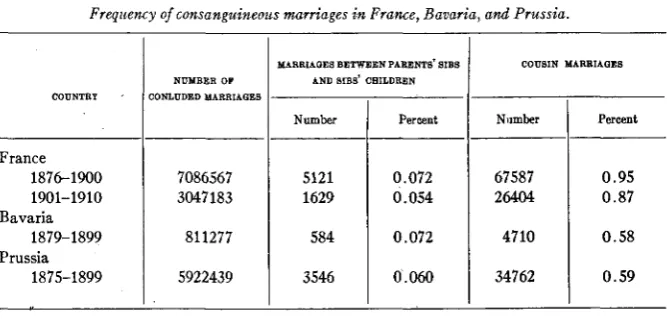
I n the offical statistics of some countries figures are given for the fre- quency of consanguineous marriages of different kinds. Some data will be found in table 2.
TABLE 2
Frequency of consanguineous marriages in France, Bavaria, and Prussia.
COUNTRY ’ :ONLUDED MARRIAQES NUMBER OF
France 1876-1900 1901-1910 Bavaria Prussia
1879-1899 1875-1899
7086567 3047183 811277 5922439
MARRIAQEB BETWEEN PABENTB’ SIBS AND SIRS‘ CAILDREN
Number
5121 1629
584 35%
Percent
0.072 0.054 0.072 0.060
COUSlN MARRIAQES
Number Percent
67587 0.95
26404 0.87 4710
0.59
34762
0.58
It will be seen from these figures that the frequency of marriage between cousins, varies between 0.5 and 1 percent, and that of marriage between Sibs’ children and parents’ sibs keeps under 0.075 percent. LENZ 1919, puts the frequency of consanguineous marriage a t t h e following percent- ages: parents’ sibs Xsibs’ children 0.06 percent, cousins Xcousins 1 percent, cousins X cousins’ children 0.3 percent, cousins’ children Xcousins’ children
INBREEDING I N MAN 429
Munich for the years 1848-1922, and his figures are in fair accordance with those from Bavaria (marriage between cousins 0.6 percent, parents’ sibsxsibs’ children 0.01 percent on 16,182 marriages). SPINDLER (1922) has examined the frequency of consanguineous marriage in three Wiirtem- burgian villages. Among 453 marriages he found no marriage between parents’ sibs and sibs’ children. Marriages between cousins were 1.8 f 0 . 8 percent, between cousins and cousins’ children 0.7f0.4 percent, and be- tween cousins’ children 7.1 f 1.2 percent. REUTLINGER (1922) gives some figures for consanguineous marriage among Jews in Hohenzollern. Eighty- two out of 117 marriages were in a town of 1320, and 35 in a town of 4320 inhabitants. The frequency of marriage between cousins was 16.2 percent and between cousins’ children 2.6 percent. REUTLINGER got the informa- tion by questioning the parties, and it is comparatively uncertain for the more distant relationship.
These figures confirm the conclusions from our above formulas, namely that the frequency of consanguineous marriage is higher in small popula- tions than in large. Judging from the empirical figures, it seems the fre- quency of marriage between cousins can be p u t a t the figure propounded by LENZ, or 1 percent, and that of marriage between parents’ sibs and sibs’ children a t 0.7 percent (a little higher than the figure proposed by LENZ). Naturally these figures, that refer in the first place to West Euro- pean official statistics, can have no pretence to universal validity. Ob- viously conditions vary in different populations. In the absence of more thoroughgoing statistical investigations, however, it would seem to be justified taking these figures as basis for our calculations.
Hereditary constitution of ojspring in consanguineous marriages
The following calculations are based on the formulas for composition of the population reproduced on p. 423. We assume that a recessive character has the probability r, and that consequently, a recessive character bearer has the probability r2.
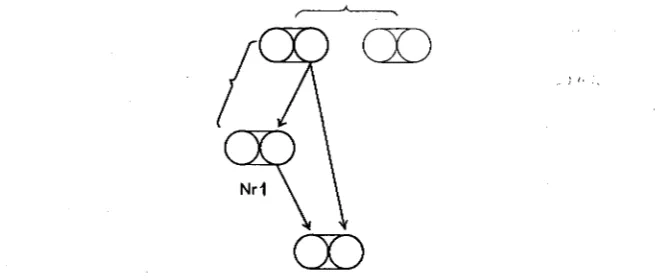
the probability of its being transmitted from this child to the offspring, once again 1/2, consequently the final probability 1/2.1/2 = 1/4. The
probability of a gene meeting itself, that is passing both directly and vi,a one of the children, consequently is 1/2.1/4= 1/8.
However, we have to reckon with 4 genes in the parents, any one of which may occasion this conjunction. Thus the probability is quadrupled; the probability of a conjunction therefore is 4.1/8 = 1/2. The probability of the original gene being a carrier of the recessive character is r. There-
-
; t , .
FIGURE 1.-Marriage between parent and child; the pairs of genes.represented by joined
circles
fore, the probability of a gene meeting itself in the offspring, producing a recessive character bearer, is 1/2r. I n the other 1/2 cases, when a gene does not meet itself, but combines with a gene deriving from different original genes, recessive character bearers should result with the same frequency as at random meeting of genes in the population, that is in r2 cases. Thus, in half the cases character bearers would result in r2 cases, that is with the probabi€ity 1/2r2, and the probability for character bearers among the off- spring in a marriage between children and parents would be
1 1
- r+ - p 2 L L
I n order to calculate the probability for the constitution of the offspring in a marriage between sibs, take a gene in one of the parents (figure 2).
The probability of this gene passing to one of the children is 1/2, and of its passing to their children 1/4. The probability of its meeting there with itself is 1/4.1/4= 1/16. Here also, however, we have to reckon with 4
INBREEDING I N MAN 43 1
4r‘ 1/16 = 1/4r. In the other 3/4 cases character bearers can be produced by R genes descended from different original genes meeting in RR combi- nations. This happens in r2 cases, as the proportion of R genes in the origi- nal individuals must’ be the same as in the population a t large = r. The
FIGURE 2.-Marriage between sibs (see FIGURE
probability for recessive character bearers in the offspring of a marriage betwee sibs consequently is
1 3
- r + -rz.
4 4
Calculating the marriage between
probability for character bearers in the offspring of a parents’ sibs and sibs’ children, we proceed from the
FIGURE 3.-Marriage between parents’ sibs and sibs’ children (see FIGURE 1).
parents of the “parents’ sibs” (figure 3). A gene in one of these has the probability 1/2 of recurring in one of the “parents’ sibs,” and 1/4
of
re- curring in one of their children. The same gene has a chance of 1/2 of reaching the parents’ sibs, 1/4 of reaching the sibs’ children, and 1/8 ofreaching their offspring. The probability of a gene meeting itself in the offspring thus is 1/8.1/4. As usual we have 4r possibilities of the gene being a character carrier. Taking into account the character bearers
produced by the coincidence of genes that are carriers of the Character,' but are descended from different original genes, the probability for reces- sive character bearers among descendants from a marriage between parents' sibs and sibs' children is
1 7
8 8
-r+-r2.
Finally, the constitution of the offspring of a marriage between cousins, is to be calculated (figure 4). An original gene has the chance 1/2 of reach-
FIGURE 4.-Marriage between cousins (see FIGURE 1).
INBREEDING IN MAN 433
final result is that the probability for recessive character bearers among the children of a marriage between cousins is
1 15 -r +-r2.
16 16
Similarly i t can be calculated that the probability for recessive character bearers among the offspring of marriages between cousins and cousins’ children is
1 31
-r+-rr2 7
32 32
and further that the probability for recessive character bearers among the offspring of marriages between cousins’ children is
1 63
-r+-r2
64 64
An examination of these formulas will for the frequency of character bearers guineous marriage is
1 28-1
show that the general expression among the offspring of consan-
-r +-r2
28 2”
where r = the frequency of the recessive gene in a population, and S = the
number of intermediary stations passed by the gene between ancestor and descendant. Consequently, in a marriage between parents and children s = l , in a marriage between sibs s=2, between parents’ sibs and sibs’ children s = 3 . The number of intermediary stations, that is individuals through which the gene has to pass before meeting itself, is clearly seen in the figures appended to our calculations, in which these intermediary stations have been numbered.
Through this formula we have obtained a measure for the increase of homozygozity (frequency of RR-individuals), conditioned by different classes of consanguineous marriage. Obviously the dominant character bearers (DD- and DR-individuals) decrease to the same extent that the recessive character bearers increase. The increase
df
dominant homo- zygotes (DD-individuals) can be obtained by inserting the frequency of the dominant gene in the formula. By adding the increase of recessive to that of the dominant homozygotes, the decrease of heterozygotes is obtained.It should however be remembered that although the number of homozy- gotes is increased, and that of heterozygotes reduced through consan- guineous marriages, the gene proportions are not changed. Consanguine- ous marriage only sorts together genes of the same kind to a greater extent than does panmixie, but does not change the percentage of genes in the population. Consequently, if the inbreeding ceases, the composition of the population is restored to the state that is to be expected a t panmixie. Consanguineous marriages affect only the offspring of the related indi- viduals marrying. If the children marry into the population, the effect of the consanguineous marriage is cancelled, but if in their turn they enter a consanguineous marriage, the effect is somewhat increased, because the parties to such a marriage are related in several ways, and the genes have several paths by which to meet with themselves. Such marriages, however, must be comparatively rare, and we do not propose to give the formulas' for these more complicated forms of consanguineous marriage. If will be understood from the above that completed consanguineous marriages in earlier generations have no influence. Consanguinity affects only the direct descendants-that is only that point in the population above which the consanguineous marriage takes place.
Conclusions
We have now the premises for an investigation of the effect of inbreeding on the composition of a population.
It has been shown above that the fortuitous occurrence of consanguine- ous marriage is infinitesimal if the population is very large, for example rising to millions. In that case, consequently, only the positive effect of actually occurring consanguineous marriages need be taken into account. Assuming that marriages between parents' sibs and sibs' ohildren occur with the frequency =P3, and marriage between cousins with the fre-
quency = P4, th.e population will have normal composition in (1 -Pa -
P4)
percent cases, in PS cases the composition expressed by the formula for children of parents' sibs-sibs' children, and in P4 cases the composition expressed by the formula for children of marriages between cousins. By adding these expressions, the composition of the population under the conditions assumed is obtained, and by sub,tracting r2 the increase of the percentage of recessive character bearers compared with panmixie is obtained. Consequently the formula for increase is:INBREEDING I N MAN 435
Employing the figures for empirical frequency of marriages betwqen parents' sibs and sibs' children, given above, and considered as normal, we insert these in our formula. If the recessive factor 'has the frequency r, consequently the increase occasioned by these marriages is 0.07125(r-r'). It will be seen from this expression as well as from the above general for- mula that the increase of recessive character bearers approaches 0, when the frequency of the factor approaches 0. The increase gmws with r, reaching its maximum a t r = 1/2, then receding to 0 a t r = 1. The maximum increase a t the frequencies assumed for consanguineous marriages is 0.0178 percent, that is so low as hardly to be statistically ascertainable. If higher figures for the frequency of consanguineous marriages are in- serted, naturally we get a higher value for the increase. Even if the percentages for the two kinds of consanguineous marriage referred to, are multiplied by ten, the absolute increase, however, will be only 0.178 per- cent or almost negligible. Besides, it should be remembered that then r has been p u t a t 1/2, which means that we get a maximal increase. I n a case of a rare character, naturally the increase is still more insignificant. I n order to demonstrate this circumstance, in the appended table 3 the increase in
TABLE 3
Table of the increase of the percentage of recessive character bearers at rising frequency of a monohy- bride factor i n a popularion with only cousin marriages.
PERCENTAQE FREQUENCY 01.4 HEREDITARY
FACTOR IN THE POPULATION
1 10 20 30 40 50 60 70 80 90
'ERCENTAQE FREQUENCY OF RECESSIVE
CEARACTER BEARER8 IN THE POPULATION 0.01 1 4 9 16 25 36 49 64 81
'ERCENTAQE INCREASE OF RECE88IVE CWRACTER BEARERS IN THE
POPULATION
0.0619 0.562 1 .oo
1.313 1.50 1 .S62 1
.so
1.313 1 .o 0.562percentages for recessive bearers a t panmixie are also given. By adding the percentage for character bearers at panmixie to the corresponding percentage for the increase, the percentage of recessive character bearers in a population where all marriages are between cousins, is obtained. The increase is calculated from the formula for marriages between cousins p. 426 and consequently is obtained by subtracting r2 from r/16+15r2/16. Thus
p e r c e n t
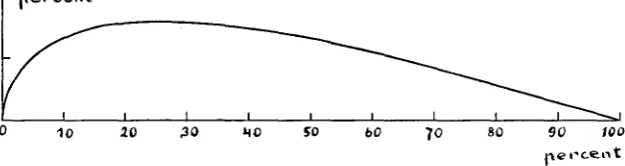
FIGURE 5.-Diagram of the percentual increase of character bearers in a population with only cousin marriages, compared to panmixie, at rising frequency of the factor. The vertical scale has had to be made 10 times as large as the horizontal one in order to make the curve perceptible.
the formula for the increase is 1/16(r-r2). I n order to obtain from this table for instance the increase a t a percentage of 10 for marriages between cousins, the figures for the increase in this table are divided by 10, the increase at a percentage of 1 is obtained by dividing by 100. The increase in a population where all marriages are between cousins also is demon-
pe ,-cent
FIGURE 6,”Diagram of the percentual increase of monohybrid, recessive character bearers in a population with only cousin marriages, compared to panmizie, at rising frequency of charac- ter bearers. The vertical scale has had to be made 10 times as large as the horizontal one in order to make the curve perceptible.
INBREEDING IN MAN 43 7 As the increase a t consanguineous marriages in more distant degrees of relationship is very much less evident there is no reason to carry out the demonstration for these degrees of relationship.
I wish to stress, that when, as here, i t is said that consanguineous marriage is of no consequence, this is done in a statistical sense only. The increase of the number of recessive character bearers that may be caused by consanguineous marriage, can hardly reach such proportions as to be of any account statistically. But this does not mean that if the population is fairly large, the number of character bearers that can be assigned to this increase, may not be quite considerable. I n the case of a country with several millions of inhabitants, a certain degree of inbreeding may cause a slight increase of the number of certain recessive character bearers, in comparison to a country with a lower frequency of inbreeding. Although this increase may not be observable with*statistical methods, i t m a y reach an amount of several hundred individuals. Insignificant though this figure may be relatively to the population as a whole, these individuals, however, may mean much suffering for the diseased and their families, and con- siderable expense for the community.
The above argument, however, applies only for very large populations. I t i s n o t t o be precluded that counting smaller populations and taking into account the non-occurrence of marriage between sibs and between parents and children, we might find a negative effect, an increase of the heterozy- gotes occasioned by the reduced number of consanguineous marriages com- pared to panmixie. Therefore we proceed to examine the conditions for small populations, employing our formulas for the frequency of consan- guineous marriages. Provisionally the non-occurring fortuitous frequency of marriage between sibs, will be=pl; that of marriage between parents and children=p2, between parents’ sibs and sibs’ children=p3, and be- tween cousins =p4. Further the empirical frequency of marriages between parents’ sibs and sibs’ children = P3, and the empirical frequency of mar- riages between cousins=P4. The formula for the increase of recessive character bearers in the population in this case is:
(1- P3- P4+p3+p4)rz+--”-- p3- P4- p3 (r+ 7r2)
+---
p4 (r+ 15r2)8 16
-
This gives
which expressed in c =number of children, and n =population, gives 2 ~ ~ + 1 8 ~ ~ + 1 2 ~ - 1 6
2Ps+p4--
(2--c)(n- 1) 16 a
- - (r-3);
This expression is 0-that is, ch’si&pineous marriage is without effect, if
J 2P3+P4=8p1+4pz+2p3+p4
or
2c3+18c2+l2c- 16 2P3+P4=
(2+c)(n- 1)
’
Taking a given; empirical consanguineous marriage, and assuming a certain average number of children, we are thus able to calculate the size of population a t which the effect ‘of consanguineous marriage is none. If the population exceeds the calculated size for equilibrium, the result is an increase of homozygoty, that is of recessive csaracter bearers. Even in the most favorable case, that is when the population is infinitely large, this increase is however, as demonstrated above, quite infinitesimal.
However, the point for equilibrium as calculated by the formula, must be higher than in reality, as, in working out the formula, it has been assumed that the age difference actually obtaining between parents and children, would not act as a check. As a matter of fact this age difference, even under the conditions of random crossing naturally must entail that the chances for such marriages become considerably less than indicated by the formulas. Employing the above formula, therefore, we reach an upper limit for equilibrium; the value obtained is too high. Assuming “normal” frequency of consanguineous marriage, and two as the number of children, we find that equilibrium obtains at 2104 individuals, that is in a population of about 2000;,.This, consequently, is the upper limit for equilibrium.
Assuming, on’the other hand, no fortuitous marriages at all between parents and children, or between parents’ sibs and sibs’ children, we get the following formula:
which gives
2Pa+P4-8p1-p4
(r - r’) 16
INBREEDING IN MAN &3 9
or if
I
2c2+6c-8
2P3+ P*=
n-1
’
This formula gives too low a vallie for equilibrium. Putting the number of children a t two, we find that equilibrium lies a t 1053 individuals, that is a t a population of about 1000 individuals.
These talculations show that consanguineous marriage a t “normal” fre- quency has no influence, that is it does not cause any departure from Sanmixie wlien the size of the population .is something between 1000 and 2000 individuals. A given frequency a f consanguineous marriage, thus corresponds to .a’certain size of population, a t which this frequency of consanguineous marriage has no effect. On the other hand;of cour.se a certain figure for population answers to a certain frequency of consan- guineous marriage, which must be found a t panmixie, and which is neced- sary if the number of character bearers is going to be that, demanded by the formulas for panmixie. A curious consequence is that if two popula- tions of similar composition, and both with panmixie, are joined, and if the frequency of consanguineous marriage remains the*same as in the original populations, the number of character bearers in the joined population a t panmixie will be somewhat larger than the added number in both the original populations. Another peculiarity is that if a population consists of one family of sibs, the number of character bearers produced by marriages between sibs, will be the same as that produced by fortuitous m a t h g in a population as large and consisting of several families of sibs. What is the effect of consanguineous marriage if the population is c o d siderably smaller than required for equilibirum? In that case there will be an increase of heterozygosity in the population, that is a reduction of the number of recessive character bearers as compared to panmixie. If the population numbers 500, and the number of children is 2, the reduction will,be found to amount to 0.0572.percent a t normal frequency of consan: guineous marriage. If the population numbers 200, and the number bf
children is 2, the reduction is 0.1697 percent.
,‘T&se figures ’are maximal, being calculated from the first formula (p. 423), which gives too high values, as the age difference is not taken into account, a& under the presumption that r = 1/2. If the character is more rare, naturally the reduction will be still smaller. Further we have been reckoning with “normal” frequency of consanguineous marriage, that is to say with a frequency that for small populations must be abnormally low.
All of which conduces to give a figure for the decrease of recessive character bearers which is decidedly too high, compared to the frequency a t pan- mizie. Nevertheless the decrease is quite infinitesimal, even for small populations, so that in practice it can be omitted. Thus, it is undoubtedly legitimate to say that in the case of small populations as well as large ones, no appreciable influence on the frequency of recessive character bearers in human populations, is to be expected. If on a comparison of the fre- quency of mono-hybrid character bearers in two populations, distinct differences in that respect are to be observed, this difference, consequently, is not to be explained by any larger or smaller frequency of consanguineous marriage in the two populations. I n order to get a perceivable difference between two populations through consanguineous marriage, frequencies and degrees of consanguinity will have to be assumed that go far above what is reasonable or possible in human populations.
INBREEDING IN MAN 44 1
question is only of children who reach marriageable age, and do marry. If this number is 2, the population must be constant. If, again, the number of children per marriage is 3, and other conditions are the same, one genera- tion would give an increase of 50 percent, that is, far more than in reality is to be found in populations generally. Judging from the actual in- crease, the number of children in Western Europe is about 2, or little over 2, that is if only children who reach marriageable age, and do marry, are counted. Thus, an assumption of 2 children will give a fairly accurate figure for the population.
For our following calculations we employ the figures given above as normal for the frequency of consanguineous marriage, and which, in the first place, refer to conditions in Western Europe. I n the above calcula- tions, these figures were taken without any discussion as to whether they actually correspond to what would be expected on account of random mating in these populations, or whether they indicate that consanguineous marriage is more or less common than conditioned by panmizie. Taking this problem under discussion, we now use the formulas previously worked out for the chance occurrence of consanguineous marriage. Can it, then, be said that consanguineous marriages occur with the same frequency a s required by our formulas? Decidedly not. The empirical figure for marriage between parents’ sibs and sibs’ children, is quite certainly too low. To begin with, we have not, on working out our formulas for the chance occurrence of such marriages, taken into account the considerable average age difference between these categories of individuals. This age difference, of course, must act as a strong restraint, so that actually such marriages are less frequent than indicated by the formulas. Further, the reputation of harmfulness appending to marriages between near relatives, should work in the same direction. But if this figure is too low, we get too high a figure for the population, when it is used to calculate the population. We assume a number of 2 children per marriage, and thus, employing the formula for marriages between parents’ sibs and sibs’ children p. 425 arrive a t a figure for the population of 2957, that is about 3000 individuals. This, then, can be regarded as the upper limit for the isolates in the population in question. The formula now gives the size of the isolates for both sexes. Taking into account the sex difference, the result is that on an average a certain person has, in these populations, the chance of marrying one out of less than 1500 individuals.
As regards marriages between cousins, there is no strong average age difference asserting a restraining influence. It rather seems an individual would have a greater chance of marrying a cousin, than other individuals
of his environment in the population, as, on account of their relationship; he will see his cousins comparatively often. Apprehensions as to the harm- fulness of consanguineous marriages, would hardly play any rble in the case of marriages between cousins. Under these circumstances, the empirical figure for marriages between cousins, would be rather too high, and in any case, hardly too low, compared to the frequency a t random mating. Assuming 1 percent of marriages between cousins, and 2 children, consequently the resultant population would be somewhat too low. The figure is 400. This means that the isolates in the population on an average hardly fall below 400 individuals, and that every individual has a chance of marrying one out of at least 200 individuals.
The limits arrived a t for the size of the isolates, thus lie a t 400 and 3000. We also know that the upper limit is decidedly too high, because, as far as the formula is concerned, it is conditioned by a frequency for mamiages between parents’ sibs and sibs’ children that is clearly too low. There is also reason to suppose that the figure for marriages between cousins is too high, and thus has given too low a figure for the isolates. Evidently nothing can definitely be said in this respect, even though the calculations may give grounds for a supposition that the isolates have to be denoted by three, rather than by four figures. It is also obvious that the size of the isdates is subject to very large variations, not anly within a population, but also from one country to another. The one extreme is the large city, with its floating mass population, the other extreme is the forest region with; .scattered small villages, in, for instance, northernmost Europe.
Under these circumstances, the working out of a more exact figure does not seem to be called for. The aim of the above calculations ha3 been only to give an approximate idea of the“norma1” order of the size of theisolates and to indicate a method for estimating their size in investigations on populations. The size of the isolates is a factor which acquires practical in,terest, when it is wished’to analyse processes of mixturesand equalization in different populations. Regarding the theory for these processes, I refer
$0 WAHLUND’S work. ,
INBREEDING IN MAN 443
not of an order to let any appreciable influence of consanguineous marriage be expected. This applies to the increase or decrease of recessive character bearers at mono-hybrid inheritance.
However, speculating on the favourable or unfavourable influence of consanguineous marriage on a population, we have in mind not only the influence on one mono-hybrid character, rather the sum of influences on all the mono- and poly-hybrid characters in a population. Assuming a certain number of equally frequent mono-hybrid characters, the effect, of course, is as many times greater, as this number denotes. When, however, the effect for one character is near zero, the total effect for the sum of the mono-hybrid characters almost certainly will be so small, as to be negligible. The same applies to the effect for poly-hybrid characters. I n order to prove this, we assume a di-hybrid, recessive character, carrying the two dispositions R1 and
Rz
with the frequencies rl and rz. Recessive character bearers of the form R1R1R2R2 then occur with the frequency rI2rz2. We assume that consanguineous marriage occasions a divergence in the fre- quency of RIR, = 6, and a divergence in the frequency of RzRz = 62. Underthese conditions recessive character bearers on consanguineous marriage will occur with the frequency
( r ~ 2 + 8 ~ ) ( r ~ 2 + 8 2 ) = r 1 2 r ~ 2 + r ~ 2 8 z + r z 2 8 ~ + 6 ~ 8 z
In this expression 6, and are very small. They denote the increase caused by consanguineous marriage for each combination of homozygous dispositions, and as has been shown above, this increase is so small that it can be neglected. Consequently the terms in the above expression into which these factors enter, also are very small. Thus it can be said that the increase for di-hybrid, and analogically for other poly-hybrid characters, on account of consanguineous marriage, is small or none. For these as well, consanguineous marriage has no effect at all compared to panmixie,
if the size of the population corresponds to the equilibrium calculated above. If however, the size of the population diverges from this equilib- rium, the effect, of course, is somewhat stronger in the case of poly-hybridz
The increase for the gene combination RIRIRzRZRsRs
.
.R,R, is: (rlZ+S1).
(rP+Sz).
(rs2+6d -(rn2+6,)where RI, RI, RI .R, are the different genes, rl, rz, rs,
.,
rn their frequencies, and 61 62, 61,.,
b. the increase of homozygosity for each pair of factors, conditioned by consanguineous marriage, according to our formulas. If the factors have equal frequencies, that is rl =,
rz = r8 =,
*
-
=rn the formula isRIR~RzRPRsRI .R.R. = (ri*+61)n
WEINBERG has given general formulas for the composition of offspring in consanguineous mar- riages with complicated polyhybridity-without, however, giving any comments on the formulas
or several kinds of mono-hybrid characters; roughly speaking the effect for a di-hybrid character is less than for two monohybrid characters with corresponding frequencies. As, however, the size of the isolates does not diverge from equilibrium to such an extent as to leave an appreciable effect of consanguineous marriage for a recessive character, it follows that even in regard to several mono-hybrid or poly-hybrid characters it can be said that there is no reason to expect any greater divergence in the compo- sition of the population, caused by consanguineous marriage as compared to panmixie.
Hitherto attempts have very frequently been made to explain different frequencies of hereditary character bearers in different populations,
different classes, etc., through a varying frequency of consanguineous marriage. From the above i t will appear that these explanations are not satisfactory. Whatever the cause may be of a different frequency of character bearers in a certain case, it is impossible that this difference, if i t is a significant one, should be the result of varying degrees of consan- guineous marriage.
THE INFLUENCE OF CONSANGUINEOUS MARRIAGE ON RELATIVES OF CHARACTER BEARERS
INBREEDING IN MAN 445
percentage among the sibs will be 25.6. In other words in the case of a comparatively rare character the hereditary composition of the relatives changes very little if the composition of the population is changed to some degree. If the character is rare, below a certain limit, i t does not much matter whether it is more or less rare. For other aspects of this question, see the work quoted above.
The formulas mentioned above have been worked out under the sup- position of punmixie. Will the hereditary composition of the relatives be changed to any considerable degree, if some consanguineous marriages occurr in the population? This can at once be denied. In the above i t has been shown that the proportion of character bearers in a population is not appreciably influenced by inbreeding. In other words, in the case of a common character, the majority of character beltrers are descended from the marriages of which it can be said that they would occur under punmixie, while only an inconsiderable number are descended from consan- guineous marriages. For more common characters, thus, the formulas apply with sufficient accuracy, even if a certain amount of consanguineous marriage occurs. I n the case of more rare and mono-hybrid dominant characters the majority of character bearers are heterozygotes. These are not, either, descended from consanguineous marriages, and consanguineous marriage, therefore, has no influence in the case of rare characters and dominance. For rare characters and recessivity, on the other hand, the majority of character bearers will be descended from consanguineous mar- riages. Will this influence the composition of the relatives? Taking one character bearer, we know that both the parents have the character in heterozygous form. Their two other genes are derived from the population, whether it is a case of consanguineous marriage or not. As the character is rare, these other genes must be the dominant ones. I n any case, we have a heterozygous marriage, and find the limit of 1/4 character bearers among the sibs of the character bearer, whether the parents are related or not. Among the parents’ sibs, grandparents and so forth, even in the case of consanguineous marriages, we practically never find a recessive homo- zygote, or heterozygote. Thus, if the character is rare and in the case of recessive inheritance, consanguineous marriage does not influence the proportion of Character bearers among the relatives. The same holds good for different forms of polyhybridity, recessive or dominhnt. Generally it can be said that for the proportion of character bearers among the relatives of character bearers, fortuitously chosen in a population, no regard need be had to consanguineous marriage occurring in the population, and that the formulas worked out on the assumption of full punmixie, can be employed.
Intimately connected with this problem is the question, how often con- sanguineous marriage is to be expected among the parents of recessive character bearers. As mentioned above, LENZ 1919, has treated this problem, and demonstrated that if a character is rare, there is to be ex- pected a perceptibly larger percentage of consanguineous marriage among the parents of recessive character bearers than in the population, and that the rarer the character, the gfeater is the increase of consanguineous marriage. This also can be illustrated by aid of the formulas given above. If there are PI cases of marriage between parents' sibs and sibs' children, and P4 cases of marriage between cousins, there will under
partmixie be recessive character bearers in (1 -P3 -P4) cases, and in these consanguineous marriages there will be P3/8(r+7r2) +P4/16(r+15r2) re- cessive character bearers. The chances for a recessive character bearer belonging to a consanguineous marriage thus are
P3
-(r+ 7r2) +-(r+ P4 15r2)
8 16
(l-PS-P4)r2+-(r+7r2)+-(r+15r2) P4 P3
8 16
3('+7)+5('+15) 8 r 16 r
INBREEDING I N MAN 447
Such an increase, naturally does not prove the existence of hereditary factors, but may be occasioned by a comparison of non-corresponding groups.
As was previously said, the absolute increase of the number of recessive character bearers caused by consanguineous marriage thus is very small. Nevertheless the majority of the few character bearers that are to be found in a population, will be descended from consanguineous marriages. From the point of view of the population, consanguineous marriage has very little importance for the occurrence of recessive character bearers. From the point
of view of the character bearers, on the other hand, it has great ;mportame, i n the case of recessivity, and if the character i s rare.
Analogically, what is the importance of consanguineous marriage in re- gard to dominant mono-hybrid characters? I s there reason to expect a greater amount of consanguineous marriage among the parents of bearers of a rare, dominant character? If the character is rare, the majority of the dominant character bearers are heterozygotes. As was pointed out above, these are not particularly frequently descended from consanguine- ous marriage: consanguineous marriage even counteracts the production of heterozygosity. As the question was of heterozygotes, there will be no increased number of consanguineous marriages among the parents. I n di-hybrid dominant heredity when, in the case of a rare character, a character bearer has been produced by the coincidence of two genes from different allelomorphous pairs, an increase of the frequency of consan- guineous marriage should be expected among the parents of the character bearers, in analogy to the conditions under mono-hybrid recessivity. This applies also in different forms of poly-hybrid inheritance.
THE RISKS OF INDIVIDUAL CONSANGUINEOUS MARRIAGES
In the above i t has been attempted to analyze the importance of con- sanguineous marriage for a population as a whole, and for the relatives of fortuitously chosen character bearers in a population. We have found that in these respects i t is of little importance with regard to the frequency of character bearers. From the public point of view the risks of consan- guineous marriage are small.
towns, it is not necessary to take the wooden houses into account. The increase conditioned by these may be so small that it does not play any part if the risk is calculated for the whole town, or for fortuitously chosen houses. Nevertheless, it is necessary in the individual case to take into account the increased risk that may be conditioned by the proximity of wooden houses.
Our case is similar. If consanguineous marriage is of small consequence for the population, i t does not follow that it is indifferent for a certain individual whether he enters into a consanguineous marriage. By such a marriage he may considerably increase his risk of having character bearers among his descendants. On the other hand this risk is naturally lessened by a consanguineous marriage, if it is known that the individual is himself healthy, and has no character bearers among his relatives.
Thus taking a certain individual, who has a certain hereditary trait, we want to find what risk he runs of having character bearers among his off- spring in a consanguineous marriage, compared to that risk in another marriage, that is the risk of a consanguineous marriage in comparison to a “normal” one. What, then, is to be regarded as a normal marriage? One possibility is to calculate the average risk for a marriage with a fortuitously chosen individual in the popu1.ation. Other possibilities are to assume that the other party is himself free from the character, that further he has healthy parents, sibs, grandparents and so forth. In the practical case, however, it is hardly possible to say anything about the qualities of the party that a certain individual would marry, if he did not conclude an intended consanguineous marriage, and so i t seems more proper to take a fortutiously chosen individual €or comparison.
For the primary individual, also, there are an udimited number of possibilities. He may himself be a character bearer, or have one or more character bearers among his nearer or more distant relatives. Further i t can be assumed that one or more of his relatives are not character bearers, and that a number of the relatives are of unknown quality. Evidently space would not allow the working out of formulas even for the immediately discernible cases, and below calculations only for two cases of cousin marriage will be carried out. If wanted, it should not meet any difficulties to make analogous calculations for other cases that may awaken interest. When a question is asked about the risks of a certain marriage, these calculations and points of view, may acquire some practical interest.
INBREEDING IN MAN 449
the frequency for a certain gene, a figure for the risk may be obtained. Such formulas, however, are of comparatively small practical interest, as generally i t is desired to calculate the risk only for relatively rare diseases etc. General formulas of this kind are comparatively complicated, and therefore will not be given in this connection; here the risk will be calculated only on the assumption that the character in question is very infrequent in the population. (Formulas of this kind will be given in a paper appearing in Archiv fur Rassen- und Gesellschafts-Biologie.) Such calculations are very much simpler, and make far less demands on time and space. Not even with this limitation, however, i t is possible to give the calculations for all the cases of immediate interest.
If a recessive factor is rare in a population, naturally the character bearers as well as the latent character bearers, also are very rare. It can thus be assumed that practically the whole population consists of free homozygotes. If an individual is a character bearer, or has a smaller or
-
h
D
'-
RD
R
D
D
&
Nr8N r l Nr9
I
FIGURE 7.-Cousin marriage, one party having the recessive character, the other not, nor
parents or grandparents.
greater, number of character bearers in his family, he will in nearly every case, on a fortuitously concluded marriage to a non-relative, marry a healthy homozygote. The risk of a recessive character bearer among the children of such a marriage, is practically 0. It can thus be said that the normal risk in these cases is near 0.
If a person is a recessive character bearer, and concludes a marriage with a cousin, it is known with certainty that his parents are heterozygotes, and that the individual NO. 2 in figure 7 has the composition RD. The
R-gene must also be found in one of the common grandparents; i t h a s a probability of 1/2 to be found in No. 5, 1/4 to be found in No. 9, and 1/8 to be found in the children. In the cases where the R-gene is to be found in the children of No. 9, these children will be character bearers, because all the children receive an R-gene from No. 1. If the factor is rare, con- sequently the risk of recessive character bearers in a marriage between cousins is 1/8.
One more example will be given. Assume that one of the parents of the individual in question through whom he is related to the other party, is a recessive character bearer (see figure S). In that case the individual with certainty is a heterozygote. Both the parents of the character bearer also are heterozygotes. Among their descendants 213 are heterozygotes, and
N r " T - Nr9
FIGURE 8.-Cousin marriage, one parent but no other relative having the recessive character.
INBREEDING IN MAN 45 1
through whom he is not related to his cousin. If, on the other hand, that one of his parents through which he is related to his cousin, had epilepsy, the risk wouId be 1/12 that the children would suffer from epilepsy (assum- ing that the cousin to whom he is married, and the parents of the cousin, were healthy). The risk in a marriage between cousins under these condi- tions evidently is comparatively high.
Along these lines it should not be difficult to calculate the risk of a con- sanguineous marriage under certain given conditions. On the Gasis of such calculations it is nossible to express a more definite opinion on the risk of a certain consanguineous marriage, than on the ground of general ideas regarding the harmfulness of consanguineous marriage in the presence of a recessive disposition for a disease in the family. Obviously, the more distant the disposition, the less is the increase of the risk in comparison with a normal marriage. If the disposition is to be found in near relatives, however, the increase of the risk for rare characters is very considerable. Under these conditions i t is, from the hereditary point of view, always to the advantage of the individual not to marry a relative, that is, if his children only are taken into account. With regard, however, to descen- dants in later generations the advantage of the individual marrying into the population is not so marked. To a certain extent the descendants in any case will be latent character bearers, and there is the risk that when they in their turn marry, they will marry another latent character bearer, the result being, perhaps, that suddenly they have a recessive character bearer among their offspring. The matter might perhaps be thus expressed that through a consanguineous marriage one takes the risk for one's own children, through marriage into the population that risk is transferred to later generations. Whichever is to be preferred, may to a certain extent be a matter of taste.
From the point of view of the community, the whole matter is of no great consequence. It should be remembered that consanguineous mar- riage hardly perceptibly alters the composition of the population. The increase of the number of recessive character bearers caused by con- sanguineous'smarriage, is very small relatively to the population. If the population is large, the increase may, however, comprise a not incon- siderable number of individuals.
hereditary diseases. In such case, consanguineous marriages might to some small extent be considered favourable, as the character then has a greater chance to meet in homozygous form, and as the character can only be eradicated in that form. To the community, therefore, it may be favourable that the character be brought together in homozygous form, the eradication proceeding quicker that way. (A similar argument can be advanccd in regard to marriages between character bearers.)
Evidently, the conclusions reached in regard to the individual risk of consanguineous marriages, can inversely be applied in regard to favourable character bearers. The different probabilities calculated for different kinds -of consanguineous marriages, obtain for recessive monoybrid characters, whether these are favourable or unfavourable.
From the point of view of the community, consanguineous marriages are, of course, to some small degree advantageous in the case of favourable characters. If the character bearers have lessened chances of reproduction, naturally inbreeding to a small extent occasions a speedier eradication of these characters in comparison to panmixie.
With regard to dominant characters, calculations on the effects of inbreeding are of little interest, as i t can be seen directly on an individual if he possesses or does not possess such a factor. I n the case of a rare character, i t can in practice always be assumed that the character bearer is a heterozygote, if there are no special indications the other way. The risk of a consanguineous marriage, like that of other marriages, under these circumstances can be directly concluded from Mendel’s law. For the population as a whole, inbreeding naturally entails a slightly reduced number of dominant character bearers, which, obviously, for the genera- tion in question, is disadvantageous if the character is a favourable one, and vice versa.