Cuckoo and Levy Flights Algorithm Applied
to Unit-Commitment Problem
J.Chitra1, Dr.C.S.Ravichandran2
Assistant Professor (Senior), Dept. of EEE, SSIET, Coimbatore, Tamilnadu, India1
Professor & HOD, Dept. of EEE, Sri Ramakrishna Engineering College, Coimbatore, Tamilnadu, India2
ABSTRACT: As the power crisis is usual every year, it is important to make the generator operations optimal. Power production cost, generation cost, shutdown and start-up cost are considered in the formulation of unit commitment (UC), which makes it more important and it should be solved fast and effectively. The cuckoo via levy flights algorithm shortly called as cuckoo search algorithm (CSA) is applied to the unit commitment problem. This algorithm is compared with Shuffled frog leap algorithm (SFLA). Cuckoo search algorithm using IEEE ten generator system as test system and the performances are compared.
KEYWORDS: Cuckoo search algorithm, unit commitment, Shuffled frog leap algorithm, meta-heuristic search algorithm
I.INTRODUCTION
Unit Commitment problem [17] is a complex problem, which is the sum of total operating cost of generation, shutdown and start-up cost in the fitness function which is used to calculate the total operating cost of the unit commitment problem. This unit commitment problem can be solved by many optimization techniques [17], the research and development in intelligent methods and meta-heuristic methods make the improvement in the result of the unit commitment. Some of the literatures, which are solved by different methods, are described as follows.
The solution of the UC problem has two simultaneous solutions of two sub-problems, mixed-integer and non-linear programing problem [17]. For this problem, solutions are carried out using Priority list method (PL) [15], Dynamic programming method (DP) [26] [33], Lagrangian relaxation (LR) [5] [19] [21] [37] and meta-heuristic methods like Genetic algorithm (GA) [3] [8] [18] [28] [34] [39], Particle Swarm Optimization method (PSO) [5] [14] [27] [30] [38].
The PL method is fast but it is highly heuristic [17]. The DP method has mathematical complexity and increase in computation time (Ouyang. Z, 1992). LR method has its inherent sub-optimality. Javad Ebrahimi, has stated that the evolutionary algorithms like GA, PSO makes long execution time and non-guarantee the convergence to optimal solutions. And the Particle swarm optimization has large search space and its convergence is assured compared to GA. Shuffled Frog Leap algorithm (SFLA) based on solutions are better compared to PSO algorithm. The computation time and the production cost of the SFLA are less compared to LR, GA and BF [17].
Moosa Moghimi Hadji and other, has made the solution to the unit commitment using the imperialist competitive algorithm (ICA) based on the colonies populations. This algorithm is compared with the genetic algorithm (GA), integer coded genetic algorithm hybrid particle swarm optimization (ICGA), hybrid particle swarm optimization (HPSO) and bacterial foraging (BF). ICA gives a best solution over the reduction of cost function. Compared to the execution time BF is better compared to ICA. The results are also compared with 10, 20, 40, 60, 80 and 100-unit system and results are tabulated.
In this paper Cuckoo search algorithm is applied to the unit commitment problem.
II. UNITCOMMITMENTPROBLEMFORMULATION
The unit commitment problem is formulated using the generator fuel cost function, start-up cost and shutdown cost [1]. Start-up cost is modelled as two-valued staircase function [18]. The stepwise formulation is given below. [16]
III. CUCKOOSEARCHVIALEVYFLIGHTS
Cuckoo Birds that are found in Europe, Asia and Africa (winter season) has many interesting features in breeding. The birds like Ani and Guira, lays eggs in communal nest. Apart from its sweet sound it makes some mimicry. Usually it chooses a host nest to lay eggs. The cuckoo eggs look alike the host birds’ egg. Generally cuckoo eggs hatches fast compared to the host eggs. After that the host bird make a move from the nest and build a new nest there it lays eggs. Or it randomly pushes the eggs from the nest. So how much number of cuckoo birds survives in the host nest is the best nest for the parent cuckoo. The Cuckoo chicks also make the mimicry like the host chicks to get the maximum food from the host bird. By making this as a mathematical concept, the algorithm is build for solving the optimization problem with the help of Levy flights. It is used in the random walk of a variable for choosing the random nests.
Some assumptions are made to make the algorithm simple. [37]
1) Each Cuckoo lays one egg at a time and dump it in random chosen nests 2) The best nests with high quality of eggs will carry over to the next generation.
3) The number of available host nests is fixed and the host bird discovers the egg laid by a cuckoo with a probability between 0 and 1.
Here each egg in a nest represents a solution and a cuckoo egg represents a new solution.
IV.UNITCOMMITMENTUSINGCSA
In Cuckoo search initial population is done with the nests, here the nest are the initial population. The population is taken for the continuous unit-operating hour. With the initial population the fitness function is evaluated. After making the randomization, minimum up and down time constraints are automatically satisfied [17]. Fitness function is the summation of total fuel cost, start-up and shut down cost. Get a cuckoo from levy flights randomly and calculate its fitness. If the calculated fitness (Fi) is less than the next random nest fitness (Fj) then replace Fj with Fi , else keep the
same nest. Now worst nest is abandoned and next random nest is formed. Keep the best nests and rank them and find the best one which is optimum. Do the operation until the termination criteria are satisfied. Finally print the best results. Figure 2 indicates the operation as flowchart.
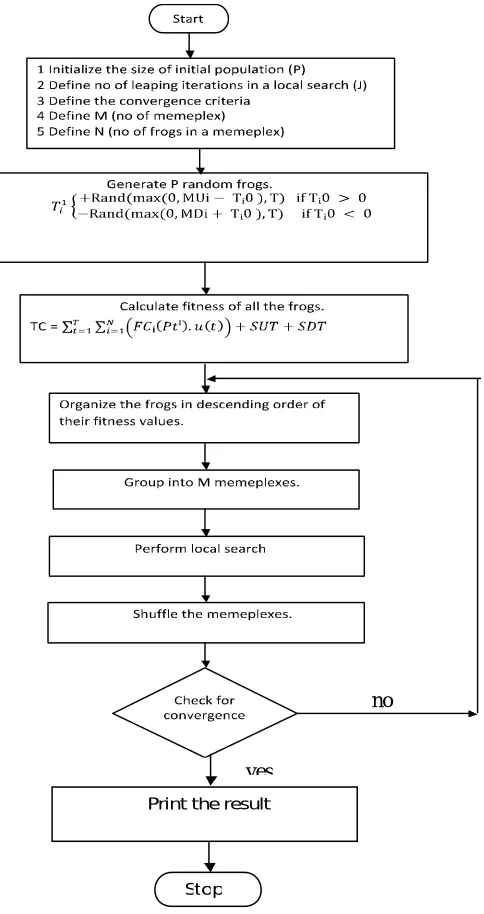
Fig.1 Flow chart of UC using SFLA
Printtheresult
Stop
no
Fig.2 UC solution using CSA
Keepthebestnests.Rankthe Solutionsandfindthecurrentbest.
Termination Criteria Satisfied?
Displaythebestsolution andresults
Stop
no
V. RESULTSANDDISCUSSION
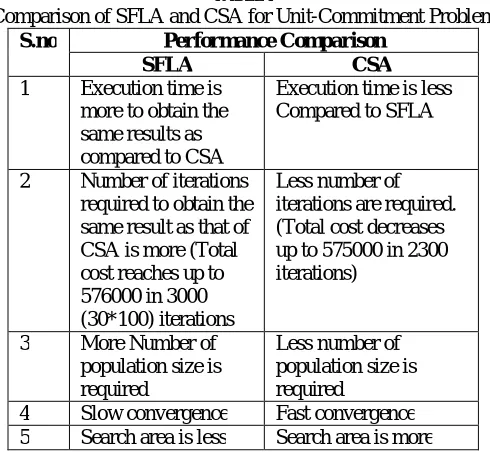
The results of the SFLA algorithm and CSA algorithm are compared here. As the Cuckoo search serves better on UC compared to SFLA. The parameters of the comparison are given in the table 1.
TABLE I
Comparison of SFLA and CSA for Unit-Commitment Problem
S.no Performance Comparison
SFLA CSA
1 Execution time is more to obtain the same results as compared to CSA
Execution time is less Compared to SFLA
2 Number of iterations required to obtain the same result as that of CSA is more (Total cost reaches up to 576000 in 3000 (30*100) iterations
Less number of iterations are required. (Total cost decreases up to 575000 in 2300 iterations)
3 More Number of population size is required
Less number of population size is required
4 Slow convergence Fast convergence 5 Search area is less Search area is more
So from the table we can see that the cuckoo search algorithm gives execution time less, it converges with in less iteration number, less number of population size, more search ability and fast convergence compared to the SFLA algorithm.
Fig
.
4. Cost Function Vs Number of iteration (CSA)From the Figure 3 the Shuffled frog leap algorithm gives the results on the number of shuffling operation that means here 50 iterations multiplied by 1000, so totally 50000 thousand iterations are carried out. But Using CSA, 2300 iterations are used to get the solution. The cost function also reduced compared to SFLA.
VI.CONCLUSION
The Cuckoo search algorithm solves better compared to shuffled frog leap algorithm. The results and discussion show the graph and the tabular column of the comparison. SFLA takes more number of iterations compared to CSA and the total fuel cost values also reduced using cuckoo search. And also the Cuckoo search algorithm gives 100% success rate in 10,000 number of run. Were in SFLA it is 97%. So the CSA serves better compared to SFLA.
REFERENCES
[1] Chitra J., Ravichandran C.S., “Performance Comparison of Integer Coded Cuckoo and Levy flights algorithm applied to Unit commitment problem,” Journal of Information and Applied Information Technology., vol. 66,No.3, pp. 876-883, Aug. 2014.
[2] Allen J. Wood, Bruce F. Wollenberg, “ Power Generation, Operation and Control, 2nd Edition”, Willey Publications, 1996
[3] Arroyo J. M. and Conejo A. J., “A parallel repair genetic algorithm to solve the unit commitment problem,” IEEE Trans. Power Syst., vol. 17, no. 4, pp. 1216–1224, Nov. 2002.
[4] Aoki K., Itoh M., Satoh T., Nara K.,and Kanezashi M.,“Optimal long-term unit commitment in large scale systems including fuel constrained thermal and pumped-storage hydro,” IEEE Trans. Power Syst., vol. 4, no. 3, pp. 1065–1073, Aug. 1989
[5] Bajpaiand P. Singh S.N.,“Fuzzy adaptive particle swarm optimization for bidding strategy in uniform price spot market,” IEEE Trans. Power Syst., vol. 22, no. 4, pp. 2152–2160, Nov. 2007.
[7] Dieu n. Vo, Peter Schegner, Weerakorn Ongsakul, “ Cuckoo Search algorithm fornon-convex economic dispatch”, IET Generation, Transmission& Distribution, 10 Feb. 2013
[8] Damousis I. G., Bakirtzis A. G., and Dokopoulos P. S., “A solution to the unit commitment problem using integer-coded genetic algorithm,” IEEE Trans. Power Syst., vol. 19, no. 2, pp. 1165–1172, May 2004.
[9] Eslamian M., Hosseinian S. H., and Vahidi B., “Bacterial foraging- based solution to the unit-commitment problem,” IEEE Trans. Power Syst., vol. 24, no. 3, pp. 1478–1488, Aug. 2009.
[10]Elbehairy H., Elbeltagi E., and Hegazy T., “Comparison of two evolutionary algorithms for optimization of bridge deck repairs,” Computer-Aided Civil Infrastr. Eng., vol. 21, pp. 561–572, 2006.
[11]Elbeltagi E., Hegazy T., and D. Grierson, “Comparison among five evolutionary-based optimization algorithms,” Adv. Eng. Informat., vol.
19, no. 1, pp. 43–53, 2005.
[12]Eusuff M. M. and Lansey K. E., “Optimization of water distribution network design using the shuffled frog leaping algorithm,” J. Water
Resour. Plan. Manage., vol. 129, no. 3, pp. 210–225, 2003.
[13]Eusuff M. M., Lansey K. E., and Pasha F., “Shuffled frog-leaping algorithm: A memetic meta-heuristic for discrete optimization,” Eng. Optimiz., vol. 38, no. 2, pp. 129–154, 2006.
[14]Gaing Z. L., “Discrete particle swarm optimization algorithm for unit commitment,” in Proc. IEEE Power Eng. Soc. General Meeting, Jul.2003, vol. 1, pp. 13–17.
[15]Happ. H. H, Johnson R. C. , and Wright W. J., “Large scale hydro-thermal unit commitment-method and results,” IEEE Trans. Power App. Syst., vol. PAS-90, no. 3, pp. 1373–1384, May/Jun. 1971.
[16]Huynh T. H., “A modified shuffled frog leaping algorithm for optimal tuning of multivariable PID controllers,” in Proc. ICIT 2008, pp. 1–6. [17]Javad Ebrahimi, Seyed Hossein Hosseinian and Gevorg B.Gharehpetian, “Unit Commitment Problem Solution Using Frog Leaping Algorithm”,
IEEE Trans on Power Systems, 2011.
[18]Kazarlis S. A., Bakirtzis A. G., and Petridis V., “A genetic algorithm solution to the unit commitment problem,” IEEE Trans. Power Syst, vol. 11, no. 1, pp. 83–92, Feb. 1996.
[19]Kennedy J.and Eberhart R.C.,“Particle swarm optimization,”inProc. IEEE Conf. Neural Networks, 1995, vol. 4, pp. 1942–1948. [20]Lee F. N., “A fuel-constrained unit commitment method,” IEEE Trans. Power Syst., vol. 4, no. 3, pp. 691–698, Aug. 1989. [21]Luo X.H., Y. Yang, and X. Li, “Solving TSP with shuffled frog-leaping algorithm,” in Proc. ISDA 2008, vol. 3, pp. 228–232. [22]Michalewicz Z., Genetic Algorithms + Data Structures = Evolution Programs. New York: Springer-Verlag, 1996.
[23]Moghimi Hadji, M., Vahidi .B, “ A solution to the Unit Commitment Problem Using Imperialistic Competition Algorithm”, IEEE Trans. Power Systems, 2012
[24]Ouyang Z. and Shahidehpour S. M., “A multi-stage intelligence system for unit commitment,” IEEE Trans. Power Syst., vol. 7, no. 2, pp. 639– 646, May 1992.
[25]Padhy. N. P, “Unit commitment—A bibliographical survey,” IEEE Trans. Power Syst., vol. 19, no. 2, pp. 1196–1205, May 2004.
[26]Pang C.K., Sheble G.B.,and Albuyeh, F. “Evaluation of dynamic programming based methods and multiple area representation for thermal unit commitment,” IEEE Trans. Power App. Syst., vol. PAS-100, pp. 1212–1218, Mar. 1981.
[27]Pappala V. S. and Erlich I., “A new approach for solving the unit commitment problem by adaptive particle swarm optimization,” in Proc. IEEE Power and Energy Soc. General Meeting, Jul. 2008, pp. 1–6.
[28]Rudolf A. and Bayrleithner R., “A genetic algorithm for solving the unit commitment problem of a hydro-thermal power systems,” IEEE Trans. Power Syst., vol. 14, no. 4, pp. 1460–1468, Nov. 1999.
[29]Rahimi-Vahed A. and Mirzaei A. H., “Solving a bi-criteria permutation flow-shop problem using shuffled frog-leaping algorithm,” in Soft Computing. New York: Springer-Verlag, 2007.
[30]Saber A. Y., Senjyu T., Urasaki N., and Funabashi, T. “Unit commitment computation—A novel fuzzy adaptive particle swarm optimization approach,” in Proc. IEEE PSCE, Nov. 2006, pp. 1820–1828.
[31]Shahidehpour. M, Yamin. H, and Z. Li, Market Operations in Electric Power Systems. New York: Wiley, 2002.
[32]Simopoulos. D. N, Kavatza.S. D, and Vournas. C. D, “Reliability constrained unit commitment using simulated annealing,” IEEE Trans. Power Syst., vol. 21, no. 4, pp. 1699–1706, Nov. 2006.
[33]Snyder W. L., Jr., Powell H. D., Jr., and Rayburn J. C., “Dynamic programming approach to unit commitment,” IEEE Trans. Power Syst., vol. 2, no. 2, pp. 339–347, May 1987.
[34]Swarup K. S. and Yamashiro S., “Unit commitment solution methodology using genetic algorithm,” IEEE Trans. Power Syst., vol. 17, no. 1, pp. 87–91, Feb. 2002.
[35]Ting T. O., Rao M. V. C., and Loo C. K., “A novel approach for unit commitment problem via an effective hybrid particle swarm optimization,” IEEE Trans. Power Syst., vol. 21, no. 1, pp. 411–418, Feb. 2006.
[36]Virmani S., Adrian E. C., Imhof K., and Muhherjee S., “Implementation of a Lagrangian based unit commitment problem,” IEEE Trans. Power Syst., vol. 4, no. 4, pp. 1373–1380, Nov. 1989.
[37]Xin-She Yang and Suash Deb, “Cuckoo Search Via Levy Flights”, World Congress on Nature & Biologically Inspired Computer, 2009 [38]Xiong W., Li M. J., and Cheng Y., “An improved particle swarm optimization algorithm for unit commitment,” in Proc. ICICTA 2008. [39]Yang H., Yang P., and Huang C., “A parallel genetic algorithm approach to solving the unit commitment problem: Implementation on the
transputer networks,” IEEE Trans. Power Syst., vol. 12, no. 2, pp. 661–668, May 1997.
[40]Zendehdel N., Karimpour A., and Oloomi M., “Optimal unit commitment using equivalent linear minimum up and down time constraints,” in Proc. 2nd IEEE PECon 08, 2008.
BIOGRAPHY
Dr.C.S.Ravichandran received B.E degree in Electrical and Electronics Engineering from Bharathidasan University, Tiruchirappalli, India in 1989, M.E., degree in Power Systems from Regional Engineering College, Tiruchirappalli, India in 1993 and Ph.D., in Control Systems from Bharathiar University, Coimbatore in 2008. At present, he is working as the Prof. & HOD /EEE Department of Sri Ramakrishna Engineering College ,Coimbatore, India. His research interests include Wireless Communication, reduced order observers and reduced order controllers. He has published many
research papers in National / International Journals / Conferences .He is a Life Member of IE(India) and ISTE.
J.Chitra received B.E degree in Electrical and Electronics Engineering from Bharathiyar University, Coimbatore, India in 1996, M.S(By Research), degree in Power Systems from Anna University, Chennai, India in 2007. At present, she is working as the Assistant Professor (Senior), EEE Department of Sri Shakthi Institute of Engineering & Technology, Coimbatore, India. Her research interests include Power Systems, Circuit analysis and Electrical Machines. She is a Life Member of ISTE and IEEE member.