American
Society of Range Management
The American Society of Range Management was created allied technologists, and to encourage professional improvement in 1947 to foster advancement in the science and art of grazing of its members.
land management, to promote progress in the conservation and Persons shall be eligible for membership who are interested greatest sustained use of forage and soil resources, to stimu- in or engaged in practicing range or pasture management or late discussion and understanding of scientific and practical animal husbandry; administering grazing lands; or teaching, range and pasture problems, to provide a medium for the or conducting research, or engaged in extension activities in exchange of ideas and facts among society members and with range or pasture management or related subjects.
T
he JOURNAL OF RANGE MAN- AGEMENT, published bimonthly, is the official organ of the American Society of Range Management. The Society, however, assumes no responsibility for the statements and opinions expressed by authors and contributors.Office, Executive Secretary. Address all inquiries and correspondence including memberships, renewals, replacements of JOURNALS, etc., to Executive Secretary, American Society of Range Management, P.O. Box 5041, Portland 13, Oregon. Dues. Membership dues should be sent to the Executive Secretary. The dues are $8.00 per year including’ a subscrip- tion to the JOURNAL OF RANGE MAN- AGEMENT. Dues for student members are $4.00 per year, including the JOURNAL. All subscriptions mailed outside the North American continent and insular possessions of the U. S. are $8.50 per year. Subscrip- tions must be paid in advance. Remit by draft or check on U. S. banks in U. S. funds. Reprinting. The reprinting of articles or parts of articles published in the JOURNAL OF RANGE MANAGEMENT is author- ized on the express condition that full credit be given the JOURNAL and the author. The date of original publication must be shown with the credit line.
Posf Office Enfry. Second-class post- age paid at Portland, Oregon, and at. ad- ditional offices.
Change of Address. Notices of change of address should be received by the Execu- tive Secretary one month before the date of issue on which the change is to take effect. Both the new and old addresses should be sent to the Executive Secretary, American Society of Range Management, P.O. Box 5041, Portland 13, Oregon.
Printers. The Nebraska Farmer Company, 1420 P Street, Lincoln, Nebraska.
Copyright 1962 by the American Society of Range Management.
JOURNAL OF RANGE MANAGEMENT EDITOR
E. J. WOOLFOLK
Pacific Southwest Forest & Range Exp. Sta. Berkeley 1, California
EDITORIAL BOARD
1960-62 F. A. BRANSON U.S. Geological Survey
Federal Center Denver, Colorado
L. ‘I’. BURCHAM LYNN RADER
California Division of Forestry Pacific Southwest Forest
Sacramento, California & Range Exp. Sta.
Susanville, California 1961-63
ROBERT W. LODGE Canada Dept. of Agric. Swift Current, Sask.
HAROLD A. PAULSEN DONALD F. BURZLAFF
Rocky Mountain Forest College of Agriculture
& Range Exp. Station Lincoln 3, Nebraska
Room 221 Forestry Building Fort Collins, Colorado
1962-64
JOHN L. LAUNCHBAUGH Kansas Agric. Expt. Sta.
Hays, Kansas
C. WAYNE COOK V. L. DUVALL
Utah State Univ. Box 1192
Logan, Utah Alexandria, La.
OFFICERS OF THE SOCIETY
President:
E. WM. ANDERSOX
215 N.W. 10th Pendleton, Oregon
President Elect: Executive Secretary:
M. W. TALBOT JOHN G. CLOUSTON
2590 Cedar P. 0. Box 5041
Berkeley, California Portland 13, Oregon
BOARD OF DIRECTORS
1960-62
WAYNE KESSLER GERALD W. THOMAS
6710 N. 10th Ave. Texas Technological College
Phoenix 13, Arizona Lubbock, Texas
1961-63
AVON DENHAM OTTO J. WOLFF
Box 4137 912 St. Patrick St.
Portland 8, Oregon Rapid City, S.D.
1962-64
C. H. WASSER ROBERT A. DARROI~
Colorado State University Texas A & M College
Fort Collins, Colorado College Station, Texas
Past President: V. A. YOUNG 733 West 2nd St. Mesa, Arizona
IN THIS
ISSUE
The Matador Ranch: Range Operaiions from Texas fo Canada....W. M. Pearce 127
Climate and Vegetation as Soil Forming Factors on ihe Llano Esfacado
Frederick B. Lotspeich and Marion E. Everhart 134
Range Condition Improves with Res~..._._...____~. Dewitt Abbott 141
Daily Versus Every-Third-Day Versus Weekly Feeding of Cottonseed Cake fo Beef Steers on Winter Range._...E. H. McIZvain and M. C. Shoop 143
Seasonal Changes in Herbage Weight in an Annual Grass Community
Raymond D. Ratliff and Harold F. Heady 146
When Illinois was Range Counfry, City Dwellers had “Christmas Beef”, and The USDA was Borllcl862..._...__~__~_E. J. Dyksterhuis 149
Effects of Contour Furrowing, Grazing Infensiiies and Soils on Infilfraiion Rates, Soil Moisture and Vegetation near Fort Peck, Montana
F. A. Branson, R. F. Miller and I. S. McQueen 151
Factors Affecting Fill and Consequently Overnight Shrinkage in Range Caf~le..._..._.___.____________._.______~_._______.Kenneth A. Wagnon and W. C. Rollins 158
Application of Soil-Climate-Vegetation Relations to Soil Survey Inferpre- f&ions for Rangelands_...__________H. B. Passey and V. K. Hugie 162
Book Reviews: Research Techniques in Use at the Grassland Research In- L sfitufe, Hurley, (Members of the Institute); The Grasses of Missouri (Kucera); Iniroducfion io the Study of Animal Populations (Andre-
wartha) .._.--_-____-~_~._________________._~_______.________~__.~~~~~~~~__._~~~~~_~~~-~~.~_~._._.__.__._~~~~-.-.---.~~~- 166 . Current Literature ___________________________________________.__________~_____________~_______________.______~~~___________.__ 168
News and Notes _______________________.._._~_~~_________________~._._______________..______________________~_______________..___ 170
National and International News..._..._____________~_.___________~______~______~________________.~______ 174
With ihe Sections _____________________________________________________._._____.______________~______~~___.____~__________________ 175
Society Business ________________________________________________________________________________._~________~________._________~_ 176
A New Idea in Point Frames...Lynn Rader and Raymond D. Ratliff 182
COLORADO
SECTION
An active student chapter is an asset to the Colorado Section. These young people arrange one meeting a year on the CSU campus. The Section sponsors their plant judging team at the Society’s annual contest and provides a scholarship to a deserving student.
The Section provides awards to winners of the Junior Grass Board Contest at the National Western Stock Show, and it also awards ribbons in three district range judg- ing contests for Colorado youth.
meetings along with an explanation of the Range Society.
The Colorado Section Exhibit, which won first place at Corpus Christi, will be dis- played at the State Cattlemen’s, Woolgrow- er’s, and Soil Conservation District’s annual
tour of a mountain ranch unit and adjoin- ing cattle and sheep demonstration allotments in Western Colorado.
William Hofmann, President Box 791
One
of our summer trips will include a Montrose, ColoradoDEPEND
ON HIGH QUALITY
PHILLIPS
66 PRODUCTS
Here’s how Phillips 66 products can help you
enjoy better living and improve profits
: (1)Phil-
lips 66 high nitrogen fertilizers for bigger, higher
profit yields; (2) a complete line of highest qual-
ity Phillips 66 Oils and Greases for every farm
machinery need; (3) top car performance with
Flite-Fuel and Sixty-Six Gasolines; (4) better
and longer engine protection with Trop-Artic*
All-Season Motor Oil; (5) Philgas* clean burning,
all purpose fuel, America’s largest sellingLP-Gas.
*A trademark
6GiGb
PHILLIPS
PETROLEUM
COMPANY
Journal of
Volume 15, Number 3 May, 1962RANGE
MANAGEMENT
The Matador Ranch: Range Operations
-
from Texas to Canada
-
W. M. PEARCE
Academic Vice President, Texas Technological College, Lubbock, Texas.
The Matador Ranch had its in- ception in 1879 when Henry H. “Hank” Campbell entered the prairie region along the base of the High Plains and obtained title to 160 acres of land at Ballard Springs in Motley Coun- ty, Texas. There, along the head- waters of the Pease River, Camp- bell began to assemble a herd and to acquire land in the name of the Matador Cattle Company of Texas, a corporation in which he had an interest.
Physiographically t h e a r e a was characterized by series of ridges and plains featuring roll- ing grasslands and broken, eroded hills. The prairie lands were covered by buffalo and grama, while triple-awn, blue-
stem and other bunch grasses prevailed in the gullies and on mesquite savannas. On the canyon floors cottonwood, hack- berry, willow, wild china and plum were present. With natural shelter, live water and vegeta- tion, the region was ideal for cattle raising. Furthermore, the grass was free.
U n d e r Campbell’s guidance the Company prospered so that by 1882 its herds numbering 40,000 head grazed on 100,000 acres held in fee and on an addi- tional million acres over which a peculiar proprietorship known as “range privileges” was ex- ercised.
With the ranch books showing a profit, one of the Company shareholders, Colonel Alfred M. Britton, went to England and Scotland in 1882 to seek buyers for the ranch. His task was not difficult for during the 1870’s,- the bonanza years in the western range cattle industry, spectacular returns f r 0 m investments in America had been reported by British financiers and in 1880 a parliamentary commission had soberly stated that profits of 33% percent could be expected from American ranching. Before the year was over a group of Dundee business men formed a joint-stock company, issued a provisional prospectus contem- plating a capitalization of E300,- 000 and requested a former Dun- dee resident, Thomas Lawson of Neosho, Missouri to inspect the range. Upon receiving a favor- able report the directors of the syndicate increased the capital to E400,OOO with 40,000 shares at ElO, and entered into an agree- ment to purchase the holdings,- land, cattle, horses and improve- merits,--of the Texas company for $1,250,000. On December 23, 1882, the sale was completed and the Matador Land and Cattle Company, Limited, of Dundee, Scotland, went into the ranching business. On that day, the head- quarters was transferred from the sunlit prairies of the Ameri-
127
can Southwest to the chilly shores of the Firth of Tay on the North Sea.
According to the terms of an agreement reached before the . sale was concluded, Henry Campbell remained as resident r a n c h superintendent, Britton became one of the six directors of the Company and served as “Manager” with an office in Fort Worth until 1885 when his con- nection with the Company was severed; William F. Sommer- ville, a Scot, went to Fort Worth as assistant manager. In the United Kingdom, the British Linen Company served as bankers for the new organiza- tion; James Robertson, Char- tered Account ant, was the auditor, and Alexander Mackay, through whose office in Dundee the business of the Company was conducted, was named Secretary. The stock of the Company was disposed of to many persons, fac- tory workers in Dundee purchas- ing large numbers of shares.
128
PEARCE
approval to cattle and land sales
and purchases.
In addition to a weekly news
letter the Board required an end-
of-month report from the ranch,
a report summarizing develop-
ments of the previous 30-day
period accompanied by the pay-
roll and an itemized list of pur-
chases for maintenance and feed-
ing of stock and crews. Too, at
the end of each year the manager
filed a report with the Secretary
ket to render the Company’s
profits too small for a dividend
in 1886, and in 1887 the same
situation existed. The blame for
low prices was placed on the
shoulders of the “Be&f Ring,”
Sommerville stating that “a few
individuals (in Chicago) whose
power of purchase and ease in
combining regulate the price of
beef cattle elsewhere and pre-
vent wholesome competition.”
.
to be read at the annual meeting
of stockholders held in Dundee
each March. At this meeting the
accomplishments of the previous
year were reviewed, dividends,
if any, were declared, and policy
for the forthcoming season was
determined.
For the transmission of urgent
messages, cable service was uti-
lized. Since this was expensive a
code was used; code-books,
elaborately prepared, were re-
vised frequently, for not only
was the matter of expense in-
volved but security as well. The
Matadors never cared to have
their neighbors know what they
were doing, when and where
they proposed to buy and sell,
nor the monies involved.
Mackay and one of the direc-
tors usually visited the ranch
each year, customarily in the fall
when cattle were being shipped.
Through this procedure a first-
hand report of the ranch could
be given to the stock-holders at
the annual meetings.
To the disappointment of all
concerned, profit s during the
1880’s did not approach
the
figures anticipated on the basis
of the Parliamentary commis-
sion’s report; they did permit,
however, the declaration
of a
respectable 8 percent dividend
at the end of 1883, 6 percent in
1884 and 7 percent in 1885. The
cost of purchasing land amount-
ing to some 270,000 acres in the
first full year of operation, was
responsible for the disappoint-
ingly low nets.
Under the hammering blows
of drought, blizzards, low prices
on the livestock market, and the
sure closing of the free grass
range, numerous foreign-owned
cattle companies
went out of
business during the 1880’s. How-
ever, the Matadors had come to
stay; their directors went into
their own pockets to create a
reserve out of which they paid
for wind-mills, tank-dams and
fencing materials. Reluctantly,
yet surely, they adjusted to the
reality of the times. A modest
upturn in prices in 1888 enabled
the directors to recommend the
payment of 1.6 percent dividend;
the importation
of Hereford
bulls, started in 1883, began to
show profits in the form of beef-
ier cattle; and the completion of
the Fort Worth and Denver Rail-
road gave better access to mar-
kets and northern ranges.
If the Dundee officials ever en-
tertained thoughts of abandon-
ing their Texas venture during
the lean years, there is no record
of it in the correspondence. Al-
ways there were overtones
of
hope for better sales in the fu-
ture; consistently the firm’s ob-
ligations through the redemption
of debentures were reduced; and
the ever-present reserve
ac-
count assured the Company’s sol-
vency.
A drought combined with the
During 1890, William F. Som-
merville announced his retire-
ment at the end of the year, and
at the same time Henry Camp-
bell resigned. After a prolonged
search for a suitable manager,
the Directors succeeded in ob-
taining the services of Murdo
rado, to fill the vacancy. This
man,-large, imposing, and full-
bearded in his younger days, was
born in 1850 near Tain, in the
vicinity of Dundee.
He had
gained experience in Scotland in
banking, in stock-raising, and in
estate management before com-
ing to America in 1885 as Man-
ager of the Prairie Cattle Com-
pany’s huge holdings. For the
next twenty-one years following
1890 his was the hand that
guided the Matadors through
lean years and good; in his own
career is reflected much of the
history of the cattle industry be-
tween 1890 and 1940, for after
leaving the Company’s service in
1912 for a six-year stay in Brazil,
he returned to be elected a direc-
tor in 1918, assumed the man-
agership again in 1922, and re-
tained a firm grasp on the Com-
pany’s affairs following his re-
tirement in 1937 until his death
in 1939 in his ninetieth year.
THE MATADOR
129
share of the Company’s paid up
capital.
Unlike Sommerville, who had
managed the Company’s affairs
in America from his desk in Fort
Worth, Mackenzie traveled
a
great deal. In going to Ballard
Springs he would catch a night
train in Trinidad,
be met at
Childress the next morning by a
buck-board, and arrive at the
ranch late in the afternoon. He
would spend several days riding
over the various pastures, seeing
for himself how the work was
going, becoming familiar with
every grassy flat, each stream
and watering place, and the con-
dition of the herd. When he was
reminded by Mackay that the
Board liked to hear once a week
at least from the manager, Mac-
kenzie replied his position was
“somewhat different from the
late Mr. Sommerville”; that he
had been at home only four days
during the past month, and that
a person who spent his time from
6 A.M. to sundown in the buck-
board or saddle had little incli-
nation to write after a day’s
work. He added in this letter of
July 6, 1891, “I have difficulties
to contend with which I did not
trouble you with, but am glad to
think the worst is past. If I had
known what I had to go through
I never would have undertaken
it. My life was threatened on
several occasions and even with
a good salary a man does not
care to take such chances. $lO,-
000 would not be any induce-
ment to me to face another 6
months of the same kind.”
It is well known that Mac-
kenzie never carried a gun, and
he is reported to have explained
it by the statement that he was
too large, “No one could miss
me.”
Over the Board’s objections
Mackenzie embarked on what he
referred to as the “Kansas adver-
tising experiment,” a program of
shipping several hundred young
steers to Strong City, Kansas,
for summer pasturage. His idea
was not to make a profit on the
venture but “to show farmers in
Kansas that Matador steers were
suitable for feeding.” This proj-
ect was carried on from 1891
through 1898.
The prolongation of another
drought in 1892 confronted the
Company with another problem,
-that of a shrinking range for
its great herds. Two solutions
were possible; 1. to reduce the
breeding herd, or 2. to lease an-
other pasture.
In favoring the latter action
contact was made with the
Francklyn Land and Cattle Com-
pany in 1893 and as a result of
negotiations the White Deer pas-
ture of some 250,000 acres lying
in Carson and Gray counties was
leased to the Matadors at five
cents per acre for two years.
Leases were renewed biennially
until 1902.
As early as 1890 the Dundee
board had considered the possi-
bilities of sending its steers to
Northern pastures for “double-
wintering”; such a practice of-
fered a double advantage since it
gave an additional year’s matur-
ity to livestock and because
cattle were known to put on
weight better in higher latitudes.
The directors were favorably im-
pressed by a proposal made in
1892 by John Clay, Jr., an official
in an Edinburgh syndicate which
controlled Western Ranches, Ltd.
This proposition called for the
Matadors to ship several thou-
sand 2-year-old
steers to the
Belle Fourche range of Western
Ranches for a two-year
stay
under Western Ranches’ riders.
At the end of two years the
steers would
be marketed
through a commission
house
owned by Clay
(which
ac-
counted in part for his enthu-
siasm for the scheme). The own-
ers were to pay a dollar a head
for the use of the grass the first
year, and a dollar a head for *each
steer delivered
by Western
Ranches at the railroad at the
end of the second year when the
herd was shipped to market.
Mackenzie saw the dangers in-
herent in such a proposal and
wrote the Board:
I would have no objections
to Mr. Clay grazing
our
cattle but would not advise
the Company to give him
full control of selling them;
I do not wish to insinuate
that Mr. Clay would do any-
thing but what would be to
your best interest, but life is
uncertain and I would con-
sider it unadvisable for the
Company to turn the control
of their cattle into the hand
of anyone as long as they are
Company property.
The Board hesitated, but nego-
tiations with Clay were not
broken off, and in 1892 an agree-
ment was reached with Western
Ranches providing
that 2,000
two-year-old steers would be de-
livered to the Belle Fourche
where they would remain until
1894, at which time they would
be marketed. A reservation
clause permitted the Company to
withdraw its herd after one year
should the Directors feel it nec-
essary to do so. Apparently the
arrangement met with every-
one’s satisfaction, for the next
year .a similar agreement was
reached with Eugene Holcomb of
’130
PEARCE
and in weight more than offset
the additional costs.
Through these undertakings,-
one with Western Ranches and
one with Holcomb, the Company
found itself in the business of
maturing steers on northern pas-
tures. From the returns and the
balances in the Dundee books,
the ventures
were successfull
Dividends, reflecting
profits,
crept upward after 1894, from
2% percent in 1895 to 6% percent
in 1901.
Am .ong the miscellany ’ of prob-
lems with which the manage-
ment had to contend
were
wolves, rustlers, nesters, taxa-
tion and quarantine restrictions.
Each of these was dealt with in
turn and on the merits (or de-
merits) of the case. As settlers
moved in to take up vacant lands
lying within the range, overtures
were made to the Company to
sell some of its properties.
Neither these offers nor the
presence of the town of Matador,
established in 1891 after the or-
ganization of the county, seem
to have influenced Company
policy in regard to its lands.
Some small purchases
were
made to provide contiguity of
pastures, and some small sales
were made when parcels of land
were deemed unnecessary for
the welfare of the organization.
Vacant sections lying within the
borders of the range were leased
from the State of Texas, but it is
rather significant
that the
amount of land owned by the
Company at its original range re-
mained between
375,000 and
400,000 acres from 1883 until
1951.
The first year of the twentieth
century saw another turning
point in Matador history for in
the summer of 1901 the Company
had been advised that the White
Deer pasture lease would not be
up for renewal
in 1902;the own-
ers of this land were planning,
according to Mackenzie’s infor-
mation, to start a town at Pampa
and wanted to reserve the lands
adjacent to the townsite to sell
to settlers. By January, 1902, the
Company realized it had only 6
months in which to secure a new
pasture for 12,000 head of its
young steers. Luck was with the
Scats, for Colonel A. G. Boyce,
general manager of the XIT, let
it be known that a tract of the
Capitol Syndicate’s property ly-
ing south of the Canadian River
in Oldham County was not for
lease but for sale. The land orig-
inally designated
for disposal
consisted of the 150,000 acre Ala-
mositas pasture, but when it be-
came known
the Matadors
wanted more, a portion of the
Rito Blanc0 lying north of the
Canadian was added. After in-
vestigation and inspection, the
Board approved the purchase
and in 1902 the Matadors ac-
quired the pasture of 213,000
acres at a price of $2 per acre.
The Capitol people were paid in
full, the Board in Dundee having
borrowed c25,OOO secured by a
vendor’s lien. In June, 1902, the
first steers wearing the rounded
“V” reached the Alamositas and
by the end of the year 17,000
head were grazing
along the
Canadian.
Hardly was the ink dry on the
Alamositas deed than Mackay
took into consideration the ac-
quisition of lands in Canada on
a long-term
lease.
Through
friends in the Dominion the Sec-
retary learned that grasslands
in the western provinces were
available in tracts up to 100,000
acres
of
public
domain.
Prompted by the knowledge that
the Western Ranches’ ranges in
Dakota were shrinking,
the
Board authorized Mackenzie to
go to Western Canada and ex-
amine areas wherein
apasture
could be secured. He found, in
1903, an ideal site some 25 miles
north of Swift Current, on the
Saskatchewan
River. He de-
scribed it as the finest piece of
land he had ever seen, with
“lakes everywhere, the best kind
of blue-stem and grama grass,”
and “absolutely unoccupied ex-
cept for geese, ducks and three
antelopes.”
After two years of delay, dur-
ing which Mackenzie expressed
himself strongly on the subject
of governmental red-tape
and
bureaucratic inefficiency, a con-
tract was signed between
the
Company officials and the Cana-
dian government in March, 1905.
Under its terms the Matadors
were granted 50,000 acres of land
on the left (north) bank of the
Saskatchewan River due north
of Swift Current. For this land
the Company paid a rental of
c200 (about $1000) per year.
Subsequent leases gave the Com-
pany an additional 150,000 acres.
In June, 1905, the first Matador
cattle reached Swift Current
from Alamositas; there the Com-
pany was to remain for sixteen
years.
The period during which
nego-THE MATADOR 131
companies both bid for and re- ceived leases on the reservation in 1904. The Matadors received 530,000 acres lying east of the Missouri River and south of the Moreau River in Dewey and Armstrong counties, South Da- kota; the annual rental was 3% cents per acre and the lease cov- ered a 5-year period.
With the acquisition of Ala- mositas and the Canadian and Dakota leases there developed a pattern of operations which was to be followed for more than twenty years. The original or Motley County division was used as a breeding ground; from here yearlings were shipped to Ala- mositas where they remained until two years old, thence to one of the northern pastures for two years before being sent to mar- ket. Each division,-at Matador, at Alamositas, in Canada, and in South Dakota,-had its own superintendent, its own corres- pondence file and set of books. From each division reports went to the manager’s office in Trini- dad and to each went the man- ager’s instructions.
Despite increased costs in shipping, leasing and upkeep, the Company prospered during the first ten years of the 20th cen- tury. Dividends rose from the aforementioned 6 l/4 percent in 1901 to 5 percent with a 5 per- cent bonus in 1911; during the same period the loan obtained when the Alamositas pasture was purchased was repaid.
One might suppose that Murdo Mackenzie’s preoccupation with affairs of the ranch would have prohibited his participation in other activities. However, he found his friends and business associates pressing upon him the need to secure redress of griev- ances which western cattlemen held against the railroads. As president of the Texas Cattle Raisers Association in 1901 and 1902, Mackenzie was called on time and again to present the western shippers’ case to the railroads and, when that failed,
to the Federal government. By 1904 cattlemen were preparing for an all-out effort to take be- fore Congress the facts which would support a move to strengthen the Interstate Com- merce Commission. When local and regional differences among cattlemen threatened to thwart unified action, it was Mackenzie who, with force yet adriotness, drew discordant elements to- gether to achieve the main goal. With Judge S. H. Cowan of Fort Worth, he went to Washington in May, 1904, to lay before the I. C. C. the cattlemen’s case. His trip did little good, yet he learned a valuable political les- son, and upon his return wrote to Henry C. Wallace, the influ- ential Iowa agricultural journal- ist, that it was a representative from Wallace’s own district, Peter Hepburn, who was largely responsible for holding up the bill which was designed to amend the Interstate Commerce Act. Just what Wallace did to remind Hepburn that he was a “representative of the people” is not known but evidently it was effective for the final measure which strengthened the I. C. C. in 1906 and gave it regulatory powers bears the name “The Hepburn Act.” Mr. Wallace was a very influential man!
In 1905 Mackenzie was elected president of the American Stock Growers Association, and held the post until 1911. Before ac- cepting the office he wrote the Board in Dundee explaining the nature of the position, detailing the pressures that had been put on him to accept, and summariz- ing the advantages which might possibly accrue to the cattle in- dustry if a reduction in rail rates could be obtained. He left the decision to the Board. A special meeting of the Directors was called, and after a conference, the secretary sent this cabled re- ply: “Accept Presidency. Condi- tion Matador incur no expense.” In a letter which followed Mac- kay recommended that the As-
sociation “give Mackenzie a paid Vice President or some equiva- lent officer to do nine-tenths of the work.”
In testimony before various Congressional committees and in an interview with the President, Theodore Roosevelt, Mackenzie continued the fight against dis- criminatory railroad rates. It is related that, upon the occasion of a delegation’s appearance before Roosevelt, the President was in an expansive mood and took up most of the alloted time him- self; when it appeared the inter- view was over, Mackenzie said: “You promised me 20 minutes then did all the talking. Now you listen to me.” Whereupon he presented his delegation’s case. Whether this is true or not, Theodore Roosevelt did come to know Mackenzie and upon the occasion of one of his famous hunts visited Murdo’s home in Brazil.
132 PEARCE
from three to four dollars higher than the offerings for other cattle. Too, the year 1911 saw the resignation of Murdo Mac- kenzie, then 61 years old, who left the Company’s service at an age when most men are prepar- ing for retirement. The lure of new lands and adventures was strong in him, and when Percy Farquhar tendered him an offer to manage the stock interest of the Brazil Land, Cattle and Packing Company in South America, the Matador board would not stand in the way of such a promotion and so the Manager, his family, and a num- ber of Matador hands made the move to Sao Paulo. Parentheti- cally, it might be stated this company owned some 2% mil- lion acres of land, utilized 8 mil- lion more, operated its own rail- road and packing houses, and ran some 250,000 cattle.
Mackenzie’s nephew, John MacBain, who had served the Company since 1898, working at the Matador division and at Trinidad, was named manager; hence there was no change in policy and few adjustments in personnel.
In 1913, MacBain received word from the superintendent of the Dakota range that the In- dians were showing a disinclina- tion to permit the renewal of the Company’s lease on the Chey- enne River reservation in 1914. It will be recalled that this pas- ture had first been leased in 1904 for a five year period; in 1909, another 5-year lease was signed. Since the Company was com- mitted to a program of northern feeding, and since this program was a profitable one, the man- ager immediately began a search for a substitute for the Dakota range. Again luck was with the Company, for by the middle of 1913 permission was secured to lease a portion (400,000 acres) of the Fort Belknap reservation, an Assiniboine and Gros Ventre re- serve, in northern Montana. It was determined, after an inspec-
tion, that this range was superior even to that in Canada, and a five-year agreement was entered into in the summer of 1913. Here the Company was to stay for 15 years, and here was the last northern grass on which Mata- dor cattle would graze.
The acquisition, in May, 1916, of the Romero pasture from John M. Shelton of Amarillo, and its addition to the Alamositas divi- sion, plus two purchases of 7,800 and 3,400 acres in Montana and Motley County respectively, drove the Company’s holdings in land to a total of 879,000 acres; this seems to have been the high- est in Matador history.
The outbreak of the First World War in 1914 boosted prices of livestock, as it did all com- modities. Yet an upward trend in cattle had begun three years before the war. Profits and divi- dends in 1912 reflected this; from a 5 percent dividend plus 5 per- cent bonus in 1911, this went to 10 percent dividend plus 5 per- cent bonus in 1912 to 15 percent and 5 percent bonus in 1916 and a 20 percent dividend in 1918.
With the end of the war, how- ever, income fell and the stock- holders had to content them- selves with more modest returns as Warren G. Harding’s “normal- cy” prevailed. Still another post- war adjustment was in the of- fing,-the surrender of the Sas- katchewan lease in 1921. This action was best explained by Mackay in his report to the shareholders in 1922:
A day came when the Governments of the United States and Canada failed to agree upon a common policy for the import and export of livestock between the two countries, and high duties were imposed. We found ourselves, as it were, ground between the upper and the nether millstones of this tar- iff policy and had to get out of Canada quickly if a large loss were to be avoided. The year of the war’s end was
marked by another event impor- tant in the Matador story. Murdo Mackenzie returned from Brazil, took up his residence in Chicago, and was elected to the Board of Directors, the first American resident to hold such a position since Colonel Britton’s time. When John MacBain died sud- denly of a heart attack in June, 1922, Mackenzie moved to Den- ver and again assumed the man- agerial reins, holding them until his retirement in 1937.
To offset the loss of its Cana- dian pasture in 1921, the Com- pany leased 300,000 acres of the Pine Ridge Indian Reservation in
South Dakota; disappointingly, cattle wintered on this fine-look- ing range failed to put on the weight expected, and in 1925 the lease was surrendered.
THE MATADOR 133
Texas was a small tract of sev- eral thousand acres owned near Malta, Montana. Here a brief ex- periment in sheep-raising was conducted, but not enthusias- tically, during the 1930’s. Fol- lowing 1928, the bulk of the stock marketed went as 2-year-olds.
The withdrawal to Texas in 1928 was accompanied by the purchase of still another pasture
of 47,000 acres adjoining Alamo- sitas on the north. Had the re- trenchment been made without the burden of paying for this last addition, the Company might have weathered the depression without support from the out- side. As it was, the collapse of the Wall Street stock market in 1929 marked the beginning of genuine “hard times”; low prices on the livestock market and the drought which blighted both ranges thrust income below op- erating costs during the lean years, 1931-1935. For the second time in the 20th century outside aid was required and a loan of a half-million dollars was ob- tained from the Southwestern Life Insurance Company of Dal- las in 1934; the notes-two in the amounts of $200,000 and $300,000, -were secured by a lien against the Alamositas pasture, a 394,000 acre tract. The year 1936, marked by the death of Alexander Mac- kay who had been the Com- pany’s secretary since its incep- tion, saw an upturn in business fortunes, a trend which con- tinued through 1939 when the loan was repaid.
In 1937, a year after Mackay died, Murdo Mackenzie retired as General Manager and was succeeded by his son, John, who had been associated with the ranch since his boyhood, except for a la-year stay in Brazil.
The onset of the Second World War curbed somewhat the Com- pany’s activities, but not its profits. Operating its two divi- sions, short-handed at times after the United States’ entry into the war, the Matador owners saw in- come, dividends, and taxes rise
to new heights. Proceeds from cattle sales alone went above the million dollar mark in 1945 and remained there through 1950. Dividends rose steadily through 1950, when they amounted to 50 percent in the following form:
an interim dividend of 10 per- cent
an interim bonus of 5 percent a final dividend of 20 percent a final bonus of 15 percent. In view of these declarations it came as something of a surprise when, late in 1950, news releases originating in San Angelo, Texas, gave the first public announce- ments of the proposed sale of the Company’s stock. Despite de- nials by some of the Company officials, the reports persisted. As early as the middle of No- vember, 1950, prices of Matador shares on the London exchange began to rise to the extent that trading in these shares was halted at the request of the Board chairman. The finding of oil several miles from Matador ranch land was credited with in- spiring the upward surge, though the only known completion was miles away from the ranch in Dickens County.
In February, 1951, the Com- pany sent out to shareholders a short report dealing with the ap- proach made by American inter- ests for the possible purchase of the whole of the shares of the Company. On June 16, the first official Company public release was made to the newspapers; it stated that Lazard Brothers and Company, Ltd., on behalf of themselves and a number of American corporations, had made an offer of $23.70 per share for all the 800,000 outstanding shares of the Matador Land and Cattle Company, Ltd.; the offer was conditioned upon acceptance by holders of 90 per cent of the shares. By the end of July the offer was accepted and the trans- fer took place on July 31; the land involved in the transaction included over 400,000 acres at Matador and 394,000 acres at Ala-
mositas, plus the Montana land. Approximately 47,000 head of cattle went to the new owners. This was not a purchase of the property; it was a purchase of practically all the shares of stock in the corporation.
The former shareholders or- ganized a new corporation, the Toreador Royalty Corporation, to which Matador conveyed an undivided one-half of the min- eral rights; shares in the new concern, incorporated July 16, 1951, under the laws of the State of Delaware, were issued Pro rata to the former Matador shareholders.
134
London exchange in 1949; when
the shareholders were offered
$23.70 in 1951,-three and a-half
times the exchange price two
years before, and thirty-four
times their capital value, it is
little wonder
they sold. An
added advantage to shareholders
resident in Britain was the per-
mission granted them to reinvest
their proceeds in American se-
curities, since they were paid in
dollars.
When the liquidation process
began in 1951, the last of the
great foreign-owned cattle com-
panies in the United States de-
voted exclusively to the produc-
tion of beef disappeared. Its his-
tory was unique in *several re-
spects; for one, the fact of its
survival to the middle of the
PEARCE
twentieth century; for another,
it experienced, in its career, the
same vicissitudes that brought
elation and dejection, success
and failure, pride and humility,
to other organizations of its kind;
yet it persisted.
In retrospect, then, “four
stable features stand out
. . .on
the balance sheet of the record:
a knowledge of good land, a re
liance on the best-bred cattle, an
ample source of reserves, and a
sound tradition of business man-
agement.“l To this might be
added the character of the men
who managed the American pro-
perties, Henry Campbell, Murdo
Mackenzie, John MacBain and
John Mackenzie.
A fitting conclusion is this ex-
cerpt from a letter written on
August 28, 1951, by Harry P.
Drought to James Wright, an-
other one of the directors in Scot-
land:
And so the great Matador
Company is going into voluntary
liquidation. I consider myself
very fortunate to have been a
part of its fine organization. Re-
gardless of how advantageous to
the shareholders the sale may
have been, there are many heart-
aches caused by this conclusion.
The Company, however, will live
forever in the history of the
Southwest. We were connected
with a cattle empire and our
pride in it outweighed our de,
sire for profits.
1J. Evetts Haley, Heraldry of the Range (Canyon, Texas; 1949), p. 22.
Climate And Vegetation
As
Soil Forming
Factors On The Llano Estacadol
FREDERICK B. LOTSPEICH AND MARION E. EVERHART
Soil Scientist, Southern Plains Branch, Soil and Water Conservation Research Division, Agricultural Research Service, USDA, Southwestern Great Plains Field Sta- tion, Bushland, Texas, and Range Conservationist,
Soil
Conservation Service, Amarillo, Texas, respectively.Although most of the Llano
Estacado is devoted to field crop
production, some of it is still
used as native ranges for live-
stock. The floristic composition
of these ranges is sensitive to
small differences in soil, espe-
cially texture, and aspect asso-
ciated with the large number of
depressions of this featureless
plain. An understanding of the
native plant communities and
the associated
soils of these
ranges assists both range and soil
scientists in managing
them.
This paper describes the broad
features of the vegetation and
climate of the area and relates
them to the soils.
Description Of The Area
“Llano Estacado” is Spanish
for that part of the Great Plains
physiographic unit south of the
Canadian River bounded on the
west by the Pecos valley in New
Mexico, and on the east by the
Rolling Plains of Texas. On the
south it merges with the Ed-
wards Plateau (Fenneman 1931).
The Llano Estacado is a plateau
without prominent topographic
features but with elevation rang-
ing from 2500 to 5000 feet, south-
east to northwest. It is about 250
miles long, north to south and
125 miles wide with an area of
about
20,000 square
miles
(Figure 1)
.Climate
Classification
Russell (1945) supplied a de-
tailed classification of Texas cli-
mates based on Koppen’s termi-
nology (Trewartha 1954, p. 381-
383)
and delineated several cli-
matic types that were too small
to be considered on a regional
basis. With the possible excep-
tion of the extreme NW corner,
all of the Llano Estacado falls
under Russell’s BScDw climatic
type described as steppe, meso-
thermal with occasional micro-
thermal years, with dry winters.
A mesothermal year is one in
which the mean temperature of
the coldest month is 32-64°F; a
microthermal year one in which
the me an temperature of the
coldest month is below 32°F.
Russell (1945) emphasized the
importance of oscillating boun-
daries of climatic
types and
based his selection of boundaries
on frequency of years that ex-
ceeded or were less than that
set by his definition. He also
stressed the distribution
and
wide variability of rainfall com-
pared to temperature.
Temperafure and Precipitation
Summer temperatures are high
on the Llano Estacado. Most sta-
134
London exchange in 1949; when
the shareholders were offered
$23.70 in 1951,-three and a-half
times the exchange price two
years before, and thirty-four
times their capital value, it is
little wonder
they sold. An
added advantage to shareholders
resident in Britain was the per-
mission granted them to reinvest
their proceeds in American se-
curities, since they were paid in
dollars.
When the liquidation process
began in 1951, the last of the
great foreign-owned cattle com-
panies in the United States de-
voted exclusively to the produc-
tion of beef disappeared. Its his-
tory was unique in *several re-
spects; for one, the fact of its
survival to the middle of the
PEARCE
twentieth century; for another,
it experienced, in its career, the
same vicissitudes that brought
elation and dejection, success
and failure, pride and humility,
to other organizations of its kind;
yet it persisted.
In retrospect, then, “four
stable features stand out
. . .on
the balance sheet of the record:
a knowledge of good land, a re
liance on the best-bred cattle, an
ample source of reserves, and a
sound tradition of business man-
agement.“l To this might be
added the character of the men
who managed the American pro-
perties, Henry Campbell, Murdo
Mackenzie, John MacBain and
John Mackenzie.
A fitting conclusion is this ex-
cerpt from a letter written on
August 28, 1951, by Harry P.
Drought to James Wright, an-
other one of the directors in Scot-
land:
And so the great Matador
Company is going into voluntary
liquidation. I consider myself
very fortunate to have been a
part of its fine organization. Re-
gardless of how advantageous to
the shareholders the sale may
have been, there are many heart-
aches caused by this conclusion.
The Company, however, will live
forever in the history of the
Southwest. We were connected
with a cattle empire and our
pride in it outweighed our de,
sire for profits.
1J. Evetts Haley, Heraldry of the Range (Canyon, Texas; 1949), p. 22.
Climate And Vegetation
As
Soil Forming
Factors On The Llano Estacadol
FREDERICK B. LOTSPEICH AND MARION E. EVERHART
Soil Scientist, Southern Plains Branch, Soil and Water Conservation Research Division, Agricultural Research Service, USDA, Southwestern Great Plains Field Sta- tion, Bushland, Texas, and Range Conservationist,
Soil
Conservation Service, Amarillo, Texas, respectively.Although most of the Llano
Estacado is devoted to field crop
production, some of it is still
used as native ranges for live-
stock. The floristic composition
of these ranges is sensitive to
small differences in soil, espe-
cially texture, and aspect asso-
ciated with the large number of
depressions of this featureless
plain. An understanding of the
native plant communities and
the associated
soils of these
ranges assists both range and soil
scientists in managing
them.
This paper describes the broad
features of the vegetation and
climate of the area and relates
them to the soils.
Description Of The Area
“Llano Estacado” is Spanish
for that part of the Great Plains
physiographic unit south of the
Canadian River bounded on the
west by the Pecos valley in New
Mexico, and on the east by the
Rolling Plains of Texas. On the
south it merges with the Ed-
wards Plateau (Fenneman 1931).
The Llano Estacado is a plateau
without prominent topographic
features but with elevation rang-
ing from 2500 to 5000 feet, south-
east to northwest. It is about 250
miles long, north to south and
125 miles wide with an area of
about
20,000 square
miles
(Figure 1)
.Climate
Classification
Russell (1945) supplied a de-
tailed classification of Texas cli-
mates based on Koppen’s termi-
nology (Trewartha 1954, p. 381-
383)
and delineated several cli-
matic types that were too small
to be considered on a regional
basis. With the possible excep-
tion of the extreme NW corner,
all of the Llano Estacado falls
under Russell’s BScDw climatic
type described as steppe, meso-
thermal with occasional micro-
thermal years, with dry winters.
A mesothermal year is one in
which the mean temperature of
the coldest month is 32-64°F; a
microthermal year one in which
the me an temperature of the
coldest month is below 32°F.
Russell (1945) emphasized the
importance of oscillating boun-
daries of climatic
types and
based his selection of boundaries
on frequency of years that ex-
ceeded or were less than that
set by his definition. He also
stressed the distribution
and
wide variability of rainfall com-
pared to temperature.
Temperafure and Precipitation
Summer temperatures are high
on the Llano Estacado. Most sta-
LLANO ESTACADO
0
\ 0
-9 -.
A\-
FIGURE 1. Outline map of the Llano Estacado and surrounding areas.
tions report maximums greater than 100°F during the warmer months. One feature of summer is the large diurnal temperature change; variations of 30 to 40” are common. Winter tempera- tures average above freezing, but short periods with below zero minimum temperatures 0 c c u r nearly every year. Diurnal tem- perature variations are as great in winter as summer. Cold fronts may cause reductions of 40 to 50” in a few hours.
Mean monthly temperatures of 4 stations (Figure 2) indicate that temperatures are highest in the south and decrease north- ward with increased elevation and latitude. Big Spring has the highest mean annual tempera-. ture and Amarillo the lowest.
An important feature of the rainfall pattern of the Llano Estacado is in the summer maxi- mum, with 70 to 80 percent of the total falling between May and October. Figure 2 shows that the rainfall occurs during the warm season; however, this dis- tribution pattern restricts the depth to which moisture pene- trates because plants extract moisture at a rapid rate.
Rainfall of the Llano Estacado
varies widely from year to year (Figure 3). Although the mean annual rainfall for most stations is less than 20 inches, the maxi- mum is usually greater than 30 inches, with minimums less than 10 inches for most stations. Clovis, with a normal precipita- tion of about 18 inches, received 46.91 inches in 1941 and only 7.58 inches in 1943, a variation within 4 years of more than 6 fold. Other stations show similar de- grees of variation with extremes usually occurring during the same year. Areas of least rain- fall have the widest variability; thus, Roswell shows a variability of about 8 fold whereas Amarillo shows variability of about 4.
Wind
Winds blow almost constantly on the Llano Estacado, and gusts exceeding 60 mph have been re- corded for most stations. Aver- age wind velocities are greater in the early spring (March totals are about 50 percent greater than for August, Figure 4) , gradually diminishing to a minimum dur- ing late summer and increasing slightly toward winter. Average monthly miles of wind is never less than 1800 for Portales with most stations reporting from 2400
135
to 4400 miles as a minimum. Maximum miles of wind vary from 6500 for Amarillo to 4000 for Portales.
Evaporation
Total evaporation, April through September, varies from 63.39 inches at Portales to 45.53 at Spur, (Table 2). Stations hav- ing the highest mean tempera- tures do not necessarily have the highest evaporation rates
(Figure 4) ; for example, al- though Portales has the highest evaporation rate, its mean an- nual temperature is lower than that of Spur, which has the low- est evaporation rate. Amarillo and Lubbock also show the ef- fects of humidity on evaporation; Lubbock, with higher humidity, has a lower evaporation.
Mean relative humidity tends to be somewhat higher in the southeast compared to the north and northwest. Thus, Amarillo has a mean relative humidity of 53 percent whereas Lubbock has 60 percent. Moisture in the air fluctuates drastically, especially during the summer, from nearly saturation to 10 percent or less within a few days.
Figure 4 graphically shows the influence of temperature versus wind on the rate of evaporation. Evaporation for March and April, when the maximum winds occur, is considerably lower than for the warmer months of June and July, when winds are much less. However, wind movement is considerable even during the summer and contributes to the high evaporation rates on the Llano Estacado.
Insolafion
136 LOTSPEICH AND EVERHART
Table 1. Climafological dafa from major weafher bureau sfafions on and near fhe Llano Esfacado.
Station
Temperature extremes Precipitation extremes Length of Av. Cloudiness/year Maximum Minimum High Low Mean record (yr) Clear Partly cloudy Degrees F Degrees F Inches Inches Inches Temp. Prec. Days Days Amarillo, Texas
Lubbock, Texas Midland, Texas Clayton, N. M. Roswell, N. M. Tucumcari, N. M. Clovis, N. M. Big Spring, Texas Crosbyton, Texas Dalhart, Texas Memphis, Texas
108 -14 107 - 9 109 - 1 102 -17 110 -15 108 -18 110 -17 109 - 7 110 -10 109 -17 117 -11
39.75 (1923) 40.55 (1941) 30.33 (1941) 37.65 (1941) 32.92 (1941) 34.96 (1941) 46.91 (1941) 29.22 (1932) 44.42 (1941) 40.91 (1941) 29.84 (1923)
9.94 (1956) 21.12 66 66 160 107
8.73 (1917) 18.89 44 46 169 94 4.24 (1951) 16.20 44 51 173 93 5.54 (1936) 15.42 50 50 175 96 4.83 (1927) 12.07 61 76 184 100 6.13 (1934) 16.04 41 50 234 66 7.58 (1943) 18.19 38 42 207 120 10.81 (1924) 17.39 56 60 169 104 9.84 (1934) 21.17 47 71 206 96 9.78 (1934) 18.01 38 38 181 155 11.98 (1927) 21.32 51 49 206 69
!t
80:70
z
a
60
a ; 50
;40
30
MAT 57.7 MAPl8.19
\’ ELEV. 4220
80
70
60
50
40
30
jvlAT 55.8 MAP21.12
JFMAMJJASOND JFMAMJ JASOND
CLOVIS AMARILLO
‘MAT 59.5 MAP18.89
40 .
ELEV. 3241 ELEV. 2537
30 .
JFMAMJ JASOND
LUBBOCK BIG SPRING
FIGURE 2. Mean monthly temperature and precipitation data for Amarillo, Lubbock, Big Spring, and Clovis.
means that 0.4 to 0.7 of the total sky is obscured during daylight, on these days a large amount of light reaches the ground surface. Clear days during winter also cause the daytime temperatures to rise above freezing during a large portion of the colder months. Daily maximum tem- peratures of 50 to 60°F are com- mon during winter.
Effectiveness of Precipifafion Moisture is the critical element of the microenvironment in the area. High evaporation, tempera- ture, and wind combine to re- duce the effectiveness of the low precipitation. Finally, the yearly distribution of rainfall reduces the moisture available for soil forming processes because the vegetation is growing vigorously during the summer and draining the moisture supply.
LLANO ESTACADO
Table 2. Tofal wind and evaporafion dafa from weather bureau siafions on and near fhe Llano Esfacado.
Evaporation April Mean annual Station Annual Wind through October temperature
Total miles Inches Degrees F
Amarillo, Texas 62,245 54.98 55.8
Lubbock, Texas 51,559 45.66 59.5
Big Spring, Texas 37,949 54.54 64.6
Spur, Texas1 58,093 45.43 61.9
Portales, N. M. 34,944 63.39 56.9
Tucumcari, N. M.l 41,887 55.83 57.8
Dalhart, Texas1 51,549 50.56 54.5
IThese stations are not on the Llano Estacado but are in similar climatic zones. Texas stations data are from Bloodgood et al. (1954) ; Tucumcari, N. M., from Burnham (1954); and Portales from Weather Bureau records.
depth of 2 to 3 feet. Some pre- cipitation received after the grasses become dormant remains in the profile and is available for soil forming processes and plant growth for the following season. From moisture retention data, Taylor (1960) has calculated the depth to which a a-inch rain will penetrate several soils of the Llano Estacado. Assuming the upper 6 inches is air dry and the rest of the profile at wilting point, these data show that 2 inches of water will only pene- trate 5.4 inches of Pullman silty
30 MEAN ANNUAL
RAINFALL 20
IO
30
IO
DALHART
30
20’ IT.39
IO
BIG SPRING
30
20
IO
;;;
‘? AMARILLO
IIIlIIIIIIIIII ,,,,I I, I,,,,,,, I,, 1920 1930 1940 1950
FrcunE 3. Variation from normal of precip- itation (in inches) of Amarillo, Lubbock, Big Spring, Clovis, Dalhart, and Roswell.
clay loam soil. Water at this depth is lost by evapotranspira- tion in a short time and a similar quantity must be added to the surface layer before the deeper layers can be wetted. The same quantity of water will penetrate to greater depths for coarser soils: 14.7 inches on Amarillo fine sandy loam, 20.4 inches on Amarillo loamy fine sand, and 33.7 inches on dune sand (Tivoli sand).
From this evidence it is ap- parent that large areas of Llano Estacado soils are seldom wetted by a single rain much below the O-6 inch layer where evaporation alone is effective in removing moisture. Since vegetation is also very effective in removing water from the upper 2 feet of soil it is apparent that unless heavy rains persist, these soils seldom contain moisture below this depth under native vegeta- tion. In most years the soil is not wetted below the 2- to S-foot zone and it is only during ab- normally wet years that the deeper horizons are wetted.
Vegetational Zones
The entire Llano Estacado is covered by plant communities of the mixed prairie association of the grassland formation. These vegetational units are described by Shantz (1923)) Weaver and Albertson (1956)) and Molden- hauer, Coover, and Everhart
(1958). Although this area is considered to belong in the mid-
137
short grass association, certain variations include tall species. Variation in the floristic com- position between the extreme northern and the southern parts of the area occurs in response to changes in climate, variations in soil texture, and minor changes in exposure associated with the playas. Under the present cli- mate with the present stage of soil development, the plant com- munities growing on the various kinds of soils are those described below. Authorities for plant names are Silveus (1933)) Van Dersal (1938)) and Forest Serv- ice (1937).
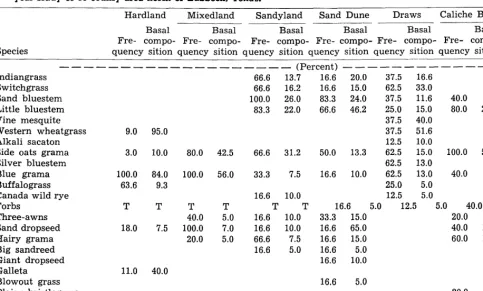
All variations of the climax re- lated to soils or exposure have grasses as dominants, but the composition is simple and usu- ally consists of 2 to 4 species. Compared to the dominants, the subordinant forbs comprise many species although their total basal area is usually less than 5 percent of the total plant cover- age. These forbs are prominent when flowering but are widely scattered, hence do not con- tribute much to the vegetational cover. West of Amarillo, galleta (Hilaria jamesii) comes into the climax community in response to somewhat drier conditions on the western portion of the pla- teau. Mesquite (Prosopis juli- flora) is common along the north portion of the plateau next to the Canadian River, and extends completely across it in the south- ern part. Table 3 gives composi- tion of vegetation occurring in the study area.
Hardland
This plant community occurs on the silty clays and silty clay loam soils on very smooth topog- raphy in the north and eastern portions of the Llano Estacado. These soils are hard when dry and, although a 4-foot profile contains about 11 inches of avail- able water at field capacity, are difficult to wet because of low permeability owing to the high clay content.