(
E
)-1-(4-Aminophenyl)-3-(naphthalen-2-yl)prop-2-en-1-one
Thawanrat Kobkeatthawin,aSuchada Chantrapromma,a*‡ Nisakorn Saewanband Hoong-Kun Func§
aCrystal Materials Research Unit, Department of Chemistry, Faculty of Science,
Prince of Songkla University, Hat-Yai, Songkhla 90112, Thailand,bSchool of
Cosmetic Science, Mae Fah Luang University, Muang, Chiang Rai 57100, Thailand, andcX-ray Crystallography Unit, School of Physics, Universiti Sains Malaysia, 11800
USM, Penang, Malaysia
Correspondence e-mail: [email protected]
Received 29 March 2011; accepted 13 April 2011
Key indicators: single-crystal X-ray study;T= 100 K; mean(C–C) = 0.004 A˚; Rfactor = 0.057;wRfactor = 0.119; data-to-parameter ratio = 9.8.
The molecule of the title chalcone derivative, C19H15NO, exists in atransconfiguration with respect to the C C double bond. The molecule is slightly twisted with a dihedral angle of 6.12 (12)between the benzene ring and the naphthalene ring
system. The prop-2-en-1-one bridge is nearly planar, with an r.m.s. deviation of 0.0194 (2), and makes dihedral angles of 8.05 (19) and 11.47 (18) with the benzene ring and the
naphthalene ring system, respectively. In the crystal, mol-ecules are linked by N—H O hydrogen bonds into chains along thebaxis. Weak N—H and C—H interactions and a short N O contact [2.974 (4) A˚ ] are also observed.
Related literature
For bond-length data, see: Allen et al. (1987). For related structures, see: Fun et al.(2008); Horkaewet al. (2010). For background to and applications of chalcones, see: Bandgar & Gawande (2010); Cheng et al. (2008); Gaber et al. (2008); Nerya et al. (2004); Nowakowska et al. (2008); Patil et al.
(2007); Svetlichnyet al.(2007); Tewtrakulet al.(2003); Xuet al.(2005). For the stability of the temperature controller used in the data collection, see Cosier & Glazer, (1986).
Experimental
Crystal data
C19H15NO
Mr= 273.32
Orthorhombic,P212121
a= 5.7422 (6) A˚ b= 9.8022 (10) A˚ c= 25.504 (3) A˚
V= 1435.5 (3) A˚3
Z= 4
MoKradiation
= 0.08 mm1
T= 100 K
0.320.280.07 mm
Data collection
Bruker APEX DUO CCD area-detector diffractometer Absorption correction: multi-scan
(SADABS; Bruker, 2009) Tmin= 0.976,Tmax= 0.994
8109 measured reflections 1940 independent reflections 1633 reflections withI> 2(I) Rint= 0.042
Refinement
R[F2> 2(F2)] = 0.057
wR(F2) = 0.119
S= 1.14 1940 reflections 198 parameters
H atoms treated by a mixture of independent and constrained refinement
max= 0.29 e A˚
3
min=0.24 e A˚
[image:1.610.313.566.366.458.2]3
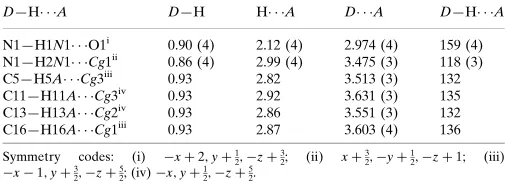
Table 1
Hydrogen-bond geometry (A˚ ,).
Cg1,Cg2 andCg3 are the centroids of the C1–C6, C10–C12/C17–C19 and C12–C17 rings, respectively.
D—H A D—H H A D A D—H A
N1—H1N1 O1i
0.90 (4) 2.12 (4) 2.974 (4) 159 (4) N1—H2N1 Cg1ii
0.86 (4) 2.99 (4) 3.475 (3) 118 (3) C5—H5A Cg3iii 0.93 2.82 3.513 (3) 132 C11—H11A Cg3iv
0.93 2.92 3.631 (3) 135 C13—H13A Cg2iv
0.93 2.86 3.551 (3) 132 C16—H16A Cg1iii 0.93 2.87 3.603 (4) 136
Symmetry codes: (i) xþ2;yþ1 2;zþ
3
2; (ii) xþ 3 2;yþ
1
2;zþ1; (iii)
x1;yþ3
2;zþ52; (iv)x;yþ12;zþ52.
Data collection:APEX2(Bruker, 2009); cell refinement:SAINT
(Bruker, 2009); data reduction:SAINT; program(s) used to solve
structure: SHELXTL (Sheldrick, 2008); program(s) used to refine
structure:SHELXTL; molecular graphics:SHELXTL; software used
to prepare material for publication:SHELXTLandPLATON(Spek,
2009).
The authors thank the Thailand Research Fund (TRF) for the research grant (RSA 5280033) and the Prince of Songkla University for financial support. The authors also thank Universiti Sains Malaysia for the Research University Grant No. 1001/PFIZIK/811160.
Supplementary data and figures for this paper are available from the IUCr electronic archives (Reference: RZ2579).
References
Allen, F. H., Kennard, O., Watson, D. G., Brammer, L., Orpen, A. G. & Taylor, R. (1987).J. Chem. Soc. Perkin Trans. 2, pp. S1–19.
Bandgar, B. P. & Gawande, S. S. (2010).J. Bioorg. Med. Chem.18, 2060–2065. Bruker (2009).APEX2,SAINTandSADABS. Bruker AXS Inc., Madison,
Wisconsin, USA.
Cheng, J. H., Hung, C.-F., Yang, S. C., Wang, J.-P., Won, S.-J. & Lin, S.-J. (2008). J. Bioorg. Med. Chem.16, 7270–7276.
Cosier, J. & Glazer, A. M. (1986).J. Appl. Cryst.19, 105–107.
organic compounds
o1204
Kobkeatthawinet al. doi:10.1107/S1600536811014024 Acta Cryst.(2011). E67, o1204–o1205 Acta Crystallographica Section EStructure Reports Online
ISSN 1600-5368
‡ Thomson Reuters ResearcherID: A-5085-2009.
Fun, H.-K., Patil, P. S., Dharmaprakash, S. M. & Chantrapromma, S. (2008). Acta Cryst.E64, o1540–o1541.
Gaber, M., El-Daly, S. A., Fayed, T. A. & El-Sayed, Y. S. (2008).J. Opt. Laser Techol.40, 528–537.
Horkaew, J., Chantrapromma, S., Saewan, N. & Fun, H.-K. (2010).Acta Cryst. E66, o2346–o2347.
Nerya, O., Musa, R., Khatib, S., Tamir, S. & Vaya, J. (2004).Phytochemistry,65, 1389–1395.
Nowakowska, Z., Kedzia, B. & Schroeder, G. (2008).Eur. J. Med. Chem.43, 707–713.
Patil, P. S., Dharmaprakash, S. M., Ramakrishna, K., Fun, H.-K., Kumar, R. S. S. & Narayana Rao, D. (2007).J. Cryst. Growth.303, 520–524.
Sheldrick, G. M. (2008).Acta Cryst.A64, 112–122. Spek, A. L. (2009).Acta Cryst.D65, 148–155.
Svetlichny, V. Y., Merola, F., Dobretsov, G. E., Gularyan, S. K. & Syrejshchikova, T. I. (2007).J. Chem. Phys. Lipids,145, 13–26.
Tewtrakul, S., Subhadhirasakul, S., Puripattanavong, J. & Panphadung, T. (2003).Songklanakarin J. Sci. Technol.25, 503–508.
supporting information
sup-1
Acta Cryst. (2011). E67, o1204–o1205
supporting information
Acta Cryst. (2011). E67, o1204–o1205 [doi:10.1107/S1600536811014024]
(
E
)-1-(4-Aminophenyl)-3-(naphthalen-2-yl)prop-2-en-1-one
Thawanrat Kobkeatthawin, Suchada Chantrapromma, Nisakorn Saewan and Hoong-Kun Fun
S1. Comment
Chalcones are the precursors of flavonoids and antiflavonoids which are available in plenty in ferns and higher plants.
Their derivatives are known to display a variety of biological properties such as analgesic, anti-inflammatory,
antibacterial and antifungal activities (Bandgar & Gawande, 2010; Cheng et al., 2008; Nowakowska et al., 2008), HIV-1
protease inhibitory (Tewtrakul et al., 2003) and tyrosinase inhibitory (Nerya et al., 2004) activities. Moreover, some of
them have also been studied for fluorescent property (Gaber et al., 2008) and used for sensor, liquid crystal display and
fluorescence probe for sensing of DNA or proteins (Svetlichny et al., 2007; Xu et al., 2005). In addition, some of them
exhibit second harmonic generation (SHG), and hence are used in non-linear optical (NLO) applications (Patil et al.,
2007). These interesting properties of chalcones have lead us to synthesize the title compound, (I), which contains the
amino and fluorophore (naphthalene) groups in order to study its NLO and fluorescent properties. Compound (I)
crystallizes in the chiral orthorhombic P212121 space group and should therefore exhibit second-order nonlinear optical
properties. (I) also shows fluorescent emission at 440 nm when excited at 380 nm. Our results also showed that (I) was
inactive for tyrosinase inhibitory. Herein the crystal structure of (I) is reported.
The molecule of the title chalcone derivative (Fig. 1), C19H15NO, exists in an E configuration with respect to the C8═C9
ethenyl bond [1.330 (4) Å], as indicated by the torsion angle C7–C8–C9–C10 = 179.1 (3)°. The molecule is slightly
twisted with the dihedral angle between the benzene and naphthalene rings of 6.12 (12)°. The prop-2-en-1-one unit (C7—
C9/O1) is nearly planar [r.m.s. of 0.0194 (2) Å] and the torsion angle O1–C7–C8–C9 is 6.4 (5)°. This middle bridge
makes dihedral angles of 8.05 (19) and 11.47 (18) ° with the benzene and naphthalene rings, respectively. The bond
distances are of normal values (Allen et al., 1987) and are comparable with those found in related structures (Fun et al.,
2008; Horkaew et al., 2010).
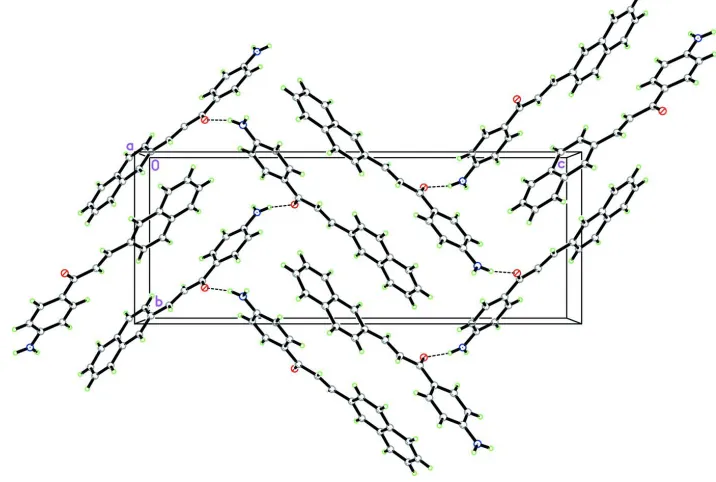
In the crystal packing, the molecules are linked by N—H···O hydrogen bonds (Table 1) into chains along the b axis (Fig.
2). N—H···π and C—H···π weak interactions (Table 1) are present in the crystal. In addition, a N···O short contact
[2.974 (4) Å; symmetry code 2 - x, 1/2 + y, 3/2 - z] is also observed.
S2. Experimental
The title compound was synthesized by condensation of 4-aminoacetophenone (0.40 g, 3 mmol) with 2-naphthaldehyde
(0.46 g, 3 mmol) in ethanol (25 ml) in the presence of 20% NaOH(aq) (5 ml). After stirring for 6 h at room temperature,
the resulting yellow solid was collected by filtration, washed with distilled diethylether, dried and purified by repeated
recrysallization from acetone. Yellow plate-shaped single crystals of the title compound suitable for X-ray structure
determination were recrystalized from acetone by slow evaporation of the solvent at room temperature after several days.
S3. Refinement
Anime H atoms were located in a difference Fourier map and refined isotropically. The remaining H atoms were
positioned geometrically and allowed to ride on their parent atoms, with d(C—H) = 0.93 Å and Uiso = 1.2Ueq(C). The
highest residual electron density peak is located at 0.73 Å from C11 and the deepest hole is located at 1.23 Å from C5. A
total of 1345 Friedel pairs were merged as there is no significant anomalous dispersion to determine the absolute
[image:4.610.122.481.170.306.2]cofiguration.
Figure 1
The molecular structure of the title compound, showing 50% probability displacement ellipsoids.
Figure 2
The crystal packing of the title compound viewed along the a axis, showing chains running along the [010] direction.
(E)-1-(4-Aminophenyl)-3-(naphthalen-2-yl)prop-2-en-1-one
Crystal data
C19H15NO
Mr = 273.32
Orthorhombic, P212121
Hall symbol: P 2ac 2ab
a = 5.7422 (6) Å
[image:4.610.123.481.345.586.2]supporting information
sup-3
Acta Cryst. (2011). E67, o1204–o1205
c = 25.504 (3) Å
V = 1435.5 (3) Å3
Z = 4
F(000) = 576
Dx = 1.265 Mg m−3 Melting point = 416–417 K Mo Kα radiation, λ = 0.71073 Å
Cell parameters from 1940 reflections
θ = 2.2–27.5°
µ = 0.08 mm−1
T = 100 K Plate, yellow
0.32 × 0.28 × 0.07 mm
Data collection
Bruker APEX DUO CCD area-detector diffractometer
Radiation source: sealed tube Graphite monochromator
φ and ω scans
Absorption correction: multi-scan
(SADABS; Bruker, 2009)
Tmin = 0.976, Tmax = 0.994
8109 measured reflections 1940 independent reflections 1633 reflections with I > 2σ(I)
Rint = 0.042
θmax = 27.5°, θmin = 2.2°
h = −6→7
k = −9→12
l = −32→33
Refinement
Refinement on F2 Least-squares matrix: full
R[F2 > 2σ(F2)] = 0.057
wR(F2) = 0.119
S = 1.14 1940 reflections 198 parameters 0 restraints
Primary atom site location: structure-invariant direct methods
Secondary atom site location: difference Fourier map
Hydrogen site location: inferred from neighbouring sites
H atoms treated by a mixture of independent and constrained refinement
w = 1/[σ2(F
o2) + (0.0233P)2 + 1.3561P] where P = (Fo2 + 2Fc2)/3
(Δ/σ)max = 0.001 Δρmax = 0.29 e Å−3 Δρmin = −0.24 e Å−3
Special details
Experimental. The crystal was placed in the cold stream of an Oxford Cryosystems Cobra open-flow nitrogen cryostat (Cosier & Glazer, 1986) operating at 100.0 (1) K.
Geometry. All e.s.d.'s (except the e.s.d. in the dihedral angle between two l.s. planes) are estimated using the full covariance matrix. The cell e.s.d.'s are taken into account individually in the estimation of e.s.d.'s in distances, angles and torsion angles; correlations between e.s.d.'s in cell parameters are only used when they are defined by crystal symmetry. An approximate (isotropic) treatment of cell e.s.d.'s is used for estimating e.s.d.'s involving l.s. planes.
Refinement. Refinement of F2 against ALL reflections. The weighted R-factor wR and goodness of fit S are based on F2, conventional R-factors R are based on F, with F set to zero for negative F2. The threshold expression of F2 > σ(F2) is used only for calculating R-factors(gt) etc. and is not relevant to the choice of reflections for refinement. R-factors based on F2 are statistically about twice as large as those based on F, and R- factors based on ALL data will be even larger.
Fractional atomic coordinates and isotropic or equivalent isotropic displacement parameters (Å2)
x y z Uiso*/Ueq
O1 1.1598 (4) 0.7032 (2) 0.85128 (9) 0.0266 (5)
N1 0.5373 (7) 1.1585 (3) 0.74175 (13) 0.0339 (8)
H2N1 0.409 (8) 1.195 (4) 0.7515 (15) 0.045 (13)*
H1N1 0.599 (7) 1.187 (4) 0.7112 (14) 0.033 (11)*
C1 0.8419 (6) 0.8481 (3) 0.83133 (11) 0.0201 (7) C2 0.9516 (6) 0.9000 (3) 0.78648 (12) 0.0224 (7)
C3 0.8535 (6) 1.0026 (3) 0.75714 (12) 0.0230 (7)
H3A 0.9314 1.0356 0.7278 0.028*
C4 0.6354 (6) 1.0583 (3) 0.77112 (12) 0.0233 (7) C5 0.5252 (6) 1.0072 (3) 0.81610 (12) 0.0232 (7)
H5A 0.3827 1.0434 0.8264 0.028*
C6 0.6244 (6) 0.9045 (3) 0.84519 (12) 0.0219 (7)
H6A 0.5466 0.8715 0.8746 0.026*
C7 0.9597 (6) 0.7405 (3) 0.86224 (13) 0.0222 (7) C8 0.8373 (6) 0.6782 (3) 0.90735 (12) 0.0221 (7)
H8A 0.6818 0.7000 0.9133 0.027*
C9 0.9441 (6) 0.5920 (3) 0.93962 (11) 0.0198 (7)
H9A 1.0988 0.5718 0.9321 0.024*
C10 0.8433 (6) 0.5257 (3) 0.98562 (12) 0.0187 (7) C11 0.9577 (6) 0.4164 (3) 1.00866 (11) 0.0204 (7)
H11A 1.1021 0.3900 0.9956 0.025*
C12 0.8612 (6) 0.3438 (3) 1.05134 (12) 0.0199 (7) C13 0.9733 (6) 0.2294 (3) 1.07446 (12) 0.0234 (7)
H13A 1.1171 0.2010 1.0617 0.028*
C14 0.8731 (7) 0.1609 (3) 1.11511 (13) 0.0275 (8)
H14A 0.9490 0.0864 1.1299 0.033*
C15 0.6544 (7) 0.2022 (3) 1.13492 (13) 0.0276 (8)
H15A 0.5864 0.1540 1.1624 0.033*
C16 0.5423 (7) 0.3123 (3) 1.11405 (12) 0.0263 (7)
H16A 0.3998 0.3395 1.1279 0.032*
C17 0.6402 (6) 0.3855 (3) 1.07164 (11) 0.0196 (7) C18 0.5282 (6) 0.4987 (3) 1.04803 (12) 0.0220 (7)
H18A 0.3853 0.5277 1.0611 0.026*
C19 0.6240 (6) 0.5658 (3) 1.00685 (12) 0.0211 (7)
H19A 0.5453 0.6395 0.9922 0.025*
Atomic displacement parameters (Å2)
U11 U22 U33 U12 U13 U23
supporting information
sup-5
Acta Cryst. (2011). E67, o1204–o1205
C14 0.035 (2) 0.0181 (15) 0.0297 (17) 0.0039 (16) −0.0075 (17) −0.0003 (14) C15 0.035 (2) 0.0226 (16) 0.0255 (16) −0.0092 (17) 0.0008 (17) 0.0016 (13) C16 0.0245 (18) 0.0296 (17) 0.0249 (16) −0.0078 (17) 0.0015 (15) −0.0075 (14) C17 0.0198 (16) 0.0196 (14) 0.0196 (14) −0.0024 (14) 0.0009 (14) −0.0085 (12) C18 0.0188 (16) 0.0220 (15) 0.0251 (15) 0.0022 (15) 0.0027 (14) −0.0069 (13) C19 0.0221 (17) 0.0152 (14) 0.0261 (15) 0.0084 (15) −0.0014 (14) −0.0020 (13)
Geometric parameters (Å, º)
O1—C7 1.238 (4) C9—H9A 0.9300
N1—C4 1.358 (4) C10—C11 1.388 (4)
N1—H2N1 0.86 (4) C10—C19 1.426 (5)
N1—H1N1 0.90 (4) C11—C12 1.413 (4)
C1—C2 1.402 (4) C11—H11A 0.9300
C1—C6 1.411 (5) C12—C13 1.421 (4)
C1—C7 1.480 (4) C12—C17 1.430 (5)
C2—C3 1.374 (4) C13—C14 1.363 (5)
C2—H2A 0.9300 C13—H13A 0.9300
C3—C4 1.412 (5) C14—C15 1.413 (5)
C3—H3A 0.9300 C14—H14A 0.9300
C4—C5 1.403 (4) C15—C16 1.364 (5)
C5—C6 1.374 (4) C15—H15A 0.9300
C5—H5A 0.9300 C16—C17 1.415 (4)
C6—H6A 0.9300 C16—H16A 0.9300
C7—C8 1.480 (4) C17—C18 1.417 (4)
C8—C9 1.330 (4) C18—C19 1.356 (4)
C8—H8A 0.9300 C18—H18A 0.9300
C9—C10 1.461 (4) C19—H19A 0.9300
C4—N1—H2N1 120 (3) C11—C10—C19 118.1 (3)
C4—N1—H1N1 123 (2) C11—C10—C9 119.7 (3)
H2N1—N1—H1N1 117 (4) C19—C10—C9 122.1 (3)
C2—C1—C6 117.4 (3) C10—C11—C12 121.9 (3)
C2—C1—C7 119.2 (3) C10—C11—H11A 119.0
C6—C1—C7 123.4 (3) C12—C11—H11A 119.0
C3—C2—C1 121.7 (3) C11—C12—C13 122.6 (3)
C3—C2—H2A 119.1 C11—C12—C17 118.9 (3)
C1—C2—H2A 119.1 C13—C12—C17 118.5 (3)
C2—C3—C4 120.6 (3) C14—C13—C12 120.9 (3)
C2—C3—H3A 119.7 C14—C13—H13A 119.6
C4—C3—H3A 119.7 C12—C13—H13A 119.6
N1—C4—C5 121.5 (3) C13—C14—C15 120.4 (3)
N1—C4—C3 120.6 (3) C13—C14—H14A 119.8
C5—C4—C3 117.9 (3) C15—C14—H14A 119.8
C6—C5—C4 121.1 (3) C16—C15—C14 120.4 (3)
C6—C5—H5A 119.4 C16—C15—H15A 119.8
C4—C5—H5A 119.4 C14—C15—H15A 119.8
C5—C6—H6A 119.4 C15—C16—H16A 119.6
C1—C6—H6A 119.4 C17—C16—H16A 119.6
O1—C7—C8 119.6 (3) C16—C17—C18 122.8 (3)
O1—C7—C1 121.0 (3) C16—C17—C12 118.9 (3)
C8—C7—C1 119.4 (3) C18—C17—C12 118.2 (3)
C9—C8—C7 121.6 (3) C19—C18—C17 121.7 (3)
C9—C8—H8A 119.2 C19—C18—H18A 119.2
C7—C8—H8A 119.2 C17—C18—H18A 119.2
C8—C9—C10 126.7 (3) C18—C19—C10 121.2 (3)
C8—C9—H9A 116.7 C18—C19—H19A 119.4
C10—C9—H9A 116.7 C10—C19—H19A 119.4
C6—C1—C2—C3 0.5 (4) C9—C10—C11—C12 −176.3 (3)
C7—C1—C2—C3 −178.1 (3) C10—C11—C12—C13 178.3 (3)
C1—C2—C3—C4 −0.7 (5) C10—C11—C12—C17 −0.7 (4)
C2—C3—C4—N1 −179.2 (3) C11—C12—C13—C14 −179.0 (3)
C2—C3—C4—C5 1.0 (5) C17—C12—C13—C14 0.0 (4)
N1—C4—C5—C6 179.1 (3) C12—C13—C14—C15 0.2 (5)
C3—C4—C5—C6 −1.0 (5) C13—C14—C15—C16 −0.8 (5)
C4—C5—C6—C1 0.9 (5) C14—C15—C16—C17 1.2 (5)
C2—C1—C6—C5 −0.6 (4) C15—C16—C17—C18 178.7 (3)
C7—C1—C6—C5 178.0 (3) C15—C16—C17—C12 −1.0 (5)
C2—C1—C7—O1 5.3 (4) C11—C12—C17—C16 179.4 (3)
C6—C1—C7—O1 −173.3 (3) C13—C12—C17—C16 0.4 (4)
C2—C1—C7—C8 −175.6 (3) C11—C12—C17—C18 −0.3 (4)
C6—C1—C7—C8 5.8 (4) C13—C12—C17—C18 −179.3 (3)
O1—C7—C8—C9 6.4 (5) C16—C17—C18—C19 −178.9 (3)
C1—C7—C8—C9 −172.7 (3) C12—C17—C18—C19 0.8 (4)
C7—C8—C9—C10 179.1 (3) C17—C18—C19—C10 −0.3 (5)
C8—C9—C10—C11 165.8 (3) C11—C10—C19—C18 −0.6 (4)
C8—C9—C10—C19 −11.5 (5) C9—C10—C19—C18 176.8 (3)
C19—C10—C11—C12 1.1 (4)
Hydrogen-bond geometry (Å, º)
Cg1, Cg2 and Cg3 are the centroids of the C1–C6, C10–C12/C17–C19 and C12–C17 rings, respectively.
D—H···A D—H H···A D···A D—H···A
N1—H1N1···O1i 0.90 (4) 2.12 (4) 2.974 (4) 159 (4)
N1—H2N1···Cg1ii 0.86 (4) 2.99 (4) 3.475 (3) 118 (3)
C5—H5A···Cg3iii 0.93 2.82 3.513 (3) 132
C11—H11A···Cg3iv 0.93 2.92 3.631 (3) 135
C13—H13A···Cg2iv 0.93 2.86 3.551 (3) 132
C16—H16A···Cg1iii 0.93 2.87 3.603 (4) 136