Errors
Abstract
The notion of decryption rights delegation was initially introduced by Blaze et al. in EUROCRYPT 1998. It, defined asproxy re-encryption, allows a semi-trusted proxy to convert a ciphertext intended for a party to another ciphertext of the same plaintext, without knowledge of the underlying plaintext and decryption key. It has been explored to many real-world applications, e.g., encrypted email forwarding. However, the intrinsic all-or-nothing share feature of proxy re-encryption yields a limitation that the share cannot be revoked. This may hinder the scalability of its applications in practice. In this paper, for the first time, we define the concept of revocability in terms of decryption rights delegation. The novel concept enables data owner to revoke the shared decryption rights when needed. Inspired by the seminal lattice-based proxy re-encryption proposed in PKC 2014, we design a concrete lattice-based construction which satisfies the notion. In our construction, we make use of binary-tree structure to implement the revocation of decryption rights, so that the update of re-encryption key is reduced toO(logN) (instead ofO(N)), whereN is the maximum number of delegatee. Furthermore, the security of our scheme is based on the standard learning with errors problem, which could be reduced to the worst-case hard problems (such as GapSVP and SIVP) in the context of lattices. The scheme is chosen ciphertext secure in the standard model. As of independent interest, our scheme achieves both backward and forward security, which means that once a user is revoked after a time periodt, it cannot gain access to all encrypted files before and aftert.
Keywords: Revocability, proxy re-encryption, lattice, learning with errors.
1
Introduction
The concept of proxy re-encryption (PRE) was first introduced by Blaze, Bleumer and Strauss[7] in EUROCRYPT 1998 to enable an intermediate proxy to convert a ciphertext of Alice to that of Bob without compromising the information of the underlying plaintext. Alice here is known as the delegator while Bob is the delegatee. The semi-trusted proxy can fulfil the conversion with help of a re-encryption key given by the delegator. PRE has been employed into many real-world applications, e.g., encrypted email forwarding, and domain interoperability manager (DIM) module in digital rights management (DRM) systems.
As for the first example, while Alice is on vacation, the email proxy may convert Alice’s incoming encrypted emails to those which can be decrypted by secretary Bob via the re-encryption key given by Alice, so that Bob can handle the emails on behalf of Alice. The PRE mechanism provides scalable and convenient features over data sharing: (i) Alice does not need always to be online; (ii) Alice does get rid of download-decrypt-and-re-encrypt mode to relieve computation and communication complexity in data sharing; (iii) Alice does not have to share her secret/decryption key with Bob for encrypted data sharing.
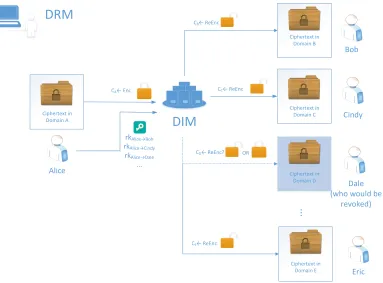
PRE can also be employed to DRM systems. Digital content providers may leverage DRM mechanism to protect the ownership and access rights of digital content from being infringed by malicious Internet users. A DRM system is able to bind digital content with ownership license, meanwhile, only an authenticated user can access the content. DRM, nevertheless, suffers from a domain limitation that a digital content in the domainAcan only be accessed by the devices within that domain. That makes DRM non-scalable in practical use. DIM intermediate module, one of the typical applications of PRE technology, may come to help solve the domain problem. Specifically, the module can be used to convert a ciphertext (license) of the domainA to the ciphertext (license) belonging to another domain, sayB. Furthermore, the module cannot extract the underlying plaintext from the ciphertexts (licenses), so that the confidentiality of data but also effective cross-domain conversion are guaranteed (please refer to Figure 1). But the DIM fails to support the revocability of decryption rights delegation.
Traditional PRE, being as a type of all-or-nothing decryption rights delegation, cannot allow a delegator to revoke its shared decryption rights from delegatee (after a re-encryption key is issued to the proxy). In the above encrypted
Ciphertext in Domain A
Ciphertext in Domain B
DIM
Ciphertext in Domain C
Ciphertext in Domain D
Ciphertext in Domain E
...
DRM
Alice
Bob
Cindy
Dale (who would be
revoked)
Eric
rkAliceїBob rkAliceїCindy rkAliceїDale
...
OR CAі Enc
CBі ReEnc
CCі ReEnc
CEіReEnc
CDі ReEnc?
Figure 1. Effective DIM Interface in DRM
email forwarding setting, Bob can keep gaining access to all encrypted emails intended for Alice (even if Alice is back to work). This may not scale well in practice because one may prefer to only share decryption rights with others within some fixed time slots, for example, after returning to work, Alice may choose to handle the emails on her own without any interference of Bob. To the best of our knowledge, there is no PRE scheme (in the context of public key encryption) dealing with the issue of revocability.
One may think that revoking the delegation of decryption rights is trivial in the sense that a delegator may just request a proxy to delete the corresponding re-encryption key (so that the re-encryption may be terminated). This naive solution, we state, may work in the context where the sharing is not time-related/updated. In practice, it may be difficult to isolate data sharing from time period. In payTV application (e.g. Netflix), an encrypted movie may be watched by subscribers based on payment status. A re-encryption key here may relate with a time period, say a month, so that subscribers can decrypt and watch the movie in the month they’ve paid the subscription fee. Simply deleting re-encryption key to revoke a subscriber’s rights may not scale well, for instance, the subscriber may join back in the next month. Another concern here for the revocation is that if the revoked subscriber is still able to gain access to the movies which are encrypted before the revocation point. In addition to maintain the confidentiality of data, the efficiency of revocation must be taken into account. How to guarantee data confidentiality in the revocation of time-related decryption rights delegation without linear complexity that motivates our work.
In recent years, lattice-based cryptography has attracted numerous attention from cryptographic researchers. The lattice as an alternative underlying primitive is more and more applicable to cryptographic schemes. Compared to the traditional cryptography based on number theory hard problems (e.g., integer factorization and discrete logarithm), the promising features of lattice-based cryptography are as follows: (i) it is conjectured to be secure against quantum computer attacks; (ii) it is with algorithmic simplicity and high parallelism; (iii) it has an average-case/worst-case reduction for commonly used hard assumptions. This paper also seeks a way to construct PRE with revocability in the lattice-based setting to present secure system which can hold against the attacks of quantum computers.
1.1
Our Contributions
and furthermore, it is allowed to update re-encryption key and revoke system users. However, it is restricted that the adversary cannot decrypt the ciphertexts which are encrypted before/after the time period of the revocation.
2. At a first glance, a trivial revocation system (as mentioned in the previous section) may incur that the revocation complexity is linear in the number of users. Our scheme relieves the workload of delegator from linear to logarithmic complexity by using binary tree structure to organize re-encryption keys. We also provide a non-interactive re-encryption key update technique which is used to shorten the time of key update (w.r.t. user revocation).
3. The forward security is considered in our construction. To achieve the goal, we need to update the ciphertext of delegator that is stored in server whilst the corresponding delegatee is revoked, say at time periodt. After confirming to revoke the decryption rights of Bob att, Alice will update the re-encryption key from herself to Bob so that a proxy cannot convert the ciphertext of Alice to Bob by using the updated re-encryption key. But the proxy can still use the re-encryption keys that are generated att′<tto convert the ciphertexts undert′ to Bob. The decryption capability of Bob is not revoked in terms of the ciphertexts generated beforet. To tackle this problem (to guarantee forward security), after the update of re-encryption key, we make an update for the ciphertext of Alice as well by executing algorithmUpCipher(afterReKeyRev) to update the ciphertexts of Alice undert′<t.
4. A concrete lattice-based revocable PRE construction is presented in this paper. The CCA security of our construction is proved based on the hardness of the learning with errors (LWE) in the standard model, which is as hard as several worst-case lattice problems, such as GapSVP for some factors ˜O(n/α) or SIVPγ for some
polynomial factorγ=poly(n).
The main technical roadmap of our construction is to design an interface to combine the technique of revoca-ble IBE [11] with PRE technique[18] to achieve efficient, non-interactive and collusion-free PRE with revocability. Specifically, we embed time information into public key of user and split the public key into three parts and further, merge re-encryption key into a binary tree structure. The time information is compatible with [18] in terms of re-encryption key generation, we therefore inject randomness to guarantee that the time term on both sides of the equation will not be eliminated, which is immune to a means of attack in [14] (note more details are given in Section 5). Furthermore, we prove that our scheme can hold against chosen ciphertext attacks (CCA). The tricky part of security proof is on how to answer re-encryption key queries issued by adversary. In the real system, denoted byAR
andAL the matrices should satisfy [A′0|A′1+H′G] =AR+AL, whereAR andAL are generated randomly. The
method we adopt is to use an invertible unimodular matrixUto constitute the public key of user in the simulation. Let [A′0|−A′0R′1] = [UAR1+ (I−U)AL1|UAR2+ (I−U)AL2], we chooseX00,X′00,X10andX′10from a Gaussian
distribution with parameters, so that
(
X′00
X′10 )
+
(
X00
X10 )
=
(
X00
X10 )
, (
X′00
X′10 )
R′1+
(
X00
X10 )
R′1=
(
X01
X11 )
, (
X′00
X′10 )
R′2=
(
X02
X12 )
,
and further the re-encryption key from userpk∗ to pk′ is constructed as
rkpk∗−→pk′ =
X00+X
′
00 X01+X′01 X′02
X10+X′10 X11+X′11 X′12
0 0 I
.
1.2
Related Work
Table 1: Comparison with related PRE schemes
PRE Based on Revocability security standard model
XT10 [17] LWE × CPA √
ABPW13 [4] LWE × CPA √
Kir14 [18] LWE × ?* √
NAL15 [25] NTRU × CPA √
Fan16 [14] LWE × CCA √
Ours LWE √ CCA √
*[14] points out that [18] is not secure.
under the LWE assumption. Seo et al. [27] design a concrete construction based on pairings, in which the construction is able to hold against the attacks, called decryption key exposure attack. Lee et al. [19] propose an adaptive-identity security revocable IBE (RIBE) scheme with pairings by using the subset difference method. Ling et al. [21] deliver the first construction of lattice-based revocable predicate encryption, satisfying the notion of full-hiding security in the standard model.
Since its introduction, PRE has been well studied for the past decades. Ateniese and Fu et al. [6] design a first unidirectional PRE scheme, which is used as a mechanism of access control over encrypted file system. Their scheme is based on bilinear pairings and achieves the security of chosen plaintext attack (CPA) in the standard model. Green and Ateniese [16] introduce the notion of identity-based PRE (IB-PRE) and propose a concrete construction satisfying the notion. The construction is unidirectional, multi-hop, and proved to be CPA secure in random oracle model. Canetti and Hohenberger et al. [10] present the first CCA secure bidirectional PRE with high efficiency in re-encryption. The security is based on the decisional bilinear Diffie-Hellman (DBDH) assumption in the standard model. In order to achieve CCA security, they leverage one-time signature to guarantee integrity of ciphertext. A new notion, called key privacy, is introduced in [5] in the sense that a proxy cannot obtain the identities of delegator and delegatee from a given re-encryption key (i.e. achieving anonymity). Their construction is with CPA security in the standard model. A few replayable CCA (RCCA) secure unidirectional PRE schemes in the standard model have been proposed by Libert and Vergnaud et al. [20]. Aono et al. [4] introduce the first lattice-based PRE based on the LWE problem, which is CPA secure in the standard model. Kirshanova et al. [18] present a CCA1 secure PRE on top of [23].
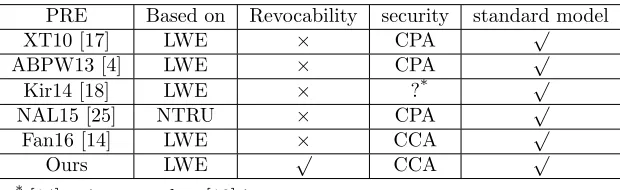
The aforementioned schemes, however, cannot provide the revocability of decryption rights delegation. We compare our scheme with other related PRE schemes in Table 1 in terms of functionality and security. We state that our scheme is the first of its type achieving revocability and CCA security with LWE in the standard model.
1.3
Paper Outline
The rest of the paper is organized as follows. In section 2, some basic definitions, hard problems, and some conclusions in lattices are given. In section 3, we present the definition of revocable PRE (RPRE) and further formalize the security model. In section 4, we give a concrete RPRE scheme and prove its security in the standard model. In section 5, we conclude our work.
2
Preliminaries
2.1
Notation
Throughout the paper we say that a function in n is negligible, denoted by negl(n), if it vanishes faster than the inverse of any polynomial in n. We say that a probabilityp(n) is overwhelming if 1−p(n) is negligible. The statistical distance between two distributionX and Y(or two random variables having those distributions), viewed as functions over a countable domainD, is defined as ∆(X;Y) = 12∑s∈D|P r[X =s]−P r[Y =s]|. We say thatX andY are statistically close ifd(λ) = ∆(X(λ);Y(λ)) is a negligible function ofλ, whereX(λ) andY(λ) be ensembles of random variables.
We denote column vectors by lower-case bold letters(e.g.,x) and matrices by upper-case bold letters(e.g.,X). We identity a matrixXwith the ordered set{xj} of its column vectors, and letX||X′ denote the concatenation of the
2.2
Lattice Definiton
Definition 1 (Integer Lattice [15, 22]). Let B = [b1|. . .|bm] ∈ Rm×m be an m×m matrix whose columns are
linearly independent vectorsb1, . . . ,bm∈Rm. The m-dimensional full-rank lattice Λgenerated by B is the set,
Λ =L(B) ={y∈Rm s.t. ∃s∈Zm,y=Bs=
m ∑
i=1
sibi}
Here, we are interested in integer lattices, i.e., whenLis contained inZm. We letdet(Λ)denote the determinant of
Λ. The dual lattice of Λ, denotedΛ∗, is defined to beΛ∗={x∈Rn:∀v∈Λ,⟨x,v⟩ ∈Z}.
Definition 2(q-ary lattice). For prime q, A∈Zn×m
q andu∈Znq, define:
Λq(A) :={e∈Zm s.t. ∃s∈Znq whereA⊤s=emodq}
Λ⊥q(A) :={e∈Zm s.t. Ae=0modq}
Λuq(A) :={e∈Zm s.t. Ae=umodq}
We can observe that ift∈Λu
q(A)thenΛuq(A) = Λ⊥q(A) +tand henceΛuq(A) is a shift ofΛ⊥q(A).
2.3
The Gram-Schmidt Norm
Definition 3 (Gram-Schmidt norm). Let S be a set of vectors S = {s1, . . . ,sk} in Rm. We use the following
standard notations:
- ∥S∥denotes theL2 length of the longest inS, i.e., max1≤i≤k∥si∥.
- S˜ :={˜s1, . . . ,˜sk} ⊂Rmdenotes the Gram-Schmidt orthogonalization of the vectorss1, . . . ,sk taken in that order.
We refer to∥S˜∥ as the Gram-Schmidt norm ofS.
Lemma 1 ([13], Lemma 7.1). There is a deterministic poly-time algorithm T oBasis(S,B) that, given a full rank setS of lattice vectors in Λ =L(B), outputs a basis T of Λsuch that ∥t˜i∥ ≤ ∥s˜i∥ for all i.
In 1996, Ajtai [3] showed how to sample an essentially uniform matrix A∈Znq×m with an associated basis SA
of Λ⊥q(A) with low Gram-Schmidt norm. Here we use an improved algorithm from [1]. The following Theorems 3.2
are derived from [1] takingσ:= 1 3.
Theorem 1. Let q⩾3be odd andm:=⌈6nlogq⌉. There is a probabilistic polynomial-time algorithmTrapGen(q,n) that outputs a pair (A∈Zn×m
q ,S∈Zn×m) such that Ais statistically close to a uniform matrix in Znq×mandS is
a basis for Λ⊥q(A)satisfying
∥Se∥⩽O(√nlogq) and ∥S∥⩽O(nlogq)
with all but negligible probability inn.
2.4
The LWE Problems
In this paper, the security of our construction is reduced to thelearning with errorsproblem, which may be seen as average case problem related to the family of lattices described above.
Definition 4 (Learning with Errors [26]). For a prime q, a positive integer n, and a distribution χ over Zq, the LW Eq,χ problem is to distinguish, given oracle access to any desiredm=poly(n)samples, between the distribution As,χ (for uniformly random and secret s∈Znq)and the uniform distribution overZnq ×Zq.
We give an outline of Gaussian distributions over lattice. For anys >0 and dimensionm≥1, the Gaussian func-tionρs:Rm→(0,1] is defined asρs(x) = exp(−π∥x∥2/s2). For any coset Λ⊥y(A), and probability zero elsewhere.
We summarize several facts from the literature about discrete Gaussian over lattices, again specialized to our family of interest.
Lemma 2 ([24], Lemma 4.4). For any n-dimensional lattice Λ, vector c∈Rn, and reals0 < ϵ <1, s⩾ηϵ(Λ)(the
smoothing parameterηϵ(Λ)is the smallest reals >0 such thatρ1/s(Λ∗\{0})⩽ϵ), we have
Pr
x∼DΛ,s,c
{∥x−c∥> s√n}⩽ 1 +ϵ
1−ϵ·2
Lemma 3 ([15]). There are two PPT algorithmsSampeGaussia(A,TA, σ,c)and a PPT algorithm SampeP re(A,
TA, σ, u), the former returns x ∈ Λ⊥q(A) drawn from a distribution statistically close to DΛ,s,c, and the latter
returnsx∈Λu
q(A)sampled from a distribution statistically close to DΛu
q(A),σ, wheneverΛ u
q(A)is not empty, where
TA be a basis forΛ⊥q (A)andσ⩾∥TgA∥ω(
√
logm), for c∈Rm andu∈Zn q.
2.5
Encoding Vectors as Matrices
Our construction needs a functionHf :Znq −→Z n×n
q which is able to map vectors (inZ n
q) to matrices (inZ n×n
q ),
and the security proof of our scheme requires the function satisfyingstrong injectivity, i.e., for two distinct vectors
u,v,det(Hf(u)−Hf(v))̸= 0.
Definition 5. Let a prime qand a positive integer n. We say that a functionHf :Znq ←−Znq×n is an encoding with
full rank differences (FRD) if:
1. For all distinctu,v∈Znq, the matrix Hf(u)−Hf(v)∈Znq×n is full rank.
2. Hf is computable in polynomial time.
We use an injective FRD encoding function in [2], and a short instruction is as follows. We have the finite fieldZq,
a polynomialg∈F[X] of degree less than n, and let coeffs(g)∈Fn be defined n-vector which element is coefficients ofg. Letf be some polynomial of degree n in F[X] that is irreducible. For input u= (u0, u1, . . . , un−1) define the polynomialg(x) =∑ni=0−1uixi.
DefineHf(u) as
Hf(u) :=
coeffs(g) coeffs(x·gmodf) coeffs(x2·gmodf)
.. .
coeffs(xn−1·gmodf)
∈F
n×n (1)
Theorem 2([12]). Let F be a field and f a polynomial inF[X]. If f is irreducible inF(X)then the functionHf(u)
defined in (1) is an encoding with full rank differences.
2.6
The Binary-tree Data Structure
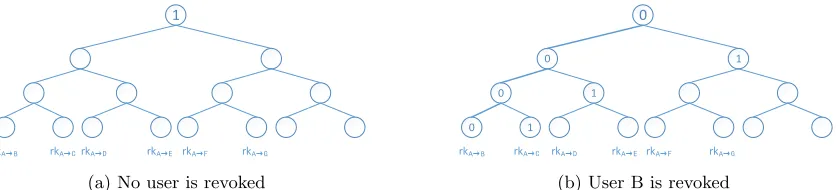
In order to reduce the number of re-encryption key update (on the side of delegator), we use a binary tree [8] and further assign re-encryption key to leaf node of the tree. Each user has keys computed on of all nodes on the path from the leaf node corresponding to that user to the root node for the decryption of ciphertext encrypted under the time periodt. When no user is revoked, the delegator just needs to submit the key update computed on the node of binary tree to the proxy. When a certain number of users are revoked, delegator first locates the minimal set of nodes in the tree which contains a common ancestor among all the leaf nodes for non-revoked users.
We use the following notations. BTdenotes the binary tree. Ifrootdenotes root node andν denotes a leaf node, the Path(ν) denotes the set of node on the path from ν to the root(including ν and the root). If θ is a non-leaf node, θl and θr denote the left and right child of θ. We assume that the mark of each re-encryption key, such as
rkA−→B, rkA−→C, rkA−→D, . . ., is assigned to each leaf node ν. Upon system registration, the delegator provides the
proxy with a set of distinct re-encryption keys for each node inPath(ν).
We here present anKUNodesalgorithm which takes as input a binary treeBT, a timet, and a revocation listRL. The delegator is able to determine a minimal setYwhich includes none ancestor of node inRLwith corresponding time on or before t (revoked re-encryption key), and all other leaf nodes (non-revoked re-encryption key) have exactly one ancestor in the setY. In other words, the algorithmKUNodesfinds a minimal set containing ancestors of non-revoked re-encryption key. Its output is all non-revoked children of the revoked nodes. The delegator further publishes a re-encryption key update for all nodes inY.
1
rkAĮB rkAĮCrkAĮD rkAĮE rkAĮF rkAĮG
(a) No user is revoked
0
0 1
0 1
1 0
rkAĮB rkAĮC rkAĮD rkAĮE rkAĮF rkAĮG
(b) User B is revoked
Figure 1: Examples of binary tree revocation structure
Algorithm 1KUNodes
Require: BT,RL,t
1: X,Y←− ∅
2: for(νi,ti)∈RLdo
3: if ti⩽t thenaddPath(νi) toXend if
4: end for
5: forθ∈X do
6: if θl∈/ X thenaddθl toYend if
7: if θr∈/ Xthenaddθr toYend if
8: end for
9: if Y=∅thenaddroottoYend if
10: return Y
3
Syntax of RPRE
We start with defining the general syntax of a revocable proxy re-encryption scheme.
3.1
System Definition
Definition 6 (Revocable Proxy Re-encryption). A proxy re-encryption with revocability includes nine probabilistic polynomial time (PPT) algorithms, namelySetup,KeyGen,Encrypt,Decrypt,ReKeyGen,UpKey,ReEnc,
ReKeyRev, andUpCipwith associated message spaceM, time spaceT. We assume that the size ofT is
polyno-mial in the security parameter 1n. Each algorithm is run by either one of parties, proxy, delegator, and delegatee. The proxy maintains a revocation list RL and state ST. In what follows, an algorithm is called stateful if it updates RL or ST. Here we regard time space as discrete rather than continuous.
– (param, RL, ST)←Setup (1n): Intake a security parameter n, the setup algorithm outputs a global public
parameterparam, a revocation list RL(initially empty), and a state ST, wheren∈N.
– (pk, sk) ← KeyGen (param): Intake param, the key generation algorithm outputs a public key pk and a secret key sk. We letparaminclude into the following algorithms as an implicit input.
– C ← Encrypt(pk, M,t): Intake a public key pk, a message M ∈ M, and a time t ∈ T, the encryption
algorithm outputs a ciphertext C∈ C.
– rkpk→pk′|t←ReKeyGen(pk, sk, pk′,t, RL, ST): Intake two public keyspk, pk′, a private keysk, a timet∈ T,
the revocation list RL, and the state ST, the re-encryption key generation algorithm outputs a re-encryption keyrkpk→pk′|t or a special symbol⊥indicating thatpk′ has been revoked.
– upkeyt→t′ ←UpKey(pk, sk,t,t′, ST): Intake a public key pk, a private keysk, two time periodst<t′ ∈ T
and the state ST, the update key generation algorithm outputs a update keyupkeyt→t′.
– Ct′ ←UpCip(pk, C, upkeyt→t′, ST): Intake the public key pk, the state ST, a cipherextC of pk at time t and a update keyupkeyt→t′, the update ciphertext algorithm outputs the updated ciphertext ofpkat timet′,
– CR ← ReEnc(rk, C): Intake a proxy re-encryption key rk and a ciphertext C, the re-encryption algorithm
outputs a ciphertext CR.
– RL←ReKeyRev(pk, pk′,t, RL, ST): Intake public keyspk, pk′, a revocation time t∈ T, the revocation list
RL, and the stateST, the re-encryption key revocation algorithm outputs an updated revocation listRL.
– M ←Decrypt(sk, C): Intake a secret keyskand a ciphertextC, the decryption algorithm outputs a message
M ∈ M.
Correctness.The correctness requires that for alln∈N,t∈ T,M ∈ M, all (pk, sk)←KeyGen(param), and all possible valid statesST and revocation listsRL, if a user with the public key pk was not revoked before or, at timet, the followings hold:
– We haveDecrypt(sk,Encryption(pk, M,t0)) =M, wheret0≤t;
– We have Decrypt(sk,UpCip(pk,Encryption(pk, M,t0),UpKey(pk, sk,t0,t1, ST), ST)) =M, wheret0<
t1≤t;
– Given a re-encryption key rkpk→pk′|t1 ←ReKeyGen(pk, sk, pk ′,t
1, RL, ST) and for anyC ←Encrypt(pk, M,t1), we haveDecrypt(sk′, ReEnc(rkpk→pk′|t1, C)) =M, wheret1≤t.
3.2
System Workflow
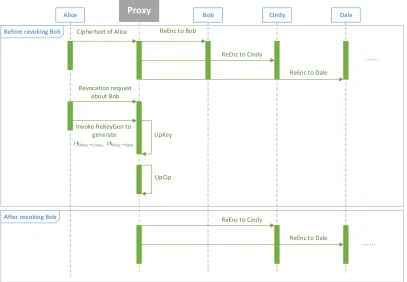
We here give a concise flow chart to illustrate our system. We assume there are four system users, in which Alice is delegator, and the rest of them are delegatees. There are two blocks in Figure 2, indicating the workflow before and after revocation, respectively. In general, our system works as follows. A data owner, Alice, encrypts her data and further uploads the ciphertext to a semi-trusted cloud server, who acts as a proxy. To fulfil secure data sharing, with the re-encryption keys (given by Alice),rkAlice→Bob,rkAlice→Cindy, rkAlice→Dale, the proxy can
convert Alice’s encryption to the ciphertexts intended for Bob, Cindy and Dale, respectively. If Alice decides to revoke the decryption rights delegation of Bob, she may send a request with necessary information to the proxy. By the necessary information, we mean the new re-encryption keys for Cindy and Dale along with a ciphertext update key. The proxy further updates the ciphertext of Alice by using the update key (without compromising the underlying plaintext). We here note that the new re-encryption keys are corresponding to the updated ciphertext of Alice, so that the proxy is allowed to convert the updated ciphertexts for Cindy and Dale. In our concrete construction (which is introduced in Section 4), we relate time period with encryption such that delegation of decryption rights (i.e. re-encryption key) is also limited to a time slot. A valid re-encryption requires that the time slot embedded into the re-encryption key must match the one associated with the ciphertext. The ciphertext update stage lifts the ciphertext from an old time slot sayt to a new onet′, so that the re-encryption key (from Alice to Bob) under t
is effective no more in re-encryption. In this way, re-encryption is only valid for the non-revoked users, Cindy and Dale. It is worth of mentioning that we make use of binary tree structure to reduce the re-encryption key update complexity toO(logN) in this paper, whereN is the number of delegatee.
3.3
Security Notion
We formalize the RPRE-CCA security below. Our security model considers not only the standard notion of PRE security but also the re-encryption key revocability.
RPRE-CCA Game. Let 1n be the security parameter, A be any PPT adversary. Consider the following
experiment for a RPRE scheme Π with a plaintext spaceM, a key spaceK, a ciphertext spaceCand the revocation listRLand the state ST:
Before proceeding to security game, we divide all users into two categories: honest user (HU) and corrupted user (CU). HU is a set of honest users only allowingAto know the corresponding public keys, while CU is a set of corrupted users manipulated byA.
Setup.Output the public parameters param, a revocation list RL (initially empty), and a state ST, where param
is sent toA. Ais given the targetpk∗and timet∗, labeling it as honest.
Phase1.Acan adaptively make a polynomial number of queries of the following oraclesO= (OKeyGen,OReKeyGen,
Alice Proxy Bob Cindy Dale
ĂĂ
Revocation request about Bob
UpCip Ciphertext of Alice ReEnc to Bob
ReEnc to Cindy
ReEnc to Dale
ĂĂ
Before revoking Bob
After revoking Bob ReEnc to Cindy
ReEnc to Dale Invoke ReKeyGen to
generate rkAliceėCindyˈrkAliceėDale
UpKey
Figure 2: System Workflow
– OKeyGen: if A request a key of user i with a tag honest, the challenger returns pki and records i ∈ HU;
otherwise, the challenger returns (pki, ski) and recordsi∈CU, where (pki, ski)←KeyGen(param).
– OReKeyGen: A is allowed to ask a re-encryption key query rkpk→pk′|t from pk to pk′ under a time t, the
challenger responds by running the ReKeyGenalgorithm to generate a re-encryption key rkpk→pk′|t for the
adversary. If a query indicates that pk = pk′ or pk ∈ HU, pk′ ∈CU, it will be ignored. The adversary can repeat polynomial times for different couple of identities.
– OReEnc: A is allowed to query re-encryption tuple (pk, pk′,t, Cpk), the challenger responds by running
ReKeyGen algorithm to generate a re-encryption key rkpk→pk′|t and further computing ciphertextCpk′ by
runningReEncalgorithm. Ifpk=pk′ orpk∈HU, pk′∈CU, the query will be ignored.
– ODec: Ais allowed to ask a decryption query onCof user pk(wherepk̸=pk∗), the challenger runsDecrypt
to returnm.
– OReKeyRev: Aoutputs a tuple (pk,t), the challenger updates RL by runningReKeyRev.
– OUpKey: Asends a tuple (pk,t,t′) to the challenger. The challenger runs the algorithmUpKey to generate
upkeyt→t′.
– OUpCip: Ais allowed to query (pk,t,t′, C). The challenger runs the algorithmUpCipto convert ciphertext
C undertto the one undert′, wheret<t′.
Challenge. A outputs two equal length plaintextm0, m1 ∈ M. The challenger picks a random bitb∈ {0,1} and sets the challenge ciphertext toC∗=Encrypt(pk∗, mb,t∗).
Phase 2. Same as Phase 1.
Guess. Aoutputs a guessb′∈ {0,1} and wins ifb=b′. The following restrictions must be hold:
– OReKeyGenandOReKeyRev must be queried in non-decreasing order, i.e., the time of the current queries must
– OReKeyRev cannot be queried at time t, if it has been queried attonce.
– WhenOReKeyGen is queried at timet∗, userpk∗ must be in RL.
– Ais not allowed to query the decryption oracle for the challenge ciphertextC∗ ofpk∗at timet∗. IfC∗at time
t∗is converted toC∗at timetfort∗<tby usingOUpCiporOUpKey,Astill cannot access to the decryption
oracle for the query of C∗ at timet.
We refer to A in the above game as an RPRE-CCA adversary. We define the advantage of A in attacking an RPRE schemeϵas
Advϵ,A=
P r
b=b′:
param←Setup(1n, N)
(m0, m1)← A(param, pk∗, t∗)O
C∗←Encrypt(param, pk∗, mb)
b′ ← A(C∗)O
−12
Definition 7. We say that an RPRE scheme is CCA if for all probabilistic polynomial time algorithmAand negligible function ε, we always have thatAdvϵ,A is a negligible function, that is, Advϵ,A⩽ε
4
Construction
4.1
Intuition of Our Construction
We first consider how to establish a connection between public key and time period for a user. Recall that a public key in a PRE scheme consists of three parts: the first two parts [A0|A1] (of the pk = ([A0|A1|A2]) are regarded
as an entirety, and the last part [A2] is regarded as the other entirety in our construction. The re-encryption key
is generated in the following two steps. First, we choose two matrices randomly, namely, AR and AL, such that
the sum of the two equals the first two parts of pk. We extract SRKR and SRKL through a Gaussian sampler
from the AR, AL, and further store them in the nodes θ ∈ P ath(v) and θ ∈ KUNodes(v), respectively. Second,
we add a random vector sto protect the time period from being cancelled out during some computation intaking the part A2. Xθ,t is also extracted through a Gaussian sampler and stored in the node θ ∈ KUNodes(v). The
revocation of re-encryption key relies on ifSRKR,SRKL, andURKt are in the same node of the tree. In order to
answer the re-encryption key query issued by adversary in the simulation, we divided the first two parts ofpkA into
U[AR1|AR2] and [I−U][AL1|AL2] in accordance with a certain proportion ofU: [I−U], whereUis a unimodular
matrix. Since the challenger of the security game will not have the private keys of honest users, we exploit Gaussian random sampling method to extractR1∗ and R∗2 from the Gauss distribution to construct honest user’s public key
pk = ([A0| −A0R1| −A0R2−Hf(t∗)G],H), and we add −Hf(t∗)G to each honest user’s key. In this way, we
enable the challenger to answer the queries of re-encryption key and decryption.
4.2
Our RPRE Scheme
Below we present our RPRE scheme from lattices.
• Setup(1n): On input a security parameter 1n, it chooses r that is a fixed function w(√logn). Set the modulus
q =pe =poly(n) andk=O(logn). The dimension of the public key ism=l+ 2nk, where l =O(nk). We adopt the standard trapdoor generation function in [23] to build the gadget matrix Gand the two functions associated with it, namely, the invert functiongGand the samplerfG. The trapdoorsR1,R2∼ Dl×nkso that (A0,A0R1,A0R2) isnegl(n)−far from uniformly distributionZqn×l×Znq×nk×Zqn×nk. AllH∈Znq×n that are
used in out scheme are invertible, and the difference between two such matrices, H′−H′′, is also invertible. This occurs with a non-negligible probability of (1−1/p)ewhenpis prime. Therefore we can always find those
matrices with rejection samplings.
The LWE error rate 1/α=O((nk)3)·r3. We define a encoding function asenc(m) =Bm∈Znk, which encodes the message space{0,1}nkto the cosets of Λ/2Λ for the lattice Λ = Λ(G⊤) using any basisB∈Znkof Λ, and
this encoding can be efficiently inverted.
• KeyGen(param): On input A0
$
←−Zn×l
q , R1,R2
$
←− Dl×nk, an invertible matrix H←−$ Zn×n
q . The public key is pk= (A,H) whereA= [A0|A1|A2] = [A0|−A0R1|−A0R2]∈Z
n×(l+2nk)
q . The private key issk= [R1|R2]∈
• Encryption(pk, m,t): On inputm∈ {0,1}nk, a vectorr←−$ Zn
q, a time vectort←−Znq. ComposeAu= [A0|A1+
HG|A2+Hf(t)G], and sample three error vectorse0
$
←− Dl
Z,αq,e1,e2
$
←− Dnk
Z,s, wheres
2= (∥e
0∥2+lαq2)·r2.
The composed error vector is concatenated by the three vectorse= (e0|e1|e2)∈Zm. Let
b⊤ = 2(r⊤[A0|A1+HG|A2+Hf(t)G] modq) +e⊤+ (0,0, enc(m))⊤mod 2q
where the dimension of first zero vector isl, and that of the second isnk. Return the ciphertextc=b∈Zm
2q.
• Decryption(pk, sk, c): Recall thatpk = [A,H], sk= [R1|R2], andc=b. ComputeAu= [A0|A1+HG|A2+
Hf(t)G] through matrixHu, and perform the following steps:
1. Output⊥if the form ofcis invalid orHf(t) = 0. Otherwise, call the algorithmInvertO([R1|R2],Au, b,
Hf(t)) to get valuesz∈Znq ande= (e0,e1,e2)∈Zql×Znkq ×Znkq so thatb⊤=z⊤Au+e⊤modq. If the
call toInvertfails for any reason, output⊥.
2. If∥e0∥⩾αq
√
lor e1,e2⩾αq
√
2lnk·w(√logn), output⊥.
3. Let v = b−e mod 2q, parsed as v = (v0,v1,v2) ∈ Z2lq ×Znk2q ×Znk2q. If v0 ∈/ 2Λ(A0⊤), output ⊥.
Otherwise, compute
v⊤
RI1 R02
0 I
mod 2q∈Znk2q
and applyencode−1 to the lastnkcoordinates if it exists, otherwise output⊥.
• ReKeyGen(pk, sk, pk′,t,RL,ST):
Recall that pk = ([A0|A1|A2],H), sk= [R1|R2], and pk′ = ([A′0|A1′|A′2],H′). In this step, the algorithm’s
input is the public key of the delegator and the delegatee, and a part of re-encryption key needed in our construction is generated by the private key of the delegator. The specific process is as follows:
1. For eachθ∈Path(υ), ifARandALhave not to been defined, the first two items of the delegatee’s public
key [A′0|A′1+H′G] would be divided into two parts: denoted by AR andAL satisfy [A′0|A′1+H′G] =
AR+AL.
We make AR parse as two matrices AR1 ∈ Z
n×l
q and AR2 ∈ Z
n×nk
q . Making use of the first part of
the secret keyR1(the Gaussian matrix) and the invertible matrixH ∈Znq×n from the public key. More
concretely, we sample column wise so that for each column of AR1 and obtain an l+nk dimensional
column of the part of re-encryption key by executing SampleO. And we derive an (l+nk)×l matrix after samplingltimes and parse it as two matricesX00∈Zl×landX10∈Znk×lwith Gaussian entries of
parameters.
[A0| −A0R1+HG] (
X00
X10 )
= [AR1]
And continue sampling for the cosets obtained from the columns ofAR2, we derive an (l+nk)×nkmatrix
after samplingnktimes and parse it as two mtricesX01∈Zl×nkandX11∈Znk×nkwith Gaussian entries
of parameters √
l
2:
[A0| −A0R1+HG] (
X01
X11 )
= [AR2]
Combined with the above two steps, we could get
[A0| −A0R1+HG] (
X00 X01
X10 X11
)
= [AR1|AR2] = [AR]
We denote
(
X00 X01
X10 X11
)
by Xθ,R, then store ARXθ,R in node θ ∈ Path(υ), and output SRKR =
2. For eachθ∈KUNodes(υ), if ARandAL are not defined, by the above definition we definiteAR andAL
to satisfy [A′0|A′1+H′G] =AR+AL.
The same calculation method as the first step is adopted to generateXθ,L= (
X′00 X′01 X′10 X′11
)
correspond to
AL, and storeAL andXθ,L in the nodeθ∈KUNodes, that is [A0|−A0R1+HG] (
X′00 X′01 X′10 X′11
)
= [AL].
And outputSRKL= (θ,Xθ,L)θ∈KUNodes(υ).
3. In this step, our algorithm whose input is the public key of the delegator and the delegatee and the private key of the delegator is used to generate the time-control part of the proxy re-encryption key needed in the scheme. The specific process is as follows:
Select matrix functionHf(x) :x−→Znq×n,x∈Z n
q whose input is the time vectort∈Z n
q and the random
vectors←−$ Znq. In order to hold the containing time titem in the final term, we have to make the con-tainingtitem on both sides of the equation inequality, to avoid it being eliminated(under the assumption that the third column and the third row of proxy re-encryption key are identity matrixI). So we
intro-duce a random vectors←−$ Znq inA2+Hf(t)G, make the right-hand side of the equationA′2+Hf(t+s)G:
[A0|A1+HG|A2+Hf(t)G] XX0212
I
= [A′2+Hf(t+s)G]
The method used here is the same asSRKeyGenin the previous step. Sampling for the cosets is obtained from the columns of the matrix A′2−A2+ (Hf(t+s)−Hf(t))Gby executing SampleO. The outputs,
namelyX02∈Zl×nk,X12∈Znk×nk, have Gaussian distributed entries with parameters
√
l:
[A0|A1+HG] (
X02
X12 )
=A′2−A2+ (Hf(t+s)−Hf(t))G
We denote
(
X02
X12 )
byXθ,t, and then storeθ and Xθ,t in node θ ∈KUNodes(υ), and outputURKt =
(θ, Xθ,t)θ∈KUNodes(υ).
4. ∀(α, Xα,R) ∈ SRKR,(β, Xβ,L) ∈ SRKL,(γ, Xγ,t) ∈ URKt, if ∃(α, β, γ) satisfies α= β =γ then the
re-encryption key is a matrix with Gaussian entries:
rk=
(
Xθ,R+Xθ,L Xθ,t
0 I
)
=
XX0010 XX0111 XX0212
0 0 I
;
on the otherwise, if any two sets ofSRKR,SRKL andURKt do not have a common node, rk←− ⊥.
5. Output re-encryption keyrksatisfying:
[A0|A1+HG|A2+Hf(t)G] (
Xθ,R+Xθ,L Xθ,t
0 I
)
= [A′0|A′1+H′G|A′2+Hf(t+s)G]
• UpKey(pk,t′,t, ST, sk): Recall that sk = [R1|R2]. The delegator would generate a proxy re-encryption key rkt′→t, and the ciphertext of delegator would be converted at time t′ to the time tby the proxy. Using the
first part of private key sk:R1 and the invertible matrixH of the public key, and executingSampleO
algo-rithm(similar to the operations in algorithmReKeyGen), outputX1∈Zl×nk,X2∈Znk×nk, where
[A0|A1+HG] (
X1
X2 )
=Hf(t)−Hf(t′)G
The re-encryption key is the matrix:
rkt′→t=
0I 0I XX12
0 0 I
• ReEnc(rk, c): Recall thatc= (Hu,b). Convert the ciphertext of delegator to the ciphertext of delegatee by using
the proxy re-encryption key. The specific process is as follows:
b⊤·rk
= 2(r⊤[A0|A1+HG|A2+Hf(t)G] modq) +e⊤+ (0,0, enc(m))⊤·
XX0010 XX0111 XX0212
0 0 I
mod 2q
= 2(r⊤[A0′|A1′+H′G|A2′+Hf(t+s)G] modq) +e⊤+ (0,0, enc(m))⊤ mod 2q, (2)
wheree= (e0,e1,e2) = (e0X00+e1X01,e0X01+e1X11,e0X02+e1X12+e2).
Finally, we output the ciphertextc= (Hf(t+s)G,b)
• ReKeyRev(pk, pk′,t, RL, ST): On input a public keypk′= ([A0′|A1′|A2′,H′]), a timet, the revocation list RL,
and the state ST, the algorithm adds (pk−→pk′,t) toRLfor all nodesvassociated withpk−→pk′ and return
RL.
• UpCipher(pk,b⊤, rkt→t′, ST,): When user pk is revoked and the proxy re-encryption keys are updated, the proxy could re-encrypt the ciphertext of delegator at timetto time t′ as follows:
b⊤·rkt→t′
= 2(r⊤[A0|A1+HG|A2+Hf(t)G] modq) +e⊤+ (0,0, enc(m))⊤·
0I 0I XX12
0 0 I
mod 2q
= 2(r⊤[A0|A1+HG|A2+Hf(t′)G] modq) +ee⊤+ (0,0, enc(m))⊤mod 2q, (3)
whereee= (fe0,fe1,fe2) = (e0,e1,e0X1+e1X2+e2).
Correctness. We present the correctness of our scheme by showing both the original ciphertext and the
re-encrypted ciphertext can be decrypted correctly. We verify that the process of re-encryption. The proxy can convert ciphertext of pk to pk′ through the corresponding re-encryption key where the pk′ is not a revoked user:
∀(α, Xα,R) ∈ SRKR,(β, Xβ,L) ∈ URKt,(γ, Xγ,t) ∈ URKt, ∃(α, β, γ) satisfies α = β = γ. We can chalk up rk =
(
Xθ,R+Xθ,L Xθ,t
0 I
)
by running ReKeyGen(SRKR,SRKL,URKt). We further call the re-encryption
algorithmReEncto get ciphertext 2(r⊤[A0′|A1′+H′G|A2′+Hf(t+s)G] modq) +e⊤+ (0,0, enc(m))⊤ mod 2q.
We here explore that how to set appropriate parameters include size of noise so that the re-encrypted ciphertext can be decrypted correctly. Our scheme has the same parameter setting of the original ciphertext as [MP12]. And the parameter setting of the re-encrypted ciphertext is as same as [EK14]’s, by taking 1/α=O(nk)3·r3we have the desired property for both error terms: e0R1′+e1, e0R′2+e2∈ P1/2(q·B(−⊤)). It can be proved that theDecryption algorithm in our revocable proxy re-encryption scheme is correct.
5
Security Analysis
We first elaborate that our scheme is immune to a means of attack in [14]. The attack method adopted in that article is that the adversary can tell the real system from the simulation system by distinguishing an equation with public key and proxy re-encryption key. The basic reason is that the second part of the third item —HuGis equal
in two sides of the following equation:
[A0|A1+HG|A2+HuG] XX0212
I
= [A′2+HuG].
[A0|A1+HG] XX0212
I
= [A∗0| −A∗R∗1]
XX0010
I
·R′2̸=A′2−A2.
The adversary could easily tell if the public keypk1, pk2, proxy re-encryption keyrk are from the real system or the simulation system after using the above comparison method.
But our scheme is immune to this attack. We add a random vectors←−Zn
q into the third part of matrix so that
the time term on both sides of the equation would not be eliminated, and the adversary cannot distinguish the real system and the simulation system effectively.
[A0|A1+HG|A2+Hf(t)G] XX0212
I
= [A′2+Hf(t+s)G]
Next we consider the security proof of our scheme. The challenger has to possessRand an invertibleHso that he can could the LWE problem successfully.
The simulator must guarantee that he is able to answer the query of adversary, that isHis an invertible matrix. However, once the adversary askes decryption query about challenge ciphertext, then H is the zero matrix, the simulator cannot transform it to a G−trapdoor matrix and decrypt it to recover the corresponding plaintext. Therefore, there is no invertibleHinvolved, we embed LWE instance into the challenge ciphertext, and the output of the adversary will help us tackle the decision-LWE problem.
Theorem 3. Our scheme is CCA-secure under conditions of decision-LWE whereα′ =α/3⩾2√n/q.
Proof. First, we transform the LWE distribution As,α′ = (a, b=<s,a > /q+emod 1) to (a,2(< s, a > modq) + e′mod 2q), wheree′ −→ DZα,q, b −→ 2qb+DZ2qb,s, s2 = (αq)2−(2α′q)2 ⩾ 4n ⩾ ηϵ(Z)2. This converts a uniform
distribution onZnq ×T to a discretized uniform distribution onZnq ×Z2q. Once the LWE samples are the required
style, we construct a column-wise matrix A0∗ and b∗, the public key of the target user is generated as follows:
select a invertible matrixH1∗, a time vectort∗ and a matrix functionHf(x), private keyR1∗,R2∗∈ D, output the
public keypkA∗= ([A0∗| −A0∗R1∗−H1∗G| −A0∗R1∗−Hf(t∗)G],H1∗), wheret∗is statistically hidden from the
adversary.
We chooseX00andX10from a Gaussian distribution with parametersso as to generate public key of valid user.
First, we set a unimodular matrixU∈Zl×l
q , and two matricesAR1,AR2 are generated respectively: Let
U−1[A0∗| −A0∗R1∗] (
X00
X10 )
=AR1,
[A0∗| −A0∗R1∗] (
X00
X10 )
=UAR1,
and
U−1[A0∗| −A0∗R1∗] (
X00
X10 )
R′1=A′0R′1,
[A0∗| −A0∗R1∗] (
X00
X10 )
R′1=UAR2.
Let X′θ,R be denoted by [
(
X00
X10 )
|
(
X00
X10 )
R′1]. And putX′θ,R into node θ∈ Path(υ), and continue to produce
X′θ,L.
We chooseX′00 andX′01from the Gaussian distribution with parameters, make
[I−U]−1[A∗0| −A∗0R∗1]
(
X′00
X′10 )
=A′L1,
[A∗0| −A∗0R∗1]
(
X′00 X′10 )
= [I−U]AL1,
[I−U]−1[A∗0| −A∗0R∗1]
(
X′00 X′10
)
R′1=A′0L′2,
[A∗0| −A∗0R∗1] (
X′00 X′10
)
R′1= [I−U]AL2.
Let X′θ,L be denoted by [
(
X′00 X′10 )
|
(
X′00 X′10 )
R′1], And put X′θ,L into node θ ∈ KUNodes(υ), noticing that [A∗0| −
A∗0R∗1][X′θ,R+X′θ,L] = [UAR1+ [I−U]AL1|UAR2+ [I−U]AL2] = [A′0| −A′0R′1].
We choose R′2 ∈Zl×nk
q from a distributionB defined over Z that outputs 0 with probability 1/2 and ±1 with
probability 1/4 each: [A∗0| −A∗0R∗1]
(
X′00 X′10
)
R′2 = A′0R′2. So the whole public key of a honest user is pk′ =
([A′0| −A′0R1′| −A′0R′2−Hf(t∗)G]). We add−Hf(t∗)Gto each honest key. A′0R′1is negl(n)-far from uniform and
−Hf(t∗) is concealed from adversary.
Let (
X′00
X′10 ) + ( X00 X10 ) = ( X00 X10 ) , (
X′00 X′10
) R′1+
(
X00
X10 )
R′1=
( X01 X11 ) , (
X′00 X′10
) R′2=
( X02 X12 ) , and (
X00+X′00 X01+X′01 X′02
X10+X′10 X11+X′11 X′12 )
=
(
X00 X01 X02
X10 X11 X02
) ,
each entry of the resulting matricesX01,X11,X′01,X′11,X′02,X′12is the inner of product of a Gaussianl-dimensional
row-vector and a {0,−1,1}-vector with half of the coordinates equal zero, which is equivalent tol/2 additions of
Gaussians with parameter s. Since in the scheme we obtain
( X01 X11 ) , ( X02 X12 )
with parameter s√l/2, then the
simulated re-encryption key is
rkpk∗−→pk′ =
XX0010 XX0111 XX0212
0 0 I
.
1. If no valid user is revoked,KU N odes(BT, RL,t∗)∩P ath(v∗) =∅the challenger replies the query about private
key ofid∗through{(θ, e=
(
X00 X01
X10 X11
)
)}θ∈path(v∗)and a update key query fort∗and{(θ, e1=
(
X00′ X01′
X10′ X11′ )
, e2=
(
X02
X12 )
)}θ∈KU N odes(BT ,RL,t∗).
2. If a user is revoked, that isrev = 1, the produce way of keys are as above. But the challenger can only reply
an updated key query fort∗ through
(
X′00
X′10
)
R′2forθ, θ∈KU N odes(BT, RL,t∗)
Next we consider the decryption query about ciphertext c = (Hf(t′),b) for pk′ = ([A′0| −A0R′1| −A′0R′2−
Hf(t∗)G],H′), where
b⊤= 2(r⊤[A0′|A1′+HG|A2′+ (Hf(t∗)−Hf(t′))G] modq) +e⊤+ (0,0, enc(m))⊤mod 2q
We first check that Hf(t′) is invertible or not, and call InvertO algorithm when Hf(t∗)−Hf(t′) is a invertible
matrix, whose input is (sk= [R′1|R′2],Au= [A0′|A1′+HG|A2′+(Hf(t∗)−Hf(t′))G,b,(Hf(t∗)−Hf(t′))]), output
is (z,e)∈ Zn
q to satisfyb=zAu+emodq. If norm of e is small enough, v =b−e= (v0,v1,v2), maintaining