Functional RNA Structures in the 3’UTR of
Tick-Borne, Insect-Specific and No-Known-Vector
Flaviviruses
Roman Ochsenreiter1 , Ivo L. Hofacker1,2 , Michael T. Wolfinger1,2*
1 Department of Theoretical Chemistry, University of Vienna, Währingerstraße 17, 1090 Vienna, Austria;
{romanoch,ivo}@tbi.univie.ac.at, [email protected]
2 Research Group BCB, Faculty of Computer Science, University of Vienna, Währingerstraße 29, 1090 Vienna,
Austria;
* Correspondence: MTW [email protected]
Abstract: Untranslated regions (UTRs) of flaviviruses contain a large number of RNA structural elements involved in mediating the viral life cycle, including cyclisation, replication, and encapsidation. Here we report on a comparative genomics approach to characterize evolutionarily conserved RNAs in the 3’UTR of tick-borne, insect-specific and no-known-vector flavivirusesin silico. Our data support the wide distribution of previously experimentally characterized exoribonuclease resistant RNAs (xrRNAs) within tick-borne and no-known-vector flaviviruses and provide evidence for the existence of a cascade of duplicated RNA structures within insect-specific flaviviruses. On a broader scale, our findings indicate that viral 3’UTRs represent a flexible scaffold for evolution to come up with novel xrRNAs.
Keywords:Flavivirus; non-coding RNA; secondary structure;
1. Introduction
Flaviviruses are small, single-stranded positive-sense RNA viruses that are typically transmitted between arthropod vectors and vertrebrate hosts. They are endemic in tropic and sub-tropic regions and represent a global health threat, although humans are considered dead end hosts in many cases. The genusFlaviviruswithin theFlaviviridaefamily comprises more than 70 species, which are organized into four groups, each with a specific host association: Mosquito-borne flaviviruses (MBFVs) and tick-borne flaviviruses (TBFVs) spread between vertebrate (mammals and birds) and invertebrate (mosquitoes and ticks) hosts, whereas insect-specific flaviviruses (ISFVs) replicate specifically in mosquitoes and no-known-vector flaviviruses (NKVs) have only been found in rodents and bats, respectively. This natural host-range-based classification is in good agreement with sequence-based phylogenetic clustering, mainly because all flaviviruses share a common genome organization [1]. Conversely, epidemilogy, disease association [2] and transmission cycles [3] are fundamentally different among different flavivirus groups.
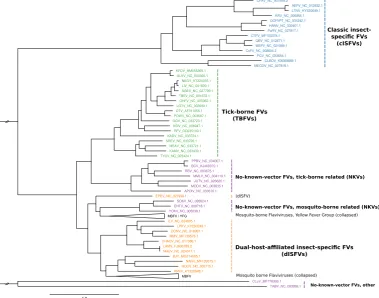
Emerging and re-emerging MBFVs such as Dengue virus (DENV), Japanese encephalitis virus (JEV), West Nile virus (WNV), Yellow fever virus (YFV) or Zika virus (ZIKV) are the causative agents of large-scale outbreaks that result in millions of human and veterinary infections every year [4]. Likewise, tick-borne encephalitis virus (TBEV), Powassan virus (POWV) and other members of the tick-borne serocomplex are neuropathogenic agents that cause a large number of infections every year, resulting in a massive incidence increase since the 1970ies [5]. Consequently, much research effort has gone into studying MBFV and TBFV biology, biochemistry and phylogeny [6]. The two remaining groups, ISFVs and NKVs, however, have received limited attention in the research community, mainly because they are generally not associated with human or veterinary disease and therefore are still underrepresented in the literature. The phylogenetic relationship among the four ecological flavivirus groups is shown in Fig1. Table A1lists all viral species considered in the present study.
1.0
CFAV_NC_001564.2
JUTV_NC_026620.1 BCV_KJ469370.1
HANV_NC_030401.1 LTNV_KY320649.1
PCV_NC_033694.1
MBFV / YFG
CLuV_MF776369.1 DONV_NC_016997.1
SOKV_NC_026624.1
KPKV_KY320648.1
LIV_NC_001809.1 SGEV_NC_027709.1
DTV_AF311056.1
MODV_NC_003635.1
ENTV_NC_008718.1
CxFV_NC_008604.2
APOIV_NC_003676.1
TABV_NC_003996.1 KADV_NC_033724.1
NHUV_NC_024017.1
YOKV_NC_005039.1
MMV_MF139576.1
BJV_MG214905.1 MMLV_NC_004119.1 SREV_NC_033726.1
ALKV_NC_004355.1 NEGV_KT224355.1
TBEV_NC_001672.1
LPKV_KY290249.1
CLBOV_KX669689.1
NANV_MF139575.1
KRV_NC_005064.1
OHFV_NC_005062.1
PaRV_NC_027817.1
MEAV_NC_033721.1
ILV_NC_024805.1
MSFV_NC_021069.1
AEFV_NC_012932.1
MECDV_NC_027819.1
RFV_DQ235149.1 LGTV_NC_003690.1
CTFV_MF153378.1
RBV_NC_003675.1
CHAOV_NC_017086.1
GGV_NC_033723.1
LAMV_FJ606789.2
NOUV_NC_033715.1
KAMV_NC_023439.1
EPEV_NC_027999.1
KFDV_HM055369.1
QBV_NC_012671.1 OCFVPT_NC_034242.1
POWV_NC_003687.1
MBFV KSIV_NC_006947.1
TYUV_NC_023424.1 PPBV_NC_034007.1
Tick-borne FVs (TBFVs)
No-known-vector FVs, tick-borne related (NKVs)
Dual-host-affiliated insect-specific FVs (dISFVs)
No-known-vector FVs, mosquito-borne related (NKVs)
Classic insect-specific FVs
(cISFVs)
(dISFV)
Mosquito-borne Flaviviruses, Yellow Fever Group (collapsed)
Mosquito borne Flaviviruses (collapsed)
No-known-vector FVs, other
Figure 1.Maximum-likelihood phylogenetic tree of the genusFlavivirus, highlighting the major groups ISFVs (blue), dISFVs(orange), TBFVs (green), and NKVs (magenta). The MBFV Yellow Fever virus group (YFG) and main MBFV branch (not covered here) were collapsed. The tree has been computed from aMAFFTalignment of complete polyprotein amino acid sequences withiq-tree. Figure rendered withFigTree.
TBFVs form a monophyletic group consisting of a single serocomplex, although pathology and clinical manifestations vary among different viruses. They comprise more than a dozen of recognized species and separate into three groups: Mammalian tick-borne flaviviruses (M-TBFV), seabird tick-borne flaviviruses (S-TBFV) and the Kadam virus group. See [7] for a comprehensive review.
ISFVs naturally infect hematophagousDiptera and are typically divided into two groups [8]: Classical insect-specific flaviviruses (cISFVs) naturally infect mosquitoes and excursively replicate in mosquito cellsin vitro. They form a phylogenetically distinct clade among known flaviviruses, appearing at the root of the MBFV, TBFV and NKV branches. The cISFV group separates into two clades, one associated withAedesspp. mosquitoes and the other associated withCulexspp. mosquitoes, respectively [9]. They lack the ability to infect vertebrates and to replicate in vertebrate cell lines and have not been in the research spotlight until very recently. The second group is comprised of arbovirus-related or dual-host affiliated insect-specific flaviviruses (dISFVs), which represent a non-monophyletic group which is phylogenetically and antigenically related to mosquito/vertebrate flaviviruses, although they do not appear to infect vertebrate cells [10]. Insect-specific viruses play a crucial role in the mosquito microbiome and have been shown to modulate the replication of other arboviruses [11]. In this line, they are currently considered as biological control agents and vaccine platforms [12].
by arthropod vectors. They form a non-monophyletic group among flaviviruses and are typically
divided into bat- (B-NKV) and rodent-associated (R-NKV) groups, see TableA1. B-NKVs can be
further separated into Entebbe virus group, which is phylogenetically closer to MBFVs, and Rio Bravo virus group, which is a sister clade to TBFVs. Species in the R-NKV group form the Modoc virus group, which is phylogenetically close to the B-NKV Rio Bravo group [13]. While NKVs are poorly characterized they represent a valuable resource to study evolutionary traits related to host-switch capacity mediated by conserved genomic elements.
1.1. Conserved RNA structures mediate pathogenesis
Conserved RNA structures in the untranslated regions (UTRs) of RNA viruses are of particular interest because they mediate the viral life cycle by promoting or enhancing replication, as proposed for elements in both 5’UTRs [14] and 3’UTRs [15–18]. Mosquito/vertebrate viruses must operate efficiently in vectors and hosts, phylogenetically distinct organisms with different cellular machineries. This requires a high level of flexibility of viral regulatory elements to evade various antiviral response strategies while assuring proper replication conditions required for maintaining a stable quasispecies population. To achieve this resilience in host adaptation, RNA duplication strategies have been
proposed as an evolutionary trait for MBFVs [19]. Tandem RNA structures within DENV 3’UTR
are under different selective pressures in alternating hosts, suggesting the idea that duplicated RNA structures differentially evolved to accommodate specific functions in the two hosts [20]. Likewise, there is evidence for evolutionary pressure on maintaining the primary sequence of parts of duplicated RNA elements, as recently shown for flaviviral dumbbell (DB) elements in the context of finding a biophysical model for explaining a possible route for ZIKV-induced neurotropism [21].
Viral RNA genomes are different from procaryotic and eucaryotic mRNA. In addition to coding for and regulating the viral machinery, viral genomic RNA (gRNA) exhibits functional regions that act upon different stages of the viral life cycle. The 10-12kB flaviviral gRNA is capped, but non-polyadenylated and encodes a single open reading frame (ORF). Upon translation, a polyprotein is produced, which is then cleaved by viral and cellular enzymes into structural and non-structural proteins [22]. The ORF is flanked by highly structured untranslated regions (UTRs), which contain evolutionary conserved RNA elements that are crucially related to regulation of the viral life cycle, thereby inducing processes such as genome circularization, viral replication and packaging [23–25].
Upon flavivirus infection, accumulation of both gRNA as well as viral long non-coding RNAs (lncRNAs) is observed. These lncRNAs, which have been referred to as subgenomic flaviviral RNAs (sfRNAs) [26] are stable decay intermediates produced by exploiting the host’s mRNA degradation machinery [27] and are associated with viral replication, pathogenesis and cytopathicity [28,29]. The production of sfRNA is induced by partial degradation of viral gRNA by the 5’-3’ exoribonuclease Xrn1, an enzyme associated with the cell’s RNA turnover machinery [30,31]. Mechanistically, sfRNAs are generated by stalling Xrn1 at conserved structural elements in the viral 3’UTR, termed xrRNA (exoribonuclease-resistant RNA elements). These structures efficiently stall Xrn1 from progressing through from the 5’ direction, thus protecting the downstream RNA from degradation, while pass-through in the 3’-5’ direction, as required for viral RNA-dependent RNA-polymerase is still possible [32]. In particular, different types of stem-loop (SL) and dumbbell (DB) elements found in many MBFVs and TBFVs have been related to quantitative protection of downstream virus RNA against exoribonuclease degradation [33].
Xrn1 stalling results in dysregulation of cellular function with the aim of promoting viral infections. In this regard, functions of sfRNA in modulating cellular mRNA decay and RNAi pathways [34] as well as modulating anti-viral interferon response [35,36] have been reported.
and NKV groups [33], highlighting the possibility that exoribonuclease resistance might be a pervasive mechanism of the viral world. Interestingly, several conserved RNA structural elements in viral 3’UTRs have been predicted in our group [43–47], some of which have later been attributed to xrRNA functionality [26]. To further expand the set of potential xrRNAs, we report here on a comparative genomics survey aimed at characterization of evolutionary conserved RNA structures in flavivirus 3’UTRs, focusing on TBFVs and the hitherto understudied groups of ISFVs and NKVs. A detailed study on the evolutionary traits of conserved RNAs in MBFV 3’UTRs will be published elsewhere.
2. Materials and Methods
Viral genome data for the present study were obtained from the public National Center for
Biotechnology Information(NCBI) refseq(https://www.ncbi.nlm.nih.gov/refseq/) andgenbank
(https://www.ncbi.nlm.nih.gov/genbank/) databases on 28 May 2018. We downloaded all complete viral genomes under taxonomy ID 11051 (genus Flavivirus) and filtered for TBFV, ISFV and NKV species listed in tableA1. Wheneverrefseqannotation was not available for a species, we selected the longest complete genome from thegenbankset as representative sequence. In total, the data set is comprised of 86 ISFV, 275 TBFV and 27 NKV isolates, respectively. The number of isolates with available 3’UTR sequence data per species varies between 1 and 167.
2.1. Phylogeny reconstruction
The polyprotein/coding sequence (CDS) regions of most flaviviruses can be aligned consistently, however, UTRs typically show large variance both in length and sequence composition, rendering them ill-suited for phylogeny reconstruction. A phylogeny of all members of the genusFlavivirus(Fig.1) was therefore reconstructed via a multiple sequence alignment (MSA) of the nucleotide sequences of the CDS regions only. The MSA was computed withMAFFT[48] and subsequent maximum-likelihood tree reconstruction was performed usingiq-tree[49] using the GTR+F+R7 substitution model.
2.2. Structural homology search with covariance models
The present study is centered around structural homology of RNA elements among phylogenetically narrow subgroups. A straightforward approach to finding novel homologous RNA structures is to search RNA sequence databases with Covariance Models (CMs), i.e. statistical models of RNA structure that extend classic Hidden-Markov-Models (HMMs) to simultaneously represent sequence and secondary structure. CMs, as implemented in theinfernalpackage[50] allow for rapid screening of large RNA sequence databases to find even weakly conserved sequence-only or structurally homologous RNAs. We have recently applied this approach to identify novel telomerase RNAs inSaccharomycetes[51].
Here, structural multiple sequence alignments of the viral 3’UTR sequences were generated
with locARNA [52] and CMs were built for known or experimentally verified xrRNAs [33]. All
3’UTR sequences were then screened and novel candidate sequences were added to perform iterative refinement until convergence. Weak sequence conservation of putative xrRNA elements resulted in initially fragile results, indicating that infernaldefault parameters are typically not optimal. Adjusting parameters, in particular disabling both heuristic filtering and local end detection, however, allowed our CMs to find homologs with strongly conserved secondary structures in presence of large sequence deviation from the original sequence the CM was built from. Likewise,cmsearchE-values turned out unsuitable for assessing hit quality in case of major sequence divergence. We therefore employed a cutoff approach, requiring a hit to form at least 75% of all base pairs listed in the CM in order to be considered significant.
2.3. De novo discovery of conserved RNA elements
covariation as evolutionary traits. In this line, locARNA-generated structural alignments of full UTR sequences were cut manually into blocks corresponding to conserved secondary structures. Alternatively, we employedRNALalifoldfrom theViennaRNApackage [53] to compute locally stable secondary structures for aligned UTR sequences. A CM was built for each structure and searched against all flavivirus 3’UTRs, keeping only CMs that scored well multiple times per UTR. The rationale here is that the occurrence of multiple copies hints towards a possible functional role of a structural element, given that the ability of two or more independently evolving sequences to form a common structure is unlikely.
The above approach is implemented as a set of custom Perl and Python scripts for semi-automatic characterization and annotation of conserved RNAs in viral UTR sequences. Internally, these scripts build on theViennaRNAscripting language interface for thermodynamics calculations, the
ViennaNGS [54] suite for extraction of genomic loci, the RNAaliSplit package [55] for splitting
alignments into subparts with common consensus structures (i.e. common structures formed by all individual sequences) andR2R[56] for visualization.
3. Results
Several flaviviruses have previously been studied in great detail, yielding a varied landscape of repeated RNA sequence and structure elements within the 3’UTRs of these viruses, which are likely to have evolved from numerous duplications [19,57,58]. Many of these studies relied on single sequence predictions, which resulted in a good understanding of both structure and genomic position of conserved elements in individual species. A unified picture of homologous RNAs within the 3’UTRs of flaviviruses, however, has not been available.
The comparative approach applied in the present study outperforms single sequence predictions by considering consensus structures formed by all sequences. This allows us not only to confirm previously described RNA structures but also to elucidate hitherto unrecognized tandem repeats in many species. In this line our results can help in understanding the complex evolution of flavivirus 3’UTRs.
3.1. Construction of seed alignments
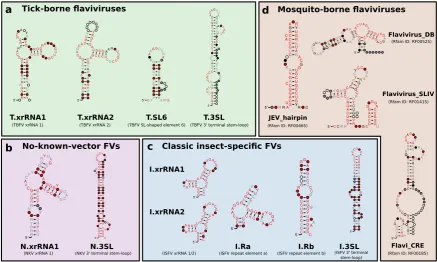
Based on recent experimental evidence for the existence of xrRNAs in TBFVs, ISFVs and NKVs, and previously characterized conserved RNA elements in flaviviral 3’UTRs, we built seed alignments for initial CMs, which were then refined iteratively, i.e., subjected to multiple rounds of screening and incorporation of best hits into the CM. Likewise, candidate structures fromRNALalifoldcalculations were used as seeds for identification of conserved RNA structures. Fig.2shows an overview of refined consensus structures for each ecologic group of flaviviruses analyzed here.
The four ecologic groups of flaviviruses show a varied 3’UTR architecture, however, the terminal 3’ stem-loop structure (3’SL, also referred to as 3’ long stable hairpin, 3’LSH) has been shown to be associated with panhandle-formation during virus replication and is therefore present in the terminal region of all flaviviruses. The element is listed in Rfam as RF00185 (Flavivirus 3’UTR cis-acting replication element) and we could use it to consistently identify terminal regions within 3’UTRs. Absence of this element from a UTR sequence is indicative of incomplete or truncated sequence data. The underlying sequences generally form a stable stem-loop structure upon structural alignment and single sequence folding. We built individual 3’SL seed alignments and CMs for each ecologic group, termed T.3SL, N.3SL and I.3SL, respectively.
3.2. Tick-borne flaviviruses
GR Y A Y R C G G C AG CA C
RC Y Y R G Y GA
C G G GAA RU G G U C G C U C C C G A C G Y A R R R Y Y 5´ R G G RR Y R Y G G C AR C R C R C A Y R Y G
R G GR A G G U C G C C C G C R R Y C C Y 5´ R R R Y R UR R G G G C A AC Y Y GG
RYUA
G
C
Y
A G GGY
UG A C G A C C Y C C C Y Y C R Y U U 5´
CCR RY
G U C A G R C C A C R YGUGCC
AC Y CY G C G A G R G U G C R G Y C U G Y R
GCC C C A G GG GA
C U G G G U 5´
RRAG UCA G G C CA G Y A R C U G C C A C CG
G A R Y U G R G U A G A C G G U G C U G C C U G Y R C 5´ R G G C C Y A A C Y R R R A G Y UG
UA Y G G
G ARGGA
C U A G A G G
U U A G A G G A G A C C C C Y 5´ C Y R G GA AG A C Y R GRR G R Y U C U R UC U Y C A A Y C A Y Y RG G C A CA G Y G C C R A
R A G R R U G R U G G R 5´ Tick-borne flaviviruses
No-known-vector FVs Classic insect-specific FVs
Mosquito-borne flaviviruses
C G C AA GG R
AG GA Y Y U C C U Y G G G
R Y UG A C A C C Y C C G 5´ C C C C A G U C C RG Y GG A G A C CC C G R GU G Y U G A A G G R C 5´ T.xrRNA1 T.xrRNA2 N.xrRNA1 T.SL6 T.3SL CYY R C Y C G R AA
G GCC R A Y G R R Y R A RG 5´ I.xrRNA2 I.Rb I.Ra I.3SL N.3SL Y R R R R R R A R RY Y Y C C A CC GU
A G G R R R Y Y U R Y U Y Y R 5´ G G C G G U U CU U
G U U C UC C C Y GA G CC Y C RY CA CY C A GA C A CA GA U A G U C U RAA
A G G A G G G R G Y U Y R G A A 5´ G U G R U Y Y Y R R R A A C YCA
G A UU G Y U R U Y Y Y G R R R AG C Y Y C G C U 5´
(TBFV xrRNA 1) (TBFV xrRNA 2) (TBFV SL-shaped element 6) (TBFV 3' terminal stem-loop)
(NKV xrRNA 1) (NKV 3' terminal stem-loop) (ISFV xrRNA 1/2) (ISFV repeat element a) (ISFV repeat element b) (ISFV 3' terminal stem-loop)
JEV_hairpin
(Rfam ID: RF00465)
Flavivirus_SLIV
(Rfam ID: RF01415)
Flavivirus_DB
(Rfam ID: RF00525)
Flavi_CRE
(Rfam ID: RF00185)
G G G C A Y R A
A R U GU C GG
G C
U G AC G C C C G C U C C C 5´ G G G C A Y R A R U GU C
GG G C
U G AC G A C C C G C C C 5´ I.xrRNA1 a b c d
Figure 2.Overview of consensus structures of all CMs used for the annotation of flavivirus 3’UTRs. TBFV, ISFV, and NKV elements were refined from published experimental data (T.xrRNA1/2, I.xrRNA1/2, N.xrRNA) or identified computationally (T.SL6, I.DB, I.SL as well as all 3’-terminal stem-loop structures). MBFV elements were obtained from Rfam. Throughout this paper, all CMs are referred to by the name written in bold. References to xrRNA-like structures refer to the generalized xrRNA CM (Section3.6).
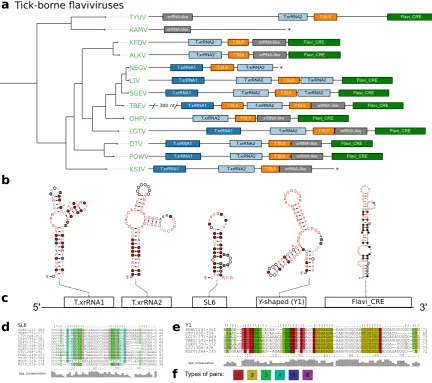
employed to search for high confidence hits within all TBFV 3’UTRs to construct seed alignments of the two exoribonuclease resistant structures in TBFVs, termed T.xrRNA1 and T.xrRNA2. These models allowed us to construct highly specific CMs for both TBFV xrRNAs, which were subsequently used to annotate xrRNA instances in already studied and previously unstudied TBFV species (Fig.3a).
The full structural alignment of the 3’UTRs of selected tick-borne species moreover suggests a short stem-loop element in several species, which is characterized by high sequence heterogeneity but heavily conserved structure supported by multiple covariations. Evidence for this element, termed stem-loop 6 (SL6), has been reported earlier for at least TBEV, LGTV and OHFV [57,58]. We kept this nomenclature and identified the exact position in each TBFV 3’UTR (Fig.3d).
Our data further shows that both TBFV xrRNA CMs (Fig.2a), as well as NKV xrRNA CMs
(Fig.2b and Sect.3.5) consistently yield plausible hits with a high degree of structure conservation immediately upstream of the strongly conserved terminal stem-loop element. Existence of a Y-shaped element (termed Y1) and putative similarity to NKVs has been proposed earlier based on single sequence structure predictions [57]. Structural locARNA alignment and subsequent RNAalifold
consensus structure prediction indicates strong secondary structure conservation with frequent structure-conserving sequence covariations. Taken together, this suggests good evidence that respective regions in TBFVs harbor a putatively structured and functional xrRNA-like RNA (Y1, Fig.3d).
additional homologous or conserved structures with any CM used in this screen in the variable region of the 3’UTR of TBEV [5], despite the substantially longer UTR (+300 nts).
TYUV xrRNA-like T.xrRNA2 T.SL6 Flavi_CRE
KAMV xrRNA-like
KFDV T.xrRNA2 T.SL6 xrRNA-like Flavi_CRE
ALKV T.xrRNA2 T.SL6 xrRNA-like Flavi_CRE
NEGV T.xrRNA1 T.SL6 T.xrRNA2
LIV T.xrRNA1 T.xrRNA2 T.SL6 T.xrRNA2 Flavi_CRE
SGEV T.xrRNA1 T.xrRNA2 T.SL6 T.xrRNA2 Flavi_CRE
TBEV T.xrRNA1 T.SL6 T.xrRNA2 T.SL6 xrRNA-like Flavi_CRE
OHFV T.xrRNA2 T.SL6 xrRNA-like Flavi_CRE
LGTV T.xrRNA1 T.xrRNA2 T.SL6 xrRNA-like Flavi_CRE
DTV T.xrRNA1 T.xrRNA2 T.SL6 xrRNA-like Flavi_CRE
POWV T.xrRNA1 T.xrRNA2 T.SL6 xrRNA-like Flavi_CRE
KSIV T.xrRNA1 T.xrRNA2 T.SL6 xrRNA-like
~ 300 nt
b
a
G R Y R C G G C A GC A C RCYRY G Y G A
C G G GAA R U
G G U C G C U C C C G A C G Y A R R Y Y 5´ R G G R Y R Y G G C AR C R C R C A Y G R G G R
AR GRY
G C C C R R R Y Y Y Y
5´ CY
Y C R AA GG Y A R C R
RRG
5´ GG
C G G Y U CU U U C UC C C R A G C Y C Y Y A G A C A CA GAU
A
G
U
C
U
RACA G R R R G G R G Y U Y G A A A 5´ R R R C C C C G R R YY GG A GG R GG G A R R R R R R A A AU
U G GC A R Y Y Y Y Y Y U
C R G G A U U U Y Y Y Y 5´
T.xrRNA2 SL6 Y-shaped (Y1) Flavi_CRE
T.xrRNA1
5' 3'
(((((..((((((((((....)))))))).))...((((((((...))))))))...)).))) POWV|291-361 AGGAG--CCCCCGAGCAUAA---CUCGGGAGGAGGGAGGAAGA-AAAUUGGCAAUCUUCCUCGGGAUUUUUCCGCCU 71 DTV|290-354 UAGAG--CCCCCGGGCAUAA---CUCGGGAGGAGGGGGGAAGA-CAAUUGGCAAUCUUCCCCGGGAUU---UUU 65 LGTV|377-449 GGAGG--CCCCCAGGGGGAAACCCCUGGGAGGAGGGAAGAGAG-AAAUUGGCAACUCUCUUCAGGAUAUUUCC-UCC 73 TBEV|573-645 GGAGG--CCCCCGGAAGCACGCUUCCGGGAGGAGGGAAGAGAG-AAAUUGGCAGCUCUCUUCAGGAUUUUUCC-UCC 73 SGEV|300-372 GGGGAGGCCCCCGGAAGCACGCUUCCGGGAGGAGGGAAGAGAG-AAAUUGGCAGCUCUCUUCAGGA--UUUUU-CCU 73 LIV|306-378 AGGGAGGCCCCCGGAAGCAUGCUUCCGGGAGGAGGGAAGAGAG-AAAUUGGCAGCUCUCUUCAGGG--UUUUU-CCU 73 KSIV|264-335 UAUGAAGGCCCCUGGAG--AGAUCCAGG-AGGGGGGAGAGAGGAAAAUUGGCAGCCUCUCUCAGGAGAUUUC--CUC 72 ...10...20...30...40...50...60...70...
Seq. Conservation:
.((((..((((((((...))))))))...)))).... SGEV|261-306 CCCCCC-GCACCAUGACAAGGCCGAACAUGGUGCACCAAAGGGGAG-G 46 TBEV|532-577 CCCCCU-GCAUCAUGAUAAGGCCGAACAUGGUGCAUGAAAGGGGAG-G 46 LIV|268-312 CCCCCC-GCCCCAUGACAAGGCCGAACAUGGAGCAUUAAAGG-GAG-G 45 LGTV|339-381 CCCCUU-GCGUCCAGAGAAGGCCGAACUGGGCGU---UAUAAGGAG-G 43 OHFV|179-222 CCCCCC-GCACCAUG-GAAGGCCAAACAUGGUGCAUG-AAGGGAAA-G 44 KFDV|164-204 CCAAAA-CCUCCCAGAGAAGGCCGAACUGGGAGGCC---AUGAA-G 41 ALKV|165-205 CCAAAG-CCUCCCAGAGAAGGCCGAACUGGGAGGCC---AUGAA-G 41 DTV|248-294 CCAAAAGGCCUCCUG-GAAGGCUCACCAGGAGUUAGGCCAUUCUAGAG 47 POWV|249-293 CCAAAAGGCCUCCUG-GAAGGCUCACCAGGAGUUAGGCCGUU-UAG-G 45 TYUV|341-386 CUUUC--CAUGAGAGGAGACGGUCAACUCUCAUGGAACAAGAAGACCG 46 NEGV|129-174 CCCCCCCUGGCCAGAAAAAGGGGGGGCAAACAGGCC--AGGGGUGAAG 46 KSIV|233-270 CUGAC---CAUCCCU-CAAGGCCGAGUGGGAUGC---GUAUGAAG 38 ...10...20...30...40...
Seq. Conservation:
Tick-borne flaviviruses
*
*
*
c
d
e
f
Types of pairs: 1 2 3 4 5 6SL6 Y1
Figure 3. aAnnotated 3’UTRs of TBFVs. The phylogenetic tree on the left has been computed from complete coding sequence nucleotide alignments and corresponds to the TBFV subtree in Fig.1. For each species with available 3’UTR sequence a sketch of the 3’UTR is drawn to scale next to the leaves of the tree. Colored boxes represent conserved RNA structural elements. Identifiers within the boxes indicate the CM which was used to infer homology at this position. Asterisks indicate incomplete 3’UTR sequences. Species without available 3’UTR are not shown.bConsensus structure plots of CM hits as calculated bymlocarna.cSchematic depiction of the common structural architecture of TBFV 3’UTRs. d,eStructural alignments of elements SL6 and Y1. fColoring scheme for paired columns. Fainter colors indicate that some sequences cannot form a base pair.
3.3. Classic insect-specific flaviviruses
3.3.1. Exoribonuclease-resistant RNAs inAedes-associated cISFVs
MacFadden et al. [33] utilized SHAPE structure probing to report the presence of two
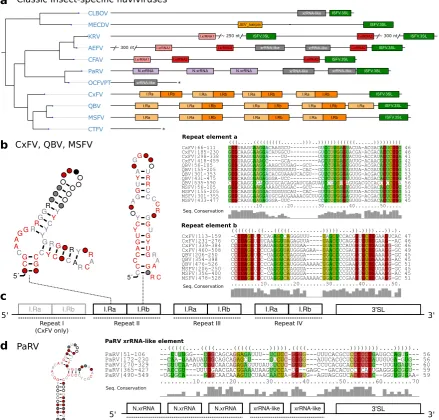
exoribonuclease-resistant RNAs in Cell fusing agent virus (CFAV), and provided evidence for a duplicated set of homologous structures in Aedes flavivirus (AEFV) and Kamiti river virus (KRV). We constructed initial alignments from the reported sequences in this clade inAedesspp. associated viruses, resulting in two seed alignments, termed I.xrRNA1 and I.xrRNA2 (Fig.2c). For both elements, seed CMs were iteratively built from structurallocARNAalignments. Minor manual adjustments to the alignments were required here, since the predicted consensus structures diverged slightly from the published SHAPE-guided prediction. Both models were then employed to search for additional high confidence hits within other isolates of CFAV, AEFV and KRV which were subsequently added to the seed alignments.
Screening the entire set of flavivirus 3’UTRs revealed that both ISFV xrRNA elements, I.xrRNA1 and I.xrRNA2, are only found in CFAV, AEFV and KRV, i.e., species initially used for the construction of the respective CMs. Furthermore, also in terms of pure structural conservation, no reliable hits in any other ISFV species could be obtained with any of these CMs (Fig.4a). This suggests that both ISFV xrRNAs may represent a specialized class of xrRNA elements only present in CFAV, AEFV and KRV. The 3’UTR of KRV is unique among all known flaviviruses because it harbors an additional copy of the terminal 3’ stem-loop element 600 nts upstream of the actual 3’-terminus, supporting previous reports that the KRV 3’UTR has undergone a full duplication during its evolution [59].
3.3.2. Conserved structures inCulex-associated cISFVs
The second distinct clade of cISFVs includes Culex flavivirus (CxFV), Quang Binh virus (QBV), Mosquito flavivirus (MSFV), Palm Creek virus (PCV), Culex theileri flavivirus (CTFV) as well as a few other species with only partial genome sequence availability [9] and is associated withCulexspp. vectors. An interesting observation in this clade is that no other CM from any of the four ecologic flavivirus groups shows a hits, not even with remote sequence or structure conservation. We therefore set out to produce a a high quality structural alignment of the complete 3’UTRs of CxFV, QBV and MSFV. Consensus structure folding of the full alignment revealed each species to harbor 3-4 repeats of two highly conserved elements supported by multiple co-varying base pairs (Fig.4b, c). We termed these “Repeat element a/b”, respectively (Ra and Rb). Both elements, while strongly conserving their folds, show highly variable loop regions as well as weak sequence conservation in the case of the Ra element. Structure conservation and occurrence in multiple copies, as typically seen with other exoribonuclease-stalling elements, hints towards possible functional importance. These results complement earlier reports of sequence repeats in the 3’UTR of CxFV [60] with the identification of a quadruplicated pair of conserved structures.
3.3.3. Diverged 3’UTR architecture in many cISFVs
Interestingly, a screen of all available CMs in Parramatta River virus (PaRV) revealed five xrRNA-like elements (Fig.4a), with elements 1-3 sharing sequence and structure properties with NKV xrRNAs (Section3.5), while elements 4 and 5 only conserve N.xrRNAs structure. All five hits can be structurally aligned into a consistent consensus structure (Fig.4d), despite the overall weak sequence consensus.
Our data suggests that the 3’UTRs of cISFVs, in contrast to TBFVs (Section 3.2and dISFVs (Section3.4), do not appear to have a consistent architectural organization. In agreement with the cISFV phylogenetic subtree (Fig.1) we constitute three diverged groups with common 3’UTR organization that conform to their respective sub-clades: (i) CFAV-AEFV-KRV, each with two instances of xrRNAs, (ii) CxFV-QBV-MSFV with 3-4 copies of I.DB/I.SL elements and (iii) PaRV with 4-5 copies of xrRNA like structures. Although no full 3’UTR sequences are available for the phylogenetically closest relatives of PaRV, HANV and OCFVPT, an xrRNA-like element in the small available fragment (syntenic to PaRV UTR) of OCFVPT 3’UTR suggests that both viruses might be organized in a similar manner, as supported by earlier reports that these viruses should be classified within the same species [1]. For CLBOV and MECDV, no clear pattern of conserved elements can be identified with our CMs. Both viruses either employ an entirely different class of elements or might not require capability for exoribonuclease stalling at all. The only element shared universally among all cISFVs is the 3’-terminal stem-loop, although cISFVs seem to diverge from other flaviviruses here, indicated by the inability of Rfam model RF00185 (Flavivirus CRE) to reliably annotate any cISFV 3’UTR.
3.4. Dual-host affiliated insect-specific flaviviruses
Isolated almost exclusively from mosquitoes, dISFVs do not seem to infect vertebrate cells, despite their phylogenetic proximity to MBFVs (Fig.1). This association is reflected by good hits of the Rfam covariance models RF00525 (Flavivirus DB element) and RF00465 (Japanese encephalitis virus hairpin structure) in all dISFV isolates studied here (Fig.5). Interestingly, we could not find evidence for any sequences or structures homologous to tick-borne or other insect-specific flaviviruses. In this line, our data is in good agreement with the phylogenetic location of these viruses, which share ancestral roots with MBFVs [10].
An unusual species within this group is Ecuador Paraiso Escondido virus (EPEV), which has been isolated from New World sandflies and has been classified as insect-specific virus. EPEV phylogenetically appears at the root of the Entebbe bat virus group (ENTVG), a clade comprised of the three NKVs Entebbe bat virus (ENTV), Sokoluk virus (SOKV) and Yokose virus (YOKV). While all of these viruses contain homologs of conserved stem-loop (SL) and dumbbell (DB) elements found in MBFVs, ENTVG species may have lost their vector dependence [1].
3.5. No-known-vector flaviviruses
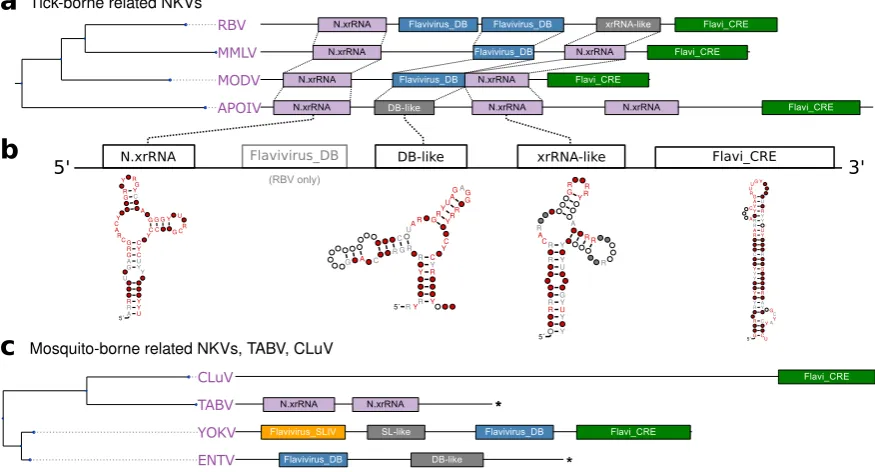
Rather than forming a monophyletic group, the no-known-vector flaviviruses can be separated into two distinct lineages, which are closely related to either TBFVs or MBFVs, respectively (Fig.1). Two additional NKVs, Tamana bat virus (TABV) and Cyclopterus lumpus virus (CLuV), are phylogenetically distant and serve as an outgroup to all flaviviruses. In analogy to the procedure outlined above for TBFVs (Section3.2) and ISFVs (Section3.3), we built a CM for experimentally verified xrRNAs in tick-borne related NKVs, termed N.xrRNA.
We found multiple hits of this CM at various loci within the 3’UTRs of tick-borne related NKVs, indicating that these species, in contrast to TBFVs, do not conserve a common 3’UTR architecture (Fig. 6a). Surprisingly, we could identify several high-quality hits of the Rfam model RF00525 (Flavivirus DB element), an element typically found in MBFVs, in Rio Bravo virus (RBV), Montana myotis leukoencephalitis virus (MMLV) and Modoc virus (MODV). This is in so far remarkable as there is no evidence for conservation of this element in TBFVs, which phylogenetically cluster with this clade of NKVs. This element might have been introduced by an ancestral recombination event. Alternatively, conservation of an MBFV element in NKVs might be indicative of an association to an unknown vector, in agreement with the hypothesis that vector specificity is mediated by characteristic 3’UTR elements [19].
(SOKV), we could annotate typical MBFV elements in the next relatives Entebbe bat virus (ENTV) and Yokose virus (YOKV), as proposed previously [32].
3.6. A generalized xrRNA structure
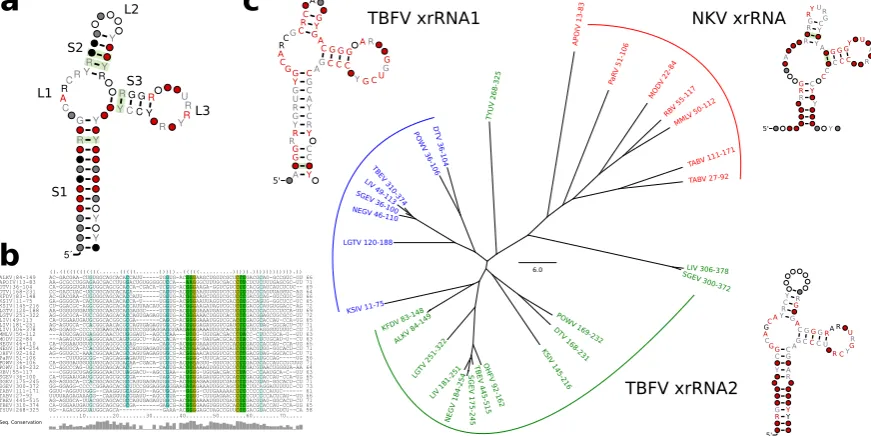
Earlier work suggested that xrRNAs from TBFVs and tick-borne related NKVs fall into a more general structural class of xrRNAs [33]. Following this line of reasoning, we investigated whether all high confidence hits obtained with our TBFV and NKV CMs could be assembled into one coherent CM that conserves the xrRNA-typical fold. A further advantage of a generalized CM would be higher sensitivity, allowing for identification of common features and eventually lead to annotation of previously unannotated xrRNAs.
Structural alignment and consensus structure prediction revealed all high confidence hits to fold into a common secondary structure (Fig.7a, b). While most of the consensus structure is characterized by low sequence conservation, stem 3 (S3) and loop 1 (L1) show medium to high degree of sequence conservation. The length of all stems is well conserved, although both major loop regions L2 and L3 show large fluctuations, with the length of L3 being de facto constant and L2 showing a high degree of flexibility.
We further investigated whether any high confidence hits from I.xrRNA1/2 in cISFVs could be aligned to the generalized xrRNA model. Although both cISFV xrRNAs (Fig.2c) bear some similarity to the generalized model , in particular to S3 and L3, we were not able to build a common alignment or consensus structure. Despite seemingly similar shape, our data also suggests that cISFV xrRNAs form a separate xrRNA subclass, unrelated to MBFV xrRNAs. In particular, we could not obtain hits of Rfam CMs (which can be seen as representatives of MBFV elements) in cISFVs, nor could we confirm any hits of cISFV-specific elements in MBFVs.
In addition to learning xrRNA features, a more generalized CM enabled us to detect xrRNA-like structures (indicated as such in all annotation plots), that could not be found previously.
4. Discussion
Mediated gRNA decay in the form of exoribonuclease resistance seems to be a pervasive strategy employed by viruses to circumvent host immune responses. Evidence of sfRNA production following incomplete Xrn1 degradation has not only been observed in different members of the Flavivirus
genus [61], but also in other species of theFlaviviridaefamily, however, with major differences in xrRNA structure and sfRNA characteristics. While MBFV produce a 300-500nt sfRNA that corresponds to degradation products of the gRNA 3’UTR, hepaciviruses and pestiviruses produce a long subgenomic RNA whose 5’ end is located within the first 130nt of the viral gRNA [62].
Moreover, recent studies have identified xrRNA functionality in several phylogenetically distant RNA viruses, such as animal-infecting, segmented viruses of theBunyaviridaeandArenavividae[63] families, as well as plant-infecting viruses of theTombusuviridaeand Luteoviridaefamilies [64,65]. The interesting question whether exoribonucleases other than Xrn1 would be blocked as well has recently been answered. MacFaddenet al.[33] could show that both RNAse J1 and Dxo1 are stalled by MBFV xrRNAs, thereby demonstrating the general nature of this structure-induced blocking mechanism. These novel findings, together with previous knowledge of Xrn1 stalling in segmented plant viruses [66,67] provide evidence for a convergent evolution scenario where xrRNAs depend on a specific folded RNA structure and form a distinct class of functional RNAs.
In this contribution we set out to identify homologs of known exoribonuclease stalling elements
and novel conserved structures. To this end, we computationally characterized homologs of
experimentally verified xrRNA in tick-borne and no-known vector viruses that seem to form a coherent class of RNA structures with capability to stall exoribonucleases (T.xrRNA1/2, N.xrRNA). Likewise, we identified another class of xrRNAs in classic insect-specific flaviviruses (I.xrRNA1/2) which appears to be only distantly related to the former class. In the same line, we predicted a set of novel conserved elements in cISFVs that appear in quadruples and do not coincide with other insect-specific elements (I.Ra,I.Rb).
While we did not focus on studying the evolutionary history of these groups of elements in detail, our data suggests that many elements share ancestral roots. This is supported by the observation that at least the tick-borne, no-known-vector andAedesspp. associated xrRNAs fold into a similar Y-shaped substructure, although the exact fold varies significantly among individual species.
We compiled a set of covariance models that can be used for rapid screening assays in the identification and characterization of novel flaviviruses. All models are available from GitHub via
https://github.com/mtw/ITNFV-Data.
A major problem is the limited availability of diverse 3’UTR sequence data for many viruses analyzed here, particularly within cISFVs. Many novel ISFVs have previously been discovered, but 3’UTR sequences were only available for a subset of them. Future studies are required to shed more light on the evolutionary history of 3’UTR evolution in flaviviruses.
Author Contributions:MTW conceived the study. RO and MTW analyzed the data, characterized conserved RNA elements and performed phylogenetic studies. All authors contributed to writing the paper and approved of the submitted version.
Funding:This work was funded in part by the Doktoratskolleg RNA Biology at Univ. Vienna and the Austrian Science Fund (SFB F43, I-1303).
Conflicts of Interest:The authors declare no conflict of interest.
Appendix A. Data set analyzed in this study
References
1. Kuno, G.; Chang, G.J.J.; Tsuchiya, K.R.; Karabatsos, N.; Cropp, C.B. Phylogeny of the GenusFlavivirus. J Virol1998,72, 73–83.
2. Gaunt, M.W.; Sall, A.A.; de Lamballerie, X.; Falconar, A.K.; Dzhivanian, T.I.; Gould, E.A. Phylogenetic relationships of flaviviruses correlate with their epidemiology, disease association and biogeography. J Gen Virol2001,82, 1867–1876.
3. Vasilakis, N.; Weaver, S.C. Flavivirus transmission focusing on Zika. Curr Opin Virol2017,22, 30–35. 4. Barrows, N.J.; Campos, R.K.; Liao, K.C.; Prasanth, K.R.; Soto-Acosta, R.; Yeh, S.C.; Schott-Lerner, G.;
Pompon, J.; Sessions, O.M.; Bradrick, S.S.; Garcia-Blanco, M.A. Biochemistry and Molecular Biology of Flaviviruses.Chem Rev2018,118, 4448–4482.
5. Kellman, E.; Offerdahl, D.; Melik, W.; Bloom, M. Viral Determinants of Virulence in Tick-Borne Flaviviruses.
Viruses2018,10, 329.
6. Braack, L.; de Almeida, A.P.G.; Cornel, A.J.; Swanepoel, R.; De Jager, C. Mosquito-borne arboviruses of African origin: review of key viruses and vectors.Parasite Vector2018,11, 29.
7. Gritsun, T.; Lashkevich, V.; Gould, E. Tick-borne encephalitis.Antivir Res2003,57, 129–146.
8. Guzman, H.; Contreras-Gutierrez, M.A.; da Rosa, A.P.T.; Nunes, M.R.; Cardoso, J.F.; Popov, V.L.; Young, K.I.; Savit, C.; Wood, T.G.; Widen, S.G.; others. Characterization of three new insect-specific flaviviruses: their relationship to the mosquito-borne flavivirus pathogens.Am J Trop Med Hyg2018,98, 410–419. 9. Blitvich, B.; Firth, A. Insect-Specific Flaviviruses: A Systematic Review of Their Discovery, Host Range,
Mode of Transmission, Superinfection Exclusion Potential and Genomic Organization. Viruses2015,
10. Alkan, C.; Zapata, S.; Bichaud, L.; Moureau, G.; Lemey, P.; Firth, A.E.; Gritsun, T.S.; Gould, E.A.; de Lamballerie, X.; Depaquit, J.; others. Ecuador Paraiso Escondido virus, a new flavivirus isolated from New World sandflies in Ecuador is the first representative of a novel clade in the genusFlavivirus. J Virol2015, pp. JVI–01543.
11. Halbach, R.; Junglen, S.; van Rij, R.P. Mosquito-specific and mosquito-borne viruses: evolution, infection, and host defense.Curr Opin Insect science2017,22, 16–27.
12. Bolling, B.; Weaver, S.; Tesh, R.; Vasilakis, N. Insect-Specific Virus Discovery: Significance for the Arbovirus Community. Viruses2015,7, 4911–4928.
13. Blitvich, B.; Firth, A. A Review of Flaviviruses that Have No Known Arthropod Vector. Viruses2017,9, 154. 14. Filomatori, C.V.; Lodeiro, M.F.; Alvarez, D.E.; Samsa, M.M.; Pietrasanta, L.; Gamarnik, A.V. A 5’ RNA
element promotes dengue virus RNA synthesis on a circular genome. Gene Dev2006,20, 2238–2249. 15. Alvarez, D.E.; Ezcurra, A.L.D.L.; Fucito, S.; Gamarnik, A.V. Role of RNA structures present at the 3’ UTR
of dengue virus on translation, RNA synthesis, and viral replication. Virology2005,339, 200–212.
16. Manzano, M.; Reichert, E.D.; Polo, S.; Falgout, B.; Kasprzak, W.; Shapiro, B.A.; Padmanabhan, R. Identification of Cis-Acting Elements in the 3’-Untranslated Region of the Dengue Virus Type 2 RNA That Modulate Translation and Replication. J Biol Chem2011, pp. jbc–M111.
17. Brinton, M.A.; Basu, M. Functions of the 3’ and 5’ genome RNA regions of members of the genus Flavivirus.
Virus Res2015,206, 108–119.
18. Ng, W.; Soto-Acosta, R.; Bradrick, S.; Garcia-Blanco, M.; Ooi, E. The 5’ and 3’ untranslated regions of the flaviviral genome. Viruses2017,9, 137.
19. Villordo, S.M.; Carballeda, J.M.; Filomatori, C.V.; Gamarnik, A.V. RNA Structure Duplications and Flavivirus Host Adaptation. Trends Microbiol2016,24, 270–283.
20. de Borba, L.; Villordo, S.M.; Marsico, F.L.; Carballeda, J.M.; Filomatori, C.V.; Gebhard, L.G.; Pallarés, H.M.; Lequime, S.; Lambrechts, L.; Vargas, I.S.; Blair, C.D.; Gamarnik, A.V. RNA Structure Duplication in the Dengue Virus 3’ UTR: Redundancy or Host Specificity?mBio2019,10, e02506–18.
21. de Bernardi Schneider, A.; Wolfinger, M.T. Musashi binding elements in Zika and related Flavivirus 3’UTRs: A comparative studyin silico. bioRxiv2018. doi:10.1101/407833.
22. Rice, C.M.; Lenches, E.M.; Eddy, S.R.; Shin, S.; Sheets, R.; Strauss, J. Nucleotide sequence of yellow fever virus: implications for flavivirus gene expression and evolution.Science1985,229, 726–733.
23. Hahn, C.S.; Hahn, Y.S.; Rice, C.M.; Lee, E.; Dalgarno, L.; Strauss, E.G.; Strauss, J.H. Conserved elements in the 3’ untranslated region of flavivirus RNAs and potential cyclization sequences. J Mol Biol1987,
198, 33–41.
24. Villordo, S.M.; Alvarez, D.E.; Gamarnik, A.V. A balance between circular and linear forms of the dengue virus genome is crucial for viral replication.RNA2010,16, 2325–2335.
25. de Borba, L.; Villordo, S.M.; Iglesias, N.G.; Filomatori, C.V.; Gebhard, L.G.; Gamarnik, A.V. Overlapping local and long-range RNA-RNA interactions modulate dengue virus genome cyclization and replication. J Virol2015,89, 3430–3437.
26. Pijlman, G.P.; Funk, A.; Kondratieva, N.; Leung, J.; Torres, S.; Van der Aa, L.; Liu, W.J.; Palmenberg, A.C.; Shi, P.Y.; Hall, R.A.; others. A highly structured, nuclease-resistant, noncoding RNA produced by flaviviruses is required for pathogenicity.Cell Host & Microbe2008,4, 579–591.
27. Akiyama, B.M.; Eiler, D.; Kieft, J.S. Structured RNAs that evade or confound exonucleases: function follows form.Curr Opin Struc Biol2016,36, 40–47.
28. Moon, S.L.; Anderson, J.R.; Kumagai, Y.; Wilusz, C.J.; Akira, S.; Khromykh, A.A.; Wilusz, J. A noncoding RNA produced by arthropod-borne flaviviruses inhibits the cellular exoribonuclease XRN1 and alters host mRNA stability.RNA2012,18, 2029–2040. doi:10.1261/rna.034330.112.
29. Roby, J.A.; Pijlman, G.P.; Wilusz, J.; Khromykh, A.A. Noncoding subgenomic flavivirus RNA: multiple functions in West Nile virus pathogenesis and modulation of host responses. Viruses2014,6, 404–427. 30. Jones, C.I.; Zabolotskaya, M.V.; Newbury, S.F. The 5’->3’ exoribonuclease Xrn1/Pacman and its functions
in cellular processes and development.Wiley Interdisciplinary Reviews: RNA2012,3, 455–468.
32. Kieft, J.S.; Rabe, J.L.; Chapman, E.G. New hypotheses derived from the structure of a flaviviral Xrn1-resistant RNA: Conservation, folding, and host adaptation.RNA Biology2015,12, 1169–1177. 33. MacFadden, A.; O’Donoghue, Z.; Silva, P.A.; Chapman, E.G.; Olsthoorn, R.C.; Sterken, M.G.; Pijlman,
G.P.; Bredenbeek, P.J.; Kieft, J.S. Mechanism and structural diversity of exoribonuclease-resistant RNA structures in flaviviral RNAs. Nat Commun2018,9, 119.
34. Hussain, M.; Torres, S.; Schnettler, E.; Funk, A.; Grundhoff, A.; Pijlman, G.P.; Khromykh, A.A.; Asgari, S. West Nile virus encodes a microRNA-like small RNA in the 3’ untranslated region which up-regulates GATA4 mRNA and facilitates virus replication in mosquito cells. Nucleic acids res2012,40, 2210–2223. 35. Schuessler, A.; Funk, A.; Lazear, H.M.; Cooper, D.A.; Torres, S.; Daffis, S.; Jha, B.K.; Kumagai, Y.; Takeuchi,
O.; Hertzog, P.; others. West Nile virus noncoding subgenomic RNA contributes to viral evasion of the type I interferon-mediated antiviral response. J Virol2012,86, 5708–5718.
36. Bidet, K.; Dadlani, D.; Garcia-Blanco, M.A. G3BP1, G3BP2 and CAPRIN1 are required for translation of interferon stimulated mRNAs and are targeted by a dengue virus non-coding RNA. PLoS Pathog2014,
10, e1004242.
37. Lorenz, R.; Wolfinger, M.T.; Tanzer, A.; Hofacker, I.L. Predicting RNA Structures from Sequence and Probing Data. Methods2016.
38. Funk, A.; Truong, K.; Nagasaki, T.; Torres, S.; Floden, N.; Melian, E.B.; Edmonds, J.; Dong, H.; Shi, P.Y.; Khromykh, A.A. RNA structures required for production of subgenomic flavivirus RNA. J Virol2010,
84, 11407–11417.
39. Silva, P.A.; Pereira, C.F.; Dalebout, T.J.; Spaan, W.J.; Bredenbeek, P.J. An RNA pseudoknot is required for production of yellow fever virus subgenomic RNA by the host nuclease XRN1.J Virol2010,84, 11395–11406. 40. Sztuba-Solinska, J.; Teramoto, T.; Rausch, J.W.; Shapiro, B.A.; Padmanabhan, R.; Le Grice, S.F. Structural
complexity of Dengue virus untranslated regions: cis-acting RNA motifs and pseudoknot interactions modulating functionality of the viral genome.Nucleic acids res2013, p. gkt203.
41. Chapman, E.G.; Costantino, D.A.; Rabe, J.L.; Moon, S.L.; Wilusz, J.; Nix, J.C.; Kieft, J.S. The structural basis of pathogenic subgenomic flavivirus RNA (sfRNA) production. Science2014,344, 307–310.
42. Akiyama, B.M.; Laurence, H.M.; Massey, A.R.; Costantino, D.A.; Xie, X.; Yang, Y.; Shi, P.Y.; Nix, J.C.; Beckham, J.D.; Kieft, J.S. Zika virus produces noncoding RNAs using a multi-pseudoknot structure that confounds a cellular exonuclease. Science2016, p. aah3963.
43. Rauscher, S.; Flamm, C.; Mandl, C.W.; Heinz, F.X.; Stadler, P.F. Secondary structure of the 3’-noncoding region of flavivirus genomes: comparative analysis of base pairing probabilities.RNA1997,3, 779–791. 44. Hofacker, I.L.; Fekete, M.; Flamm, C.; Huynen, M.A.; Rauscher, S.; Stolorz, P.E.; Stadler, P.F. Automatic
detection of conserved RNA structure elements in complete RNA virus genomes. Nucleic acid res1998,
26, 3825–3836.
45. Witwer, C.; Rauscher, S.; Hofacker, I.L.; Stadler, P.F. Conserved RNA secondary structures in Picornaviridae genomes. Nucleic acid res2001,29, 5079–5089.
46. Hofacker, I.L.; Stadler, P.F.; Stocsits, R.R. Conserved RNA secondary structures in viral genomes: a survey.
Bioinformatics2004,20, 1495–1499.
47. Thurner, C.; Witwer, C.; Hofacker, I.L.; Stadler, P.F. Conserved RNA secondary structures in Flaviviridae genomes. J Gen Virol2004,85, 1113–1124.
48. Katoh, K.; Standley, D.M. MAFFT multiple sequence alignment software version 7: improvements in performance and usability.Mol Biol Evol2013,30, 772–780.
49. Nguyen, L.T.; Schmidt, H.A.; von Haeseler, A.; Minh, B.Q. IQ-TREE: a fast and effective stochastic algorithm for estimating maximum-likelihood phylogenies. Mol biol Evol2014,32, 268–274.
50. Nawrocki, E.P.; Eddy, S.R. Infernal 1.1: 100-fold Faster RNA Homology Searches. Bioinformatics2013,
29, 2933–2935. doi:10.1093/bioinformatics/btt509.
51. Waldl, M.; Thiel, B.C.; Ochsenreiter, R.; Holzenleiter, A.; de Araujo Oliveira, J.V.; Walter, M.E.M.; Wolfinger, M.T.; Stadler, P.F. TERribly Difficult: Searching for Telomerase RNAs in Saccharomycetes. Genes2018,9. doi:10.3390/genes9080372.
52. Will, S.; Reiche, K.; Hofacker, I.L.; Stadler, P.F.; Backofen, R. Inferring noncoding RNA families and classes by means of genome-scale structure-based clustering.PLoS Comp Biol2007,3, e65.
54. Wolfinger, M.T.; Fallmann, J.; Eggenhofer, F.; Amman, F. ViennaNGS: A toolbox for building efficient next-generation sequencing analysis pipelines.F1000Research2015,4. doi:10.12688/f1000research.6157.2. 55. Wolfinger, M.T. Bio::RNA::RNAaliSplit 0.09, 2019. https://github.com/mtw/Bio-RNA-RNAaliSplit,
doi:10.5281/zenodo.2532826.
56. Weinberg, Z.; Breaker, R.R. R2R-software to speed the depiction of aesthetic consensus RNA secondary structures. BMC Bioinformatics2011,12, 3.
57. Gritsun, T.; Gould, E. Origin and Evolution of 3’UTR of Flaviviruses: Long Direct Repeats as A Basis for the Formation of Secondary Structures and Their Significance for Virus Transmission. Adv Virus Res2006,
69, 203–248.
58. Gritsun, D.J.; Jones, I.M.; Gould, E.A.; Gritsun, T.S. Molecular Archaeology of Flaviviridae Untranslated Regions: Duplicated RNA Structures in the Replication Enhancer of Flaviviruses and Pestiviruses Emerged via Convergent Evolution.PLoS One2014,9, e92056.
59. Gritsun, T.; Gould, E. The 3’ untranslated regions of Kamiti River virus and Cell fusing agent virus originated by self-duplication. J Gen Virol2006,87, 2615–2619.
60. Hoshino, K.; Isawa, H.; Tsuda, Y.; Yano, K.; Sasaki, T.; Yuda, M.; Takasaki, T.; Kobayashi, M.; Sawabe, K. Genetic characterization of a new insect flavivirus isolated fromCulex pipiensmosquito in Japan. Virology
2007,359, 405–414.
61. Clarke, B.; Roby, J.; Slonchak, A.; Khromykh, A. Functional non-coding RNAs derived from the flavivirus 3’ untranslated region. Virus Res2015,206, 53–61.
62. Moon, S.L.; Blackinton, J.G.; Anderson, J.R.; Dozier, M.K.; Dodd, B.J.; Keene, J.D.; Wilusz, C.J.; Bradrick, S.S.; Wilusz, J. X1 Stalling in the 5’UTR of Hepatitis C Virus and Bovine Viral Diarrhea Virus Is Associated with Dysregulated Host mRNA Stability. PLoS Pathog2015,11, e1004708.
63. Charley, P.A.; Wilusz, C.J.; Wilusz, J. Identification of Phlebovirus and Arenavirus RNA sequences that stall and repress the exoribonuclease XRN1. J Biol Chem2018,293, 285–295.
64. Steckelberg, A.L.; Akiyama, B.M.; Costantino, D.A.; Sit, T.L.; Nix, J.C.; Kieft, J.S. A folded viral noncoding RNA blocks host cell exoribonucleases through a conformationally dynamic RNA structure.Proc Natl Acad Sci USA2018, p. 201802429.
65. Steckelberg, A.L.; Vicens, Q.; Kieft, J.S. Pervasiveness of exoribonuclease-resistant RNAs in plant viruses suggests new roles for these conserved RNA structures. bioRxiv2018, p. 433672.
66. Iwakawa, H.o.; Mizumoto, H.; Nagano, H.; Imoto, Y.; Takigawa, K.; Sarawaneeyaruk, S.; Kaido, M.; Mise, K.; Okuno, T. A viral noncoding RNA generated by cis-element-mediated protection against 5’- 3’ RNA decay represses both cap-independent and cap-dependent translation. J Virol2008,82, 10162–10174. 67. Flobinus, A.; Hleibieh, K.; Klein, E.; Ratti, C.; Bouzoubaa, S.; Gilmer, D. A viral noncoding RNA
complements a weakened viral RNA silencing suppressor and promotes efficient systemic host infection.
C C CC A G U YC Y AG G U Y A GG U R R C C C C R G G U G Y U GR A A G R C 5´ C G C A AG
GRR GG R Y Y C Y Y
G RG
RY R A C R A C C Y C C G 5´
CxFV, QBV, MSFV
b
CLBOV xrRNA-like ISFV.3SL
MECDV JEV_hairpin ISFV.3SL
KRV I.xrRNA1 ISFV.3SL I.xrRNA2 ISFV.3SL
AEFV I.xrRNA1 I.xrRNA2 xrRNA-like xrRNA-like I.xrRNA2 ISFV.3SL
CFAV I.xrRNA1 I.xrRNA2 I.xrRNA2 ISFV.3SL
PaRV N.xrRNA N.xrRNA N.xrRNA xrRNA-like xrRNA-like ISFV.3SL
OCFVPT xrRNA-like
CxFV I.Ra I.Rb ISFV.3SL
QBV ISFV.3SL
MSFV ISFV.3SL
CTFV ~ 300 nt
~ 250 nt ~ 300 nt
a
* * Y Y G G C A RCARR G U
Y C
Y
GGG U A C G C Y C C C C C C G G 5´ ..(((((....((((...(((((...))))).((((...))))))))....)))))..
PaRV|51-106 ---CUUUGG---CGGCAGCAGGAGAUUU--UCUCC-GGGG---UUUCACGCUCCCCCCGAUGCCAGUG--- 56
PaRV|172-230 --CAA-UAAAUAUGGCAGCAGAGCU---GUCUC-GGGG---AUUCACGCUCCCCCCAUUGUGA-GUG-- 56
PaRV|270-329 --GUUCAA-AUCCGGCAACAGAGAGUUUAUGUCUC-GGGG---CCUCACGCACCCCCCG--UUGUGAGU-- 60
PaRV|365-427 --ACCGU---UUUGGAACGACGGAAAUAAGUUCCA-UG--GAGC--GACACUCCCCACUGAGGGGCGGU-- 59
PaRV|490-549 -UGUGCA---GGGCAACAAAGUUCUAACAACUA-GGGUG--AGUAGCGUCACCCCCC--GGUUGUGAA- 59
...10...20...30...40...50...60...70 Seq. Conservation
Seq. Conservation
(((((((.((...(((((...)))))....)).))))...)).).
CxFV|113-159 -CCCAGUUCCCAGAGCCAGGGUUU----UAGCUCCACGGUGCUGGAAGUCAC 47
CxFV|231-276 CCCCAGUUCUCAAGGUUAGAGUUA----UAACCUCAGGGUGUUGGAAG--AC 46
CxFV|339-384 CCCCAGUCCGAUAGGUCAUGGAA---UGACCCCAUGGUGCUGAGAGG-GC 46
CxFV|460-508 CCCCAGUCCCCCAGGUUAUGGGAGAA--UAACCCCGACGUGCUGGAAGG-GC 49
QBV|206-250 CCCCAGUUCC-UAGGUCCAGGGA---GGGCCCCGUGGCGCUGAAAGG-GC 45
QBV|354-398 CCCCAGUCCC-CAGGUCAGGGUA---UGACUCCGUGGUGUUGAAAGG-AC 45
QBV|476-526 CCCCAGUCCCCCAGGUCAUGGGAAAAACUGACCCCGAAGUGCUGCAAGG-GC 51
MSFV|206-250 CCCCAGUUCC-UAGGUCCAGGUA---GGAUCCCGUGGCGCUGUGAGG-GC 45
MSFV|356-400 CCCCAGUCCC-CAGGUCAGGGUA---UGACCCCGUGGUGUUGAAAGG-AC 45
MSFV|478-528 CCCCAGUCCCCUAGGUCAUGGGAAAAACUGACCCCGAAGUGCUGCAAGG-GC 51
...10...20...30...40...50. Seq. Conservation
(((...(((((((((...)))..))))))((((((...))))))))) CxFV|66-111 CCGUAAGGAAGGACAAGGCU---GUCCUUGAGUACUA-ACGACACUCCGG 46 CxFV|185-230 GCGCAAGGAAGGACAUGGCU---GUCCUUGGGUACGA-ACGACACCCCGC 46 CxFV|298-338 UCGCAAGGGAGGA----UU---UUCCUCGGGUACUG-ACCAUACCCCGA 41 CxFV|418-459 CCGUAAGGAAAGC----GCA---AGCUUUGAGCAUUG-ACAACGCUCCGG 42 QBV|56-105 GCGCAAGGAAGGGAAGCUUGAG--GCU---ACCUUAGGUGGUG-ACGACACCUCGC 50 QBV|155-205 CCGCAAGGAGGGGUGUGUGUUU--CAC--GCCCCUGGGAGUUA-ACGAUUCUCCGG 51 QBV|301-353 GCGCAAGGAAGGACACGUAAAUCACGU--GUUCUUGGGAGUUG-ACGACUCUCCGC 53 QBV|431-475 CCGCAAGGGAGAGGGA-UCC---CCUCUCGGGUUUGG-ACGACACCCCGG 45 QBV|535-590 CCGCAAGGUGAGGGCGCACAGGAUCGAGUAUCCGGGUGAGUGACGCCACCCCCCGA 56 MSFV|56-105 GCGCAAGGAAGGAAAGCUGGAC--GCU---ACCUUAGGUGGUG-ACGACACCUCGC 50 MSFV|155-205 CCGCAAGGAGGGACGUGUGCAU--CAC--GUUUCUGGGAGUUA-ACGGCUCUCCGG 51 MSFV|301-355 GCGCAAGGAAGGAUGCGAUGAAAACGCUUGUCCUUGGGAGUUG-ACGACUCUCCGC 55 MSFV|433-477 CCGCAAGGGAGAGGGA-UUC---CCUCUCGGGUGUGG-ACGACACCCCGG 45
...10...20...30...40...50...
c
d
5' I.Ra I.Rb 3'SL 3'
Repeat I (CxFV only)
Repeat II Repeat III Repeat IV
I.Ra I.Rb I.Ra I.Rb I.Ra I.Rb
Classic Insect-specific flaviviruses
PaRV
Repeat element a
Repeat element b
3'SL
5' 3'
Elements 1,2,3: NKV-xrRNA like
xrRNA-like xrRNA-like
N.xrRNA
Elements 4,5: xrRNA like
N.xrRNA N.xrRNA
PaRV xrRNA-like element
I.Rb I.Rb I.Rb
I.Ra I.Ra I.Ra I.Ra I.Ra I.Rb I.Rb I.Rb I.Rb I.Rb I.Rb I.Ra I.Ra I.Ra I.Ra I.Ra I.Ra I.Ra
Figure 4. aAnnotated Tree of cISFV 3’UTRs. Asterisks denote incomplete 3’UTR sequences. Species without available 3’UTR are not shown. b Consensus secondary structure plots and structural alignments of CM hits of Repeat a/b elements in CxFV, QBV, and MSFV.cSchematic of the common architecture of CxFV, QBV, and MSFV. Element I-IV refers to the respective repeat of elements. d
R RAG UC A G R C C
AR G
C CA C A G R U A R R G U G C U G Y C U G Y R R 5´ G R G G C R R Y A G C Y
A R R Y R
G AC U AG
G G U U A G
A G G A G A C C C C Y Y R R 5´ Y G G G AAAG
A C C R G A R A Y Y U R RU U Y U CG R C R G G C A CA GR
C
G C
CRA
R A R R U R R Y A A A A A Y A R Y 5´
JEV_hairpin Flavivirus_DB Flavi_CRE
3' 5'
b
...(.(((((...((.(((((...))))))).))))))....
EPEV|10-64 AAAAAGUCAGCCCAGAAAA---UGCCACAACUAAGCUG--UAAGUUGUGCUGGCUGUAA-C 55
EPEV|92-139 AAAGAGUCAGGCCGAGAA---GCCACAC---AGCAAAAGUGUGCUGCCUGUAA-G 48
CHAOV|36-88 UGAGAGUCAGGCCU--AAA---UGCCACCGG-AUGAUA-GUAGACGGUGCUGCCUGCAG-C 53
LAMV|34-86 UGGGAGUCAGGCCU--AAA---UGCCACCGG-AUGAUA-GUAGACGGUGCUGCCUGCAG-C 53
NHUV|78-139 UUUGAGUCAGACCAGGAUGAAACCUGCCACCUCUAUGGAAGCUAAGUGGUGCUGUCUGUAA-G 62
DONV|22-81 UUGCAGUCAGGCCUCACGAAUGUGAGCCACCG-GAUGGGA-CUAGACGGUGCUGCCUGCGC-G 60
MMV|51-110 UUGCAGUCAGGCCUCAAGACAUUGAGCCACCG-GAUGGGA-CUAGACGGUGCUGCCUGCGC-G 60
BJV|68-128 AACGAGUCAGGCC-GGCUUAUGCUUGCCACCUCUAUGGAAACUAGGGGGUGCUGCCUGCGU-G 61
NANV|61-116 AUGAAGUCAGGCCUU-AAG---UGCCACCCGUAUGAGA-CUAUCGGGUGCUGCCUGUCGUC 56
NOUV|61-115 ACGAAGUCAGGCCCU-AAC---GGCCACUCUUAAGAUG-CUAAAGAGUGCUGUCUGUAAG- 55
...10...20...30...40...50...60.. Seq. Conservation:
((((((((((((((..(((((...)))))....)))).)))))...((((...)))))))))...
CHAOV|131-206 GGGGGACACAUGCAC-CCAGC---AGCCCGAGCUGGACAAGGCA-UGUGUACUAGCGGUUAGAGGAGACCCCCCCAAAAAU 76
LAMV|131-206 GAGGGACAUGCAAGC-CCAGG---AGCCCGACCUGGACUACUUG-CAUGUACUAGCGGUUAGAGGAGACCCCCUCAAAAAU 76
NHUV|250-323 AGUGGCUAGCGAAA--UUGGUG-AAGCUAUAACCAA---CUUUG-GCUGGACUAGUGGUUAGAGGAGACCCCACUGCUGAG 74
DONV|141-221 GGGGGCCAGAUGUCAUGUCUCUCAAGCCUAGGAGACACUAGACACUCUGGACUAUCGGUUAGAGGAAACCCCCCCAAAAAU
MMV|171-251 GGGGGCCAGAUGGACUGCUUCUUCAACCUAGGAAGCAAACACCACUCUGGACUAUCGGUUAGAGGAAACCCCCCCAAAAAC
NANV|200-272 GAGGGCCUGGACAA---UGCUA-AAGCUGUAAGCGC---AUUGA-AAAGGACUAGAGGUUAGAGGAGACCCCCUCAUUAUU 73
NOUV|293-347 G---CCCAUCG---CACUG--AAGCUAUAAGGUG---CGGGAAGG-ACUAGAGGUUAGAGGAGACCC--- 55
...10...20...30...40...50...60...70...80 Seq. Conservation:
((((...)))).((((((.((((.((.((.(((..((((((((((..((((...))))...))))))))))..))).)).)).)))).)))))).
EPEV|214-316 CAGGGAAAAGACCGGAGAAACUUCUUGCUUACUCGCAGCAACCACCGAA--AGGCACAGUAUGCCUGAA-ACAUUCGGUGGUUGAUGU-AGUAAACAACCAGUUUCU 103
CHAOV|227-325 UUGGGAA-AGACCAGAGGUACUCGCUGAUUCACCGCCACCAGACUACA---CGGCACAGCGCGCCGGAAAAG---GUAGUUUGGAGGUUGUAAAACAACAAGUA-UC 99
LAMV|227-326 UUGGGAA-AGACCAGAGGUACUCGUUGAUUCACCGCCACCAAACUACA---CGGCACAGCACGCCGAAAAAG---GUAGUUUGGAGGUUGUAAAACAGCAAGUAACU 100
NHUV|345-449 UUGGGAAGAGACCAGAGAUAUGAUGUUGUUUGUCAAUGCUGACAACAGCCAUGGCACAGAGCGCCUGAAGAGAGCUGUUGUUAUAAUUUACAAAAAAUAACAUAU-- 105
DONV|244-342 CUAGGAA-AGACUGGA-GAUACCUUUGGUUCUUCG--ACACUAACUCCUAAUGGCACAGAGCGCCAUAAGAAACGGAGUUAGUAUGG--AAAAAACAUAAGUAUC-- 99
MMV|274-372 CUAGGAA-AGACUGGA-GAUACCUUUGGUUCUUCG--ACAUUAACUCCAAUCGGCACAGAGCGCCGUGGGAAACGGAGUUAAUAUGG--AAAAAACAUAAGUAUC-- 99
NANV|294-395 CAGGGAU-AGACCGGA-GAAAUACACAAUUUCUGGGCACUAAACAACUAC-AAGCACAGAGCGCUUCGAGAAGUAGUUGUUUCUUGACGAGAGAAUAUGUAUAUC-- 102
...10...20...30...40...50...60...70...80...90...100... Seq. Conservation:
a
CHAOV JEV_hairpin Flavivirus_DB Flavi_CRE
LAMV JEV_hairpin Flavivirus_DB Flavi_CRE
NHUV JEV_hairpin Flavivirus_DB Flavi_CRE
DONV JEV_hairpin Flavivirus_DB Flavi_CRE
MMV JEV_hairpin Flavivirus_DB Flavi_CRE
BJV JEV_hairpin DB-like
NANV JEV_hairpin Flavivirus_DB Flavi_CRE
NOUV JEV_hairpin Flavivirus_DB
EPEV JEV_hairpin JEV_hairpin Flavi_CRE
*
*
JEV_hairpin (EPEV only)
c
Dual-host affiliated Insect-specific flaviviruses
Figure 5. aAnnotated Tree of dISFV 3’UTRs. Asterisks denote incomplete 3’UTR sequences. Species without available 3’UTR are not shown.bSchematic Architecture of the dISFV 3’UTR.cStructural alignments and consensus structure plots of dISFV elements.
RBV N.xrRNA Flavivirus_DB Flavivirus_DB xrRNA-like Flavi_CRE
MMLV N.xrRNA Flavivirus_DB N.xrRNA Flavi_CRE
MODV N.xrRNA Flavivirus_DB N.xrRNA Flavi_CRE
APOIV N.xrRNA DB-like N.xrRNA N.xrRNA Flavi_CRE
DB-like xrRNA-like Flavi_CRE
N.xrRNA Flavivirus_DB G R RY Y Y Y Y C RA R R A CYY
A G R UU G Y U R Y Y U Y R G R A YG C Y A Y C CU 5´ RYR
Y R R G R C A G C UA
R GR YU AG A G G R R Y C Y C Y R Y 5´ A R R U G A G R G C R A CY G R YR G Y C A G G G YU
R C G C C Y C Y C U Y Y Y Y U 5´ R R R R C A R G R R R Y A R R R Y Y U G Y U Y Y 5´ Tick-borne related NKVs
CLuV Flavi_CRE
TABV N.xrRNA N.xrRNA
YOKV Flavivirus_SLIV SL-like Flavivirus_DB Flavi_CRE
ENTV Flavivirus_DB DB-like
a
b
c
(RBV only)
Mosquito-borne related NKVs, TABV, CLuV
* *
*
5' 3'
R G C
AR
CR Y R
Y
Y R
RG GR U
R R Y R Y C C Y Y Y Y Y 5´ 6.0
RBV 55-117
DTV 168-23
1
TBEV
445-515
TABV 111-1 71
MMLV 50-11 2 LIV 306-378 LIV 49-113 MOD V 22-84 POWV 36-106 APOIV 13-83 TABV 27-92 TBEV 310-374
KFDV 83-14 8 NEGV 184 -254 LGTV 120-188 NEGV 46-110 SGEV 36-100 OHFV 92-1 62 SGEV 175 -245 ALKV 84-149 DTV 36-104 POWV 169-23 2
LGTV 251-3 22 KSIV 11-75 TYUV 268 -325 LIV 181-251 SGEV 300 -372 KSIV 145-2 16 PaR V 51-106 NKV xrRNA R R G A R RG RYUR
G C Y YA
G G G
Y U A R C C C C C C Y Y Y 5' TBFV xrRNA1 A G G RR Y G R U G Y G G C AR
CGC RC A G Y G A
C G G G AR
G G U C G Y C C C G A C G C A Y C R Y C C Y 5' TBFV xrRNA2 R G Y C G G C A GC
AYR CY RG
G A C GGGRA R U
R G Y C R U C C C G A C G A R Y Y 5'
a
b
c
((.((((((((((((...(((((...)))))..(((((...))))).)))))))))))).)) ALKV|84-149 AC-GACGAA-CUGUGGCAGCACACCAUU---UGGUG-ACGGGAAGCUGGUCGCUCCCGACGCAG-GCCGUC-GU 66 APOIV|13-83 AA-GCGCCUGGAGAGCGACCUUGGACUGUGGGGGUCCA---AAGGGCUUUGCGACCCUUCUCUCUUUGAGCGC-UU 71 DTV|36-104 CA-GGGGGUGAUGUGGCAGCGCACCA-CGACA-UCGUG-ACGGGAAGA-GGUCGUCCCCCACGCAUCAUCUCUC-- 69 DTV|168-231 CC-GACCUAC-UGCGGCAGCACACA---CAGUG-ACGGGAAGUUGGUCGCUCCCGACGCAGUUAGGUC-AG 64 KFDV|83-148 AC-GACGAA-CUGUGGCAGCACACCAUU---UGGUG-ACGGGAAGCUGGUCGCUCCCGACGCAG-GUCGUC-GU 66 KSIV|11-75 GA-GGGGCA-CACUGGCAACACACCA-U---UGGUG-ACGGGAAUUAGGUCGACCCCGCCAGUG-GGCUCC-UC 65 KSIV|145-216 CU-GGACGC-AGGCGGCAGCACACCAUUAACAUCGGUG-ACGGGAAGAUAGUCGCUCCCGACGCAUGUGGACC-AG 72 LGTV|120-188 AA-UGGUGGGAUGCGGCAACGCACGAGGC----UCGUG-ACGGGGAAAUGAUCGCUCCCGACGCACCCCUCCA-UU 69 LGTV|251-322 AG-GGCGCA-UUCCGGCAGCACACCAGUGAGAGUGGUG-ACGGGAAACUGGUCACUCCCGACGGAGCUGCGCC-UU 72 LIV|49-113 CA-UGGAAUGAUGCGGCACGGCGCGA---CAGCG-ACGGGGAAAUGGUCGCACCCGACGCACCAU-CCA-UG 65 LIV|181-251 AG-AGUGCA-CCACGGCAACACGCCAGUGAGAGUGGCG-ACGGGGAGAUGGUCGAUCCCGACGUAG-GGCACU-CU 71 LIV|306-378 AG-GGAGG-CCCCCGGAAGCAUGCUUCCGGGAGGAGGGAAGAGAGAAAUUGGCAGCUCUCUUCAGGGUUUUUC-CU 73 MMLV|50-112 ---AUGCGAGUGAGGGCAACUCUGGGAUU--AGCUCAA---UGGG-UGUGACGACCCUACC-CUUCCGCA-U--UU 63 MODV|22-84 ---AGAGUGUUGAGGGCAACCAGUGGGCU--AGCCACA---UGGG-UAUGACGCACCCACC-CUCUGCAU-U--CU 63 NEGV|46-110 CA-UGGAAUGGUGCGGCAGCGCGCAG---CAGCG-ACGGGGAAAUGGUCGCACCCGACGCACCAU-CCA-UG 65 NEGV|184-254 AG-AGUGCA-CCACGGCAGCACGCCAGUGAGAGUGGCG-ACGGGAGAAUGGUCGAUCCCGACGUGG-GGCACU-CU 71 OHFV|92-162 AG-GGUGCC-AAACGGCAACACGCCAGUGAGAGUGGCG-ACGGGAACAUGGUCGCUCCCGACGUAG-GGCACU-CU 71 PaRV|51-106 ---CUUUGGCGG--CAGCAGGAGAUUU----UCUCC---GGGG-UUUCACGCUCCCCCCGAUGCCAG---UG 56 POWV|36-106 CA-GGGGAUGGUGUGGCAGCGCACAA-CGACA-UCGUG-ACGGGAGUG-GGUCGCCCCCGACGCACCAUCCUCUUG 71 POWV|169-232 CU-GGCCCAG-UGCGGCAGCACACU---CAGUG-ACGGGAAAGUGGUCGCUCCCGACGUAACUGGGUA-AA 64 RBV|55-117 ---CGGUGCUGAGGGGCAACUCUAGGACU--AGCCUAA---UGGG-UGUGACGACCCUACC-CCAAUGCA-C--UU 63 SGEV|36-100 CA-UGGAAUGAUGCGGCAGCGCGCGA---UAGCG-ACGGGGAGAUGGUCGCACCCGACGCACCAU-CCA-UG 65 SGEV|175-245 AG-AGUGCA-CCACGGCAGCACGCCAGUGAGAGUGGCG-ACGGGAGAAUGGUCGAUCCCGACGUAG-GGCACU-CU 71 SGEV|300-372 GG-GGAGG-CCCCCGGAAGCACGCUUCCGGGAGGAGGGAAGAGAGAAAUUGGCAGCUCUCUUCAGGAUUUUUC-CU 73 TABV|111-171 GGUU-AGGUUUGGG--CAAGGUGCAGGUU--AGCUGCA---GGGG-CUUGAAAAACCCCCCCCCCCAUUC--- 61 TABV|27-92 UUUUAAGAGAAAGG--CAAGGUACGGAUU--AGCCGUA---GGGG-CUUGAGAACCCCCCCUCCCCACUCAU--UU 66 TBEV|445-515 AG-AGUGCA-UUACGGCAGCACGCCAGUGAGAGUGGCG-ACGGGAAAAUGGUCGAUCCCGACGUAG-GGCACU-CU 71 TBEV|310-374 CA-UGGAAUGAUGCGGCAGCGCGCGA---GAGCG-ACGGGGAAGUGGUCGCACCCGACGCACCAU-CCA-UG 65 TYUV|268-325 UG--AGACGGGUAUGGCAGCA---GAAA-ACGGGGAGCUAGCCGUUCCCGACGUACUCGUCU--CA 58 ...10...20...30...40...50...60...70... S1 L1 S2 S3 L2 L3 Seq. ConservationGroup Accession number† Acronym Scientific name 3’UTR length (nt) Isolates
ISFVc NC_012932.1 AEFV Aedes flavivirus 942 3
ISFVc NC_001564.2 CFAV Cell fusing agent virus 553 3
ISFVc KX669689.1 CLBOV Calbertado virus 546 8
ISFVc MF153378.1 CTFV Culex theileri flavivirus 112 1
ISFVc NC_008604.2 CxFV Culex flavivirus 654 13
ISFVc NC_030401.1 HANV Hanko virus N/A N/A
ISFVc NC_005064.1 KRV Kamiti River virus 1208 3
ISFVc NC_027819.1 MECDV Mercadeo virus 638 3
ISFVc NC_021069.1 MSFV Mosquito flavivirus 674 6
ISFVc NC_034242.1 OCFVPT Ochlerotatus caspius flavivirus 148 2
ISFVc NC_027817.1 PaRV Parramatta River virus 629 2
ISFVc NC_033694.1 PCV Palm Creek virus N/A N/A
ISFVc NC_012671.1 QBV Quang Binh virus 673 2
ISFVd MG214905.1 BJV Barkedji virus 335 1
ISFVd NC_017086.1 CHAOV Chaoyang virus 326 2
ISFVd NC_016997.1 DONV Donggang virus 343 2
ISFVd NC_027999.1 EPEV Paraiso Escondido virus 316 2
ISFVd NC_024805.1 ILV Ilomantsi virus N/A N/A
ISFVd KY320648.1 KPKV Kampung Karu virus N/A N/A
ISFVd FJ606789.2 LAMV Lammi virus 326 1
ISFVd KY290249.1 LPKV Long Pine Key virus N/A N/A
ISFVd KY320649.1 LTNV La Tina virus N/A N/A
ISFVd MF139576.1 MMV Marisma mosquito virus 376 1
ISFVd MF139575.1 NANV Nanay virus 399 1
ISFVd NC_024017.1 NHUV Nhumirim virus 451 1
ISFVd NC_033715.1 NOUV Nounane virus 347 3
NKVe NC_003676.1 APOIV Apoi virus 576 1
NKV KJ469370.1 BCV Batu Cave virus N/A N/A
NKV MF776369.1 CLuV Cyclopterus lumpus virus 601 1
NKVf NC_008718.1 ENTV Entebbe bat virus 308 3
NKVe NC_026620.1 JUTV Jutiapa virus N/A N/A
NKVf NC_004119.1 MMLV Montana myotis leukoencephalitis virus 460 1
NKVe NC_003635.1 MODV Modoc virus 366 1
NKVf NC_034007.1 PPBV Phnom Penh bat virus N/A N/A
NKVf NC_003675.1 RBV Rio Bravo virus 486 2
NKVf NC_026624.1 SOKV Sokoluk virus N/A N/A
NKV NC_003996.1 TABV Tamana bat virus 241 1
NKVf NC_005039.1 YOKV Yokose virus 429 1
TBFVa NC_004355.1 ALKV Alkhumra hemorrhagic fever virus 393 21
TBFVa AF311056.1 DTV Deer tick virus 459 1
TBFVa NC_033723.1 GGV Gadgets Gully virus N/A N/A
TBFV NC_033724.1 KADV Kadam virus N/A N/A
TBFVb NC_023439.1 KAMV Kama virus 282 2
TBFVa HM055369.1 KFDV Kyasanur forest disease virus 392 6
TBFVa NC_006947.1 KSIV Karshi virus 381 3
TBFVa NC_003690.1 LGTV Langat virus 568 5
TBFVa NC_001809.1 LIV Louping ill virus 500 5
TBFVb NC_033721.1 MEAV Meaban virus N/A N/A
TBFVa KT224355.1 NEGV Negishi virus 266 1
TBFVa NC_005062.1 OHFV Omsk hemorrhagic fever virus 410 4
TBFVa NC_003687.1 POWV Powassan virus 480 23
TBFV DQ235149.1 RFV Royal Farm virus N/A N/A
TBFVa NC_027709.1 SGEV Spanish goat encephalitis virus 493 2
TBFVb NC_033726.1 SREV Saumarez Reef virus N/A N/A
TBFVa NC_001672.1 TBEV Tick-borne encephalitis virus 764 167
TBFVb NC_023424.1 TYUV Tyuleniy virus 591 3
Table A1. Viral genomes considered in this study. Flaviviruses are categorized into the groups tick-borne flaviviruses (TBFV), insect-specific flaviviruses (ISFV) and no-known-vector flaviviruses (NKV). The length of the 3’UTR is listed for each isolate.†Representative accession number from the