An Improved Affine Equivalence Algorithm for
Random Permutations
Itai Dinur?
Department of Computer Science, Ben-Gurion University, Israel
Abstract. In this paper we study the affine equivalence problem, where given two functionsF,G :{0,1}n → {0,1}n, the goal is to determine whether there exist invertible affine transformationsA1, A2 overGF(2)n
such thatG=A2◦F◦A1. Algorithms for this problem have several
well-known applications in the design and analysis of Sboxes, cryptanalysis of white-box ciphers and breaking a generalized Even-Mansour scheme. We describe a new algorithm for the affine equivalence problem and focus on the variant whereF,Gare permutations overn-bit words, as it has the widest applicability. The complexity of our algorithm is about n32n bit operations with very high probability whenever F (or G) is a random permutation. This improves upon the best known algorithms for this problem (published by Biryukov et al. at EUROCRYPT 2003), where the first algorithm has time complexity ofn322n and the second has time complexity of about n323n/2 and roughly the same memory complexity.
Our algorithm is based on a new structure (called arank table) which is used to analyze particular algebraic properties of a function that remain invariant under invertible affine transformations. Besides its standard ap-plication in our new algorithm, the rank table is of independent interest and we discuss several of its additional potential applications.
Keywords: Affine equivalence problem, block cipher, Even-Mansour ci-pher, cryptanalysis, rank table.
1
Introduction
In the affine equivalence problem, the input consists of two functionsF,G and the goal is to determine whether they are affine equivalent, and if so, output the equivalence relations. More precisely, if there exist invertible affine transfor-mations (over some field) A1, A2 such that G = A2◦F ◦A1, output A1, A2. Otherwise, assert thatF,Gare not affine equivalent.
Variants of the affine equivalence problem have been studied in several branches of mathematics and are relevant to both asymmetric and symmetric cryptogra-phy. In the context of asymmetric cryptography, the problem was first formalized by Patarin [16] and referred to as isomorphism of polynomials. In this setting
F,G are typically of low algebraic degree (mainly quadratic) over some field. ?
The focus of this work is on the affine equivalence variant in whichF,Gmap betweenn-bit words and the affine transformationsA1, A2are overGF(2)n. This
variant is mostly relevant in several contexts of symmetric-key cryptography. In particular, it is relevant to the classification and analysis of Sboxes (see [6, 13]) as affine equivalent Sboxes share differential, linear and several algebraic properties (refer to [7] for recent results on this subject). Moreover, algorithms for the affine equivalence problem were applied in [3] to generate equivalent representations of AES and other block ciphers. These algorithms also have cryptanalytic ap-plications and were used to break white-box ciphers (e.g., in [14]). Additionally, solving the affine equivalence problem can be viewed as breaking a generaliza-tion of the Even-Mansour scheme [10], which has received substantial attengeneraliza-tion from the cryptographic community in recent years. The original scheme builds a block cipher from a public permutation F using twon-bit keys k1, k2 and its encryption function is defined asE(p) =F(p+k1) +k2(where addition is over GF(2)n). The generalized Even-Mansour scheme replaces the key additions with secret affine mappings and breaking it reduces to solving the affine equivalence problem, as originally described in [3].
The best known algorithms for the affine equivalence problem were presented by Biryukov et al. at EUROCRYPT 2003 [3]. The main algorithm described in [3] has complexity of aboutn322nbit operations, while a secondary algorithm has time complexity of about n323n/2, but also uses about the same amount of
memory.1 Besides its high memory consumption, another disadvantage of the
secondary algorithm of [3] is that it cannot be used to prove that F and Gare not affine equivalent.
In this paper we devise a new algorithm for the affine equivalence problem whose complexity is aboutn32nbit operations with very high probability when-everF (orG) is chosen uniformly at random from the set of all permutations onn-bit words. Our algorithm is also applicable without any modification to ar-bitrary functions (rather than permutations) and seems to perform similarly on random functions. However we focus on permutations as almost all applications actually require solving the affine equivalence problem for permutations. Since our algorithm can be used to prove that F and G are not affine equivalent, it does not share the disadvantage of the secondary algorithm of [3].
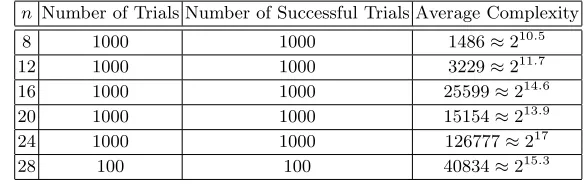
As a consequence of our improved algorithm, we solve within several minutes affine equivalence problem instances of size up to n = 28 on a single core. Optimizing our implementation and exploiting parallelism would most likely allow solving instances of size at least n= 40 using an academic budget. Such instances are out of reach of all previous algorithms for the problem.
Technically, the main algorithm devised in [3] for the affine equivalence prob-lem is a guess-and-determine algorithm (which is related to the “to and fro” algorithm of [17], devised to solve the problem of isomorphism of polynomi-als) whereas the secondary algorithm is based on collision search (it generalizes
Daemen’s attack on the original Even-Mansour cipher [8]). On the other hand, algorithms that use algebraic techniques (such as [5]) are mainly known for the asymmetric variant, in whichF,Gare functions of low degree, and it is not clear how to adapt them to arbitrary functions.
In contrast to previous algorithms, our approach involves analyzing algebraic properties ofF,G which are of high algebraic degree. More specifically, we are interested in the polynomial representation (algebraic normal form or ANF) of each of the n output bits of F (and G) as a Boolean function in the n input bits. In fact, we are mainly interested in “truncated” polynomials that include only monomials of degree at least d(in particular, we choosed=n−2). Each such polynomial can be viewed a vector in a vector space (with the standard basis of all monomials of degree at least d =n−2). Therefore we can define the rank of the set ofntruncated polynomials for eachF,G as the rank of the matrix formed by arranging these polynomials as row vectors. In other words, we associate a rank value (which is an integer between 0 and n) to F (and to
G) by computing the rank of its n truncated polynomials (derived from its n
output bits) as vectors. We first show that if F,G are affine equivalent, their associated ranks are equal.2
To proceed, we analyzeF,Gindependently. We derive fromF several func-tions, each one defined by restricting its 2n inputs to an affine subspace of di-mensionn−1. Since each such derived function (restricted to an affine subspace) has an associated rank, we assign to each possible (n−1)-dimensional subspace a corresponding rank. As there are 2n+1possible affine subspaces (such a subspace
can be characterized using its orthogonal subspace by a single linear expression overnvariables and a free coefficient), we obtain 2n+1rank values forF. These
values are collected in the rank table of F, where a rank table entry r stores the set of all affine subspaces (more precisely, their compact representations as linear expressions) assigned to rankr.3
The main idea of the algorithm is to compute the rank tables of bothF and
G and then use these tables (and additional more complex structures derived from them) to recover the (unknown) affine transformation A1, assuming that
G = A2◦F ◦A1. In essence, the rank tables allow us to recover matchings
between (n−1)-dimensional affine subspaces that are defined by A1: an affine subspace S in matched with S0 if A1 transforms S to the affine subspace S0. Each such matching betweenSandS0 reveals information aboutA1 in the form of linear equations. Hence we aim to use the rank tables to recover sufficiently many such matchings and computeA1using linear algebra. OnceA1 is derived,
computingA2is trivial. The main property of the rank table that we prove and
exploit to recover the matchings is that ifSin matched withS0, thenS appears in the rank table ofGin the same entryrasS0 appears in the rank table ofF.
2
The choice ofd=n−2 seems arbitrary at this stage. We only note that choosing a larger or smaller value fordtypically results in a rank value which is constant for almost all functions, providing no information about them.
3
Since the number of (n−1)-dimensional affine subspaces is 2n+1, each
contain-ing 2n−1 elements, a naive approach to computing the rank table (which works
independently on each subspace) has complexity of at least 2n+1·2n−1 = 22n. However, using symbolic computation of polynomials, we show how to reduce this complexity to aboutn32n bit operations. While this computational step is easy to analyze, this is not the case for the overall algorithm’s performance. In-deed, its success probability and complexity depend on the monomials of degree at least n−2 ofF and G. In particular, if all n output bits of F and G are functions of degreen−3 or lower, they do not contain any such monomials. As a result, all affine subspaces for F and G are assigned rank zero and the rank tables of these functions contain no useful information, leading to failure of the algorithm.4
WhenF (or G) is chosen uniformly at random from the set of all possible
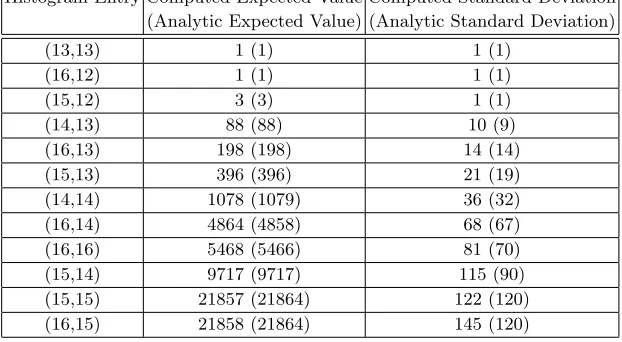
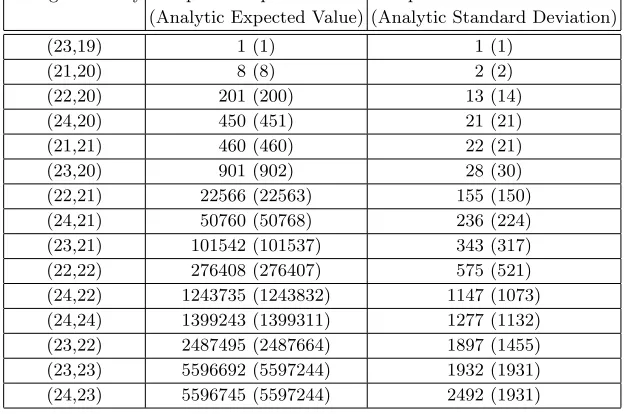
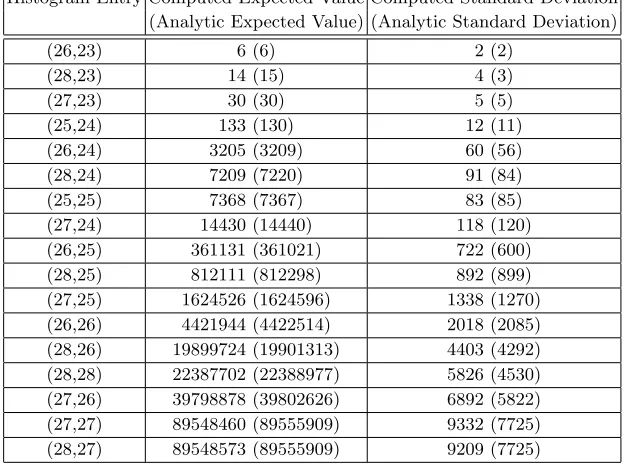
n-bit permutations (or n-bit functions in general), the case that its algebraic degree is less thann−2 is extremely unlikely forn≥8. Nevertheless, rigorous analysis of the algorithm seems challenging as its performance depends on subtle algebraic properties of random permutations. To deal with this situation, we make a heuristic assumption about the distribution of high degree monomials in random permutations which enables us to use well-known results regarding the rank distribution of random Boolean matrices. Consequently, we derive the distribution of the sizes of the rank table entries for a random permutation. This distribution and additional properties enable us to show that asymptotically the algorithm succeeds with probability close to 1 in complexity of about n32n bit operations. This heuristic analysis is backed up by thousands of experiments on various problem instances of different sizes. Rigorously analyzing the algorithm and extending it to succeed on all functions (or permutations) with probability 1 in the same complexity remain open problems.
The properties of the rank table and the algorithm for computing it are of independent interest. In particular, we propose methods to build experimental distinguishers for block ciphers based on the rank table and a method to effi-ciently detect high-order differential distinguishers based on the algorithm for its computation. Furthermore, our techniques are relevant to decomposition at-tacks on the white-box ASASA block cipher instances proposed by Biryukov et al. [2]. In this application, we adapt the algorithm for computing the rank table in order to improve the complexity of the integral attack on ASASA published in [9] from 23n/2to about 2n (wherenis the block size of the instance).
The rest of the paper is organized as follows. In Section 2 we describe some preliminaries and give an overview of the new affine equivalence algorithm in Section 3. In Section 4 we prove the basic property of rank equality for affine equivalent functions, while in Section 5 we define and analyze the matching between (n−1)-dimensional affine subspaces that we use to recoverA1. In Sec-tion 6 we define the rank table and addiSec-tional objects used in our algorithm, and describe the relation between these objects for affine equivalent functions.
4
In Section 7 we analyze properties of rank tables for random permutations under our heuristic assumption. Then, we describe and analyze the new affine equiva-lence algorithm in Section 8. Next, in Section 9, we describe applications of the new algorithm and the rank table structure. Finally, we conclude the paper in Section 10.
2
Preliminaries
For a finite set R, denote by |R| its size. Given a vectoru= (u[1], . . . , u[n])∈
GF(2)n, letwt(u) denote its Hamming weight. Throughout this paper, addition between vectors u1, u2∈GF(2)n is performed bit-wise overGF(2)n.
Multivariate Polynomials Any Boolean functionF :{0,1}n→ {0,1}can be represented as a multivariate polynomial whose algebraic normal form (ANF) is unique and given as F(x[1], . . . , x[n]) = P
u=(u[1],...,u[n])∈{0,1}n
αuMu, whereαu ∈ {0,1} is the coefficient of the monomial Mu = Q
n i=1x[i]
u[i], and the sum is
over GF(2). The algebraic degree of the function F is defined as deg(F) =
max{wt(u)|αu6= 0}.
In several cases it will be more convenient to directly manipulate the repre-sentation ofF as a multivariate polynomialP(x[1], . . . , x[n]) =P
u∈{0,1}nαuMu. Note that unlike F, the polynomial P is not treated as a function but rather as a symbolic object. P(x[1], . . . , x[n]) can be viewed as a vector in the vector space spanned by the set of all monomials{Mu|u∈ {0,1}n}.
Given a multivariate polynomialP(x[1], . . . , x[n]) =P
u∈{0,1}nαuMu and a positive integer d, define P(≥d) by taking all the monomials ofP of degree at
leastd, namely, P(≥d)(x[1], . . . , x[n]) = P
u∈{0,1}n∧wt(u)≥d
αuMu. Note that P(≥d)
can be represented using at mostPn
i=d n i
non-zero coefficients.
Given a functionF :{0,1}n→ {0,1}represented by a polynomialP(x[1], . . . , x[n]), defineF(≥d):{0,1}n→ {0,1}as the function represented byP(≥d).
Vectorial Functions and Polynomials Given a vectorial Boolean function
F :{0,1}n→ {0,1}m, letF(i):{0,1}n→ {0,1}denote the Boolean function of itsi’th output bit.
We say that a sequence ofmpolynomialsP ={P(i)(x[1], . . . , x[n])}m i=1
rep-resentsF if for each i∈ {1,2, . . . , m}, thei’th polynomialP(i)represents F(i).
Given a positive integer d, denote P(≥d) = {P (i)
(≥d)(x[1], . . . , x[n])}
m i=1. The
vectorial functionF(≥d):{0,1}n→ {0,1}mis defined analogously.
The algebraic degreedeg(P) ofP is defined as the maximal degree of itsm
polynomials. The algebraic degreedeg(F) is defined analogously.
As each P(i) can be viewed as a vector in a vector space, we define the
symbolic rank of P as the rank of the m vectors {P(i)}m
i=1. We denote the
Affine Transformations and Affine Equivalence An affine transformation
A:{0,1}m→ {0,1}n overGF(2)mis defined using a Boolean matrixL
n×mand a word a∈ {0,1}n as A(x) = L(x) +a(L(x) is simply matrix multiplication). The transformation is invertible ifm=nandLis an invertible matrix. Ifa= 0, then the A is called a linear transformation (such functions are a subclass of affine functions).
Two functions F : {0,1}n → {0,1}m, G : {0,1}n → {0,1}m are affine
equivalent is there exist two invertible affine transformations A1 : {0,1}n →
{0,1}n and A
2 : {0,1}m → {0,1}m such that G = A2◦F ◦A1. It is easy to
show that the affine equivalence relation partitions the set of all functions into (affine) equivalence classes. We denoteF ≡GifF is affine equivalent toG.
Symbolic Composition Given P = {P(i)(x[1], . . . , x[n])}m
i=1, and an affine
function A1 : {0,1}n0
→ {0,1}n, the composition P ◦A1 is a sequence of m polynomials in n0 variables. For i ∈ {1,2, . . . , m}, the i’th polynomial in this composition isP(i)◦A1. It can be computed by substituting each variable x[j] in P(i) with the (affine) symbolic representation of the j’th output bit of A1
(and simplifying the outcome to obtain the ANF).
For example, given P(x[1], x[2], x[3]) = x[1]x[2] +x[1]x[3] +x[2] + 1 and
A1 : {0,1}2 → {0,1}3 defined by the relations x[1] = y[1] +y[2] + 1, x[2] = y[2], x[3] =y[1] +y[2], then
P◦A1= (y[1] +y[2] + 1)(y[2]) + (y[1] +y[2] + 1)(y[1] +y[2]) +y[2] + 1 = (y[1]y[2] +y[2] +y[2]) + (y[1] +y[1]y[2] +y[1]y[2] +y[2] +y[1] +y[2]) +y[2] + 1 =
y[1]y[2] +y[2] + 1.
Thus, we compose each monomialMuwith coefficient 1 inP withA1to obtain a polynomial expression, add all the expressions and simplify the result. Formally, if we denoteP’sMu coefficient byαu, then
P◦A1= X
u∈{0,1}n
αu·(Mu◦A1).
Note that composition with an affine function does not increase the algebraic degree of the composed polynomial, namelydeg(P ◦A1)≤deg(P).
Analogously, given an affine functionA2 :{0,1}m→ {0,1}m 0
, the composi-tionA2◦P is a sequence ofm0 polynomials innvariables. It can be computed by substituting each variablex[j] in the (affine) symbolic representation of A2
withP(j). Equivalently, ifA2(x) =L(x) +a, thenA2◦P can be computed by
symbolic matrix multiplication (and addition ofa) asL(P) +a. In particular, if
m0 = 1 anda= 0, thenA2reduces to a vectorv= (v[1], v[2], . . . , v[m])∈ {0,1}m andv(P) =Pm
i=1v[i]P
(i) is a symbolic inner product.
By rules of composition, ifF is represented by P, then P ◦A1 represents
F ◦A1 (which is a standard composition of functions) andA2◦P represents
Half-Space Masks and Coefficients LetA:{0,1}n−1→ {0,1}n be an affine transformation such that A(x) = L(x) +a for a matrix Ln×n−1 with linearly
independent columns. Then the (affine) range of A is an (n−1)-dimensional affine subspace spanned by the columns ofLwith the addition ofa. The subspace orthogonal to the range of A is of dimension 1 and hence spanned by a single non-zero vectorh∈ {0,1}n. Namely, a vector v∈ {0,1}n is in the range ofAif and only ifh(v+a) = 0, i.e.,vsatisfies the linear equation h(v) +h(a) = 0.
Sincehpartitions the space of{0,1}ninto two halves, we callhthehalf-space
mask (HSM) ofAand call the bith(a) thehalf-space free coefficient (HSC) ofA. We call the linear subspace spanned by the columns ofLthelinear range of
A. A vector v∈ {0,1}n is in the linear range ofAif and only ifh(v) = 0.
Canonical Affine Transformations Given non-zero h ∈ {0,1}n and c ∈ {0,1}, there exist many affine transformations whose HSM and HSC are equal to h, c, respectively. We will use the fact (stated formally below) that all affine transformations with an identical affine range are related by composition on the right with an invertible affine transformation.
Fact 1 The affine transformationsA1:{0,1}n−1→ {0,1}nandA2:{0,1}n−1→
{0,1}n have the same affine range if and only if there exists an invertible affine
transformationA0 :{0,1}n−1→ {0,1}n−1 such that A1=A2◦A0.
GivenA1, A2 the matrixA0 above can be computed using basic linear algebra.
We now define thecanonical affine transformationC|h,c:{0,1}n−1→ {0,1}n with respect to h, c. Let ` denote the index of the first non-zero bit of h = (h[1], . . . , h[n]). WriteC|h,c(x) =L(x) +a. We define a=c·e` (wheree` is the
`’th unit vector) and define L[i] (the i’th column of L) using h and the unit vectors as follows:
L[i] =
(
ei ifi < `
ei+1+h[i+ 1]e` otherwise (`≤i≤n−1)
Thus, on input (y[1], . . . , y[n−1]), the transformationC|h,cis defined by the symbolic form
(x[1], x[2], . . . , x[n]) = (y[1], . . . , y[`−1],
n−1
X
i=`
h[i+ 1]y[i] +c, y[`], . . . , y[n−1]).
The motivation behind the definition ofC|h,c is that it allows very simple sym-bolic composition when applied on the right: its main action is to replace the variable x[`] with the affine combination that is specified by the coefficients of
hand byc. Other variables are just renamed: variables with indexi < `remain with the same index, while for each variable with indexi > `, its index it reduced by 1.
that h, c are indeed the HSM and HSC of C|h,c. For this purpose, it suffices to show that for each column L[i], the vector L[i] +a satisfies the equation
h(L[i] +a) +c= 0. Sinceh(a) =h(c·e`) =c·h(e`) =c (ash`= 1), it remains to show that h(L[i]) = 0. Indeed, if 0 ≤ i < `, then h(L[i]) = hi = 0 (as ` is the index of the first non-zero bit of h). Otherwise, ` ≤ i ≤ n−1, then
h(L[i]) =h[i+ 1] +h[i+ 1]h[`] = 0 (ash[`] = 1).
3
Overview of the New Affine Equivalence Algorithm
We demonstrate the new algorithm using an example. Although it is oversim-plified, this example is sufficient to convey the main ideas of our algorithm.
Definition of Functions We define the functionF : {0,1}3 → {0,1}3 using
its symbolic representationP ={P(i)(x[1], x[2], x[3])}3
i=1, P(1)(x[1], x[2], x[3]) =x[1]x[2] +x[1]x[3] +x[2] + 1
P(2)(x[1], x[2], x[3]) =x[1]x[2] +x[1] +x[2]
P(3)(x[1], x[2], x[3]) =x[1]x[3] +x[3].
We define G : {0,1}3 → {0,1}3 using 2 affine transformations as G = A2◦F◦A1, whereA2is simply the identity andA1is defined using the relations
x[1] =y[1] +y[3] + 1, x[2] =y[1] +y[2], x[3] =y[2].
ComposingA2◦P ◦A1 and simplifying the resultant ANFs, gives the symbolic
representation ofGasQ={Q(i)(y[1], y[2], y[3])}3
i=1, where Q(1)(y[1], y[2], y[3]) =y[1]y[3] +y[1] +y[2] + 1
Q(2)(y[1], y[2], y[3]) =y[1]y[2] +y[1]y[3] +y[2]y[3] +y[3] + 1
Q(3)(y[1], y[2], y[3]) =y[1]y[2] +y[2]y[3].
The input to our affine equivalence algorithm isF,Gdefined above and its goal is to recover the (presumably) unknown affine transformationA1. The first step of the algorithm is to interpolate F,Gand obtainP,Q, respectively.
Rank Tables and Histograms The most basic property that we prove in Theorem 1 is that since F and G are affine equivalent, the symbolic ranks of
P andQ (as vectors) are equal. Indeed, it is easy to verify that bothP andQ
have symbolic rank of 3. More significantly, Theorem 1 is stronger and asserts that SR(P(≥d)) =SR(Q(≥d)) for everyd≥1. Indeed, if we take d= 2, we get
P(≥2)={x[1]x[2]+x[1]x[3], x[1]x[2], x[1]x[3]}, which has symbolic rank 2. This is
We would like to use this property to recover A1. Let us examine the
2-dimensional affine subspace defined by the 3-bit HSMh0 = 100 (whose bits are
h[1] = 1, h[2] = 0, h[3] = 0) and the single bit HSC c = 0. We calculate the symbolic form of (F ◦C|h0,0)(≥1) by evaluating (P ◦C|h0,0)(≥1) (i.e., plugging x[1] = 0 into P(≥1)) and obtain {x[2], x[2], x[3]} which has symbolic rank 2.
Similarly, forc= 1 we calculate (P◦C|h0,1)(≥1)(i.e., plug x[1] = 1 intoP(≥1))
and obtain{x[3],0,0}which has symbolic rank 1. Hence, we attach the symbolic rank pair (2,1) toh0= 100. We do the same for all 7 non-zeroh0∈ {0,1}3. The
result is a table whose entries are pairs of ranks of the form (maxR, minR)∈ Z4·Z4(wheremaxR≥minR), such that entry (maxR, minR) stores the set of
HSMs that are associated with this pair of ranks.
(3,2) :{010,011,111,110} (2,2) :{001}
(2,1) :{100,101}
This table is called therank table ofF (with respect to the degreed= 1 as we only considered monomials of degree at least 1). The set of HSMs in an entry (maxR, minR) of the rank table is called a rank group (e.g., the rank group with index (2,1) is{100,101}). Similarly, we compute the rank table ofGwith respect to d= 1.
(3,2) :{100,001,110,011} (2,2) :{010}
(2,1) :{101,111}
Although the rank tables are different, the size of each rank group (maxR, minR) ofF,G is identical. We define therank histogram ofF (with respect to d) as a mapping from each (maxR, minR) value to the corresponding rank group size (e.g., the histogram entry forF with index (2,1) has value|{100,101}|= 2). As we show in Lemma 9, that rank histograms of affine equivalent functions (such asF,G) are identical.
To explain this, we look at the HSM h = 101 in the rank group of G =
A2◦F ◦A1 with index (2,1) and note that it partitions the space into halves {000,101,010,111} and{001,011,100,110}(according to whetherx[1] +x[3] = 0 or x[1] +x[3] = 1). After applying A1, these half-spaces are mapped into
{100,101,110,111}and{000,001,010,011}. This is exactly the partition defined byh0= 100, which is in the rank group ofF with the same index (2,1). In terms of canonical affine transformations,C|h0,candA1◦C|h,0have the same half-space
range of {100,101,110,111} (forc = 1 in this case) and we define a mapping
h7→A1 h
0 to capture this. In Lemma 3 we show that this mapping is a bijection
Exploiting Matchings The central property of the mapping7→A1 is proved in Lemma 6 which asserts that it preserves affine equivalence. Namely, if F ≡G
andh7→A1 h0, then F ◦C|h0,c≡G◦C|h,0(for somec∈ {0,1}). By flipping the
half-space ranges and applying the same argument, we also obtainF◦C|h0,c+1≡
G◦C|h,1. Combined with Theorem 1 (which states that symbolic rank is an
invariant of affine equivalent functions) we obtain that for any d ≥ 1, r0 , SR((F ◦C|h0,c)(≥d)) =SR((G◦C|h,0)(≥d)) andr1 ,SR((F ◦C|h0,c+1)(≥d)) = SR((G◦C|h,1)(≥d)). Since the ordered rank pairs forh0, h inF,Gare equal to
(maxR, minR) (for maxR = max{r0, r1}, minR = min{r0, r1}), they belong
to rank groups with the same index (maxR, minR) in the rank tables ofF,G, respectively. The fact that 7→A1 is a bijection leads to Lemma 9 (which assets that the rank histograms of F,Gare identical).
The main goal of our affine equivalence algorithm is to recover matchings
h7→A1 h0 for several pairsh, h0. This is useful, as in Lemma 5 we show that each such matching gives n linear equations on the unknown matrix L of A1(x) = L(x) +a. Furthermore, the constant c associated withh7→A1 h
0 (which
deter-mines whether F ◦C|h0,0 ≡G◦C|h,0 or F ◦C|h0,1 ≡ G◦C|h,0) gives a linear
equation on a (once again, by Lemma 5). In total, we need to find about n
matchingsh7→A1 h
0 along with their associated constants to completely recover A1.
Going back to the example, the rank group with index (2,2) forGis{010}, while the rank group with the same index forF is{001}. Therefore, after com-puting the rank tables we know that
0107→A1 001. (1)
Remark 2. We matched 0107→A1 001 in the rank group (maxR, minR) = (2,2) and since maxR=minRwe cannot derive the constant c associated with this matching (hence we cannot derive a linear equation ona). Such constants can only be derived for matchingsh7→(A1)h
0 in rank groups wheremaxR > minR,
as in such cases we know whetherF◦C|h0,0≡G◦C|h,0orF◦C|h0,1≡G◦C|h,0
according to the equalitySR((F ◦C|h0,c)(≥d)) =SR((G◦C|h,0)(≥d)). More
pre-cisely, ifmaxR > minR, then eitherSR((F ◦C|h0,0)(≥d)) =SR((G◦C|h,0)(≥d))
or SR((F ◦C|h0,1)(≥d)) =SR((G◦C|h,0)(≥d)), but not both. In this sense, it is
more useful to recover matchings for HSMs in rank groups (maxR, minR) such that maxR > minR.
By applying similar arguments to the rank group (2,1), we know that either 101 7→A1 100 or 101 7→A1 101 (and similarly 111 7→A1 100 or 111 7→A1 101). Since we have very few possibilities, we can guess which matchings hold, derive
A1 and test our guess. Unfortunately, for largernwe expect the rank groups to
be much bigger and it would be inefficient to exhaustively match HSMs forF,G
only based on their ranks. Thus, to narrow down the number of possibilities and eventually uniquely match sufficiently many pairsh, h0 such thath7→A1 h
0, we
HSM Rank Histograms The main observation that allows attaching more data to each HSM is given in Lemma 4 which shows that the mapping 7→A1 is additive.
Consider the two rank groups with index (3,2) for F,G. They are of size 4 and their HSMs cannot be uniquely matched. We first focus on G and ex-amine the rank group (3,2) which is {100,001,110,011}. We take h1 = 011 and compute its HSM rank histogram with respect to the rank group (2,1) (which is{101,111}). This is done by computing the (maxR, minR) rank pairs for the set defined by adding all elements of rank group (2,1) to 011, namely {011 + 101,011 + 111}={110,100}. Looking for 110 and 100 in the rank table ofG, both HSMs have ranks (3,2). Thus, the HSM rank histogram ofh1= 011
with respect to rank group (2,1) has a single non-zero entry (3,2) with the value of 2. We write this HSM rank histogram in short as [(3,2) : 2].
We now consider the match ofh1= 011 underA1which ish01= 110 (namely,
h17→(A1)h01). Similarly toh1, we compute the HSM rank histogram ofh01 with
respect to the rank group (2,1) forF (which is{100,101}) and obtain the same HSM rank histogram [(3,2) : 2]. This is a particular case of Lemma 10, which shows that matching HSMs forF,Ghave identical HSM rank histograms (with respect to a fixed rank group). Lemma 10 is derived using Lemma 4 which asserts that the mapping7→A1 is additive: ifh17→(A1)h
0
1 andh27→(A1)h02, then
(h1+h2)7→(A1)(h
0 1+h02).
Fixing h1 = 011 for G and its match h01 = 110 under A1, let hi2, h02i for i∈ {1,2}vary over the 2 elements of the rank groups with index (2,1) inG,F, respectively. Then, as h1 7→(A1) h
0
1 and hi2 7→(A1) h
0i
2 for i ∈ {1,2}, we get
(h1+hi2) 7→(A1) (h
0
1+h02i). By the aforementioned Theorem 1 and Lemma 6
(equating ranks for matching HSMs) we conclude that indeed the HSM rank histograms of 011 and 110 with respect to rank group (2,1) are identical (which is a special case of Lemma 10).
HSM Rank Histogram Multi-Sets Since we do not know in advance that
h1 7→(A1) h01, we have to compute the HSM rank histograms (with respect to
rank group (2,1)) for all HSMs in rank group (3,2). The outcome is the HSM rank histogram multi-set of rank group (3,2) with respect to rank group (2,1). It is computed by considering all the HSMs in the rank group (3,2), namely {100,001,110,011}forGand{010,011,111,110}forF. Lemma 11 (whose proof is based on Lemma 10) asserts that these HSM rank histogram multi-sets are identical asF,Gare affine equivalent.
We hope that these multi-sets contain unique HSM rank histograms (with multiplicity 1), which would allow us to derive more matching between HSMs. Unfortunately, the resultant multi-set (for bothF andG) is{[(3,2) : 2],[(3,2) : 2],[(3,2) : 2],[(3,2) : 2]}. It contains 4 identical elements and does not give us any new information about A1. If the multiplicity of the element [(3,2) : 2]
Remark 3. Generally, whennis very small (as in our case), the direct application of the algorithm is more likely to fail to completely recoverA1. As we show later
in this paper, for n ≥8 the fraction of instances for which this occurs is very small (and tends to 0 as ngrows). In some cases a failure to retrieveA1 occurs since the affine mappingsA1, A2are not uniquely defined. In particular, if there are several solutions for A1, then we cannot hope to obtain unique matchings that completely defineA1, but we can recover all possible solutions to the affine equivalence problem by enumerating several possibilities for the matchings.
In conclusion, we attached to each HSM in rank group (3,2) for F,G its HSM rank histogram with respect to rank group (2,1) and in general such data may allow us to derive additional matchingsh7→(A1)h0. Once we obtain about nmatchings, we can recoverA1 by solving a system of linear equations.
4
A Basic Property of Affine Equivalent Functions
Before proving the main result of this section, we state two useful lemmas (the first is proved in Appendix A).
Lemma 1. Let P ={P(i)(x[1], . . . , x[n])}m
i=1, let A1 :{0,1}n 0
→ {0,1}n, A
2 :
{0,1}m→ {0,1}m0 be affine functions, anddbe a positive integer. Then,
1. (P(≥d)◦A1)(≥d)= (P ◦A1)(≥d)
2. (A2◦ (P(≥d)))(≥d) = (A2 ◦P)(≥d) and if A2 is a linear function, A2◦
(P(≥d)) = (A2◦P)(≥d).
Essentially, the lemma states that removing all monomials of degree less than
dfrom P can be done before or after composing it with an affine function and the outcomes are identical.
Note that a potentially simplified first part of the lemma which equates
P(≥d)◦A1 and (P ◦A1)(≥d) is generally incorrect, as the first expression may
contain monomials of degree less thand. For example, ifd= 2 and we compose the affine transformation defined by x[1] = y[1] +y[2] and x[2] = y[2] with the polynomial x[1]x[2], then we get the polynomial y[1]y[2] +y[2] which has a monomial of degree 1.
Lemma 2. Let P ={P(i)(x[1], . . . , x[n])}m
i=1, and letA1:{0,1}n → {0,1}n be
an invertible affine function. Then,deg(P) =deg(P◦A1).
Proof. We show that fori∈ {1,2, . . . , m}, deg(P(i)) =deg(P(i)◦A
1). Observe
that deg(P(i))≥deg(P(i)◦A1) as composition with an affine function cannot
increase the algebraic degree of a polynomial. By the same argument and by the invertibility of A1, we also obtain deg(P(i)◦A1)≥ deg(P(i)◦A1◦(A1)−1) = deg(P(i)).
Theorem 1. Let F : {0,1}n → {0,1}m, G : {0,1}n → {0,1}m be two affine
Proof. At a high level, the fact that P and Q have the same symbolic rank follows since rank is preserved by composition with invertible affine transfor-mations. Moreover, this rank equality is preserved after truncating low degree monomials since they cannot affect the high degree monomials when composing with invertible affine transformations. The formal proof is below.
WriteG=A2◦F◦A1, implying thatQ=A2◦P◦A1. DenoteP0=P◦A1
and observe that
SR(P0(≥d)) =SR((A2◦(P0(≥d)))(≥d)) =SR((A2◦P0)(≥d)) =SR(Q(≥d)),
where the first equality holds since rank is preserved by invertible linear trans-formations5and the second equality is due to the second part of Lemma 1.
It remains to show that SR(P0(≥d)) =SR(P(≥d)), orSR((P ◦A1)(≥d)) = SR(P(≥d)). We first show thatSR(P(≥d))≥SR((P ◦A1)(≥d)).
IfP(≥d)has full rank ofmthen the claim is trivial. Otherwise, letv∈ {0,1}m
be a non-zero vector in the kernel ofP(≥d), namelyv(P(≥d)) = 0. Then, v((P◦A1)(≥d)) = (v((P◦A1)(≥d)))(≥d)= (v(P(≥d))◦A1)(≥d)= 0,
where the first equality follows from the second part of Lemma 1 and the second equality follows from the first part of this lemma. This implies thatv is also in the kernel of (P◦A1)(≥d), as required.
To prove thatSR(P(≥d))≤SR((P◦A1)(≥d)), observe that ifvis a non-zero
vector in the kernel of (P ◦A1)(≥d), then by the equality above we have 0 = v((P◦A1)(≥d)) = (v(P(≥d))◦A1)(≥d). This implies thatdeg(v(P(≥d))◦A1)< d
and sinceA1is invertible, by Lemma 2,deg(v(P(≥d))) =deg(v(P(≥d))◦A1)< d.
This givesv(P(≥d)) = 0, as the polynomial does not contain monomials of degree
less than d. Hence,v is in the kernel ofP(≥d)which completes the proof.
5
The Half-Space Mask Bijection and its Properties
Definition 1. Let A:{0,1}n → {0,1}n be an invertible affine transformation.
Define a mapping between HSMs using A as follows: h∈ {0,1}n is mapped to
h0 if there existsc∈ {0,1}such that the affine ranges of A◦C|h,0 andC|h0,c are
equal. We write h7→(A)h0 and say thathandh0 match (underA). The bitc is
called the associated constant ofh7→(A)h0.
Lemma 3. Let A : {0,1}n → {0,1}n be an invertible affine transformation.
The mapping7→(A)is a bijection and its inverse is given by7→(A−1).
Proof. The proof follows from the invertibility of A. Given that h 7→(A) h0,
there exists c ∈ {0,1} such that the affine ranges of A◦C|h,0 and C|h0,c are
equal. According to Fact 1, this implies that there exists an invertible affine
5
The affine transformationA2also adds a constant, but it does contribute to the rank
transformation A0 : {0,1}n−1 → {0,1}n−1 such that A◦C
|h,0 = C|h0,c◦A0.
Consequently, C|h,0◦(A0)−1 =A−1◦C|h0,c and the affine ranges of C|h,0 and A−1◦C
|h0,c are equal (again, according to Fact 1). This implies that the affine
ranges of A−1◦C
|h0,0 and C|h,c are equal (flipping the HSC of both sides if
c= 1), namelyh0 7→(A−1)h.
A property of7→(A) which will be very useful is that it is additive. This is
established by the lemma below (proved in Appendix A).
Lemma 4. LetA:{0,1}n → {0,1}n be an invertible affine transformation. Let
h1, h01, h2, h02 ∈ {0,1}n be HSMs where h1 6= h2 and h1 7→(A) h01, h2 7→(A) h02
with associated constantsc1, c2, respectively. Then(h1+h2)7→(A)(h01+h02)with
the associated constantc1+c2.
The following lemma (proved in Appendix A) shows that the bijection reveals information about the presumably unknown transformationA.
Lemma 5. Let A : {0,1}n → {0,1}n be an invertible affine transformation
such thatA(x) =L(x) +a. Leth, h0∈ {0,1}n be HSMs such thath7→
(A)h0 with
associated constant c. Then, Asatisfies the following constraints.
1. For eachi∈ {1,2, . . . , n}, thei’th column of L, denoted byL[i], satisfies the equationh0(L[i]) =h[i], whereh[i] is thei’th bit ofh.
2. The vectorasatisfies the equation h0(a) =c.
The following lemma asserts that affine equivalence is preserved under com-position with matching HSMs.
Lemma 6. Let F : {0,1}n → {0,1}m, G : {0,1}n → {0,1}m be two affine
equivalent functions such that G = A2◦F ◦A1. Let h, h0 ∈ {0,1}n be HSMs
such that h7→(A1) h
0 with associated constant c. Then, F ◦C
|h0,c ≡ G◦C|h,0
andF ◦C|h0,c+1≡G◦C|h,1.
Proof. Since h 7→(A1) h0 with associated constant c, the affine ranges of A1◦ C|h,0 andC|h0,c are equal. According to Fact 1, there exists an invertible affine
transformationA01:{0,1}n−1→ {0,1}n−1 such thatA1◦C
|h,0=C|h0,c◦A01.
We obtain,A2◦F ◦C|h0,c◦A01 =A2◦F ◦A1◦C|h,0 =G◦C|h,0, implying
that F ◦C|h0,candG◦C|h,0 are affine equivalent.
The claim that F ◦C|h0,c+1 and G◦C|h,1 are affine equivalent follows by
considering the complimentary half-space and observing that the affine ranges ofA1◦C|h,1 andC|h0,c+1 are equal. The remainder of the proof is similar.
Definition 2. Let F :{0,1}n → {0,1}m be a function represented byP, let d
be a positive integer and leth∈ {0,1}n be a HSM. Letr0=SR((P◦C
|h,0)(≥d)), r1=SR((P◦C|h,1)(≥d)),maxR=max{r0, r1} andminR=min{r0, r1}.
2. The attached constant ofhis the valuec∈ {0,1}such thatmaxR=SR((P◦
C|h,c)(≥d))(if maxR=minR, the attached constant is undefined).
The lemma below states that the HSM ranks of matching HSMs are equal for affine equivalent functions.
Lemma 7. Let F : {0,1}n → {0,1}m, G : {0,1}n → {0,1}m be two affine
equivalent functions and letdbe a positive integer. Assume thatG=A2◦F◦A1. Let h, h0∈ {0,1}n be HSMs such that h7→
(A1)h
0. ThenR
G,d,h=RF,d,h0.
Proof. Let c ∈ {0,1} be the associated constant of h 7→(A1) h
0. According to
Lemma 6,F ◦C|h0,c≡G◦C|h,0 andF ◦C|h0,c+1≡G◦C|h,1.
Assume thatF,Gare represented byP,Q, respectively. Denoter00 =SR((F◦
C|h0,c)(≥d)),r10 =SR((F◦C|h0,c+1)(≥d)),r0=SR((G◦C|h,0)(≥d)),r1=SR((G◦ C|h,1)(≥d)).
By the above affine equivalences and Theorem 1, we haver0=r00andr1=r01. Hence max(r0, r1) =max(r00, r01) and min(r0, r1) =min(r00, r01) and the lemma follows.
6
Rank Tables, Rank Histograms and their Properties
Definition 3. Given a functionF :{0,1}n→ {0,1}mand a positive integer d,
define the following mappings.
1. The rank table ofF with respect todis a mappingTF,d, whose keys (indexes)
are integer pairs(maxR, minR)∈Zm+1×Zm+1 such that maxR≥minR.
It is defined as
TF,d(maxR, minR) ={h∈ {0,1}n|RF,d,h = (maxR, minR)}.
Moreover, along with each such HSMh, the table stores its attached constant
c∈ {0,1} (if defined).
An entry in the rank table TF,d(maxR, minR) (containing all HSMs with
this rank) is called a rank group.
2. The rank histogram of F with respect to d is a mapping HF,d : Zm+1×
Zm+1→Z such thatHF,d(maxR, minR) =|TF,d(maxR, minR)|.
To simplify our notation, in the following we refer to a HSM rank (maxR, minR)∈ Zm+1×Zm+1 such thatmaxR≥minRusing a single symbolr.
The lemma below states that ifF ≡G, then each HSM with rank rfor G
is matched in the rank group with the same HSM rankr forF.
Lemma 8. Let F : {0,1}n → {0,1}m, G : {0,1}n → {0,1}m be two affine
equivalent functions and letdbe a positive integer. Assume thatG=A2◦F◦A1
and let r∈Zm+1×Zm+1. Then, for eachh∈ TG,d(r), there existsh0∈ TF,d(r)
Proof.By Lemma 7, givenh∈ TG,d(r), its matchh0 underA1satisfiesRF,d,h0 = RG,d,h=rhenceh0 ∈ TF,d(r) as claimed.
Lemma 9. Let F : {0,1}n → {0,1}m, G : {0,1}n → {0,1}m be two affine
equivalent functions and letdbe a positive integer. Then the rank histograms of
F andG with respect todare equal, namelyHF,d=HG,d.
Proof. Assume that G = A2◦F ◦A1. Given a histogram entry with index r, for each h∈ TG,d(r) let h0 be its match h7→(A1) h0. Then, by Lemma 8, h0 ∈
TF,d(r). Sinceh7→(A1)h0 is a bijection, this shows thatHG,d(r) =|TG,d(r)| ≤ |TF,d(r)| = HF,d(r). On the other hand, as HG,d(r) ≤ HF,d(r) holds for all histogram entries r and the sum of entries in both histograms is 2n−1, this implies thatHF,d=HG,d.
Definition 4. Given a function F :{0,1}n → {0,1}m, a positive integer d, a
HSMh1∈ {0,1}n andr∈
Zm+1×Zm+1, we define the HSM rank histogram of h1 with respect to (or relative to) the rank groupr and denote it by HGF,d,h1,r.
As the standard histogram, it is a mapping HGF,d,h1,r : Zm+1×Zm+1 → Z,
where
HGF,d,h1,r(r
0) =|{h1+h2|h2∈ {0,1}n∧h16=h2∧R
F,d,h2 =r∧RF,d,h1+h2=r 0}|.
Note that unlike the (standard) rank histogram, the HSM rank histogram is defined for a specific HSM with respect to a rank group. We further remark that the HSM rank histogram of h1 can also be defined with respect to its own the
rank group (this is assured by the conditionh16=h2).
The following lemma equates HSM rank histograms for matching HSMs in affine equivalent functions.
Lemma 10. Let F : {0,1}n → {0,1}m, G : {0,1}n → {0,1}m be two affine
equivalent functions and letdbe a positive integer. Assume thatG=A2◦F◦A1. Leth1, h01∈ {0,1}nbe such thath17→
(A1)h01. Then, for everyr∈Zm+1×Zm+1,
HGG,d,h1,r=HGF,d,h01,r.
Proof. The proof follows from the fact that the mapping7→(A1)preserves HSM
ranks for affine equivalent functions (Lemma 7), and by exploiting its additive property (Lemma 4).
Fix a HSM rank histogram entryr0 ∈ Zm+1×Zm+1. Define the following
two sets:
D1={h1+h2|h2∈ {0,1}n∧h16=h2∧RG,d,h2 =r∧RG,d,h1+h2=r0} and
D2={h01+h02|h02∈ {0,1}
n∧h0
16=h02∧RF,d,h0
To prove the lemma, we need to show that|D1|=|D2|. Leth1+h2 ∈ D1
and denote by ˆh∈ {0,1}n the vector such thath1+h27→
(A1)ˆh. We show that
ˆ
h∈D2.
Sinceh1+h27→(A1)ˆh, by Lemma 7, RF,d,ˆh=RG,d,h1+h2 =r
0. Next, write ˆ
h = h01+ (h01+ ˆh). Since h1 7→(A1) h
0
1 and h1+h2 7→(A1) ˆh, by Lemma 4,
h2 7→(A1) h01+ ˆh, and by Lemma 7,RF,d,h0
1+ˆh = RG,d,h2 =r, giving ˆh∈ D2. Since7→(A1)is a bijection this implies that|D2| ≥ |D1|.
As|D2| ≥ |D1| holds for all HSM histogram entriesr0 and the sum of HSM histogram entries in bothHGG,d,h1,r andHGF,d,h0
1,r is equal to size of the rank group6r(which is equal toH
F,d(r) =HG,d(r)), the equality|D1|=|D2|holds.
Definition 5. Given a function F : {0,1}n → {0,1}m, a positive integer d,
HSMs ranksr,r0∈
Zm+1×Zm+1, we define the HSM rank histogram multi-set
of rank group rwith respect to rank groupr0 as
HMF,d,r,r0 ={HGF,d,h,r0|RF,d,h =r}.
The HSM rank histogram multi-set collects all the HSM histograms for HSMs in rank group r with respect to the rank group r0. Note that it is possible to have r=r0.
The following lemma equates HSM rank histogram multi-set in affine equiv-alent functions.
Lemma 11. Let F : {0,1}n → {0,1}m, G : {0,1}n → {0,1}m be two affine
equivalent functions and let d be a positive integer. Then, for every r,r0 ∈ Zm+1×Zm+1,HMF,d,r,r0=HMG,d,r,r0.
Proof. Fix r,r0 ∈ Zm+1×Zm+1. We define a mapping between the elements
(HSM histograms) of the multi-setsHMG,d,r,r0andHMF,d,r,r0. Naturally, the
mapping is based on the bijection7→(A1).
Assume thatG=A2◦F◦A1. Leth∈ {0,1}nbe such thatR
G,d,h=rwhich implies that HGG,d,h,r0 ∈ HMG,d,r,r0. Leth0 ∈ {0,1}n be the HSM such that h7→(A1)h0. By Lemma 10,HGG,d,h,r0=HGF,d,h0,r0. Furthermore, by Lemma 7
we have RF,d,h0 = RG,d,h =r, henceHGG,d,h,r0 =HGF,d,h0,r0 ∈ HMF,d,r,r0.
Since7→(A1)is a bijection, we obtainHMG,d,r,r0 ⊆ HMF,d,r,r0 as multi-sets. On the other hand, the number of elements (HSM histograms) in both multi-sets is equal to the size of the rank group r (which is equal to HF,d(r) = HG,d(r)), henceHMG,d,r,r0 =HMF,d,r,r0.
Definition 6. Let F : {0,1}n → {0,1}m, let d be a positive integer and let
r,r0∈Zm+1×Zm+1. A HSM h∈ {0,1} such that RF,d,h =r is called unique
(with respect to F, d,r0) if HGF,d,h,r0 ∈ HMF,d,r,r0 has multiplicity 1 in this
multi-set.
6
The following theorem establishes the importance of unique HSMs in recov-ering matchings between HSMs for affine equivalent functions.
Theorem 2. Let F : {0,1}n → {0,1}m, G : {0,1}n → {0,1}m be two affine
equivalent functions and letdbe a positive integer. Then for everyr,r0∈Zm+1×
Zm+1, ifh∈ {0,1}n (such that RG,d,h =r) is unique with respect to G, d,r0,
then the following statements hold:
1. There existsh0 ∈ {0,1}n such thatR
F,d,h0 =randh0 is unique with respect
toF, d,r0.
2. HGG,d,h,r0=HGF,d,h0,r0.
3. Assume thatG=A2◦F ◦A1. Then, h7→(A1)h
0. Moreover, if the attached
constants ofh, h0 are defined and equal toc, c0, respectively, then the
associ-ated constant ofh7→(A1)h
0 isc+c0.
Proof.By Lemma 11, we have equality of the multi-setsHMF,d,r,r0 =HMG,d,r,r0
which immediately implies the first two statements. Denote byh00∈ {0,1}n the HSM such that h7→(A1) h
00. To complete the proof of the third statement we
show that h00=h0.
By Lemma 7, we haveRF,d,h00=RG,d,h=r. HenceHGF,d,h00,r ∈ HMF,d,r,r0
(and alsoHGF,d,h0,r ∈ HMF,d,r,r0 from the first statement). Sinceh0 is unique
with respect toF, d,r0, thenHGF,d,h0,r0has multiplicity 1 inHMF,d,r,r0. Thus
if we show thatHGF,d,h0,r0=HGF,d,h00,r, thenh00=h0 must hold.
According to Lemma 10,HGG,d,h,r =HGF,d,h00,r and by the second
state-ment we obtainHGF,d,h0,r0 =HGG,d,h,r0=HGF,d,h00,r as required.
Finally, we examine the attached constantsc, c0ofh, h0, respectively (assum-ing they are defined). Ifc=c0, then the affine ranges ofA1◦C|h,0andC|h0,0are
equal implying that the associated constant ofh7→(A1)h0is 0 =c+c0. Otherwise c=c0+ 1 and the affine ranges ofA1◦C|h,0and C|h0,1 are equal implying that
the associated constant ofh7→(A1)h
0 is 1 =c+c0.
7
Analysis of the Distribution of Rank Histogram Entries
for Random Permutations
In this section we analyze the distribution of entries of the rank histogramHF,d for a random permutationF :{0,1}n → {0,1}n. The analysis is performed for
d=n−2, which is the value that we use in our algorithm as explained in detail next.
Assume thatF is represented byP ={P(i)(x[1], . . . , x[n])}n
i=1. For a given h∈ {0,1}n, we considerSR((P◦C
|h,0)(≥n−2)) andSR((P◦C|h,1)(≥n−2)). Forc∈
{0,1}, every one of thenpolynomials of (P◦C|h,c)(≥n−2)hasn−1 variables (the
number of variables inP is reduced by 1 after composition withC|h,c). Hence, the number of possible non-zero monomial coefficients in each such polynomial is nn−−11
+ nn−−12
= 1 +n−1 =n. Therefore, (P◦C|h,c)(≥n−2)can be represented
Choosingd=n−1 would leave at most one non-zero monomial which almost always would be present in (P◦C|h,c)(≥n−1). Hence, essentially all HSMs would
fall into a single rank group and the affine equivalence algorithm would not be able to distinguish and match them. On the other hand, choosingd≤n−3 would leaveΩ(n2) non-zero monomials and (P◦C
|h,c)(≥r) would almost always have
full rank, leading once again to a single rank group. We conclude thatd=n−1 is indeed the optimal choice.
Our analysis is based on the following heuristic assumption.
Assumption 1 For a random permutation F : {0,1}n → {0,1}n represented
by P, for every h ∈ {0,1}n and c ∈ {0,1}, the entries of the n×n Boolean
matrix(P◦C|h,c)(≥n−2)are uniform independent random variables.
Then×nBoolean matrix (P ◦C|h,c)(≥n−2)is indeed uniform for a random
function F (rather than a random permutation), given any h ∈ {0,1}n and
c∈ {0,1}. However, even for a random function the Boolean matrices obtained for differenth, cvalues are correlated. Nevertheless, these correlations (and the fact thatF is a permutation) do not seem to have a noticeable influence on our algorithm in practice (as we demonstrate in Section 8.5 and Appendix B).
The rank of random matrices is a well-studied problem. For largen and a non-negative integer r ≤n, we denote the probability that a random Boolean
n×nmatrix has rankrbyβr. We can lower boundβrby considering the event where we first select rlinearly independent rows to form a subspace of size 2r (which occurs with constant probability) and then select the remaining n−r
rows within this subspace (which occurs with probability 2−(r−n)2
). This gives a lower bound ofΩ(2−(r−n)2
) onβr. The exact formula is given by the theorem below, taken and adapted from [12].
Theorem 3 ([12], page 126, adapted). For n → ∞, the probability that a random Boolean n×nmatrix has rank ris
βr= 2−(r−n) 2
·α· n−r
Y
i=1
(1−1/2i)−2, (2)
whereα=Q∞
i=1(1−1/2
i)≈0.2888. Sinceα≤α·Qn−r
i=1(1−1/2
i)−2 <1/α, the initial probability estimation of
≈ 2−(r−n)2 is correct up to a small constant. We also note that (2) is a good
estimation even for relatively small values ofn(e.g.,n≥8). Let
pmaxR,minR=
(
2βmaxRβminR ifminR < maxR
βmaxRβminR otherwise (minR=maxR),
(3)
where
βmaxRβminR=α2·2−(maxR−n)
2−(minR−n)2 ·
n−maxR
Y
i=1
(1−1/2i)−2· n−minR
Y
i=1
Then, based on Assumption 1 and Theorem 3, for every (maxR, minR) ∈ Zm+1×Zm+1such thatmaxR≥minR, givenh∈ {0,1}n, we haveP r[RF,n−2,h= (maxR, minR)]≈pmaxR,minR. Hence, according to Assumption 1, the entries of HF,n−2are distributed multinomially, with parameter 2n(the number of HSMs7)
and probabilities given bypmaxR,minR. In particular, each individual histogram entry HF,n−2(maxR, minR) is distributed binomially with parameter 2n and
probability pmaxR,minR.
Experimental results that support this conclusion are given in Appendix B).
Asymptotic Analysis of Specific Histogram Entries For largen, the bi-nomial variableHF,n−2(maxR, minR) is with high probability very close to its
expectation, which is about
2n·pmaxR,minR.
If we ignore constant multiplicative factors, we can approximate this expec-tation by
2n·2−(maxR−n)2−(minR−n)2, (4)
aspmaxR,minR≈2−(maxR−n)
2−(minR−n)2 .
We now approximate (up to constant multiplicative factors) the expected values of two specific histogram entries which will be useful for our algorithm. Denoteγn=b(n/2)1/2c, and letr1= (n+ 1−γn, n−γn) andr2= (n, n−γn). Define the random variables S1 = HF,d(r1) and S2 = HF,d(r2). Below, we estimate their expected values according to (4).
Writeγn =b(n/2)1/2c= (n/2)1/2−k, where 0 ≤k < 1. Hence, with very high probability we have S2 = HF,d(r2) = HF,d(n, n−γn) ≈ 2n·pn,n−γn ≈
2n ·2−(γn)2 = 2n ·2−((n/2)1/2−k)2 = 2n ·2−n/2+2k(n/2)1/2−k2 = 2n/2+O(n1/2).
Therefore,S2 is close to 2n/2.
SimilarlyS1=HF,d(r1) =HF,d(n+ 1−γn, n−γn)≈2n·pn+1−γn,n−γn≈
2n·2−(γn−1)2−(γn)2 = 2n·2−2(γn)2+2γn−1 = 2n·2−n+(4k+2)(n/2)1/2−2k2−2k−1=
2Θ(n1/2). HenceS1is sub-exponential inn.
8
Details of the New Affine Equivalence algorithm
In this section we describe and analyze our new affine equivalence algorithm. We start with a description of the auxiliary algorithms it uses.
8.1 The Rank Table and Histogram Algorithm
For F : {0,1}n → {0,1}n represented by P = {P(i)(x[1], . . . , x[n])}n i=1, the
following algorithm computes the rank histogramHF,dand rank tableTF,d for
d=n−2. The algorithm is given as inputP≥(n−2).
7
1. For each non-zero HSMh∈ {0,1}n:
(a) Compute RF,n−2,h = (maxR, minR) as follows. Compute (P(≥n−2) ◦ C|h,0)(≥n−2) = (P ◦ C|h,0)(≥n−2) and calculate its
symbolic rank r0 using Gaussian elimination. Similarly, compute
(P(≥n−2)◦C|h,1)(≥n−2)= (P ◦C|h,1)(≥n−2) and its symbolic rank r1. LetmaxR=max{r0, r1} andminR=min{r0, r1}.
(b) Insert h into TF,n−2(maxR, minR), along with the value of the
attached constant c ∈ {0,1} such that maxR = SR((F ◦
C|h,c)(≥n−2)) (if maxR > minR). In addition, increment entry
HF,n−2(maxR, minR).
Note that (P(≥n−2)◦C|h,0)(≥n−2)= (P◦C|h,0)(≥n−2)holds according to the
first part of Lemma 1.
The time complexity of the algorithm depends on how a polynomial is rep-resented. Here, we represent it using a bit array that specifies the values of its monomial coefficients.
We first analyze the complexity of computing the composition (P(≥n−2)◦ C|h,c)(≥n−2) in Step 1.(a), which is performed for each non-zero h ∈ {0,1}n
and c ∈ {0,1}. Each of the npolynomials of P(≥n−2) contains at most nn
+ n
n−1
+ n−n2< n2 non-zero monomials. As described in Section 2, computing the composition P(≥n−2)◦C|h,c requires substituting one of the n variables with a linear combination of the remainingn−1 variables (while renaming the variables of the monomials).
In total, for each polynomial ofP(≥n−2)◦C|h,c, we compose itsn2monomials with a linear combination of size n, which requires n2·n= n3 bit operations.
However, as we are only interested in monomials of degree at least n−2, the outcome (P(≥n−2)◦C|h,0)(≥n−2) is a polynomial of at most nn−−11
+ nn−−12
= 1 +n−1 =nmonomials, and the average complexity can be easily reduced to
n2 using low-level optimization techniques.8
In conclusion, the average complexity of computing the n polynomials of (P(≥n−2)◦C|h,0)(≥n−2)isn·n2=n3and the total time spent on composition is n3·2n bit operations (up to multiplicative constant factors). Similarly, Gaussian elimination requires n3 bit operations, hence the total time complexity of the algorithm isn3·2n bit operations.
8.2 The Unique HSM Algorithm
The following algorithm computes the HSM rank histogram multi-setHMF,n−2,r,r0
and uses it to compute a set of unique HSMs, denoted by UF. This set
con-tains triplets of the form (h, c,HGF,n−2,h,r0), where h ∈ TF,n−2(r) is unique
with respect to F, n−2,r0 and c ∈ {0,1} is its attached constant. Note that
8
For example, we can exploit the fact that the composition (P(≥n−2)◦C|h,c)(≥n−2)is
computed for eachh∈ {0,1}nandc∈ {0,1}, and the effect of flipping a bit inhon the outcome can be precomputed. Consequently, we iterate overh∈ {0,1}n
for the attached constant to be defined, we must have maxR > minR, where (maxR, minR) =r.
The algorithm is given as input the rank tableTF,n−2and rank group indexes
r,r0.
1. For eachh∈ TF,n−2(r), computeHGF,n−2,h,r0 as follows:
(a) for eachh0∈ T
F,n−2(r0):
i. Computeh+h0, find its rank r00=R
F,n−2,h+h0 inTF,n−2and
incrementHGF,n−2,h,r0(r00).
(b) Insert HGF,n−2,h,r0 along withh and its attached constant c into
the multi-setHMF,n−2,r,r0.
2. For each unique HSM h in HMF,n−2,r,r0, add the triplet
(h, c,HGF,n−2,h,r0) toUF.
The time complexity of the algorithm is the product of sizes of the rank groups|TF,n−2(r)| · |TF,n−2(r0)|=HF,n−2(r)· HF,n−2(r0).
Since the goal of the affine equivalence algorithm will be to findn linearly independent unique HSMs, it is useful to estimate their number. In Appendix C we lower bound the expected number of unique HSMs inHMF,n−2,r,r0
asymp-totically (ignoring constant factors) based on Assumption 1, given thatF is a random permutation. More specifically, we obtain the lower bound ofS−S2/√S0,
whereS =HF,n−2(r), andS0=HF,n−2(r0).
8.3 The Affine Transformation A1 Recovery Algorithm
Assume that we have affine equivalent functionsF and G such thatG=A2◦
F ◦A1 andA1(x) =L(x) +a.
The following algorithm recoversA1 using sets of unique HSMsUF andUG,
computed with the previous algorithm of Section 8.2 (where its invocations forF
andGuse the same parameters values ofr,r0). SinceF andGare affine equiva-lent, the HSM rank histograms of the HSMs in these sets have to match according to Theorem 2. Each equal HSM histogram pair reveals the matchingh7→A1 h
0
and its associated constant is revealed by adding the attached constants ofh, h0
(which are defined in casemaxR > minR, where (maxR, minR) =r), again by Theorem 2.
Each matching h 7→A1 h
0 and its associated constant give linear equations
on the columns of L and on a(respectively) according to Lemma 5. Assuming that UF andUG containn linearly independent unique HSMs,A1 is recovered
by linear algebra.
1. Allocaten+1 linear equation systems{Ei}ni=1+1, each of dimensionn×n:
the firstnequation systems are on the columnsL[i] of Land the final equation systemEn+1 is ona.
2. Locatenlinearly independent HSMs inUG. For each such HSMh:
(b) Search UF for a triplet (h0, c0,HGF,n−2,h0,r0) such that
HGF,n−2,h0,r0 = HGG,n−2,h,r0. If no match exists, return “Not
Equivalent”.
(c) Based on Lemma 5, fori= 1,2, . . . , nadd equation h0(L[i]) =h[i] to Ei.
(d) Based on Lemma 5, add equationh0(a) =c+c0 toEn+1.
3. Solve each one of {Ei}ni=1+1, recover A1 and return its matrix L and
vectora.
The complexity of the algorithm is aboutn·n3=n4 bit operations, which is
polynomial inn. Since we solve the same linear equation (with coefficients given by the h0 vectors)n+ 1 times with different constants, the complexity can be reduced ton3 by inverting the matrix which defines the linear equations.
8.4 The New Affine Equivalence Algorithm
We describe the new affine equivalence algorithm below. Letr1= (n+1−γn, n−
γn) andr2= (n, n−γn) forγn=b(n/2)1/2c, as defined in Section 7.
1. Given F : {0,1}n → {0,1}n, G : {0,1}n → {0,1}n, compute their corresponding ANF representationsP≥(n−2)andQ≥(n−2).
2. Run the algorithm of Section 8.1 to compute the rank tableTF,n−2and
rank histogram HF,n−2 for F using P≥(n−2), and similarly compute
TG,n−2 and HG,n−2 for G. IfHF,n−26=HG,n−2, return “Not
Equiva-lent”.
3. Run the unique HSM algorithm of Section 8.2 forF on inputsTF,n−2
andr1,r2 defined above, and obtain the setUF. Similarly, obtain the
set forUG by running this algorithm on inputsTG,n−2andr1,r2. If |UF| 6= |UG|, return “Not Equivalent”. Otherwise, if UF does not
containnlinearly independent HSMs, return “Fail”.
4. Run the affine transformation recovery algorithm of Section 8.3 on in-putsUF andUG. If it returns “Not Equivalent”, return the same output.
Otherwise, it returns a candidate forA1.
5. Recover a candidate forA2=L2(x)+a2by evaluating inputsv∈ {0,1}n to F ◦A1 andG: each inputv givesnlinear equations on L2 and a2. Hence, after a bit more thannevaluations, we expect the linear equation system to have a single solution which gives a candidate forA2. 6. Test the candidates A1, A2 by equating the evaluations ofG andA2◦
F ◦A1 on all 2n possible inputs. IfG(v) 6= A2◦F ◦A1(v) for some
v∈ {0,1}n , return “Not Equivalent”. Otherwise, returnA1, A2.