
EzPC: Programmable, Efficient, and Scalable
Secure Two-Party Computation for Machine Learning
Nishanth Chandran
MSR India [email protected]Divya Gupta
MSR India [email protected]Aseem Rastogi
MSR India [email protected]Rahul Sharma
MSR India [email protected]Shardul Tripathi
IIT Delhi [email protected]ABSTRACT
We present EzPC: a secure two-party computation (2PC) frame-work that generates efficient 2PC protocols from high-level, easy-to-write programs. EzPC provides formal correctness and security guarantees while maintaining performance and scalability. Previ-ous language frameworks, such as CBMC-GC, ObliVM, SMCL, and Wysteria, generate protocols that use either arithmetic or boolean circuits exclusively. Our compiler is the first to generate protocols that combine both arithmetic sharing and garbled circuits for better performance. We empirically demonstrate that the protocols gen-erated by our framework match or outperform (up to 19x) recent works that provide hand-crafted protocols for various functionali-ties such as secure prediction and matrix factorization.
1
INTRODUCTION
Today it is hard for developers to program secure applications using cryptographic techniques. Typical developers lack a deep un-derstanding of cryptographic protocols, and cannot be expected to use them correctly and efficiently on their own. Ideally, a developer would declare the functionality in a general purpose, high-level programming language and a tool, e.g. a compiler, would generate an efficient protocol that implements the functionality securely, while hiding the cryptography behind-the-scenes.
This paper presents such a framework for Secure Two-party Computation (2PC), a powerful cryptographic technique that al-lows two mutually distrusting parties to compute a publicly known joint function of their secret inputs in a way that both the parties learn nothing about the inputs of each other beyond what is re-vealed by their (possibly different) outputs. For example, 2PC can be used forsecure prediction([3, 9, 40, 44, 56]), where one party (the server) holds a proprietary classifier to predict a label (e.g., a disease, genomics, or spam detection), and the other party (the client) holds a private input that it wants to run the classifier on. Using 2PC guarantees that the server learns nothing about the client’s input or output, and that the client learns nothing about the classifier, beyond what is revealed by the output label.
To understand the state-of-the-art, let us consider an example un-derlying many secure prediction algorithms. Suppose Alice wants to write a 2PC protocol to securely computewTx >b. Herew(a vector) andb(a scalar) constitute the server classifier, andxis the client’s input vector. Further,·T is the matrix transpose operator, andwTx denotes the inner product ofwT andx. Alice has the following options.
She can program the computation in one of the several program-mer friendly, domain-specific languages (such as Fairplay [41], Wys-teria [51], ObliVM [39], CBMC-GC [29], SMCL [47], Sharemind [8], [43] etc.) that would automatically compile it to a 2PC protocol. However, all of these frameworks use cryptographic backends that take as input the computation expressed either as a boolean cir-cuit ([23, 58]) or as an arithmetic circir-cuit ([15, 20, 21]). The efficiency of the generated 2PC protocol is thus bounded by the efficiency of representing the computation inoneof these representations. For instance, multiplication of twoℓ-bit integers can either be ex-pressed as a boolean circuit of sizeO(ℓ2), or as an arithmetic circuit with 1 multiplication gate. It is well-known that boolean circuits are not suitable for doing arithmetic operations such as integer multiplications but are unavoidable for boolean operations such as comparison [18, 27, 34, 40, 44, 52]. For better efficiency, Alice would ideally like to computewTxusing an arithmetic circuit, and the comparison withbusing a boolean circuit.
Unfortunately, none of the above frameworks support combina-tions of arithmetic and boolean circuits, and using different tools for different parts of the computation is cumbersome and error-prone. Alternatively, Alice can use a tool such as ABY (Demmler et al. [18]) that allows the computation to be expressed as a com-bination of arithmetic and boolean circuits. However, here, the programming interface is quite low-level: the programmer is re-quired to first manually split the computation into arithmetic and boolean components, and then write the circuits for all the compo-nents manually, including the appropriate inter-conversion gates between them. Clearly, writing correct and efficient protocols in such a framework is beyond an average programmer who does not understand the various trade-offs between arithmetic and boolean circuits, and even for an expert cryptographer, writing large com-putations in such a framework can be tedious (a sentiment echoed by Demmler et al. [18] themselves).
A third option for Alice is to earn a PhD in cryptography, and design and implement specialized, efficient 2PC protocols (similar to [9, 40, 48, 56]) for her tasks.
This paper presents EzPC1, the first “cryptographic-cost aware” compiler that generates efficient and scalable 2PC protocols using combinations of arithmetic and boolean circuits. EzPC is backed by a formal model that enables it to choose arithmetic or boolean rep-resentations for different parts of the program, while automatically inserting inter-conversion gates as necessary. In addition to guiding
1Read as “easy peasy”, stands for Easy 2 Party Computation.
1 uint w[30]=input1(); uint b=input1(); uint x[30]=input2();
3 uint acc=0;
for i in[0:30]{acc = acc+ (w[i]×x[i]);}
5 output2((acc>b)?1 :0)//only to party 2
Figure 1: EzPC code forwTx>b
the compiler, the formal model also provides strong correctness and security theorems. Our comprehensive evaluation shows that the automatically generated protocols have performance comparable to or better than the custom, specialized protocols from previous works [9, 22, 40, 44, 48, 56]. In fact, these papers (and others) cite the inefficiency of generic 2PC as the major motivation behind the design of specialized protocols. Using EzPC, we empirically demon-strate that generic 2PC implementations are much more efficient than what they were believed to be. Below we describe the salient features of EzPC.
Ease of programming.EzPC source programs are ideal
function-alities that describe “what” computation needs to be done, rather than “how” to do it. In particular, the programmer writes the high-level computation without thinking about the underlying cryp-tographic details. For example, Figure 1 shows an EzPC source program forwTx >b. The program is quite similar to what a pro-grammer might write in C++ or Java. The simplicity of the language comes with the usual benefits: it is easily accessible to the devel-opers, there are fewer avenues for making mistakes, developers don’t bear the burden of getting cryptographic details right, code optimizations can be left to the compiler, and it is easy to main-tain and modify the programs. Needless to say, frameworks that expose low-level circuit APIs to the programmer do not enjoy these benefits.
Cryptographic-cost aware compiler.The EzPC compiler
com-piles a source program to a hybrid computation consisting ofpublic andsecretparts. In the example above, for instance, EzPC com-piler realizes that the array indexiis public, and generates non-cryptographic code for the array accesses. Further, within the secret parts, EzPC compiler is aware of the cryptographic costs of arith-metic and boolean representations of the source language operators. Based on these costs, the compiler automatically picks arithmetic or boolean representations for different sub-parts, and generates the corresponding circuits along with the required inter-conversion gates. The outcome is an efficient 2PC protocol combining arith-metic and boolean circuits, while the programmer remains oblivious of all these cryptographic details. Indeed, EzPC is the first such cryptographic-cost aware compiler.
Scalability (secure code partitioning).2PC tools often do not
scale to large functionalities. The reason is that most 2PC imple-mentations use a circuit-like representation as an intermediate language. Hence, the largest compute that can be done securely is upper-bounded by the largest circuit that can fit in the machine memory2. This is a show-stopper for applications like secure ma-chine learning, secure prediction, etc. that operate on large amounts of data. EzPC addresses the scalability concern using a novel tech-nique that we call secure code partitioning (or partitioning in short). At a high level, we decompose the original program into a sequence
2Using swap and disk space is feasible but it causes huge slowdown.
of small sub-programs, which are then sequentially processed by EzPC, while appropriately threading the intermediate outputs along. While this addresses the scalability concern (i.e., the circuit sizes of the sub-programs are now small enough to fit in the memory), we still have to address the security risk of revealing the intermedi-ate outputs. EzPC comes to the rescue; it automatically inserts the required instrumentation to ensure security of these intermediate outputs (Section 5). As we show in our evaluation, partitioning allows us to program large applications in EzPC.
Formal guarantees.We prove formal correctness and security
theorems for our compiler. The correctness theorem relates the “trusted third party” semantics of a source program and the “proto-col” semantics (the distributed 2PC semantics that relies on circuit evaluation) of the corresponding compiled program. The theorem guarantees that for all well-typed source programs, the two seman-tics successfully terminate (e.g., there are no array index out-of-bounds errors) with identical observable outputs. For the security theorem, we formally reduce the security of our scheme against semi-honest (or “honest but curious") adversaries to the semi hon-est security of the 2PC back-end. The theorem provides protection against side-channels arising from conditionals and memory ac-cess patterns. We also prove a formal security theorem against semi-honest adversaries for our partitioning scheme (Section 4 and Section 5).
Evaluation.We have implemented EzPC using ABY [18] as the
cryptographic back-end. We compare EzPC with Yao-based compil-ers in Section 2.1 and with specialized protocols in Section 7. We evaluate EzPC by implementing a wide range of secure prediction benchmarks including linear and naïve bayes classifiers, decision trees, deep neural networks, state-of-the-art classifiers from Tensor-flow [1] and Bonsai [36], and also the matrix factorization example from Nikolaenko et al. [48]. Our results demonstrate three key points. First, EzPC makes it convenient for general programmers to write 2PC protocols. E.g. we provide the first 2PC implementation of Bonsai [36], and it was programmed in the high-level EzPC source language by a non-cryptographer. Second, the performance of the protocols generated by EzPC are comparable to or better than (up to 19x) their state-of-the-art, hand-crafted implementations. Finally, we demonstrate the usefulness of partitioning by implementing an application that requires more than 300 million gates (Section 6 and Section 7).
Related Work.Before ABY [18], several works have proposed
combining secure computation protocols based on homomorphic encryption and Yao’s garbled circuits (e.g. [3, 6, 10, 19, 31, 48, 49, 53]), and some have also developed tools that allow writing such combi-nations (e.g. [7, 27, 34, 54]). However, as Demmler et al. [18] observe, due to the high conversion cost between homomorphic encryption and Yao’s garbled circuits, these combined protocols do not gain much performance over a single protocol. Additionally, these prior works provide informal languages or libraries that lack formal se-mantics and static guarantees. Finally, we focus on the language features necessary to implement machine learning applications. In particular, we do not discuss declassification of intermediate values or indexing into arrays at secret indices. Handling them requires ad-ditional complexity. For example, Wysteria [51] handles the former using dependent types and ObliVM [39] uses Oblivious RAM for
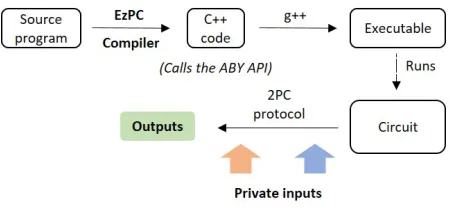
Figure 2: EzPC toolchain
the latter. These situations seldomly arise in the machine learning applications that we consider: intermediate values don’t need to be declassified and arrays are traversed in an oblivious manner. We provide a detailed survey of related work in Section 8.
2
EZPC OVERVIEW
Figure 2 shows an overview of the EzPC toolchain. We give a brief overview of each of these phases below.
Source language.Consider the examplewTx >bfrom Section 1, wherewandbare the server’s input (a classifier) andxis the client’s input vector. Figure 1 shows the EzPC code for this example. The code first reads the server’s (resp. client’s) input usinginput1(resp.
input2). It then uses aforloop to computeacc, the inner product ofwandx. Finally, the code comparesaccwithband outputs this only to the client usingoutput2.
EzPC source language is a simple, imperative language that enables the programmers to express 2PC computations in terms of their “ideal” functionalities, without dealing with any cryptographic details. The language provides multi-dimensional arrays with public indices, conditional expressions (the ternary ? : operator),forloops,
ifstatements, and special syntax for input/output from each party.
EzPC compiler.EzPC compiler takes as input a source program
and produces a C++ program as output. Figure 3 shows the output code for the example in Figure 1 – this is also how a program written directly in ABY would look like. The output program contains party-specific code for inputs and outputs (role==SERVERand
role==CLIENT), and common code for the computation. The compiler splits the input program intopublicandsecret components. The public components translate into regular C++ code, while the secret components translate into API calls into our 2PC back-end (ABY). For example, in Figure 1, the EzPC compiler realizes that the array indexiin the inner product loop is public, and hence the access locations need not be hidden. Therefore, it compiles theforloop into a C++forloop that will be executed in-clear (line 11).
Within the secret components, the EzPC compiler is “crypto-graphic cost-aware”, and appropriately picks either arithmetic or boolean circuit representations for different sub-components. For example, the compiler realizes that the inner product computation is more efficient in the arithmetic representation, and therefore it builds the corresponding circuit using the arithmetic circuit builder
acirc(lines 12 and 13). On the other hand, since the compari-son withb, and the conditional expression computation are more efficient in the boolean representation, the EzPC compiler uses the Yao circuit builderycircto build the corresponding circuits
(lines 19 to 24) (in our usage of ABY, boolean is synonymous with Yao, we elaborate in Section 6). We elaborate on cryptographic cost awareness in Section 3.
Using both arithmetic and boolean representations requires con-versions between them. The EzPC compiler also instruments these conversion gates accordingly. For example, in line 17, the compiler convertsa_accto a boolean representation, before it is input to the comparison and multiplexer circuits.
1 // c i r c u i t b u i l d e r s for a r i t h m e t i c and b o o l e a n Circuit ∗ycirc=s[S_YAO]→GetCircuitBuildRoutine(); 3 Circuit ∗acirc=s[S_ARITH]→GetCircuitBuildRoutine();
. . .
5 if(role==SERVER){
// Put gates to read w and b 7 }else{//role == CLIENT
// Put gates to read x 9 }
11 for(uint32_t i = 0;i < 30;i=i+1){ //acc = wTx share ∗a_t_0=acirc→PutMULGate(a_w[i],a_x[i]); 13 a_acc=acirc→PutADDGate(a_acc,a_t_0);
}
15
// c o n v e r t acc and b from a r i t h m e t i c to b o o l e a n 17 share ∗y_acc=ycirc→PutA2YGate(a_acc);
19 share ∗y_pred=ycirc→PutGTGate(y_acc,y_b); uint32_t one=1;
21 share ∗y_1=ycirc→PutCONSGate(one,bitlen); uint32_t zero=0;
23 share ∗y_0=ycirc→PutCONSGate(zero,bitlen); share ∗y_t=ycirc→PutMUXGate(y_pred,y_1,y_0); 25
share ∗y_out=ycirc→PutOUTGate(y_t,CLIENT); 27 party→ExecCircuit();
29 if(role==CLIENT){ //only to the client
uint32_t_o=y_out→get_clear_value⟨uint32_t⟩(); 31 }
Figure 3: EzPC compiler (partial) output for Figure 1
Circuit generation and evaluation.The next step in EzPC is to
compile the output C++ code and execute it. Doing so evaluates away the public parts of the program, including the array accesses, and generates a circuit comprising of arithmetic and boolean gates, with appropriate conversion gates. The circuit is then evaluated using a 2PC protocol.
Advantages of EzPCWe can now concretely see the advantages
of EzPC. Unarguably, it is easier for a developer to program and get the code right in Figure 1, rather than the code in Figure 3. EzPC also enables the programmer to easily modify their code, while the compiler takes care of efficiency. For example, consider in Figure 1 a change from multiplication to bitwise-or in theforloop. It turns out that in this case, it is more efficient to do both the addition and bitwise-or using boolean circuits (if the addition is done using arithmetic, the conversion cost starts to take over). In EzPC, the programmer simply needs to change one operator in the source code, and the compiler generates efficient code that uses boolean addition. Whereas, if the programmer was writing ABY code, she either has to sacrifice performance, or would have to revisit many parts of the circuit and change them. In summary, EzPC raises the
level of abstraction for the programmer, and generates efficient 2PC protocols automatically, while its metatheory provides strong correctness and security guarantees.
2.1
Comparison with garbled circuits
We show that it is critical to use a mix of arithmetic and boolean circuits for performance. Previous works have observed that Yao’s garbled circuits do not scale to machine learning examples that require a large number of multiplications [18, 27, 34, 40, 44, 52]. Indeed, this is one of the main drivers behind the development of various specialized 2PC protocols in previous works [9, 40, 44] (we compare against them in Section 7) . Here, we empirically demonstrate the performance benefits of mixed computations over boolean-only compute by comparing with state of the art Yao-based compilers CBMC-GC [29] and ObliVM [39].
The largest benchmark in CBMC-GC is a multiplication of two 8×8 matrices for which it generates about a million gates and takes about ten seconds to run. In contrast, EzPC uses arithmetic sharing, generates 1218 gates, and runs in less than 0.1 seconds. When we tried multiplying two 20×20 matrices with CBMC-GC, it timed out after 5 hours. Our benchmarks require much bigger computations (e.g., multiplying a 64×576 matrix with a 576×1024 matrix). Unlike CBMC-GC, ObliVM can scale to larger benchmarks (because it uses Yao-pipelining [30]). We evaluated the program in Figure 1 with vectors of lengths varying between 103and 106using both EzPC and ObliVM. EzPC evaluates the inner-product in arithmetic and, empirically, is at least 25x faster than ObliVM.
3
CRYPTOGRAPHIC COST-AWARENESS
In this section, we explain various heuristics that EzPC uses to split the computation in a program into arithmetic and boolean parts. Since finding an optimum split is an NP-hard problem (the predicates inifstatements can have arbitrary non-linear arith-metic), EzPC uses heuristics that perform well in practice (Sec-tion 7).
The split between arithmetic and boolean requires knowing the cost of individual operations (addition, multiplication, inter-conversion between arithmetic and boolean, etc.). Demmler et al. [18] document these costs by running microbenchmarks for basic operations and interconversions (Figures 2 and 3 in [18]). EzPC heuristics are based on their results.
Converting an arithmetic share to a boolean share requires com-puting a garbled circuit for addition. The size of this circuit grows linearly in the bit-width of the inputs. Similarly, converting from boolean to arithmetic requires computing a garbled circuit for sub-traction, which is also linear. Since each conversion has roughly the same cost as a boolean addition, EzPC performs addition using a boolean circuit if the operands are boolean shared, else it uses an arithmetic circuit.
For multiplication, EzPC always chooses an arithmetic circuit, as the cost of a boolean multiplication is much higher than the cost of converting the operands from boolean to arithmetic, performing an arithmetic multiplication, and then converting the result back to boolean (∼9xmore time &∼20xmore communication in a LAN setting). The size of a boolean multiplication circuit is quadratic in
the bit-width, which causes this performance gap. Roughly, multi-plying two 64-bit integers using arithmetic sharing requires only 2 multiplications, whereas Yao requires at least 4096 AES operations in the online phase. Since this gap is quite large, we believe that this choice is optimal for realistic network settings. Finally, EzPC chooses boolean circuits for all the operations lacking arithmetic support in ABY, e.g., comparisons, bit-shifts, etc. Further implemen-tation details can be found in Section 6.
4
FORMAL DEVELOPMENT
In this section we prove correctness and security of our EzPC compiler. The readers who are interested in using the compiler as a black box can move directly to Section 5 without loss of continuity. We first formalize our source language (an example program being Figure 1), and its runtime semantics. This semantics describes the “trusted third party" execution semantics of the source programs and generates observations corresponding to the values revealed to the parties. We then present the compilation rules that type check a program in the source language and generate a program in the intermediate language (an example program being Figure 3). Next, we present the runtime semantics of our intermediate language that evaluates to a circuit by “evaluating away” the public parts and the arrays. Crucially, this step does not have access to the secret inputs; those are processed by our distributed circuit semantics that model the 2PC back-end. Evaluation in this distributed setting involves the parties running an interactive protocol. This step, like the source semantics, emits observations corresponding to the values revealed to the parties.
To prove the correctness of EzPC, we prove that the observa-tions in source semantics and the distributed circuit semantics are identical (Theorem 4.1). We combine this correctness theorem and the security of the 2PC back-end to prove security of the protocols generated by EzPC (Theorem 4.2). We present only selected parts of our formalization. Full definitions and auxiliary lemmas can be found in Appendix C. We will also release complete typeset proofs in a tech report.
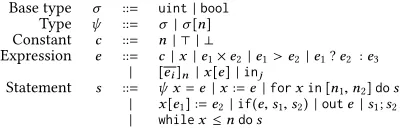
Base type σ ::= uint|bool
Type ψ ::= σ |σ[n]
Constant c ::= n| ⊤ | ⊥
Expression e ::= c|x|e1×e2|e1>e2|e1?e2 :e3
| [ei]n |x[e]|inj
Statement s ::= ψ x=e|x:=e|forxin[n1,n2]dos | x[e1] :=e2|if(e,s1,s2)|oute|s1;s2 | whilex≤ndos
Figure 4: Source language syntax
Source language.Our language is a simple imperative language
shown in Figure 4. Typesψconsist of the base typesσ, and arrays of base typesσ[n], wherenis the array length. Though we model only one dimensional arrays, our implementation supports multi-dimensional arrays as well. Expressionsein the language include the integer constantsn,boolconstants⊤and⊥, variablesx, binary operationse1×e2ande1>e2(we support several other operators in the implementation, detailed in Section 6), conditionalse?e1 :e2, array literals [ei]n3, and array readsx[e]. The expressioninj de-notes input from partyj. The statementssin the language comprise 3We writee(and similarly for other symbols) to denote a sequence of expressions.
The length of the sequence is usually clear from the context.
of variable declarations, assignments,forloops, array writes,if
statements, and sequence of statements. The statementoute de-notes revealing the value ofeto the parties4. Thewhilestatement is an internal syntax that is not exposed to the programmer.
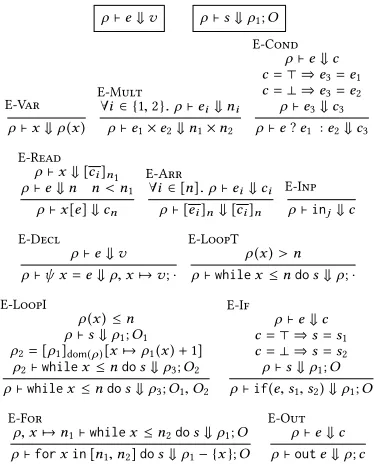
ρ⊢e⇓v ρ⊢s⇓ρ1;O
E-Var ρ⊢x⇓ρ(x)
E-Mult
∀i∈ {1,2}.ρ⊢ei⇓ni
ρ⊢e1×e2⇓n1×n2
E-Cond ρ⊢e⇓c c=⊤ ⇒e3=e1
c=⊥ ⇒e3=e2
ρ⊢e3⇓c3
ρ⊢e?e1 :e2⇓c3
E-Read ρ⊢x⇓[ci]n1
ρ⊢e⇓n n<n1
ρ⊢x[e]⇓cn
E-Arr
∀i∈[n].ρ⊢ei⇓ci
ρ⊢[ei]n⇓[ci]n
E-Inp ρ⊢inj⇓c
E-Decl ρ⊢e⇓v
ρ⊢ψ x=e⇓ρ,x7→v;·
E-LoopT ρ(x)>n ρ⊢whilex≤ndos⇓ρ;·
E-LoopI
ρ(x)≤n
ρ⊢s⇓ρ1;O1
ρ2=[ρ1]dom(ρ)[x7→ρ1(x)+1]
ρ2⊢whilex≤ndos⇓ρ3;O2
ρ⊢whilex≤ndos⇓ρ3;O1,O2
E-If
ρ⊢e⇓c
c=⊤ ⇒s=s1
c=⊥ ⇒s=s2
ρ⊢s⇓ρ1;O
ρ⊢if(e,s1,s2)⇓ρ1;O
E-For
ρ,x7→n1⊢whilex≤n2dos⇓ρ1;O
ρ⊢forxin[n1,n2]dos⇓ρ1− {x};O
E-Out ρ⊢e⇓c
ρ⊢oute⇓ρ;c
Figure 5: Source semantics
Source semantics.The runtime semantics for the source language
is shown in Figure 5. These semantics show how a “trusted third party" computes the outputs when given the inputs of both the parties. Valuesv, runtime environmentsρ, and observationsOare defined as follows:
Value v ::= c|[ci]n
Runtime environment ρ ::= · |ρ,x7→v
Observation O ::= · |c,O
Values consist of constants and array of constants, runtime envi-ronmentρmaps variables to values, and observations are sequences of constants.
The judgmentρ ⊢e ⇓vdenotes the big-step evaluation of an expressioneto a valuevunder the runtime environmentρ. Rule (E-Var) looks up the value ofxin the environment. Rule (E-Mult) inductively evaluatese1ande2, and returns their product. Rule (E-Read) evaluates an array read operation. It first evaluatesxto an array value [ci]n1, andeto auintvaluen. It then returnscn, then -th index value in -the array, providedn<n1, the length of the array.
Rule (E-Inp) evaluates to some constantcdenoting partyj’s input. An array input can be written in the language as [inj]n, which can then evaluate using the rule (E-Arr) (the notation∀i∈[n] is read as∀i∈ {0. . .n−1}). The remaining rules are straightforward, and are elided for space reasons.
The judgmentρ⊢s⇓ρ1;Orepresents the big-step evaluation of a statementsunder environmentρ, producing a new environment
ρ1and observationsO. Rule (E-Decl) evaluates the expressione tov, and returns the updated environmentρ,x7→v, with empty 4Our language also has statementsout
1e(resp.,out2e) to reveal value ofeto only
the first (resp., second) party. We omit these for brevity.
observations. Theforstatements evaluate through the internal
whilesyntax. Specifically, the rule (E-For) appendsρwithx7→n1, evaluateswhilex ≤n2dostoρ1;O, and returnsρ1− {x}(removing xfromρ1) andO. Rule (E-LoopI) shows the inductive case forwhile
statements, whenρ(x)≤n. The rule evaluatess, producingρ1;O1.
It then restrictsρ1to the domain ofρ([ρ1]dom(ρ)) to remove the variables added bys, increments the value ofx, and evaluates the
whilestatement under this updated environment. Rule (E-LoopT) is the termination case forwhile, whenρ(x) > n. Finally, the rule (E-Out) evaluates the expression, and adds its value to the observations.
Secret label m ::= A | B
Label ℓ ::= P |m
Type τ ::= σℓ|σℓ[n]
Expression He ::= c|x|He1×ℓHe2|He1>ℓHe2|x[He]|[Hei]n | He?ℓHe1 :He2|in
m
j | ⟨ℓ▷m⟩He
Statement Hs ::= τ x=He|x:=He| · · · |Hs1;Hs2|. . .
Figure 6: Intermediate language syntax
Intermediate language.Figure 6 shows the intermediate
guage of our compiler. The syntax follows that of the source lan-guage, except that the types and operators arelabeled. A labelℓcan be the public labelPor one of the secret labelsAorB, which de-note arithmetic and boolean respectively. Typesτare then labeled base typesσℓand arrays of labeled base typesσℓ[n]. Most of the ex-pression formsHeare same ase, except that the binary operators, and the conditional forms are annotated with labelsℓ. Looking ahead, the label determines how the operators are evaluated:P-labeled operators are evaluated in-clear,A-labeled operators generate arith-metic circuits, andB-labeled operators generate boolean circuits. The form⟨ℓ▷m⟩Hedenotes coercingHefrom labelℓto labelm. Source to intermediate compilation.We provide the
compila-tion rules in Figure 7. We present the rules in a declarative style, where the rules are non-syntax directed, and the labelsℓare cho-sen non-deterministically. Section 6 describes the label inference scheme in our implementation.
The judgmentΓ⊢e:τ{He, whereΓmaps variablesxto types
τ, says that underΓ,e(in the source language) compiles toHe(in the intermediate language), whereHehas typeτ. Rules (T-UInt) and (T-Bool) assigns the labelPto the constants, as the constants are always public. Rule (T-Mult) compiles a multiplication to either a public multiplication (×P), or a secret arithmetic multiplication (×A). As our compiler is cryptographic cost aware, it never com-piles the multiplication to boolean multiplication×B(Section 6). In a similar manner, rule (T-Gt) compilese1>e2to either public
comparison, or secret boolean comparison>B(and never>A). The rule for conditional (T-Cond) has two cases: when the conditional expressioneis of typeboolP, both the branches have a base type
σℓ1, for an arbitraryℓ1, and the conditional is compiled to a public conditional, whereas when the conditional expression has type
boolB,ℓ1is alsoB, and the conditional is compiled to a secret
conditional using a boolean circuit. Note that we restrict the type of the branches to be of base type. Rule (T-Read) type checks an array read. It checks that the array indexe is public, and uses a static bounds checking judgment|=e<nto prove that the array index is in bounds5. Rule (T-Inp) picks a labelmfor the input. Finally, the 5Section 6 discusses our implementation of this check.
Γ⊢e:τ{He Γ⊢s{Hs|Γ1
T-UInt
Γ⊢n:uintP{n
T-Bool c=⊤ ∨c=⊥ Γ⊢c:boolP{c
T-Inp
Γ⊢inj:σm{inmj
T-Mult
∀i∈ {1,2}.Γ⊢ei:uintℓ{Hei (ℓ=P)∨(ℓ=A) Γ⊢e1×e2:uintℓ{He1×ℓHe2
T-Gt
∀i∈ {1,2}.Γ⊢ei:uintℓ{Hei (ℓ=P)∨(ℓ=B) Γ⊢e1>e2:boolℓ{He1>ℓHe2
T-Read
Γ⊢x:σℓ[n]{x Γ⊢e:uintP{He
|=e<n Γ⊢x[e] :σℓ{x[He]
T-Cond
Γ⊢e:boolℓ{He ∀i∈ {1,2}.Γ⊢ei:σℓ1{
H
ei ℓ=P ∨(ℓ=B ∧ℓ1=B) Γ⊢e?e1 :e2:σℓ1{He?ℓHe1 :He2
T-Arr
∀i∈[n].Γ⊢ei:σℓ{Hei Γ⊢[ei]n:σℓ[n]{[Hei]n
T-Sub
Γ⊢e:σℓ{He Γ⊢e:σm{⟨ℓ▷m⟩He
T-Decl
Γ⊢e:ψℓ
{He Γ⊢ψ x=e{ψℓx=He|Γ,x:τ
T-Assgn
Γ(x)=σℓ
Γ⊢e:σℓ{He Γ⊢x:=e{x:=He|Γ
T-For
Γ,x:uintP⊢whilex≤n
2dos{whilex≤n2doHs|_ Γ⊢forxin[n1,n2]dos{forxin[n1,n2]doHs |Γ
T-Write
Γ⊢x:σℓ[n]{x Γ⊢e1:uintP{eH1
Γ⊢e2:σℓ{eH2 |=e1<n
Γ⊢x[e1] :=e2{x[eH1] :=eH2|Γ
T-Out
Γ⊢e:σm
{He Γ⊢oute{outHe|Γ
T-If
Γ⊢e:boolP{He ∀i∈ {1,2}.Γ⊢si{Hsi |_ Γ⊢if(e,s1,s2){if(He,Hs1,Hs2)|Γ
T-Seq
Γ⊢s1{Hs1|Γ1 Γ1⊢s2{Hs2|Γ2 Γ⊢s1;s2{sH1;Hs2|Γ2
T-While
Γ(x)=uintP Γ⊢s{Hs|_ x<modifies(s) Γ⊢whilex≤n2dos{whilex≤n2doHs|Γ
Figure 7: Source compilation
rule (T-Sub) is the subsumption rule that coerces an expression of typeσℓto an expression of typeσmusing the coerce expression. It is important for security that the secrets cannot be coerced to public values and indeed (T-Sub) does not permit it.
JudgmentΓ ⊢s :τ {Hs |Γ1compiles a statementsresulting in the statementHsand type environmentΓ1. Rule (T-Decl) picks a labelℓ, and adds the binding forx to the environment (ifψ =σ,
ψℓ =σℓ, else ifψ = σ[n],ψℓ = σℓ[n]). Rule (T-Assign) looks up the type ofxinΓand compileseto ˜eof same type. Note that in this rule we restrict the type of variablex to be of base type. Rule (T-For) adds the loop counterxtoΓat typeuintP, and del-egates type checking to thewhileform. Rule (T-Out) types the expressione at some secret labelm. Rule (T-If) checks that the conditional expression is public, and rule (T-Seq) sequences the type environments. Finally, the typing rule for the (internal)while
form ensures thatxis mapped inΓat typeuintP, and that the statementsdoes not modifyx(x <modifies(s))–this is necessary
for ensuring termination.
Wire id w
Circuit gate д ::= w|inmj |multд1д2|gtд1д2 | muxд д1д2| ⟨ℓ▷m⟩д|c
Sub-circuit vH ::= д|[дi]n
Circuit χ ::= · |bindд w|outд|χ1;χ2
Figure 8: Circuits syntax
As mentioned earlier, the intermediate language models the code such as in Figure 3 output by our compiler. Next, a program in the intermediate language is evaluated to a circuit that can be executed in the distributed runtime later. The evaluation to a circuit computes away the public parts of the program and alsoflattensthe arrays so that the circuits are unaware of the array structure. Crucially, this phase of the semantics does not have access to the secret inputs. Below, we first provide the language for the circuits followed by the evaluation rules.
Evaluation to Circuits.Figure 8 shows the syntax of circuits.
A wire id rangew denotes a set of circuit wires that carry the runtime value of a variable with a secret label (we will concretely define these runtime values later as part of the circuit semantics). Circuit gatesдare wiresw, input gatesinmj , multiplication gates
mult, comparison gatesgt, and multiplexermuxgates, coerce gates
⟨ℓ▷m⟩, and constants. Sub-circuitsvH(generated fromHe) then consist of gates and arrays of gates. A circuitχis either empty,bind-ing of a circuit gateдto wirew,outgate, or a sequence of circuits.
H
ρ⊢He⇓vH ρH⊢Hs⇓Hρ1;χ
S-Var
H
ρ⊢x⇓Hρ(x)
S-PMult
∀i∈ {1,2}.ρH⊢Hei⇓ni
H
ρ⊢He1×PHe2⇓n1×n2
S-Read
H
ρ⊢x⇓[wi]n1
H
ρ⊢He⇓n n<n1
H
ρ⊢x[He]⇓wn
S-SMult
∀i∈ {1,2}.Hρ⊢Hei⇓дi
H
ρ⊢He1×AHe2⇓multд1д2
S-SGt
∀i∈ {1,2}.Hρ⊢eiH⇓дi
H
ρ⊢eH1>BeH2⇓gtд1д2
S-SCond
∀i∈ {1,2,3}.ρH⊢Hei⇓дi
H
ρ⊢He1?BHe2 :He3⇓muxд1д2д3
S-Coerce
H
ρ⊢He⇓д
H
ρ⊢ ⟨ℓ▷m⟩He⇓ ⟨ℓ▷m⟩д
S-PCond
H
ρ⊢He⇓c
c=⊤ ⇒He3=He1 c=⊥ ⇒He3=He2 H
ρ⊢He3⇓vH
H
ρ⊢He?PHe1 :He2⇓vH
S-Inp
H
ρ⊢inmj ⇓inmj
S-DeclC
H
ρ⊢He⇓vH (vH=c)∨(vH=[ci]n)
H
ρ⊢τ x=He⇓Hρ,x7→v;H·
S-DeclCkt
H
ρ⊢He⇓д freshw
H
ρ⊢τ x=He⇓ρH,x7→w;bindд w
S-DeclCktA
H
ρ⊢He⇓[дi]n ∀i∈[n].freshwi
H
ρ⊢τ x=He⇓ρH,x7→[wi]n;bindдiwi
S-Out
H
ρ⊢He⇓д
H
ρ⊢outHe⇓ρ;outH д
S-If
H
ρ⊢He⇓c
c=⊤ ⇒Hs=sH1
c=⊥ ⇒Hs=sH2 H
ρ⊢Hs⇓ρH1;χ
H
ρ⊢if(eH,sH1,sH2)⇓Hρ1;χ
S-WriteCkt
H
ρ⊢x⇓[wi]n ρH⊢He1⇓n1
n1<n freshw Hρ⊢He2⇓д H
ρ1=Hρ[x7→([wi]n[n17→w])]
H
ρ⊢x[He1] :=eH2⇓Hρ1;bindд w
Figure 9: Evaluation of Intermediate Language to Circuit
Figure 9 shows the judgments for the evaluation of the inter-mediate language to a circuit. The circuit generation environment maps variables to sub-circuits:
Circuit generation environment Hρ ::= · |ρH,x7→vH
We first focus on the expression evaluation judgmentρH⊢He ⇓ H
v. Rules (S-PMult) and (S-SMult) illustrate the significance of the operator labels. In particular, the rule (S-PMult) evaluates a public multiplicationHe1×PHe2ton1×n2, similar to the source semantics of Figure 5. In contrast, the rule (S-SMult) evaluates a secret multiplicationHe1×AHe2 to an arithmetic multiplication gatemultд1д2. As mentioned above, the intermediate language expressions generated by our compiler never haveHe1×BHe2, as our compiler is aware that×is more performant using an arithmetic circuit compared to a boolean one [18]. Rules PCond) and (S-SCond) are along similar lines. Rule (S-PCond) evaluates a public conditional to the sub-circuit from one of the branches, while the rule (S-SCond) evaluates to a multiplexermuxgate that takes as input the sub-circuits from the guard (д1) and both the branches (д2 andд3). Recall, for performance reasons, the expressions in the intermediate language generated by our compiler do not have
e1?Ae2 :e3. Rules (S-Coerce) and (S-Inp) evaluate to coerce and
input gates respectively.
Statement evaluationρH⊢Hs⇓Hρ1;χevaluates a statementHsunder the environmentρHto produce a new environmentHρ1, and a circuit
χ. Rules (S-DeclC), (S-DeclCkt), and (S-DeclCktA) show the variable declaration cases. Rule (S-DeclC) shows the case whenHe evaluates tovH, wherevHis either a constant or an array of constants. In this case, the mappingx7→vHis added to the environment, and the resulting circuit is empty. WhenHeevaluates to a sub-circuitд, rule (S-DeclCkt) picks a fresh wirew, adds the mappingx7→w
to the environmentHρ, and outputs the circuitbindд w. The rule (S-DeclCktA) is analogous forHeevaluating to an array of sub-circuits. The variable assignment rules (not shown in the figure) are similar. The rule (S-WriteCkt) shows the case for writing to an array, where the array contents are secret. Finally, rule (S-Out) compiles to anoutcircuit.
Circuit semantics.Evaluating a program in the intermediate
lan-guage produces a circuit to be computed using a distributed 2PC protocol. With our circuit semantics, we model thefunctional as-pect of a 2PC protocol, parametrized by cryptographic encoding and decoding functions.
During the circuit evaluation, the wire idsware mapped to (ran-dom) stringsb. The semantics of these strings is given by pairs of encode-decode algorithms, written asEmandDm(wheremis eitherAorB). More concretely,Em(c)returns a pair of strings (b1,b2)with the property thatDm(b1,b2) =c. The stringbj
de-notes thejthparty’sshareofc. We assume that the underlying 2PC protocol instantiatesEmandDmappropriately. For ABY pro-tocol [18], algorithms(EA,DA)(resp.(EB,DB)) correspond to the arithmetic (resp. boolean) secret-sharing and reconstruction algorithms.
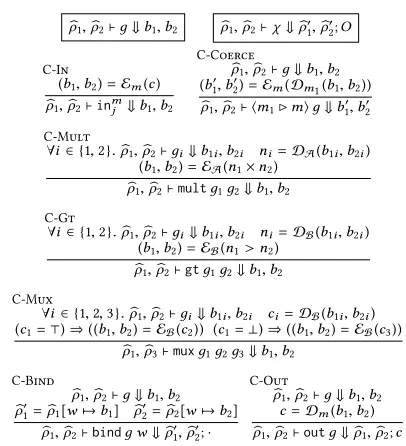
Figure 10 gives the judgments for evaluation of circuits by the two parties using a 2PC protocol. The circuit environment is a map from wires to shares:
Circuit environment ρD ::= · |ρD,w7→b
D
ρ1,ρD2⊢д⇓b1,b2 Dρ1,ρD2⊢χ⇓ρD ′ 1,Dρ
′ 2;O
C-In
(b1,b2)=Em(c)
D
ρ1,Dρ2⊢in
m j ⇓b1,b2
C-Coerce
D
ρ1,Dρ2⊢д⇓b1,b2 (b′
1,b ′
2)=Em(Dm1(b1,b2)) D
ρ1,ρD2⊢ ⟨m1▷m⟩д⇓b ′ 1,b2′
C-Mult
∀i ∈ {1,2}.Dρ1,ρD2⊢дi⇓b1i,b2i ni=DA(b1i,b2i) (b1,b2)=EA(n1×n2)
D
ρ1,Dρ2⊢multд1д2⇓b1,b2
C-Gt
∀i∈ {1,2}.ρD1,Dρ2⊢дi⇓b1i,b2i ni=DB(b1i,b2i) (b1,b2)=EB(n1>n2)
D
ρ1,ρD2⊢gtд1д2⇓b1,b2
C-Mux
∀i∈ {1,2,3}.ρD1,Dρ2⊢дi⇓b1i,b2i ci=DB(b1i,b2i) (c1=⊤)⇒((b1,b2)=EB(c2)) (c1=⊥)⇒((b1,b2)=EB(c3))
D
ρ1,ρD3⊢muxд1д2д3⇓b1,b2
C-Bind
D
ρ1,ρD2⊢д⇓b1,b2
D
ρ′
1=ρD1[w7→b1] Dρ ′
2=Dρ2[w7→b2] D
ρ1,Dρ2⊢bindд w⇓Dρ ′ 1,ρD
′ 2;·
C-Out
D
ρ1,ρD2⊢д⇓b1,b2
c=Dm(b1,b2)
D
ρ1,ρD2⊢outд⇓Dρ1,Dρ2;c
Figure 10: Circuit semantics in a distributed runtime
We useDρjto denote the circuit environment for partyj.We give the judgmentsDρ1,Dρ2⊢д⇓b1,b2, andDρ1,Dρ2⊢χ⇓ρD
′
1,Dρ ′
2;O, where Oare the observations (similar to source semantics). The former judgment evaluates a gate under the environmentsρDjand generates sharesbj of the gate’s output. Rule (C-In) evaluates the input gate
inmj , and creates them-type shares of the valuecinput by partyj. Rule (C-Mult) illustrates the pattern for evaluating circuit gatesд. To evaluatemultд1д2, the rule first evaluatesд1to(b11,b21)and
д2to(b12,b22). Shares(b11,b21)are then combined usingDAto
n1, and similarly(b12,b22)are combined ton2. The final output of themultgate is thenEA(n1×n2). Note that this is a functional description of how themultgate evaluates, of course, concretelyn1
andn2are not observed by the parties. Rule (C-Coerce) creates the new shares usingEm(the corresponding rule for coercion fromP
is similar). The evaluation ofbindupdates the mapping ofwin the input environments, and the rule (C-Out) outputs the clear valuec to the observations.
Correctness Theorem.We prove that all well typed programs
always terminate successfully (array indices are always in bounds, there are no unbounded loops, etc.) and the 2PC protocol produces the same outputs as the source program. That is, if a source state-mentsis well-typed, and compiles toHsin the intermediate language, thensterminates in the source semantics with observationsO,Hs evaluates to circuitχ, andχ terminates in the circuit semantics with the same observationsO. Formally, the correctness theorem is as follows (the environments on the left of⊢are empty and we elide the environments on the right of⊢for brevity):
Theorem 4.1 (Correctness). ∀s,Hs, if⊢s {Hs |_ then∃O,χ, s.t.⊢s⇓_;O,⊢Hs⇓_;χ, and⊢χ⇓_,_;O.
We prove the theorem in Appendix C.
Security theorem.The protocols we generate provide
as non-uniform interactive Turing machines (ITMs), with inputs provided by an environmentZ. An adversaryA, selects and “cor-rupts” one of the parties - however,Astill follows the protocol specification.Ainteracts withZthat observes the view of the corrupted party. At the end of the interaction,Zoutputs a single bit based on the output of the honest party and the view of the adversary. Two different interactions are defined: thereal worldand anideal world. In the real interaction, the parties run the protocol Πin the presence ofAandZ. LetREALΠ,A,Zdenote the distribu-tion ensemble describingZ’s output in this interaction. In the ideal interaction, parties send their inputs to a trusted functionality that performs the desired computation truthfully. LetS(the simulator) denote the adversary in this ideal execution, andIDEALF,S,Zthe distribution ensemble describingZ’s output after interacting with the ideal adversaryS. A protocolΠis said tosecurely realizea func-tionalityF if for every adversaryAin the real interaction, there is an adversarySin the ideal interaction, such that no environment
Z, on any input, can tell the real interaction apart from the ideal interaction, except with negligible probability (in the security pa-rameterκ). More precisely, the above two distribution ensembles are computationally indistinguishable.
We shall assume a cryptographic 2PC backend that securely im-plements any circuitχthat is output by our compiler (see Figure 8). This means that for any well-typed source programs, letχbe the circuit generated as in Theorem 4.1. We assume that there exists a 2PC protocolΠthat securely realizes the functionalityχand let
S2pcbe the corresponding simulator (that runs onχ, input of the corrupt party and the output obtained from trusted functionality for
χ). We note that ABY [18] provides such a protocolΠand simulator
S2pc for all circuitsχoutput in our framework. We now state and prove our security theorem.
Theorem 4.2 (Security). Letsbe a well typed program in our source language that generates a circuitχ (as defined in Theorem 4.1). Let protocolΠbe the two-party secure computation protocol that securely realizesχ(as defined above). Then,Πsecurely realizess. Proof.Our simulatorSsimply runs our compiler on programs to obtainχ. It is crucial that this compilation to circuits does not require the secret inputs of the parties. Next,Ssends the input of the corrupt party to the trusted functionality ofsto obtain outputs
O1. Note thatO1is same as the observations in the source seman-tics. By Theorem 4.1, these outputsO1are identical to outputs (or
observations)O2ofχunder circuit semantics. Next,SrunsS2pc
onχ, input of the corrupt party andO2. From the security ofΠ, we have that the simulated view output byS2pcis indistinguishable from the real view. Hence, the security follows.
5
SECURE CODE PARTITIONING
In this section, we describe our “secure code partitioning” tech-nique that allows EzPC to execute programs that require large circuits. Our techniques take inspiration from the idea of pipelining Yao’s garbled circuits described in FastGC [30]. However, unlike FastGC, we do not operate at a circuit level and partitioning is independent of the specific 2PC protocol. Letsbe a program in our source language that generates a circuitχ. For some programs,
the circuitχcan be larger than the memory size6and fail to exe-cute. Partitioning enables us to execute such programs via a source to source transformation that is oblivious to the underlying 2PC backend. Partitioning decomposes the programsinto a sequence of smaller EzPC programst1,t2, . . . ,tk(as defined below) such that the circuit size requirement for each of thetiitself is manageable. We compile and execute eachtisequentially, feeding the outputs of
tias state information toti+1. We prove our partitioning scheme to
be correct (sand sequential execution oft1,t2, . . . ,tkcompute the same functionality) and secure (sequential execution oft1,t2, . . . ,tk
does not reveal any more information thans). More formal details follow, while an example illustrating the technique of secure code partitioning is provided in Appendix A.
Letsbe a program that takes (secret) inputsxfrom Alice andy from Bob and produces an outputzto both parties. Lets1||s2||. . .||sk
be a decomposition ofssuch that the following holds. Defineq0=⊥
(the public empty state). For all 1≤i≤k−1,si takes inputsx,y andqi−1and outputs stateqi. Finally,sktakes inputsx,yandqk−1
to outputz. It is possible to decompose any programsinto such
s1||s2||. . .||sk. If EzPC generates circuitχi fromsi, the parties can executeχ1,χ2, . . .χksequentially (in a distributed setting) to ob-tainq1, . . . ,qk−1,and finally outputz. At theithstep, the parties
only need to store information proportional tox,y,qi−1andχi
(which is much smaller thanχ). However, this execution enables the parties to learnqi (for all 1 ≤i ≤k−1), which completely breaks the security.
To overcome this problem, we define a sequence of new programs
ti(1≤i≤k) as follows. Once again, defineq0=⊥. Without loss of generality, let allqibe values in some additive ring(Z,+)(e.g.,
the additive ring(Z264,+), i.e., the additive ring of integers modulo 264). Letr1,· · ·,rk−1be a sequence of random values sampled from
the same ring(Z,+)by Alice (in our implementation, allri values are generated by a pseudorandom function). Lett1be the program that takes as inputx,r1from Alice andyfrom Bob (and empty state
q0), and runss1(as defined above) to computeq1and then outputs
o1=q1+r1only toBob7. Alice’s output fromt1isr1. Next, everyti
(2≤i≤k−1) takes as inputsx,ri−1,rifrom Alice andy,oi−1from
Bob, runssion inputsx,yand stateqi−1=(oi−1−ri−1)(where−
denotes subtraction in the ring(Z,+)) and then outputsqi+rito
Bob andrito Alice. The last programtktakes inputsx,y,rk−1,ok−1,
runsskon inputsx,yand stateqk−1=(ok−1−rk−1)and outputs zto both parties. Although we have used arithmetic sharing here, Boolean sharing can be used to achieve the same effect.
Thus, given a decomposition ofsintos1||s2||. . .||sk, we can use the construction above to generate programst1,t2, . . . ,tk, that can be sequentially executed, using the unmodified underlying 2PC backend. We prove the following theorem for code partitioning:
Theorem 5.1 (Correctness and security of partitioning). Ifs1||s2||. . .||skis a decomposition of a programs, then there exists a sequence of programst1,t2, . . . ,tk and protocolsΠ1,Π2, . . . ,Πk
6In fact, there is an upper limit of232−1 gates for the circuit size in ABY but for most
machines the memory limit is hit first.
7While the description of the scheme here assumes that the underlying backend
supports only one party receiving output, this is only a simplifying assumption, and we can easily modify our protocol in the case where both parties must receive the same output.
such that for alli,Πi securely realizesti andΠ =Π1,Π2, . . . ,Πk
securely realizess.
Proof.Lett1, . . . ,tkbe the sequence of programs as defined above corresponding to the decompositions=s1||s2||. . .||sk. For every 1≤i≤k, letΠibe the 2PC protocol output by our framework forti. Our construction for programstiensures that ifsis well-typed, then for each 1≤i≤k,ti is well-typed. By Theorem 4.2,Πi, the 2PC protocol that evaluates the circuit generated byti, securely realizes
ti. That is, for every 1≤i≤k−1, theΠi provides observations
ri to Alice andoi to Bob. ProtocolΠk provides observationzto both Alice and Bob. Finally, sinceri andoi (1 ≤i ≤k−1) are individually uniformly random (in(Z,+), outputs received by the
adversary can be simulated given the final outputz.
Implementing code partitioning.We use partitioning for
pro-grams that require large circuits. Specifically, we first decompose the programsinto a sequence of small programss1||. . .||sk. And then, EzPC generates sequence of programst1, . . .tk automati-cally. We then compile and execute thekprogramst1,t2, . . . ,tk
sequentially, freeing up memory usage after execution of eachti. Automating the decomposition step requires an analysis that can statically estimate the resource usage of a EzPC program. Resource analysis of high-level programs is a well-known hard problem [28] and we describe a heuristic analysis.
To builds1, we consider the longest prefix ofswhose compu-tationsizeis below the threshold enforced by the available mem-ory of the machine. Ifs =s1;sr then we recurse onsr to obtain
s2, . . . ,sk. For a programu, to estimatesize(u), we need to dis-cuss three important cases: ifu≡u1;u2thensize(u)=size(u1)+ size(u2); ifu≡if(e1,u1,u2)thensize(u)=max(size(u1),size(u2));
ifs ≡foriin[n1,n2]dou1thensize(u) = (n2−n1)size(u1). If
(n2−n1)size(u1)is above the threshold then we replaceuby
foriin[n1,n1+n2
2 ]dou1;foriin[
n1+n2
2 ,n2]dou1 and recurse to find the prefix again. This heuristic analysis is suffi-cient for the benchmarks discussed in our evaluation.
6
IMPLEMENTATION
We discuss some implementation details of EzPC. The EzPC com-piler is written in Python and compiles each of our benchmarks in under a second to C++ code that makes calls to the ABY library [18]. ABY provides support for Arithmetic computations based on [34], and boolean computations based on GMW [23] as well as Yao’s garbled circuits [58]. Although EzPC can generate code for both kinds of boolean computations, we have observed better perfor-mance when using garbled circuits and use it in our evaluation. Hence, EzPC generated code uses Arithmetic computations and garbled circuits based boolean computations. We use 128 bits of security and OT extension-based arithmetic multiplication triplets generation. ABY provides multi-threading support (for the offline phase of the 2PC protocol); we leverage the support and use at most four threads in our evaluation.
EzPC programs can have the following operators: addition, sub-traction, multiplication, division by powers of two, left shift, logical and arithmetic right shifts, bitwise-(and, or, xor), unary negation, bitwise-negation, logical-(not, and, or, xor), and comparisons (less than, greater than, equality). Because of their high cost, integral
division and floating-point operators are not supported natively by EzPC. However, we have implemented integral division in 30 lines of EzPC, while the floating-point support in ABY is under active development [17].
Some of our benchmarks require accessing arrays at secret in-dices. While EzPC enforces the array indices to be public, secret indices can be encoded in EzPC using multiplexers. For example, consider the expressionA[x] whereAis an array of size 2 andxis secret-shared. The developer can express this functionality in EzPC asx>0 ?A[1] :A[0]. In general, a secret access to an array of size
nrequiresn−1 multiplexers in EzPC.
We use an off-the-shelf solver (SeaHorn [26]) to check that the array indices are within bounds (|=e<nin (T-Read) and (T-Write), Figure 7). We take the EzPC source program and translate it as an input C program to the solver. The solver takes less than a minute on our largest benchmark to verify that all the array accesses are in-bounds. This C program also enables validation of EzPC generated protocols via differential testing [42, 46].
Our implementation assigns the type labels (rule T-Decl) con-servatively. Only the variables that govern the control flow, i.e., variables inif-conditions andfor-loop counters are assigned pub-lic labels. All other variables are assigned arithmetic labels (that can later be coerced to boolean). We leave a more sophisticated type inference procedure for future work.
The compilation rules of Figure 7 can introduce repeated co-ercions from arithmetic to boolean and vice versa. Since EzPC is aware of the cryptographic costs associated with these coercions, it tries to minimize them using several optimizations, e.g., by the standard “common subexpression elimination" optimization [2]. On each coercion, EzPC memorizes the pair of arithmetic share and boolean share involved in the coercion. EzPC invalidates such pairs when the variables corresponding to the shares are overwritten by assignments. In subsequent coercions, EzPC reuses valid pairs (if available) instead of inserting code to recompute them afresh. These optimizations are standard compiler optimizations [2], and we rely on their correctness (optimizations preserve outputs and well-typedness) to maintain the security of the optimized programs.
7
EVALUATION
We evaluate EzPC on a variety of problems that can fall under the umbrella ofsecure prediction, where one party (the server) has a machine learning model, and the other party (the client) has an input. The goal is to compute the output of the model on client’s input, with the guarantee that the server learns nothing about the input, and the client learns nothing about the model beyond what is revealed from the output.
To begin, we first implement the benchmarks from Bost et al. [9] and MiniONN [40] (both of which study the same setting), and show that the performance of the high-level code written in EzPC is comparable to their hand-crafted protocols. Next, we demonstrate the generality and programmability aspects of EzPC by implement-ing state-of-the-art machine learnimplement-ing models from Tensorflow [1] and Bonsai [36]. Indeed, we provide the first 2PC implementation of Bonsai. We implement a Deep Neural Network (DNN) for CIFAR-10 dataset [35] from MiniONN [40] and matrix factorization [48] to evaluate partitioning.
Dataset d Prev time (s)
Prev comm
(KB) LAN
(s) WAN
(s) Comm
(KB) Num
gates LOC
Breast cancer 30 0.3 36 0.1 0.3 25 727 20
Credit 47 0.3 41 0.1 0.3 36 795 20
Table 1: Linear classification results. We compare EzPC
(LAN, WAN, Comm) with [9] (Prev time, Prev comm).
Dataset n F
Prev time (s)
Prev comm
(MB) LAN
(s) WAN
(s) Comm
(MB) Num
gates LOC
Nursery 5 9 1.5 0.2 0.1 0.4 0.6 73k 50
Audiology 24 70 3.9 2.0 1.5 2.9 37 4219k 50
Table 2: Naïve Bayes results. We compare EzPC (LAN, WAN,
Comm) with [9] (Prev time, Prev comm).
Dataset d N
Prev time (s)
Prev comm
(KB) LAN
(s) WAN
(s) Comm
(KB) Num
gates LOC
Nursery 4 4 0.3 102 0.1 0.3 32 3324 20
ECG 4 6 0.4 102 0.1 0.4 49 5002 20
Table 3: Decision tree benchmarks.We compare EzPC (LAN,
WAN, Comm) with [56] (Prev time, Prev comm).
We present the numbers for two network settings, a LAN setting and a cross-continent WAN setting. The round trip time between the server and the client machines in the two settings is 1ms and 40ms respectively. Each machine has an Intel(R) Xeon(R) CPU E5-2673 v3 processor running at 2.40GHz with 28 GBs of RAM. When we compare our execution times with prior protocols, we match our system and network parameters with those of the prior work (as the code for works such as Bost et al. [9] and MiniONN [40] are not publicly available). Most of our benchmarks are related to machine learning and we set up (largely standard) notation and describe our benchmarks in Appendix B.
7.1
Secure prediction
Standard classifiers.We evaluate the three standard classifiers,
linear, Naïve Bayes, and decision trees, from [9] on the following data sets from the UCI machine learning repository [38]: the Wis-consin Breast Cancer data set, Credit Approval data set, Audiology (Standardized) data set, Nursery data set, and ECG (electrocardio-gram) classification data from [3].
The results for linear classification are in Table 1. The input and the model are both vectors of lengthd. The columns “Prev. time” and “Prev. comm” show the time and the total network communication reported by Bost et al. [9] for a network setting with 40ms round trip time, which is same as our WAN setting. The total execution time of EzPC generated code in the LAN and the WAN setting is reported next, followed by the total communication. We observe that the EzPC code performance matches the hand-crafted protocol of Bost et al., and the programmer effort in EzPC is just 20 lines (last column in the table) of high-level code in the EzPC source language.
The results for Naïve Bayes are in Table 2. As before,ndenotes the number of classes andFis the number of features. As before, we compare with Bost et al. [9] and observe that EzPC generated code
DNN Prev time (s)
Prev comm
(MB) LAN
(s) WAN
(s) Comm
(MB) Num gates
Model
size LOC
SecureML 1.1 15.8 0.7 1.7 76 366k 119k 78
Cryptonets 1.3 47.6 0.6 1.6 70 316k 86k 88
CNN 9.4 657.5 5.1 11.6 501 9480k 35k 154
Table 4: DNN benchmarks. We compare EzPC (LAN, WAN,
Comm) with [40] (Prev time, Prev comm).
has better performance, despite using a generic 2PC, as opposed to custom designed protocols developed by Bost et al. Moreover, they remark that in their setup, generic Yao-based 2PC did not scale to the smallest of their Naïve Bayes classifiers, so they had to scale down the prediction task, and even then Yao-based 2PC was 500x slower. Whereas, we show that by using a cryptographic-cost aware compiler, we can scale generic 2PC to real prediction tasks, and get performance competitive to or better than the specialized protocols. Table 3 compares against the more recent work of [56] on decision trees and further validates this claim.
Deep neural nets.We evaluate EzPC on the DNNs described in
SecureML [44], Cryptonets [22], and the CNN from MiniONN [40]. For comparison, we consider their implementations from Min-iONN [40], which outperforms their previous implementations. Ta-ble 4 shows the results8. We note that for each of these DNNs, Min-iONN provides a specialized protocol, while EzPC uses a generic 2PC protocol (auto) generated from high-level code.
The first benchmark is the DNN described in SecureML [44] (Figure 10 in [40]). It has three fully connected layers with square as the activation function. Next, we implement the DNN described in Cryptonets [22] (Figure 11 in [40]) in EzPC. This DNN also uses square as the activation function and has one convolution (with 5 output channels) and one fully connected layer. Finally, we implement CNN from MiniONN (Figure 12 in [40]), that has two convolutions (with 16 output channels each) and two fully connected layers. In contrast to the previous two DNNs, it uses ReLU for activation and has significantly higher number of boolean-and gates. Note that square activation can be implemented entirely using arithmetic gates but ReLU requires boolean-and gates. For a complete description of these benchmarks and their accuracies, we refer the reader to the original references.
In Table 4, the column “Model size” is the number of parameters in the trained model. We observe that our performance is compet-itive with specialized MiniONN protocols, for both the LAN and the WAN settings. Further, lines of EzPC source code required is still small. We note that while the MiniONN implementation is based on the ABY framework, it does not use ABY “off-the-shelf” and performs application-specific optimizations. In contrast, EzPC focuses on generic 2PC and directly exploits the existing perfor-mant implementations in ABY. MiniONN also reports performance results on a bigger DNN with 7 convolution layers. In EzPC, this benchmark requires partitioning and we discuss it in Section 7.2. State-of-the-art classifiers.Tensorflow [1] is a standard machine
learning toolkit. Its introductory tutorial describes two predic-tion models for handwritten digit recognipredic-tion using the MNIST dataset [37]. Each image in this dataset is a greyscale 28×28 im-age of digits 0 to 9. The first model that the tutorial describes is a
8MiniONN does not report the network round-trip time nor the bit-length of their
inputs (we use32-bit inputs).
Classifier LAN(s) WAN(s) Comm(MB) NumAnd NumMul Numgates Modelsize LOC
Regression 0.1 0.7 5 2k 8k 35k 8k 38
CNN 30.5 60.3 2955 6082k 4163k 42104k 3226k 172
Table 5: Tensorflow tutorial benchmarks
Dataset LAN
(s) WAN
(s) Comm
(MB) Num
And Num
Mul Num
gates depth LOC
Chars4k 0.1 0.7 2 18k 3k 85k 1 89
USPS 0.2 0.9 4 62k 2k 285k 2 156
WARD 0.3 1.1 9 106k 8k 506k 3 283
Table 6: Bonsai benchmarks
softmax regression that provides an accuracy of 92%. The classifier evaluatesargmaxW·x+b. Here,xis a 784 length vector obtained from the input image,Wis a 10×784 matrix, andbis a 10 length vector. We implement this classifier in EzPC and present the results in the first row of Table 5.
The next classifier in the Tensorflow tutorial is a convolution neural net with two convolutions (with 32 output channels) and two fully connected layers with ReLU as the activation function. This DNN is both bigger and more accurate than the DNNs presented in the previous section. In particular, it has an accuracy of 99.2%. Since, we are not aware of any other tools that have used this model as a benchmark, we only report numbers for EzPC. We observe that this DNN can take a minute per prediction in the WAN setting and is the largest benchmark that we have evaluated without partitioning. We next present Bonsai [36] results on three standard datasets: character recognition (Chars4k [16], accuracy 74.71%), text recogni-tion (USPS [32], accuracy 94.4%), and object categorizarecogni-tion (WARD [57], accuracy 95.7%). We implement the trained classifiers in EzPC for all the benchmarks from [36], and show the representative re-sults in Table 6. Out of all the benchmarks from [36], the dataset WARD requires the largest model. The column “depth” shows the depth of the tree used by Bonsai. The size of EzPC program grows with the depth of the tree, as the straightforward EzPC implemen-tation requires a loop for each layer of the tree9.
To summarize, by providing first 2PC implementations of state-of-the-art classifiers, we have demonstrated the expressiveness of EzPC. We discuss scalability next.
7.2
Secure code partitioning
The largest benchmark of MiniONN [40] is a DNN for CIFAR-10 dataset [35]. The classifier’s task is to categorize colored (32×32) images into 10 classes. A secure evaluation of this DNN needs more memory than what is available on our machines. Therefore, we use partitioning and divide the computation into seven stages. The first step does a convolution with 64 output channels and a ReLU activation. The next four stages together perform a convolution that involves multiplying a 64×576 matrix with a 576×1024 matrix. The sixth stage performs a ReLU and a convolution. The final stage has four convolutions, five ReLUs, and a fully connected layer. The total number of lines of EzPC code for this benchmark is 336 lines.
9We remark here that our current language does not support functions (which we
leave for future work) and with this support, LOC would be lower and independent of depth.
LAN (s) WAN (s) Comm(MB) NumAnd NumMul Numgates
Total 265.6 647.5 40683 21m 61m 337m
Stage 6 55.2 122.6 6744 12m 10m 98m
Table 7: Partitioning results for CIFAR-10. MiniONN takes
544 seconds and communicates 9272 Mb.
Stage LAN (s) WAN (s) Comm(MB) depth Numgates LOC
1 175 662 29816 16370 33m 500
2 193 1095 31945 30916 37m 516
3 178 627 29810 16369 32m 478
Total 546 2384 91571 – 102m 1494
Table 8: Partitioning results for matrix factorization. The
time reported by [48] for this computation is 10440 seconds.
Figure 11: Comparison of EzPC code with and without
par-titioning. x-axis denotes the number of layers in the DNN,
while y-axis denotes time in seconds for the secure protocol.
Table 7 shows the end-to-end numbers as well as the numbers for the sixth stage, which is the heaviest. The number of gates are in millions, hence the suffix ‘m’ in the last three columns. As with Table 4, EzPC generated generic 2PC protocol is competitive with MiniONN here as well. Therefore, we believe that with parti-tioning, EzPC can scale to large computations while maintaining performance competitive with existing specialized protocols. In particular, for a large enough DNN, MiniONN could run out of memory but an appropriately partitioned EzPC implementation would still succeed.
Scalability.To illustrate the scalability of partitioning, we evaluate
7.3
Matrix factorization
EzPC is not tied to secure prediction and can express more gen-eral computations. To demonstrate this expressiveness, we imple-ment secure matrix factorization [48]. Abstractly, given a sparse matrixMof dimensionsn×mandMnon-zero entries, the goal is to generate a matrixU of dimensionn×dand a matrixV of dimensiond×msuch thatM ≈UV. This operator is useful in recommender systems. In particular, Nikolaenko et al. [48] shows how to implement a movie recommender system which does not require users to reveal their data in the clear, i.e., the ratings the users have assigned to movies are kept secret. The implementation is a two party computation of an iterative algorithm for matrix fac-torization (Algorithm 1 in [48]). This algorithm is based on gradient descent and iteratively converges to a local minima. We implement this algorithm in EzPC.
To ensure that the algorithm converges to the right local minima, Nikolaenko et al. require 36 bits of precision. Since ABY supports either 32-bit or 64-bit integers, our EzPC implementation manipu-lates 64-bit variables. For the matrixMof user data, Nikolaenko et al. considern =940 users,m=40 most popular movies, and
M=14683 ratings from the MovieLens dataset. The time reported in [48] for one iteration is 2.9 hours10. This computation is large enough that we partition each iteration into three stages. The first stage involves a Batcher [4] sorting network followed by a linear pass. The second stage involves sorting and gradient computations and is the heaviest stage. The third stage is similar to the first stage. The results are presented in Table 8. These circuits have a large depth (column “depth"); the circuits for secure prediction had depth below 100.
We observe that in the LAN setting, we are about 19 times faster than [48] and in the WAN setting we are about 4 times faster. The main source of these significant speedups is that, unlike [48], EzPC does not need to convert the functionality into boolean circuits. However, this benchmark requires more lines of code than the previous benchmarks because of Batcher’s sort (450 lines of EzPC code in each stage). However, the current programmer effort seems minuscule compared to the mammoth implementation effort put in by Nikolaenko et al. (Section 5 of [48]) to scale a boolean circuits based backend to this benchmark.
7.4
Subsequent Work
Subsequent to our work, Juvekar et al. [33] have presented Gazelle, a specialized protocol for DNNs. Gazelle use a lattice-based packed additively homomorphic encryption scheme (PAHE) for arithmetic computations and garbled circuits for boolean com-putations. Gazelle can evaluate the CNN benchmark of Table 4 in 0.8 seconds, as opposed to 5.1 seconds taken by EzPC with the ABY backend. Such advances in cryptographic backends are orthogonal to our contributions. In particular, once Gazelle is available, we could add it as another cryptographic backend to EzPC. Further-more, the authors of Gazelle remark: “A final, very interesting and ambitious line of work would be to build a compiler that allows us to easily express arbitrary computations and automatically factor the computation into PAHE and two-party primitives” – the exact problem that EzPC solves.
10[48] does not report the network round-trip time.
8
RELATED WORK
EzPC falls into the category of frameworks that compile high level languages to 2PC protocols. We discuss other such frameworks next. Fairplay’s Secure Function Definition Language (SFDL) [5, 41] and CBMC-GC [29] compile C or Pascal like programs into boolean circuits that are then evaluated using garbled circuits [58]. ObliVM [39] protects access patterns using an oblivious RAM [24, 50] and also uses garbled circuits for compute. In Secure Multi-party Computation Language (SMCL) [47], Java like programs are compiled into arithmetic circuits that are then evaluated using the VIFF framework [15]. Wysteria [51] enables programmers to writen-party mixed-mode programs that combine local, per-party computations with secure computations. It compiles secure compu-tations to boolean circuits and uses a GMW-based backend [14, 23]. Mitchell et al. [43] allow the user to select between Shamir’s se-cret sharing [20] and fully homomorphic encryption [21]. Unlike EzPC, all these tools use either an arithmetic backend or a boolean backend but not a combination of both.
Next, we discuss tools that expose libraries which developers can use to describe 2PC protocols. To generate efficient protocols for a functionality, the programmer must break the functionality into components and call the appropriate library functions. For example, ABY [18] falls in this category. The TASTY tool [27] allows mix-ing homomorphic encryption based arithmetic computations and garbled circuits based boolean computations and the interconver-sions between the two are inserted by the programmer explicitly. The work of Kerschbaum et al. [34] provides a scheme to auto-matically assign homomorphic encryption or garbled circuits to each operator in a computation that is expressed as a sequence of dyadic operations. They conjecture that the problem is NP hard and gave a linear programming based solution and a quadratic time greedy heuristic. These techniques are not directly applicable to EzPC programs because offor-loops andif-conditions. How-ever, we are exploring if these ideas can be extended to yield better type inference. Other examples include the VIFF framework [15] for arithmetic computations and Sharemind [8] (secure 3-party boolean computation).
2PC backends have made tremendous progress in the last decade. For example, the circuits can be optimized for depth [11, 17], large garbled circuits can be pipelined [30, 39], online complexity can be reduced at the cost of offline complexity [25], encrypted values output from a garbled circuit can be reused [45] and oblivious RAM [24, 50] can be used to hide access patterns of MIPS code [55]. Incorporating these backends would only improve the performance and scalability of EzPC implementations.
Many works have designed specialized protocols for various 2PC tasks. This requires deep knowledge of cryptography to ensure security. Examples include [3, 6, 9, 10, 19, 31, 40, 44, 48, 49, 56].
9
CONCLUSION AND F UTURE WORK
We presented EzPC, the first cryptographic-cost aware frame-work that generates efficient and scalable 2PC protocols from high-level programs. The generated protocols comprise combinations of arithmetic and boolean circuits and have performance compa-rable to, or better than the previously known custom specialized
![Table 4: DNN benchmarks. We compare EzPC (LAN, WAN,Comm) with [40] (Prev time, Prev comm).](https://thumb-us.123doks.com/thumbv2/123dok_us/7959352.1320445/10.612.64.286.265.312/table-dnn-benchmarks-compare-ezpc-comm-prev-prev.webp)
![Table 8: Partitioning results for matrix factorization. Thetime reported by [48] for this computation is 10440 seconds.](https://thumb-us.123doks.com/thumbv2/123dok_us/7959352.1320445/11.612.328.549.291.430/table-partitioning-results-factorization-thetime-reported-computation-seconds.webp)
