Secure Opportunistic Multipath Key Exchange
Sergiu Costea
ETH Zürich Zürich, Switzerland [email protected]
Marios O. Choudary
∗University Politehnica of Bucharest Bucharest, Romania [email protected]
Doru Gucea
University Politehnica of Bucharest Bucharest, Romania [email protected]
Björn Tackmann
IBM Research – Zürich Rüschlikon, Switzerland
Costin Raiciu
University Politehnica of Bucharest Bucharest, Romania [email protected]
ABSTRACT
The security of today’s widely used communication security proto-cols is based on trust in Certi�cate Authorities (CAs). However, the real security of this approach is debatable, since certi�cate handling is tedious and many recent attacks have undermined the trust in CAs. On the other hand, opportunistic encryption protocols such as Tcpcrypt, which are currently gaining momentum as an alternative to no encryption, have similar security to using untrusted CAs or self-signed certi�cates: they only protect against passive attackers. In this paper, we present a key exchange protocol,Secure Mul-tipath Key Exchange (SMKEX), that enables all the bene�ts of op-portunistic encryption (no need for trusted third parties or pre-established secrets), as well as proven protection against some classes of active attackers. Furthermore, SMKEX can be easily ex-tended to a trust-on-�rst-use setting and can be easily integrated with TLS, providing the highest security for opportunistic encryp-tion to date while also increasing the security of standard TLS.
We show that SMKEX is made practical by the current availability of path diversity between di�erent AS-es. We also show a method to create path diversity with encrypted tunnels without relying on the network topology. These allow SMKEX to provide protection against most adversaries for a majority of Alexa top 100 web sites. We have implemented SMKEX using a modi�ed Multipath TCP kernel implementation and a user library that overwrites part of the socket API, allowing unmodi�ed applications to take advantage of the security provided by SMKEX.
CCS CONCEPTS
•Security and privacy→ Public key encryption;Security protocols;
KEYWORDS
key exchange, opportunistic security, multi-path TCP ∗I thank Christ our God for all His help during this work.
Permission to make digital or hard copies of all or part of this work for personal or classroom use is granted without fee provided that copies are not made or distributed for pro�t or commercial advantage and that copies bear this notice and the full citation on the�rst page. Copyrights for components of this work owned by others than the author(s) must be honored. Abstracting with credit is permitted. To copy otherwise, or republish, to post on servers or to redistribute to lists, requires prior speci�c permission and/or a fee. Request permissions from [email protected].
CCS’18, October 15–19, 2018, Toronto, ON, Canada
©2018 Copyright held by the owner/author(s). Publication rights licensed to ACM. ACM ISBN 978-1-4503-5693-0/18/10...$15.00
https://doi.org/10.1145/3243734.3243791
ACM Reference Format:
Sergiu Costea, Marios O. Choudary, Doru Gucea, Björn Tackmann, and Costin Raiciu. 2018. Secure Opportunistic Multipath Key Exchange. In2018 ACM SIGSAC Conference on Computer and Communications Security (CCS ’18), Oc-tober 15–19, 2018, Toronto, ON, Canada.ACM, New York, NY, USA, Article 4, 18 pages. https://doi.org/10.1145/3243734.3243791
1 INTRODUCTION
Secure communication is at the heart of our society today: we use secure e-mails, secure HTTP (HTTPS), secure shell (SSH), se-cure Voice-over-IP, sese-cure messaging, etc. However, passive and active attackers still threaten the security of our communications. In particular, recent intelligence leaks and journalistic investigations have shown that the NSA controls some of AT&T’s main rout-ing facilities in order to analyze Internet tra�c and long-distance calls [48, 51]. Rob Joyce from NSA has also admitted that NSA, as a persistent-threat adversary, will do everything it can to break into other people’s machines and communications [25].
As a result, we have seen two major shifts in the landscape of communications: a) enabling HTTPS by default on most major websites and b) moving toward opportunistic encryption as the baseline instead of no encryption at all (plaintext). Unfortunately, the popular protocols that support these shifts (TLS and Tcpcrypt) still have their shortcomings.
TLS (Transport Layer Security) [13], as well as similar protocols such as QUIC [22], rely on third party servers – certi�cate author-ities (CA) – to ensure the authenticity of public keys exchanged between two communicating parties (e.g., client and server), hence protecting against active man-in-the-middle (MITM) attacks. Yet, in the past years we have seen many issues with this system: a) CA’s have been fooled to issue certi�cates to untrusted parties [33]; b) CA servers have been hacked [17, 20]; c) the mechanism for revoking bad or hijacked certi�cates is problematic [35]; d) CA’s share their secret keys with other potentially insecure parties [7]. As a result, the protection that current TLS provides against active MITM attacks is debatable.
active ones (i.e. those that can tamper with the data). In essence, this is similar to using a compromised CA or self-signed certi�cates. In this paper, we introduce Secure Multipath Key Exchange (SMKEX), a key exchange protocol that is an extension of the Di� e-Hellman key exchange to multiple channels. SMKEX provides op-portunistic encryption with partial protection against active MITM attacks by leveraging the use of multiplepubliccommunication channels between communicating parties. Hence, our protocol has all the usability advantages of opportunistic encryption1, while
providing protection against several classes of active attackers. Fur-thermore, SMKEX can be easily extended to a trust-on-�rst-use (TOFU) setting and can be easily integrated with TLS, providing increased security for both TOFU and TLS-like protocols.
The security and practicality of our protocol is made possible by two main factors:a) the wide availability of path diversity between
di�erent AS-es [39];b) the widespread adoption of Multipath TCP (MPTCP) [1] both on workstations and smartphones [37]. We have performed measurements of path diversity in several countries, which show that SMKEX can provide protection against local active attackers for a majority of Alexa top 100 websites. Furthermore, we can also use encrypted tunnels to create path diversity, allowing SMKEX to provide security even against nation-wide adversaries. Overall, our work provides several useful contributions towards secure and practical opportunistic encryption:a) proof that SMKEX
can resist active, but unsynchronized attackers, thus providing the highest security of an opportunistic encryption protocol to date (§6);b) evidence that existing path diversity in the Internet allows SMKEX to secure connections to many popular websites (§7);c) a method based on encrypted tunnels which allows SMKEX to protect against nation-wide adversaries (§7.2);d) an implementation of SMKEX using a modi�ed MPTCP kernel implementation and a user library that overwrites the Socket API, allowing unmodi�ed applications to use SMKEX (§8);e) description of integration with TLS and TOFU-based protocols (§10).
SMKEX builds on hash functions and is proven secure in the random-oracle model. We additionally describe in §D a variant of the protocol that is secure in the standard model.
2 ATTACKER MODEL
Generally, there are two types of network attackers:passive attack-ers, which only eavesdrop on a path, andactive attackers, which additionally modify messages.
We consider the setting where a client connects to a server across multiple paths. If multiple attackers target the same path, we view them as a single attacker. If at least one of the attackers is active, we view all of them as a single active attacker. If only passive attackers target that path, we view them as a single passive attacker. In the Internet, attackers that are present on di�erent paths can decide to collude. However, due to physical and national boundaries, attackers in di�erent AS-es or countries might not be able to exchange data in real time. To capture such behavior, we de�ne two types of relationships.
D���������1 (S����������� ���������). Two attackersX1and
X2are said to be synchronized (writtenX1-X2) if they can exchange messages between the start and end of a speci�c protocol session.
1See the SoK paper of Unger et al. [49, Section III, Table I] for more details.
P/P,P-P
A/P
A-P A/A
A-A
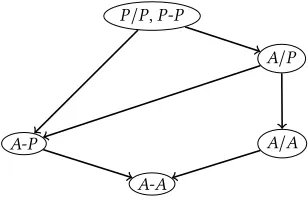
Figure 1: Map of all our possible adversaries based on intru-siveness(A,P)and communication capabilities( ,/).
D���������2 (U������������� ���������). Two attackersX1
andX2are said to be unsynchronized (writtenX1/X2) if they can only exchange messages before the start and after the end of a speci�c protocol session.
Unsynchronized attackers may agree over keys or data prior to protocol execution. They may also cooperate after termination of the session; this must not compromise the con�dentiality of tra�c.
2.1 Attack hierarchy for 2 paths
Based on attacker capabilities (active or passive) and the relation-ships between attackers (synchronized or unsynchronized) we clas-sify attacks according to total attacker power. While the classi� ca-tion is simple for two paths (where we have only two attackers and one relationship between them), the complexity increases quickly as the number of paths grows. We discuss only the 2-path attacks in-depth, and in §C.2 introduce methods that reduce the complexity of any multipath attack to the 2-path case.
By looking at all possible combinations of attackers for the 2-path case, we obtain the following attack scenarios:P/P,P-P,A/P, A-P,A/A, andA-A.
it also implies they are secure againstP/P,P-P,A/P. Opportunis-tic protocols cannot achieve security againstA-Aattackers, so an opportunistic protocol secure against bothA/AandA-Pattackers achieves the best possible security according to our classi�cation.
3 FUNDAMENTAL GOALS
In the following, we present the fundamental goals for secure op-portunistic multipath key exchange in our model. In all our protocol analyses, we model the network as asynchronous, with no upper bound on the time required for a message to be delivered. Secure key exchange.Our�rst goal (and the focus of our work) is to obtain a secure key exchange between two parties. We de�ne a secure key exchange as a distinguishability game, adapting the model of Canetti and Krawczyk [6]. In particular, as they target authenticated key exchange and assume an adversary that has full control over the network, we describe restricted classes of adversaries that modelA/AandA-Pattackers, respectively. The guarantee formalized by our model is that any protocol session in which the adversary behaved as anA/Aor anA-Pattacker (and not as anA-Aattacker) produces a key that is indistinguishable from a purely random one. This is the common security requirement for key-exchange protocols.
Forward and backward secrecy.Key exchange protocols are of-ten required to also provideforward secrecyandbackward secrecy
(aka. future secrecy [11, 49]). Forward secrecy guarantees that an attacker that is able to compromise all the key material of commu-nicating parties at a given time (e.g. temporary access to a device) is not able to decrypt data from previous communications [49, Section IV]. Often, forward secrecy is de�ned in terms of long-term secrets: compromising the long-term secrets should not allow an adversary to decrypt previously encrypted data. However, given the lack of long-term secrets in the basic version of our key exchange proto-col, we de�ne forward secrecy more generally, as Unger et al. [49, Section IV], meaning that an adversary that can compromise all the keying material cannot decrypt previously encrypted data. This de�nition also captures protocols using long-term keys (see our TOFU extension in §10).
Similarly, backward (or future) secrecy guarantees that an at-tacker that is able to compromise all the key material of communi-cating parties at a given time is not able to decrypt data from future communications [49, Section IV]. Again, this generic de�nition does not necessarily imply the use of long-term secrets, but only that an adversary be given all key material available at a given time.
4 UNDESIRABLE EXTENSIONS FOR
MULTIPATH KEY EXCHANGE
Di�e and Hellman proposed the�rst e�cient solution to exchange a secret key over a public path back in 1976 [14]. This protocol works as follows. Let Alice (A) and Bob (B) be the two parties that want to communicate (e.g. a client and a server) and letGbe a cyclic group of prime orderq, with generator (with|q|, the bit
length ofq, large). Alice and Bob may agree on parametersG,q, beforehand. A chooses a secret exponentainZqand sends the public value a(an element ofG) to B. Similarly, B chooses a secret
exponentbinZqand sends bto A. They can now both obtain the
secret keyK= ab, by exponentiating the public value received
from the other party to their secret exponent2.
While the DH protocol is still the predominant key exchange mechanism used today, it is completely vulnerable to an active MITM attacker (M) that can intercept and modify the key exchange in order to set up di�erent known keys with each of the participants. A common solution to prevent such attack, as used in TLS, is to sign the public value sent by the server and verify the signature through a chain of certi�cates [13]. But relying on certi�cates signed by third parties might lead to false security. Hence, we would like to establish secure communications without relying on trusted third parties or pre-established secrets (the context of opportunistic encryption). As we show in the next sections, this is possible by taking advantage of multiple communication paths.
In the following, we explain why previously proposed solutions for multipath key exchange, as well as some ideas that may seem good at�rst glance, fail to provide a secure key exchange against A/AorA-Padversaries.
Replicated Di�e-Hellman.A�rst possible approach would be to replicate the DH key exchange across all paths and then rely on majority voting to decide on the good key. But this would only work when there is a majority of passive attackers, which we cannot know in advance. Another option is to stop if we get di�erent keys across some paths. However, in this caseA/Aadversaries could agree before the key exchange on the parameters, resulting in the same key exchange across all paths but with keys known to the attackers.
Rely on Data Transfer Encryption.Another option is to perform a single DH key exchange on one path (chosen randomly) and then use a multipath data transfer protocol such as MPTCP [1] to send encrypted data. This is practically what would happen if we perform a standard DH key exchange (or any other single path key exchange protocol) on top of MPTCP and then encrypt tra�c with the exchanged key.
In this case (see Figure 2, left), an active attacker on the path we performed the key exchange on would have access to the secret keys used by the participants (saykAM andkMB). However, during data
transfer, this attacker would useKMBto re-encrypt the data sent
by A for B, while the data on the other paths would be encrypted with the keykAM (assuming adversaries cannot communicate –
A/A– or that the other adversaries are passive –A-P). Therefore, at some point B could reject the connection due to the impossibility of decrypting data from these other paths.
While this seems better than DH on a single path, it still exposes the data sent by A to the attacker (note that attackers may col-lude after the key exchange to gather all the data they collected). Therefore, a straight-forward extension of DH to the multiple path scenario is not enough. This also implies that a straightforward im-plementation of TLS on top of a multipath protocol such as MPTCP will not increase its security. In Section 10, we show how to combine SMKEX (§5) with TLS to actually increase its security.
Alice Bob
A1 kAM M kMB B1
A2 kAM B2
A1 M B1
a randA
m randM
m randM
b rand B
A2 randA M B2
randM
randM
randB
Figure 2: Multipath extensions for Di�e-Hellman. Left: single DH then MPTCP. Right: shared secret Di�e-Hellman.
Shared Secret Di�e-Hellman.Another possible approach is to combine the DH key exchange with secret sharing [45]. This was done by Takano et al. [47] in the context of P2P networks. The idea is to split the public values, e.g. a, into sharess1,s2, ...up to the
number of paths, such that a=s1 s2 ...(see Figure 2, right).
However, bothA-PandA/Aadversaries might compromise the exchanged key either during or after the session. For example, let’s take the case ofA/Aadversaries that communicate after the session. Say A starts the protocol and sends her sharess1,s2, ...to B. The attacker M can agree beforehand on the shares he will reply to A ( m =s0
1 s20 ...), without requiring communication during the key exchange. Upon receiving these shares, A creates the shared secretkAM= amand starts sending data to M (thinking of B). M
cannot decrypt the data at this point, since he cannot recover a.
However, after the protocol run, the attackers can collude to get a
and�nallykAM. At this point it is possible to recover the data sent
by A. The same happens on B’s side.
Multiple Di�e-Hellman.Yet another simple approach is to per-form a di�erent DH key exchange on each communication path, obtaining a di�erent keyki on each path. Then, A and B can compute a new global key, e.g. by adding the key bits modulo 2:kA=kA1 k2A .... However, this solution has the same problem as the one above: it does not actually provide a secure key exchange. The attackers can also reconstructkAafter the key exchange and
hence obtain data sent by A.
In summary, none of the simple extensions of DH to multiple paths presented above can provide a secure key exchange against A/AandA-Padversaries.
5 SECURE MULTIPATH KEY EXCHANGE
In this section, we present our secure multipath key exchange pro-tocol (SMKEX). This propro-tocol provides secure key exchanges with forward and backward secrecy againstA-PandA/Aadversaries without relying on long-term secrets or trusted third parties.
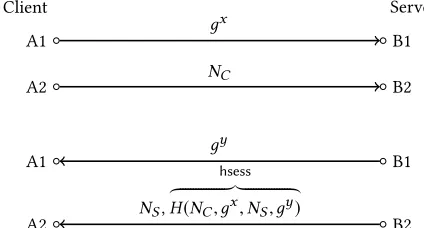
SMKEX, shown in Figure 3, performs a standard Di�e-Hellman key exchange on one path while exchanging a hash of session information and some nonces on the other path. Compared to classical Di�e-Hellman, the only extra costs are computing and sending the hash and nonces. As the protocol consists of a single round trip, it can also easily be be included in other protocols, such as the initial TLS key exchange, without introducing additional delays. The protocol�elds are described in Table 1.
In isolation, the Di�e-Hellman key exchange on the�rst path is vulnerable to a man-in-the-middle attack. To prevent this, the server sends a hash of session information (the public keys and the cryptographic nonces) on the second path. The client uses
Client Server
A1 x B1
A2 NC B2
A1 B1
A2 NS, B2
hsess
z }| {
H(NC, x,NS, )
Figure 3: Secure multipath key exchange protocol (SMKEX) in the 2-path case.
this additional information to verify that it has the same session information as the server. Additionally, it allows the client to verify that the server’s public key was created by the server itself and not chosen by the attackers (because in our model the attackers are unable to synchronize across both paths to forge both the server’s public key and the hash).
In theA-Pscenario, the protocol exploits the fact that the passive attacker is unable to modify messages, so at least one path is safe against tampering. If the Di�e-Hellman exchange happens on this safe path, then the security of the key follows immediately from the properties of the Di�e-Hellman protocol. If the session information hash is sent on the path with the passive attacker, then it will reach the client unchanged. Thus, the client can compare its own session information to what it received from the server and abort the protocol if it detects a mismatch.
For theA/Ascenario, the protocol exploits the lack of synchro-nization between attackers. The intuition here is that the attacker that sees the session information hash does not glean any informa-tion about the public keys themselves. Due to the random oracle nature of the hash, this makes the attacker unable to construct a new hash that matches the client’s own public key and a forged server public key. The client thus either receives an acceptable hash for a session where no man-in-the-middle attempt happened, or a di�erent hash that produces a mismatch and causes the client to abort the session. If the public keys and the nonces match, the client concludes that no man-in-the-middle attack happened and accepts the negotiated secret.
The noncesNC andNScould also be sent on the�rst path,
NC,NS Client and server nonces
x, Client and server Di�e-Hellman public
key shares
sess Session information (nonces and key shares)
hsess Hash of session information sk Negotiated Di�e-Hellman secret ss Negotiated secret string atk Application tra�c key
Table 1: Notation for exchanged messages
HDKF-Extract
HKDF-Expand 0
sk
ss
atk
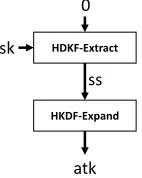
Figure 4: Key derivation tree using HKDF-Extract and HKDF-Expand as de�ned in RFC5869 [29]. HKDF-Extract with a0seed is a good randomness extractor in the random-oracle model.
�rst path cannot send a message toA2, which is not required by our protocol. The exact security property achieved by SMKEX is described in §6 and in more detail in §A.
We de�ne a session as a tuple containing the client’s and server’s Di�e-Hellman key shares and hello�elds:
sess= NC, x,NS, (1)
The value present at the client are indicated via⇤in the super-script. The session, as viewed by the client, is therefore:
sess⇤= N⇤
C, x⇤,NS⇤, ⇤ (2)
To guarantee session independence, eachNC,NS,xand must
be randomly generated for each new session.
The client starts the protocol by sending its public value xon
the�rst path and its nonceNCon the second path.
The server uses a randomly generated secret to compute the shared Di�e-Hellman secretsk = x , which is, as we show in
§6, a secure Di�e-Hellman key. To extract a key for use in further cryptographic schemes, such as symmetric encryption, one uses a randomness extractor such as HKDF [29], which is depicted in Figure 4. Alternatively, one can use an almost-universal hash func-tion [8] and extract via the Leftover Hash Lemma [24], usingNSas
the seed, at the cost of some entropy loss.
The server replies on the�rst path with its own public value , and sends its nonceNSand the hash of the entire session
informa-tion (hsess) on the second path. Upon receiving the two messages, the client computes its own shared Di�e-Hellman secretsk⇤= x
and extracts a key analogously to the server. The client then hashes its own session information and checks whether the result matches
with what it received from the server. If the hashes do not match (hsess,hsess⇤), the key exchange fails and the client outputs?.
While SMKEX provides a clean extension of Di�e-Hellman to multiplepublicchannels, its careful design results in better security than the approaches from the previous section: it enables a secure key exchange with forward and backward secrecy for bothA-P andA/Aadversaries. Therefore, it can protect even against some categories of active adversaries, increasing the level of protection achievable by opportunistic encryption.
As we describe in §C.2, the protocol can be extended to a larger number of paths at low communication cost: the communication on all further channels is similar to the one on the second channel.
6 FORMAL ANALYSIS
We analyze SMKEX in a model that adapts that of Canetti and Krawczyk [6] to opportunistic multi-path key exchange. We provide a high-level description of our modi�cations in this section and defer a more formal description of the model to §A.
In the model of Canetti and Krawczyk [6], initiator and respon-der of a key exchange session obtain as input asession identi�er. Since the existence of such a predetermined identi�er seems un-realistic in opportunistic protocols, we follow the approach of Choo et al. [9] and de�ne the session IDsidof a protocol is con-sidered as an output—not an input—of the protocol. To model the property that, in SMKEX, the initiator begins the protocol by sending both messagesA1 ! B1 andA2 ! B2as in Fig-ure 3, we let the initiatorPi�rst be initiated through an invocation
(Pi,Pj,initiate,id)analogously to [6], and subsequently through an invocation(Pi,Pj,follow-up,id), which lets the initiator send
the second messageA2!B2in Figure 3. (The valueidis only used locally byPi to identifywhichone of the possibly multiple
sessions betweenPi andPjis referred to.) The responder need not
receive such an explicit invocation, as the sessions are started by the messages received on the network. In the security game, ad-versaryAmay start an arbitrary number of SMKEX sessions and
attack them by observing and modifying network messages, as well as by corrupting parties. At some point,Aselects a test session and obtainseitherthe correct key computed in that sessionora purely random key, andAmust guess whether or not it received
the correct key. The advantageAdvSMKEX
�� (A)of adversaryAis then de�ned as
AdvSMKEX
�� (A)=2 Pr[Aguesses correctly] 1, which is analogous to the original model [6].
An adversary for SMKEX can always emulate a client to a server; therefore, the fact that a server session completes and accepts the key although it does not communicate with the actual client is not considered an attack. This resembles the server-only authentica-tion scenario considered in previous work such as by Krawczyk et al. [28], and analogously with that work we require that the test session chosen by the adversary must be a client (or: initiator) session.A-PandA/Aadversaries in the sense of §2 are modeled by restricting the types of adversaries considered in the security de�nition, as follows.
•A-P adversary. The adversaryA delivers at least one of
unmodi�ed toPi. This model also implies that the active
attacker cannot inject a message on the path controlled by the passive one, as stated in Section 2.1.
•A/Aadversary. The adversary consists of two separate Tur-ing machinesA1forA1$B1andA2forA2$B2. (For a precise formal model see §A.) The query(Pi,Pj,initiate,id)
toPi in the test session, as well as the queries to deliver the
messagesA1!B1toPj andB1!A1toPi are made by
A1. The query(Pi,Pj,follow-up,id)toPi in the test session
is made byA2, AdversariesA1andA2interact (in the sense of activating, revealing state, or corrupting) with disjoint sets of parties; that is, there is no partyPn such that both
A1andA2make a query targetingPn.
The above conditions formalize the models described in §2. In §B.2, we prove the following theorem and show that SMKEX is secure againstA-Padversaries if the DDH problem is hard in the considered group. The proof exploits that ifA1$B1is attacked passively, then the protocol corresponds to Di�e-Hellman against passive adversaries, and ifA2$B2is attacked passively, then the correct transmission of the hash value ensures that a modi�cation to the Di�e-Hellman elements is detected.
The proof, and the subsequent one, are in the random-oracle model. Collision resistance of the hash function is not su�cient for security, which can be seen as follows: In Theorem 2 the hash function is also required tohidethe input; otherwise the active attacker onB2 ! A2could forge.3Thishidingis exactly what we achieve by using the random-oracle assumption. We provide a standard-model construction, based on split-state non-malleable codes, in §D.
T������1. LetAbe anA-P adversary that makes at mostq
queries to the random oracle and initiates at mostssessions. Then there is an adversaryB, described in the proof, such that
AdvSMKEX
�� (A)2sAdvG���(B)+sq/2 ,
whereAdvG���(B)is the advantage ofBin distinguishing a DDH
triple inGfrom a purely random one and is the output length of the hash function.
In §B.3, we then show that SMKEX is secure againstA/A adver-saries, again under the assumption that the DDH problem is hard. The termstq/22 1corresponds to adversaryA1guessing both NCandNS, mounting a successful man-in-the-middle attack, and
2stq/#Gcorresponds toA2guessing x. The termst/2 comes
from correctly guessing the hash valueh.
T������2. LetAbe anA/Aadversary that makes at mostq
queries to the random oracle, initiates at mostssessions at clients and at mosttsessions at servers. Then there is an adversaryB, described in the proof, such that
AdvSMKEX
�� (A)stAdvG���(B)+stq/22 1+2stq/#G+st/2 ,
where#Gis the group order ofG.
Both theorems are proven via a sequence of game hops, a stan-dard proof technique. The proofs are deferred to the appendix.
3Consider the identity function, which is trivially collision-resistant. Thereby the attacker onB2!A2learns x, and anA/A-attack with prede�ned will succeed.
LTE$$ celltower$
WiFi$AP$
Mobile$ISP$
Campus$ISP$
Core$ISP$ Server$
Client$ Path$over
lap$
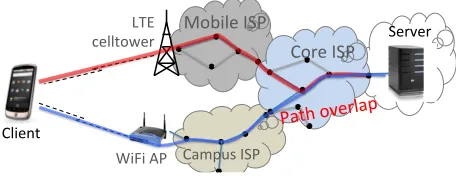
Figure 5: Path diversity available to mobile users.
Since di�erent sessions of the protocol are completely indepen-dent, the security statements imply both forward and backward secrecybetweenmultiple sessions, but notwithina session. More formally, the security game allows the adversary to obtain all infor-mation except for the ephemeral secrets used in the test session.
7 EMERGING PATH DIVERSITY FOR SECURE
MULTIPATH COMMUNICATIONS
The Internet has evolved to the point where it o�ers physically disjoint paths for many client-server pairs: the hierarchical inter-connection between autonomous systems in the Internet is being replaced by a�atter structure where content providers and CDNs peer directly with access networks (DSL, hotspot and cellular), re-ducing path length and latency and increasing path diversity [31]; content distribution networks deploy servers throughout the Inter-net and allow content providers to move their data closer to the users;�nally, mobile devices, which are one of the main contribu-tors to tra�c growth in the Internet [10], connect to the Internet via multiple wireless interfaces such as Wi�and cellular.
To understand the added security provided in practice by SMKEX, in this section we present a brief measurement study of the path diversity available to mobile devices. We have shown that SMKEX is secure in theA/AandA-Psettings; to break SMKEX, adversaries must thus be present, active and synchronized across all paths between endpoints, which raises the bar for successful attacks. Consider the example in Figure 5 where the mobile uses Multipath TCP to talk to the server via its two wireless interfaces. In this example, the two paths start out on di�erent networks and converge a few hops away from the server. When the two paths are disjoint, there must be active, synchronized attackers on both paths for a successful attack; in the core operator, however, the attack is simpler because all tra�c crosses a single network operator and even a single router.
To estimate the di�culty of executing an attack, we classify attackers based on their ability to subvert one or more Autonomous Systems (or ASes). In this classi�cation, we consider only active attackers, as this is the safer assumption, focusing on the di�erence betweenA/AandA-A, since as we mentioned in Section 2 theA-P case collapses toA-Aif the active attacker can inject packets into the passive path.4Hence, we de�ne the following classes of active
attackers, partially inspired from Unger et al. [49, Section III.A]:
Path
Overlap 0 AS 1 AS 2 AS 3+ AS
USA 16/70 10/34 0/17 0/26
UK 48/54 26/27 5/13 0/20
Switzerland 30/80 10/75 0/25 0/5
Romania 12/50 26/58 0/30 1/30
Israel 60/60 21/21 4/4 15/30
Figure 6: Path overlap measurements: routes to popular websites are surpris-ingly disjoint, with many having no over-lap regardless of the origin country.
0 2 4 6 8 10
0 10 20 30 40 50 60 70 80
Overlapping ASes
Website rank
Figure 7: AS path overlap when a mobile client uses a cellular and a�xed connec-tion (USA)
0 2 4 6 8 10
0 10 20 30 40 50 60 70 80
Overlapping ASes
Website rank
Figure 8: AS path overlap when a mobile client uses a cellular and a�xed connec-tion (Romania)
•local MITM: an attacker controlling local networks (e.g., owners of Wi�access points or localized internet service providers).
•nation-wide MITM: an attacker controlling small parts of the Internet, such as the internet service providers (ISPs) of a country or small geographical regions.
•global MITM: an attacker controlling large segments of the
Internet, such as powerful nation states or large ISPs.
7.1 Measurement study
We set out to measure the path diversity that exists in practice for dual-homed mobile clients. As servers, we used Alexa’s top 100 websites to which we added some sites such as local news-papers (which may be subject to surveillance or censorship). We ran traceroute from client devices connected via a variety of�xed and mobile networks in countries where we had access to mobile clients (via volunteers): USA, UK, Switzerland, Romania and Israel. While our study is by no means exhaustive, it does shed a light on the amount of path diversity that exists today in the Internet. For each traceroute, we�rst perform a DNS lookup and then traceroute to the resulting address. This means that our traceroutes may be redirected to di�erent servers serving the same website.
A previous study has tried to examine the same question starting from an inferred AS-level map of the Internet [38], estimating
o�inethe amount of path diversity there exists between any two endpoints. The study’s conclusions paint a mixed picture, noting that“only about 5% of the countries show good chances of being robust against MITM from a device view”, however they note that
“careful choice of the edge providers could make this likelihood positive for a majority of the countries”. Our study is complementary: it only focuses on a subset of the Internet (a few edge ASes and the top 100 servers) but it focuses on mobile devices and it is much more accurate, because it uses actual Internet routing (as opposed to estimated routes based on the AS graph) and because it also measures the e�ect of CDNs on path diversity.
The basic metric we are interested in ispath overlap: the number of autonomous systems that are traversed byboththe mobile and wired path en-route to the server. We do not count the destination AS as path overlap: if an attacker controls the server (or its AS) there is little SMKEX can do.
To measure path diversity, we traced the paths from all or a subset of the cable providers and mobile operators in each country to our target websites (2-5�xed operators and 1-5 mobile ones per
country). We then studied the path overlap when the client uses any cable operator in conjunction with any mobile operator in their country. When traceroutes include private addresses we assume these belong to AS0; thus if AS0 appears in multiple traceroutes, we assume the paths overlap, when in practice they might be di�erent.
As expected, our experiments show that AS path lengths to Alexa top 100 sites are short: 40% of paths have three AS hops or less, and 95% have six hops of less; the longest path contains 11 ASes.
Measurement results in Table 6 show the minimum and maxi-mum path overlap across all mobile-�xed provider combinations to the target websites that respond to traceroute, per country. De-pending on the choice of providers, as many as 50 to 80 (out of 100) websites can be reached via AS paths without any overlap, or 12 to 50 in the worst�xed/cellular provider combination. Most remaining websites can be reached via paths that have only one AS in common. In the best case, none of the paths to our targets had overlaps including two or more hops for most countries. Israel is a special case because we only had access to one mobile operator and one cable operator - even so, 80 websites can be reached via paths that have at most one AS hop in common.
In Fig. 7 and 8, we show the measurements for USA and Romania in detail. Romania has the highest path overlap of all the countries we studied; still, if one chooses the best�xed-mobile provider com-bination, there is no path overlap for 50 websites, and a single AS is present on the two paths for the remaining 25 servers in our set. In the USA, almost 70 websites can be reached without any overlap, and all that respond to traceroutes can be reached with paths that overlap in at most one AS. Note that for these two countries, only 75 of the 100 websites can be traced via all the networks we used. This is because ICMP TTL exceeded messages are�ltered on at least one path. We omit these servers from our detailed analysis, and in the summary results shown in Table 6, we assume that they are a worst case that have three or more overlapping AS.
DigiMobil
AS8708
Vodafone
AS1273
Orange
AS5511 UPC
AS3257 Roedu
3 hops
RDS
AS6830 Telekom
AS26769
Akamai
AS2914 AS0
AS5580
Figure 9: Routes to Akamai from endpoints in Romania.
and show the results for Romania (where path diversity is worst among the countries we measured). While large content providers are building their own distribution networks (e.g. Google, Facebook and Microsoft), most other content providers are turning to Akamai (or other CDNs) to help them�ght DDoS attacks and terminate TLS sessions close to the customers. Paths to Akamai are therefore a proxy for path diversity in this large category of websites. In Figure 9, we show paths from Romanian clients to Akamai. In the �gure, the operators shown in red o�er mobile access, and the ones in blue o�er�xed connectivity. Paths to other major providers (Google, Microsoft) are similar (ommited for brevity). The�gure shows very encouraging results: to successfully attack SMKEX when communicating with Akamai from a single�xed operator, a nation-wide attacker must intercept tra�c�owing via that operator and all possible secondary paths, such as the three mobile operators shown in red. Therefore, in our experiments, SMKEX is secure against local MITM adversaries also for websites using Akamai.
These results show that SMKEX can raise the bar for successful attacks against opportunistic encryption beyond the reach of local MITM to nation-wide MITM attackers in many practical situations.
7.2 Protection against nation-wide attackers
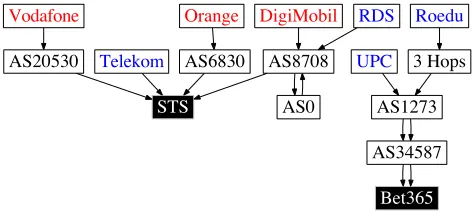
We discovered an interesting example of nation-wide attack be-havior in the routes towardsbet365.com, a betting website hosted in Hong Kong. The routes we measured are shown in Figure 10. We see that most clients are redirected to STS (special telecom-munications service of the Romanian Government) while clients using Roedunet or UPC reach the actual website in Hong Kong. In fact, all other clients get a page saying that tra�c is restricted to Bet365 because it does not comply with Romanian law. Detailed analysis has shown that the redirection is achieved via static DNS routes to STS servers returned by the operators’ DNS resolvers; if we switch the resolver to a public one (e.g. Google’s 8.8.8.8), all clients resolve Bet365 to the correct address, and can reach the website: IP tra�c is not restricted at all. Note that both the DNS resolvers of Roedu, the educational network operator, and that of UPC resolve Bet365 correctly; we could not explain the reason for this di�erent behavior.
To protect against such nation-wide attackers, in our example above it is su�cient to use a path through one of the operators that was not rewriting DNS; but this will not work against more diligent states. We propose a general and pragmatic solution to create arti�cial path diversity that relies on tunneling. Before any
DigiMobil
AS8708
Vodafone
AS20530
Orange
AS6830 UPC
AS1273
Roedu
3 Hops
RDS
Telekom
STS
Bet365
AS0
AS34587
Figure 10: Routes to Bet365 from endpoints in Romania. communication is made, all clients set up long-lived tunnels that cross jurisdictional and geographical boundaries, and all servers use a CDN that has a international footprint (i.e. deployments in multiple countries).
To set up such tunnels, clients can rely on cloud computing and rent virtual machines in other countries, as shown in Figure 11, where a user based in Europe sets up a long-lived tunnel between his machine and its VM in the US. This user will have IP address A1 in Europe, and address A2 in the USA as provided by the cloud provider. The tunnel is secured when the user�rst registers with the cloud, and will be used to create path diversity forall connections
this user makes with other parties5. The bene�ts of this setup are
clear: thepublicpath segments aresmalland completely disjoint (in Europe and the US). Furthermore, only SMKEX setup messages need to cross the Atlantic, all data tra�c can stay on the European path, avoiding unnecessary costs. To achieve this, the client can simply close the trans-Atlantic sub�ow after SMKEX negotiation �nishes successfully.
To understand how well such a solution may work, we rented virtual machines in multiple Amazon EC2 datacenters worldwide, and ran measurements from these VMs to our Alexa top 100 servers list. We analyzed AS path overlap between these routes and our local ones,�nding that there is little overlap in general. However, disjoint AS paths are not enough to ensure protection against nation-wide attackers (e.g. governments of the countries traversed by our tra�c). Ideally, we would place the traceroutes on the world map, and examine whether there is any country that is crossed by both the Amazon and the local (e.g. Romanian) path. Unfortunately, using IP geolocation to map the routes yields big errors. Even worse,�ber path layouts are not well known or easily traceable.
We use, instead, the idea of Alibi routing[34] that uses speed of light as proof a certain path does not visit a remote country. This concept is shown in Figure 11: if the sum of the RTTs measured betweenA1 BandA2 Bis smaller than the time it takes light to travel fromA1toA2and back, then the two paths cannot be overlapping anywhere. Since we know the location of our client and our datacenter (as reported by the cloud operator), we can compute a lower bound beyond which it is impossible for the two paths to overlap. In particular, it is impossible for nation-wide attackers situated in Romania or USA to see both paths and break SMKEX.
USA UK Switzerland Romania Israel
Datacenter Thresh Mobile Fixed Thresh Mobile Fixed Thresh Mobile Fixed Thresh Mobile Fixed Thresh Mobile Fixed
Virginia N/A N/A N/A 60ms 3% 48% 68ms 0-50% 50-66% 82ms 34-48% 47-65% 97ms 24% 87%
Frankfurt 68ms 30-32% 39-56% 5ms 0 6% 8ms 0 0-15% 17ms 0-10% 6-13% 28ms 0 70%
Sydney 121ms 34-43% 38-46% 170ms 11% 50% 165ms 41-50% 51-68% 152ms 42-50% 48-68% 141ms 44% 76%
Table 2: Using geographic diversity to ensure security: for di�erent country and location of our tunnel, we list the percentage of Alexa top 100 websites to which the measured RTT across the “public” paths is smaller than the theoretical minimum RTT between the two paths.
USA$
A1$ A2$
B$ B$
Encrypted$$ tunnel$ Encrypted$tunnel$
Figure 11: Using long-term tunnels to ensure path and juris-diction diversity.
We present our results, for three Amazon datacenters (Frankfurt, Virginia and Sydney) and clients in�ve countries in Table 2. For each country / datacenter combination, we compute the theoretical latency threshold by dividing the geographical distance between the origin country and the country hosting the datacenter to the speed of light in�ber. Then, we used the measured latency to Alexa top 100 websites from various vantage points. If the added RTT from the client to websiteAand from the datacenter to websiteA is smaller than this threshold, then the paths are provably disjoint and are safe against one nation-state attack.
In the table, we split our results based on the type of network operator (�xed/mobile) and show the minimum and maximum fraction of Alexa websites for which there exist such secure paths. The table shows that a good fraction of websites can be reached by paths that are secure against one nation state, but this percent-age depends on a few factors. First, when the datacenter is close to the origin country (e.g. Frankfurt for Switzerland, UK or Ro-mania), there are very few sites with safe routes; this is because the geographical distance is small, resulting in a small RTT; on such distances, the router and server processing times a�ect the measured RTTs considerably.
When we use VMs further away (e.g. USA), the fraction of sites reachable via guaranteed non-overlapping paths by European clients increases to 50%, which is quite remarkable and is explained by the fact that all these sites have local replicas very close to the clients. Non-replicated sites provide no guarantees of path disjoint-ness. Finally, using a tunnel to Sydney only marginally improves the results; this is because almost all replicated sites were already “covered” by the US datacenter.
Another observation is that, in all our datasets, the fraction of secure paths when using mobile operators is smaller than for�xed operators. This is expected, since wireless latencies (e.g. LTE or 3G) are known to add at least 20ms to the wired RTT for any given destination.
These results show that SMKEX can also protect against nation-wide attackers for a majority of popular websites, if we allow the use of an encrypted tunnel between continents.
8 IMPLEMENTATION
Mobile devices are switching to Multipath TCP (MPTCP) [1], a recently standardized TCP extension that can utilize multiple paths (called sub�ows) within a single transport connection. Past research has shown that MPTCP can be used to ensure smooth mobility between cellular and Wi�networks [43] or between overlapping Wi�deployments [12]. MPTCP has already been widely deployed on mobile phones on all Apple devices and top-end Android devices (such as the Samsung Galaxy 7 & 8 series).
Hence, to make experimentation with SMKEX simple for users and to increase its impact, we have implemented SMKEX over MPTCP. Our implementation has two main parts: a) the SMKEX library, running in user-space that allows unmodi�ed applications to use our opportunistic encryption, and b) the integration with a Multipath TCP Linux kernel implementation, including some minor kernel changes.
User-space Library.Our user-space library allows apps that rely on the TCP sockets API to run over SMKEX/MPTCP without any changes. To this end, we overwrote the socket API calls and pack-aged our algorithms as a dynamic library which can be pre-loaded at program instantiation time beforelibc; this way unmodi�ed
apps will use our implementations of the socket APIs instead of the system implementations. Our library code relies on the system calls to interact with the MPTCP implementation. We implemented all the cryptographic operations using the OpenSSL crypto library. For the key exchange part, we used 256-bit ECDH keys and SHA-256 hashes, and AES-GCM for data transfer experiments.
MPTCP integration.Integrating SMKEX with MPTCP is in prin-ciple straightforward, however there are some subtleties to properly ensure path diversity and to ensure resilience to DNS hijack attacks, which we discuss in greater detail next.
Server%
Client%
Edge1%
Edge2% Overlay(( network( CDN(( servers(
Figure 12: CDNs terminate TCP close to the end user.
0 20 40 60 80 100
0.3 0.35 0.4 0.45 0.5 0.55 0.6
CDF (%)
Connection setup time (ms) DH SMKEX
Figure 13: CDF of connection setup time, RTT=0.2ms.
690 695 700 705 710 715 720
512 1024 2048 4096 8192 16384 32768
Time (milliseconds)
File size (bytes)
Figure 14: Data transfer duration using SMKEX over trans-atlantic tunnels.
To run SMKEX, our library implementation�rst opens an MPTCP connection and uses an MPTCP API (from Hesmans et al.[23]) that blocks until the speci�ed number of sub�ows is created. If the con-nection falls back to regular TCP the SMKEX handshake fails; the same happens if the desired number of sub�ows is not created in a prede�ned amount of time.
Once the MPTCP connection has enough active sub�ows (two by default), SMKEX can start the handshake. However, if we simply send SMKEX messages using the sockets API provided by default by MPTCP, there is no control over the sub�ow that will carry the handshake data. In most cases, all the messages will be delivered by the�rst sub�ow, and this would break the security of SMKEX making MITM attacks easy to execute.
To send and receive data on speci�c sub�ows, we have made two changes to the MPTCP Linux kernel implementation as fol-lows: a) thesendsyscall allows specifying which sub�ow must
carry the provided application data, and b) thereceivesyscall
allows specifying which sub�ow to receive data from. When data is received on another sub�ow than the expected one, therecv
returns a speci�c error code telling the library which sub�ow it should read data from. Finally, to avoid changing the syscall API, our implementation reuses an unused byte in theflagsparameter
to specify the desired sub�ow in thesendandrecvcalls.
Finally, we use thefullmeshMPTCP path manager that, by de-fault, creates one sub�ow for each interface: a mobile client, for instance, will create two sub�ows to the server, one on cellular and one on Wi�.
CDN integration.There are two deployment scenarios we target; in both scenarios, a server and a mobile client support SMKEX running over MPTCP. The�rst scenario is the one depicted in Figure 5, where the MPTCP sub�ows are terminated at the server. The second scenario involves a CDN and is shown in Figure 12: in this case the two sub�ows do not reach the same server, and an additional mechanism is required to direct the secondary MPTCP sub�ows to the appropriate server. This is the preferred scenario for SMKEX because it provides the best path diversity, as shown in our measurement study; we discuss it next.
To route client tra�c to nearby edge servers, CDNs use one of two approaches: DNS redirection, where the client location is used to select a local replica, or use IP anycast where all edge servers ad-vertise the same IP address and Internet routing distributed clients to their closest servers. In this paper, we assume the edge servers
rely on IP anycast; this solution is used by many, including the Microsoft CDN [21].
Consider the example in Figure 12, where the service address Ais advertised in BGP by both edge servers. When the MPTCP connection starts over the cellular interface, its�rst sub�ow will be handled by edge server 1 which is closest to the client (from a routing hops point of view). Edge server 1 will serve content from its local cache, or contact the origin server the required content is not cached. When the client opens its wireless sub�ow, the resulting sub�ow will reach edge server 2. The only remaining problem is that edge server 2 must now forward the sub�ow to edge server 1 over the CDN’s internal network.
To achieve this, we use Beamer [40], a load balancer that supports MPTCP. To use Beamer, the CDN�rst assigns a unique numeric identi�er to each of its edge servers. Beamer works as follows: when the�rst sub�ow is setup to edge server 1, the edge server will tell the client its unique identi�er. The client will include this identi�er into its second sub�ow which will reach edge server 2; this server will simply proxy the connection to edge server 1.
Note that on-path attackers can modify the connection ID, but the only e�ect is that the secondary sub�ows will be rerouted incorrectly in the CDN network, and will be broken (i.e. edge server 2 will send the sub�ow to another edge server instead of sending to edge server 1). In this case, the SMKEX handshake will fail. Practicality of SMKEX.While this section shows that SMKEX relies on CDN’s and popular websites to update their infrastructure in order to ensure the highest security possible, it is important to note that MPTCP deployment requires the same changes as SMKEX: an MPTCP enabled kernel and a load balancer. We believe such deployment is near because load balancers are already widely deployed in production [18, 36, 41] and MPTCP is already widely deployed on mobile clients.
9 EVALUATION
The goal of our evaluation is to test the correctness of our implemen-tation and its behavior in practice. We tested our implemenimplemen-tation on our local testbed and using Amazon to create wide-area path diversity.
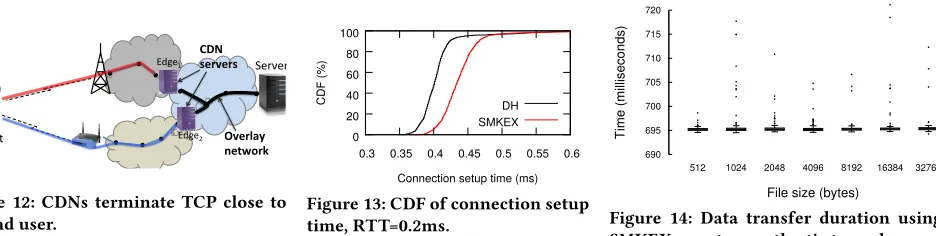
CDF of connection setup times for SMKEX compared to standard Di�e-Hellman. In the median, SMKEX takes about 50µsmore than standard Di�e Hellman; this di�erence is explained by the addi-tional round-trip time our MPTCP-based implementation requires. MPTCP only sets up the second sub�ow after the�rst sub�ow is setup.
Amazon EC2 Experiments.To test our path diversity setup, we rented two VMs in two EC2 datacenters on the east coast (Virginia and Ohio). One VM terminates a long term client tunnel, o�ering path diversity. The other VM is used to emulate an edge CDN server. Our server and client are close to each other (5ms RTT), but they also set up a path via the USA using long-term openVPN tunnels to one of the Amazon VMs. Our client repeatedly downloads�les of di�erent sizes from the server. In�gure 14 we plot the total download time. The measured latencies are as follows: the long path has an RTT of 280ms (crossing the Atlantic four times), and the short path has an RTT of 5ms.
For small�les, the expected download latency should be domi-nated by the long path RTT: our implementation requires two RTTs over this path, one to setup the MPTCP sub�ow and one to perform the key exchange. After the key is set up, the server sends all data via the low latency path. The experiments con�rm this hypothesis the latency is around 650ms for all�le sizes we tested. The�le size has little in�uence on the download because the local, high-speed (50Mbps) link is used for data transfer.
10 EXTENSIONS OF SMKEX
Due to its simplicity, SMKEX may be easily extended to actually increase the security of TOFU or TLS-like protocols. In the pre-vious sections, we have focused on the basic version of SMKEX, because this provides the highest degree of usability. As Unger et al. [49] write,“defending against mass surveillance requires a com-munication system that virtually all users can successfully use. Thus, it may be wise to start from the basic user experience of today’s widely deployed communication apps and try to add as much security as possible...”. Hence, in this section we show two possible enhance-ments of SMKEX: (a) TOFU enhancement; (b) TLS integration. In §C.3, we also discuss the possibility of using double ratcheting to provide forward and backward secrecy even across messages from a single session. Note that these extensions are shown informally, with the goal to show how SMKEX can be used in various other scenarios. We leave a formal analysis of these extensions and their implementation to future work.
10.1 TOFU enhancement
SMKEX can be enhanced by using a Trust-on-�rst-use (TOFU) ap-proach6, increasing the security of applications that rely on TOFU
authentication, such as SSH or websites using self-signed certi� -cates.
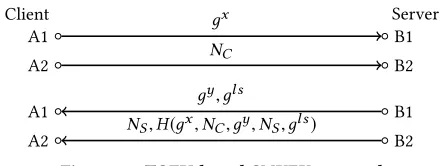
This could be done by having the server use a long-term pub-lic/private key pair which is stored by clients and then used together with the server’s ephemeral public key to derive the session key. That is, if we letX = xbe the ephemeral public key of the client
(with corresponding private keyx),Y= be the ephemeral public
6Term probably coined by Wendlandt et al. [50].
Client Server
A1 x B1
A2 NC B2
A1 , ls B1
A2 NS,H( x,NC, ,NS, ls) B2
Figure 15: TOFU-basedSMKEXprotocol.
key of the server (with private key ) andLS= lsbe the long-term
public key (with corresponding private keyls), then the client can send as input to the key derivation the concatenation ofYx and LxS, while the server would useX andXls. A similar approach, but requiring the client to also use a long-term key, is used in Sig-nal [46], known as triple Di�e-Hellman, possibly inspired from Protocol 4 of Blake-Wilson et al. [5]. A similar protocol has also been proposed and analyzed by Krawczyk and Wee [30].
A depiction of our modi�ed protocol with the server using a long-term key is shown in Figure 15. As mentioned by Wendlandt et al. [50], existing TOFU protocols su�er from two main issues: a) possible active attacks during the�rst connection; b) possible active attacks during an update of the server’s long-term key. With our TOFU-based SMKEX protocol, such attacks are no longer possible in theA/AandA-Pscenarios. Therefore, by storing and checking the server’s long-term public key, our TOFU-based SMKEX proto-col provides partial protection against active adversaries (i.e.,A/A andA-P) during initial setup and during server key update (which was not the case for previous TOFU approaches), while providing protection even againstA-Aadversaries if these are not able to synchronize during the initial key setup (or key update).
The main disadvantage of TOFU-based approaches (including this extension of SMKEX), is that when long-term keys change (either genuinely or due to an attack), the client is forced to either:
a) drop the connection (if we want no user interaction) orb) ask the user about what to do in this case (which might hinder usability).
Nevertheless, given that previous TOFU-based methods pro-vided the highest security for opportunistic encryption (see the survey of Unger et al. [49, Table I]) and that SMKEX also increases the security of TOFU approaches, we can conclude thatusing a TOFU-enhanced SMKEX protocol provides the highest security for opportunistic encryption to date.
10.2 Integration into TLS
We can also easily integrate SMKEX with TLS, obtaining a combined protocol (which we called MTLS) that provides increased security over TLS, while retaining all the security bene�ts of the classic single-path TLS. This extension bene�ts TLS security in two ways: �rst, it provides improved opportunistic security to unauthenticated TLS, which is described in [44, Section C.5]. Second, it works as an additional barrier in case of Certi�cate Authority (CA) attacks, as described below.
Protocol Auth Rogue Auth RogueA-P,A/A A-A
SMKEX - X
-TLS X X
MTLS X
Table 3: Comparing the security features of SMKEX, TLS and MTLS
Client Server
A1 ClientHello, x B1
A2 NC B2
A1 ServerHello, B1
A2 NS,H(NC, x,NS, ) B2
Figure 16: Key exchange in Multipath TLS (MTLS) proto-col. The�rst path executes the standard TLS key exchange, while the second path is used to validate keying information similarly to SMKEX.
installed in browsers. Finally, governments might force their ISPs and local CAs to collaborate and trick users into using rogue certi� -cates. By combining SMKEX with TLS we may thwart such attacks. We illustrate the advantage of MTLS over single TLS or SMKEX in Table 3 for the di�erent attackers (A-P,A/A,A-A) and scenarios (authentic and rogue certi�cates).
We illustrate our design using TLS1.3. SMKEX is supported with the (EC)DHE exchange mode and the PSK with (EC)DHE key ex-change mode. Accordingly, we assume that the client and servers exchange some form of Di�e-Hellman public key shares xand
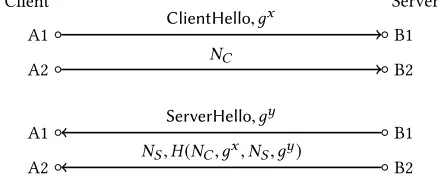
(�nite-�eld or elliptic curves). We only improve the security of the server authentication portion of TLS; client authentication and other key exchange extensions downgrade to the single path case. Figure 16 illustrates the MTLS key exchange. The standard TLS key exchange runs on the�rst path, with two modi�cations. First, the Client Hello message indicates in an extension that MTLS is used, and theClientHello.randomNCin this message, as well as
theServerHello.randomNSin the response, are dropped.7MTLS
introduces two new messages on the second path. The client sends NC, and the server responds withNSas well as a hash ofNC,NS,
xand .
MTLS provides all the security of a standard TLS exchange, with added protection against attackers that forge the server’s long term secret. For example, in the case of a forged certi�cate an attacker that is only present on the�rst path is unable to successfully com-plete the key exchange with the client. The veri�cation of the hash fails at the client, and the key exchange terminates immediately.
More precisely, MTLS provides security against all attackers for which the test session is either fresh according to the original de�nition [6], i.e. the server session is uncorrupted, or the adversary
7To keep the message format compatible with standard TLS, therandom�elds can be replaced by independent values and ignored in the computation.
behaves as anA/Aadversary, in which case it can even corrupt the (long term key of the) server session.
T������3 (MTLS;��������). For the described type of adver-sary, MTLS is secure under the condition that the DDH assumption holds in the selected group and that the signature scheme used in TLS is existentially unforgeable. The statement holds in the random-oracle model.
The proof is essentially a combination of the proof of Theorem 2 and a standard analysis of the TLS 1.3 core protocol.
11 RELATED WORK
There have been many schemes proposed for trust establishment. We refer the reader to the survey of Unger et al. [49, Section III] for a comprehensive treatment. Here, we shall focus mostly on opportunistic approaches, popular protocols such as TLS, QUIC and Signal, as well as some previous proposals for using multiple channels to establish trust.
One of the best-known protocols for basic opportunistic encryp-tion is Tcpcrypt [4]. It performs an e�cient key exchange8over a
TCP connection to derive keys and then can output an authentica-tion tag over the session transcript, which could be veri�ed using a trusted certi�cate or using a di�erent communication channel. As in SMKEX, we could send the authentication tag over a secondary public channel (secondary sub�ow in MPTCP) rather than relying on a certi�cate or di�erent form of communication channel. Hence, our design can also be seen as a model for increasing the security of previous opportunistic encryption methods such as Tcpcrypt.
An enhanced version of basic opportunistic encryption is done through trust-on-�rst-use (TOFU), as is the case for SSH or using self-signed certi�cates, where the client remembers the�rst long-term key sent by the server. However, as Wendlandt et al. [50] men-tion, such approaches are completely vulnerable to active MITM attackers during the initial key setup or during key update. SMKEX can protect against many active attackers at all all times. Hence, by combining SMKEX with TOFU, we obtain the best protection possible to date for opportunistic encryption.
The most popular protocols for securing client-server commu-nications, TLS [13] and QUIC [22], as well as the most popular protocol for secure messaging, Signal [46], all rely on trusted third parties to issue correct certi�cates (TLS, QUIC) or long-term public keys (Signal). However, such trust is problematic, as third parties can become corrupted [17, 20, 33], veri�cation is di�cult [35] and keys may be shared among many untrusted parties [7]. Hence, several schemes have been proposed to cope with these issues (mainly focusing on certi�cates), including:a) monitoring issued
certi�cates [19, 50];b) creating and managing public logs of all issued certs [32];c) proposing modi�cations to the existing archi-tecture [26, 27]. Unfortunately, all of these schemes still require trust in one or more entities. Furthermore, solutions in the�rst cat-egory add overhead to TLS connections, the solutions in the second category cannot quickly cope with compromised private domain keys, while those in the third category remain largely impractical due to the many actors and work required.
Finally, there have also been some proposals for using multiple communication channels. Some of these require using a secure channel [52], while others propose to use secret sharing for dis-tributing the key [47], which we have shown not to be secure in our setting (see §4). In contrast, SMKEX provides asecurekey exchange, proven againstA-PandA/Aadversaries, which works acrosspublic
channels.
12 CONCLUSION
SMKEX allows the most secure opportunistic encryption method to date, by relying on severalpubliccommunication channels. We have proven that it provides secure key exchanges with forward and backward secrecy across a wide range of adversaries and we have shown that the current path diversity across the Internet allows SMKEX to protect against local and nation-wide active man-in-the-middle attackers. Its simplicity also means that we can easily integrate SMKEX with TOFU and TLS-like protocols, increasing their security.
We have a fully-working implementation of SMKEX, based on a modi�ed Linux MPTCP kernel implementation and a user-level library, which allow unmodi�ed applications to use SMKEX. There-fore, SMKEX is ready to be used. Servers only need to support MPTCP across their edge servers, which can be easily done with the methods we have shown. With the ongoing deployment of MPTCP, we expect this to happen soon, but perhaps the advan-tages of SMKEX can motivate some of the large web sites to deploy MPTCP even sooner.
SOURCE CODE
The source code for SMKEX is available here: https://github.com/nets-cs-pub-ro/smkex
and the modi�ed MPTCP kernel, required for SMKEX, is here: https://github.com/nets-cs-pub-ro/mptcp-smkex
Acknowledgement:
We thank all the people that have helped us in this work, through ideas, experiments, comments in previous drafts and several other ways. Among them, we thank Ross Anderson, Virgil Gligor, Markus Kuhn, Mike Bond and Hugo Krawczyk.
This work was sponsored in part by the European Commission, through the SSICLOPS H2020 project.
REFERENCES
[1] A. Ford and C. Raiciu and M. Handley and O. Bonaventure. RFC6824:TCP Extensions for Multipath Operation ... https://tools.ietf.org/html/rfc6824. [2] D. Aggarwal, S. Agrawal, D. Gupta, H. K. Maji, O. Pandey, and M. Prabhakaran.
Optimal computational split-state non-malleable codes. InTheory of Cryptogra-phy, volume 9563 ofLNCS, pages 393–217, 2016.
[3] M. Bellare and P. Rogaway. Entity authentication and key distribution. In D. R. Stinson, editor,Advances in Cryptology — CRYPTO 1993, volume 773 ofLecture Notes in Computer Science, pages 232–249. Springer, 1993.
[4] A. Bittau, M. Hamburg, M. Handley, D. Mazieres, and D. Boneh. The case for ubiquitous transport-level encryption. InUSENIX Security Symposium, pages 403–418, 2010.
[5] S. Blake-Wilson, D. Johnson, and A. Menezes. Key agreement protocols and their security analysis.Crytography and Coding, pages 30–45, 1997.
[6] R. Canetti and H. Krawczyk. Analysis of key-exchange protocols and their use for building secure channels. InInternational Conference on the Theory and Applications of Cryptographic Techniques, pages 453–474. Springer, 2001. [7] F. Cangialosi, T. Chung, D. Cho�nes, D. Levin, B. M. Maggs, A. Mislove, and C.
Wil-son. Measurement and analysis of private key sharing in the https ecosystem. In Proceedings of the 2016 ACM SIGSAC Conference on Computer and Communications Security, pages 628–640, New York, NY, USA, 2016. ACM.
[8] L. Carter and M. Wegman. Universal classes of hash functions. Journal of Computer and System Sciences, 18(2):143–154, 1979.
[9] K.-K. R. Choo, C. Boyd, and Y. Hitckcock. Examining indistinguishability-based proof models for key establishment protocols. InAdvances in Cryptology — ASIACRYPT 2005, volume 3788 ofLNCS, pages 585–604. IACR, Springer, 2005. [10] Cisco. Global Mobile Data Tra�c Forecast. http://www.cisco.com/c/
en/us/solutions/collateral/service-provider/visual-networking-index-vni/ mobile-white-paper-c11-520862.html.
[11] K. Cohn-Gordon, C. Cremers, B. Dowling, L. Garratt, and D. Stebila. A formal security analysis of the signal messaging protocol. InSecurity and Privacy (EuroS&P), 2017 IEEE European Symposium on, pages 451–466. IEEE, 2017. [12] A. Croitoru, D. Niculescu, and C. Raiciu. Towards wi�mobility without fast
handover. In12th USENIX Symposium on Networked Systems Design and Imple-mentation (NSDI 15), pages 219–234, Oakland, CA, 2015. USENIX Association. [13] T. Dierks and E. Rescorla. The transport layer security (TLS) protocol version
1.2. RFC 5246. 2008.
[14] W. Di�e and M. Hellman. New directions in cryptography.IEEE transactions on Information Theory, 22(6):644–654, 1976.
[15] V. Dukhovni. Opportunistic Security: Some Protection Most of the Time. 2014. [16] S. Dziembowski, K. Pietrzak, and D. Wichs. Non-malleable codes. InITCS, 2010. [17] Eckersley, P. Iranian hackers obtain fraudulent HTTPS certi�cates: How close to a Web security meltdown did we get? https://www.e�.org/deeplinks/2011/03/ iranian-hackers-obtain-fraudulent-https. Last accessed: November 2017. [18] D. E. Eisenbud, C. Yi, C. Contavalli, C. Smith, R. Kononov, E. Mann-Hielscher,
A. das Cilingiroglu, B. Cheyney, W. Shang, and J. D. Hosein. Maglev: A fast and reliable software network load balancer. In13th USENIX Symposium on Networked Systems Design and Implementation (NSDI 16), pages 523–535, Santa Clara, CA, Mar. 2016. USENIX Association.
[19] Electronic Frontier Foundation. Ssl observatory. https://www.e�.org/observatory. [20] Fisher, D. Final report on diginotar hack shows to-tal compromise of ca servers. https://threatpost.com/ �nal-report-diginotar-hack-shows-total-compromise-ca-servers-103112/ 77170/. Last accessed: November 2017.
[21] A. Flavel, P. Mani, D. Maltz, N. Holt, J. Liu, Y. Chen, and O. Surmachev. Fastroute: A scalable load-aware anycast routing architecture for modern cdns. In12th USENIX Symposium on Networked Systems Design and Implementation (NSDI 15), pages 381–394, Oakland, CA, 2015. USENIX Association.
[22] R. Hamilton, J. Iyengar, I. Swett, and A. Wilk. QUIC: A UDP-Based Secure and Reliable Transport for HTTP/2. 2016.
[23] B. Hesmans, O. Bonaventure, and F. Duchene. A socket api to control multipath tcp (draft-hesmans-mptcp-socket-03). 2008.
[24] R. Impagliazzo, L. Levin, and M. Luby. Pseudo-random generation from one-way functions. InSTOC, 1989.
[25] R. Joyce. Disrupting nation state hackers. San Francisco, CA, 2016. USENIX Association.
[26] T. H.-J. Kim, L. Huang, A. Perrig, C. Jackson, and V. Gligor. Transparent key integrity (tki): A proposal for a public-key validation infrastructure.Technical Report CMU-CyLab-12-016, Carnegie Mellon University, 2012.
[27] T. H.-J. Kim, L.-S. Huang, A. Perrig, C. Jackson, and V. Gligor. Accountable key infrastructure (aki): A proposal for a public-key validation infrastructure. InProceedings of the 22nd international conference on World Wide Web, pages 679–690. ACM, 2013.
[28] H. Krawcyzk, K. G. Paterson, and H. Wee. On the security of the TLS protocol: A systematic analysis. InAdvances in Cryptology — CRYPTO 2013, Heidelberg, 2013. Springer.
[29] H. Krawczyk and P. Eronen. Hmac-based extract-and-expand key derivation function (hkdf). 2010.
[30] H. Krawczyk and H. Wee. The optls protocol and tls 1.3. In2016 IEEE European Symposium on Security and Privacy (EuroS&P), pages 81–96. IEEE, 2016. [31] C. Labovitz, S. Iekel-Johnson, D. McPherson, J. Oberheide, and F. Jahanian.
Inter-net inter-domain tra�c. InProceedings of the ACM SIGCOMM 2010 Conference, SIGCOMM ’10, pages 75–86, New York, NY, USA, 2010. ACM.
[32] B. Laurie, A. Langley, and E. Kasper. Certi�cate Transparency. 2013. [33] Lemos, R. Microsoft warns of hijacked certi�cates. https://www.cnet.com/news/
microsoft-warns-of-hijacked-certi�cates/. Last accessed: November 2017. [34] D. Levin, Y. Lee, L. Valenta, Z. Li, V. Lai, C. Lumezanu, N. Spring, and B.
Bhat-tacharjee. Alibi routing. InProceedings of the 2015 ACM Conference on Special Interest Group on Data Communication, SIGCOMM ’15, pages 611–624, New York, NY, USA, 2015. ACM.
[35] Y. Liu, W. Tome, L. Zhang, D. Cho�nes, D. Levin, B. Maggs, A. Mislove, A. Schul-man, and C. Wilson. An end-to-end measurement of certi�cate revocation in the web’s pki. InProceedings of the 2015 Internet Measurement Conference, pages 183–196, New York, NY, USA, 2015. ACM.