
Western University Western University
Scholarship@Western
Scholarship@Western
Electronic Thesis and Dissertation Repository
11-29-2011 12:00 AM
Reactivity of Dimethylplatinum (II) Complexes
Reactivity of Dimethylplatinum (II) Complexes
Muhieddine A. Safa
The University of Western Ontario
Supervisor
Dr. Richard J. Puddephatt
The University of Western Ontario
Graduate Program in Chemistry
A thesis submitted in partial fulfillment of the requirements for the degree in Doctor of Philosophy
© Muhieddine A. Safa 2011
Follow this and additional works at: https://ir.lib.uwo.ca/etd
Part of the Inorganic Chemistry Commons
Recommended Citation Recommended Citation
Safa, Muhieddine A., "Reactivity of Dimethylplatinum (II) Complexes" (2011). Electronic Thesis and Dissertation Repository. 315.
https://ir.lib.uwo.ca/etd/315
REACTIVITY OF DIMETHYLPLATINUM(II) COMPLEXES
(Thesis Format: Monograph)
by
Muhieddine Ahmad Safa
Department of Chemistry
Submitted in partial fulfilment
of the requirements for the degree of
Doctor of Philosophy
The School of Graduate and Postdoctoral Studies
The University of Western Ontario
London, Ontario
November, 2011
Dr. Richard J. Puddephatt Dr. Paul J. Ragogna
Dr. John F. Corrigan
Dr. Kim M. Baines
Dr. Yang Song
Dr. Ulrich Fekl
Dr. Jose E. Herrera
Dr. Margaret J. Kidnie THE UNIVERSITY OF WESTERN ONTARIO
THE SCHOOL OF GRADUATE AND POSTDOCTORAL STUDIES
CERTIFICATE OF EXAMINATION
Chief Advisor Examining Board
_________________________ _________________________
Advisory Committee _________________________
_________________________ _________________________
_________________________ _________________________
The thesis by
Muhieddine Safa
entitled
Reactivity of Dimethylplatinum(II) Complexes
is accepted in partial fulfilment of the
requirements for the degree of
Doctor of Philosophy
Date ____________________ __________________________
ABSTRACT
This thesis describes a study of dimethylplatinum(II) and dimethylplatinum(IV)
complexes containing bidentate nitrogen donor ligands. This work deals with oxidative addition,
and reductive elimination chemistry, and it focuses on synthesis, characterization, and reaction
mechanisms in studies of these complexes.
The compound [PtMe2(bpe)], bpe = 1,2-bis(2-pyridyl)ethane, is easily oxidized to give
octahedral organoplatinum(IV) complexes and the subsequent chemistry is profoundly
influenced by the accompanying strain induced in the 7-membered Pt(bpe) chelate ring. On
reaction of [PtMe2(bpe)] with HCl, the initial product [PtHClMe2(bpe)] undergoes reductive
elimination of methane to form [PtClMe(bpe)]. In contrast, methyl iodide reacts with
[PtMe2(bpe)] to give [PtIMe3(bpe)], and this decomposes by loss of the bpe ligand to give the
cubane [(PtIMe3)4] and not by reductive elimination. Finally, a new class of platinum(IV) double
cubane clusters was obtained on oxidation of complex [PtMe2(bpe)] with either hydrogen
peroxide to give [Pt4(µ-OH)4(µ3-OH)2Me10], as a mixed complex with [PtMe2(CO3)(bpe)], or
with oxygen in methanol to give [Pt4(µ-OH)2(µ-OMe)2(µ3-OMe)2Me10].
The oxidation of the complex [PtMe2(bps)], bps = bis(2-pyridyl)-dimethylsilane, by
oxygen, hydrogen peroxide or dibenzoyl peroxide in the presence of water or alcohol gives the
complex cation, [PtMe3(κ3-N,N,O-HOSiMe(2-C5H4N)2)]+, in a reaction involving easy cleavage
of a methylsilicon bond. Treatment of the complex [PtMe2(bps)] with B(C6F5)3 in
trifluoroethanol in air gives the complex [Me(bps)Pt-OSiMe(2-C5H4N)2PtMe3]+
[B(OCH2CF3)(C6F5)3]-. The unique binuclear platinum complex is formed via the competitive
the platinum(II) fragment and oxidation by air to give the platinum(IV) fragment. Combination
of the two units then gives the binuclear complex which involves a very easy methylsilicon
group cleavage reaction.
The platinum(II) complexes containing five-membered heterocyclic imidazole ligands
show high reactivity to a broad variety of alkyl halides, peroxides, and halogens forming stable
platinum(IV) complexes. The dimethylplatinum(II) complex [PtMe2{(mim)2C=CH2}],
(mim)2C=CH2 = 1,1-bis(1-methylimidazole-2-yl)ethene reacts with dichloromethane to give the
dimethylplatinum(IV) complex [PtCl(CH2Cl)Me2{(mim)2C=CH2}]. The product exists as a
mixture of two isomers, the cis isomer as the kinetic product and the trans isomer as the
thermodynamic product.
The dimethylplatinum(II) complex [PtMe2(DECBP)], DECBP =
4,4’-diethoxycarbonyl-2-2’-bipyridine], undergoes easy oxidative addition to the corresponding platinum(IV)
complexes. The reactions of the complex [PtMe2(DECBP)] with alkyl bromides RCH2Br, which
have hydrogen bond donor or acceptor functional groups, result in the formation of stable
platinum(IV) complexes. Those complexes self-assemble in the solid state to form
supramolecular polymers via the intermolecular OH•••O=C, N-H•••Br, OH•••BrPt, interactions,
with other predicted interactions such as the π-stacking, and the C(H)•••BrPt secondary weak
interactions.
Keywords: Platinum complexes, oxidative addition, reductive elimination bidentate nitrogen donor ligands, NMR spectroscopy, X-ray
ACKNOWLEDGEMENT
I would like to express my deepest appreciation to my supervisor, Dr. Richard J.
Puddephatt, for his patience, encouragement, and guidance during the course of this work.
I would like to express my sincere thanks to Drs. Jennings, Payne and Popov for their
crystallographic expertise. Special thanks to Dr. M. Jennings, Dr. G. Popov, Dr. Benjamin
Cooper, and Mrs. Aneta Borecki for solving the X-ray structures.
Many thanks are also extended to Dr. Mathew Willans, who has provided excellent NMR
service. I would also like to acknowledge Doug Hairsine for his help with mass spectrometry.
I would like to thank faculty, graduate students and staff for their help and support during
the course of this work.
I would also like to express my gratitude for the friendships formed among the graduate
students. In particular I would like to mention Anas Lataifeh, Matthew McCready, Mohammad
Afifi, Kyle Pellarin and Shawn Robinson.
Most of all, I would like to thank my family for their support, patience and understanding
TABLE OF CONTENTS
Page
CERTIFICATE OF EXAMINATION... ii
ABSTRACT... iii
ACKNOWLEDGEMENTS... v
DEDICATION... vi
TABLE OF CONTENTS... vii
LIST OF TABLES... xi
LIST OF FIGURES... ... xiv
ABBREVIATIONS... ... xix
CHAPTER 1 – GENERAL INTRODUCTION... 1
1.1 The History of Platinum... 2
1.2 Platinum in Organometallic Chemistry... 2
1.3 Oxidative Addition... 4
1.3.1 Three-Centre Concerted Mechanism... 5
1.3.2 Bimolecular SN2 Mechanism... 7
1.3.3 Radical Non-chain Mechanism... .. 8
1.3.4 Radical Chain Mechanism... .. 10
1.4 Reductive Elimination... 12
1.5 Activation of Inert Bonds... .. 14
1.6 Supramolecular Chemistry... .. 18
1.7 A Description of the Thesis... 23
CHAPTER 2 – Synthesis, Characterization and Reactions of the Complex
[PtMe2(1,2-di-2-pyridylethane)]... 28
2.1 Introduction... 29
2.2 Results and Discussion... 31
2.2.1 Synthesis and Characterization of [PtMe2(dpe)]... .. 31
2.2.2 Reaction of [PtMe2(dpe)] with Methyl Iodide... 34
2.2.3 Reactions of [PtMe2(dpe)] with Halogens, X2 (X = Br, I)... 37
2.2.4 Reactions of [PtMe2(dpe)] with Hydrochloric Acid... 50
2.2.5 Reactions of [PtMe2(dpe)] with Hydrogen Peroxide... 54
2.2.6 Reactions of [PtMe2(dpe)] with Methanol... 64
2.3 Conclusions... 68
2.4 Experimental... 70
2.5 References... 81
CHAPTER 3 – The Chemistry of Platinum Complexes Containing Bis(2-pyridyl)dimethylsilane Ligands... 84
3.1 Introduction... 85
3.2 Results and Discussion... 87
3.2.1 The Preparation of Complex [PtMe2(bps)]... 87
3.2.2 Easy Oxidatively Induced Silicon-Carbon Bond Activation... ... 90
3.2.2.1 The Reaction of [PtMe2(bps)] with B(C6F5)3... 90
3.2.2.2 The reaction of [PtMe2(bps)] with H2O2 and Alcohols... 95
3.2.2.3 The reaction of [PtMe2(bps)] with Dibenzoyl Peroxide... 99
3.2.2.4 The Reaction of [PtMe2(bps)] with I2... 106
3.2.3 Oxidative Addition Reaction of MeI to Complex 3.2... 108
3.2.4 Protonolysis Reactions of Complex 3.2 Using HCl... 115
3.3 Conclusions... 123
3.4 Experimental... 125
3.5 References... 139
CHAPTER 4 – The Chemistry of Platinum Complexes Containing Imidazole Nitrogen Donor Ligands... 142
4.1 Introduction... 143
4.2 Results and Discussion... 145
4.2.1 The Preparation of [PtMe2{(mim)2C=CH2}]... 145
4.2.2 The Reactions of [PtMe2{(mim)2C=CH2}] with Alkyl Halides... 146
4.2.2.1 Reactivity Towards Methyl Iodide... 146
4.2.2.2 Reactivity and Stereoselectivity Towards Benzyl Halides... 149
4.2.2.3 Oxidative Addition with Dichloromethane... 159
4.2.2.4 The Reactions of [PtMe2{(mim)2C=CH2}] with Peroxides.... 161
4.2.3 The Synthesis of [PtMe2{(mim)2CHMe}]... 163
4.2.3.1 The Reactivity and Stereoselectivity of Oxidative Addition to [PtMe2{(mim)2CHMe}]... 164
4.2.3.2 The Reactions of [PtMe2{(mim)2CHMe}] with Benzyl Halides... 167
4.2.3.3 The Reactions of [PtMe2{(mim)2CHMe}] with Hydrogen Peroxide... ... 171
4.3 Conclusions... 172
4.4 Experimental... 173
CHAPTER 5 – Supramolecular Organoplatinum(IV) Chemistry...187
5.1 Introduction...188
5.2 Results and Discussion...191
5.2.1 Synthesis and Characterization of [PtMe2(DECBP)]...191
5.2.2 The Oxidative Addition Chemistry of [PtMe2(DECBP)]... ...194
5.2.3 The Self-Assembly of Organoplatinum(IV) Complexes... 211
5.2.3.1 Carboxylic Acids as Hydrogen Bonding Groups...211
5.2.3.2 Introduction of Amide Hydrogen Bonding Groups... 217
5.2.3.3 Boronic Acid and Alcohol Groups as Hydrogen Bonding Donors... 220
5.3 Conclusions... 232
5.4 Experimental... 233
5.5 References... 254
CHAPTER 6 – General Conclusions...257
LIST OF TABLES
Table Description Page
1.1 Properties of strong, moderate, and weak hydrogen bonds 20
2.1 Selected bond lengths [Å] and angles [°] for [PtI2(dpe)], 2.7 42
2.2 Selected bond lengths [Å] and angles [°] for [PtMe2I2 (µ-{(NC5H4)-CH2CH(C5H4NMe)}], 2.9 47 2.3 Selected bond lengths [Å] and angles [°] for complexes 2.13 and 2.14 62
2.4 Calculated relative energies (kJ mol-1) of structures B, C, and D (Scheme 2.7) for complexes [(PtMe3X•PtMe2X2)2] with X = OH, Cl, Br, or I 63
2.5 Selected bond lengths [Å] for complex 2.15 67
2.6 Crystallographic data for [PtI2(dpe)], 2.8 77
2.7 Crystallographic data for complex 2.9 78
2.8 Crystallographic data for complex 2.13•½2.14 79
2.9 Crystallographic data for complex 2.15 80
3.1 Selected bond lengths [Å] and angles [°] for [PtMe2(bps)], 3.2 89
3.2 Selected bond lengths [Å] and angles [°] for complex 3.3 94
3.3 Selected bond lengths [Å] and angles [°] for complex 3.8 102
3.4 Selected bond lengths [Å] and angles [°] for complex 3.10 108
3.5 Selected bond lengths [Å] and angles [°] for complex 3.15 117
3.6 Selected bond lengths [Å] and angles [°] for complex 3.16 119
3.7 Crystallographic data for 3.2 132
3.8 Crystallographic data for 3.3 133
3.9 Crystallographic data for 3.8 134
3.12 Crystallographic data for 3.15 137 3.13 Crystallographic data for 3.16 138 4.1 Selected bond lengths [Å] and angles [°] for [PtIMe3{
(mim)2C=CH2}], 4.3 148
4.2 Selected bond lengths [Å] and angles [°] for trans-[PtBr(CH2-
C6H5)Me2{(mim)2C=CH2}], 4.4a 153 4.3 Selected bond lengths [Å] and angles [°] for trans-[PtBr(CH2-
2-C6H4-CF3 Me2{(mim)2C=CH2}], 4.6a 156 4.4 Selected bond lengths [Å] and angles [°] for trans-[PtBr(CH2-
3,5-C6H3-t-Bu2)Me2{(mim)2C=CH2], 4.7a 159 4.5 Selected bond lengths [Å] and angles [°] for trans-[PtBr(CH2-
2-C6H4-CF3)Me2{(mim)2CHMe], 4.15 169 4.6 Crystallographic data for 4.3 180 4.7 Crystallographic data for 4.4a 181 4.8 Crystallographic data for 4.6a 182 4.9 Crystallographic data for 4.7a 183 4.10 Crystallographic data for 4.15 184 5.1 Selected bond lengths [Å] and angles [°] for 5.2 [PtMe2(DECBP)] 194 5.2 Selected bond lengths [Å] and angles [°] for 5.4 [PtI2Me2(DECBP)] 197 5.3 Selected bond lengths [Å] and angles [°] for 5.5atrans-
[PtBr2Me2(DECBP)] 200 5.4 Selected bond lengths [Å] and angles [°] for 5.6a cis-
[Pt(CH3CO)ClMe2(DECBP)] 202 5.5 Selected bond lengths [Å] and angles [°] for [PtClMe(DECBP)] 205 5.6 Selected bond lengths [Å] and angles [°] for 5.8 [PtCl2(DECBP)] 207 5.7 Selected bond lengths [Å] and angles [°] for 5.10 trans-[PtBrMe2
5.8 Selected bond lengths [Å] and angles [°] for 5.12 trans-
[PtBrMe2(CH2-CO2H)(DECBP)] 215 5.9 Selected bond lengths [Å] and angles [°] for 5.14 trans-
[PtBrMe2(CH2-CONH-C6H4)(DECBP)] 219 5.10 Selected bond lengths [Å] and angles [°] for 5.16 trans-
[PtBrMe2(CH2-3-C6H4-B{OH}2)(DECBP)] 224
5.11 Selected bond lengths [Å] and angles [°] for 5.17 trans-
[PtBrMe2(CH2-4-C6H4-B{OH}2)(DECBP)] 227
5.12 Selected bond lengths [Å] and angles [°] for 5.18 trans-
[PtBrMe2(CH2-2-C6H4-B{OH}2)(DECBP)] 229
LIST OF FIGURES
Figure Description Page
1.1 Graphical definition of the terms r, d, D, θ, ø in a hydrogen 19
bond A-H•••B-Y
2.1 The 1H-NMR spectrum (400 MHz, acetone-d6) of complex 2.2,
[PtMe2(dpe)] 32
2.2 The VT-NMR spectra (400 MHz, acetone-d6) of complex 2.2,
[PtMe2(dpe)] 33
2.3 The VT-NMR spectra (400 MHz, acetone-d6) for the reaction of
CD3I with 2.2 36
2.4 The 1H NMR spectrum (400 MHz, CD2Cl2) for the reaction of
complex 2.2 with bromine at room temperature 38 2.5 The 1H NMR spectra (400 MHz, CD2Cl2) from 20 0C to -80 oC
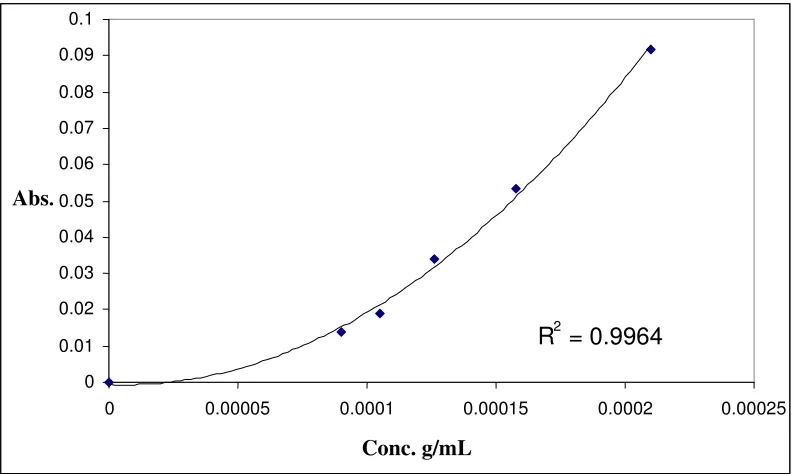
for the reaction of 2.2 with bromine 40 2.6 The structure of the complex [PtI2(dpe)], 2.7 42 2.7 A view of the molecular structure of complex 2.8 43 2.8 1H NMR spectra (400 MHz) for the reactions of complex 2.2 with I2 in CD2Cl2 at (a) 20 oC; and (b) -60 oC 45 2.9 The molecular structure of complex 2.9 46 2.10 The absorbance of the ligand 1,2-di-2-pyridylethane as
a function of concentration 49
2.11 The absorbance of complex 2.2 as a function of concentration 49 2.12 The1H-NMR spectrum (400 MHz, CD2Cl2) at room temperature in
methylplatinum regions for the reaction of 2.2 with DCl 52
2.13 The 1H NMR spectrum (600 MHz, D2O) of cis-[PtMe2(OH2)4]2+ ion 54
2.14 The 1H NMR spectrum (400 MHz, CD
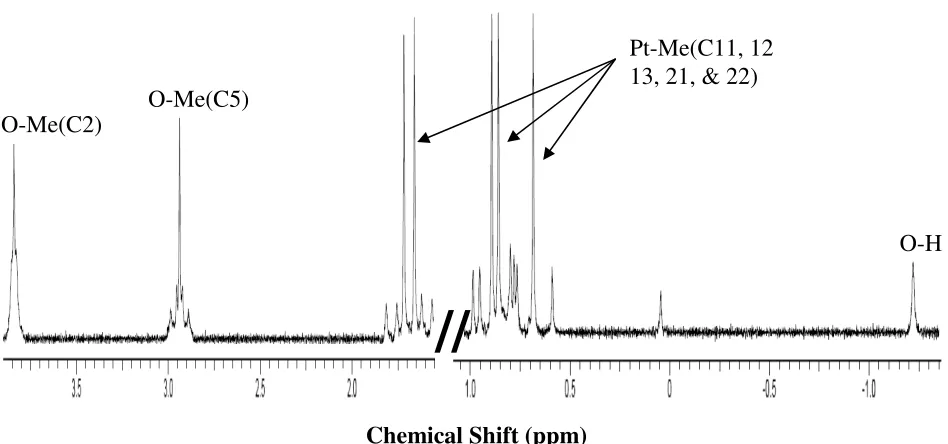
2Cl2) of supramolecular
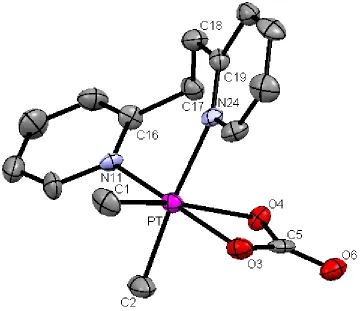
[PtMe2(CO3)(dpe)], 2.13 57
2.15 A view of the structure of complex 2.13 58 2.16 A view of the structure of complex 2.14 59 2.17 The hydrogen bonding between complexes 2.13 (top, bottom)
and 2.14 (centre) 61
2.18 A view of the structure of complex 2.15 65 2.19 The 1H NMR spectrum (400 MHz, CD2Cl2) of complex 2.15 66 2.20 The hydrogen bonding between complexes 2.15 (top, bottom)
and methanol 67
3.1 The structure of complex 3.2, [PtMe2(bps)] 89 3.2 1H-NMR spectrum (400 MHz, acetone-d6) of complex 3.3 in
the methyl region 90
3.3 The structure of complex 3.3 91 3.4 The 1H-NMR spectra (400 MHz, CD3OD) in the methyl region
for complexes 3.4b (i) and 3.7b (ii) 98 3.5 The 1H-NMR spectrum (600 MHz, CD
2Cl2) of complex 3.8,
[PtMe3(OH){(NC5H4)-(µ-SiMe)-(C5H4N)}]+ [PhCOO]-. 100
3.6 The crystal structure of complex 3.8, [PtMe3(OH){(NC5H4)-
(µ-SiMe)-(C5H4N)}]+ [PhCOO]- 101
3.7 The 1H-NMR spectrum (400 MHz, CD2Cl2) of complex 3.9, [PtMe(C- D3)2(OH){(NC5H4)-(µ-SiMe)-(C5H4N)}]; (a) day one. (b) a day after 103 3.8 Calculated relative energies and structures of platinum
complexes and potential reaction intermediates 105
3.9 The structure of complex 3.10, [PtMe2I2(bps)] 107 3.10 The 1H NMR spectrum (400 MHz, CD2Cl2) for complex 3.11,
3.12 The 1H NMR spectrum (400 MHz, CD2Cl2) for complex 3.12,
[PtMe3I(pyridine)2] 111
3.13 Chosen spectra of VT-NMR (400 MHz, acetone-d6) experiment for
the reaction of CD3I with 3.2 113 3.14 The 2H-NMR spectrum (600 MHz, acetone-d6) of complex 3.13
at room temperature 114
3.15 The molecular structure of complex 3.15, [PtCl2(bps)] 115 3.16 The 1H-NMR spectrum (400 MHz, CD2Cl2) of complex 3.15,
[PtCl2(bps)] 116 3.17 The hydride-platinum region 1H-NMR spectra (400 MHz, CD2Cl2)
at -80 oC and 0.0 oC 117
3.18 The 1H-NMR spectrum (400 MHz, acetone-d6) of complex 3.16,
[PtMe3(OH2)(bps)]+ [CF3SO3]- 118
3.19 A view of the structure of complex 3.16, [PtMe3(OH2)(bps)]+
[CF3SO3]- 119
3.20 The VT-NMR spectra (400 MHz, acetone-d6) for the reaction of
complex 3.2 with methyl triflate 121 3.21 The 1H-NMR spectrum (400 MHz, acetonitrile-d3) for complex 3.17;
the reaction of complex 3.2 with methyl triflate at 25 0C 122 4.1 The 1H-NMR spectrum (600 MHz, acetone-d6) of complex 4.2,
[PtMe2{(mim)2C=CH2}] 146
4.2 The 1H-NMR spectrum (400 MHz, CD2Cl2) of complex 4.3,
[PtIMe3{(mim)2C=CH2}] 148
4.3 A view of the structure of complex 4.3, [PtIMe3{(mim)2C=CH2}] 149 4.4 The 1H-NMR spectrum (600 MHz, CD2Cl2) of complex 4.4 in the
high field region, [PtBr(CH2-C6H5)Me2{(mim)2C=CH2}] 151
CH2-Pt region at selected temperatures 152
4.6 A view of the structure of complex 4.4a, trans-[PtBr(CH2-
C6H5)Me2{(mim)2C=CH2}] 153
4.7 The structure of complex 4.6a, trans-[PtBr(CH2-2-C6H4-
CF3)Me2{(mim)2C=CH2}] 156
4.8 The structure of complex 4.7a, trans-[PtBr(CH2-3,5-C6H3-{t-
Bu}2)Me2{(mim)2C=CH2}] 158
4.9 The 1H-NMR spectrum (400 MHz, acetone-d6) of complex 4.12,
[PtMe2{(mim)2CHMe}] 164
4.10 The 1H-NMR spectra (400 MHz, acetone-d6) of the methylplatinum
region for the reaction of complex 4.12 with: a) MeI at room
temperature. b) CD3I at -60 oC 166
4.11 The structure of complex 4.15, trans-[PtBr(CH2-2-C6H4-CF3)
Me2{(mim)2CHMe}] 168
4.12 The 1H-NMR spectrum of complex 4.16, trans-[PtBr(CH2-
4-C6H4-CF3)Me2{(mim)2CHMe}] 170
5.1 1H-NMR spectrum (400 MHz, acetone-d6) of [PtMe2(DECBP)], 5.2 192 5.2 A view of the structure of complex 5.2 193 5.3 A view of the structure of complex 5.4 196 5.4 Supramolecular dimer structure of 5.4 and iodine 197 5.5 A view of the molecular structure of complex 5.5a 200 5.6 1H-NMR spectra (400 MHz, CD2Cl2) for the reaction of complex
5.2 with acetyl chloride after 30 minutes, and after 24 hours 203 5.7 A view of the molecular structure of complex 5.6a 204
5.8 A view of the molecular structure of the complex [PtClMe(DECBP)] 206
after 5 minutes and 24 hours from adding H2O2 to complex 5.2 210
5.11 A view of the molecular structure of complex 5.10 213 5.12 A view of supramolecular dimer structure of 5.10 215
5.13 A view of the molecular structure of complex 5.12 216 5.14 A view of supramolecular dimer structure of 5.12 216
ABBREVIATIONS
a, b, c, α, β, γ = unit cell parameters
A = absorbance
Å = Ångstrom = 10-8 meters
Anal Calcd = analysis calculated
Ar = aryl
bipy = 2,2’-bipyridyl
dpe = 1,2-bis(2-pyridyl)ethane
bps = bis(2-pyridyl)dimethylsilane
br = broad
tBu =
tert-butyl
oC = degrees centigrade
δ = chemical shift
DECBP = 4,4’-diethoxycarbonyl-2-2’-bipyridine
d = doublet
dd = doublet of doublet
dt = doublet of triplets
DPK = di-2-pyridyl ketone
Et = ethyl
Et2O = diethylether
Eq = equation
g = gram
∆G‡ = free energy of activation
h = Planck’s constant
IR = infra-red
J = coupling constant
x
J(AB) = coupling constant between nuclei A and B through X number of bonds
J = joule
K = degrees kelvin
L-L/N-N = bidentate diimine ligand
MS = mass spectrometry
m = meta
Me = methyl
MHz = megahertz
min = minutes
mL = millilitre
mmol = millimole
MW = molecular weight in g/mol
M = molarity or metal center, depending on the context
mol = mole
m = multiplet
nm = nanometre
NMR = nuclear magnetic resonance
N = Avogadro’s number
o = ortho
p = para
ppm = parts per million
Ph = phenyl
Py = pyridyl
PN = 2-(di-tert-butylphospinomethyl)pyridine
R = ideal gas constant or alkyl/aryl, depending on the context
s = singlet
SN2 = bimolecular nucleophilic reaction
t = triplet
T = temperature
Tc = coalescence temperature
tert = tertiary
UV = ultraviolet
VT-NMR = variable temperature-NMR (1H unless otherwise stated)
X = halogen (unless otherwise stated)
CHAPTER 1
1.1
The History of Platinum
Platinum, from the Spanish “platina” is translated as little silver, is a metal with many
unique properties. Later on it became known as Platina del Pinto, which is a small river near
Popayan in New Granada, and then known as “oro blanco”, white gold, or “juan blanco”. Local
archives had the first reference of platina in 1707, where it had been used to adulterate the gold.1
The metal was intriguing to many people due to its high melting point and corrosion resistant
properties, so platinum was used for lining crucibles used in the production of special glasses. It
was first introduced to Europe by Ulloa, the Spanish explorer of Colombia. The first samples of
platinum to reach Europe were brought by Charles Wood, a British metallurgist in 1741.2 Two
centuries later, the Europeans realized that platina was actually a mixture of elements: platinum,
palladium, rhodium, iridium, osmium, and ruthenium. Today, platinum is found in ores from
Canada, China, Colombia, South Africa and Russia. These ores tend to contain nickel and copper
along with platinum too.
1.2
Platinum in Organometallic Chemistry
Organometallic complexes are compounds containing at least one chemical bond between a
carbon atom and a metal atom. Zeise’s salt was the first organometallic compound, prepared in
1827 by Zeise.3 He produced the salt by boiling a solution of potassium hexachloroplatinate in
ethanol, obtaining the complex, K[Pt(C2H4)Cl3].H2O. Ever since that time, organoplatinum
chemistry has been of major interest to chemists. The chemistry of platinum metal is dominated
by three major oxidation states, 0, +2, and +4. Also known are the +1, +3, +5, and +6 oxidation
oxidation and reduction among the three dominant oxidation states, via oxidative addition and
reductive elimination reactions, which typically involve the two-electron transfer between the
ligands and platinum center.5
Organoplatinum complexes can exist in many different geometries. Platinum(0) complexes
usually favor tetrahedral geometry as in the case of [Pt(PF3)4],6 or trigonal planar geometry as for
[Pt{Sn(NR2)2}3].7 Square planar geometry is preferred by platinum(II) complexes as for
[PtMe2(bipy)], bipy = 2,2’-bipyridyl, while platinum(IV) complexes favor octahedral geometry
such as in [PtIMe3(bipy)], bipy = 2,2’-bipyridyl.8 Platinum has three principal non-radioactive
isotopes 194Pt, 195Pt, and 196Pt, which exist with roughly equal natural abundance. The isotope
195Pt is particularly significant in organometallic chemistry. Platinum compounds are typically
studied using NMR spectroscopy due to the presence of the spin active isotope 195Pt, which has a
nuclear spin of ½ and is found in 33.7% natural abundance. In compounds of platinum, the 195Pt
atoms can couple with other NMR active nuclei such as 1H, creating unique patterns in the NMR
spectrum. The compounds of third-row transition metals such as platinum often react more
slowly than first and second row transition metals in reactions such as ligand substitution, which
makes platinum complexes ideal for the characterization of reaction intermediates and the study
of reaction mechanisms.9 The main focus in this thesis is on square planar platinum(II) and
1.3
Oxidative Addition
10Oxidative addition is a class of reaction, which is a very important process in organometallic
chemistry that proceeds via several mechanistic pathways. This type of reaction involves the
oxidation of a metal via the addition of a substrate X-Y, which increases the coordination
number and the formal oxidation state by two units due to the formation of two new bonds M-X
and M-Y. The term is usually used to describe a two-electron oxidation, but one-electron
oxidative addition reactions are also known. In two-electron oxidative addition the formal charge
of the metal increases by 2, and two electrons are removed from its d-electron configuration
(Equation 1.1). While in one-electron oxidative addition the formal oxidation state increases by
1, and one electron is removed from the d-electron configuration (Equation 1.2). In both cases,
there is an overall two-electron change, M(n) to M(n+2) or 2M(n) to 2M(n+1), and an increase in the
coordination number of the metal center.
Oxidative addition reactions are common for 16-electron square planar platinum(II)
complexes, and lead to the formation of 18-electron octahedral platinum(IV) complexes. These
reactions could often occur in an 18-electron complex, where a two-electron site must be opened
in the complex by the loss of a ligand. There are three different classes of substrates for oxidative (1.1)
addition. Class A substrates which are non-polar or have low polarity (e.g., H2, R-H, B-H, and
R3Sn-H) usually react via two different oxidative addition mechanisms, cis oxidative addition
(concerted), and homolytic bond activation. Reagents with polar bonds (class B substrates), such
as alkyl halides (R-X), often undergo oxidative addition through formal one-electron or
two-electron mechanisms. There are two categories of one-two-electron mechanisms, the free radical
chain mechanism, and the free radical non-chain mechanism. Formal two-electron oxidative
addition proceeds usually via bimolecular SN2 type mechanism. The mechanism of reaction of
the class C substrates, such as O2 and epoxides, are similar to class B substrates.
1.3.1
Three-Centre Concerted Mechanism
Substrates for oxidative addition reactions which are non-polar or have low polarity such
as H2 and alkanes usually react by a three-center, or concerted, oxidative addition mechanism as
shown in Scheme 1.1. Class A substrates are often very difficult to activate, so the oxidative
addition of this category of reagents to platinum(II) complexes is not widely represented. The
reaction mechanism involves the formation of a three-centred transition state between the metal
center and the X-Y substrate, which then proceeds to form the product of cis addition.
Coordinative unsaturation is necessary for the reaction to proceed, and retention of configuration
at chiral carbon is expected. Class A substrates rarely undergo oxidative addition via homolytic
bond activation and two metal centers are needed (Scheme 1.2).
Concerted three center oxidative addition is initiated by an associative substitution
reaction. The intramolecular oxidative addition of a C-H bond is achievable upon using an
electron rich platinum(II) complex such as [PtMe2{PhCH=N(CH2)2NMe2}].11 The reaction
follows first-order kinetics, and it proceeds via a concerted C-H oxidative addition to form a
five-coordinate intermediate (Chart 1.1a), which is followed by the reductive elimination of CH4.
By the use of specially designed ligands, the ortho-metallation can occur in which C-H bond
undergoes a secondary bonding with the platinum center.12 Chart 1.1 shows some of the
proposed five coordinate intermediates which would lead to the intramolecular oxidative
addition of C-H bonds.
1.3.2
Bimolecular S
N2 Mechanism
Reagents with polar bonds often undergo oxidative addition by the SN2 mechanism
(Scheme 1.3). The oxidative addition of an alkyl halide to a metal complex proceeds via the
attack from a nucleophilic metal at the carbon center to break the C-X (X = I, Br, Cl, F) bond in
the substrate. The SN2 mechanism is found in the addition of methyl, allyl, and benzyl halides.
The reaction kinetics are second order, and the reaction involves an inversion of configuration at
a chiral electrophilic carbon of the substrate. The rate of the reaction is accelerated using polar
solvents, and the alkyl halides show greater reactivity in the order Me > primary > secondary >>
tertiary, and I > Br > Cl >> F. In some cases, oxidative addition occurs through coordination of
an anion to a neutral metal complex, which proceeds to generate an anionic complex prior to the
oxidative addition of the C-X bond via SN2 mechanism (Scheme 1.4).
Scheme 1.3
Another related mechanism is known in reactions with hydrogen halides, which proceeds
via the dissociation of hydrogen halides in solution, and then the anion and the proton add to
metal complexes in different steps. Usually, the metal complex is basic enough to be protonated,
and then the anion coordinates to give the final product. If the initial complex has a net positive
charge, the reaction often proceeds by coordination of the halide ion, followed by the protonation
of the intermediate complex. The formation of a cationic intermediates were proposed for the
reaction of methyl iodide with the platinum(II) complex [PtPh2(bipy)], which was observed in
polar solvents such as CD3CN at low temperatures using 1H-NMR spectroscopy. That process is
then followed by the rapid substitution of the charged species to produce the platinum(IV)
complex [PtIMePh2(bipy)].13
1.3.3 Radical Non-chain Mechanism
Radical mechanisms in oxidative addition often lead to mixtures of products.14 The free
radical non-chain mechanism is shown in Scheme 1.5, where the alkyl halide R-X is the
substrate oxidatively added to the metal center. The reaction mechanism proceeds through the
coordination of the R-X substrate to the metal center, which is then followed by the electron
transfer from the metal to R-X to form a solvent-caged radical pair. The reaction then could
collapse to form the oxidative addition product, or the radical pair could escape forming free
radicals R•, which reacts further forming side products. The oxidative addition product from this
pathway is the same as that formed from the SN2 pathway, except that racemization instead of
inversion of the stereochemistry is usually observed. The reaction mechanism is faster the more
basic the metal, and the substrates follow the reactivity order of R-I > R-Br > R-Cl. The reaction
M(n) + R X M (n+1)
RX
-escape collapse
M X
(n+1) R
+ R M X
(n+2)
R R
M(n)
M R
(n+1)
cage
PtL3 fast PtL2
PtL2 + R-X slow PtXL2 + R
fast
RPtXL2 PtXL2 + R
reactivity order of 3o > 2o > 1o > Me. Scheme 1.6 shows a proposed free nonchain radical
mechanism which operates in the addition of alkyl halides R-X, to Pt(PPh3)3 ( R = Me, Et; X = I;
R = PhCH2; X = Br).
Scheme 1.5
1.3.4 Radical Chain Mechanism
Another type of oxidative addition of organic halides through radical intermediates could
occur via radical chain mechanisms, which usually has an induction period (Scheme 1.7). This
type of reaction requires a coordinatively unsaturated metal center, and a radical initiator, In•.
The reactions shown in Scheme 1.6 could sometimes lead to chain mechanism if the formed
radicals could escape from the cage without combination; otherwise a radical initiator is required
to start the process. Free radical chain mechanisms are often slowed down through the presence
of radical inhibiters, and are identified via the racemization at chiral carbon.
A study conducted by Hill and Puddephatt proposed a free radical chain mechanism of
the photochemically-initiated oxidative addition of isopropyl iodide to [PtMe2(bpy)].15 The
reaction is initiated by photochemical MLCT to form [PtMe2(bpy)]*, which has a primarily
triplet character. The intermediate then abstracts an iodine atom, thus generating an alkyl radical.
The reaction mechanisms are shown in Scheme 1.8.
1.4 Reductive Elimination
10The reductive elimination reaction is the reverse process of oxidative addition. This reaction
is observed in complexes with electron deficient transition metals in high oxidation states, and
the formal oxidation state of the metal is reduced by two. Reductive elimination often forms
products from the coupling of two covalent ligands at single metal center, or two ligands at two
different metal centers (Scheme 1.9). The reductive elimination in a mononuclear system
decreases the oxidation state at the metal center from n + 2 to n, and it increases the number of
electrons in the metal d-configuration by 2. On the other hand, the process in systems containing
two different metal center decreases the oxidation state at each metal center from n + 1 to n, and
it increases the number of electrons in the d-electron configuration by 1. The reaction is well
known for d6 metal ions, such as Pt(IV), Pd(IV), and Ir(III). The ligands must be cis to each other
in order for concerted reductive elimination to occur, and so, in these examples, a prior
isomerization has to occur for ligands that are initially trans to each other. Steric and electronic
properties play a big role in the rate of reductive elimination process.
Pt Ph2 P P Ph2 Me Me Me I Pt Ph2 P P Ph2 Me Me Me - I
-Pt Ph2 P P Ph2 Me I Pt Ph2 P P Ph2 Me I -Me-Me Pt Ph2 P P Ph2 Me Me Me Me-I Pt Ph2 P P Ph2 Me Me I
-Electron deficient transition metal centers in octahedral d6 complexes of platinum(IV)
and palladium(IV) usually undergo the reductive elimination process, but prior to that often a
5-coordinate intermediate is formed. A proposed mechanism by the Goldberg group for complex
[PtMe3I(PPh2-C2H4-PPh2)] showed that the octahedral d6 platinum(IV) complex undergoes
reductive elimination thus producing the square planar d8 platinum(II) complex (Scheme 1.10).16
Other side products were observed such as methyl iodide, and ethane. The reductive elimination
proceeds through the formation of less rigid 5-coordinate intermediates. The elimination of two
methyl groups cis to each other produces ethane, while methyl iodide is produced through the
iodine attack on the methyl group trans to the open site.
1.5 Activation of Inert Bonds
In recent years extensive research efforts have been aimed at the selective functionalization
of alkanes by transition metal complexes. Thus many examples of the inter- and intramolecular
C-H bond activation have been discovered.17 However, only a few of these discoveries lead to
actual functionalization.18 Selective C-H bond functionalization is considered to be a very
valuable approach for synthesis in areas ranging from fuels and commodity chemicals to
pharmaceuticals.16,19 The selective transformation of alkanes leading to oxygenated
petrochemicals such as alcohols is essential for improved utilization of petroleum and natural gas
resources. The activation of C-H bonds by platinum(II) complexes has been gaining a lot of
interest since the discoveries of Shilov during the late 1960’s and 70’s, when he demonstrated
that solutions of platinum(II) salts were capable of activating and functionalizing normally
unreactive hydrocarbon C-H bonds (Scheme 1.11).16-20 Shilov’s discoveries have attracted much
interest due to the mild reaction conditions and the air stability of the system. The reactions are
Pt OH2 II
Pt CH4 II Pt
CH3 IV OH
OH
Pt CH3 IV H
Pt CH3 II
H+ 1/2 O2+ H2O
CH3OH
CH4
Only few practical processes exist on converting alkanes or saturated hydrocarbons
directly to valuable products.19b Methane is used in industry to produce methanol that is vital in
the production of several essentials such as paint and plastics. A potential mechanism of
converting methane gas into methanol using platinum(II) complexes is shown in Scheme 1.12.20
According to the proposed mechanism by Shilov the first step in the catalytic formation of
methanol from methane involves the coordination of methane to the platinum(II) complex
through displacement of a weakly coordinating water ligand. Then oxidative addition of methane
via C-H bond activation proceeds to form the electrophilic methylplatinum(IV) complex. The
platinum(IV) complex undergoes reductive elimination by proton loss to give the more stable
platinum(II) complex. The platinum(II) intermediate is then oxidized to platinum(IV) in the
presence of oxygen and water, which helps in functionalizing the methyl group. Finally, the
reductive elimination proceeds to produce methanol, and regenerate the platinum(II) starting
material.
Pt N
N
Me
Me
Pt N
N
Me
Me OH
OMe
a b
N
N = bpy, phen
The oxidant used by Shilov was a platinum(IV) salt and not dioxygen, and the system
was not industrially useful.20c In recent years, developments have occurred in the area of
mechanistic understanding of the Shilov system, which helped in speeding up the process in
utilizing this system in functionalizing alkanes. It is especially important to use cheaper oxidants
such as O2.21 Monaghan and Puddephatt reported in 1984 the oxidation of platinum(II) dialkyls
(Chart 1.2a) via alcohols or water, which proceeded to form the platinum(IV) alkoxides (Chart
1.2b).22 The work was done in an aerobic system, and extra studies on the same system by
Rostovtsev and Bercaw in 1998 proved that the oxidation happened via O2 as oxidant.23
The research group of Britovsek showed the insertion of dioxygen in a
platinum(II)-methyl bond.24 The platinum(II) complex was reacted with oxygen in polar solvent acetonitrile at
room temperature in the presence of light, which proceeded to form the final product via O2
insertion according to Equation 1.1. The presence of light played a vital role in the rate of the
Goldberg reported similar results on the platinum(II) complex [PtMe2(PN)], PN =
2-(di-tert-butylphospinomethyl)pyridine, where insertion reaction of dioxygen into the platinum(II)-methyl
bond occurred easily at room temperature in the presence of light.25 The complex [PtMe2(PN)]
could be reacted in CD2Cl2 or C6D6 in 5 atm of O2, and monitoring the reaction via 1H-NMR
showed the presence of a platinum methylperoxo complex, which formed through the insertion
of dioxygen in the Pt-Me bond (Equation 1.2).
1.1
1.6 Supramolecular Chemistry
Supramolecular chemistry is simply known as the chemistry of multicomponent
molecular assemblies in which the component structural units are typically held together by a
variety of weaker (non-covalent) interactions.26 This field has developed rapidly over recent
years. The notion “supramolecular chemistry” was first introduced in 1978 by Jean-Marie Lehn27
who understood, “Just as there is a field of molecular chemistry based on the covalent bond,
there is a field of supramolecular chemistry, the chemistry of molecular assemblies and of the
intermolecular bond.” Supramolecular chemistry has a more concise definition such as
“chemistry beyond the molecule” or “the chemistry of non-covalent bonds” which are regularly
utilized to describe the rapidly growing field.28
Supramolecular compounds result from the connection of two or more molecules through
intermolecular interactions.29 These interactions are typically non-covalent in nature and include
metal ion coordination, hydrogen bonding, electrostatic forces, π-π stacking interactions and van
der Waals interactions.28 There is continuing interest in self-assembly of polymers and networks
using simple coordination complexes as building blocks to give functional molecular materials.
This extensive field uses the combination of inorganic and organometallic synthetic pathways
with self-assembly through hydrogen bonding to produce a variety of unusual polymeric and
network matertials.30 Self-assembly is usually defined as the process by which a supramolecular
species forms spontaneously from its components. Molecular compounds are typically
synthesized via the formation of covalent bonds between suitable precursors, while
ø d r
θ
D
Hydrogen bonds can be considered to represent a special type of electrostatic interaction.
A simple description is that it is an attractive interaction between a proton donor and a proton
acceptor.26, 28 Pimentel and McClellan defined a hydrogen bond as follows: “A hydrogen bond
exists between a functional group A-H and an atom or a group of atoms B in the same or a
different molecule when (a)there is evidence of bond formation, (b)there is evidence that this
new bond linking A-H and B specifically involves the hydrogen atom is already bonded to A.”32
Usually both the donor (A) and the acceptor (B) atoms have electronegative character, with the
proton involved in the hydrogen bond being shared between the electron pairs on A and B, and
the hydrogen then acting as a bridge between them. A hydrogen bond could be abbreviated as
A-H•••B (A = donor, B = acceptor) and described in terms of r, d, D, θ, ø, where the hydrogen atom
is the bridge between both A and B as shown in Figure 1.1.
~
Hydrogen bonds can vary in strength from being very weak to being the strongest of the
intermolecular interactions.26-29 Several spectroscopic and structural methods are typically used
to study hydrogen bonding and investigate the several types. The energy of hydrogen bond varies
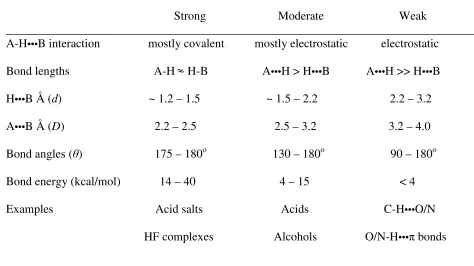
from 14-40 kcal/mol (strong) to 4-15 kcal/mol (moderate) to < 4 kcal/mol (weak).33 Table 1.1
shows some properties of strong, moderate, and weak hydrogen bonds.33a Some of the most
common hydrogen bonding motifs reported in the literature are of the type O-H•••O, N-H•••O,
O-H•••N and N-H•••N, and are formed via interactions between functional groups such as NH2, OH,
CO2H, CONH2 and CONHR.
Table 1.1. Properties of strong, moderate, and weak hydrogen bonds.33a
______________________________________________________________________________
Strong Moderate Weak
______________________________________________________________________________ A-H•••B interaction mostly covalent mostly electrostatic electrostatic
Bond lengths A-H ~ H-B A•••H > H•••B A•••H >> H•••B
H•••B Å (d) ~ 1.2 – 1.5 ~ 1.5 – 2.2 2.2 – 3.2
A•••B Å (D) 2.2 – 2.5 2.5 – 3.2 3.2 – 4.0
Bond angles (θ) 175 – 180o 130 – 180o 90 – 180o
Bond energy (kcal/mol) 14 – 40 4 – 15 < 4
Examples Acid salts Acids C-H•••O/N
HF complexes Alcohols O/N-H•••π bonds
______________________________________________________________________________
Hydrogen bonding in organometallic complexes has played an important role in
supramolecular chemistry. In recent years, attention has been aimed at the role of
organoplatinum complexes in self-assembly through hydrogen bonding, π-stacking, and other
weak secondary bonding.34 Much of research has been aimed at the formation of porous
organometallic materials that have potential as size-selective catalysts.34b Supramolecular
organometallic chemistry has slowly developed, because many metal-carbon complexes are
incompatible with the functional groups NH and OH that are usually used in self-assembly
through hydrogen bonding. The ability to understand the intermolecular interactions controlling
the organization of molecules or ions in the solid state is essential prerequisite for the
construction of materials with predefined chemical and physical properties.34a There have been
exciting advances in supramolecular chemistry recently, where the first polymeric
organometallic double helix has been synthesized by self-assembly through hydrogen bonding
using organoplatinum(IV) complexes.35 Two different cationic organoplatinum(IV) complexes
were synthesized containing carboxylic acid groups and amides as hydrogen bond acceptors and
donors. The dicationic complexes are shown in Chart 1.3. The complex shown in Chart 1.3a
formed zigzag one dimensional polymer through hydrogen bonding between the carboxylic acid
groups. The dicationic complex shown in Chart 1.3b formed a one dimensional polymer chain
through hydrogen bonding between carboxylic acid groups, but the flexible ligand
1.7 A Description of the Thesis
In general, this thesis is concerned with reactions of dimethylplatinum(II) complexes
containing bidentate nitrogen donor ligands with main group reagents. In this thesis, efforts have
been focused on understanding the mechanism of oxidative addition reactions which are relevant
to catalysis, and isolating the products of new reactions.
Recent discoveries in the activation of C-H bonds of arenes using platinum(II) complexes
containing bidentate nitrogen donor ligands with 6-membered chelate ring encouraged us to
attempt activation of inert bonds, like Si-C and C-H bonds, using a ligand system with
7-membered chelate ring.36 Chapter 2 is concerned about the reaction of the new dimethylplatinum
system with various organic reagents. Chapter 2 also covers the reactions of [PtMe2(dpe)], dpe =
1,2-di-2-pyridylethane, with hydrogen peroxide and methanol which give
[{PtMe3OH·PtMe2(OH)2}2][PtMe2(CO3)(dpe)]2, in which the central cluster has an unexpected
structure based on a face-bridged double cubane. The mechanisms of these reactions are
discussed in detail, and the products are fully characterized.
Chapter 3 deals with the oxidative addition of organic compounds to [PtMe2(bps)], bps =
bis(2-pyridyl)dimethylsilane. The main focus is the detection of intermediates, the isolation and
characterization of products, and the investigation of the mechanism for the various
organoplatinum complexes. This chapter also covers easy oxidatively induced silicon-carbon
bond activation using the platinum(II) complex [PtMe2(bps)].
Chapter 4 elaborates on the use of the classical bidentate nitrogen donor ligands, by using
a range of related bidentates containing 1-methylimidazol-2-yl rings as ligands. Platinum(II)
complexes containing these ligands are shown to be very reactive to organic compounds, and
Chapter 5 in this thesis is concerned with the supramolecular chemistry using
platinum(IV) complexes containing nitrogen donor ligands with 5-membered chelate rings. The
crystal engineering of organoplatinum(IV) complexes was achieved through introducing various
hydrogen bond donors and acceptors. The complex [PtMe2(DECBP)], DECBP =
4,4’-diethoxycarbonyl-2-2’-bipyridine, is reacted with various alkyl bromide and benzyl bromide
reagents containing amide, ester, alcohol functional groups. Finally, general conclusions are
given in chapter 6.
NMR spectroscopy is a powerful method of characterizing all of the complexes discussed
in this project. The presence of the spin (I) = ½ isotopes 1H, 13C, 19F, and 195Pt provides an easy
way to characterize all the complexes by NMR spectroscopy. The relative abundances of these
nuclei are: 1H 100%, 13C 1.1%, 19F 100%, and 195Pt 33.7. In this work 1H NMR spectroscopy is
used extensively, and couplings of 1H to 13C, 19F, and 195Pt provide valuable chemical
information that can be used to identify the nature of the novel species in solution. Also, X-ray
crystallography and mass spectrometry are used in the characterization of the work conducted
1.8 References
1. McDonald, D.; Hunt, L. B. A History of Platinum and its Allied Metals; Johnson Matthey, London, 1982, Chapter 1.
2. Cotton, S. A., Chemistry of Precious Metals, Blackie Academic and Professional, New York, 1997, P. 173-174.
3. Zeise, W. C. Ann. Phys., 1827, 9, 932.
4. Wilkinson, G; Stone, F. G. A.; Abel, E. W. Comprehensive Organometallic Chemistry, Vol. 6, Pergamon Press, Oxford, 1982, P. 478.
5. Shriver, D. F.; Atkins, P.; Langford, C. H. Inorganic Chemistry, 2nd Ed.; W. H. Freeman and Company, New York, 1994, P. 649.
6. Marriot, J. C.; Salthouse, J. A.; Ware, M. J.; Freeman, J. M. Chem. Commun., 1970, 595. 7. Hitchcock, P. B.; Lappert, M. F.; Misra, M. C. J. Chem. Soc., Chem. Commun., 1985, 863. 8. Zhang, F.; Broczkowski, M. E.; Jennings, M. C.; Puddephatt, R. J. Can. J. Chem., 2005, 83, 595.
9. Shriver, D. F.; Atkins, P.; Langford, C. H. Inorganic Chemistry, 2nd Ed.; W. H. Freeman and Company, New York, 1994, P. 247.
10. a) Collman, J. P.; Hegedus, L. S.; Norton, J. R.; Finke, R. A. Principles and Applications of Organotransition Metal Chemistry, 2nd ed.; University Science Books: Mill Valley, California,
1987. b) Rendina, M. L.; Puddephatt, R. J. Chem. Rev., 1997, 97, 1735. c) Crabtree, R. H. The Organometallic Chemistry of the Transition Metals, 5th Ed.; John Wiley, 2009, Chapter 6. d) Hartwig, J. F. Organotransition Metal Chemistry, University Science Books, Sausalito,
11. a) Anderson, C. M.; Puddephatt, R. J.; Ferguson, G.; Lough, A. J. J. Chem. Soc., Chem. Commun., 1989, 1297. b) Anderson, C. M.; Crespo, M.; Jennings, M. C.; Lough, A. J.; Ferguson, G.; Puddephatt, R. J. Organometallics, 1991, 10, 2672.
12. Puddephatt, R. J. Coord. Chem. Rev., 2001, 157.
13. Jawad, J. K.; Puddephatt, R. J. J. Organomet. Chem., 1976, 117, 297. b) Jawad, J. K.; Puddephat, R. J. J. Chem. Soc., Dalton Trans, 1977, 1466.
14. Peloso, A. J. Chem. Soc., Dalton Trans, 1976, 984.
15. Hill, R. H.; Puddephatt, R. J. J. Am. Chem. Soc., 1985, 107, 1218.
16. a) Fekl, U.; Kaminsky, W.; Goldberg, K. I. J. Am. Chem. Soc., 2001, 123, 6423. b) Fekl, U.; Goldberg, K. I. Adv. Inorg. Chem., 2003, 54, 259.
17. a) Zhong, H. A.; Labinger, J. A.; Bercaw, J. E. J. Am. Chem. Soc., 2002, 124, 1378. b) Arndtsen, B. A.; Bergman, R. G.; Mobley, T. A.; Peterson, T. H. Acc. Chem. Res., 1995, 28, 154.
18. a) Waltz, K. M.; Hartwig, J. F.; J. Am. Chem. Soc., 2000, 122, 11358. b) Chen. H. Y.; Schlecht, S.; Semple, T. C.; Hartwig, J. F. Science, 2000, 287, 1995.
19. a) Williams, T. J.; Caffyn, A. J.; Hazari, N.; Oblad, P. F.; Labinger, J. A.; Bercaw, J. E. J. Am. Chem. Soc., 2008, 130, 2418. b) Labinger, J. A.; Bercaw, J. E. Nature, 2002, 417, 507. 20. (a) Goldshlegger, N. F.; Eskova. V. V.; Shilov, A. E.; Shteinman, A. A. Zhur. Fiz. Khim., 1972, 46, 1353. (b) Shilov, A. E. Activation of Saturated Hydrocarbons by Transition Metal Complexes; D. Reidel Publishing: Dordrecht, 1984. c) Lersch, M.; Tilset, M. Chem. Rev., 2005, 105, 2471.
21. a) Vedernikov, A. N. Chem. Commun., 2009, 4781. b) Rostovtsev, V. V.; Henling, L. M.; Labinger, J. A.; Bercaw, J. E. Inorg. Chem., 2002, 41, 3608.
23. Rostovtsev, V. V.; Labinger, J. A.; Bercaw, J. E. Organometallics, 1998, 17, 4530.
24. Taylor, R.; Law, D.; Sunley, G.; White, A.; Britovsek, G. Angew. Chem. Int. Ed., 2009, 48, 5900.
25. Grice, K. A.; Goldberg, K. I. Organometallics, 2009, 28, 953.
26. Lindoy, L. F.; Atkinson, I. M. Self-Assembly in Supramolecular Systems. 2000, 3. 27. Lehn, J.-M. Pure Appl. Chem. 1978, 50, 871.
28. Lehn, J.-M. Supramolecular Chemistry; Concepts and Perspectives, VCH: Weinheim. 1995. 29. Steed, J. W.; Atwood, J. L. Supramolecular Chemistry, John Wiley & Sons Ltd., 2000. 30. Au, R. H. W.; Jennings, M. C.; Puddephatt, R. J. Organometallics, 2009, 28, 3734. 31. a) Espinet, P.; Esteruelas, M. A.; Oro, L. A.; Serrano, J. L.; Sola, E. Coord. Chem. Rev., 1992, 117, 215. b) Collin, J. P.; Gavina, P.; Heitz, V.; Sauvage, J. Eur. J. Inorg. Chem., 1998, 14. 32. Pimentel, G. C.; McClellan, A. L. The Hydrogen Bond, Freeman, San Francisco, 1960. 33. a) Jeffrey, G. A. An Introduction to Hydrogen Bonding. Oxford University Press: New York, 1997. b) Atwood, J. L.; Steed, J. W. Encyclopedia of Supramolecular Chemistry, Marcel Dekker: New York, 2004.
34. a) Braga, D.; Grepioni, F.; Desiraju, G. J. Organomet. Chem., 1997, 548, 33. b) Zhang, F.; Jennings, M. C.; Puddephatt, R. J. Chem, Commun., 2007, 1496. c) Au, R. H. W.; Jennings, M. C.; Puddephatt, R. J. Organometallics, 2009, 28, 3754. d) Au, R. H. W.; Jennings, M. C.; Puddephatt, R. J. Organometallics, 2009, 28, 5052.
35. Fraser, C. S. A.; Eisler, D. J.; Jennings, M. C.; Puddephatt, R. J. Chem, Commun., 2002, 1224.
CHAPTER 2
Synthesis, Characterization and Reactions of the
Complex [PtMe
2(1,2-di-2-pyridylethane)]
A version of this chapter has been published: a) Safa, M.; Jennings, M. C.; Puddephatt, R. J.
2.1 Introduction
Organoplatinum complexes are significant molecules due to their well established roles
in catalysis and photochemistry.1 Platinum(II) complexes containing nitrogen-donor ligands are
typically highly reactive in oxidative addition reactions.1,2 This high reactivity plays a major role
in the activation of normally inert chemical bonds such as C-H bonds. Oxidative addition
reactions of organic halides, and halogens to platinum(II) compounds have been studied
thoroughly during recent years.1 These reactions are essential in many industrially important
catalytic reactions, and typically occur via the SN2 mechanism, involving a second order rate
law.1,3
The oxidative addition of a wide variety of reagents to platinum(II) complexes
[PtMe2(LL)], LL = 2,2’-bipyridyl or its derivatives have been studied intensively, since such
reactions are vital in the activation of inert bonds. The dimethylplatinum(II) complex
[PtMe2(DPK)], DPK = di-2-pyridyl ketone, has been reported to undergo easy oxidative addition
to give platinum(IV) complexes. The platinum(II) complex contained a six membered chelate
ring, which resulted in distortion from planarity, thus playing a significant role in the reactivity.2
Platinum(II) complexes containing 2,2’-bipyridyl give five-membered chelate rings that are
planar, and this geometry appears to be unsuitable in the activation of C-H bonds.
Few studies exist on catalytic reactions of platinum(II) complexes containing bidentate
nitrogen donor ligands that form seven membered chelate rings. It was revealed that the chelate
ring size of bis-pyridine ligands plays a major role in C-H activation of arenes (Chart 2.1).4
Square planar platinum(II) complexes that formed five membered chelating rings with bipyridine
ligands failed to activate the C-H bonds in hydrocarbons, probably due to the steric effects
N
N X N
N Pt
X = CO, NH, and CH2 Me
Me Pt
Me
M e
complexes that formed six membered chelating rings with bis-pyridine ligands were successful
in activating C-H bonds in arenes, because the ortho hydrogens on the bowed pyridine rings are
out of plane, and cause less steric effect.2
In this chapter, a new platinum(II) complex containing the bidentate nitrogen donor
ligand 1,2-di-2-pyridylethane is reported. The dimethylplatinum(II) complex contained a seven
membered chelate ring, which resulted in unusual products with exciting molecular structures.
The main goal was to activate C-H bonds in alkyl or aryl groups. This goal was not achieved
due to the unanticipated lability of the platinum ligand bonds. This labile bond feature caused the
ligand to exchange rapidly or to dissociate from platinum to produce unique structures such as
[{PtMe3X)(PtMe2X2)}n], X = OH, or OMe upon the reaction with hydrogen peroxide or
methanol. These structures are based on a face-bridged double cubane with two vertices missing.
We were able to activate the C-H bond in the ligand 1,2-bis(2-pyridyl)ethane (dpe) through the
oxidative addition of iodine to the platinum(II) complex. Other oxidative addition and reductive
2.2 Results and Discussion
2.2.1 Synthesis and Characterization of [PtMe
2(dpe)]
The ligand 1,2-bis(2-pyridyl)ethane, 2.1, was prepared using a modified procedure of Quagliotto et al.5 and isolated as an oily product. The complex [PtMe2(dpe)], 2.2, was synthesized readily by the reaction of the ligand dpe with the precursor [Pt2Me4(µ-SMe2)2],6 in
diethyl ether solution (Equation 2.1). Complex 2.2 was precipitated as a white solid, and was characterized by its 1H-NMR spectrum. The methyl platinum groups give a resonance at δ =
0.60, with coupling constant 2JPt-H = 88 Hz. The doublet resonance of the ortho hydrogen atoms
of the pyridine ring also shows a coupling to platinum with 3
JPt-H = 18 Hz (Ar-Hortho). A broad
singlet resonance for the two CH2 groups of the dpe ligand was observed at δ = 4.01 ppm. The
presence of the broad resonance suggests that the platinum(II) complex is non planar, and the
two site system is undergoing exchange at room temperature. The 1H-NMR parameters for the
dpe ligand of complex 2.2, were similar to those for [PtCl2(dpe)],7 with differences as expected in the coupling constants of the ortho protons due the higher trans influence of the methyl groups
in complex 2.2, compared to the chloro groups in [PtCl2(dpe)]. The 1H-NMR spectrum of complex 2.2 is shown in Figure 2.1.
(2.1) Pt Pt Me2 S S Me2 Me Me Me
Me + N N
Et2O
Figure 2.1. The 1H-NMR spectrum (400 MHz, acetone-d6) of complex 2.2, [PtMe2(dpe)].
A variable temperature NMR study was needed to calculate the energy of exchange, ∆G‡,
between the protons Ha and Hb. The NMR spectra were recorded at 20 oC intervals between -80
and +20 oC (Figure 2.2). The resonance for the CH2 protons is broad at room temperature due to
the fast exchange, and two resonances are observed at -80 oC. The coalescence temperature, Tc=
-20oC, is then used to calculate the free activation energy using Equation 2.2.
RTc√2 ∆G‡ = RTc. ln π. N . h νA - νB
The calculated value for the free activation energy ∆G‡ is 47 (±1) kJ.mol-1. In the above
equations h is Planck’s constant in J.s, N is Avogadro’s number in mol-1, R is the value for the (2.2)
N N
1 2 3
4
1' 2' 3' 4' 5
Pt
Me Me
6
H1
H3
H4H2
H5
H6
//
2JPt-H = 88 Hz
gas constant in J.K-1.mol-1, Tc is the coalescence temperature in Kelvin, and νA - νB is the
frequency difference in Hz between the two observed proton resonances.
Figure 2.2. The VT-NMR spectra (400 MHz, acetone-d6) of complex 2.2, [PtMe2(dpe)].
20
oC
0
oC
-20
oC
-40
oC
-60
oC
-80
oC
Ha Hb
N N
Pt Me Me
MeI
I
(Me)3Pt I
Pt(Me)3 (Me)3Pt
I Pt(Me)3
I
- dpe
2.3 2.2
+
2.2.2 Reaction of [PtMe
2(dpe)] with Methyl Iodide
Complex 2.2 reacts rapidly with MeI to form a yellow solid compound 2.3, which was identified as the known complex [(PtIMe3)4] by its 1H NMR spectrum [δ(Me-Pt) = 1.81 ppm, 2J
(Pt-H)= 80 Hz].8 The 1H NMR spectrum also showed the presence of the uncoordinated dpe ligand,
so the reaction occurred according to equation 2.3.
A variable temperature 1H NMR experiment was obtained to investigate the reaction of
CD3I with complex 2.2 in acetone-d6. The reagents were mixed at -80 oC and spectra were recorded at 20 oC intervals between -80 oC and 20 oC (Figure 2.3). At -80 oC it was observed that
the CD3I reacted with 2.2 via oxidative addition to give a mixture of the intermediates A and B in ~1:2 ratio (Scheme 2.1). The resonance of [(PtI(CD3)Me2)4], 2.4, at δ = 1.81, started to appear at -20 oC. At 0 oC, the separate resonance for the CHaHb protons and the methyl platinum protons
of A and B coalesced. This reaction shows that complex 2.2 is reactive to oxidative addition, but that the dpe ligand is easily displaced from platinum(IV). The coalescence temperature Tc= 0 oC,
which is used to calculate the free activation energy. The calculated value for the free activation
energy ∆G‡ for the axial and equatorial methyl groups using Equation 2.2 is 49 (±1) kJ.mol-1.
N N Pt Me Me + CD3I I
-+
I -I
-- dpe
[{PtIMe2(CD3)}4]
![Figure 2.1. The 1H-NMR spectrum (400 MHz, acetone-d6) of complex 2.2, [PtMe2(dpe)].](https://thumb-us.123doks.com/thumbv2/123dok_us/7760504.1273914/54.612.96.536.76.281/figure-nmr-spectrum-mhz-acetone-complex-ptme-dpe.webp)


![Table 2.2. Selected bond lengths [Å] and angles [°] for [PtMe2I2(µ-{(NC5H4)-CHCH(CHNMe)}],](https://thumb-us.123doks.com/thumbv2/123dok_us/7760504.1273914/69.612.153.495.137.418/table-selected-bond-lengths-angles-ptme-chch-chnme.webp)
![Table 2.5. Selected bond lengths [Å] for complex 2.15 _________________________________________________________](https://thumb-us.123doks.com/thumbv2/123dok_us/7760504.1273914/89.612.248.403.75.438/table-selected-bond-lengths-a-complex.webp)
![Figure 3.1. The structure of complex 3.2, [PtMe2(bps)].](https://thumb-us.123doks.com/thumbv2/123dok_us/7760504.1273914/111.612.145.484.491.703/figure-structure-complex-ptme-bps.webp)
