© 2013, IJCSMC All Rights Reserved 440
Available Online atwww.ijcsmc.com
International Journal of Computer Science and Mobile Computing
A Monthly Journal of Computer Science and Information Technology
ISSN 2320–088X
IJCSMC, Vol. 2, Issue. 12, December 2013, pg.440 – 447
RESEARCH ARTICLE
Modeling of Image Compression and
Decompression using Huffman Code Technique
Dr. Deepa Raj
Assistant Professor, BBAU University, Lucknow
Abstract
Image compression is a technology in the field of digital image processing. It is a process of reducing the size of image at the time of storing on the disk and transmitting the image from one place to other place. Now a days whole world adopt the online system for carry out any official or academic work for sending or receiving textual or image data. Therefore for fast speed transmitting, image should have smaller size. Different techniques are available for reducing the size of image. In this paper I discussed on coding redundancy method for lossless type of compression of images, in which it choose a less number of bits for frequently occurring data at the time of compression. I gave here compression technique model and also gave the algorithm for compression of an image which will easy for the programmer for coding or writing program for compression.
© 2013, IJCSMC All Rights Reserved 441 1. Introduction
Image compression plays a key role in much application such as image data base, image communication, digital movie, televideo conferencing, remote sensing ,document and medical imaging, fax and in camera. It speed the processing due to reduce the size of image. Web page image and high resolution digital camera photos also are compressed routinely to save storage space and reduce transmission time. The residential internet connections deliver data at speed ranging from 56 Kbps via conventional phone line and more than 12 Mbps for broadband. The time required to transmit a small 128X128X8 bit full color image over this range of speed is from 7.0 to 0.03 seconds. Compression can reduce the transmitting time by the factor of 2 to 10 or more. Number of work has been done on this area. [1] has described the compression using DCT.[2] has A new Lossless method of image compression and decompression using Huffman coding technique.[3] has explained about data compression. Singh has described about Edge preserving compression technique using feed forward neural network. In this paper I described the model of compression using Huffman code technique which is based on Coding redundancy method and also designed a small algorithm for compressing and decompression of an image.
2. Background
Data compression is the process of reducing the amount of data required to represent a given quantity of information. Data are the means by which information is conveyed. Amount of data can be used to represent the same amount of information, representation that contain irrelevant or repeated information are said to contain redundant data. Suppose b and b’ contain the number of bits in two representation of the same information then compression ratio is
nothing but ratio of b and b’ and relative data redundancy (R)
© 2013, IJCSMC All Rights Reserved 442
Which shows how much percent data is redundant. Where C is called compression ratio defined as
C = b/b’
2.1 Different types of redundancy
There are different types of redundancies that can be identified in two dimensional representation of image
a) Coding redundancy- A code is a system of symbols used to
represent a body of information or a set of events. Each piece of information or event is assigned a sequence of code symbol called a code word. The number of symbol in each code word is its length. In coding redundancy the symbol which are used many times in a image, set a less number of symbols. In this way reducing the size of image.
b) Spatial redundancy-this types of redundancy called a inter pixel
redundancy. The neighborhood pixels are correlated. So the redundant data may be deleted to compress image.
c) Irrelevant information- Most 2D intensity arrays contains
information that is ignored by the human visual system. That information is redundant data.
Data compression is achieved when one or more of these redundancies are eliminated. Hoffman coding method uses a coding redundancy to compress the image.
3. Types of compression
There are two types of compression. Lossless compression compress image is identical to the original image while lossy compression depredates the compress image relative original image. Compression techniques for the lossless compression are
a) Run length encoding
b) Huffman Coding
c) Arithmetic coding
© 2013, IJCSMC All Rights Reserved 443
e) Area coding
Compression techniques for the Lossy compression
a) Predictive coding
b) Transform coding(FT/DCT/Wavelet)
4. Huffman coding technique for coding redundancy
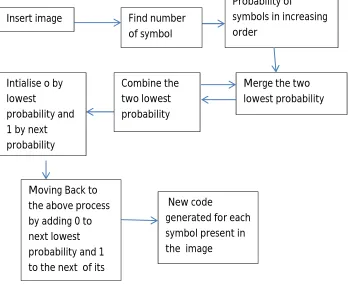
Huffman coding method of compression uses a coding redundancy technique. In an image 2D matrix, number of different symbol present is calculated. In the 8-bit representation each pixel use 8 bit to represent intensity in the image. With the probability method, largest occurrence of symbol will be calculated. This method reduces the number of bits for largely occurrence symbol. In this way storage capacity of image may reduce.
Figure 1. Models of Huffman coding as Encoder
New code
generated for each symbol present in the image Insert image
Probability of
symbols in increasing order
Find number of symbol
Merge the two lowest probability Combine the
two lowest probability Intialise o by
lowest
probability and 1 by next probability
© 2013, IJCSMC All Rights Reserved 444
Let us take one example to understand the Huffman coding technique-
Probability of each symbol can be calculated by nak/n where nak is
number of times ak occurs in the image and n is the total number of pixel
in image. If N is number of row and M is numbers of column then n= MN.
Entropy can be the average number of bits used to represent each pixel. Let each symbol or each pixel use 8 bits then number of bits use for each pixel is be calculated as
L avg = ∑ l(ak) pr(ak) for k= 0 to n-1 (1)
Where l(ak) is number of bits used to represent the symbol ak .
Average number of bits used in the pixel is calculated by using equation-1. 0.5*8 +0.4*8+0.3*8+0.3*8+0.2*8+0.1*8+0.1*8= 8
Table 1. Huffman source reduction
symbol probability Code Source reduction technique
a1 0.5 01 0.5
01 0.5 01 0.6 00 0.8 1
1.1 0
a2 0.4 10 0.4
10 0.4 10 0.5 01 0.6 00
0.8 1
a3 0.3 000 0.3
000 0.4 11 0.4 10 0.5 01
a5 0.3 001 0.3
001 0.3 000 0.4 11
a8 0.2 110 0.2
110
0.3 001
a7 0.1 1110 0.2
111
© 2013, IJCSMC All Rights Reserved 445
Here a1 comes number of times but less number of bits is for this symbol. At the time of scanning image row by row, binary bits are replaced by particular symbols mentioned in the table 1 and send or store in the internet or disk. At the time of decompression particular code is replaced by binary bits and original image is obtained at receiving end. Due to the size of image decrease at the time of compression, fast transportation taking place and use less space in the disk to store. After coding redundancy average number of bits used for each pixel is calculated by using equation 2.
0.5*2 +0.4*2+0.3*3+0.3*3+0.2*3+0.1*4+0.1*4= 5.0
5. Decoder
As a compressed image is inserted into the another node after transmitted, the decoding software run to change into decompressed image as a original image. In this procedure, decimal code is generated for each symbol mentioned in the table 1.Higher code length is 4, therefor at the time of decoding higher bits is taken if it is not matched with the corresponding decimal digits then next higher decimal digits matching taking place until getting the correct match from the Huffman code table. If matching take place particular code is replace by the symbol mentioned in the table 1. Repeating the same procedure for complete scan of the compressed image using Huffman reduction code method, we get the decompressed image as an original image.
6. Model for compression of image.
© 2013, IJCSMC All Rights Reserved 446
Figure-2 Model for compression of image
7. Conclusion
Compression is a technique to reduce the size of any image at the time of storing or transmitting. This paper helps the software developer to develop the compressed software for compressing any image as a lossless original image using Huffman coding technique. Ones can generate an own frame work for compressing any image with less complexity as a time and space.
References
[1] A.B. Watson, “ Image compression using the DCT”, Mathematica journal, 1995, pp 81-88.
[2] J. H. Pujar and L. M. Kadlaskar, “A new Lossless method of image compression and decompression using Huffman coding technique”, Journal of theoretical and applied information technology.
[3] K. Sayood, “ Introduction to data compression”, 2nd and 3rd edition Academic press Morgain Kaufmann Publishers, 2000, 2006.
Insert image Huffman coding
(encoding) Quantize
Compressed image Symbol decoder
© 2013, IJCSMC All Rights Reserved 447
[4] M Nourani and M.H Tehranipour, “RL-Hufman Encoding for Test Compression and Power Reduction in Scan Application”, The university of Texas at Dallas.
[5] R Singh, “Edge preserving compression technique using feed forward neural network”, IJCST vol. 2,Issue 1, march 2011.