235 |
P a g e
DESIGN OF LOW POWER PRE-COMPUTATION
BASED CAM USING XOR AND GATE BLOCK
SELECTION SCHEME
Pallavi Shivatare
1, V.G.Raut
2 1PG Student, Department of E&TC, SCOE, Maharashtra, (India)
2
Assistant
Professor, Department of E&TC, SCOE, Maharashtra, (India)
ABSTRACT
Content-addressable memory (CAM) is a special type of computer memory which provides a fast data search
operation in single clock cycle. Content-addressable memory (CAM) is frequently used in applications such as
lookup tables, databases, associative computing, and networking. However the high speed of CAM increases the
power consumption. This paper presents low power techniques i.e. One’s count, XOR approach and Gate block
selection to improve power efficiency of pre-computation based CAM. In this experiment VHDL modeling is
used and implemented using Xilinx to estimate the power consumption. Compared with the ones count PB-CAM
system the experimental result shows that proposed approach can achieve 30 % power reduction.
Keywords: Content Addressable Memory, Gate Block Selection, One’s Count, Pre-Computation,
XOR
I INTRODUCTION
Content addressable memory (CAM) is the special type of memory in which data can be identified by its content
instead of its address. CAM compares input search data with stored data, and returns the address of the matching
data. CAM has fast search capability. CAMs can be used in a wide variety of applications such as asynchronous
transfer mode (ATM), communication networks, databases, lookup tables, data compression. Due to its vast
number of comparison operation CAM consumes large amount of power.
There are many methods for reducing CAM power consumption which are focused on reducing match-line
power [3], [4], [12] or by dividing the match line [5], [6] ,[13],performance degradation, pre-computation
techniques [1], [8], low power cache [9]-[11], search architecture [14], [15]. One‟s count pre-computation-based
CAM [8] (PB-CAM) that achieves low-power. Furthermore to improve the efficiency of PB-CAMs, the
parameter extractor architecture is modified.
In this work, two efficient techniques for reducing power for the PB-CAM.are Compared with the one‟s count
technique. Proposed techniques achieve power reduction.
II CAM ARCHITECTURE
236 |
P a g e
Content addressable memory (CAM) provides a fast data search function by comparing the search data with allof the stored data in a single clock cycle. CAMs can be used in a wide variety of applications requiring high
search speeds. However due to high speed of a CAM, silicon area and power consumption increases. For lager
CAM the power problem further increases. To reduce the power consumption the CAM can be modified at
architecture level.
We can compare CAM to RAM. RAM produces the data for a given address. But in case of CAM, it produces
an address for a given data word. For RAM, data search is done serially. Thus, finding a particular data word
can take many cycles. In case of CAM searches all addresses in parallel and produces the address storing a
particular word. CAM supports writing "don't care" bits into words of the memory. The don't care bit can be
used as a mask for CAM comparisons. The output of the CAM can be encoded. It ensures duplicate data is not
written into the CAM.
2.2
Operation of CAM
Fig.1 shows general CAM architecture. In this block, data is stored already in the CAM memory. The input to
the system is search word. The input search data is broadcasted to searchlines and then it is compared with the
stored data.
Fig.1 CAM Architecture [2]
Each stored word has matchline which indicates that whether the search data and stored data are same or
different. Then matchlines are connected to encoder. The encoder gives the match location corresponding to
match line which in match state. CAM does this searching operation at very high speed. So it requires large
amount power. In order to reduce the power consumption we have introduced PB-CAM (pre computation-Based
CAM) architecture.
III PRE-COMPUTATION BASED CAM ARCHITECTURE
Pre-computation is the technique applied to the CAM at architectural level. This technique stores some extra
237 |
P a g e
used for initial search operation. Initially if this searching operation fails then it will stop further search and thussaves power.
Fig.2 Pre-computation based CAM Architecture.
Fig. 2 shows the architecture of the PB-CAM which consists of data memory, parameter memory, and
parameter extractor, where k < n. To reduce number of comparison for search operation, the operation is divided
into two parts. The first consist of input data, parameter extractor and parameter memory, and the second part
contains CAM memory (data memory). To reduce power consumption this pre computation-based content
addressable memory is introduced as in the first part. For further pre-computation techniques here only the
parameter extractor block is changed. Therefore, the parameter extractor of the PB-CAM is critical, because it
determines the number of comparison operations in the second part. So, the parameter extractor plays an
important role.
3.1 One’s count parameter extractor
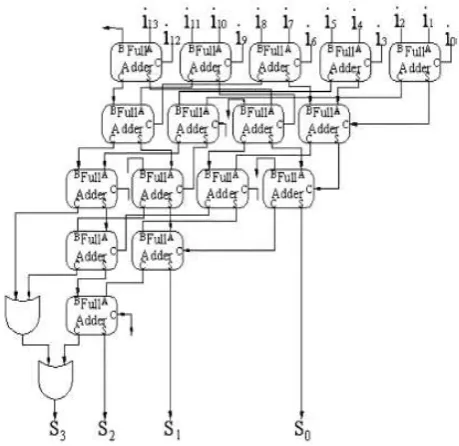
Fig.3 shows the 14-bit ones-count parameter extractor. In this method input is 14 bit and it will produce 4-bit
output (S0, S1, S2, and S3). The ones-count parameter extractor is implemented with full address. As name
suggested it will count number of ones. If the output is 0101 means it will select parameter P5 in parameter
memory. If there is no match in the first part, it means that the input search data mismatches with thedata related
to the stored parameter. Otherwise, the data related to those stored parameters have to be compared in the
second part. Output of parameter extractor has been is given in Table I. The number of data for each parameter
and its average probability is tabulated in Table 1.
238 |
P a g e
Here n is a type of one‟s count (from 0 to 14 ones-counts).Fig.3 14-bit one’s count parameter extractor
Table 1: Output of One’s count parameter extractor
1
Parameter
No. of data
related to the
same
parameter
Average
probability
0000 0 1 0.01%
0001 1 14 0.09%
0010 2 91 0.56%
0011 3 364 2.22%
0100 4 1001 6.11%
0101 5 2002 12.22%
0110 6 3003 18.33%
0111 7 3432 20.95%
1000 8 3003 18.33%
1001 9 2002 12.22%
1010 10 1001 6.11%
239 |
P a g e
1100 12 91 0.56%
1101 13 14 0.09%
1110 14 1 0.01%
1111 15 Valid bit
For example average probability for parameter P5 can be calculated as follows.
Number of data related to P5 is
= 14*13*12*11*10/5*4*3*2*1 = 2002
The average probability = 2002 / 2^14
= 2002/1638 = 0.12219
Probability (%) = 12.22%
The disadvantage of one‟s-count technique is that from parameter 5 to 9 the number of data related to the same
parameter is around 2000-3000. Hence comparison operations also increased simultaneously which will also
increase the power consumption. Ones-count PB-CAMs fail to reduce the number of comparison operations in
the second part. As it can be seen in Table I, random input patterns for the ones-count approach demonstrate the
Gaussian distribution characteristic. Here the Gaussian distribution will limit any further reduction of the
comparison operations in PB-CAMs. So, we replaced Block-XOR technique for reducing the amount power
consumption.
IV PROPOSED PARAMETER EXTRACTOR ARCHITECTURE FOR PB-CAM
4.1 XOR Gate Parameter Extractor
240 |
P a g e
In this technique 14-bit input data is distributed uniformly over the parameters, then the number of input datarelated to each parameter would be 214/15 =1093. So the maximum number of required comparison operations
would be same i.e. 1093 for each case in the second part of the comparison process. This approach can reduce
comparison operations by a several number of times as compared to one‟s count.
Fig.4 shows the block XOR parameter extractor. In this block XOR concept the input data is first is applied to
several blocks. These blocks are several XOR logic combinations from which an output bit is computed. The
output bits are then combined to become the input parameter for the second part of the comparison Process.
However, the concept of Block-XOR approach does not provide a valid bit for checking whether the data is
valid. For this reason the multiplexer is used. It will select the correct parameter.
The selected signal is defined as,
s=A3.A2.A1.A0 (2)
If the parameter is “0000 - 1110” (s = “0"), the multiplexer will transmit the i0 data as the output. In other
words, the parameter will not change. Otherwise, (A3A2A1A0 =„„1111”, s =„„1”), the first block of the input data
will become the new parameter, and “1111” can then be used as the valid bit. Note that the case where “1111” was not considered, because for case “1111”, s=‟1‟ then I will select “D13 D12 D11 D10”. So then finally we have
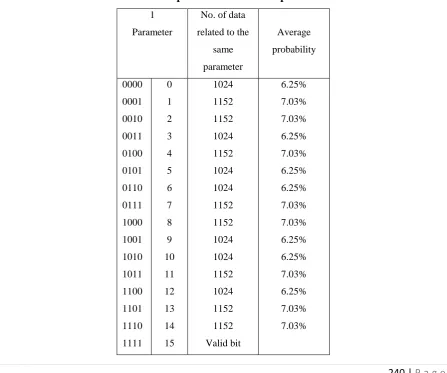
avoided the “1111”. Table 2 shows the output of blocked XOR parameter extractor.
Table 2: Output of XOR extractor parameter
1
Parameter
No. of data
related to the
same
parameter
Average
probability
0000 0 1024 6.25%
0001 1 1152 7.03%
0010 2 1152 7.03%
0011 3 1024 6.25%
0100 4 1152 7.03%
0101 5 1024 6.25%
0110 6 1024 6.25%
0111 7 1152 7.03%
1000 8 1152 7.03%
1001 9 1024 6.25%
1010 10 1024 6.25%
1011 11 1152 7.03%
1100 12 1024 6.25%
1101 13 1152 7.03%
1110 14 1152 7.03%
241 |
P a g e
4.2
Gate Block Selection Technique
In XOR gate PB-CAM parameter extractor we consider only XOR logic gate. So to make the parameter
extractor more useful for specific data types, we consider different characteristic of logic gates. Fig.5 shows the
proposed parameter extractor architecture. There are several partition block and each block contains several
sub-blocks G0-G6. Each sub-block stands for different logic gates. Output bit is computed using synthesized logic
operation for each of these sub-blocks. Then the output bits will become the parameter for data comparison
process. The main objective is to select the proper logic gates in Fig.5 so that the parameter can reduce the
number of data comparison operations.
For this parameter extractor, the bit length of the parameter is set into [n/8], and then the levels in each
partition block equal [log2 8](which is 3). Suppose that we use basic logic gates (AND, OR, XOR, NAND,
NOR, and NXOR) to synthesize a parameter extractor for a specific data type. This parameter extractor will
have different logical combinations. So to select appropriate optimal combination gate block algorithm is
proposed. The mathematical analysis is given as below.
Fig.5
n
-bit block diagram of the proposed parameter extractor architecture.
The probability function P of the output signal Y is given by,
(3)
Here 2-input logic gate is considered and p is the probability of output signal that is in one state. The average
number of comparison operations in each data search operation can be calculated as,
242 |
P a g e
Table 3 shows an example. Here 2 input logic gates are considered for parameter extractor and Cavg iscalculated for each logic gate. The best selection for this case are OR and NOR gates because they require the
least average number of comparison operations (which is 3). When we use the inverse relation of logic gates
(NAND, NOR, XOR) to generate the parameter, the average number of comparison operations for each data
search operation required in the PB-CAM will be the same. To reduce the complexity of proposed algorithm we
select only NAND, NOR, and XOR gates to synthesize the parameter extractor for our implementation. Fig.6
shows our proposed gate block selection algorithm.
Table 3: Truth table and average no. of comparison operation of basic logic gates
A B AND OR XOR NAND NOR
0 0 0 0 0 1 1
1 0 0 1 1 1 0
1 0 0 1 1 1 0
0 0 0 0 0 1 1
1 1 1 1 0 0 0
0 0 0 0 0 1 1
Cavg 4.33 3 3.33 4.33 3
243 |
P a g e
V SIMULATION RESULTS
In this work the PB-CAM is simulated using VHDL. The waveforms for XOR and gate block selection
techniques are as shown in Figures (7, 8, 9 and 10).
Fig.7 Data write operation for CAM using XOR technique
244 |
P a g e
Fig.9 Data write operation for CAM using Gate block selection technique
Fig.10 Data read operation for CAM using Gate block selection technique
VI CONCLUSION
In this paper low power pre-computation based content addressable memory (PB-CAM) is simulated in VHDL.
Simulation results and mathematical analysis shows that the XOR and gate-block selection techniques can
effectively save power as compared to one‟s count. It also reduces the number of comparison operations. From
power report it shows that power consumption is also reduced. This PB-CAM performs data searching operation
245 |
P a g e
such as asynchronous transfer mode (ATM), communication networks, databases, lookup tables, datacompression.
The power can be further reduced by using XNOR approach instead of XOR approach for parameter extractor
design of CAM.
VII ACKNOWLEDGEMENT
I would like to thank Mrs. V.G. Raut, Associate professor, SCOE, Pune University for her support and valuable
guidelines to prepare this paper. I also thank Mr. M.B. Mali, HOD, SCOE, Pune University for his help and
support to complete this work.
REFERANCES
[1] S. Jeeva, S. Bharati, Power Efficient Architecture of Pre-computation Based Content Addressable Memory,
ICCCI, Jan. 2012.
[2] K. Pagiamtzis and A. Sheikholeslami, Content-addressable memory (CAM) circuits and architectures:A
tutorial and survey, IEEE J. Solid-State Circuits , vol. 41, no. 3, Mar. 2006, pp. 712–727.
[3] H. Miyatake, M. Tanaka, and Y. Mori, A design for high- speed low-power CMOS fully parallel
content-addressable memory macros, IEEE J. Solid-State Circuits , vol. 36, no. 6, Jun. 2001, pp. 956–968.
[4] I. Arsovski and A. Sheikholeslami, A mismatch-dependent power allocation technique for match-line
sensing in content- addressable memories, IEEE J. Solid-State Circuits , vol. 38, no. 11,Nov. 2003, pp.
1958–1966.
[5] K. Pagiamtzis and A. Sheikholeslami, A low-power content-addressable Memory (CAM) using pipelined
hierarchical search scheme , IEEE J. Solid-State Circuits, vol. 39, no. 9 Sep. 2004, pp. 1512–1519.
[6] I. Arsovski, T. Chandler, and A. Sheikholeslami, A ternary content addressable memory (TCAM) based on
4T static storage and including a current-race sensing scheme , IEEE J. Solid-State Circuits , vol. 38, no.
1, , Jan. 2003, pp. 155– 158.
[7] K. Pagiamtzis and A. Sheikholeslami, Using cache to reduce power in Content-addressable memories
(CAMs), in Proc. IEEE Custom integer. Circuits Conf., Sep. 2005, pp. 369–372.
[8] C. S. Lin, J. C. Chang, and B. D. Liu, A low-power pre computation based Fully parallel
content-addressable memory, IEEE J. Solid-State Circuits, vol. 38, no. 4, Apr. 2003, pp. 622–654.
[9] Y. J. Chang, S. J. Ruan, and F. Lai, Design and analysis of low power cache using two-level filter scheme,
IEEE Trans. Very Large Scale Integr. (VLSI) Syst., vol. 11, no. 4, pp. 568–580, Aug. 2003.
[10] K. Vivekanandarajah, T. Srikanthan, and S. Bhattacharyya, Dynamic filter cache for low power instruction
memory hierarchy, in Proc. EuromicroSymp. Digit. Syst. Des., Sep. 2004, pp. 607–610.
[11] R. Min, W. B. Jone, and Y. Hu, Location cache: A low-power L2cache system, in Proc. Int. Symp. Low
Power Electron.Des., Apr.2004, pp. 120–125.
[12] K. H. Cheng, C. H.Wei, and S. Y. Jiang, Static divided word matching line for low-power content
246 |
P a g e
[13] S. Hanzawa, T. Sakata, K. Kajigaya, R. Takemura, and T. Kawahara, A large-scale and low-power CAMarchitecture featuring a one-hotspot block code for IP-address lookup in a network router, IEEE J.
Solid-State Circuits, vol. 40, no. 4, pp. 853–861, Apr. 2005.
[14] Y. Oike, M. Ikeda, and K. Asada, A high-speed and low-voltage associative co-processor with exact
Hamming/Manhattan- distance estimation using word-parallel and hierarchical search architecture, IEEE
J. Solid-State Circuits, vol. 39, no. 8, pp. 1383– 1387, Aug. 2004.
[15] K. Pagiamtzis and A. Sheikholeslami, A low-power content-addressable memory (CAM) using pipelined