Factors impacting on the development of initial
education in Nepal, with special reference to
English language teaching, 1950-1995
Rosemary Kerr
Thesis submitted for the
Degree of Doctor of Philosophy,
Faculty of Human Development,
Victoria University of Technology
degree or diploma.
No other person's work has been used without due acknowledgement in the main text of the thesis.
This thesis has not been submitted for the award of any other degree or diploma in any other institution.
( ^
V'^UAM^<<A^ri£.
keep her, the child heard crying himself to sleep because poverty dictated he was hungry and sick, the woman in the
Thesis Abstract
Acknowledgments
A Note to the Reader
List of Maps
List of figures
List of Photographs
List of Tables
Acronyms and Abbreviations
Historical Timeline of Nepal as Related to Kathmandu Valley
Timeline of Educational Development: Nepal
1
iii
V
vii
vii
vii
viii
ix
39
41
Chapter One Introduction, Literature Review and Methodology
Chapter Two Initial Education in Nepal, BCE-1950
Chapter Three Foreign Aid and Development of Initial Education:
1950-1970
Chapter Four Educational Goals and Planning, 1971-1992
Chapter Five Material Conditions in Schools: 1991 -1994
Chapter S k Nepali Teachers, 1991 -1994
Chapter Seven EngUsh Language Teaching in Nepal
Chapter Eight Nepali English Language Teachers:
Standards and Problems, 1994
Chapter Nine Conclusion
1
44
61
81
116
164
207
234
259
education, and educational administrators and planners 291
Appendix B1 Written questionnaire: including sentence
and short paragraph responses 293
Appendbc B2 English assessment: Cloze tests 298
Appendbc C ASLPR criteria 302
Appendix D Tribhuvan University courses: ESL units 329
Appendix E List of ESL approaches and methods 372
Appendbc F In-service training modules, PEDP project 375
Appendix G New primary school curriculum: draft proposal 399
Appendix H Sample pages from new reading texts promulgated by
BPEP 407
Appendix 1 ACTFL 470
Appendix J First Steps 473
Appendix K Learning Assessment Project, Victorian Board of
Studies 495
This thesis sets out to examine the planning and practice of the goals for the development of initial education in Nepal between 1950 and 1995.
Firstly the thesis sets out to explore the historical, religious and cultural background of the development of Initial Education in Nepal against which the modernization of Nepali education was attempted. The thesis elaborates on the profusion and confusion of educational aims of Nepali government planners and foreign aid workers, and the ways in which these plans impact on Nepali classroom practice and conditions, teacher training programs and the teaching of English as a Foreign Language.
A consistent theme is the limited success of the successive five year plans for educational development of His Majesty's Government of Nepal since planning was inaugurated in 1952. Evidence marshalled in the thesis points to a pronounced disparity between the planning and execution of the goals for the development of initial education in Nepal during the period in which research was undertaken (1991-1995). The thesis sets out to answer why Nepali planners and educational developers incorporate ideas that are inappropriate to the Nepali situation - the degree to which these ideas are taken up with little attempt to make appropriate adaptations, and no apparent plan for coordinated implementation.
Kathmandu Valley and a remote area of the Terai recently opened up for development.
As indicated in the Introduction to this thesis this research resulted from the persistent requests for advice from officers of Plan International (Nepal) which stemmed from their concern over the problems they were encountering in their attempts to improve the quality of Initial Education in Nepal. Without their continued encouragement and the assistance of the Private and Boarding Schools' Association (PABSON) and the Nepal English Language Teachers' Association (NELTA) the thesis research would not have been possible. My thanks go to all those who were involved in facilitating the work; in particular Binu Rana (Project Officer Rautahat District, Nepal), Ram Ashish Giri (Senior Lecturer, Department of English and Foreign Languages, Faculty of Education, Tribhuvan University, Kathmandu, and Secretary of NELTA), Dr Raj Awasthi, (Senior Lecturer, Department of English and Foreign Languages, Faculty of Education, Tribhuvan University, Kathmandu). Most of all my thanks go to the Nepali teachers who have contributed to the research.
Throughout the research I have been grateful for the encouragement of friends and colleagues. Special thanks go to Professor John and Mrs Shirley McLaren. Shirley's practical help and advice, along with her continuous encouragement, has been invaluable. My thanks also go to Ruth McFarland who travelled with me to Nepal in 1991 and 1992 and to Carol Andrew, who accompanied me in 1994.
go to Dr Yoland Wadsworth for her guidance with methodology; especially her advice on the place of intuition within the research process. I will always be appreciative of the help given with English as a Second Language (ESL) by Yvonne Williams and Christine Riddell. Christine allowed me to audit several of her ESL units at Victoria University of Technology in 1996. Later she never failed to answer an inquiry or a call for help. My thanks also go to Dr Kate White (Acting Head of the Post-Graduate Research Unit at Victoria University of Technology), for her constant encouragement and support and to Professor David Lawson, (Pro-Vice Chancellor, International, Victoria University of Technology), who in his former role as Faculty Dean ensured I received funding for two field trips to Nepal.
In particular I wish to thank my supervisors. Dr. Stephen Duggan, who oversaw the initial research; and Professor John D. Wilson (Department of Education, Victoria University of Technology), Professor Ron Adams (Head of City Campus and Deputy Director of the Europe-Australia Institute, Victoria University of Technology), and Dr Anitra Nelson (RMIT University), who shared in the oversight of the writing process. Any words I write would be inadequate to express my gratitude to my rewrite supervisors.
To my husband I say this: "Your help and support have not passed unnoticed."
As noted in the Introduction, Nepal does not issue research visas. All attempts to obtain such a visa from within Australia proved futile. The Royal Nepalese Consul in Melbourne and Sydney, as well as the central base in Japan, recommended that the research be undertaken on a tourist visa. On the one hand this proved to be sound advice, as I was received and given interviews by government officials at all levels with no inquiry as to my visa status and no impediments to the information being sought. However, as a tourist visa gave me no official status within the country and given the conditions of a tourist visa, namely that no paid or voluntary work could be undertaken, I was reluctant to press the Nepali government for any formal assistance with the conduct of the research.
For the purpose of the research the term Initial Education has been used. This is defined as that part of the formal education system that extends from pre-school to upper secondary level.
The style adopted for the purposes of documenting this thesis is based on The Chicago Manual of Style: the Essential Guide for Writers,
Editors and Publishers {I4th. Edition), 1993.
Where possible definitions of unfamiliar Nepali or Sanskrit words have been included in brackets within the text.
reading accurate dates as Nepal does not operate on the Gregorian calendar:
for example the year 1993 is recorded as 2049 in Nepali documents.
Noted historian on Nepal, Father Ludwig Stiller, writing in his book
Nepal: Growth of a Nation states:
Many of my friends will be surprised at my use of 'Nepalese'
in place of the more familiar 'Nepalis' ... The less familiar
spelling suited my purpose and my audience more than the
more familiar one. (1993, ii)
Although the term 'Nepali' can sometimes cause confusion for Westerners
unfamiliar with its interchangeable usage between language and people,
unlike Stiller I have made no such concession to a Western audience within
the text of this thesis. During the course of the research I have had
extraordinary assistance from many Nepalis. Out of respect to their
commitment and help 1 use the term Nepali (which they favour). 1 am
honoured to call them my friends.
Similarly, to distinguish between cultural and geographic use of the
term 'western', I have consistently referred to British, European and North
American influences under the generic term 'Western'.
Map 2. Map of Nepal xii
Map 3. Map of Geographic Research Area 21
LIST OF FIGURES
Figure i Stages in the Growth of a Primary School System 31
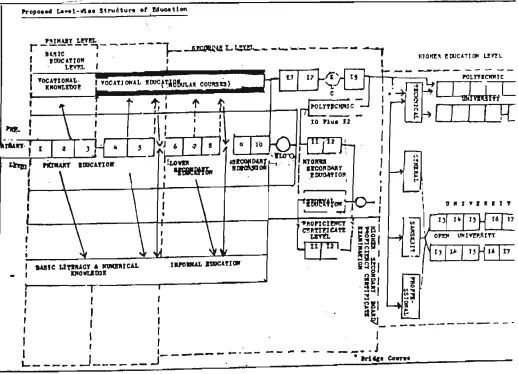
Figure ii Recommended Three Tier Structure for Education 97
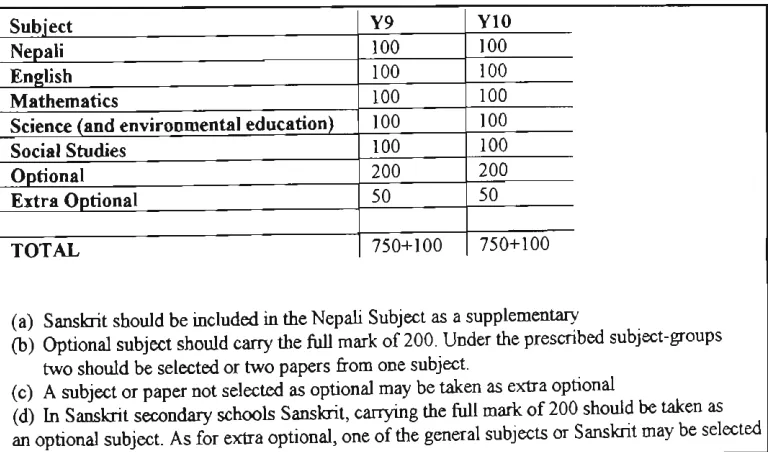
Figure iii Lower secondary subjects and points 99
Figure iv Higher secondary subjects and points 99
Figure v Primary level subjects and points 102
LIST OF PHOTOGRAPHS
An example of a sign written in English in Kathmandu ^ 2
Child playing in the streets of Kathmandu in school hours j2
Gorkhana school in village street 228
New school at Gorkhana 129
Mani Jyoti Primary School 13 j
The entrance to Budhanilkuntha j34
Community meeting, 1994 24-7
Skillion roof weighted with stones 2 51
Kshitiz boarding school in the old Rana palace 2 52
Waiting for the only toilet 253
A private school in Bhaktapur, 1994 2 60
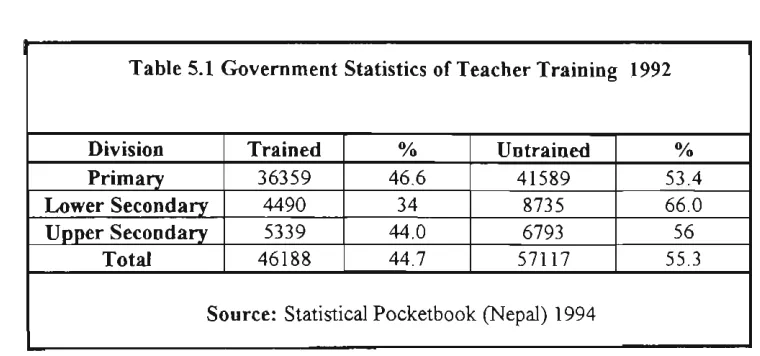
Table 5.2 ConsoHdated Statistics for Teacher Training
Table 5.3 Teacher Training of Private and Government School Teachers
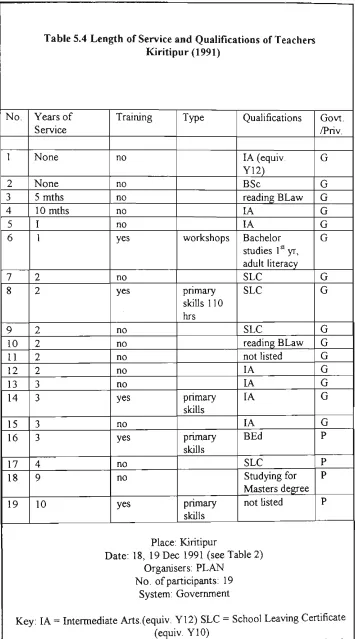
Table 5.4 Length of Service and Qualifications of Teachers, Kiritipur
Table 5.5 Length of Service and Qualifications of Teachers, Gorkhana
Table 5.6 Qualifications of Teachers and Period of Service
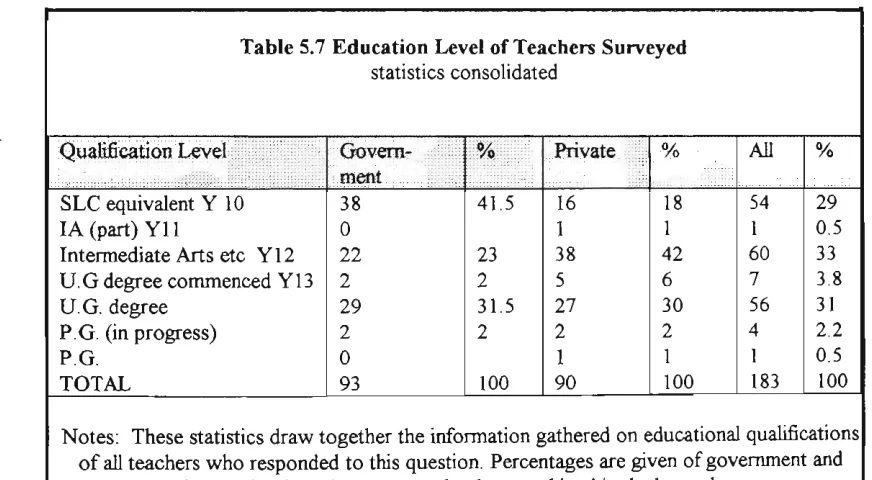
Table 5.7 Education Level of Teachers Surveyed
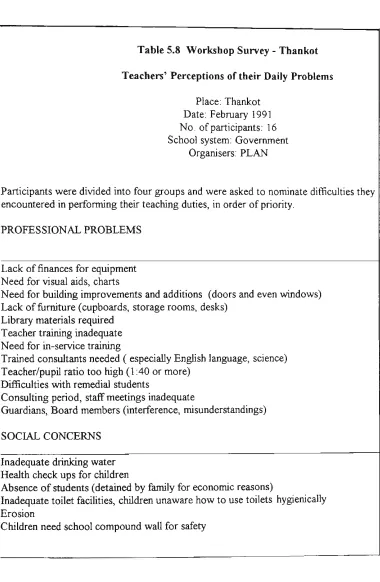
Table 5.8 Workshop Survey, Thankot
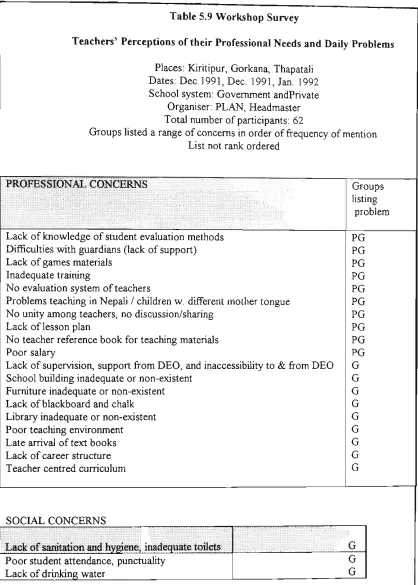
Table 5.9 Workshop Survey, Kiritipur, Gorkhana and Thapatali
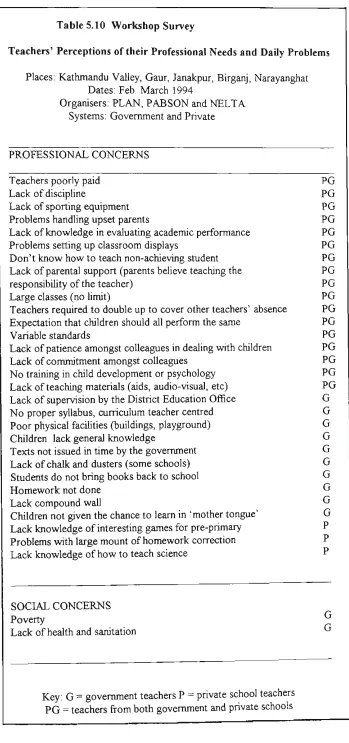
Table 5.10 Workshop Survey
Table 5.11 Qualifications of Teachers and period of Service, Thapatali
Table 5.12 Length of Service and Main Interests of Teachers, Thankot
Tables. 13 Age of Teachers, 1994 Survey
Table 5.14 Age of Teachers, surveyed in 1991 -92
Table 5.15 Survey of Teachers' Backgrounds
166
168
168
171
172
173
175
179
180
181
187
188
189
190
ADB ACTFL AGFUND ANEC APEID APPEAL ASLPR BA BCom BCE BEd BLaw BNFP BPEP BRAC BSc CDC CERID CEIFL CTSDC CWIN DEO EFA EFL EL ELT ERDP FOE GDP GSS HMGN lA ICom lEd INF INGO lOE ISc 1ST Kg MA MOE MOEC MOEC/SW NEC NELTA NEPC NESP NGO NRS ODA
Asian Development Bank
American Council for Teachers of Foreign Languages Arab Gulf Programme for United Nations Development All Round National Education Commission
Asian Programme for Educational Innovation and Development
Asia-Pacific Programme of Education for All Australian Second Language Proficiency Rating Bachelor of Arts
Bachelor of Commerce Before the Common Era Bachelor of Education Bachelor of Law
Basic Needs Fulfihnent Programme Basic Primary Education Project
Bangladesh Rural Development Committee Bachelor of Science
Curriculum Development Centre
Centre for Educational Research, Innovation and Development
central Institute of English and Foreign Languages, Hyderabad, India
Curriculum, Textbook and Development Centre Child Workers in Nepal
District Education Office/OflHcer (interchangeable) Education for AU
English as a Foreign Language English Language
English Language Teaching/Teacher (interchangeable) Education for Rural Development
Faculty of Education Gross Domestic Product
Gonoshashajjo Sangstha, Bangladesh INGO His Majesty's Government, Nepal
Intermediate Arts Intermediate Commerce Intermediate Education International Nepal Fellowship
International Non-Government Organisation Institute of Education
Intermediate Science In-Service Training Kindergarten Master of Arts
Ministry of Education (1950-71, 1998- ) Ministry of Education and Culture (1971-91)
Ministry of Education, Culture and Social Welfare (1991-97) National Education Commission
Nepal English Language Teachers' Association National Education Planning Commission New Education System Plan
Non-Government Organisation Nepalese Rupees
g E
ushl
o
ndh
i
nhal
a
ami
l
elug
u
ihe
r 1
.
1. c/5 (/I 1— 1— o
]D
ill! • ; • . . - .u cc o: < o I o — o m
•g ® o ®
PEP Primary Education Project
PEDP Primary Education Development Project RC Resource Centre
RP Resource Person/Received Pronunciation RPP Panchayat Party
SEAD South East Asia Development Organisation SLC School Leaving Certificate
TA Travel Allowance
TAR Technical Assessment Report TU Tribhuvan University
UMN United Mission to Nepal
UNDP United Nations Development Fund
UNESCO United Nations Education, Scientific and Cultural Organisation UNICEF United Nations Children's Fund
USA United States of America
USAID United States Agency for International Development USD United States Dollar
WB World Bank
E "E
E
I e
e
lU
DiDGC
GAL
I
" • v ^ ; : ^ ;
-c to' E "D c < GAL I 2 iU c m
<P-1 O
. ° 10 CO .o — LU
J3 < 0 CD .2 O 2 O 2 o o u < CO U < y (7) > • .M~~ Z < ^-•"f < 2 1 tn . ;
Cultural Atlas of India Gordon Johnson
Introduction, Literature Review and Methodology
When I first visited Nepal in February 1990 I arrived at Tribhuvan International airport with the standard Western misconception that I was entering a country of high mountains and deep valleys, steeped in peace. As I left the airport precinct I was aware that my 'mountains in the sky' were barely discemible through the haze of pollution. Kathmandu city was visibly over-populated and under-resourced. Roads were poorly surfaced, footpaths unpaved, litter lay everywhere, public instrumentalities (where they existed) were poorly maintained, sanitation and safe water were scarce. Within two days I had developed bacillary dysentery and, on recovery ten days later, I discovered that the nation had erupted into civil unrest. Unable to leave Nepal for four weeks, I vowed never to return. I returned five times; however, my first visit provided a number of other consciousness-raising experiences which eventually gave rise to the questions which this thesis sets out to investigate. Reflecting back now, three images stand out as seminal:
1. A little girl dressed in a faded cotton British-style box-pleated tunic sitting alone on the footpath outside one of Nepal's major hospitals. A notice placed in front of her revealed that her family could no longer care for her. It pleaded for someone to take her in. We prayed it would not be a tout for an Indian brothel.
2. The cacophony of noise at the bus terminal.^ A woman in an adult literacy class indicated that she was attending classes so she could 'learn how to read and write so that I can read which way the bus is going, and I can write a letter to my grand-daughter'.
Her statement echoed the sentiment expressed by many other women, who claimed that they wanted to be able to read and write so that they could get a loan to commence income generating activities. Both responses suggested that the women desired the opportunities that are open to those who are literate. 3. Plan International fieldworkers' constant requests for advice on how best to assist teachers who had a low level of general education, no teacher training, and who were faced with exceptionally large classes conducted in inadequate facilities.
My experiences seemed to encapsulate some of the primary concerns of Nepalis, and so the subsequent research was influenced by an intuitive perspective - which Marshall and Rossman claim is a research tool that allows: 'ideas to incubate, and through retaining a respect for the mind's capacity for reorganization and reconstruction, the researcher finds richer questions evolve' (1989, 29).
Further, there were many times during the research period when, following the ethnographic method of semi-structured interviews (Bums 1997,330), I found that I leamed a great deal more by allowing interviewees to follow a pathway they had introduced. This not only enabled access to additional information, but also imparted a deeper understanding of the complexities of the situation. It frequently provided contrasting points of view and an opportunity for triangulation (Bums 1997,324).
To ascertain the material conditions which existed in Nepal's system of Initial Education between 1991 and 1995 four fieldtrips were undertaken:
Febmary 10-20, 1991;
December 3, 1991 -January 23, 1992; January 3 - Febmary 25, 1994;
November 1 - December 14, 1994.^
My intention of these fieldtrips was to collect data pertaining to the qualifications, general education and background of teachers in Nepal, as well as to record observations, interviews and attitudes towards Initial Education in Nepal experienced within the research area 1991-95.
As the research developed, English language teaching (ELT) seemed to best illustrate a major contradiction which emerged as characteristic of the planning and practice of initial education in Nepal. As a result, the latter fieldtrips focussed on how planning goals (or the lack of them), material conditions and teaching standards impacted on ELT. In Nepal English was taught as the major foreign language, yet the Government of Nepal had no official goal as to how English could best be supported and taught. My fieldtrips revealed that the lack of such a plan created an atmosphere of confusion in the practice of teaching English and added to the disparity
existing in the overall system of initial education in Nepal between the children of the elite and the lower classes. Furthermore, despite the perception of educationists and guardians that the standard of ELT in Nepal was declining, the available literature suggested that the most recent govemment sponsored survey into ELT was that undertaken on behalf of the British Council and His Majesty's Govemment of Nepal (HMGN) in 1983/4. Apart from this evidence, only two independent surveys of English language standards could be found. These surveys involved the standard of English language demonstrated by Proficiency Level students (P.C. equivalent Year 11 and 12)4 on Tribhuvan University's (TU) Pokhara campus (Giri ^ 1985 and 1986).
The lack of independent research into material conditions and teacher 'growth states'^ and the lack of a govemment goal for the teaching of ELT suggested that there was a need for an independent examination of how the system of Initial Education was being practised in Nepal between 1950 and
1995.
Initial observations made during Febmary 1991 suggested that material conditions in Nepali schools, and teaching standards within the geographic research area, were as poor as the Plan Intemational fieldworkers indicated. This thesis aims to explore the extent of the deficit conditions between 1990 and 1995, and to suggest some possible reasons for them. Using ELT as an example, the thesis attempts to demonstrate how the apparent disparity between goals and practice impacted on the system of
initial education in Nepal. These aims gave rise to two specific and guiding questions:
(1) What were the standards of teachers and conditions in Nepali schools, 1991-95?
(2) What do these conditions indicate about the planning and implementation of the goals for initial education in Nepal 1950-1995?
As previously implied (cf. p. 3 above), the answers to these questions are framed primarily by data collected during the four fieldtrips. However, to contextualise both questions and answers it is necessary first to review the literature informing the study, and to outline the methodology followed.
Literature Review
observations indicate, Nepalis do not find the view that Nepal is a satellite of India acceptable. However, Raeper and Hoftun indicate Nepalis from all levels of the social spectrum are critical of the amount of political and economic influence they claim India has had over successive Nepali governments from the time of the Rana regime (1992, 132) "^.
Vir outlines the development of education in relation to the state policy of Nepal as a developing society (1988, Preface ix) and, similar to Pigg, examines how Nepal's social hierarchy is tempered by increased education amongst the general population. He claims that this tempering enables tradition and modemisation to co-exist, though he also notes that 'persons from the higher strata of Nepali society are more disposed towards the process of modernisation' (158). The accuracy of such a claim would explain, in part, fieldtrip observations of the elite's preference for private English medium schools. The suggestion by Vir that the elite are more disposed towards modemisation may qualify the claims of Pigg and N. R. Shrestha that the elite made use of the development process solely to consolidate their own position. Macfarlane sees India as a periphery of the West, and Nepal as a periphery of India, concluding that this makes Nepal a periphery of a periphery. Macfarlane's view is highly controversial but, along with Bista and H. and M. Reed, he is in accord with the central premise of this thesis, that no single factor is responsible for Nepal's problems in achieving its development goals. The legacy of neo-colonialism and a belief in fatalism may be factors in developmental problems, but, like the political explanation given by Raeper and Hoftun (cf. p. 19 below), they are not a sufficient explanation. Many other factors exist, and these include
geographic, demographic, and economic factors. While this thesis refers to how such factors have impacted and interacted on the development goals of Initial Education, it concentrates on the social and historical influences.
socio-cultural pattem. In addition, they observed that some programs had been impractical due to the restraints of limited personnel, infrastructure and finance.
Hugh and Mary Reed (1968), who worked on a project implementing science education in Nepali schools in the l%0s, accepted that religious tradition influences Nepali society, but argued that these beliefs could be used to benefit development provided they were hamessed rather than confronted. Dharam Vir (1988), who studied the relationship between education and polity in Nepal in 1974, argued that although the State now takes responsibility for the development of initial education in Nepal, institutionalised religious belief influences the State and in effect each supports the other.
Others have written on general development issues which further contribute to an understanding of development in Nepal. Amongst these are Rostow (1960), Andre Gunder Frank (1969), Camoy (1976), Said (1978 and 1994), Weiler (1982) and Lewellen (1995). However, while this thesis attempts to take account of both Western and South Asian perspectives regarding Nepal's developmental challenges, it takes note of Pigg's waming that
the role of development in Nepal has been limited by the rhetoric of
development [and] ... Most discussions of development in Nepal debate
economics, administration, or politics within a framework that separates
development from the society (1993,45).
but it seeks to balance discussion of development rhetoric with first-hand data and observations collected during fieldtrips.
With respect to the planning goals for the development of initial education in Nepal (1950-1995), this thesis employs Vir's division of the development of initial education in Nepal into four main periods:
traditional education (prior to 1846), modem education (1846-1950),
the rapid expansion of modem education (1951-70) and planned development of modem education (1970 onwards).
HMGN set goals for the development of initial education through a series of eight five year plans, an exception being the initial planning period which covered three years. The list of the plans is as follows:
1952-55 Initial Planing Period; 1955-60 The First Plan; 1960-65 The Second Plan; 1965-70 The Third Plan; 1970-75 The Fourth Plan; 1975-80The Fifth Plan; 1980-85The Sixth Plan; 1985-90 The Seventh Plan; 1990-95 The Eighth Plan.8
During the periods being researched - the rapid expansion of modem education (195070), and planned development of modem education (1971 -onwards) - HMGN aimed to achieve:
• a single system of adequately funded govemment schools; • good facilities;
• the availability of free education for all (EFA) by 1985 (now amended to 2000);
• increasing the literacy rate;
• encouragement of the enrolment of girls;
an adequately qualified and trained teaching service and • provision of tertiary institutions.
Later goals included: • equity of access;
• qualitative improvement of material conditions in schools; • universal availability of quality texts and
• the development of a system of technical and vocational education. (Wood 1977, Asian Programme of Educational Innovation for Development [APEID] 1984, Nepal District Profile 1986, Vir 1988, Asia-Pacific Programme of Education for All [APPEAL] 1991).
As this thesis describes, the model of initial education chosen in 1952 was based on the British colonial system in India which used a teaching methodology of rote learning. This method allows little scope for the practical application of curriculum and does not promote the development and use of technical skills.
Nepal, and some fieldtrip interviewees facilitated access to unpublished documents and articles which have been listed in the bibliography. Applying Freire's claim that 'education is not neutral, it is for domestication or liberation' (see Hill 1992, 2), the choice made and followed by Nepal after 1950 might be said to have had the effect of 'domesticating' the general public.
tTWKmm
%"^W^
^ ^ S ^ H B ^ ' ^ ' ~ ' ^k
IIP .
^"-'^
*••'• • m - ^
%.<..j^3>'- *
• A K *
m^
:. ^ ^ ' •
^*'fe 3
M||J^
y'i -^
-r--,- -^^B
This understanding of the setting has been supplemented by the works of Vir (1988), Bista (1991, 116-132) and Stiller (1993), who give outlines of the history of initial education in Nepal prior to 1950. Vir notes that in Nepal,
a formal education system has not been a part of either the central or the political traditions and prior to 1951 the intention was to withhold education from most Nepalis (1988, 9).
He goes on to claim that 'liberalisation of education was brought about by the idea that education was important for economic development' (38). This view was prevalent in 1950 when Nepal embarked on its development programs. The nation's initial exposure, therefore, was to the prevailing post World War Two (WWII) Westem paradigm that 'formal education made a significant contribution to the modemisation process' (Harbison and Myers 1964).
As already noted, there was a paucity of independent ethnographic data on material conditions in schools and on the 'growth states' of Nepali teachers. While some data regarding the number and type of schools, literacy rates and college graduates in Nepal during 1952 were available (Wood^ 1977, APEID 1984, APPEAL 1991, Macfariane 1994) and some description of the evolving conditions and the staffing of schools was presented by H. and M. Reed (1968), Mitchell (1977) and Macfariane (1994), no detailed description of the actual conditions pertaining to the initial education system in the 1980s or early 1990s could be located until the Nepal Multiple Indicator
Surveillance ^^ was published in 1996.
^H. B. Wood was an adviser to the National Planning Commission for Education in 1952 and he has maintained a life-long interest and connection with Nepal.
^ ^National Planning Commission Primary Education, Final Report: Nepal Multiple Indicator
Vir (1988) provides some insights into the possible background of Nepali teachers, but his conclusions are based on research done in 1974. However, in the light of the low status and background of Nepali teachers, most researchers agree that education was not regarded as a high status occupation in Nepal (Pigg 1993,50; G. M. Shrestha and Bennett in Bambach
1993a, 2-3; Bambach 1993a, 3). Other information available pertaining to the professional status of teachers (APEID 1984, APPEAL 1991) appears to have largely been based on Nepali govemment information. Statistics on the number of trained and untrained teachers in Nepal were available (Statisticcd
Pocket Book, Nepal 1994), though, as the Nepali govemment has no set
measuring instruments for collecting such data, the reliability of the information and figures is in doubt.
Surveys were undertaken on behalf of the Nepali Govemment during 1992 and 1993 by an intemational technical assessment team investigating the problems associated with the lack of a career stmcture for primary school teachers (Bambach 1993, Manandhar 1993, Y. R. Pant 1993, L. P. Tripatiiee 1993). However, while this assessment reviewed teacher status, in-service training programs and teaching service regulations, no survey of the general education or training qualifications of teachers actually working in the field of initial education was undertaken during the technical assessment period. ^ ^ A report written by Bambach in August 1993, and based on 1991 figures (source unstated), cites 38 percent of primary teachers as qualified and trained, 55 percent qualified but untrained, 4 percent under-qualified but trained, and 1 percent under-qualified and untrained. In Nepal the term 'qualified' for primary school teachers applies to teachers with School
Leaving Certificate of Nepal (SLC), YIO or its equivalent from India or elsewhere. 12 The term 'trained' can mean anything from basic training of five to one hundred and fifty hours of in-service training to pre-service training of one year's duration onwards. Until Matheson (1985) and Crowley (1990) wrote an assessment of the Education for Rural Development Project in the Seti zone (which was jointiy funded by the Nepali govemment, the United Nations Children's Fund (UNICEF^) and other multilateral agencies) and the Primary Education Project (PEP), there appears to have been littie other direct written evidence of the reality of the initial education system.
As well as the arguments presented earlier regarding the hierarchical religious and social stmcture of the society, and the possible influence of India and neo-colonialism (cf. p. 6 above), additional factors affecting the choice of plan for the development of initial education made in 1952 must be considered. First, the educational experience and social and political background of the planners was limited. Along with Wood all members were male. Apart from Wood they were politically allied with the new govemment. Few women were available to contribute as prior to 1950 initial education was largely restricted to males and, as society was male dominated at the time, women would not have been considered for inclusion on the planning committee. As a result, the curriculum chosen was in accordance with what men regarded as important. Second, there was an extremely low literacy rate within the Nepali community, with very few high school or college graduates (Wood 1977, Macfarlane 1994), which meant there was no trained or semi-trained manpower base needed for the country's economic modemisation.
Third, there was little infrastructure for education. Fourth, the prevailing development philosophy or paradigm of the major development agencies was based on the premise that a literate and technically trained society would lead to economic prosperity (cf. p. 14 above).
Despite the liberalisation of the government's attitude, insufficient funds were allocated for education, suggesting, as Vir claims, that education was not viewed as an indispensable investment for economic growth by the Nepali govemment (1988, 43). Vir suggests this probably occurred because the plan for the development of initial education was wholly unrelated to the national goals (43) - a choice that Bista (1991), N. R. Shrestha (1993) and Pigg (1993) claim was influenced by a fatalistic belief in karma combined with an attempt by the elite to maintain the status quo. The fact that the elite quickly opted out of the govemment system and encouraged the development of a system of private education for their own children suggests that Pigg and N. R.Shrestha may have a valid claim. Further arguments of N. R. Shrestha and Pigg that development in Nepal was uneven, are supported by Vir, who indicates that, in 1952, two-thirds of the limited number of high school and college graduates were situated in Kathmandu, and that this remained the case in 1974 (1988, 79).
ontological and epistemological distinction between the 'Orient' and the 'Occident':
Taking the late eighteenth century as a very roughly defined starting
point. Orientalism can be discussed and analysed as the corporate
institution for dealing with the Orient - dealing with it by making
statements about it, authorizing views of it, settling it, ruling over
it: in short. Orientalism as a Western style for dominating,
restructuring and having an authority over the Orient (1994, 3).
Fieldtrip observations suggest an acceptance in Nepal that, in order to modernise, superior Westem approaches should be adopted. This suggests that an orientalist predisposition affected the State's choice of goals and model for the development of initial education. In addition to this orientalist predisposition Vir (1988), Bista (1991), N. R. Shrestha (1993), Pigg (1993) and Macfarlane (1994) claim that the State's choices were also affected by the socio-religious values of Nepal.
Whatever the major planning influences may have been, and despite the goal of HMGN for a single system of initial education consisting of adequately-funded Nepali language schools, a private English medium system developed as well. As a result a dual system was created. This occurred without apparent opposition from either the govemment or the general population.
This in tum challenges the status quo and destabilises the State' (1996, 7). As a result of the volatility in Nepal, many Nepalis decided to live in exile in India after 1960 because of fear of Nepali Government reprisals for any opposition. Despite the government's claim that the political system between
1960 and 1990 in Nepal was one of partyless (Panchayat) mle, and that it would neutralise the elite's influence; according to Raeper and Hoftun the system created an even stronger elite (1992,11). Fisher describes this period of Nepal's history as one of absolute monarchy (1997, 1). Raeper and Hoftun claim that many Nepali people believed that 'development in Nepal
[between 1960 and 1990] had failed because of political repression' (1992, 24). However, as noted (cf. p. 6 above), like all the arguments already discussed, the argument that political turmoil alone impeded development in Nepal is insufficient.
What is apparent is that the model accepted regarding the development of Initial Education in Nepal in 1952 was based on conflicting goals and a lack of coordination and communication between planners and the Nepali govemment. Fieldtrip observations and experiences indicated that a lack of communication and coordination noted by H. and M. Reed in the 1960s, was still evident and impacting on projects during the period of this research in the
1990s. However, while the mismatch between the model for educational development and government goals can be explained by a lack of coordination and communication, the government's acceptance of the plan put forward by the national planners in 1952 for the development of initial education points to a number of other factors at work.
goals for development were implemented in a manner which confronted the caste system. In addition to the views of H. and M. Reed, Bista (1991, passim), Seddon (1992, 161) and Macfariane (1994,119) claim Nepali social stmcture, which designates skills by caste, and the Brahmanic attitude which views the function of education as a means to free one from menial work, have impacted upon the development of technical schools. Like H. and M. Reed, Bista, Seddon and Macfarlane suggest that technical education and science based subjects had not developed according to the Nepali govemment's goals because of a mismatch between the Nepali culture and the ways in which attempts were made to implement the goals.
The foregoing views suggest that there are a number of perspectives from which development programs in Nepal must be evaluated, and these are discussed in Chapters Two, Three and Four of this thesis. However, as already indicated, the primary focus of this research is on examining the material conditions of schools observed and of teachers surveyed in the research area between 1991 and 1995. It is through the independent fieldwork, undertaken during this period^^^ tj^at the thesis seeks to make a contribution towards understanding the problems facing initial education in Nepal during the 1990s.
During the fieldwork, as evidence of a disparity emerged between the planning of educational goals and their implementation, the research focussed on how the teaching of English in Nepal was affected by the apparent failure to achieve the main goals for the development of initial education. The method of assessment and analysis for the survey of ELT and English
language teachers in Nepal is detailed in Chapters Seven and Eight of the thesis.
Methodology
Delineation of the Geographic Area for Study
The geographic area in which the research took place extended from Kathmandu Valley, north-west to Trisuli, west to Pokhara Valley, then south to the Terai regions of Birganj, Janakpur and the remote town of Gaur. With the exception of Gaur these places were heavily populated and had been exposed to development for several years, i'* It was expected that these areas would have had a greater chance than the remoter regions of achieving the nation's development goals. The area chosen for the research for this thesis was also influenced by time and budgetary constraints.
-XiV^:
S0lpal lot
\ Q Daile kh
Dliauloglrl 8172.
° Rukumkol
'Sallyank toll V
'E^.Vs-c£:i^-7^' KalhttiandU':;''VT'-, )
! 8163 ,? K - l i c i U 8163 ij I'okhaii) "M^^-.Ji.
Map 3. Geographic Research Area
The Model
As the purpose of this research was to describe the existing conditions in schools and the professional level of teachers, the methodology involved a number of research techniques, implemented over a succession of phases (cf. p. 31 below). However, as the overall methodology was that of 'progressive focussing', the commencement point for the research was observation and informal interviews (Bums 1997,330). These were based on the first of the guiding questions: What are the standards of teachers and conditions in Nepali schools, 1991-95? (cf p. 4 above). Using the method of progressive focussing the research followed parallel paths. The main path focussed on 'leamingfrom experience' (Connell 1982 in Wadsworth 1997, 11), and a series of four fieldtrips took place between Febmary 1991 and December 1994. The field research involved a number of research methods: observation, semi-structured interviews, survey questionnaires and, later, when the problems of ELT were discussed, several approaches were used relevant to the assessment of standards of ELT (cf. Chapter Eight). The other path was an examination of the choice and implementation of goals for the development of initial education in Nepal as framed by a review of the relevant literature and written materials noted in this introduction and throughout the thesis.
Ethical Issues
explained in both Nepali language and English. When these explanations were made and the ethics clearance form presented, the participants made it clear - both in English and Nepali - that they felt such documents were unnecessary. As a result the interpreters advised that the Nepalis were unfamiliar with the mles of Westem research. The participants' view was:
• that the signing of a document identified them as attending a workshop;
• the signing of documents or written statements was associated with officialdom and govemment;
• the research was anonymous therefore the signing of such a document was unnecessary; and
• the research could be beneficial to the Nepali teaching service. A similar response was experienced during 1994. As an identifying code was all that was necessary to collate responses to the ELT assessment process, it was decided not to insist on the signing of an ethics clearance at any point in the research but to do everything possible to protect the identity of those contributing.
Sampling
consisted of the historically important school, Durbur High School, and the most prestigious schools in Nepal, Budhanilkantha, Gandakhi Boarding School (GBS), and St. Xaviers. As the thesis is biased towards qualitative research, the aim was to describe qualitatively the situation found in the schools researched. There has not been a strong emphasis on quantifying the situation statistically.
Twenty-five schools were observed in detail and the number of visits to each school recorded along with the reason for their inclusion. The descriptive observations of eleven of these schools are detailed in Chapter Five where it will be seen the ratio of private to government schools is higher, as there was a greater variety of standards in private schools. However, overall a balance between the number of govemment schools and private schools observed was maintained. Nevertheless, given the risk of bias in opportunity based selection (Bums 1997, 86), only indications can be posited: generalised conclusions for the whole of Nepal cannot be made. Similarly, as the bulk of the data pertaining to the education, qualifications and background of teachers were collected from groups of teachers during workshops, 15 it is acknowledged that the incentive for teachers to attend in-service training workshops may have been stronger amongst those who were untrained and this in itself may skew the data. While there is no evidence that this was the case, it must be acknowledged that those teachers who did not attend the workshops might have had quite different characteristics to those who attended. Further, the incentive to attend workshops arranged by Plan Intemational may have been linked with a desire to please the International Non-Government Organization (INGO) working in the teachers' communities. In the case of workshops organised by PABSON, staff were
generally required to attend by the principal of the school in which they taught. However, the workshops organised by NELTA appeared to be free of coercion. Furthermore, as the surveys indicate, the teachers attending workshops were generally young. It may well be that their youthfulness equated with enthusiasm whereas older teachers may be confirmed in their ways. To overcome this possibility the data collected on govemment schools and teachers were compared with data supplied by HMGN and UNICEF
{Nepal Multiple Indicator Surveillance 1996). The subsequent comparison
indicated that the thesis sample profiling 294 teachers generally reflected the HMGN and UNICEF information regarding teachers' general education and training in Nepal which was compiled in 1995. Similarly, the govemment schools visited during the thesis research fitted the standard described by HMGN and UNICEF (Nepal Multiple Indicator Surveillance 1996).
As is the case with other studies, the combined HMGN/UNICEF study did not include private schools. As a result no data were available for comparison with the thesis data pertaining to private schools.
Questionnaires
Generally there were no time constraints as to how long a teacher could take to complete the questionnaires and the participants were free to converse with one another. However, due to an administrative oversight - not the fault of the researcher - during January 1994, for three schools visited on the Terai only a portion of the questions could be answered because of time constraints which occurred when the visits to schools had to be hastily arranged. As most of the research was independenfly funded,16 financial constraints prevented a longer stay or a retum visit to these schools.
A further difficulty was that because of time and budgetary constraints, the questionnaires were not able to be pre-tested. An attempt to compensate for the lack of a pre-test was made by having the questions read and discussed by representatives of the facilitating groups. During this process it was felt the issue of 'caste' was sensitive and advice was given to delete a question pertaining to caste.^"^ However, despite preliminary discussions, two ambiguous questions were not noted until the research was underway. The first of these asked. Do you have any tertiary qualifications? This question created confusion for the participants as, until 1992, Yl 1 and Y12 were undertaken on a campus of TU. In Nepal this level of study was considered by many to be a level of tertiary study, whereas in the West Y11 and Y12 are generally regarded as secondary schooling. A further problem occurred in relation to tertiary qualifications as in Nepal the certification of Intermediate Education (lEd) is regarded as both a level of general education and a teaching qualification, whereas the other intermediate certificates in arts, science and commerce are not. When the problem of overlapping caused by
' " Two retum airfares were contributed by the Faculty of Human Development of Victoria University of Technology, Melbourne.
the confusion of terminology was realised, adjustments were made when collating the data.
Observations
Fieldtrip observations were ongoing and included direct descriptive observation of the conditions of school buildings, playground facilities, sanitation, maintenance, general equipment and storage. Descriptive observations of schools, including criteria for selection and the number of visits made to a particular school, are contained in Chapter Five of the thesis. Further non-participant observations were made throughout the research period of teachers' behaviour and attitudes to teaching - attendance, punctuality, planning and evaluation - as well as the teaching methodology they employed. These observations were correlated with responses contained in the questionnaires. Some observations were made as a participant observer while filling the role of a voluntary in-service teacher trainer, during thirteen teacher training workshops in the research area. As already noted, these workshops were variously organised by field-workers from Plan Intemational, PABSON and NELTA. ^^ Additional observations of teachers were made during visits to schools where interaction took place between myself, teachers and children.
Interviews
As noted (cf. p. 2 above) to enable triangulation, information was collected during semi-stmctured interviews (Bums 1997, 330), sometimes with the help of a Nepali interpreter from Plan Intemational, PABSON or NELTA. Information obtained in these interviews confirmed, corrected or complemented data obtained from participant and general observations (Bums
1997, 315). On occasion, information obtained in one interview contradicted that of another informant and demonstrated that further research was required. Semi-stmctured interviews were favoured given Taylor and Bogdan's claim (1984, 77) that the advantages of this method include the chance of increased rapport, a lesser chance of the perspective of the researcher being imposed, and the informant being given the opportunity to be equal in status to the researcher in the dialogue. However, the latter, while encouraged, was difficult to achieve in view of the commonly-held Orientalist and hierarchical attitudes in Nepali society. The fact that the interviewer was a Westerner and the interpreter was a member of a higher caste could have influenced some responses. Data were also supplemented with information obtained from informal interviews and fieldtrip observations.
Interviewees
Interviewees came from the following groups: A. School level.
B. Guardians and community spokespersons.
Interviews were conducted with guardians of pupils in private schools as opportunity presented. A community meeting of local people, whose children attended govemment schools, was arranged in Nagarkot by fieldworkers of the INGO Plan Intemational. Nagarkot was selected because I was known in the area and it was a district which Plan had been working in for two years. Further, the area was multi-ethnic and contained a large community which was Tibeto-Burmese in origin, and, although they spoke Nepali, they had a different mother-tongue, linguistically divorced from Nepali. It was also a popular tourist destination on the edge of Kathmandu Valley, which meant that the community had had a small amount of exposure to the English language.
(C) Multinational spokespersons, INGO directors and fieldworkers. Consultants working for the Asian Development Bank (ADB) projects, and representatives of local organisations: PABSON and NELTA.
These interviews were selected and arranged on the basis of the experience of their agents and the relevance of their expert knowledge to the thesis research.
(D) MOEaSWi9 officials, the Vice Chairman of the National Education Commission (NEC 1992), the Assistant Minister to the MOEC/SW 1993-94, the former Minister for MOEC/SW who introduced and implemented the New Education System Plan (NESP).
These people were selected on the basis of their position, experience and relevance to the research.
(E) Community leaders, teachers' college lecturers, university lecturers involved in English language teaching at tertiary level.
The selection here was largely as opportunity presented. (F) The Vice Chancellor of TU.
This interview took place early in November 1994. He was interviewed to obtain a perspective from a leader in the tertiary sector on the system of initial education in Nepal.
(G) Officials and staff of the Centre for Educational Research and Development (CERID).
They provided an overview of research that had been undertaken into the development of initial education in Nepal during the period 1980-94. (H) Officers of the Sanothimi Materials publication centre, distance radio teacher training, curriculum and text-book designers.
These categories were deliberately selected and sought because of the position and experience of the people involved.
Data Evaluation
below). Later, in 1980, Beeby modified his taxonomy slightly and claimed that his fourth stage of development - the stage of reason - may not be 'acceptable'20 to all societies.
S T A G E S I N T H E G R O W T H O F A P R I M A R Y S C H O O L S Y S T E M (1) Stage (2) Teachers (3) Characteristics (4)
Distribution of Teachers
I. Dame School
II. Formalism
Ill-educated, untrained
Ill-educated, trained
III. Transition Better-educated, trained
IV. Meaning Well-educated, well-trained
Unorganized, relatively meaningless symbols; very narrow subject content—^^
3 R's; very low standards; memorizing all-important
Highly organized; symbols with limited meaning; rigid syllabus; emphasis on 3 R's; rigid methods—"one best way"; one'textbook; external examinations; inspection stressed; discipline tight and external; memorizing heavily stressed; emotional life largely ignored.
Roughly same goals as stage II, but more efficiently achieved; more emphasis on meaning, but it is still rather
"thin" and formal; syllabus and text-books less restrictive, but teachers hesitate to use greater freedom; final leaving examination often restricts experimentation; little in classroom to cater for emotional and creative life of child.
Meaning and understanding stressed; somewhat wider curriculum, variety of content and methods; individual differences catered for; activity
methods, problem solving and creativity; internal tests; relaxed and positive discipline; emotional and aesthetic life, as well as intellectual; closer
relations with community; better buildings and equipment essential.
/ years
Reproduced from Beeby 1966
Schon, writing on professionalism in a Westem environment, indicates that for successful change to take place there must be agreement about the change between both professional and client. Joyce and Showers (1988, 131-33), writing about in-service training programs, also in a Westem context, claim that teachers largely teach from their own reserve of experience and that to extend this reserve by promoting in-service training out of the teacher's own setting is insufficient. They maintain training must be followed up and supported, preferably within the teacher's own environment, for skills to be successfully added to the teacher's knowledge base and implemented. Tripathee working from the premise that Nepali teachers' experience of teaching is limited to the practice of rote learning, claims that in Nepal teacher training should be mandatory for the sake of the efficiency of the professional standing of the teacher (1993, 1).
The Research Process
The research process comprised four phases as follows:
Phase One (February 1991)
The Febmary 1991 fieldtrip to Kathmandu Valley focussed on the observable conditions in the field. During this period a small amount of data was collected to identify what questions really needed to be asked (Wadsworth 1997, 9). This phase of the research, conducted in Kathmandu Valley consisted of:
B. Observations of teachers' inter-relationships and their responses to each other's problems.
C. Observation of campus facilities and informal discussions with teachers' college lecturers on Tahachal campus to ascertain their views of the needs of pre-service teacher training in Nepal. D. Informal discussions with INGO workers to establish their perception of Nepal's educational needs.
E. Two days of intermittent observation of classroom management and teaching methodology in a govemment school in Kathmandu Valley.
F. Informal interviews with representatives of MOEC/SW, and the Basic and Primary Education Project (BPEP).2i
Running parallel with evaluation of the fieldtrip and providing a framework for understanding the information collected, the following questions guided a review of the literature:
1. What were the major factors influencing the development of initial education in Nepal, prior to 1950, against which the modemisation and development of initial education has had to take place?
2. What were the goals and what influenced the selection of goals for initial education in Nepal between 1950 and 1995?
3. What has been achieved by the eight plans in terms of material conditions in Nepali schools, and the standard of teachers?
4. What influenced the choice of English language as the major foreign language taught in Nepal?
5. Using the example of ELT, what were some of the basic problems - related to the material conditions, the standard of teachers, the curriculum, and texts - discemible between 1991-95? 6. What factors may assist understanding of the gap observed between policy and practice in the development of initial education in Nepal?
The data collected at the end of the first fieldtrip indicated that teachers believed that their working conditions were poor. Specific problems listed related to inadequate physical facilities and equipment, large classes and poor support from guardians.22 Given that the initial data regarding teachers' perceptions of problems affecting their role as teachers were collected in an area that had experienced several years of assistance from an INGO, an additional question emerged: How typical were the responses of teachers in communities assisted by INGOs compared with communities which had not had INGO assistance? This question lead to the second phase of fieldwork.
Phase Two:
Phase Two commenced with a fieldtrip December 3rd 1991-January 30th 1992. The general aim was for the researcher to be immersed in the world of the researched (Wadsworth 1997, 11), and having done so to evaluate the material gathered. More specific aims were:
(a) to broaden the research to include private as well as govemment schools;
(b) to extend the research area from Kathmandu Valley to include Pokhara valley;
(c) to develop a focus on material conditions and teachers, and to examine the curriculum and texts in use in govemment and private schools for ELT;
(d) to continue observations of Nepali schools and teachers;
(e) to expand the number of interviews of personnel involved in initial education in Nepal.
These aims involved the collection of data from government and private school teachers, govemment school principals, private school principals, officials of the BPEP, the Vice Chairman of the National Education Commission,^^ members of PABSON, and long term missionaries from the United Mission to Nepal (UMN). The data were collected through semi-stmctured interviews conducted in English - sometimes with the aid of an interpreter - written questionnaires (cf. Appendix A, p. 291), and personal observations.
The specific objectives of Phase Two were to:
(a) ascertain the amount of planning done and the type of problems experienced by, Nepali govemment and private school teachers. The teachers interviewed and the government schools observed were divided into those with INGO, multilateral or other external assistance, and those reliant on govemment assistance alone;
(b) collect additional data from govemment school teachers using questionnaires, interviews and observation (see [1] above);
(c) collect data from private school teachers using the same questionnaires, interviews and observations as were given to govemment school teachers.
(d) have semi-structured interviews with officials of the MOEC/SW both as arranged and as the opportunity presented; (e) interview those involved in the development of plans for Nepali education both in Nepal and at United Nations Education, Scientific and Cultural Organisation (UNESCO) in Bangkok; (f) make additional descriptive observations of the physical conditions of Nepali govemment and private schools;
(g) interview those involved in curriculum and materials development at the govemment centre at Sanothimi in Kathmandu Valley;
(h) obtain copies of curriculum and texts and ascertain the manner in which these materials were used by teachers;
(i) obtain copies of textual materials in use in Nepali private schools and assess teacher usage and response;
(j) collect articles drawn from the Nepali press regarding education;
(k) obtain research materials (books and documents) not available outside Nepal.
Phase 3. January 1,1994- February. 23 1994
This phase involved an extension of the research area to include Trisuli, a short distance north-west of Kathmandu Valley and south of Kathmandu Valley to the Terai region (cf. Map 3, p. 21 above). The broadening of the area took place to facilitate the collection of data regarding teachers and schools in Nepal. At the same time ELT was chosen as a focus for the problems that were associated with the emerging evidence of a disparity between the planning and practice of the goals for the development of initial education in Nepal.
This choice involved more participant observation, which took place mainly during ELT workshops. The data collection involved a number of ELT assessment procedures which, as indicated earlier, are contained in Chapter Eight (cf. Appendix B2, p. 298 below). As part of the assessment procedure, and to facilitate the collection of additional data on the background of teachers, the questionnaires were expanded and rephrased (cf. Appendix Bl, p. 293 below).
This phase also involved additional visits to schools and retum visits to schools as the opportunity presented. The list of people interviewed was extended to include UNICEF's Regional Adviser for Education, South Asia Region, from the regional office, and education advisers for UNICEF from Nepal's national office; Westem and Nepali consultants working in Nepal with the Primary Education Development Project (PEDP) and the Vice Chairman of the National Education Commission 1992 were also interviewed.
Phase Four: November 1 - December 14, 1994
(TU). It also involved follow-up interviews with the then Director of the BPEP, the UNICEF Regional Adviser South Asia, curriculum and textbook designers for the new curriculum and texts for the teaching of English in government primary schools, and members of NELTA and PABSON. Retum visits were also made to a number of schools (cf Chapter Five).
Throughout all phases there was an ongoing review of written materials. This was used to assist the understanding of the data collected during fieldtrips.
Ancient History lOOOBCE
900BCE-800BCE
200BCE
Beginning of the Common Era
Medieval Period 1099
14* century 1320
Late 'Medieval' 18* century
1737
1846
Twentieth Century 1938
Modem History 1950-51
suggest possible Chinese influence and that Kathmandu Valley was once a lake.
A fossil-tooth has been found in Kathmandu Vailey, and it is believed to be 1,000,000 years old. There is evidence of Aboriginal tribes in Nepal in Nepal during this period. Evidence of the Nepa/Gopala (herdsmen) appear towards the end of this period.
Evidence of people of Tibeto/Burmese origin (Kirats/Kirantis)
Evidence of people of Indo-Aryan origin (Khas)
Asoka visits Nepal. Hindu and Buddhist preachers follow his visit and commence preaching and teaching.
Nepal consisted of a number of princely states
Lichchavi dynasty
5 caste hierarchy indicated
Lichchavi dynasty begins to fragment
Buddhist culture and Magyar influence becomes evident
A reign of terror is believed to have taken place under the reign of the Mallas, resulting in book-burning and temple destruction.
64 caste hierarchy
During the Moslem invasion of India, many Indians moved north to Nepal.
Mallas continue to be dominant.
An invasion by Gorka state begins to unity Kathmandu Valley and surrounding ststes and Nepal gradually becomes a unified nation.
A treaty is made with the British East India Company and Nepali Prime Ministers of the Rana caste assume dominance over the Nepali king
A major earthquake takes place in Kathmandu Valley
1972
1990
1995-97
and sets up a national system of panchayat democracy with himself as the final source of
power. 1
King Birendra ascends the throne
Civil uprising
Constitutional monarchy returned with elected parliament.
PERIOD OF EDUCATIONAL TRANSITION PERIOD OF MODERN EDUCATION PERIOD OF MODERN EDUCATION ENCULT-URATION and Infomnial spread of information 250 BCE 1382 CE 1846 CE 1853 1901 1903 1904 1912 1918 1933 1938 Religious enculturation. Priests follow Asoka.
Hindu and Buddhist tuition commences. Hindu Sanskrit schools for males only, limited to high
castes.
Malla kings did not place restrictions on who could attend school (males only). In theory untouchables
were eligible.
British East India Company Treaty
Selected Nepali youth chosen for British army, educated to Y8. After retirement these youths commenced tutoring in villages.
Durbur High School established in palace grounds
Dev Shamsher Rana establishes vernacular schools (ISOapprox.).
Vernacular schools closed by Chamsher Rana. Select group of Nepali men sent to Japan, India and Britain to study.
Civil code schools established.
Nepali Basha Prakashini Samiti published Chandrika (Nepali Grammar).
Tri Chandra Tertiary College established and aflBliated with Patna University, India. Limited number of primary and secondary schools were established for upper caste males.
SLC Exammation Board established.
PERIOD OF MODERN EDUCATION
PERIOD OF RAPID EXPANSION COMMENCES 1951-70 1940 1947 1950 1952 1953 1953 1959 1961 1960-62 1970
Syllabus for first five years of primary school established. Also some schools established on Ghandian pattern for basic education.
Padma Kanya school for girls established..
Schools established by popular initiative.
National Board of Education established. Education recognised as a right of all people.
Padma Kanya College for girls estabUshed and the National Education Planning Commission
established.
Establishment of educational structure with emphasis on universal primary education and establishment of university.
Tribhuvan University and institutions of Liberal Arts, Science and some professional colleges were
established.
Secondary - high and middle, multipurpose high schools established. Primary classes 1-5 established. Vocational ed. included in Y3-Y5
All-round National Education Commission (ANEC) moved to eliminate English language from the Primary School curriculum. Community backlash prevented this move.
Rapid expansion of adult education and teacher education
PERIOD OF PLANNED DEVELOPMENT (1971-92)
1971
1976
1979
1980-85
1981
1984
1985
1988
1992
National Education Systems Plan (NESP) commences. Infrastructure and financing of education reorganized (FOURTH PLANT). Primary education to Y3 only.
FIFTH PLAN restores primary education to Yl-5.
Teacher training no longer compulsory to be employed as a teacher.
SIXTH PLAN. Expansion of adult literacy, vocational ed. and trade schools.
Education for Rural Development Program commenced in the Seti Zone
Primary Education Project (PEP) commenced in six districts.
SEVENTH PLAN introduced.
Basic needs fiilfilment project (BNFP) established to give all teachers 150 hrs 1ST. Aim for all children aged 6-10 to enrol in school.
Private school policy discussed.
Career structure for teachers discussed. Policy to encourage girls to attend school implemented.
Introduction
This chapter explores the context within which the modemisation and development of education has had to take place from Before the Common Eral (BCE) until 1950. The period BCE-1950 covers the stages of development designated by Vir (1988, 28) as 'the period of traditional education prior to 1846', and 'modem education 1846-1950'. Drawing on the work of Vir (1988), Bista (1991) and Stiller (1993), it will be shown that during these two stages of educational development the State began to play an increasing role in the control of initial education, an area which was originally the province of the extended family and religious institutions.
The chapter will show how foreign influence on Nepal was limited until HMGN signed a treaty with the British Govemment in India in 1846. This treaty involved the provision of Nepali youth for service in the British army, where they obtained formal education to Y8, which on retirement they were able to share with their own villagers. The treaty ensured additional contact with the British in India and indicated a desire within Rana ranks to emulate some British ways. A result of this emulation was the development of a British style school in Kathmandu in 1853/4, which in tum resulted in the gradual exposure of Nepalis to British educational thinking and practice in relation to curriculum, texts, methodology and English language teaching.