
Nonlinear adaptive algorithm for active noise control with loudspeaker nonlinearity
34
0
0
Full text
(2) PM. RRI IGGH HT U TPM U. NONLINEAR ADAPTIVE ALGORITHM FOR ACTIVE NOISE CONTROL WITH LOUDSPEAKER NONLINEARITY. By. ©. C. O© PCYO. PY. SEPEHR GHASEMI DEHKORDI. Thesis Submitted to the School of Graduate Studies, Universiti Putra Malaysia, in Fulfilment of the Requirement for the Degree of Master of Science. August 2014.
(3) COPYRIGHT. ©. C. O© PCYO. PY. RRI IGGH HT U TPM U. Copyright © Universiti Putra Malaysia. PM. All material contained within the thesis, including without limitation text, logos, icons, photographs and all other artwork, is copyright material of Universiti Putra Malaysia unless otherwise stated. Use may be made of any material contained within the thesis for non-commercial purposes from the copyright holder. Commercial use of material may only be made with the express, prior, written permission of Universiti Putra Malaysia..
(4) ©. PM. RRI IGGH HT U TPM U. PY. O© PCYO. C.
(5) DEDICATION. ©. C. O© PCYO. PY. RRI IGGH HT U TPM U. PM. I dedicate this thesis first and foremost to my mom, dad and sister for their financial support and love throughout those three years spent in Malaysia. I also dedicate this thesis to my fiancée Mahrokh for the laughs, encouragement, admiration and all the love and strength you always give me..
(6) Abstract of thesis presented to the Senate of Universiti Putra Malaysia in fulfilment of the requirement for the degree of Master of Science. By. SEPEHR GHASEMI DEHKORDI. RRI IGGH HT U TPM U. August 2014. PM. NONLINEAR ADAPTIVE ALGORITHM FOR ACTIVE NOISE CONTROL WITH LOUDSPEAKER NONLINEARITY. Chairman : Y.M Raja Mohd Kamil bin Raja Ahmad, PhD Faculty. : Engineering. O© PCYO. PY. Low frequency noise is an environmental pollution which affects human psychologically and physiologically. Low frequency noise of excessive amplitude could cause hearing loss, negative social behaviours, sleep and cardiovascular diseases. There are two methods to cancel or control noise which are active and passive methods. Passive method involves the use of enclosures, barriers and silencers but is ineffective at low frequency noise (below 500Hz). An active method which has received much attention is the use of Active Noise Control (ANC) system which involves an electro acoustic system that cancels unwanted noise using the principle of superposition.. ©. C. Adaptive algorithms are prevalently applied in the design of nonlinear active noise control (ANC) system. The most important nonlinearity in ANC is the saturation effect produced by the electro-acoustical sensors and transducers. The dominant saturation nonlinearity in the transducers is the loudspeaker which can be represented by a Wiener model. An effective solution to mitigate such nonlinearly distortion is to employ the Nonlinear Filtered-X Least Mean Square (NLFXLMS) algorithm. The controller compensates the nonlinearity using a model of the saturation effect represented by Scaled Error Function (SEF). However, the NLFXLMS is limited by two practical issues such that the degree of nonlinearity has to be known in advance and the SEF cannot be evaluated in real time.. In this work, the NLFXLMS algorithm is modified by incorporating Tangential Hyperbolic Function (THF) to model the saturation effect of the loudspeaker. The proposed THF-NLFXLMS algorithm models the Wiener secondary path and applies the estimated degree of nonlinearity of the nonlinear secondary path in the control algorithm design. The results show that the Wiener secondary path with saturation nonlinearity represented by SEF can be modelled by THF with a certain degree of i.
(7) ©. C. O© PCYO. PY. RRI IGGH HT U TPM U. PM. accuracy and yield a good estimate of the degree of nonlinearity can be obtained. The performance of the proposed algorithm is comparable with the benchmark NLFXLMS and superior to the conventional FXLMS with the proposed algorithm.. ii.
(8) Abstrak tesis yang dikemukakan kepada Senat Universiti Putra Malaysia sebagai memenuhi keperluan untuk ijazah Master Sains. Oleh SEPEHR GHASEMI DEHKORDI. RRI IGGH HT U TPM U. Ogos 2014. PM. ALGORITMA ADAPTIF TIDAK-LINEAR UNTUK KAWALAN HINGAR AKTIF DENGAN PEMBESAR SUARA TIDAK-LINEAR. Pengerusi. : Y.M Raja Mohd Kamil bin Raja Ahmad, PhD. Fakulti. : Kejuruteraan. O© PCYO. PY. Hingar berfrekuensi rendah adalah satu bentuk pencemaran alam sekitar yang menjejaskan manusia dari aspek psikologi dan fisiologi. Hingar berfrekuensi rendah dengan amplitud yang berlebihan boleh menyebabkan kehilangan pendengaran, perilaku sosial yang negatif, penyakit yang berkaitan dengan tidur dan penyakit kardiovaskular. Terdapat dua kaedah yang boleh digunakan untuk menyah atau mengawal hingar iaitu kaedah aktif dan pasif. Kaedah pasif melibatkan penggunaan kurungan, sekatan dan penyenyap tetapi ia tidak efektif pada hingar berfrekuensi rendah (di bawah 500Hz). Kaedah aktif yang berjaya menarik perhatian ramai ialah penggunaan sistem Kawalan Hingar Aktif (ANC) yang melibatkan sistem akustik elektro yang membatalkan hingar yang tidak dikehendaki menggunakan prinsip superposisi.. ©. C. Algoritma adaptif banyak diaplikasikan dalam rekabentuk sistem Kawalan Hingar Aktif (ANC). Ketidak-linearan yang paling penting dalam ANC adalah kesan saturasi yang dihasilkan oleh pengesan-pengesan dan transduser elektro-akustik. Kebukan-linearan saturasi yang dominan dalam transduser adalah pembesar suara yang diwakili oleh model Wiener. Satu jalan penyelesaian yang efektif yang boleh mengurangkan herotan yang tidak linear ialah dengan menggunakan algoritma yang dipanggil Nonlinear Filtered-X Least Mean Square (NLFXLMS). Alat kawalan memampas ketidak-linearan tersebut menggunakan model kesan saturasi yang dipaparkan oleh Kefungsian Ralat Berskala atau Scaled Error Function (SEF). Namun demikian, NLFXLMS dikekang oleh dua isu praktikal di mana aras ketidaklinearan perlu diketahui lebih awal dan SEF tidak boleh dinilai dalam masa yang sebenar.. Dalam kajian ini, algoritma NLFXLMS diubahsuai dengan menggabungkan Kefungsian Hiperbolik Bertangen atau Tangential Hyperbolic Function (THF) untuk menunjukkan kesan saturasi alat pembesar suara. Algoritma THF-NLFXLMS yang disarankan cuba menunjukkan laluan sekunder Wiener dan mengaplikasikan aras iii.
(9) ©. C. O© PCYO. PY. RRI IGGH HT U TPM U. PM. ketidak-linearan laluan sekunder bukan-linear yang dianggarkan dalam rekabentuk algoritma kawalan. Keputusan menunjukkan bahawa laluan sekunder Wiener dengan ketidak-linearan saturasi yang diwakili oleh SEF boleh dimodelkan oleh THF dengan ketepatan tertentu dan hasil satu anggaran aras ketidak-linearan yang baik dapat diperolehi. Prestasi algoritma yang disarankan boleh dibandingkan dengan penandaaras NLFXLMS dan lebih baik dari FXLMS konvensyional dengan algoritma yang dicadangkan.. iv.
(10) ACKNOWLEDGEMENTS. I thank all who in one way or another contributed in the completion of this thesis. First, I give thanks to God for protection and ability to do work.. RRI IGGH HT U TPM U. PM. I would like to express my special appreciation and thanks to my supervisor Ir. Dr. Raja Mohd Kamil bin Raja Ahmad, you have been a tremendous mentor for me. I would like to thank you for encouraging my research and for allowing me to grow as a research scientist. Your advice on both research as well as on my career have been priceless. I would like to thank my co-supervisor, Associate Professor Dr. Mohammad Hamiruce Marhaban for the patient guidance, encouragement and advices. I also would like to thank all staff members of the Electrical and Electronics Engineering Department at Universiti Putra Malaysia.. ©. C. O© PCYO. PY. A special thanks to my family. Words cannot express how grateful I am to my mother, father, sister and fiancée for all of the sacrifices that you’ve made on my behalf. Your prayer for me was what sustained me thus far. I would also like to thank all of my friends who supported me in writing and incented me to strive towards my goal.. v.
(11) PM. I certify that an Examination Committee has met on 20 August 2014 to conduct the final examination of Sepehr Ghasemi Dehkordi on his Master of Science thesis entitled “NONLINEAR ADAPTIVE ALGORITHM FOR ACTIVE NOISE CONTROL WITH LOUDSPEAKER NONLINEARITY” in accordance with Universiti Pertanian Malaysia (Higher Degree) Act 1980 and Universiti Pertanian Malaysia (Higher Degree) Regulations 1981. The Committee recommends that the candidate be awarded the relevant degree. Members of the Examination Committee are as follows:. RRI IGGH HT U TPM U. Chairman, PhD Assoc. Prof. Dr. Norhisam b. Misron Faculty of Graduate Studies Universiti Putra Malaysia (Chairman). Examiner 1: Assoc. Prof. Dr. Samsul Bahari b. Mohd. Noor Faculty of Graduate Studies Universiti Putra Malaysia (Internal Examiner). O© PCYO. PY. Examiner 2: Assoc. Prof. Dr. Tang Sai Hong Faculty of Graduate Studies Universiti Putra Malaysia (Internal Examiner). C. Examiner 3: Professor Faculty of Graduate Studies Universiti Putra Malaysia (External Examiner). ___________________. ©. Seow Heng Fong, PhD Professor/Deputy Dean School of Graduate Studies Universiti Putra Malaysia Date:. vi.
(12) This thesis was submitted to the Senate of Universiti Putra Malaysia and has been accepted as fulfillment of the requirement for the degree of Master of Science. The members of the Supervisory Committee are as follows:. PM. Y.M Raja Mohd Kamil b. Raja Ahmad, PhD Senior Lecturer Faculty of Engineering University Putra Malaysia (Chairman). ©. C. O© PCYO. PY. RRI IGGH HT U TPM U. Mohammad Hamiruce b. Marhaban, PhD Associate Professor Faculty of Engineering University Putra Malaysia (Internal Member). vii. ___________________. BUJANG BIN KIM HUAT, PhD Professor and Dean School of Graduate Studies Universiti Putra Malaysia Date:.
(13) Declaration by graduate student I hereby confirm that:. . . PM. . this thesis is my original work; quotations, illustrations and citations have been duly referenced; this thesis has not been submitted previously or concurrently for any other degree at any other institutions; intellectual property from the thesis and copyright of thesis are fully-owned by Universiti Putra Malaysia, as according to the Univesiti Putra Malaysia (Research) Rules 2012; written permission must be obtained from supervisor and the office of Deputy Vice-Chancellor (Research and Innovation) before thesis is published (in the form of written, printed or in electronic form) including books, journals, modules, proceedings, popular writing, seminar papers, manuscripts, posters, reports, lecture notes, learning modules or any other materials as stated in the Universiti Putra Malaysia (Research) Rules 2012; there is no plagiarism or data falsification/fabrication in the thesis and scholarly integrity is upheld as according to the Universiti Putra Malaysia (Graduate Studies) Rules 2003 (Revision 2012-2013) and the Universiti Putra Malaysia (Research) Rules 2012. The thesis has undergone plagiarism detection software.. RRI IGGH HT U TPM U. . Signature: ________________________. Date: ______________________. ©. C. O© PCYO. PY. Name and Matric No.: _________________. viii.
(14) Declaration by Member of supervisory Committee This is to confirm that: The research conducted and the writing of this thesis was under our supervision; Supervision responsibilities as stated in the Universiti Putra Malaysia (Graduate Studies) Rules 2003 (Revision 2012-2013) are adhered to.. Signature:. PM. . ____________________. Name of Supervisory. RRI IGGH HT U TPM U. Chairman of Committee:. ____________________. Signature:. ____________________. Name of Chairman of Supervisory. ____________________. ©. C. O© PCYO. PY. Committee:. ix.
(15) TABLE OF CONTENTS Page i iii v vi viii xii xiii xv xvi. PM. ABSTRACT ABSTRAK ACKNOWLEDGEMENTS APPROVAL DECLARATION LIST OF TABLES LIST OF FIGURES LIST OF ABBREVIATIONS LIST OF SYMBOLS. LITERATURE REVIEW 2.1 Introduction 2.2 Active noise control structures 2.2.1 Feedforward control structure 2.2.2 Feedback control structure 2.2.3 IMC based feedback control structure 2.3 Nonlinearity in active noise control 2.3.1 Propagation path nonlineartiy 2.3.2 Reference noise nonlinearity 2.3.3 Nonlinearity in sensors and actuators 2.4 Nonlinearity model for nonlinear system 2.5 Saturation nonlinearity models 2.6 Nonlinear active noise control algorthims 2.6.1 Filtered-X LMS algorithm 2.6.2 Volterra FXLMS 2.6.3 BFXLMS 2.6.4 Nonlinear FXLMS algorithm 2.6.5 Leaky FXLMS algorithm 2.6.6 MOV-FXLMS algorithm 2.6.7 Variable Leaky FXLMS algorithm 2.6.8 Variable MOVFXLMS algorithm 2.6.9 THF-NLFXLMS 2.7 Summary. ©. C. O© PCYO. PY. 2. RRI IGGH HT U TPM U. CHAPTER 1 INTRODUCTION 1.1 Background 1.2 Problem Statement 1.3 Aims and Objectives 1.4 Research Scope 1.5 Thesis Organization. 3. 1 2 2 3 5. 6 6 6 9 10 12 12 12 13 13 15 17 18 18 20 21 22 23 24 25 25 28. METHODOLOGY 3.1 Wiener secondary path modeling based on THF 29 3.1.1 Approximation of SEF with THF 29 3.1.2 Modeling secondary path with saturation nonlinearity using THF 33 x.
(16) 4. CONCLUSION AND FUTURE WORKS 5.1 Conclusion 5.2 Future works and study. 41 50. 54 55. RRI IGGH HT U TPM U. 5. SIMULATION RESULTS AND DISCUSSION 4.1 Modeling of nonlinear secondary path 4.2 THF-NLFXLMS control algorithm. 35 36 36 40. PM. 3.1.3 Error analysis of the adaptive equation 3.2 Development of the THF-NLFXLMS control algorithm 3.2.1 Wiener THF-NLFXLMS controller design 3.3 Summary. 56 63 64. ©. C. O© PCYO. PY. REFERENCES BIODATA OF STUDENT LIST OF PUBLICATIONS. xi.
(17) LIST OF TABLES Table. Page Summary of the nonlinearity in ANC system. 13. 2.2. Smooth nonlinear function to represent saturation nonlinearity. 16. 2.3. The summary of the comparison between NANC algorithms. 27. 4.1. Comparison between true and estimated values of secondary path in with initial condition iteration. 46. RRI IGGH HT U TPM U. True and estimation of with percentage of error between SEF is used as the true nonlinearity. ©. C. O© PCYO. PY. 4.2. PM. 2.1. xii. and. while 50.
(18) LIST OF FIGURES Page Research Scope. 3. 1.2. Research Methodology. 4. 2.1. Feedforward structure of active noise control [30]. 7. 2.2. Feedforward signal processing ANC block diagram [25]. 2.3. Feedback structure of ANC system [30]. 2.4. IMC based feedback control structure [33]. 2.5. IMC feedback structure with perfect secondary path estimation [33]. 11. 2.6. Block oriented model, (a) Wiener model, (b) Hammerstein model, (c) Linear-nonlinear-linear (LNL) model. 15. 2.7. Hard clipping function mapping. 16. 2.8. SEF function with different degree of nonlinearity. 2.9. VFXLMS NANC block diagram [25]. 20. 2.10 BFXLMS NANC block diagram [25]. 21 22. PM. 1.1. PY. Figure. 8. 10. RRI IGGH HT U TPM U. 11. [19]. 17. O© PCYO. 2.11 Feedforward structure of NANC with loudspeaker nonlinearity [17] 2.12 THF-NLFXLMS controller adaption scheme [19]. 25. 3.1. 30. 3.2. and different value of. THF and SEF functions with different values of. 32. Approximation error %E of modeling THF with SEF. 33. Proposed modeling technique for Wiener secondary path with saturation nonlinearity. 33. C. 3.3. THF with fixed. ©. 3.4. 3.5. 3.6 4.1. Basic feedforward active noise control setup with Wiener secondary path [17]. 36. Feedforward NLFXLMS algorithm with Wiener secondary path based on THF model. 39. Learning curves of and with different initial values , (b) Medium , (c) High Low xiii. . (a) 42.
(19) 4.4. 4.5 4 .6 4.7. 44. for each coefficient. (a) Low Learning curves of Medium , (c) High Learning curves of initial conditions. when .. directly equal to. , (b) 45 with different 48. for each coefficient. Learning curves of dashed line , dotted line.. solid line,. 49. Estimated and true nonlinear functions when SEF function used as the true nonlinearity. SEF (Solid line) , THF (dotted line). 49. Mean Square Error (MSE) comparison with tonal (frequency=200Hz) as the reference signal. (a) Low Medium , (c) High. 52. noise , (b). Mean Square Error (MSE) comparison with white noise as the , (b) Medium , (c) High reference signal. (a) Low. ©. C. O© PCYO. PY. 4.8. . (a) Low. PM. 4.3. Learning curves of with different initial values , (b) Medium , (c) High. RRI IGGH HT U TPM U. 4.2. xiv. 53.
(20) LIST OF ABBREVIATIONS Analog to Digital Converter. ANC. Active Noise Control. BFXLMS. Bilinear Filtered-X Least Mean Square. DAC. Digital to Analog Converter. FIR. Finite Impulse Response. FSLMS. Filtered-S Least Mean Square. FXLMS. Filtered-X Least Mean Square. IMC. Internal Model Control. LFN. Low Frequency Noise. LFXLMS. Leaky Filtered-X Least Mean Square. LMS. Least Mean Square. LTI. Linear Time Invariant. MOVFXLMS. Minimum Output Variance Filtered-x Least Mean Square. MSE. Mean Square Error. NANC. Nonlinear Active Noise Control. NARX. Nonlinear Auto Regressive models with eXogenous variables. NLFXLMS. Nonlinear Filtered-X Least Mean Square. NN. Neural Networks. SEF. Scaled Error Function. SISO. Single Input Single Output. THF. Tangential Hyperbolic Function. RRI IGGH HT U TPM U PY. O© PCYO. VFXLMS. Volterra Filtered-X Least Mean Square. VLFXLMS. Variable Leaky Filtered-X Least Mean Square Variable Minimum Output Variance Filtered-X Least Mean Square. ©. C. VMOVFXLMS. PM. ADC. xv.
(21) LIST OF SYMBOLS Percentage of the approximation error Tangential hyperbolic function Initial value of Initial value of. PM. Coefficient of the Volterra filter. RRI IGGH HT U TPM U. Coefficients of the Bilinear filter delayed input Even index Bernoulli number Coefficients of the delayed output Coefficients of the Bilinear filter delayed input-output cross multiplied sample Order of the Volterra filter Estimated secondary path. Derivative of the estimated tangential hyperbolic function Estimated primary noise signal at the observer Nonlinear error. Derivative of the nonlinear function Scaled error function. Filtered reference signal Optimum leakage factor. PY. Degree of nonlinearity in SEF function Convolution operator. O© PCYO. Derivative of the cost function. The matrix of the Volterra coefficient Cost function Length of FIR filter Number of samples. ©. C. Primary path Secondary path Controller Primary noise signal at the observer Linear error Nonlinear function Sign function Modeling signal Reference signal. xvi.
(22) Scaling parameters in THF function Degree of nonlinearity in THF function Leakage factor Step size of the adaptive algorithm. ©. C. O© PCYO. PY. RRI IGGH HT U TPM U. Scaling parameter of the sigmoid function Scaling parameter of the soft clipping function. PM. Scaling parameter of the sigmoid function. xvii.
(23) CHAPTER. 1. INTRODUCTION 1.1. Background. RRI IGGH HT U TPM U. PM. Low frequency noise (LFN) is an environmental pollution which affects human psychologically and physiologically. LFN has diverse negative impacts on human's life such as mental health, negative social behavior, sleep disturbances and cardiovascular diseases[1, 2]. Low frequency noise can radiate from vehicles, aircraft, roads, construction and transportation systems. Canceling and reducing low frequency noise is a paramount concern that must to be considered especially with an increasing volume of this type of noise in our everyday life [3, 4].. Two methods have been introduced to cancel the acoustic noise which are active and passive methods. Passive method involves the use of enclosures, barriers and silencers but they are ineffective for low frequency noise (below 500Hz) [3, 5]. An active method which has received much attention recently is the use of Active Noise Control (ANC) system which involves an electro acoustic system that cancels unwanted noise using the principle of superposition [6]. The electro acoustic system generates a canceling secondary source signal that travels through a secondary path which is then against with the primary source. ANC systems usually consist of sensors and actuators such as microphone, loudspeakers, controllers, digital to analog converters (DAC) and analog to digital converters (ADC) [7].. O© PCYO. PY. The characteristic of noise is time varying and non-stationary, so adaptive control technique is prevalently used in designing ANC systems [8]. One of the common adaptive algorithms which are used in ANC system is Filtered-X Least Mean Square (FXLMS) [9]. This algorithm is an extension of the least mean square (LMS) algorithm whereby the reference signal is filtered by the estimation of the secondary path to ensure the convergence of the adaptive controller [10].. ©. C. FXLMS adaptive algorithm has excellent performance when all the components and environments are linear, but in reality, ANC systems are subjected to different nonlinearities which have great negative impacts on the FXLMS performance [11, 12]. Generally, there are three different source of nonlinearity in an ANC system; noise source, acoustics propagation path, sensor and actuators [13-15]. Among these nonlinearities, saturation nonlinearity of sensors and actuators is the main nonlinearity in ANC, especially when low cost acoustical equipments are used [1618]. The main saturation nonlinearity is attributed to power amplifiers and loudspeakers in the secondary path [16, 19].. Since FXLMS suffers from reduced noise cancelation performance in Nonlinear ANC (NANC), various types of nonlinear algorithms based on FXLMS, are used to overcome nonlinearity in NANC systems [12, 20]. These algorithms are usually 1.
(24) RRI IGGH HT U TPM U. PM. based on FXLMS algorithm and employed as an alternative to standard FXLMS. The NANC algorithms are separated in two different approaches namely the direct and indirect algorithms. In the direct algorithm, the controller is adapted directly without using nonlinear model of the secondary path and involves filtering the reference signal with an estimated linear part of the secondary path. Some of the algorithms used in the direct method are Volterra FXLMS (VFXLMS) [15], Functional link (FSLMS) [21], Bilinear FXLMS (BFXLMS) [22], Leaky FXLMS (LFXLMS) [18], Minimum Output Variance FXLMS (MOVFXLMS) [16], Variable Leaky FXLMS (VLFXLMS) [23] and Variable MOVFXLMS (VMOVFXLMS) [24]. The direct method performs better than FXLMS but suffer from high computational complexity or tuning parameters like leakage factor in their cost function [24, 25]. The other approach in designing NANC is by means of indirect algorithm where the controller is designed using the nonlinear saturation model of the secondary path. At present only NLFXLMS algorithm falls under this category [17, 26]. In using NLFXLMS, the secondary path needs to be modeled prior to designing the controller [19, 24]. Of all the algorithms, NLFXLMS provides the highest level of noise reduction and serves as the benchmark because the algorithm uses the true value of the degree of nonlinearity associated saturation nonlinearity [17, 25] .. 1.2. Problem Statement. Aims and Objectives. C. 1.3. O© PCYO. PY. NLFXLMS provides the highest level of noise reduction and serves as the benchmark because the algorithm used the true value of the degree of nonlinearity associated with saturation model [17, 19]. In designing NLFXLMS controller the degree of nonlinearity associated with the memoryless saturation scaled error function (SEF) is employed [26]. However, In order to design NLFXLMS controller, the degree of nonlinearity associated with SEF must be known in advance and is usually assumed to be known [16, 19]. This limits the applicability of the method for real time implementation. Due to this limitation, NLFXLMS based on Tangential hyperbolic Function (THF) algorithm has been proposed to overcome the nonlinearity of the power amplifier [19]. THF function is widely used to represent the loudspeaker nonlinearity [17, 27-29] and combining the THF with the NLFXLMS to overcome the loudspeaker nonlinearity in the benchmark performance has not been explored and is addressed in this research.. ©. The aim of this research is to develop a methodology of modeling the nonlinearity of the loudspeaker and used this model to design an active noise controller based on NLFXLMS algorithm. The proposed algorithm must have comparable performance with the benchmark NLFXLMS in terms of level of noise cancelation.. The following objectives have been outlined in order to achieve the aims of the research:. 2.
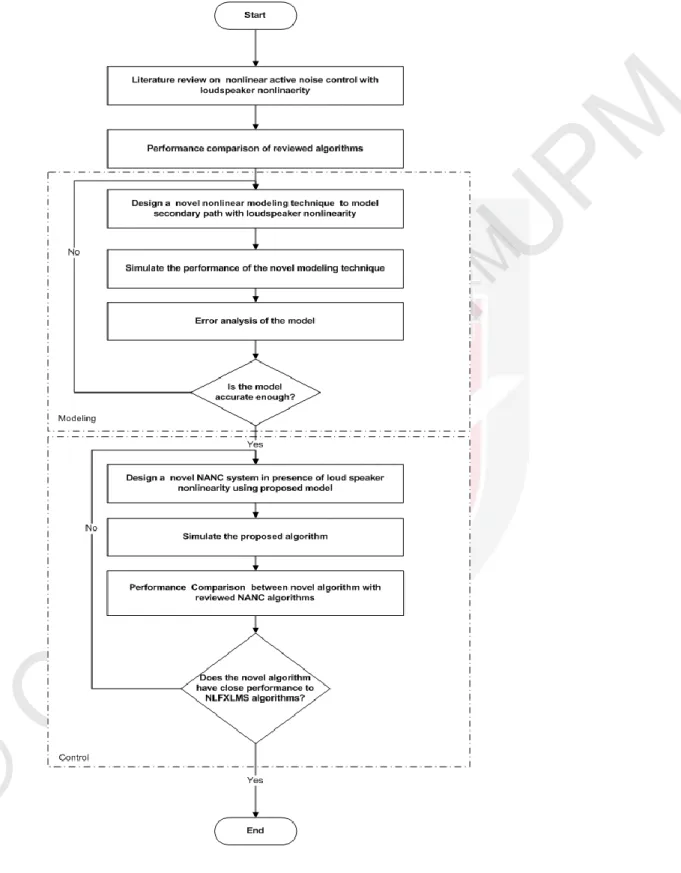
(25) i.. ii.. To develop a method for modeling the nonlinear secondary path associated with loudspeaker nonlinearity based on THF and design NLFLXMS algorithm using the proposed model. To compare the performance of THF-NLFXLMS with the benchmark NLFXLMS in the presence of loudspeaker nonlinearity.. Research Scope. PM. 1.4. RRI IGGH HT U TPM U. In this work, a novel nonlinear modeling technique in NANC is proposed to overcome the drawbacks of NLFXLMS algorithm. Sequentially, the proposed model is used to develop a controller algorithm based on Tangential hyperbolic function (THF). The work is restricted to single input, single output (SISO) ANC system. The feedforward strategy is used to control the noise at the observer [30]. All the transfer function and filters are assumed to be linear except the loudspeaker which is represented by a memory less saturation nonlinearity. The work involves designing and simulating the proposed modeling technique. At the control stage, an alternative THF-NLFXLMS algorithm is proposed and compared with NLFXLMS and FXLMS when ANC system deals with loudspeaker nonlinearity. Figure1.1, illustrates the research scope which is covered in this argumentation.. Noise Control. Passive Control. PY. Feedforward control. O© PCYO. Feedback control. Active Control. Single Channel. Linear ANC. C. Nonlinearities in Primary Path. ©. Power Amplifier. IMC-feedback control. Multiple Channel Nonlinear ANC. Nonlinearities in Secondary Path. Loudspeaker. Nonlinearities in Reference noise. Microphone. Acoustic Path. Figure 1.1: Research Scope. The methodology of this research is shown in Figure 1.2. This methodology has two substantial parts: modelling and control. In the first part, the nonlinear secondary path is modelled the characterization of the loudspeaker and the accuracy of the model has been evaluated in low, medium and high saturation effect. Then the proposed model is used to design an alternative THF-NLFXLMS algorithm to overcome saturation nonlinearity caused by loudspeaker in the secondary path. The proposed designs are verified by means of simulation. Mean Square Error (MSE) is 3.
(26) ©. C. O© PCYO. PY. RRI IGGH HT U TPM U. PM. used as a criteria to compare the proposed nonlinear algorithm with the NLFXLMS as the benchmark.. Figure 1.2: Research Methodology. 4.
(27) 1.5. Thesis Organization. ©. C. O© PCYO. PY. RRI IGGH HT U TPM U. PM. This thesis is organized in five chapters. The first chapter presents the introduction, research problems, research objectives, research aim and methodology of the study. Chapter two presents the literature survey related to the structure of ANC systems and common algorithm specifically used in loudspeaker nonlinearity. In Chapter three, Wiener nonlinear block oriented structure used to represent loudspeaker saturation nonlinearity in the secondary path is introduced. The nonlinear part is represented by a memory less saturation function. Scaled Error Function (SEF) nonlinearity representing the true nonlinearity is modeled by Tangential Hyperbolic Function (THF). Them a nonlinear FXLMS algorithm is derived based on proposed THF model to overcome the loudspeaker nonlinearity in the secondary path. In chapter four, the proposed methodology is evaluated by means of simulation. Finally, chapter five presents the conclusion of the work and possible future perspectives of the work.. 5.
(28) REFERENCES Münzel T., Gori T., Babisch W. and Basner M., "Cardiovascular effects of environmental noise exposure," European Heart Journal, vol. 35, pp. 829836, 2014.. [2]. Hurtley C., Night noise guidelines for Europe: WHO Regional Office Europe, 2009.. [3]. Bies D. A. and Hansen C. H., Engineering noise control: theory and practice: CRC Press, 2009.. [4]. Babisch W., "Transportation noise and cardiovascular risk: updated review and synthesis of epidemiological studies indicate that the evidence has increased," Noise and Health, vol. 8, pp. 1-29, 2006.. [5]. Elliott S., Signal processing for active control: Academic press, 2000.. [6]. Hansen C. H., Active control of noise and vibration: CRC Press, 2013.. [7]. Kuo S. M. and Morgan D., Active noise control systems: algorithms and DSP implementations: John Wiley & Sons, Inc., 1995.. [8]. Kuo S. M., Lee B. H. and Tian W., Real-Time Digital Signal Processing: Fundamentals, Implementations and Applications: John Wiley & Sons, 2013.. [9]. Costa M. H., Bermudez J. C. M. and Bershad N. J., "Stochastic analysis of the filtered-X LMS algorithm in systems with nonlinear secondary paths," IEEE Trans. on Signal Processing, vol. 50, pp. 1327-1342, 2002.. [10]. Tabatabaei Ardekani I. and Abdulla W. H., "Theoretical convergence analysis of FxLMS algorithm," Signal Processing, vol. 90, pp. 3046-3055, 2010.. [11]. Costa M. H., Bermudez J. C. M. and Bershad N. J., "Statistical analysis of the FXLMS algorithm with a nonlinearity in the secondary-path," in Proc. IEEE Int. Conf. on Circuits and Systems, 1999, pp. 166-169.. O© PCYO. PY. RRI IGGH HT U TPM U. PM. [1]. Zhou D. and DeBrunner V., "Efficient adaptive nonlinear filters for nonlinear active noise control," IEEE Trans. on Circuits and Systems I: Regular Papers, vol. 54, pp. 669-681, 2007.. [13]. Napoli R. and Piroddi L., "Nonlinear active noise control with NARX models," IEEE Trans. on Audio, Speech and Language Processing, vol. 18, pp. 286-295, 2010.. ©. C. [12]. [14]. Zhao H., Zeng X. and Zhang J., "Adaptive reduced feedback FLNN filter for active control of nonlinear noise processes," Signal Processing, vol. 90, pp. 834-847, 2010.. [15]. Tan L. and Jiang J., "Adaptive Volterra filters for active control of nonlinear noise processes," IEEE Trans. on Signal Processing, vol. 49, pp. 1667-1676, 2001.. [16]. Costa M. H. and Bermudez J. C. M., "A new adaptive algorithm for reducing non‐linear effects from saturation in active noise control systems," International Journal of Adaptive Control and Signal Processing, vol. 19, pp. 177-196, 2005. 56.
(29) Tobias O. J. and Seara R., "Performance comparison of the FXLMS, nonlinear FXLMS and leaky FXLMS algorithms in nonlinear active control applications," in Proc. European Signal Processing Conference (EUSIPCO), 2002, pp. 1-4.. [18]. Tobias O. J. and Seara R., "Leaky-FXLMS algorithm: stochastic analysis for Gaussian data and secondary path modeling error," IEEE Trans on. Speech and Audio Processing, vol. 13, pp. 1217-1230, 2005.. [19]. Sahib M. A., Kamil R. and M. H. Marhaban, "Nonlinear FXLMS algorithm for active noise control systems with saturation nonlinearity," IEEJ Trans. on Electrical and Electronic Engineering, vol. 7, pp. 598-606, 2012.. [20]. Bo Z., Sun C., Xu Y. and Jiang S., "A variable momentum factor filtered-x weighted accumulated LMS algorithm for narrowband active noise control systems," Measurement, vol. 48, pp. 282-291, 2014.. [21]. Das D. P. and Panda G., "Active mitigation of nonlinear noise processes using a novel filtered-s LMS algorithm," IEEE Trans. on Speech and Audio Processing, vol. 12, pp. 313-322, 2004.. [22]. Kuo S. M. and Wu H.-T., "Nonlinear adaptive bilinear filters for active noise control systems," IEEE Trans. on Circuits and Systems I: Regular Papers, vol. 52, pp. 617-624, 2005.. [23]. Gontijo W. A., Tobias O. J., Seara R. and Lopes E. M., "FxLMS algorithm with variable step size and variable leakage factor for active vibration control," in Proc. IEEE Int. Conf. on Telecommunications Symposium, 2006, pp. 572-575.. [24]. Tobias O. J. and Seara R., "On the LMS algorithm with constant and variable leakage factor in a nonlinear environment," IEEE Trans. on Signal Processing, vol. 54, pp. 3448-3458, 2006.. RRI IGGH HT U TPM U PY. Sahib M. A. and Kamil R., "Comparison of performance and computational complexity of nonlinear active noise control algorithms," ISRN Mechanical Engineering, vol. 2011, doi:10.5402/2011/925085. Costa M. H. and Bermudez J. C., "A true stochastic gradient adaptive algorithm for applications using nonlinear actuators," in Proc. IEEE Int. Conf. on Acoustics, Speech, and Signal Processing (ICASSP), 2001, pp. 3489-3492.. C. [26]. O© PCYO. [25]. PM. [17]. Russo F. and Sicuranza G. L., "Accuracy and performance evaluation in the genetic optimization of nonlinear systems for active noise control," IEEE Trans. on Instrumentation and Measurement, vol. 56, pp. 1443-1450, 2007.. [28]. Fu J. and Zhu W. P., "A nonlinear acoustic echo canceller using sigmoid transform in conjunction with RLS algorithm," IEEE Trans. on Circuits and Systems II: Express Briefs, vol. 55, pp. 1056-1060, 2008.. [29]. Agerkvist F., "Modelling loudspeaker non-linearities," in Proc. 32nd International Audio Engineering Society Conf. on DSP for Loudspeakers, 2007.. [30]. Kajikawa Y., Gan W. S. and Kuo S. M., "Recent advances on active noise control: open issues and innovative applications," APSIPA Transactions on. ©. [27]. 57.
(30) Signal and Information Processing, vol. 1, 2012, e3, doi:10.1017/ ATSIP.2012.4. Kuo S. M. and Morgan D. R., "Review of DSP algorithms for active noise control," in Proc. IEEE Int. Conf. on Control Applications, 2000, pp. 243248.. [32]. Kuo S. M. and Morgan D. R., "Active noise control: a tutorial review," Proceedings of the IEEE, vol. 87, pp. 943-973, 1999.. [33]. Elliott S. J. and Sutton T. J., "Performance of feedforward and feedback systems for active control," IEEE Trans. on Speech and Audio Processing, vol. 4, pp. 214-223, 1996.. [34]. Akhtar M. T., Abe M., Kawamata M. and Mitsuhashi W., "A simplified method for online acoustic feedback path modeling and neutralization in multichannel active noise control systems," Signal Processing, vol. 89, pp. 1090-1099, 2009.. [35]. Kuo S. M., "Active noise control system and method for on-line feedback path modeling," U.S. Patent: 6,418,227, 2002.. [36]. Kuo S. and Luan J., "On-line modeling and feedback compensation for multiple-channel active noise control systems," Applied Signal Processing, vol. 1, pp. 64-75, 1994.. [37]. Iwamatsu Y., Fujii K. and Muneyasu M., "Frequency domain method to estimate the coefficients of feedback control filter for active noise control systems," Acoustical science and technology, vol. 27, pp. 264-269, 2006.. [38]. Akhtar M. T., Abe M. and Kawamata M., "On active noise control systems with online acoustic feedback path modeling," IEEE Trans. on Speech Audio Processing, vol. 15, 2007.. [39]. Malik S. and Enzner G., "State-space frequency-domain adaptive filtering for nonlinear acoustic echo cancellation," IEEE Trans. on Audio, Speech and Language Processing, vol. 20, pp. 2065-2079, 2012.. [40]. Ardekani I. T. and Abdulla W. H., "Effects of imperfect secondary path modeling on adaptive active noise control systems," IEEE Trans. on Control Systems Technology, vol. 20, pp. 1252-1262, 2012.. [41]. Chang C. Y., Pan S. T. and Liao K. C., "Active Noise Control and its Application to Snore Noise Cancellation," Asian Journal of Control, vol. 15, pp. 1648-1654, 2013.. ©. C. O© PCYO. PY. RRI IGGH HT U TPM U. PM. [31]. [42]. Hinamoto Y. and Sakai H., "A filtered-X LMS algorithm for sinusoidal reference signals—Effects of frequency mismatch," IEEE Signal Processing Letters, vol. 14, pp. 259-262, 2007.. [43]. Niedzwiecki M. and Meller M., "A new approach to active noise and vibration control—Part I: The known frequency case," IEEE Trans. on Signal Processing, vol. 57, pp. 3373-3386, 2009.. [44]. Niedzwiecki M. and Meller M., "A New Approach to Active Noise and Vibration Control—Part II: The Unknown Frequency Case," IEEE Trans. on Signal Processing, vol. 57, pp. 3387-3398, 2009. 58.
(31) Olson H. F. and May E. G., "Electronic sound absorber," The Journal of the Acoustical Society of America, vol. 25, pp. 1130-1136, 2005.. [46]. Behera S. B., Das D. P. and Rout N. K., "Nonlinear feedback active noise control for broadband chaotic noise," Applied Soft Computing, vol. 15, pp. 80-87, 2014.. [47]. Datta A., Adaptive internal model control: Springer-Verlag New York, Inc., 1998.. [48]. Meurers T., Veres S. M. and Elliott S. J., "Frequency selective feedback for active noise control," IEEE control systems Mag., vol. 22, pp. 32-41, 2002.. [49]. Sakai H. and Miyagi S., "Analysis of the adaptive filter algorithm for feedback-type active noise control," Signal Processing, vol. 83, pp. 12911298, 2003.. [50]. Buchard M. and Paillard B., "An alternative feedback structure for the adaptive active control of periodic and time-varying periodic disturbances," Journal of sound and vibration, vol. 210, pp. 517-527, 1998.. [51]. Kuo S. M. and Puvvala A. B., "Effects of frequency separation in periodic active noise control systems," IEEE Trans. Audio, Speech, and Language Processing, vol. 14, pp. 1857-1866, 2006.. [52]. Wang T., Gan W. and Kuo S., "Effects of frequency separation in feedback active noise control systems," in Proc. Inter-Noise, Japan, Sep. 2011.. [53]. Elliott S. J. and Nelson P. A., "Active noise control," IEEE Signal Processing Mag., vol. 10, pp. 12-35, 1993.. [54]. Kannan G., Milani A. A., Panahi I. M. and Briggs R., “An efficient feedback active noise control algorithm based on reduced-order linear predictive modeling of fMRI acoustic noise.” IEEE Trans. on Biomedical Engineering, vol. 58, pp. 3303-3309, 2011.. [55]. Wang T. and Gan W. S., "Stochastic analysis of FXLMS-based internal model control feedback active noise control systems," Signal Processing, vol. 101, pp.121-133, 2014.. Zhou Y., Zhang Q., Li X. and Gan W., "Model-free control of nonlinear noise processes based on c-flan," in Proc. The Sixth International Symposium on Neural Networks (ISNN), 2009, pp. 535-541.. C. [56]. O© PCYO. PY. RRI IGGH HT U TPM U. PM. [45]. Zhang Q. Z. and Gan W. S., "Active noise control using a simplified fuzzy neural network," Journal of sound and vibration, vol. 272, pp. 437-449, 2004.. [58]. W. Klippel, "Active attenuation of nonlinear sound," US Patent: 6,005,952, 1999.. ©. [57]. [59]. Reddy E. P., Das D. P. and Prabhu K., "Fast exact multichannel FSLMS algorithm for active noise control," Signal Processing, vol. 89, pp. 952-956, 2009.. [60]. Strauch P. and Mulgrew B., "Active control of nonlinear noise processes in a linear duct," IEEE Trans. on Signal Processing, vol. 46, pp. 2404-2412, 1998. 59.
(32) Tarchi D., Lukin K., Fortuny-Guasch J., Mogyla A., Vyplavin P. and Sieber A., "SAR imaging with noise radar," IEEE Trans. on Aerospace and Electronic Systems, vol. 46, pp. 1214-1225, 2010.. [62]. Li Z., Dong H. and Quan T., "Apply genetic algorithm to parameter estimation in chaotic noise," in Proc. IEEE Int. Conf. on Signal Processing, 2002, pp. 1399-1402.. [63]. Zhao H. and Zhang J., "Filtered-s Lyapunov algorithm for active control of nonlinear noise processes," in Proc. IEEE Int. Conf. on Signal Processing (ICSP), 2008, pp. 311-314.. [64]. Sicuranza G. L. and Carini A., "On the accuracy of generalized Hammerstein models for nonlinear active noise control," in Proc. IEEE Int. Conf. Instrumentation and Measurement Technology (IMTC), 2006, pp. 1411-1416.. [65]. Sprott J. C. and Sprott J. C., Chaos and time-series analysis: Oxford University Press, 2003.. [66]. Kuo S. M. and Wu H. T., "Active noise control systems with adaptive nonlinear filters," in Proc. IEEE Int. Conf. on Control Applications, 2004, pp. 1330-1335.. [67]. Kuo S. M., Wu H. T., Chen F. K. and Gunnala M. R., "Saturation effects in active noise control systems," IEEE Trans. on Circuits and Systems I: Regular Papers, vol. 51, pp. 1163-1171, 2004.. [68]. Sicuranza G. L. and Carini A., "Compensation of memoryless nonlinearities for active noise control applications," in Proc. IEEE Int. Conf. on Communications, Control and Signal Processing (ISCCSP), 2008, pp. 299304.. [69]. Bouchard M., Paillard B. and Le Dinh C. T., "Improved training of neural networks for the nonlinear active control of sound and vibration," IEEE Trans. on Neural Networks, vol. 10, pp. 391-401, 1999.. O© PCYO. PY. RRI IGGH HT U TPM U. PM. [61]. Zhao H. and Zhang J., "A novel adaptive nonlinear filter-based pipelined feed-forward second-order Volterra architecture," IEEE Trans. on Signal Processing, vol. 57, pp. 237-246, 2009.. [71]. Ogunfunmi T., Adaptive Nonlinear System Identification: The Volterra and Wiener Model Approaches. Signals and Communication Technology: Springer, 2007.. ©. C. [70]. [72]. Bambang R. T., "Adjoint EKF learning in recurrent neural networks for nonlinear active noise control," Applied Soft Computing, vol. 8, pp. 14981504, 2008.. [73]. Behera S. K., Das D. P. and B. Subudhi, "Functional link artificial neural network applied to active noise control of a mixture of tonal and chaotic noise," Applied Soft Computing, vol. 23, pp. 51-60, 2014.. [74]. Bendat J. S., Nonlinear system techniques and applications: John Wiley & Sons, Inc., 1998.. [75]. Sankar D. and Thomas T., "Nonlinear modeling of loudspeaker using adaptive second order Volterra filters," in Proc. IEEE Int. Conf. on 60.
(33) Information and Communication Technology in Electrical Sciences (ICTES), 2007, pp.87-92. Isaksson M., Wisell D. and Ronnow D., "A comparative analysis of behavioral models for RF power amplifiers," IEEE Trans. on Microwave Theory and Techniques, vol. 54, pp. 348-359, 2006.. [77]. Giri F. and Bai E. W., Block-oriented nonlinear system identification: Springer, 2010.. [78]. Stenger A. and Kellermann W., "Adaptation of a memoryless preprocessor for nonlinear acoustic echo cancelling," Signal Processing, vol. 80, pp. 17471760, 2000.. [79]. Nollett B. S. and Jones D. L., "Nonlinear echo cancellation for hands-free speakerphones," in Proc. NSIP, 1997, pp. 877-880.. [80]. Costa J.-P., Lagrange A. and Arliaud A., "Acoustic echo cancellation using nonlinear cascade filters," in Proc. IEEE Int. Conf. on Acoustics, Speech, and Signal Processing (ICASSP), 2003, pp. 389-392.. [81]. Bershad N. J., "On weight update saturation nonlinearities in LMS adaptation," IEEE Trans. on Acoustics, Speech and Signal Processing, vol. 38, pp. 623-630, 1990.. [82]. George N. V. and Panda G., "Advances in active noise control: A survey, with emphasis on recent nonlinear techniques," Signal Processing, vol. 93, pp. 363-377, 2013.. [83]. Chen W. and Zhang Z., "Nonlinear adaptive learning control for unknown time varying parameters and unknown time varying delays," Asian Journal of Control, vol. 13, pp. 903-913, 2011.. [84]. Huang D. and Xu J. X., "Discrete‐time adaptive control for nonlinear systems with periodic parameters: A lifting approach," Asian Journal of Control, vol. 14, pp. 373-383, 2012.. RRI IGGH HT U TPM U PY. Bershad N. J., "On error-saturation nonlinearities in LMS adaptation," IEEE Trans. on Acoustics, Speech and Signal Processing, vol. 36, pp. 440-452, 1988.. Sicuranza G. L. and Carini A., "Filtered-X affine projection algorithm for multichannel active noise control using second-order Volterra filters," IEEE Signal Processing Letters, vol. 11, pp. 853-857, 2004.. C. [86]. O© PCYO. [85]. PM. [76]. Tan L. and Jiang J., "Adaptive second-order volterra filtered-X RLS algorithms with sequential and partial updates for nonlinear active noise control," in Proc. IEEE Int. Conf. on Industrial Electronics and Applications (ICIEA), 2009, pp. 1625-1630.. ©. [87]. [88]. Piroddi L. and Spinelli W., "An identification algorithm for polynomial NARX models based on simulation error minimization," International Journal of Control, vol. 76, pp. 1767-1781, 2003.. [89]. Cartes D. A., Ray L. R. and Collier R. D., "Lyapunov tuning of the leaky LMS algorithm for single-source, single-point noise cancellation," in Proc. IEEE Int. on American Control Conference, 2001, pp. 3600-3605. 61.
(34) Cartes D. A., Ray L. R. and Collier R. D., "Experimental evaluation of leaky least-mean-square algorithms for active noise reduction in communication headsets," The Journal of the Acoustical Society of America, vol. 111, pp. 1758-1771, 2002.. [91]. Bermudez J. and Costa M. H., "Optimum leakage factor for the MOV-LMS algorithm in nonlinear modeling and control systems," in Proc. IEEE Int. Conf. on Acoustics, Speech, and Signal Processing (ICASSP), 2002, pp. 1393-1396.. [92]. Sahib M. A. and Kamil R., "Loudspeaker nonlinearity compensation with inverse tangent hyperbolic function-based predistorter for active noise control," Transactions of the Institute of Measurement and Control, 2014, dio: 10.1177/0142331214527602.. ©. C. O© PCYO. PY. RRI IGGH HT U TPM U. PM. [90]. 62.
(35)
Figure
Related documents
It is the (education that will empower biology graduates for the application of biology knowledge and skills acquired in solving the problem of unemployment for oneself and others
In a surprise move, the Central Bank of Peru (BCRP) reduced its benchmark interest rate by 25 basis points (bps) to 3.25% in mid-January following disappointing economic growth data
We nd that if individuals dier in initial wealth and if commodity taxes can be evaded at a uniform cost, preferences have to be weakly separable between consumption and labor
- Habitat for Humanity International – Provided computer support for the direct mail, telemarketing, major donor, matching gift, and special event fundraising programs -
Control << ButtonBase >> Button CheckBox RadioButton DataGridView DataGrid << TextBoxBase >> TextBox RichTextBox GroupBox PictureBox StatusBar ToolBar TreeView
The distributor may seek to limit the producer’s right to terminate until distributor has recouped its advance (assuming it has given the producer an advance.) Another
Development of the curriculum of the Master of Advanced Industrial Management European Academy on Industrial Management (AIM) Industrial enterprises & Organizations.
In general, human capital strategy including training, development, and empowerment is formulated in universities of medical sciences throughout the country and
